Well, Blow Me Down!

Digital illustration: Blow Me Down!The old expression in my title here—close cousin of ‘you could knock me over with a feather‘—is a colloquialism for great surprise. It’s also, was so many colloquial phrases are, comically colorful and exaggerated. Hyperbole and humor grow out of genuine life experiences and events. They are anchored in recognizably real sensations and situations as much as in silly imagination.

After all, when in shock, don’t I feel my knees suddenly go uncomfortably loose and slack, and go all light-headed as though not only my hat but the whole top of my head might just fly off at the slightest whiff of a breeze?

The appeal of the idiomatic phrase, regional quirks of language, colloquial expressions and other ‘decorative’ forms of description is that they can often communicate far more about the situation than mere facts can do. They share more of our personality and character and our own experience of the moment than the dry recitation of what can be scientifically charted could ever be able to convey. And they amuse and entertain, which gives much more impact to any statement than simple and bald recitation, and what has such verve is more likely to stick in the memory as well.

Also, it’s kind of hard to make a little illustrative sketch that conveys the astonishment with which an unforeseen hat-snatching or similar surprise nearly so well as one that says, Well, Blow Me Down! If you know what I mean.
‘On Pouvait Dire . . . ‘

‘Ah! non! c’est un peu court, jeune homme!
On pouvait dire…Oh! Dieu!…bien des choses en somme…’

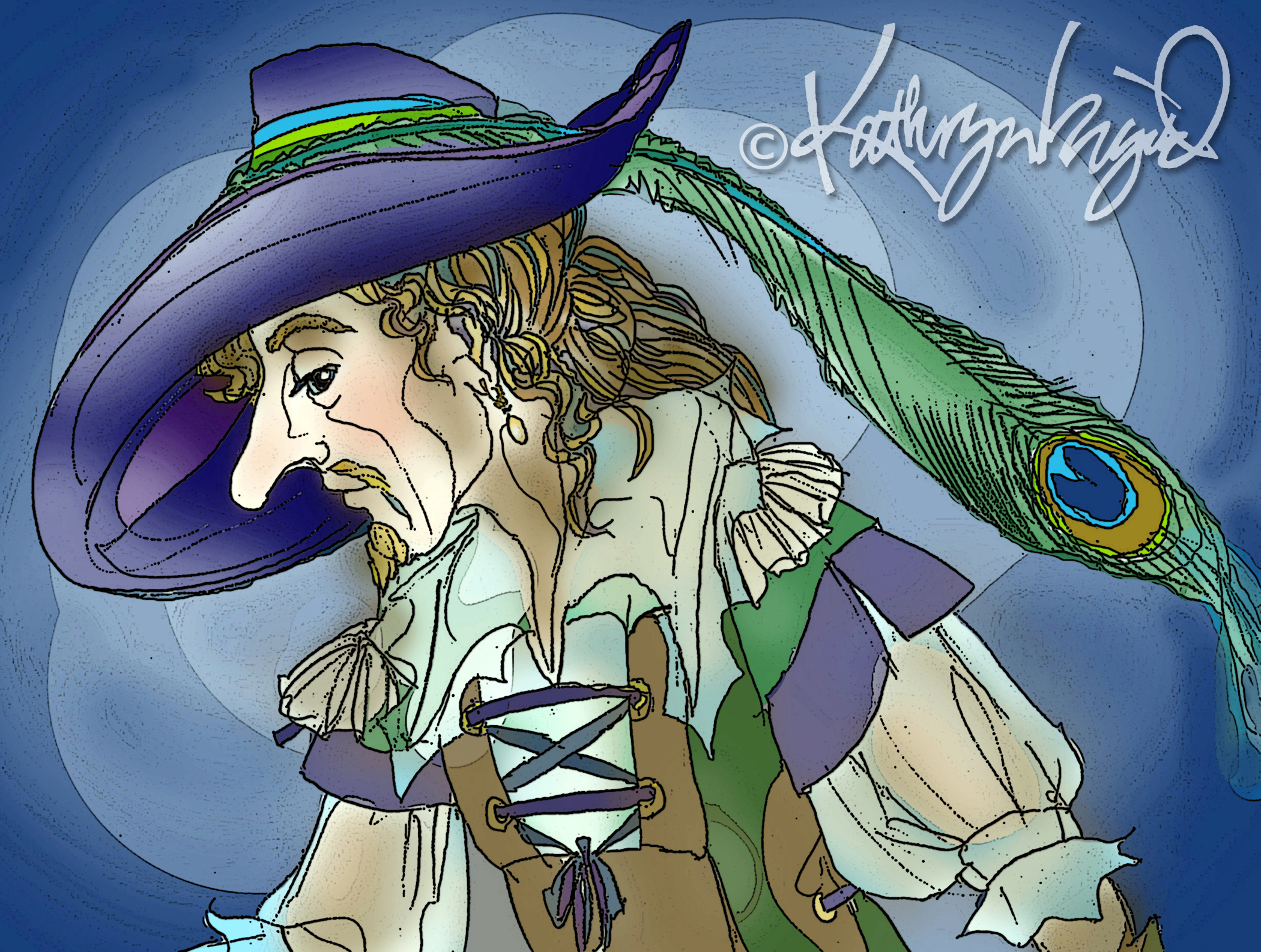
digital artworkWould that I had the miraculous gift of the silver tongue–it’s said that the genuine Cyrano de Bergerac, the writer and duelist enshrined in fiction as some sort of demigod of dramatic speech, was in life something quite near to it as well. As a youthful admirer of the romantic dream, I memorized Rostand‘s most famed soliloquy of Cyrano’s (in English, naturally), but what remains after so many years have passed is not so much the poetry of his slick speech; it is instead a deeper sense that for all my staring at his nose along with everyone else I managed to miss the point.

The story is told in fictional form to so exaggerate the majesty of his nasal promontory that all we see in most readings and performances onstage is a caricature or cartoon man, led by a nose of bowsprit proportions and foolish improvidence to oversized action and wildly improbable joys and sorrows as a result. These kinds of things do happen to real people in real life, of course; even the real man behind the character was larger-than-life in both nose and existence, according to what we know. He did, if his contemporary portraits are anything near the truth, have a substantial prow, and we have his writings–satirical pieces to classical tragedies–to prove that his wordplay was quite substantial too.

But what perhaps ought to be said of him–whether real or imaginary–is that he was a bit of an outsider by virtue of looking Different, and his response was to fight for respect, both with his rapier and his rapier wit. [Given the historical man and the possibility that he was (not surprisingly, given the era and culture and his reputed exploits) syphilitic, he may well have experienced life completely without a nose if he lived long enough.] It’s easier to label and classify others on the basis of unpopular appearance or differing from the currently decreed norms than it is to cultivate what we have in common. Yet we can learn from some of our outlier counterparts if we will stop, for a moment, being so mesmerized and distracted by what makes them seem unlike us, what it is that we have and value in common. Best if we do that before losing the duel.

Though at least, if the duel is purely verbal, there can be some entertainment inherent in getting taught a lesson. I can live with being the unarmed woman in a battle of wits, as long as I get to keep living long enough to laugh about it. I may not be a genius, but that, my friends: c’est mon panache!