Spring in Texas is a highly variable thing. Like most regions where I’ve lived or visited, north Texas can rightly claim (any day, any part of the year) that if you don’t like the weather, all you have to do is wait five minutes. Ma Nature is that sort of fickle filly. She treats us mighty differently from moment to moment, season to season, and from year to year, too. So while last year, the drought and excessive heat both started early enough that we saw virtually nothing of the vaunted swaths of Lupinus texensis, the state flower, the Texas Bluebonnet, this year’s mildness and largesse of rains has kissed the sullen banks of the highways, the pastures and prairies, and not a few lawns, with a brilliant return, as if our nature-mistress apologized with flowers for running off and abandoning us to sere and lonely brownness all of last season. The extravaganza began with a wild froth of yellow sprayed over nearly everything–it’s a wildflower form of mustard known by many names and perhaps most commonly here as bastard cabbage, that nomenclature derived from the rosette at its base that resembles a false cabbage, but Texans probably embracing the less kindly interpretation of its first name because it has spread so widely as to be an invasive and predatory plant whose tough rosettes block out the bluebonnets‘ rise. While I would hate to see it usurp the blue beauty of the state flower, the wild mustard‘s foam floating over the rolling grasslands is a very pretty herald of the return of spring’s wildflowers.
Following the arrival of the mustard, in quick succession, the verges are airbrushed, in turn, with the purples of several vetch-and-clover-like wildflowers I don’t yet know after moving to this region, then the red hues of Texas Paintbrush (Castilleja indivisa), then the sea of bluebonnets, punctuated by handfuls of the pale pink-and-white tissue of Lady Bird Johnson‘s favorites, the Showy Evening Primroses (Oenothera speciosa).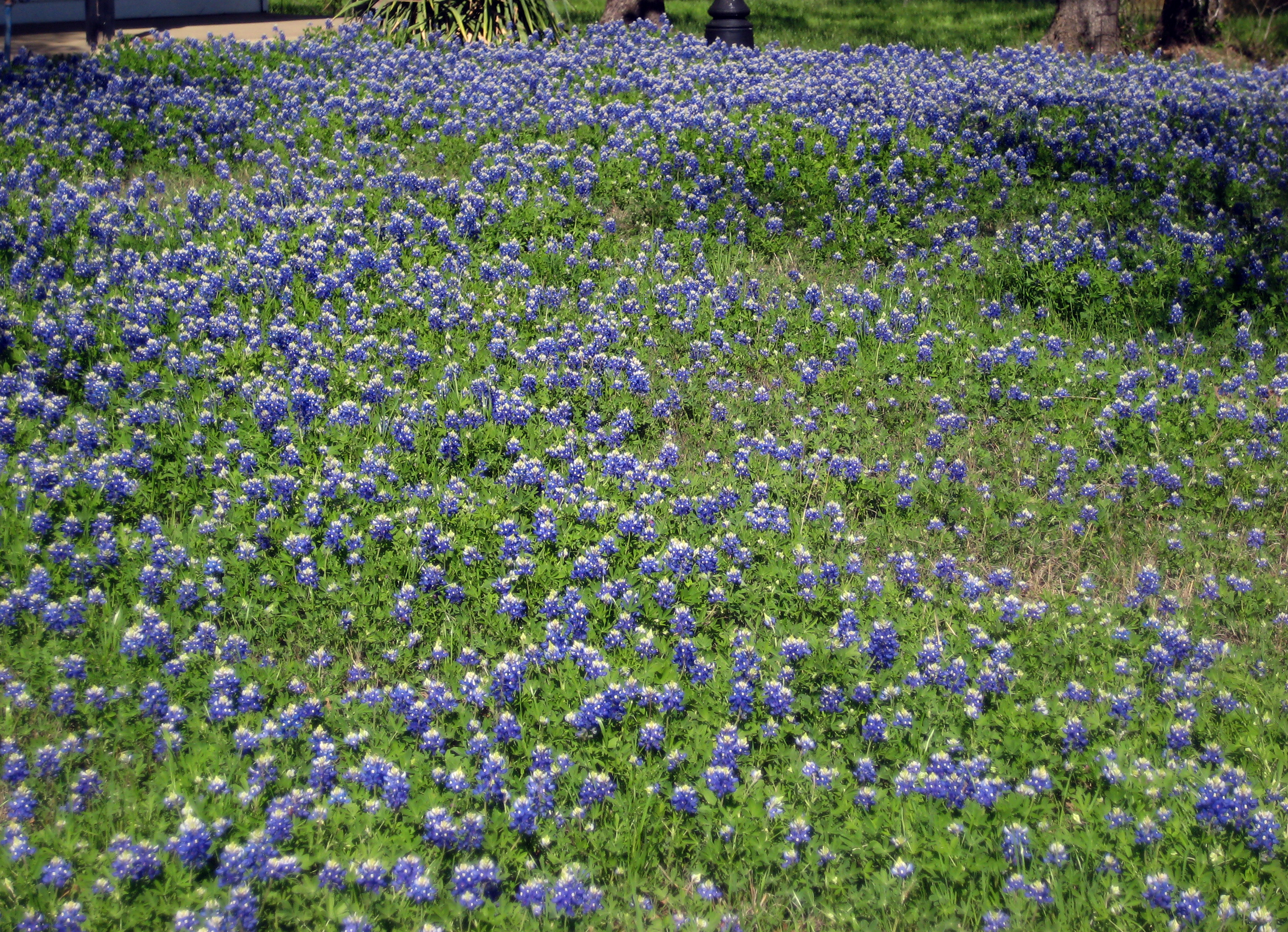 When you’re just moseying along, running errands and minding your own business and an explosion of living color appears before your very eyes, it’s not something you just ignore. If you’re me, you ask your husbandly chauffeur to be so kind as to pull over in the empty lot across the street from the biggest mass nearby so you can hop out and ogle, and take a few pictures. See, there’s this little bit of tension in the romance with wildflowers. As easy on the eye as nearly all of them are, they are, ahem, wild. People don’t really like wild very well, a lot of the time: everybody wishes in his or her secret heart to control the world–at least, to believe they can do so. Wildflowers grow and bloom when and where they are wiling and able to do it, and in many cases they’re not all that cooperative when we try to grow them on purpose. Never mind when the weather patterns of the moment aren’t as particularly conducive to their happiness, health and vigor as they could be. When the blossoming wild does decide to make a grand entrance, however, it can create these impressive and celebratory masses of glory right across the most inhospitable-seeming acres of dirt and weediness. Because, after all, wildflowers are weeds; weeds, wildflowers. As witness the aggressive behavior of the deceptively dainty-looking bastard cabbages, sweeping right over the top of the other spring blooms like a vegetable horde of Huns or Visigoths and laying siege until the smaller, weaker plants succumb and yield their ground.
 Like humans and animals and plants of all kinds, every living thing in fact that populates the earth, wildflowers are essentially invaders and will happily fill in any available space when they’re good and ready to do so. A plague upon the earth! Thankfully, unlike most species, wildflowers, whether annual or perennial, tend to repay their carbon debt rather quickly, subsiding into glorious compost almost as quickly as they arrived on the loam of last year’s dead. So I say, three cheers for the Texas Bluebonnet, which survives drought and depredation, bad seasons and bad gardeners, and gives us a massive dose of grand color virtually for free, then turns around politely and sacrifices its glories for the good of next year’s, or next decade’s, wild display.
 Art-Colored Glasses
Yes, it is oh so wonderful (and the rest of the wildflowers, too). I’ve written a poem about bluebonnets but haven’t published it on my blog. I’m saving it with 70 or 80 others to shop around to publishers. However, I don’t think most are interested in traditional poetry and I’m not sure my would be good enough if they were. Sooner or later, it’ll end up on my blog.
Your writing is *plenty* good for publication–your surmise about the antipathy toward traditional forms may, however, be quite accurate. Honestly, when I go through bookstores and see what seems to be selling actively, I’m quite mystified by what flies–and what does or doesn’t get picked up for publication in the first place.
Hang onto your blue bonnet, man! 😉
Thanks!
I love the Dixie Chicks songs.. “On a pillow of bluebonnets and a blanket made of stars..” I see what they mean now.. they’re stunning and so thick.. could you lie comfortably on these?? xo Smidge
I’m going to have to look up that song!
A pillow of bluebonnets might, in fact, be quite cushy–but I am *not* going to test this theory, especially after I saw a wonderful photo series of bluebonnets here in Texas that, like mine, went from a wide shot at distance through a range of closer, closer, and closer ones that ended with the excellent last image of a *big* rattlesnake all neatly coiled up in their midst. YIKES! 🙂
Thanks for promoting one of our native wildflowers. Months of normal rain made the spring of 2012 a good season for bluebonnets, but then it’s been a good spring for many other native wildflowers as well. Some species are more abundant in central Texas than I’ve ever seen them in my 13 years of paying attention to such things.
Steve Schwartzman
http://portraitsofwildflowers.wordpress.com
My little paean is nothing compared to the homage you pay daily to wildflowers! (And etymology.) I’ve been missing too much time for catching up on your blogs, so went for a ‘stroll’ through umpteen-plus posts on your wildflower site yesterday. I’m simply overwhelmed by the beauty you capture on a regular basis, and capture so very exquisitely indeed. I’m sorry I can’t find the time to comment on each and every one of the fabulous plants, insects, birds, marvelous photos, posts of history and magical detail you share so prolifically, but want you to know that I appreciate every bit of the effort when I finally do get a moment to visit and absorb and bask in what you share!
Kathryn
Thanks so much, K.I. If I ever need an agent to do publicity for my work, I’ll know where to turn. This has continued to be such a great spring for wildflowers and their fellow travelers that the only difficulty is scrambling to keep up with it all.
How sweet are those blue bonnets? At first glance, they looked like grape hyacinth and I knew I needed a closer look which you so sweetly provided, because it is a lot better than that Wiki link’s photo!
Now that you mention it, they *do* look very like grape hyacinth–perhaps the sense of familiarity from my northern roots accounts for part of the bluebonnets’ attraction for me. But they’re just plain pretty in their own right, too. And certainly impressive en masse!
I do enjoy seeing photos of fields of wildflowers and these are perfect examples. Oddly enough, it was only this past Sunday morning that I first saw the bluebonnet’s leaves and realized it was a lupine. Sorry to learn about bastard cabbage, though, and it’s spread throughout Texas and a number of states. It’s so discouraging to see the damage invasive plants do to the native species.
I try to think of invasive plants (not necessarily all imports, either) as a bit of earth’s evolutionary history, though, to be fair: while they may usurp some of the other natives, they are winning by being better adapted to some degree, and as in even in the case of the bastard cabbage, many are quite lovely plants themselves. All the same, I would be loath to see the bluebonnet erased from the prairies. Much too exquisite!
I second that three cheers for the Texas Bluebonnet!
🙂 Mandy
Six cheers, then, and loudly! 🙂
Kathryn
Nothing like the Texas roadsides in a ‘good’ spring…Many’s the time I mumbled thanks to St. Ladybird as we whizzed past in the car!
It *has* been a Good Spring here this year. If you don’t already visit him, you should see the spectacular shots over at Steve Schwartzman’s wildflower blog (see his comment above for the link). Lady Bird would be delighted.
Last time we were in Texas we would see bunches of them along the highway. Never got a chance to see how pretty they were up close.
I do use a certain amount of caution when approaching wildflower fields for closeups, ever since seeing the photos mentioned in my reply to Smidge (above). But so worth the effort. Like a number of flowers, bluebonnets have a wonderful, faintly sparkly quality when seen up close. You can just get a hint of it in the last photo. The blue/violet is so intense, though, that not much else matters or is noted until you’re very near to them indeed.
I really think they look stunning. So fresh and blue~ 😀
Fresh. Exactly!! 😀
I love the photos. A carpet of bluebonnets is one of the prettiest ways there is to decorate a field.
Would that I could carpet my living room with them!
What a wonderful post, Kathryn! Especially to a fellow flower-lover…fellow WILD flower lover.
‘Wildflowers grow and bloom when and where they are wiling and able to do it, and in many cases they’re not all that cooperative when we try to grow them on purpose.’
And isn’t that what why we gravitate towards them? I love how you MAKE your husband stop and pull over so you can photograph them. Why not? These are among all the other special moments you must capture for your heart as well as your camera!
It’s true, we have to stop and smell the, erm, bluebonnets! After all, another characteristic of many wildflowers like them is their incredibly fleeting presence. The moment passes too quickly to not be savored if we can. 🙂
Reblogged this on gloriailtakenaka8.