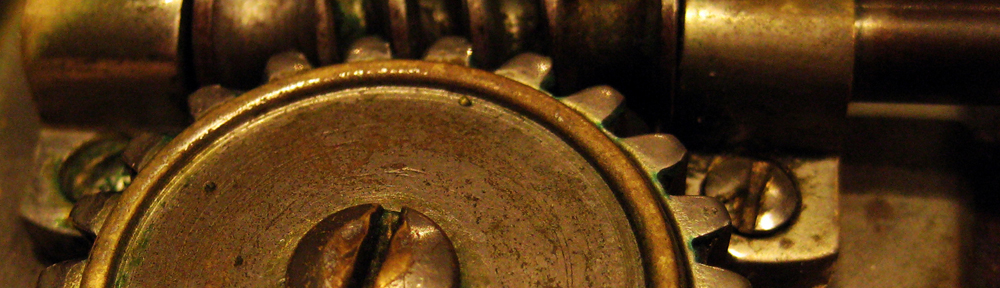
Craftsmanship is not one of my greater strengths. I credit myself so far as to say that I have a pretty good eye for fine craftsmanship. But when it comes to my own work, I’m impatient, short of attention, and lazy enough that I’m always that dilettante rushing through to get the job done and hoping it’s enough to hang together as long as needed. Until the homework is graded; until I can hire a professional to come and do the job properly; until I have escaped notice as the maker of said shabby construct. I have an honest recognition of the limitations of my skills, I think, if it is perhaps slightly magnified by my lack of gumption toward improving them in numerous areas. I could argue that I’m doing my part to support true craftsmen in their arts by not competing with them unduly, but anyone would see through that excuse, I’m afraid. Still, I am awed quite genuinely by the beauty inherent in passionate craftsmanship, whatever the cause. I love the artistry of beautifully handmade or hand-finished objects, whether they are intended as art or meant as humble functional things, everyday items that we might pass over in their daily use but for the marvels of their refinement and Fit.
 I’ve long been equally taken with the ridiculousness of both badly designed and foolishly impractical objects that were intended to be functional. Perhaps it’s the extreme contrast they have with fine craftsmanship. It’s silly enough to make something that by virtue of its careless design does not or cannot accomplish that for which it was meant, but often that very malfunction is trumpeted by the sheer ugliness or oddity of the object: one can see by simply looking at it that it won’t work or will be seriously flawed. It takes no time or effort to amass quite the collection of weirdly inept designs, from Patent applications right on up to the failed products remaindered and forlornly dusty on store shelves, and one can be endlessly entertained by the verbal autopsy of such strange husks from top to bottom–gadgets and gizmos meant to do so many unrelated tasks that they were too obviously cumbersome and ill-integrated to accomplish a single one of them. And dressed up in badly applied finishes of bizarre colors probably in hopes of distracting the customer from all other evident failings, but only drawing attention to the inherent cheapness and outlandish impossibility of their ever working as promised.
But there are so many things of the opposite sort that I think it’s too easy for us to gloss over what’s right in front of us or under our very fingertips as beautifully conceived and crafted objects worthy of our admiration for both a thing and its maker. Yes, it’s natural to admire the loveliness of the bow made for a Baroque Violin or the delicate carving on a lute, for a painting or sculpture or print made with evident and painstaking care. But it ought to be equally impressive to any of us when we pick up a dinner fork that is perfectly weighted and fits smoothly in the hand, to eat a marvelously tasty meal that has been made with such loving attention that the addition or removal of any tiny thing would be superfluous to its elegance–even if that meal is a profoundly rustic stew.
When we sit in a chair, do we notice not only how pretty, how well suited it is to the general character of the room, but also how the height of the arms supports our elbows just so and the curve of its upholstered back is designed to magically adjust to the lumbar spine of each individual sitter? Do we ask ourselves, Who made those helicopter blade fittings so exquisitely that after sixty years the contraption not only still flies the way it was made to fly but is a supremely wonderful geometric confluence of sweetly fitted parts, a sculpture of its kind, as well? Do we remember to look at the window sashes on that old house and be moved by how the intensely focused care of their making has enabled those ancient wooden single-pane mullioned windows to keep the home’s dwellers snug through 150 winters and summers? I hope that I, for one–as poorly equipped as I am myself to create that kind of grandeur in simple things, and too impatient to strive for better as often as I should–will always take the time at least to pay homage to the real craftsmen and women among us. To notice the attention to detail and graceful touch that they have applied to rebuilding stone porches, stitching a brocaded lining for a coat, painting a portrait of an old woman because her lined face is marked with history and pain and beauty and not because she is famous or has the money to pay for a portrait. To say Thank You to those who have made something fine and elegant and Right simply because it was what they were compelled to do.
 Art-Colored Glasses
We all have our talents. I’m grateful for that too. What’s the point of all those lovely forks with no yummy food to eat?
ExACTly!
Happy Friday to you and all the Rumpy household!
Hi. I loved this ode to good design. I’m the same as you. I love things like turning old jackets inside out and seeing all the work that’s gone into the stitching. I have a favourite spoon. It makes me smile every time I eat with it. It’s everything a spoon should be. A couple of weeks ago I spent a few minutes sitting in and lauding the construction of the dining chairs in a friend’s house, while everyone watched on in disbelief probably thinking I was nuts. Good stuff makes me smile, but I’m just like you too with my limits. There is a Japanese notion of appreciating the beauty that still exists in the imperfect, called wabi-sabi. I like the notion, and it brings me great comfort sometimes. It isn’t praising bad design, but allowing for those times where necessity or a slight inability to soar to the heights still produces something that has an inherent beauty of its own. Sometimes I think that makes me smile more.
Thank you, Chrysalis! I’m glad this resonated with your interests too. I think you’d love one of my favorite design collections, if it still even exists as it was eons ago when I visited (I’ve written the collections curator at the Tacoma Art Museum where it was once housed and curated, to ask): the Sarah Little Center for Design Research. I got to go to a wonderful lecture/demo session there where we visitors were shown a variety of items from Sarah Little Turnbull’s personal collection of designed objects and were told about how she sought out particular elements of fine design and beautiful craftsmanship–it was such an exquisite, almost spiritual, experience that although I’d forgotten about it for a long time, when it came to mind as I wrote this post it really flooded back suddenly. And that’s what the whole of this topic is about for me–those things that are taken for granted on an everyday basis but suddenly move us deeply when we pause to reconnect with their inherent loveliness . . .
Well said Kathryn. Attention to detail is the hallmark of good craftsmanship. Your reference to the fork triggered my memory about a book I read a few years back: “The Evolution of Useful Things” by Henry Petroski. He devotes an entire chapter to the evolution of tableware. The second chapter is titled “Form Follows Failure” and it’s a fascinating premise. I also learned why women’s clothes button on the left.
Indeed, Mr. Petroski’s book sounds similar to one I’ve greatly enjoyed, Donald A. Norman’s ‘The Psychology of Everyday Things’. The cover photo of the edition I own has a coffeepot with spout and handle on the same side. But it’s kind of charming looking. Maybe more so than a really useful, Normal coffeepot. 🙂
Form and function and fine craftsmanship make some of our everyday objects seem extraordinary. If one notices. Glad you did.
And you, my dear, notice *so much*–your posts are so full of things that no one else pays attention to enough to admire and describe so poetically that we *all* sit up and take notice.
I so appreciate fine, quality workmanship. Especially in todays modern society where so much is made to be disposable. I love the detail and craft of the things you have shown today (especially the saddle!). 🙂
If you can believe it, that saddle was in the window of a pawn shop in town. I can only assume one would have to be in serious need to pawn something so lovely. I hope it was there for happier reasons, but at the very least a fond admirer got to see it there and take its portrait and share it with a larger appreciative audience.
Amen to your paean to the crafts people in our midst. They are the unsung heroes around us, who impact our lives sometimes in ways which we sometimes are scarcely conscious of. I know I have been refreshed by looking at something simple but hand crafted – for example a pottery jug and all the better if there is a small bunch of daffodils stood in it.
I have seen plenty of evidence for *your* appreciation of handmade beauty!
And if you had need of daffodils, the town where I spent most of my youth was once the source of some of the largest crops of daffodils outside of the Netherlands. One of my younger sisters was even a candidate for Daffodil Princess in high school, and I helped attach daffodils all over the exterior of a float for the Daffodil Parade.
But somehow, I sincerely doubt that daffs are hard to acquire where you are!! And happily, I *know* that you can find just the pottery jug in which to stand those beauties. So many lovely things to keep our attentions!
This was great, i agree entirely and yes I do weigh and bounce that fork and wriggle into the old old chair! We are lucky that we SEE!.. c
We’re also lucky to be in company that never shies away from show-and-tell so we get such marvelous chances to see not only such wonders as we have on hand but also those brought to our attention by our compatriots!
So very true. A friend of mine is helping to sell off a deceased relatives´estate and is getting some beautiful pieces valued for the family. We spent a happy hour yesterday looking at photos of a set of beautiful Georgian chairs (I think they were a type of “kissing chair”) and saying “they don´t make furniture like that anymore” so your post really struck a chord!
That’s precisely the wonder of the miraculously crafted things that *are*–they withstand the test of time, survive intensive use, and remain among us as exemplars from which, if we’re fortunate, even those of us unable to replicate such near-perfection will learn to value it enough to support those who can. Meanwhile we have this great stuff around us to love . . .
The combination of good design and beautiful craftmanship is one of the most moving things to observe, and, in my opinion, to try and capture through photography. You’ve done a wonderful job here.
Thank you, Journey! I appreciate your kind words and support.
Exactly! And this is why I come by here daily: to admire and partake of your craftsmanship. I never know what to expect, only that I’m going to really enjoy what I see and read. So, to quote you, “Thank You”.
Many thanks, John! It means so much that friends like you are so faithful in your support and, better yet, *like* what I do!
xo!
I love the juxtaposition of the ornate carving on the organ and the rotor assembly – both marvelous examples of design, yet worlds apart.
(You want to know how I know it’s time to go to bed? When I open your latest post, and all that makes sense are the photos…I have to come back the next morning. 😀 )
Honeychile, isn’t it a sign of shaky sanity when you *can* decipher my wordy weirdness? 🙂
wow!!! good work.. i love the photographs!!!! totally baroque!!! love eht
Thank you, Robi! I appreciate your coming by and enjoying the work. 🙂
Your words “a supremely wonderful geometric confluence of sweetly fitted parts” reminded me of a phrase from “The Major General’s Song” in The Pirates of Penzance: “with many cheerful facts about the square of the hypotenuse.” Maybe you (or your musical husband) can set your words to music.
If you had ever heard the pinnacle of my compositional work, “Hurry Little Pony,” you wouldn’t even suggest such a thing! I’m happy to say that that pianistic abomination occurred when I was too young to know better, but let’s just let the world remain peacefully free of further such turkeys! (Yes, I know I was mixing my animals a bit too freely here. Call me a Frankenstein.) 😉
Lovely words. We spend see the things around us so much, we forget to look at them. Let this be a day of looking. Thank you for the reminder.
Kathryn, my sentence is baroque: two verbs after “We.” Sigh….
Uh-oh, craftsmanship overload! It happens to us all! 😉 I guess you *were* looking closely today after all, my dear!
This is a lovely reminder, Kathryn, to notice details in life…so elegantly written and your photos are perfect in showing the many different contrasts~xx
Thank you, Lauren. I know you’re much more attentive and observant than average as it is, but I’m glad you enjoyed the post all the same. 🙂
I enjoyed this post. I tend to think that good craftsmanship, making sure the line is just so, is the foundation of good art. I like the photo illustrations too.
Thank you! Believe me, I appreciate the craftsmanship I see in the writing and art over at ‘your place’ every time I visit.
a beautiful post. So well said… and I agree with you completely, and loved the photography.
Thank you, Shimon! As you can see I had some fun with Photoshop once I chose the photos to illustrate this post.
In this day and age of mass production, I share your love for hand-made or hand-finished work too. I love looking for the little details but I’ve also come to appreciate that what I find beautiful may differ very greatly to another’s eyes, and sometimes it takes my husband’s down to earth nature to also keep my feet on the ground – while I would love to surround myself with beautiful things, he makes me realise that we can’t always get what we want, and that the chairs we have are fine as they are, and we don’t need a new set just because I see new ones I like 🙂
Oh, yes, I do know exactly what you mean! It’s important to keep the common sense and restraint handy whilst admiring fabulousness!
But! Can you pay the same homage to the creation of “Pajama Jeans?” ACK!!!!!
This post brings to mind the funding that is continually funneled away from art programs in our public schools as being unnecessary. Just how do they think the mundane objects they use, the adverts they watch and the music they enjoy is made? Humph!
Double Humph from here!! Pajama Jeans are definitely a horror that would better have been left to fiction. And just think, if we get enough arts programs cut, we can have more “designers” of their inventor’s ilk concocting the Stuff of our lives. Yikes!
I absolutely agree, I’m fascinated sometimes at the craftsmanship in the simplest items like for instance kitchen utensils or toys or more complex things such as musical instruments or motors. Even when they are made by machine, man’s ingenuity is at the heart of their design and manufacture.
Endless food for thought and creative fodder for amazement. Let’s hope the love of it–and more importantly, the ability to engender it–never dies out!