Snaking Upward
I’m not a caterpillar, no,
I’m just a humble worm;
I have my aspirations, though
Ambitions make me squirm;
I like to keep a secret how
I wish for fame and wealth;
I know to climb’s not bad, I just
Prefer it done by stealth.
‘Ah! non! c’est un peu court, jeune homme!
On pouvait dire…Oh! Dieu!…bien des choses en somme…’
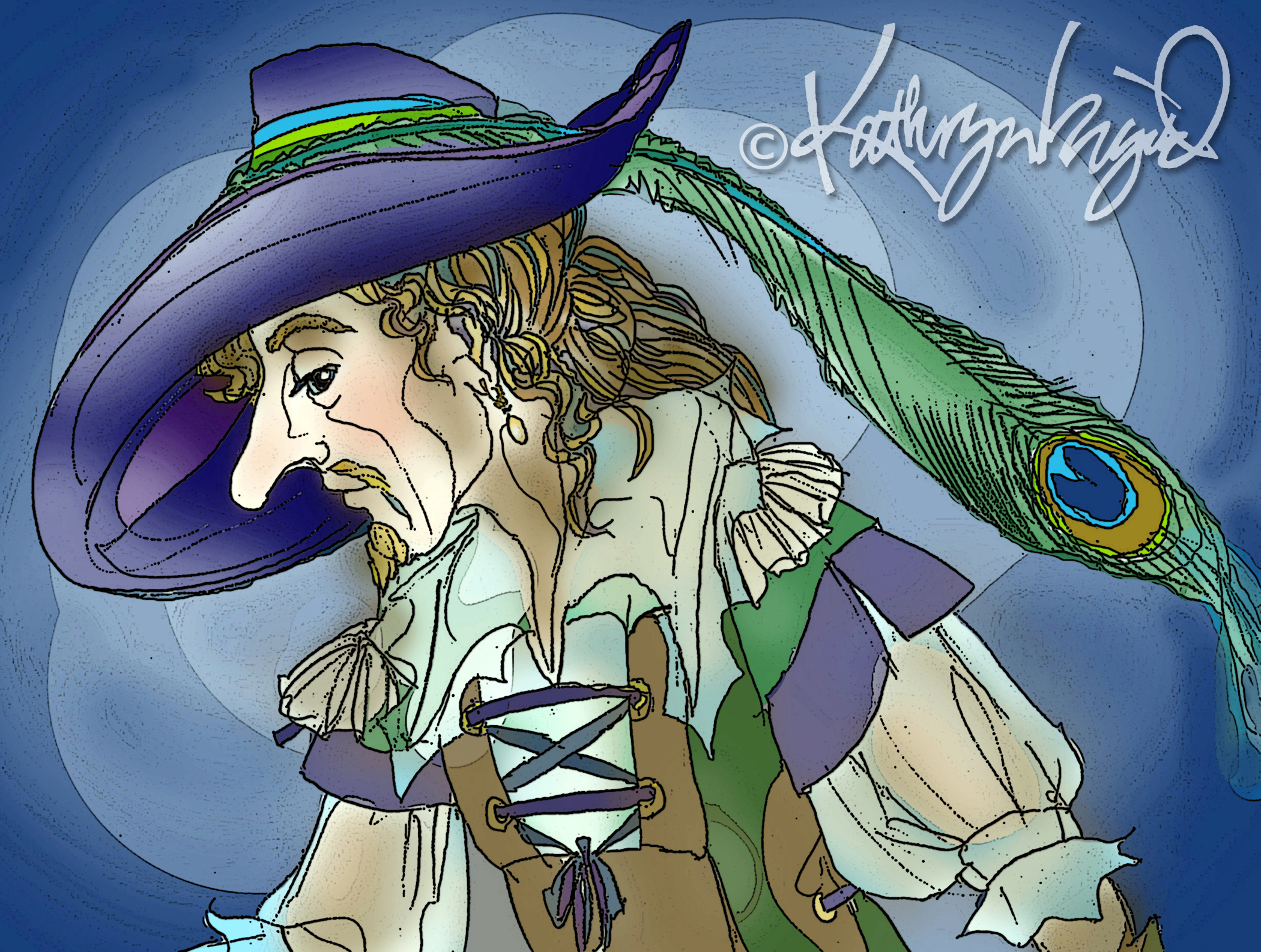
Would that I had the miraculous gift of the silver tongue–it’s said that the genuine Cyrano de Bergerac, the writer and duelist enshrined in fiction as some sort of demigod of dramatic speech, was in life something quite near to it as well. As a youthful admirer of the romantic dream, I memorized Rostand‘s most famed soliloquy of Cyrano’s (in English, naturally), but what remains after so many years have passed is not so much the poetry of his slick speech; it is instead a deeper sense that for all my staring at his nose along with everyone else I managed to miss the point.
The story is told in fictional form to so exaggerate the majesty of his nasal promontory that all we see in most readings and performances onstage is a caricature or cartoon man, led by a nose of bowsprit proportions and foolish improvidence to oversized action and wildly improbable joys and sorrows as a result. These kinds of things do happen to real people in real life, of course; even the real man behind the character was larger-than-life in both nose and existence, according to what we know. He did, if his contemporary portraits are anything near the truth, have a substantial prow, and we have his writings–satirical pieces to classical tragedies–to prove that his wordplay was quite substantial too.
But what perhaps ought to be said of him–whether real or imaginary–is that he was a bit of an outsider by virtue of looking Different, and his response was to fight for respect, both with his rapier and his rapier wit. [Given the historical man and the possibility that he was (not surprisingly, given the era and culture and his reputed exploits) syphilitic, he may well have experienced life completely without a nose if he lived long enough.] It’s easier to label and classify others on the basis of unpopular appearance or differing from the currently decreed norms than it is to cultivate what we have in common. Yet we can learn from some of our outlier counterparts if we will stop, for a moment, being so mesmerized and distracted by what makes them seem unlike us, what it is that we have and value in common. Best if we do that before losing the duel.
Though at least, if the duel is purely verbal, there can be some entertainment inherent in getting taught a lesson. I can live with being the unarmed woman in a battle of wits, as long as I get to keep living long enough to laugh about it. I may not be a genius, but that, my friends: c’est mon panache!
Wars build walls
On a foundation of
Corpses–
The evil and
The innocent alike–
And what do the walls
Keep in?
Keep out?
How is it that
Battles can be declared
Won or Lost?
For both sides die,
Both parties always
Somehow
Lose land and goods
And certainly, soul;
Starve in the snow or
Roast in the heat,
All the while watching
The world they knew
Reduced to ugly
Holes and rubble and
Its storied walls replaced
By a fortress that
Is really
Only a new prison
Here Lies a Haunted Man
First thing in the morning a perfect blue sky,
with a few sheepish clouds and a breeze,
gives no indication of what, when or why
we believe we must hide in the trees,
to disguise from what enemy, storm, or what foe,
or to vanish from sight for which reason;
we know none of that, but we certainly know
we have entered a paranoid season.
Dreamscape
Out of the leaves of a banana tree
A mysterious Eye is staring at me;
I have some magnetic pull, it seems,
For the kind of stuff that makes up dreams.
Ten past midnight, and all is well
Except that I’m under the nightly spell
That thrusts me onto those strange savannahs
Where pursuers send me stark bananas.
What Comes Naturally,
But I have to Scold You, My Pet
I know you only meant to make
A dandy first impression
By killing this whole crowd, but Jake,
Behold my grave expression–
For it is impolite, I think,
And maybe even naughty,
Recruiting everyone in sight
To play the role of Body–
Your nature calls you to the task,
I knew from your first GRRR!—
But some restraint gets less complaint
Than utter massacre.
I thank you that you rout the moles
And rodents by your labors,
Dear Jakey Boy, but next time leave
Your teeth out of the neighbors.
Practice as though Your Life Depended on It
Two singers strolled into a wood, and I
Followed the one less skillful; why?
Starved beasts will flock to an anguished cry,
As they did that day; in the wink of an eye,
I was on the road less traveled by,
And that has made all the difference.
[With sincerest apologies to Robert Frost]
There is, of course, one overriding, excellent reason that Ireland should celebrate the remembrance of her patron saint with a vivid display of everything-green. Ireland is the Emerald Isle. I’m not Irish, but I suppose I can pretend to a certain level of affinity on the strength of two excellent reasons of my own, the first being that my Viking ancestors (if any of my Norse forebears were actually so intrepid and aggressive) had a pretty good chance of crossing paths somewhere along the line with their counterparts in the British Isles, Norwegians having gone on various exploratory and marauding forays in that direction. My patronymic (Wold), after all, sounds suspiciously more Anglo than Nordic to me, no matter how many in Norway do share the name.
The second and far kindlier tie I feel to Ireland is because I was born in the Emerald City (Seattle’s nickname) in the Evergreen State (Washington’s), surrounded by every known flavor of green and a few yet undiscovered, and I think it was anything but coincidental that on my one visit to Ireland thus far I felt remarkably at home even in the middle of the winter, when the chill and snow still couldn’t entirely subdue the exquisite greenness of the land. It may not have hurt this sense of connection that some of the locals on that trip asked me what part of Ireland I came from, given that my accent apparently wasn’t heard by them as being wildly different from some in the UK. In any event, as green and growing things resonate so deeply in my heart and soul, I can’t help but celebrate the beauty of Green while millions are wearing, spending, planting and drinking it, and otherwise rejoicing in the character seen as protector of the great green land of Eire on this most Irish of days.
Here in this Emerald Land
Because there is no sapling in the earth
But that springs out when water wakes its seed
And sunlight calls it up in urgent need,
I think the rain and sun of equal worth–
Yet all the riches of a blooming world
No greater shine than that most humble weed
Whose leaf invites the passing deer to feed
Because its banners, sweetly green, unfurled–
No flower can surpass, exotic bloom
Outdo green’s living beauty or exceed
Its life-affirming sweetness when we heed
The subtler potency of its perfume–
And so I bow my head, ecstatic–sing
The joys of every green and living thing.
Much as I adore sunshine, I am willing, too, to be showered with the rain, for it slakes the thirsty earth and brings forth all of its green glories.