I’m in the Support Group for “I Can’t Help being Human” (Part 2 of a 3-part series)

Disclaimer: I’m no doctor, therapist, counselor, or genius. If this post about hope in the midst of depression and anxiety and related mental-health experiences is in any way true for you, know that it might be uncomfortable to read in the first place, but much more importantly, that reading it will not, cannot save you from your troubles. What you need is not a word of empathetic support from a fellow mortal with related experiences but genuine professional help, just as its what I needed first. Come back and visit me if and when you’re ready. If you don’t have any such problems, hurray for you! And read on anyway, because you might be able to help another person if you know better how she or he is living. Everyone’s truth matters, even when we don’t agree with or share it.

♥♥♥♥♥♥♥♥♥♥♥♥♥♥♥♥♥♥♥♥♥♥♥♥♥♥♥♥♥♥♥♥♥♥♥♥♥♥♥♥♥♥♥♥♥♥♥♥♥♥♥♥♥♥♥♥♥♥♥♥♥♥♥♥♥

Digital illo from a photo: Depression & Anxiety Cloaked the GardenI’ve recently met a new friend who is dealing with levels of anxiety and depression that sound like where I stood about a decade ago. It makes me both sorry for her struggles and incredibly glad I don’t have that same weight to carry consistently anymore myself. Depression and anxiety, especially the kind of chronic or recurring stuff, both work differently for everybody I know who deals with them, but one characteristic that I see pretty universally is that they can’t be cured or solved purely by smart practices. Real anxiety and clinical depression are inherently opposed to logic. They flatly refuse to listen to reason, and that is what makes us feel afraid, angry, useless, and without options.

It doesn’t help that some people who have never dealt with similar things can be ignorantly dismissive and believe that if we just shut up, pull up our socks, and get over ourselves all will be right in the world. I may know a perfect solution to my mental health problems, or a whole slew of solutions, and be able to imagine myself accomplishing the rescue flawlessly in my mind, but even if the means to that end is sitting less than an arm’s length from me I don’t have the clarity, will, or energy to make like a Nike commercial and Just Do It, not even if I sit staring at the conveniently available means all week long. Another classic and frustrating aspect of deep depression is that it saps us of energy, strength, and will to such a degree that we’re robbed of both clarity and the drive to do what we long most to do, even for the sake of those we love most dearly. It’s no wonder depressed people feel useless—they have been robbed of all of their power and hope, and worst of all, the culprit lurks right inside and can’t seem to be evicted.

When one’s brain or biochemistry can’t process the facts of the situation in sensible ways, the natural instinct is to curl up in a fetal position and hide from everything/one, including oneself. For me, when I’m in the middle of an acute anxiety attack or even a period of general anxiety, my rational brain can still assess the present situation quite neatly and spell out all of the logical explanations—what I could do to solve what’s making me anxious, and why I would be perfectly safe to just let go all of that discomfort—but I’m immobilized by anxiety instead and only feel more afraid, sick, confused, and as a bonus, tremendously guilty for “not taking my own good advice.”

It sounds, frankly, ridiculous to anyone who’s never experienced it, and even to me when I’m not stuck in an attack. But it’s the reality, and it’s awful. It has absolutely nothing to do with whether your life is good, with whether you’re smart, lovable, or desirable, or are surrounded by supportive people or wealth or any other grand resource you can imagine; you can have all of those things in abundance and still fight depression and anxiety. I have had a great life, with very few major causes for even normal kinds of sadness (you know, those well-known major stressors like the death of a loved one, changing jobs, moving to a new home, and so forth), yet when I finally ‘crashed’ with clinical depression in my 40s, I learned that I had probably had not only previous periods of severe depression in my life but also chronic anxiety all of my life. The lack of obvious causes or catalysts for the existing state in an otherwise pretty charmed life only further confirmed my doctor and therapist’s diagnoses—in my case, of an inherent chemical imbalance that various “triggers” simply helped bring to the surface periodically and that, over time, became harder to manage without both counseling and medication.

This may all be TMI for a non-sufferer or casual passerby, but I think it helps explain a few rather useful things. Again, these are my own thoughts and experiences, not yours. Only you can find your way through them.

Those who do experience various forms of mental illness are far from alone. I happen to believe that mental health, along with all sorts of other aspects of personal health and identity, is not merely a ‘spectrum’ of states or conditions, but a cloud of them, a thick and rich matrix in which each of us is created. That in any one person, his, her, or my place in all of the matrices of physical and mental health, skills and interests, sex identification, attitudes and beliefs, and the many other aspects of humanity that make us our individual selves shifts gradually but constantly, however the pace may vary from one time or characteristic to another. If I multiply all of the changes within one such self-identity matrix by how many different matrices of personality can make up the whole and how much they are likely to shift their Me point of intersection over a lifespan, it seems entirely probable that everybody hits the occasional crossroads of whatever for them qualifies as less than prime mental health and well-being.

I’m a firm believer in daring to ask for help, whenever/wherever you possibly can, starting with your counselor and/or doctor; find better suited ones, if the ones you have aren’t helpful! I know as well as anybody how near-to-impossible it is to ask for help, and it doesn’t matter if the reason is insecurity or lack of self-worth or sheer tiredness. It’s just that I also know that my life and sanity have been saved more than once by those little moments of supreme effort it took for me to humble myself and crawl toward help. I could sit around singing infinite maudlin verses of ‘Nobody Knows the Trouble I’ve Seen‘ or, as I always tended to do, wear a mask of pretension that everything was just spiffy, but no matter how much anybody else loved or cared about me, they couldn’t read my mind—how I expected them to when I couldn’t read it myself, I don’t know—so nothing would have happened if I hadn’t just let go of all my ‘should’ ideas and asked.

Treatments vary just as much as bodies’ and minds’ uniqueness differentiates us. It’s hard work to find strategies that help us individually, but it’s the only path I’ve seen whose light at the end of the tunnel isn’t that of an oncoming train. Somebody else’s quick fix or longterm “cure” isn’t necessarily what will serve my needs. I love life in a whole different way nowadays than in my earlier years, thanks to stumbling into and muddling through the process of finding what was best for my situation.

It is a lifelong process, make no mistake. For me, it means I will probably always be on medications in addition to checking in with my doctors occasionally. One of my doctors opened my eyes about this, first overcoming my resistance to medicinal intervention by explaining to me how much the current varieties differ from earlier forms of antidepressants and their ilk in terms of long-term safety and efficacy, and then keeping close watch to insure a good ‘fit’ for me.

On one visit, I asked the doctor whether, feeling so much healthier and better, I should start weaning myself from the medication. “How do you feel?” she asked. “Great!” “Do you want to feel different from ‘great’?” [Me, grinning and shaking my head NO.] “Then why would you stop taking your medication?” Duh. “Come and see me if things change for the worse.” Ten years later, I noticed I was slipping and feeling the old, familiarly dark fears and discomforts creeping in on me and suffusing my sense of self. My current doctor—we’d moved to another state, meanwhile—agreed I could add incrementally to my current dose. Barely ten days later, back to my New Normal. My sense is that depression and anxiety, like alcoholism, are states of imbalance that aren’t curable but can and may be managed over time with consistent care.

I understand very well the resistance to meds that comes from feeling like one has lost a certain amount of emotional depth or dulled some personal distinction when medicated. Yes, I have experienced deep, and superb, lasting joys from my earliest years when not in the abyss, and sometimes I do think that my emotions since ‘entering recovery’ might be slightly duller in general than before, but I would not trade a single second of what I have now as a healthier person for that tiny, shiny bit of edge, if it really is gone. Once the right meds kicked in for me, and it wasn’t instantaneous, I knew that I was my REAL self in ways that I had never, ever experienced before: able to feel normal pain, fear, sadness, or worry without the absolutely constant sense that they would never pass or that each one meant sure disaster.

I could ride in a car without the conviction that every other car approaching mine was aimed directly for me. I’d always known, objectively, that they weren’t, but I couldn’t stop that irrational inner sense from warning me endlessly that they were. I could now plan to meet a new person and not have to spend a number of days before it feeling physically ill and crying and being sulky and short-tempered because I was so terrified of meeting her. If I tried to learn or do a new thing and didn’t get it perfectly on the first try, it wasn’t an indictment of me as a human but a teachable moment of setback.

Now, when I shed tears, they’re not in the uncontrollable flow of incurable grief but born of a sadness that even in its midst I know will abate in time. Or, thank goodness, they’re sometimes tears of joy. Because not only is my life still good, now I can genuinely feel it. I wish the same for all people. It’s why, as an avowed non-expert, I still feel responsible, compelled, to answer when asked out of the darkness, ‘Is there anyone who knows me?

More tomorrow, friends…
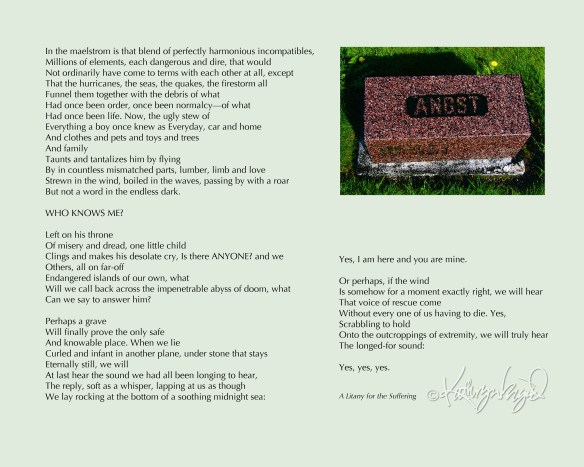
Is There Anyone Who Knows Me?

This is the first post of a three-part series on depression and anxiety, so if that’s an off-limits topic for you, I’ll see you again on the weekend! But it’s really intended as a series on hope from someone who has been-there-done-that and loves life in all of its complicated craziness as I know it now, on the other, generally sunnier, end of the tunnel. Today, for your contemplation, a meditation based on a true story of fear and loneliness and the possibility of triumph through one faint but persistent call for help.Photo + text: Under Sea, Under Stone 1

Photo + text: Under Sea, Under Stone 2

Foodie Tuesday: Salivating

Photo: Sprightly ApplesAs part of the perpetual human inclination to long for what is impossible, I suppose it’s no surprise that in the midst of one season I am frequently hungry for whatever is furthest out of season. When summer’s blistering and swelter have long since worn out their welcome, I think with great fondness of weather cold enough not only to cool my overheated brain to a slightly more manageable temperature but also to encourage the peak production of root vegetables with which to make those satisfying soups and roasted dishes that give a welcome tot of inner warmth to body and soul. In springtime, the autumn’s pears and quinces seem so remote as to have been but a beautiful fever dream of seasons past.

And though winter is short and blunt in north Texas most of the years I’ve spent living in it, it isn’t long dropped toward freezing before I think what a joy it would be to have weather balmy enough to require something cool and liquid, or just bursting with juicy freshness, to cheer my fainting spirits. Mostly, this is merely a sorry reflection of my lack of maturity and patience with whatever is present on the table or in my life. But perhaps it’s also possible to place a little of the blame on some of the first-world realities of the modern era. Indoor climate controls make winter ever so much drier than it was in my soggy single-pane-windowed youth. The normal chill of wintertime is confused in my body and household by a central heating system, never mind by old lady hot flashes, and the vast improvements in food packaging, shipping, and storage mean that I have access not only to fresh, picture-perfect produce that is nothing like currently in season where I live but just arrived on store shelves there from a country where it is at its peak growth. I can buy freeze-dried or frozen goods that are sometimes fresher and more flavorful on being prepared or reconstituted in my kitchen for having been processed so quickly at the point of harvest than any such things often were right in their natural local peak years ago.Photo + text: Juicy

My tastebuds and dietary inclinations care nothing, still, for seasonal propriety. So if I can get something preserved—old-school, as jams and canned goods and classic charcuterie, or flash-frozen on a factory ship in mid-ocean—that’s able to be prepared in ways making it as tantalizing and palatable as the fresh-harvested stuff, you can bet I’ll be indulging. Today, sitting in a blower-heated space at elevation and looking out at drizzles of snow, what should my wandering mind and salivary mechanism conspire to make me wish for most fondly? Some juicy, dazzlingly bright tasting fruit. Thank goodness for being a spoiled twenty-first century citizen. It doesn’t hurt to make a dish that will assuage both the out-of-sync wish for cool, juicy refreshment and any appropriately wintry hopes for a good tummy warmer.

Baked Apples with Raspberry-Rose Snow

Clean and core fresh, crisp apples. When I don’t have a cylindrical fruit corer on hand, I will opt to use a melon baller and just work my way through each apple sphere by sphere until I’ve tunneled through it and removed stem, blossom and seeds. Lacking a melon baller, I will use a narrow-bladed knife. You can leave the blossom end of the apple intact to keep it from leaking its filling during the baking, or you can make an edible “stopper” out of dried apple pieces, a handy way to give your diners a treat without any inedible parts. Set the prepared apples aside for the moment.

Make a paste, of whatever proportions please you, using marzipan (since there’s such a long tradition of wonderful commercially made marzipan, I feel no obligation to make my own, but if you want homemade, have at it), seedless raspberry jam (ditto), cream cheese (or labneh or goat cheese), a tiny pinch of salt, a dash of cardamom, and some elderflower cordial. Fill the apple tunnels with this goodness.

Put the apples into the buttered ramekins (individual) or casserole and bake them just until softening. About a half hour at medium-high heat (375°F/190°C), give or take a little, will do. While they’re baking, take a small handful of beautiful frozen raspberries per apple, crush them into their individual arils (gently enough to make pretty little dots rather than a messy mash), and stir in a dash of rosewater. Stick them back in the freezer that way until the moment before serving the apples, when you’ll sprinkle them over the top as a cool, burst-of-winter-sun contrast to the heat and creamy juice of the apples. And a tiny reminder of what fresh-from-the-garden goodness is like in other seasons.

Photo: Raspberry

On a Windy Day of Blue

Digital illo from photos: Ripples

Digital illo + text: Memorable

Maturity is So Overrated

I make this claim boldly, though as all of you know by now, I have never supped of maturity myself. I simply rely on the expertise of my betters who have visited the halls of grown-up-itude, however unwillingly or briefly, and am assured that my current Peter Pan flight plan will serve my needs and interests far better than the perhaps morally uplifting or civically productive ones others pursue. Sorry, world. What you see is undoubtedly what you’ll get.

Still, I flatter myself (another of my peculiarly abundant gifts) that many of my true role models, from my esteemed pater on out to remoter avatars like, yes, S. J. Perelman, have made careers and lives out of similarly irresponsible seeming stuff and yet managed in the greater scheme of things to have marvelous adventures out of those lives and careers, and even influenced others so to do. While I have no delusions of my own future grandeur based on their successes, I at least think of them as a partial excuse.

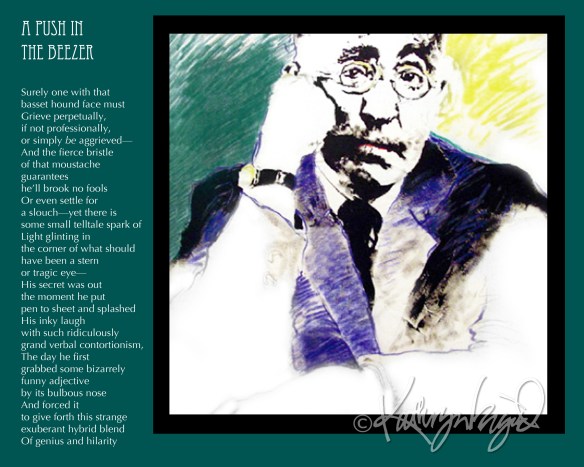
Mixed media artwork + text: A Push in the Beezer

Best of Intentions

Mirrors, those revealers of the truth, are hated; that does not prevent them from being of use. -Victor Hugo, novelist and dramatist (26 Feb 1802-1885)Digital illo: Naughty but Nice?

What Fools, These Mortals

Hester the Jester was not a protester,

but every semester she stood

Proclaiming the truth, and she fought, nail and tooth,

for the right and the ruth and the good,

And I really should mention her kindly intention:

dissension and strife she eschewed,

While meaning to find ways to open the mind

and the eyes of the blind, not be rude—

But whatever she meant with her selfless intent,

there began to foment quite a storm

Of objection to this, her good aims gone amiss,

dissertation destroyed by the norm

Of assuming one’s thought was aright and was not

to be questioned or brought ridicule,

Called privilege, might—for the mighty, a Right

to be right, day and night, was the rule—

Her well-meaning japes made the men feel like apes

and the womenfolk’s napes itch with ire,

And the moment arose when a number of those

tweaked her nose, set her hairpiece on fire,

Bashed her quite black and blue with a strop and a shoe,

swapped her lip balm with glue, stole her hat

With its jingling bells, threw her in prison cells

with appalling bad smells—and with that,

They ended her reign, in despite of the brain

and the might and the main she had shown,

And, as Jester no more, she was only a boor

who got kicked out the door on her own.

The moral, you ask? Keep your thoughts in a cask,

in a secretive flask of great tact,

And instead of Truth, Charm will prevent much alarm

and protect you from harm, and in fact,

Diplomacy’s best, whether true or in jest,

and at Hester’s behest, you should wait,

Your opinions held fast, silently, to the last,

lest your presence be past, and you, Late.

Digital illo: Well-Meaning but Mean?

All Kinds of Music

Drawing/painting illo: Three ComposersIn my head, there is music. Mostly, it’s a rambling, meandering thing without much form or direction, just a little ditty that my subconscious seems to hum to itself along the journey of the day. Once in a while, it’s an earworm, some tune or phrase caught in the soundtrack of my brain and put on long-term Repeat because I heard it or remembered it recently and didn’t have another thing to replace it with soon enough. Often, when I’m drifting off to sleep or marking time while I wait for something to happen, there’s a sort of internal theme song of mine, a mere snippet of a melody that might be a simple part of a Bach invention or might just as well be something of my own invention inspired by Bach or some similar composer, a line that becomes more or less complicated, turns from something slightly Baroque to a more Classical seeming style for a bit and then becomes a very plain little row-your-boat kind of canon before returning to its silent corner to wait for my next moment of internal quiet. On rare occasions, there might be words attached or an obvious external source of whatever song seems to have sneaked and snaked its way into my frontal lobe for a lope or two around my one-track mind.

Yet I have not the gift of composition. When I think about it in a more determined and purposeful way, I have all sorts of ideas about how I would probably set a particular poem or story text of mine if I did have compositional skills, how I might voice the piece or what instrumentation I think would be just right for the words and ideas therein. But it would be helpful, if I really intended to do any such a thing, if I had the slightest notion whatsoever of music theory or how to read a score (let alone write one), of what certain instruments can and cannot do, and whether the human voice is actually capable of making the sounds that might be required of such a project.

I am ever so glad that there are composers in the world capable of carrying a musical idea to magnificent, magical fruition. I sincerely doubt that any of them would set any text, mine or another’s, in just the way that my moseying mind seems to believe it would—for good or ill—and that is the way the universe operates. Each of us has skill sets and desires and training and passions that make us better, or worse, fitted for the tasks and arts that we imagine to be useful or pleasurable, and each has limitations even on our own abilities to recognize where we will excel and when we might fall short. What a wonderful thing it is that, though I’m not a composer myself, there are excellent composers who can and will set my words to their own music, because after all, choral music is one of the most clearly collaborative of activities anyway.

What a wonderful thing it is that, though I will most likely never master bringing what rings inside my skull out of it in an intelligible way, let alone anything like the one I imagine in its internal incubator, somebody out there is busy penning loveliness and longing, drama and dreams, that will carry their music forth into the hearts, minds, and ears of a waiting world’s humming silence.

For Guiding Us All

We learn how to live, in many ways, mostly by accident. But those of us who learn to live well, whether as better scholars, more skilled laborers or artisans, or simply as more loving and kind and generous and good-hearted people—that growth and knowledge is gained best of all through the care and guidance of those who serve as our teachers and mentors. Parents and relatives can do this, friends and neighbors and co-workers. We who are most fortunate of all have many such positive influences come into our lives and help to shape us and bring forth our best selves.

And those who are best at being this sort of careful, patient, challenging, and giving tutors in one other person’s life tend to be so naturally inclined to raise up the best in anyone within their reach that they serve as mentors to many, regardless of any plan or intention. We who have been the beneficiaries of this largesse owe a debt of gratitude, and perhaps too, our own best efforts to pass the gifts along to another circle of influence in the great, rippling pond of our connectedness, to a further acre or two of young and beautiful growth that waits between today and our own eventual horizons. Life is brief, and best enriched in its short seasons by propagating mutual help and guidance. I am thankful to have been gifted with a number of superb guides and examples, friends and mentors, in my own life. May you all be as well.Photo: A Dahlia for Neil

Bright Dahlias

The autumn came too soon, and left a pallor on the pretty paint

of those tall dahlias that you had nurtured faithfully, their saint;

It turned them into shadows of

themselves too soon, shadows of love…

Frost cut them down and took them in its bony hands to steal their dance

the graces you had tended there so tenderly, by circumstance,

From shoot to bud to blooming beds,

by stealthy ice that bowed their heads…

And you saw early autumn, too, too soon—were bit untimely by

the frost and plucked from gardening, the sun still in your sky-blue eye

Made winter’s sparkling snowy air

of beauties we were loath to spare…

Yet all this theft you had foreseen, and readied us to stay and tend

bright dahlias, each, our own; to go on gardening, and so amend

Our sorrows in your still-wide gaze

by passing on your gentle ways…

The rich inheritance you gave still grows like dahlias among

us all, your heirs, and in their turn, those we raise up as happy young

New imitators of your gift

for singing to give hearts a lift…

In loving memory of Neil Lieurance, and with deep and abiding gratitude for the treasure that is a true mentor in any life.


Transitory or Transitional

Pen & ink drawing: Transitory or TransitionalMy spouse, in his combined capacities as a natural-born teacher and a lifelong curious learner himself, is constantly reading, studying, talking shop with others both in and out of his field of music, and cogitating inwardly and through his writing about ways to grow and improve. I am neither a born teacher nor as dedicated and skillful a learner as he is, but I have, I think, grown a fair amount in my appreciation of what quantities and depth of effort it takes to improve oneself, let alone help others to improve themselves, in any chosen course of study. One of the things that intrigues me is that, as in so many areas of life’s experiences, the macro and the micro aspects of learning and, in turn, teaching, always ebb and flow: it takes a multitude of tiny pieces of knowledge and/or effort to make any significant larger ones, and the large ones must generally be reduced to smaller and more manageable parts in order to be changed, eliminated, or simply learned, as well.

In a day’s rehearsal for an upcoming concert, it’s marvelous to see and hear what occurs as a major composition is broken down into its component parts and those parts studied and practiced and rehearsed in detail, bit by bit, but also to realize that the individual parts have no beauty or meaning unless also studied in the context of the whole. Fixing one small phrase or chord at a time can be a portion of the improvement process, but if that’s all that happens, then the performance will never have any cohesion or sense of drama but will forever remain a collation of essentially separate and unrelated atoms that happened to be sounded in the same room on the same night. Playing or singing through transitions—the places where one phrase or larger idea in a composition ends and the next begins—is a way in which my conductor husband helps his choirs, orchestras, and other performers to experience and express the whole of the story more convincingly themselves, and thus bring an audience into the flow of the work as well.

Music is a wonderful vehicle for individual experience of the aesthetic, emotional, artistic, and ephemeral aspects of existence, and as such is a grand gift. But when it becomes a communal, communicative experience rather than only an isolated solo, it has incredible power for building relationships between people, ideas, cultures, lives. When it is a bit of a song, hummed or played on the street, in the car, at work in the kitchen, it can cheer or soothe, feed or please; when it is a performance of a major musical work in concert, in a musical or opera, an oratorio or a middle school end-of-year concert that has many participants and has been labored over with passion by all of them through a string of intense rehearsals, its power is magnified and resonates for a long, long time to come. It’s as though the practice of singing or playing through the transitions from one passage to another of that single composition has expanded into life, letting the dissonances and harmonies, the threads of meaning and the ecstatic shimmer of aural beauty, all remain in the air and in our spirits long after the last notes have gone silent, carrying us through the transition from art into life with renewed depth and purpose.

Foodie Tuesday: Up to My Elbows in It

Photo: Fat, Glorious FatYou already know that of my many edible obsessions, fats are among the most prized. Butter in virtually any form is the glistening Sun of my oblations when it brings its sleek graces to the sweet and the savory alike. Meat fats, vegetable-derived fats: yea verily, I can’t imagine how I would find culinary happiness if it weren’t for the kind kisses of olive oil, duck fat, tallow, avocado oil, sweet and mild nut oils, leaf lard, coconut oil, and all of their slick cohort bringing the foods I eat to their most well-rounded state. Barbecue of the highest order doesn’t even exist, in my book, unless I have to scrub like a surgeon after eating it to clean up the goodness that ran up my arms before getting to my mouth. The mere sheen of the translucent butcher paper sticking to the smokehouse table is enough to start a Pavlovian response in me.Photo: Brisket, Burnt Ends, Ribs, & Sausage

The thing is, I’ve learned over a long and avid career as an eater, that it’s not fats, per se, that make me rounder, but which fats I eat, and when, and how much. I am well aware that food is faddish, and you know I’ve posted about such things on many a Tuesday of yore, but I pay better attention to my own body’s definition of what works and what doesn’t than I used to do, and by now I’ve seen that while it’s not very helpful to me in terms of my physical fitness or comfort to indulge as much as I wish in eating like a ruminant or like a three-year-old with a credit card, I can be more generous with my desire for fat. You can cringe if you like; I know it’s not for every body, and Fat has been made a dirty word for generations not only because it’s been considered unhealthy, unseemly or both but because it’s been considered dangerous and therefore ugly on people.

But I’ve known folk who lived long, happy, productive lives without ever being particularly svelte, let alone stick-figure thin like fashion models are wont (and expected) to be. I’ve known of dietary health or fitness fanatics who died young of health-related causes. They aren’t the supposed norm, no, but then most of us aren’t, one way or another. When I get my medical checkups I have consistently high cholesterol levels, enough so the doctor sends me off for sophisticated coronary calcium tests, and I come home with a chart that could just as well have a grade school star sticker or happy face on it to go with its perfect Zero score; it defies not only the odds but logic, yet there it is. My blood pressure remains on the low-moderate side, my heart keeps ticking, and the amount of cholesterol in my pipes seems to be irrelevant to my general health thus far in life.

On the other end of the scale, for me, is the unfortunate truth that two things I adore eating, wheat (breads, cookies, pasta, and the like) and uncultured dairy products (ice cream, ice cream, ice cream, and a few other items), almost instantaneously expand my gut and make me feel logy and uncomfortable. I would love to be that grass-eating goat who can munch on wheat-based goodies endlessly without consequence, or that toddler with a bank account running amok in a forty-flavors ice cream parlor, but I’m learning to face the reality that I’m not one of those for whom that’s a good or even fun choice.

One way I am learning to deal with the profound sense of loss that not indulging those wicked-tasty urges very often, if at all, is of course by simply substituting temptations that I like as well and that like me back a little more kindly. Fats. As my spouse just read to me from a newsmagazine, pretty much anything can be improved with a drizzle of browned butter, and who am I to argue with printed infotainment? I suspect there are few foods that, if listed on two menus with one touting Beurre Noisette as an ingredient and the other not, wouldn’t sucker me right in for the sale with the former version. And don’t even get me started on low-fat and nonfat foods being offered as supposed temptations to my fat-loving palate. If they were low-fat or nonfat in the beginning, say, leafy greens, I’m quite happy to eat them, but I promise you I’ll dive in so much the faster if you cook ’em and offer me a good dollop of butter melted on top.

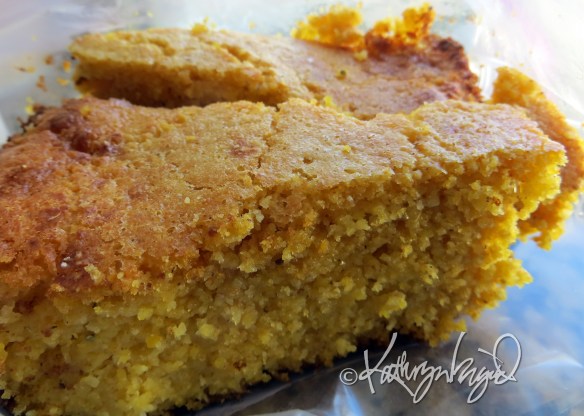
Inspired by Emeril Lagasse‘s skillet cornbread recipe, I merely added a little seasoning, slightly more fat and Voila! It got even better. See how easily that works?!Photo: Slightly Fatter Cornbread

Slightly Fatter Skillet Cornbread

Preheat oven to 450°F/232°C (or whatever approximates those temps in your oven), with your well-seasoned cast iron skillet in it.

Combine dry ingredients with a fork or whisk in a large measuring pitcher (I like my 64 oz pitcher, because it makes ingredient transfers so easy) or bowl: 3 cups cornmeal, 1 tsp baking powder, 1 tsp baking soda, 2 tsp salt, 1 tsp smoked paprika, 1/4-1/2 tsp cayenne pepper. In a separate measuring pitcher or bowl, beat together the wet ingredients: 3 cups buttermilk (or my on-hand substitute of 1 cup heavy cream, 2-3 T lemon juice, and enough whole milk to bring the total to 3 cups—which combination I think I might like even better than the buttermilk), 3 large eggs, and 2/3 cup of melted [salted] butter. Pour the wet ingredients into the dry and stir just until mixed.

When the oven’s temp is right, pull out the skillet, melt 2 T bacon fat in it and tip the pan to coat it thoroughly. Pour in the cornbread mixture, pop the skillet back in the oven, and bake until a rich, russety golden brown, somewhere around 30 minutes. In a household of two, I find it’s useful to cut the cornbread into 12 wedges, and as soon as it’s cool enough to handle, package two at a time in bags or parchment wraps and seal them in a big zipper bag in the freezer, where the residual steam will help keep them moist and manageable for thawing for later meals.

But I do keep a couple of pieces handy for the day’s lunch or dinner straight from the oven, preferably slathered with yet more [browned] butter and topped, perhaps, with some sweet honey, molasses, jam, fresh fruit…or more butter. Don’t tell anybody. They’ll know when they see the shine on my lips, anyhow.