Best of Intentions

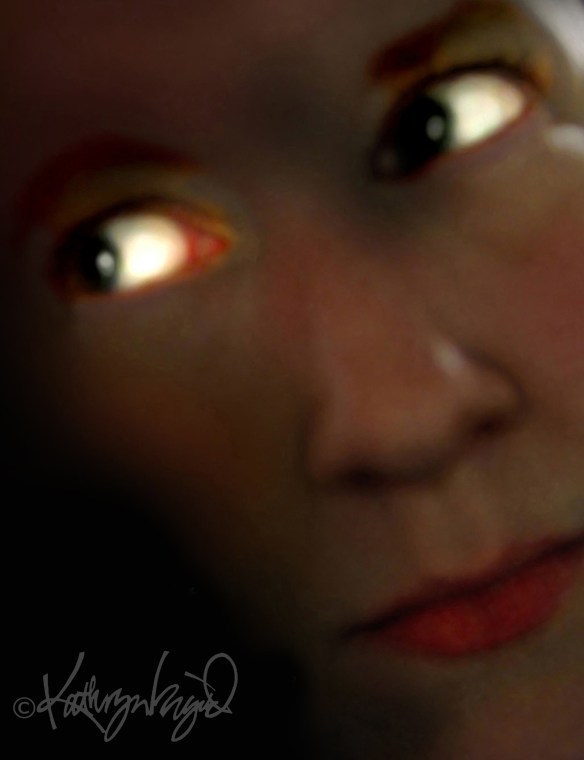
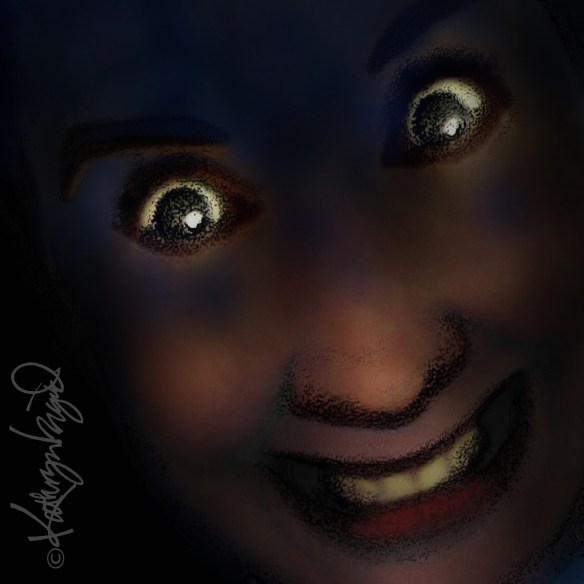
Mirrors, those revealers of the truth, are hated; that does not prevent them from being of use. -Victor Hugo, novelist and dramatist (26 Feb 1802-1885)Digital illo: Naughty but Nice?

What Fools, These Mortals

Hester the Jester was not a protester,

but every semester she stood

Proclaiming the truth, and she fought, nail and tooth,

for the right and the ruth and the good,

And I really should mention her kindly intention:

dissension and strife she eschewed,

While meaning to find ways to open the mind

and the eyes of the blind, not be rude—

But whatever she meant with her selfless intent,

there began to foment quite a storm

Of objection to this, her good aims gone amiss,

dissertation destroyed by the norm

Of assuming one’s thought was aright and was not

to be questioned or brought ridicule,

Called privilege, might—for the mighty, a Right

to be right, day and night, was the rule—

Her well-meaning japes made the men feel like apes

and the womenfolk’s napes itch with ire,

And the moment arose when a number of those

tweaked her nose, set her hairpiece on fire,

Bashed her quite black and blue with a strop and a shoe,

swapped her lip balm with glue, stole her hat

With its jingling bells, threw her in prison cells

with appalling bad smells—and with that,

They ended her reign, in despite of the brain

and the might and the main she had shown,

And, as Jester no more, she was only a boor

who got kicked out the door on her own.

The moral, you ask? Keep your thoughts in a cask,

in a secretive flask of great tact,

And instead of Truth, Charm will prevent much alarm

and protect you from harm, and in fact,

Diplomacy’s best, whether true or in jest,

and at Hester’s behest, you should wait,

Your opinions held fast, silently, to the last,

lest your presence be past, and you, Late.

Digital illo: Well-Meaning but Mean?

All Kinds of Music

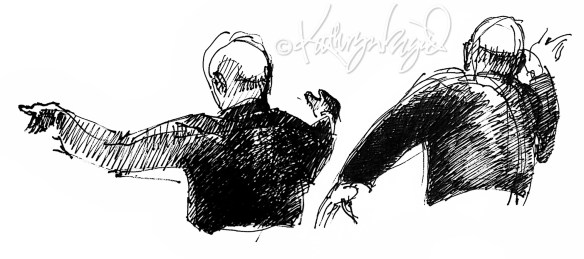
Drawing/painting illo: Three ComposersIn my head, there is music. Mostly, it’s a rambling, meandering thing without much form or direction, just a little ditty that my subconscious seems to hum to itself along the journey of the day. Once in a while, it’s an earworm, some tune or phrase caught in the soundtrack of my brain and put on long-term Repeat because I heard it or remembered it recently and didn’t have another thing to replace it with soon enough. Often, when I’m drifting off to sleep or marking time while I wait for something to happen, there’s a sort of internal theme song of mine, a mere snippet of a melody that might be a simple part of a Bach invention or might just as well be something of my own invention inspired by Bach or some similar composer, a line that becomes more or less complicated, turns from something slightly Baroque to a more Classical seeming style for a bit and then becomes a very plain little row-your-boat kind of canon before returning to its silent corner to wait for my next moment of internal quiet. On rare occasions, there might be words attached or an obvious external source of whatever song seems to have sneaked and snaked its way into my frontal lobe for a lope or two around my one-track mind.

Yet I have not the gift of composition. When I think about it in a more determined and purposeful way, I have all sorts of ideas about how I would probably set a particular poem or story text of mine if I did have compositional skills, how I might voice the piece or what instrumentation I think would be just right for the words and ideas therein. But it would be helpful, if I really intended to do any such a thing, if I had the slightest notion whatsoever of music theory or how to read a score (let alone write one), of what certain instruments can and cannot do, and whether the human voice is actually capable of making the sounds that might be required of such a project.

I am ever so glad that there are composers in the world capable of carrying a musical idea to magnificent, magical fruition. I sincerely doubt that any of them would set any text, mine or another’s, in just the way that my moseying mind seems to believe it would—for good or ill—and that is the way the universe operates. Each of us has skill sets and desires and training and passions that make us better, or worse, fitted for the tasks and arts that we imagine to be useful or pleasurable, and each has limitations even on our own abilities to recognize where we will excel and when we might fall short. What a wonderful thing it is that, though I’m not a composer myself, there are excellent composers who can and will set my words to their own music, because after all, choral music is one of the most clearly collaborative of activities anyway.

What a wonderful thing it is that, though I will most likely never master bringing what rings inside my skull out of it in an intelligible way, let alone anything like the one I imagine in its internal incubator, somebody out there is busy penning loveliness and longing, drama and dreams, that will carry their music forth into the hearts, minds, and ears of a waiting world’s humming silence.

For Guiding Us All

We learn how to live, in many ways, mostly by accident. But those of us who learn to live well, whether as better scholars, more skilled laborers or artisans, or simply as more loving and kind and generous and good-hearted people—that growth and knowledge is gained best of all through the care and guidance of those who serve as our teachers and mentors. Parents and relatives can do this, friends and neighbors and co-workers. We who are most fortunate of all have many such positive influences come into our lives and help to shape us and bring forth our best selves.

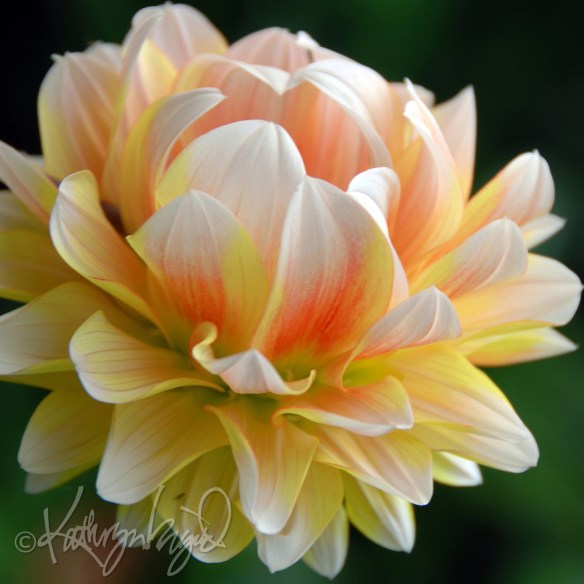
And those who are best at being this sort of careful, patient, challenging, and giving tutors in one other person’s life tend to be so naturally inclined to raise up the best in anyone within their reach that they serve as mentors to many, regardless of any plan or intention. We who have been the beneficiaries of this largesse owe a debt of gratitude, and perhaps too, our own best efforts to pass the gifts along to another circle of influence in the great, rippling pond of our connectedness, to a further acre or two of young and beautiful growth that waits between today and our own eventual horizons. Life is brief, and best enriched in its short seasons by propagating mutual help and guidance. I am thankful to have been gifted with a number of superb guides and examples, friends and mentors, in my own life. May you all be as well.Photo: A Dahlia for Neil

Bright Dahlias

The autumn came too soon, and left a pallor on the pretty paint

of those tall dahlias that you had nurtured faithfully, their saint;

It turned them into shadows of

themselves too soon, shadows of love…

Frost cut them down and took them in its bony hands to steal their dance

the graces you had tended there so tenderly, by circumstance,

From shoot to bud to blooming beds,

by stealthy ice that bowed their heads…

And you saw early autumn, too, too soon—were bit untimely by

the frost and plucked from gardening, the sun still in your sky-blue eye

Made winter’s sparkling snowy air

of beauties we were loath to spare…

Yet all this theft you had foreseen, and readied us to stay and tend

bright dahlias, each, our own; to go on gardening, and so amend

Our sorrows in your still-wide gaze

by passing on your gentle ways…

The rich inheritance you gave still grows like dahlias among

us all, your heirs, and in their turn, those we raise up as happy young

New imitators of your gift

for singing to give hearts a lift…

In loving memory of Neil Lieurance, and with deep and abiding gratitude for the treasure that is a true mentor in any life.


Transitory or Transitional

Pen & ink drawing: Transitory or TransitionalMy spouse, in his combined capacities as a natural-born teacher and a lifelong curious learner himself, is constantly reading, studying, talking shop with others both in and out of his field of music, and cogitating inwardly and through his writing about ways to grow and improve. I am neither a born teacher nor as dedicated and skillful a learner as he is, but I have, I think, grown a fair amount in my appreciation of what quantities and depth of effort it takes to improve oneself, let alone help others to improve themselves, in any chosen course of study. One of the things that intrigues me is that, as in so many areas of life’s experiences, the macro and the micro aspects of learning and, in turn, teaching, always ebb and flow: it takes a multitude of tiny pieces of knowledge and/or effort to make any significant larger ones, and the large ones must generally be reduced to smaller and more manageable parts in order to be changed, eliminated, or simply learned, as well.

In a day’s rehearsal for an upcoming concert, it’s marvelous to see and hear what occurs as a major composition is broken down into its component parts and those parts studied and practiced and rehearsed in detail, bit by bit, but also to realize that the individual parts have no beauty or meaning unless also studied in the context of the whole. Fixing one small phrase or chord at a time can be a portion of the improvement process, but if that’s all that happens, then the performance will never have any cohesion or sense of drama but will forever remain a collation of essentially separate and unrelated atoms that happened to be sounded in the same room on the same night. Playing or singing through transitions—the places where one phrase or larger idea in a composition ends and the next begins—is a way in which my conductor husband helps his choirs, orchestras, and other performers to experience and express the whole of the story more convincingly themselves, and thus bring an audience into the flow of the work as well.

Music is a wonderful vehicle for individual experience of the aesthetic, emotional, artistic, and ephemeral aspects of existence, and as such is a grand gift. But when it becomes a communal, communicative experience rather than only an isolated solo, it has incredible power for building relationships between people, ideas, cultures, lives. When it is a bit of a song, hummed or played on the street, in the car, at work in the kitchen, it can cheer or soothe, feed or please; when it is a performance of a major musical work in concert, in a musical or opera, an oratorio or a middle school end-of-year concert that has many participants and has been labored over with passion by all of them through a string of intense rehearsals, its power is magnified and resonates for a long, long time to come. It’s as though the practice of singing or playing through the transitions from one passage to another of that single composition has expanded into life, letting the dissonances and harmonies, the threads of meaning and the ecstatic shimmer of aural beauty, all remain in the air and in our spirits long after the last notes have gone silent, carrying us through the transition from art into life with renewed depth and purpose.

Foodie Tuesday: Up to My Elbows in It

Photo: Fat, Glorious FatYou already know that of my many edible obsessions, fats are among the most prized. Butter in virtually any form is the glistening Sun of my oblations when it brings its sleek graces to the sweet and the savory alike. Meat fats, vegetable-derived fats: yea verily, I can’t imagine how I would find culinary happiness if it weren’t for the kind kisses of olive oil, duck fat, tallow, avocado oil, sweet and mild nut oils, leaf lard, coconut oil, and all of their slick cohort bringing the foods I eat to their most well-rounded state. Barbecue of the highest order doesn’t even exist, in my book, unless I have to scrub like a surgeon after eating it to clean up the goodness that ran up my arms before getting to my mouth. The mere sheen of the translucent butcher paper sticking to the smokehouse table is enough to start a Pavlovian response in me.Photo: Brisket, Burnt Ends, Ribs, & Sausage

The thing is, I’ve learned over a long and avid career as an eater, that it’s not fats, per se, that make me rounder, but which fats I eat, and when, and how much. I am well aware that food is faddish, and you know I’ve posted about such things on many a Tuesday of yore, but I pay better attention to my own body’s definition of what works and what doesn’t than I used to do, and by now I’ve seen that while it’s not very helpful to me in terms of my physical fitness or comfort to indulge as much as I wish in eating like a ruminant or like a three-year-old with a credit card, I can be more generous with my desire for fat. You can cringe if you like; I know it’s not for every body, and Fat has been made a dirty word for generations not only because it’s been considered unhealthy, unseemly or both but because it’s been considered dangerous and therefore ugly on people.

But I’ve known folk who lived long, happy, productive lives without ever being particularly svelte, let alone stick-figure thin like fashion models are wont (and expected) to be. I’ve known of dietary health or fitness fanatics who died young of health-related causes. They aren’t the supposed norm, no, but then most of us aren’t, one way or another. When I get my medical checkups I have consistently high cholesterol levels, enough so the doctor sends me off for sophisticated coronary calcium tests, and I come home with a chart that could just as well have a grade school star sticker or happy face on it to go with its perfect Zero score; it defies not only the odds but logic, yet there it is. My blood pressure remains on the low-moderate side, my heart keeps ticking, and the amount of cholesterol in my pipes seems to be irrelevant to my general health thus far in life.

On the other end of the scale, for me, is the unfortunate truth that two things I adore eating, wheat (breads, cookies, pasta, and the like) and uncultured dairy products (ice cream, ice cream, ice cream, and a few other items), almost instantaneously expand my gut and make me feel logy and uncomfortable. I would love to be that grass-eating goat who can munch on wheat-based goodies endlessly without consequence, or that toddler with a bank account running amok in a forty-flavors ice cream parlor, but I’m learning to face the reality that I’m not one of those for whom that’s a good or even fun choice.

One way I am learning to deal with the profound sense of loss that not indulging those wicked-tasty urges very often, if at all, is of course by simply substituting temptations that I like as well and that like me back a little more kindly. Fats. As my spouse just read to me from a newsmagazine, pretty much anything can be improved with a drizzle of browned butter, and who am I to argue with printed infotainment? I suspect there are few foods that, if listed on two menus with one touting Beurre Noisette as an ingredient and the other not, wouldn’t sucker me right in for the sale with the former version. And don’t even get me started on low-fat and nonfat foods being offered as supposed temptations to my fat-loving palate. If they were low-fat or nonfat in the beginning, say, leafy greens, I’m quite happy to eat them, but I promise you I’ll dive in so much the faster if you cook ’em and offer me a good dollop of butter melted on top.

Inspired by Emeril Lagasse‘s skillet cornbread recipe, I merely added a little seasoning, slightly more fat and Voila! It got even better. See how easily that works?!Photo: Slightly Fatter Cornbread
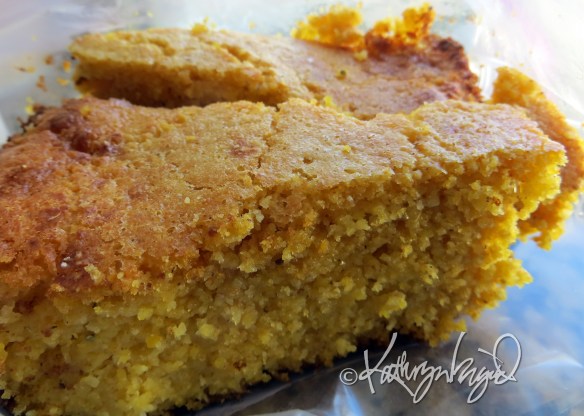
Slightly Fatter Skillet Cornbread

Preheat oven to 450°F/232°C (or whatever approximates those temps in your oven), with your well-seasoned cast iron skillet in it.

Combine dry ingredients with a fork or whisk in a large measuring pitcher (I like my 64 oz pitcher, because it makes ingredient transfers so easy) or bowl: 3 cups cornmeal, 1 tsp baking powder, 1 tsp baking soda, 2 tsp salt, 1 tsp smoked paprika, 1/4-1/2 tsp cayenne pepper. In a separate measuring pitcher or bowl, beat together the wet ingredients: 3 cups buttermilk (or my on-hand substitute of 1 cup heavy cream, 2-3 T lemon juice, and enough whole milk to bring the total to 3 cups—which combination I think I might like even better than the buttermilk), 3 large eggs, and 2/3 cup of melted [salted] butter. Pour the wet ingredients into the dry and stir just until mixed.

When the oven’s temp is right, pull out the skillet, melt 2 T bacon fat in it and tip the pan to coat it thoroughly. Pour in the cornbread mixture, pop the skillet back in the oven, and bake until a rich, russety golden brown, somewhere around 30 minutes. In a household of two, I find it’s useful to cut the cornbread into 12 wedges, and as soon as it’s cool enough to handle, package two at a time in bags or parchment wraps and seal them in a big zipper bag in the freezer, where the residual steam will help keep them moist and manageable for thawing for later meals.

But I do keep a couple of pieces handy for the day’s lunch or dinner straight from the oven, preferably slathered with yet more [browned] butter and topped, perhaps, with some sweet honey, molasses, jam, fresh fruit…or more butter. Don’t tell anybody. They’ll know when they see the shine on my lips, anyhow.

Mermaids in the Conservatory

Isn’t it a little odd that so many of us find it calming to watch colorful fish swim? We don’t live underwater ourselves, generally preferring to breathe oxygen from above water level. I’m quite certain that most people would agree that the very idea of attempting to survive in a fish’s environment without plenty of protective gear or at least an ability to hold one’s breath for great lengths of time is more intimidating than inviting, especially as it would mean spending time rubbing…hmmm…elbows (?) with a fish. (Pectoral fins? Dorsals?)

No matter. When I’m feeling tired, under stress, or otherwise out of sorts, few things comfort me like the peaceful ripple of calm water when a few fish pass quietly by me. I would go on about it further now, but I’m growing pleasantly sleepy just thinking about it and shall go off to bed to dream of orchid beds and fountains, fan palms and a stone-lined pond filled with a silent, painterly array of highly bred carp easing past me. I’ll leave you with this little pond-full for your own moment of uncoiling in calm.Digital illo from a photo + text: Koi

A Touch of Existentialism

Like most people, I suppose, I am an odd collection of contradictions. Having a pretty dandy education and good genes, I’m not entirely dimwitted, in fact, would say that I’m not only intelligent enough to have gotten good grades in school right on up through my graduate studies but even so much so that I get along rather well in my life. But everybody who knows me also knows that I am also almost supernaturally dyslexic, being unable to read with ease or tell left from right, up from down, forward from back, and a host of other handy life skills that others, as I’ve observed, seem to come by naturally. This is not a complaint or bragging, either one, just a statement of fact. I do well, when I do well, because I have found sidelong ways to get the job done, whether it’s by reading any text at least three times through before it falls into sensibility in my quirky brain or by traveling on trust and a fairly reliable eye for landmarks to keep me finding home base despite my utter lack of an inner compass.

I am by nature exceedingly shy and have had from early childhood what I only learned as an adult was an unusually high level of constant anxiety that, with serious therapy and a consistent supply of low-level medicine, turns out to be manageable. So even though it seems incredibly unlikely and counterintuitive to people who meet me now, I appear to be a lifelong social butterfly, an extrovert, and naturally fearless about interactions even though without the meds and training I would be wholly unable to function at this happy level. My vocal cords are irritatingly subpar for regular use thanks to my SD*, but when I’m with someone I really enjoy and trust, I can be counted on to chatter without stopping (*other than when forced to) for great lengths of time.

And I have no magical powers. Again, I think myself essentially ordinary in having no skills or talents, knowledge or gifts, of special note. I am not overly self-deprecating or sad on this account, merely noting that if you’re looking for the person who will end all wars, cure cancer or the common cold, or discover a way to stabilize the planet’s climate forever, you should jolly well be looking at almost anybody else imaginable as a better go-to heroine. Yet I really do think we all exist for some sort of reason or purpose. It might well be that mine is nothing more than to spend a lifetime figuring out what my purpose is, and die slightly more contented than otherwise if I should be so lucky as to solve that puzzle any time before I’m taking my last breath.

You know what? That’s good enough for me.Digital illo + text: Hovercraft

Another Day in the Life of a Dead Person

Today I saw a televised ad encouraging persons who had experienced negative results from using a particular medical treatment to come forward and be represented in a class action suit by the law firm posting the advertisement. The advert had the usual tangle of legal terms sprinkled among references to the undesirable outcomes various patients had experienced, as this  sort of campaign usually does, but somebody in the TV production department seems to have had his or her own unintended grammatical consequences, because the last frame of text that appeared on the TV screen exhorted victims “If you have used this product and experienced injury, stroke, heart attack, or death, please call now,” and gave a toll-free telephone number.

I wonder what the protocol is for operators being contacted by any plaintiffs in the latter category, and whether, if any said operator should in turn have a stroke or heart attack or just die from the shock, that too would be legally admissible as a result of the faulty medication, however indirectly. Might set off quite the cycle of problems, though the more it filled coffins, the more it would presumably also fill the lawyers’ coffers.

No matter. Surely everybody needs a little understanding now and then for not responding as the inviting party might wish on every occasion, no matter how enticing the invitations might be. After all, I’d imagine it can be difficult to be perfectly socially correct when one has already kicked the bucket. Just saying.Photo + text: Pardon Me If I Don't Get Up

Text: Regrets Only

Art in the Middle of Dying

Digital illo + text: Angels DescendingThere’s little in the world that gives more meaningful respite from earthly trials than art. Those sorrows and struggles that range from the brutality of human weakness and evil to the most monstrous of natural disasters have no true cure, no end. Safe to assume that they have existed since long before recorded history, and will outlast the lives of any of us now present. But art—a painting, a dance, a song, a story—in its turn outlasts, too, the horrors and madness of the darkest time. What exists in the background, dwells in the underground, during suffering and oppression, so strong that it cannot be extinguished, and both records the terrible event and defies it? Art.

If we learn anything from our history, it should include the knowledge that any threat to eliminate or suppress art by force or merely by neglect and dissolution is a time when we should most avidly practice our defiance of oblivion. When it is bleakest, we should dance most wildly and gracefully; when dark, sing boldly and sweetly; when empty, we should fill the void with thought and challenge it with beauty. The blank Nothing may not mock us into meek obsolescence if we refuse to silence our passion and surrender our dreams.

Sometimes It’s Better to Part Ways with One’s Parts

When something goes wrong inside, for most of us it’s no big deal; just an off day in the old innards, whether physically or emotionally, and it’ll pass. But when something goes wrong in a more complicated way, I tend to think it’s pretty good luck if “all” one has to do to get well is remove a malfunctioning part and either replace it or live without. Modern life makes that possible: a swift appendectomy with a tiny scar to show for it, a manufactured hip here, a transplanted kidney there. Lots of things that, if not chronic, are reparable and survivable when they used to lead to long, slow, miserable declines or instant death.

There’s still plenty of the latter kind of illness and injury to keep doctors busy and patients unhappy and money funneling from the latter to the former in ever-widening streams, and that’s no joke. But I think it remarkably good that I live in an era when far less stuff is fatal by default. I was especially glad that when my poor brother-in-law was violently attacked by his own gallbladder recently and it tried to stone him to death, there was adequate artillery to fight back and win. What did he ever do to it, to deserve such lousy treatment! I can tell you from (supposed) experience that gallbladder pain is horrendous. I can’t tell you what it’s like to have the offending organ removed, or even have the stones destroyed and extracted, because either I don’t have a gallbladder at all or it is an expat living in a foreign part of my body from where they are normally located: the doctor and ultrasound technician spent a lot of time hunting and could never find the little hunk of meanness before the pain, thankfully, dissipated on its own.

Photo: Plumbing

Don’t you just hate it when something goes wrong with your plumbing?

My BIL was not such a fortunate escapee, and the pain persisted and worsened until he ended up with several exceedingly un-fun procedures to zap the stones and remove the offending organ, which if you ask me did have a heck of a lot of gall to treat him like that. I am ever so glad he has already begun a full recovery! I wrote him a silly poem, ’cause I love him.

Parting with Parts

is Such Sweet Sorrow

Can anything be worse, or sadder,

Than to give up one’s gallbladder?

Well, perhaps one worser quirk:

Still having one that doesn’t work…

And one worse yet: the wails and groans

Induced by one that’s filled with stones.

So I’ll amend Assertion One:

Having a gallbladder’s no fun.

But then again, I must concede

That surgery is bad indeed.

It all comes down, if I should guess

To what will save my happiness

More fruitfully: intact gallbladder?

None? Can’t say: it doesn’t matter,

Since the choice will not be mine—

‘Til then, I s’pose I’ll be just fine—

I hope. Of course, I still don’t know

Whether I even have one, though.