Who’s the Real Pest around Here Anyway?

photoNo fan of squirrels am I. In the abstract, I can enjoy their wild gymnastic athleticism and pranks and admire their elegant plumy tails and all of that, yes I can. But when I hear that familiar thud on the roof when they’re jumping from the red oak to the shingles and holding their miniature NASCAR events up there, what I’m thinking is not ‘how cute’ but ‘rats’.

They are, after all, rodents. The little scarpers have nice sharp claws that scrape bits off of our roofing (see: roof confetti in gutters) and nice sharp teeth that chew chunks off of our siding (see: bare wood fringe appearing on siding near where only birds or squirrels could possibly reach) and not-so-nice habits of eating every bit of bird seed that I put out if they can reach it (see: squirrel hanging upside down by ankles from gutter like trapeze artist while he stares longingly and calculatingly at nearby-but-not-near-enough bird feeder, then dashing back down to the patio below to scarf up every seed, nut, pod and shell left below said feeder before dashing back up again for another recon) and of ‘recycling’ said bird feed onto patio, porch, garage perimeter and paths for me to sweep up after them (see: squirrel excrement scattered decoratively hither and yon).

But there are as many fans of squirrel-dom as there are less sympathetic critics like me, and there are certainly many, whether among squirrel friends or not, who think many other creatures more dirty, pesky, or persistent than I do. Take pigeons, for one. I’ve heard them called ‘flying rats’ more than once, and know that they are at least as frequently cited as disease carriers and civic troublemakers as are squirrels. Other than the remarkably tiny headed (and I confess to thinking them remarkably tiny brained in equal proportion) mourning doves that visit our place occasionally, there are rarely pigeons around there, so it’s probably simple arithmetical odds that make me like them perfectly fine when I’m so prejudiced against squirrels. As long as you don’t swing by for the seemingly sole purpose of eating my food and then expelling it back out upon me and mine when you’ve had your fun with it, I guess I’ll give you a free pass.

I should very likely just cut the poor squirrels some slack, too, in exchange for the hijinks they provide as compensatory amusement. After all, they, along with all of the other critters that call our garden, yard, ravine, neighborhood and planet home, must surely look on me as a dirty, self-centered, gluttonous and destructive interloper on their home turf, and they would not be wrong. And I sure don’t expect to be able to repay the affront by amusingly hanging by my ankles from the gutter anytime soon.

What We Can Learn from Dogs

So it’s Monday. All. Day. Long. One of those times when you can easily believe in the purported accursedness of the day; one unlucky, frustrating, impossible thing after another and not a coffee break in sight. We’ve all had ’em. Rotten, rotten Mondays, no matter what day of the week in reality, are the bane of humankind.

Dogs, however, rarely let a Monday take their essential doggy happiness away. It takes, in fact, quite a lot of horribleness to take the equanimity and enthusiastic canine capering down to a level recognizable as sad, and once cheered up again, dogs are remarkably good at forgiving and forgetting. Barring ill-treatment or illness, every day is the greatest day ever to your average dog.

photo

Why lie around counting the time until your human will take you walking farther, when you can back-scratch your way headfirst right down the hill?

It’s not that dogs are stupid. Far from it; some dogs I’ve known would beat some people I’ve known at any IQ test, and the average dog is a pretty clever problem solver and able to perform all sorts of magnificent deeds, accomplish numerous astounding feats. It’s more that dogs, simply, seem to have a highly developed power for living in the moment, finding the good in the small and ordinary and letting unpleasantness drift past them as quickly as the turning of the world will allow. They’re not much on sulking, self-pity, or wallowing and very rarely hold grudges–and these, as far as I’ve seen, only when pressed to it by persons or events truly deserving of their scorn.

What dogs seem to hold among their many fine and useful instincts is the one that tells one to be thrilled when a maple seed helicopters out of a tree in his path, to slurp lustily at a handy puddle of water when thirsty, and to leap into the air rather than toddling through the weeds when crossing the parking strip to get to the park for a romp. The wisdom to nuzzle the hand that pets him, to lie like a shaggy, comforting blanket on the cold feet of a human companion when he’s sad and to shoot across the house like water from a fire hose when the other human gets home from her long day at the office. All of this is noble work, and keeping as busy at it as any good dog does makes him far too busy to mope and snarl and bemoan his bad fortune. Even on a typical Monday.

photo

It’s a good day to be a dog!

It’s Early Yet

graphite line drawingBeing an inveterate late riser, and a crabby one when forced to get up before I’m ready, no matter what the hour, I am flummoxed for the most part by those who tout the glories of the break of day. I say, for the most part, because even I have been known to admire the sunrise, and even in my worst and most heel-dragging, snarling moments can see how incredibly pretty and magical the beginning of the day can be. In fact, I can outright admire and relish the whole thing if I know I get to watch the show and go instantly to bed again until I’ve had my requisite number of hours abed.

I’ve a fairly wide variety of reasons for not having children, too, not least among them my aforementioned monstrosity in the beginnings of the day, a time when babies and young persons of all persuasions and personalities are apt to be chirping and squealing adorably and performing all manner of gymnastics and, just possibly, noisy and/or noisome bodily functions that would demand kind attentions from me. I am not that nice at the best of times, never mind any time before I’m willing to rise up and be Awake. You can imagine how the very prospect of pregnancy and its sleep disruptions, and those only leading precipitously to years more of the other sort, would seem to me, most particularly as I was already sliding off the back five of my fourth decade of life by the time I got married and thus would have had any hope of an ongoing partner in the proceedings.

You must know, however, that I think children are a very fine invention and well worth the trouble, and also that I have nothing but the greatest admiration for that mystical marvel that occurs when the tiniest edge of the sun peers over the horizon and then in seeming seconds is blazing up the morning sky. It’s just that I am content to leave all of the heavy lifting in those categories to finer beings for as long as I can. My siblings and other relatives and friends have gifted me with an abundance of outstandingly beautiful, brilliant and engaging children to admire, cuddle, tease, flirt with, trade tall tales with or about, and otherwise delight in before handing them back to their parents just in time for any less scintillating activities to be addressed more expertly and semi-willingly than I would do. And dawn, well–that will likely become part of my repertoire when I hit that Certain Age incapable of sleeping massive amounts any longer, but until then, it belongs to others, except in my imaginings or when I am dragged out of repose by duty or airport hours or some other sort of the unavoidably morning-oriented difficulties life presents.

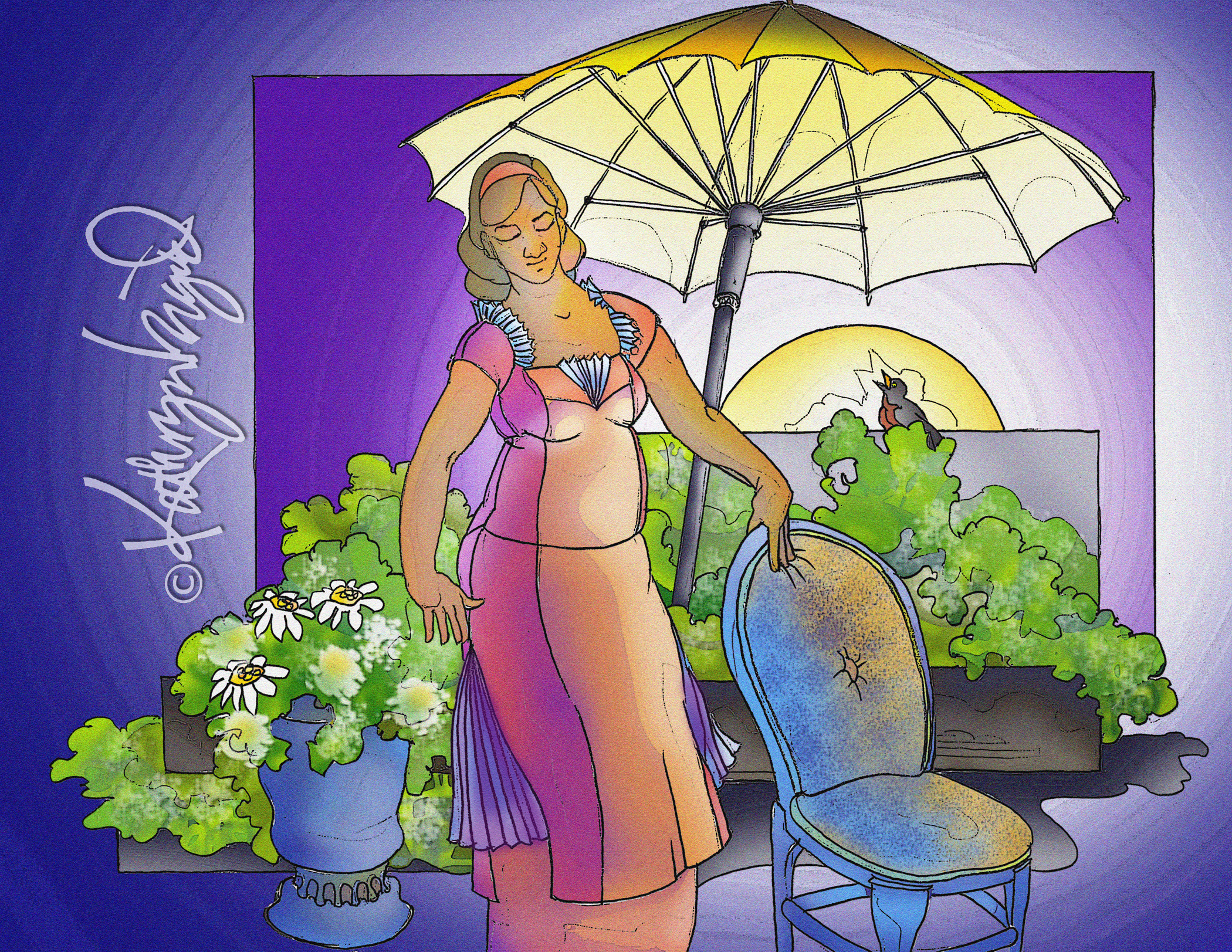
So I am quite content to enjoy a made-up version of sunrise, even making a picture of it with a very slightly baby-shaped mother-to-be washed in its dainty light as she lingers in some little secret garden. I am not designed either for motherhood or for getting up at the first whisper of dawn, but that needn’t prevent my admiring them both from a safe distance. I can assume my odds of conceiving a child at this advanced age have shrunk to a manageable nothingness by now, and I will count on the passage of my hours, days and years to prepare me for that unthinkable morning when I might willingly resurrect my carcass from the pleasant dead-of-bed state before daybreak. Meanwhile, my fancies are large enough to amuse and amaze me, and I thank the rest of you who have so kindly practiced and reported on either of the foregoing astonishing activities and reported back to me for my edification and vicarious enjoyment. I may get back to you with my own first-daylight infatuations someday, but it’s early for that yet.digital illustration

Memento Quod Vivitis

The longtime artistic tradition of the ‘memento mori‘ has always appealed to me. I think it’s valuable to recognize our mortality and the limitations of our time on this plane to devote to earthly enjoyments, the better to value them fully. Not to mention that I love skeletons and a lot of that stuff so often used symbolically in these works. I’m not disheartened, horrified, or unsettled by death and the subjects surrounding it, under everyday circumstances, in the way that some people are.digital illustration from a photoThe main thing is, I think it’s even more important to (as my guesswork-Latin post title suggests) remember that you’re alive. It’s not enough motivation to live a full, meaningful, rich, purposeful life just to know that you’re going to kick the bucket one day; everybody knows that, and it’s probably not even a majority of our kind that actually give serious thought to being fully present in their lives and making the most of their life spans. I know for certain that I haven’t always been especially good at such things.photoSo I’m rather happy to have an eye-opening, soul-tweaking glimpse of my little collection of death-defying totems, kept in view around my home and work spaces, at any moment when they happen to some into my field of vision. Not a bad way to refocus me and make me feel especially alive.

Röda tråden (The Red Thread)

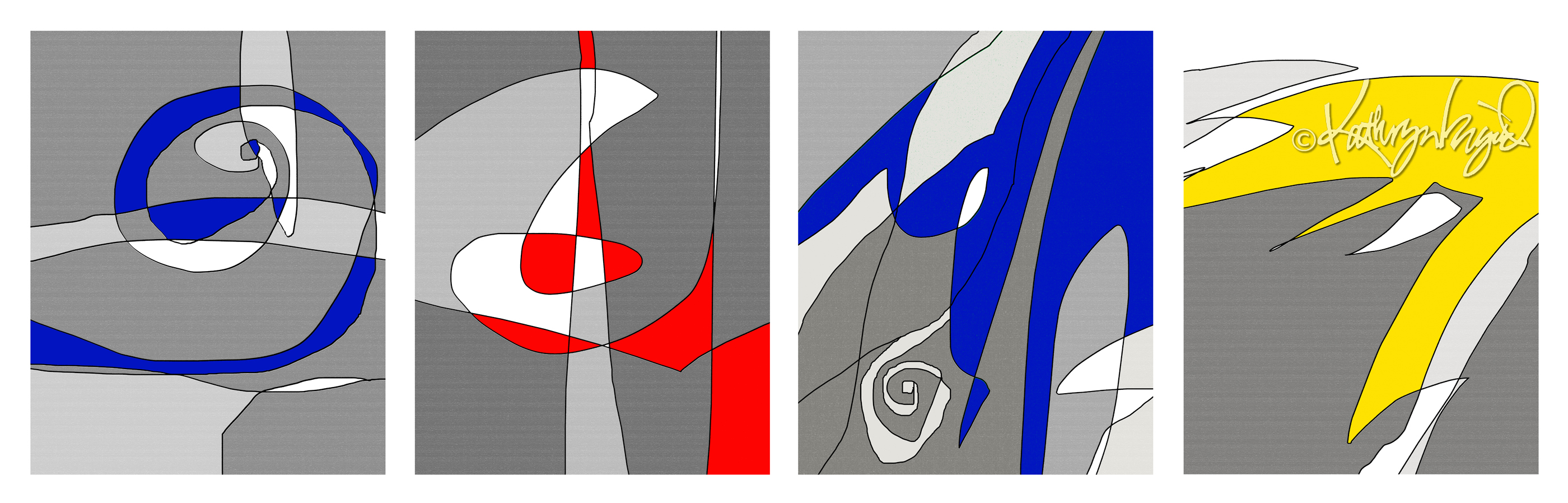
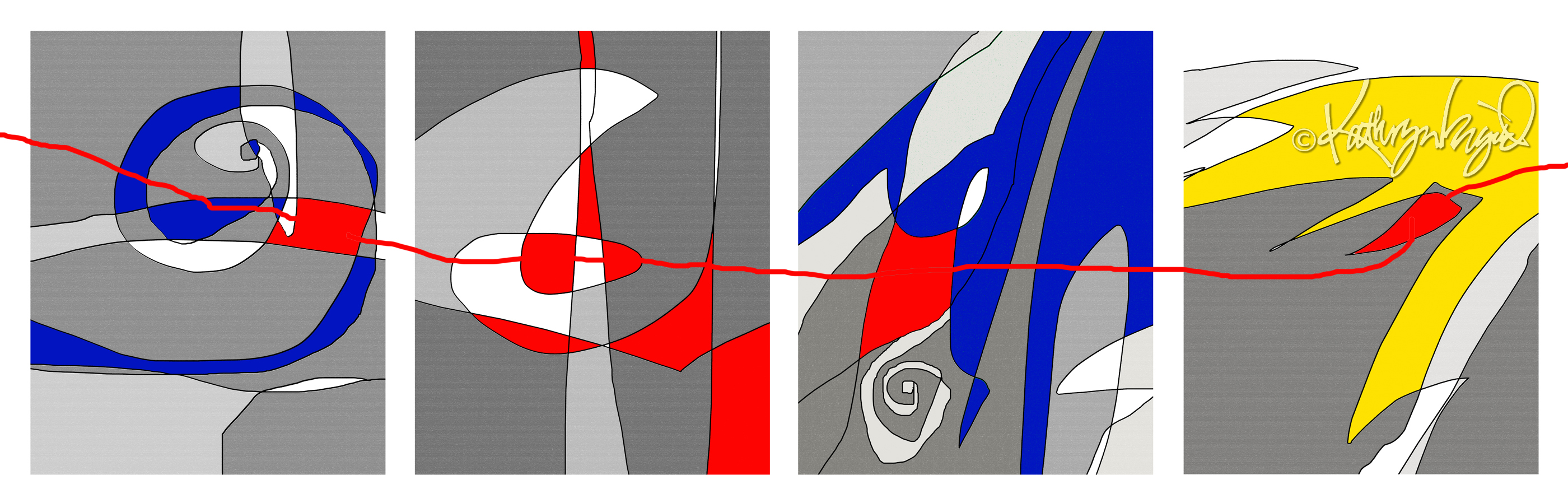
Röda tråden is the Swedish phrase for connectivity. I learned it from my husband, who in turn learned it during his dissertation studies on modern Swedish choral history, and in a way it’s the perfect encapsulation of what his research revealed: that the astonishingly deep and broad influence of such a small country, in such a short time, on such a large field as Western choir singing and music came about primarily because of the remarkable and unique confluence and joining together of a huge number of events, people, ideas and resources in that little land at the end of the Second World War. As unimaginably terrible as war is on any scale, it’s all the more a testament to connectedness that at the end of one of the largest we’ve known, such good and meaningful and positive elements were all drawn into one significant, beautiful growth spurt in the art of singing together.digital illustrationAs a miniature of String Theory in the arts, this surge of the choral art in Sweden is notable (no musical pun intended) not only because it posits a reasonably substantial explanation for the larger choral sector’s modern expansive development amid the general devastation and struggle following the end of WWII, but also because in doing so it illustrates wonderfully how the intertwining of all sorts of seemingly disparate elements such as safe havens from political unrest and postwar reevaluation of norms, personal and professional relationships and experimentation with new media could come into contact and interact to create a new mode of thinking, acting, composing, teaching and singing. In turn, this is a striking model of how people from distinct cultures, educational backgrounds, economic resources and political systems and of widely varying personalities, unified by the one tiny thread of choral music, could be pulled together into a complicated system that, though still colorfully messy and imperfect, led to a potent common end that has had lasting and marvelous influence for long and fruitful decades since.

I am, of course, grateful on a personal level because this Swedish postwar influence on Western choral culture has not only enriched my husband’s professional and artistic endeavors–not to mention was the basis for his award-winning doctoral dissertation that in turn opened a lot of friendly doors to us both in Sweden–but because it produced so much spectacular music and inspiration for so much more.

digital illustration

Röda Tråden is the Swedish version of the idea that–indeed literally–fascinates so many of us: the connecting thread–that which binds one thing to another. I can think of nothing greater than to spend life seeking the Red Thread that shows us our commonalities and binds all people together as well.

Further, though, I am grateful that such an otherwise inexplicable event as the ‘Swedish Choral Miracle‘ seems to me ample proof that all things and people really are connected. And that through recognizing and making good use of those connections, however, odd or tenuous they may appear, there is hope for new and better songs to be sung everywhere.

If I needed further proof of this, last night’s concert gave it amply. My spouse conducted the combined forces of the Chancel Choir of the church where he’s currently interim choirmaster plus their excellent hired pro orchestra in performing Haydn and Dvorak’s two settings of the Te Deum text as the concert opening and closing, respectively, bookending the extraordinarily lovely and moving Missa Brevis of Kodaly. I came in to sit for the concert among strangers and acquaintances from the church and discovered a friend from another parish sitting across the aisle from me, then learned from one of the choir administrators that a friend of hers in attendance turned out to be a long-ago colleague of my husband’s from another state, and finally went up to greet my guy after the concert and found him speaking with a group of ladies in the front row, one of whom was the wife of a former US president. What brought all of us divergent people together in this moment? Music. Beautiful singing and playing. Chance, kismet, divine intervention. Call it what you will, the slender but unbreakable thread that connects us all drew us into one place for a time of basking in the inscrutably beautiful harmony that is beyond craft, beyond art. That is a concert without peer.

Urbanity

There is a huge difference between the merely impressive and the expressive when it comes to modern cities. Rotterdam, once one of the glories in the European architectural crown, was bombed to dust in WWII and, given the poverty of post-war resources, was rebuilt in the following decades as a horrifyingly soulless, boxy blot of concrete on the face of the Netherlands. There is no comfort in knowing that the firestorm that destroyed the city was probably not planned as it happened but resulted from a perfect storm of another kind in miscommunications; the horrors of war are a long testimony to the potential for such devastation. In any even, it took Rotterdam ages to be revitalized into the place of energy and beauty that it is today. Why? What made it such a heart-stopping graveyard of a place when it had once been full of life and loveliness, and how could it ever come back to be something gracious and potent again?

There is no obvious single word that can express the massive destructive toll the bombing took on that city; annihilation is perhaps a close approximation, since it’s clear even from faded photos that the thoroughness of the attacks left very little evidence there had ever been a Rotterdam. I find it nearly impossible to imagine even when staring at proof. When my spouse and I visited the city for a conference even less than fifteen years ago it was still a sad shadow of its former glory, still dominated by 1950s-vintage blocks of affordable and utilitarian harshness that made me want to scream when I saw them in juxtaposition to the few tiny remnants of the beautiful architecture that had once filled the place.

The main reason that Rotterdam is beautiful once again, and that many other cities have, and some have never lost, such beauty is simple: architectural thought and distinction. Building what is cheapest and easiest to construct is a poor solution to lack of structure anywhere. Places that have never experienced the ravages of war, urban decay and other forms of damage and neglect in such extremes can retain the beauty and patina of urbane culture in their urban settings far more easily. Take Boston, Massachusetts, a city that has seen its share of ups and downs over time, but as one of the older cities in a young and generally untouched-by-war country, still has many of its older–even oldest–and most prized, elegant, distinctive buildings. Despite the expected problems of social unrest, economic up- and downturns, spots of urban blight and misdirected city planning that Boston has faced like any modern city, the knowledge that the architectural strengths it does have are worthy of protecting and preserving means that it was built as more than mere indoor space in the first place and that the character of the structures has as much value in shaping the city’s identity as do its great denizens.photoIt should be obvious to those of us wishing to see all of the world housed and sheltered in humane and useful structures and towns and cities that simply throwing up whatever is cheapest and most readily available is hardly more useful, in the long term, than just plain, well, throwing up on people. If we want others to live educated, healthy and therefore productive and admirable lives, we can’t stuff them into trash bins of buildings that, even if they don’t collapse under their own flawed ugliness, will never encourage their occupants and users to flourish. If we don’t intend to fill others’ lives with the vomitous garbage we ourselves would reject and flee, we must find ways to make good, practical, appealing design a mandate and not an afterthought or an unaffordable dream.

That approach not only makes living and working in tolerable shelter possible but nurtures the human spirit and pushes us all to better ourselves, our cities and our world. photo

Huntin’ ‘n’ Fission

I’m told that it’s both fun and useful to have hobbies. There are certainly plenty of books, magazines, news articles, classes, clubs and social organizations devoted to leisure-time pursuits, all of them trumpeting the value of such avocations. Some of them are decidedly age-specific: I haven’t seen a large number of free solo rock climbing promotions aimed at senior citizens, for example. There are hobbies considered preferable to persons of certain economic strata, fitness levels, sexes, nationalities and any number of other identifying categories, some active and some quite passive or spectatorial, some of them expensive to learn and requiring extensive training and practice and others free and simple to master. Regional favorites abound, like, say, noodling (catching catfish by hand), which would be hard to enjoy in desert climates unless you happened to be both a big fan of the sport and dedicated enough to stock your own evaporation-protected pond. Some of the more intellectually stimulating hobbies, like competitively designing robotics for cage fights or nuclear plants for home use, are highly entertaining to their practitioners but utterly escape the attentions of us more modest-brained folk as either too highfalutin or just plain incomprehensible. Sudoku, popular with millions of people cleverer than I am, falls into that too-challenging category for me since I’m so mathematically unfit, but I do like some kinds of word puzzles reasonably well if I’m in that rare mood.

Should I take up golf, having decided to move (when my spouse gets around to retiring) to a place on a golf course partly for its–surprise!–affordability and its location in a great town in a great part of the country, and in no small part as well for its great view into the green and leafy first fairway of the course? That would require my learning which end of the club is the grip and which the head, not to mention a whole bunch of other stuff, and on top of that, paying dearly for the privilege.photoWhile I’m still living in Texas I’d certainly be in a logical place to take up hunting, but that doesn’t appeal to me at all, unless it’s with a camera. For that matter, I’m more inclined to practice target shooting with a longbow, something I’ve enjoyed briefly in the distant past, than with a gun as well, being mighty skittish about those things. Being on the fast track to old age, I could probably pick up something more sedentary like knitting and crocheting if I had the patience. My single brief fishing moment post-childhood actually garnered me a cute little throw-back bass (as a kid I never caught anything but one big scary looking White Sucker that even my older boy cousins wouldn’t touch) and was enjoyed in good company while sipping a fine Texas brew; maybe that should inspire me to get busy with fishing.photoThat’s the thing, though: I just don’t enjoy games and sports, puzzles and pastimes much at all. Whether this arose or was reinforced by my longtime social phobias, perfectionistic fear of being seen as incompetent, dyslexic inability to keep anything I’m doing on a standard track, hilariously hideous sporting skills or any combination thereof is probably irrelevant. You see, there’s no separation of church and state in my life. I spend my days and evenings doing the very things that lots of folk can only do on an occasional basis and to fill their free time.

If I took up drawing, concert-going, reading and writing, cooking, DIY projects, gardening, photography or collecting weird bits of Stuff as a so-called hobby, what would I do with my day job? The truth is simply that I’m a fully fledged frivolous person. If eccentric creative activities and ways of thinking are on the periphery of real life, then I am a bona fide fiction, an imaginary character myself. If on the other hand art is, as I’m convinced it should be, central to existence and well-being, why then I’m just ahead of the curve; I won’t need to retire to any old rocking chair or go in a desperate search for something to keep me occupied, because I already have too many fun and pleasing things to do. Either way, I’m keeping busy.

Twists of Fate

It shouldn’t surprise me, as little sense of direction as I have and as seldom as I have an inkling where my path is leading, that I end up in some weird and completely unpredictable spots at times. Take the time I was at a luncheon with the queen and king of Norway. It’s entirely safe to say that they forgot the occasion right about the minute their motorcade zipped off with its Secret Service escort to ship them back to the White House for their next performance. Having lunch with a bunch of foreign academics, even if it’s coupled with getting a doctoral degree (Queen Sonja was receiving an honorary doctorate for her humanitarian work) and having a permanent outdoor sculpture dedicated in your honor is so yesterday. Like that kind of stuff doesn’t happen to royals every day of the week. I, on the other hand, don’t have that sort of thing occur very regularly in my life and found the events of the day pretty memorable.

photo

(Left to Right: King Harald V and Queen Sonja of Norway; Pacific Lutheran University President Loren Anderson; Gene and Esther Grant, donors; the Rev. David Wold, Bishop and university board Chairman; li’l ol’ me, sculpture designer; David Keyes, professor and chief fabricator of the sculpture; Frank Jennings and other assorted faculty and board representatives. That’s the sculpture, Generations of Oak, behind me.)

It was amusing to take part in the bizarre hoopla that takes place when an assembled group of citizens in a country that takes itself far too seriously as being above such things as royal-worship (erm, Have you not looked into the mirror, O nation of celebrity-slavish fools?) gets a chance to suck up to the high and mighty of another nation. To experience the hilariously artificial and probably pointless stiltedness of security instruction from our friends the Feds; to shake hands with other humans who have been designated super-important and wonder why they would bother to shake hands with me–or, admittedly, I with them–and to hear all of the earnest speech-making and watch the well-meaning maneuvers; all of this was really educational indeed. That it was so for me in the context of the university where I taught was certainly not lost on me. I almost felt like I should get some undergraduate credit in sociology or anthropology for being involved in my little way.

But I’ll admit that most of all, it was entertaining to realize that through no particular virtue of my own I had once again stood in a spot that others might envy and reaped unearned rewards that would remain in my memory-book for a long time to come. Just call me Lucky.

Enlightenment

photoGetting smarter is a lifelong thing, in and out of school–for the fortunate and attentive.

Me, I’m sad at the end of every school year. Those students and colleagues of my husband’s who have become such a big part of our lives and are now graduating or moving on to other jobs or retirement are about to disappear from immediate view. Even the ones who remain close with us after relocating are now to be infrequent contacts rather than the people we happily run into in the hall on a casual basis. I get lonesome for them even before anyone leaves.

The lovely inverse of this, happily, is the ingathering of ongoing and new compatriots as the school year is once more underway. New faces, new voices and new personalities are integrated into the weave of the community and once again it becomes the rich underlay of the year, the pleasant buzz of the bass line, the light up ahead growing ever so slightly brighter as the weeks and months pass and we travel through them.

It’s funny that I sort of forget this changing of the guard between times. Between my years as a student myself, the nearly two decades of my own teaching, and the time spent observing my husband and his colleagues at work, you’d think I would be so irrevocably inculcated with the cycles of the academic and concert seasonal years that I would have a sort of song of it playing internally at all times. In real life, though, I am not so consistently observant.

It’s only when I am right in the moment of it that I recognize what is such a piquant part of my emotional life and I mark these transitions. It’s in these times, in fact, that I most benefit from my spouse’s longtime practice of getting his choirs and groups to sing or play through transitions. In music, this helps performers to internalize a multi-movement piece as a whole and not be stuck performing it as a disjointed, choppy conglomeration so that it loses its sense as a unified entity. It helps a song avoid sounding horribly like a bunch of unrelated anecdotal verses interrupted by further disconnected refrains that act more like speed bumps than gateways between the events of the expedition.

In life, I’m working to find the balance between living and operating while fully engaged in the present, letting that part always be led by the best of the past, and moving toward the best of what is yet to come. I know I’m enjoying the present verse immensely even though some of the singers, players, conductors and teachers of the last semester have moved on to other places and joined in other songs, and I expect that the current moment will lead to yet more marvels of music and camaraderie. I just need to pay attention, follow the score, and be ready whenever a bit part is offered, because I keep humming along in the background and every passage tends to be more illuminating than the last.photo

Messengers

I admire real journalists and documentarians. Now, I do think that they are a very rare breed among news-people, the rest of whom are too driven by their corporate sponsors’ and their own biases by a long shot, no matter where on the spectrum of politics, religion, personal philosophy or other conviction they fall, but there are those honest characters who, if they do consistently let their beliefs steer their messages, at least recognize those prejudices and are quite open about them and still manage to give air time to opposing or differing points of view.

Still, the ones I really find compelling are a different sort of message bearers. They are harder to recognize, because they can be quite ordinary seeming mortals or wholly incorporeal, quotidian or fantastical, intentional or entirely, serendipitously accidental in their delivery of important news in our lives. Are they strangers we meet by happenstance and happy crossing of paths, like the townspeople in Germany who saw my older sister and me debarking a train after dark and looking around to orient ourselves? The kind couple approached us, told us that Celle (however lovely) was a very small town indeed and that there were few places for visitors to stop overnight but they’d help us find one, gave us directions and set us on the path to a very cozy little bed and breakfast before disappearing into the dark like a mist.

Are the messengers those outstanding teachers who have acted not only as educators in our lives but also as inspiration, as mentors, counselors, guides and friends? Mrs. Willis, Mr. Cunningham, Prof. Keyes: I salute you! Teachers have done as much to bring light to my life as to the dim corners of my mind over the years, and I am grateful for the news and stories and messages they bring. Are there other beings among us able to protect and direct us without our even being aware of it? Of course there are. Some of them are simply gracious fellow humans whose good deeds and kindness will never be seen or fully known and recognized in our lifetimes, either because we are too dim-witted and self-involved to notice as we should or because they merely do their mitzvahs without fanfare, without expecting or needing any recognition and recompense. These we should imitate and their message should be spread further by our going out in turn to do kindnesses for others and requiring no attention or glory.

And I think that–given how beautiful and rich life can be when we do pay attention–there must be others in our midst too; angels or aliens, I don’t much care what we name them, but there must be Love looking out for us to make even the tiniest good possible, let alone the many graces that fill our days if we only look. Their message, I suspect, is nothing more or less than that we are being well looked after, and our little lives recorded no matter how small they may seem to us.pen and ink