Totems, Tokens, Things Taken

Since I got on the tangent of thinking about various indigenous-culture/immigrant persons and themes in recent times, I’m now in that phase one has of noticing connections with them everywhere.

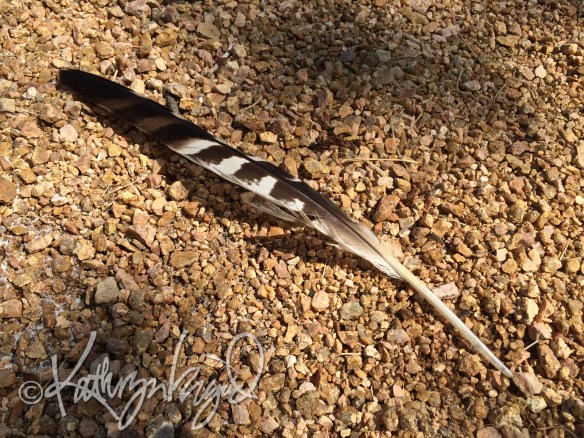
Today’s little starting episode was that of walking up my front yard path and spying on it a lovely wing feather. I’m quite certain it was shed by the same hawk that I’ve heard giving its piercing cry and seen circling over our place on numerous occasions, and that I saw a couple of weeks ago slurping up a foot-long snake like so much hawk spaghetti right out under my backyard flowering pear tree. I’m relatively sure it’s a Cooper’s Hawk that watches over me here at home, and I love it. I’ve mentioned before that I’m fond of and fascinated by animals in general, birds among the favorites, and corvids and accipiters my particular royalty. I may have even noted earlier that I specifically think of a hawk as something like my personal secular icon, or the companion of my heart, given how often I find I’ve seen one nearby, seemingly watching over me at various times and events that turn out to be important in my life. This, of course, can be attributed to the aforementioned habit of noticing that one cultivates, but I like to think there’s room in the coincidence for a causality conundrum, a chicken-or-egg puzzle, too. Either way, I admire hawks.Photo: A Fugitive's Feather

So I was pleased to see the wing feather there, looking to my mind’s eye rather like a “thinking of you” note left for me by my guardian hawk while I was away, or sleeping. I picked it up and pondered it. I set it on my table as I started writing my post.

Then, reality began to set in, of course. A very quick web search in an attempt to confirm or correct the identification of my hawk companion led me to discover that I was suddenly a criminal, since American law forbids possession or use of migratory bird feathers, a law enacted during a period of mass avian murder on behalf, mainly, of milliners and their customers in an era of highly feathered fashions. Given those massacres, not to mention the extermination of whole animal species, both native and not, in times past in this country, I am neither shocked that such a law would have been deemed necessary nor opposed to the intent of it to protect animal life. I have no desire to hunt any animal for sport nor to denude it of its natural beauty for my amusement.

But I can understand those who are irked by the hard-line status of the injunction, given the common experience of finding shed or molted feathers of all sorts on every beach, in every garden. “No animals were harmed in the making of this” object. Still, the law is the law. So my feather went back outdoors to disintegrate naturally, as we all will do. (With the exception, I guess, of plastinated creatures, but that’s decidedly another topic altogether.)

Not before I took pictures of it, of course, because I am allowed to photograph things I’m not allowed to own.Photo: Birds of a Feather aren't Necessarily Allowed to Flock Together

And that law, of course, led me back to the whole idea of ownership with which these native-vs-nonnative thoughts are inextricably tied. The indigenous or aboriginal peoples of the continent I call home, and where I consider myself equally native though my ancestors immigrated to the place in times past, are known to have had religious and practical reasons for thinking of ownership as a notion that simply couldn’t be applied to nature: that one existed at all was a gift of nature, and whatever one did in life and death should be done with respect for that benevolence. I’ve no doubt that some applied this attitude better than others, as is true for all people and their beliefs and rules, but the concern was deeply enculturated and not easily ignored—at least until the near culturcide brought on by the colonization of the continent by various immigrant powers.

We did not inherit Mother Earth from our Ancestors…..
We have borrowed Her from our Descendants.
Attributed to Chief Si’ahl (Seattle) of the Suquamish People [to whom is also attributed the magnificent speech and subsequent letter about the impossibility of land “ownership” in response to the new government demand that the natives relinquish their home territories to US rule and non-native occupation]

Man belongs to the Earth…Earth does not belong to Man.
Attributed to Black Elk of the Lakota People

As an enthusiast of little biological or scientific knowledge of, but great admiration for, nature and all of its wonders, I find I walk a wavering line in my relationship with it. The attractions of living creatures, of all sorts of things animal, vegetable, and mineral, are often for me first noticed as visible beauties and/or curiosities, or as other sensory (often, sensational) experiences. I am drawn to the amazing characteristics and anomalies of the whole natural world. But I also live in it. I depend upon its resources for my life and health and happiness. The very fact of my existence affects, and can even destroy, other parts of nature. When I take a breath, I process the air into something that it was not before, and send it back out into the universe as a new and different thing.

I don’t begrudge myself my breath. I don’t feel I’m evil for intruding on the rest of nature by means of my very existence. But I hope that with every breath, every moment I do exist, I grow a bit wiser in what it means to be allowed to exist by nature, this planet, and the vast Otherness that holds us all in its spacious embrace. And I promise that when I do die, I will return whatever I can of what I took with me, feeding later generations of nature’s bounty with the space I once occupied, the physical remains of what I garnered from this plane, and the hawk-befriended spirit that will be grateful for as long as is possible.Digital illo from photos + text: The Earth is Our Mother

Documented/Undocumented

I’ve been thinking more, lately, about history. About cosmic and cultural, political and personal history. About the way that people do and don’t keep records of any kind of history, how each documentarian shapes the way things are remembered or forgotten, and how each person on the receiving end of the documentation shapes it all further, given the multitudinous filters of experience, intelligence, and personality each brings to the process. School learning, book learning, deep research, and autodidactic learning all depend upon the vicissitudes of human understanding and communication. And a whole lot, also, on luck and succeeding history, since all of the learning can be lost or found many times over the decades and centuries.
Machinist's School Certificate

My family recently unearthed the above little slip of paper that marked my maternal grandfather’s completion of his first machinist training. Gramps had immigrated to the States some years earlier in search of work, and had kept busy and alive in the piecemeal way that [willing, as opposed to indentured or enslaved] immigrants have done since time immemorial, bunking in cheap rented quarters with other young immigrant men, laboring long hours for little pay, and playing greenhorn pranks on each other in the few hours outside of work when they weren’t downing a hasty bite of food or sleeping exhaustedly. His machinist training eventually led to his working at General Motors for quite a long time, even serving on the team that built the first Duck prototypes for the army. And then his life took various turns, over the years, and I grew up knowing him as a skillful carpenter and homebuilder and the hobby-farmer tending beautiful produce gardens and a handful of Cheviot sheep.

But of course I knew very little of his life story. I did have the privilege of sitting and quizzing my grandpa over dinner more often than most, since I rented a bedroom from him and Granny for the three years I worked near their home in between my undergraduate and grad studies. So I heard some of the tales, like the one about his flatmates sending each newest member of the household to town to buy “ten cents worth of Piggly Wigglies,” a silly quest after a mythical grail that afforded the rest the cheap entertainment of watching from afar as their victim tried in his broken English to persuade shopkeepers to hand over something that didn’t exist even if his speech could be deciphered, and the store owners eventually sending the series of foreign-born youths off, each now smarting with the same outsider embarrassment they’d all experienced in their early days in the US. I heard, too, of that uncle of my grandpa’s who had tried to dissuade him from going to America, and if he did, to at least be as wary and canny as possible because “those Americans will sue you for anything.” This was, mind you, not in the modern day that we generally agree is such a ridiculously litigious one, but in 1929 or so. (Apparently some things haven’t changed very radically in this country.) Still, I know only scraps of Grandpa’s whole biography.

I can at least say with conviction that I come by my stubbornness honestly. Despite the family pleas and warnings, Elias Omli sailed willfully ahead, and lived most of the rest of his life in the US of A. In those early times, he must have struggled immensely, yet found fulfillment enough in the life he forged for himself and later, his family, that despite his longing for the old country and one brief but unsuccessful attempt to reintegrate with the family in Norway when my mother was very small, he lived and died an American. Between those atoms of information he shared with any of us his descendants about his childhood and youth in Norway and the rest of his existence in the US, there was a whole, complicated, adventure-filled, and ordinarily colorful life, very little of which anyone really knows, or could know.

That is how we all exist. Even the most documented, celebrated, and historically dissected characters and the events in which they take part in life or death cannot be fully known, let alone understood, by anyone but themselves. If I’m any example, I suspect even such self-knowledge is pretty shallow in the long run. Having written and shared over 1500 posts here in Bloglandia, where I immigrated from the semi-real-world over 4 years ago now, I may in some ways be better documented than a few other people, should anyone care to sift through all of my imagery and verbiage at any point, but even in this, I share what I choose to share, and only my point of view on it all is represented, so that skew is also bound to be imperfect, if not a little disingenuous.

(I’ll at least aver that the stuff I tag as Fiction is really fictional, and leave determining the rest of it up to readers, who will of course interpret it at will anyhow.)
Island Log Book

Gramps’s story was unique, but not dissimilar from many others’ in history, whether they decamped to new homes and lives from their birthplaces or not, whether they had vocations that called them at an early age and flourished throughout their days or they followed more unpredictable routes. The fate of an individual is inevitably affected not only by his own choices and acts but by the natural and national events and changes that fall in his life’s path. The person who penned the Swedish grocery and supply list above, many years ago, did so as the manager of a remote coastal household for not only the family but probably also a handful of townsfolk who shared the responsibility for overseeing the safe arrival of boats and their occupants on that forbiddingly rocky shore. What this little slip of paper denotes is a glimpse into the everyday life of not just the one person who wrote it but of a small group of people whose names are no longer known and whose life stories probably exist, if at all, only in the bloodstreams of distant great-grandchildren, yet the quaint harbor town they once labored to keep in existence all those decades ago is today a thriving and colorful, lively place. New stories are born there all of the time, and I can attest that the dry goods and groceries now available there are, respectively, more plentiful than and as delicious as ever.

Individuals, communities and cultures all have their times of trial and those of triumph, some noticeably more of one than the other.
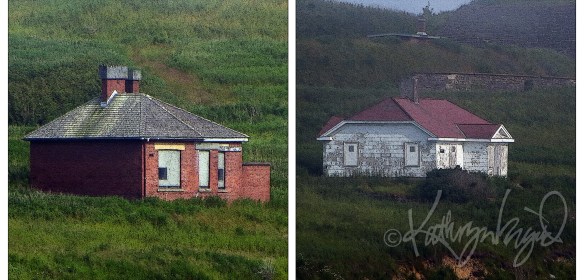
Digital illo from photos: Houses of Sorrow

A recent reminder of that came into my view when my spouse and I spent a few days in Halifax. It is as beautiful a part of the continent as I’d always imagined, and yet like the rugged coast of that Swedish island it certainly presents difficulties to the ships that approach it today, and all the more must have challenged the lives, safety, and ingenuity of all comers in days long gone. I loved exploring as a tourist and seeing, especially, the natural beauties of the area with all of its geographical wonders, sea-borne marvels, and magnificent greenery, and also the wide variety of architectural styles that hint at the multicultural roots of the region. Not surprising that the shores are dotted with lighthouses large and small, as well as the houses of those who tended them.

When at the waterfront of the city proper, I admired the old lighthouse and the humble buildings near it on the island most visible from the piers. For a lighthouse location, which is by nature placed in a potentially volatile coastal setting, it looks sweetly bucolic, ideal, and peaceful. Indeed, it is nowadays a quiet and pretty place, a heritage site in mid-restoration for its intended future as an historical park. But that heritage is far from peaceful, let alone ideal; like many other islands in such prominent coastal positions, it has a long and storied past as a fort, a military encampment and, even darker, as a prison and internment camp.

Some of those imprisoned on that place now known as Georges Island, Nova Scotia, were among the estimated 1660 prisoners out of 11,500 local Acadians expelled from their homes and lands en masse by British forces during the 18th century imperialist battles between English and French forces over New World territories. Three quarters of the entire Acadian population were deported in those times and thousands died in raids, counterattacks, and battles; others died under torture, of drowning on the deportment ships, of disease, or of starvation. And Acadians were far from alone in being imprisoned or worse on that pretty-looking little island.

Their own comrades, the Mi’kmaq (and other aboriginal Atlantic inhabitants), with whom Acadians on their arrival as French colonists are said to have lived quite equably, suffered on the island along with numerous captured French sailors and soldiers and any number of other “enemies” of the British rule. Something far less benign than a lovely coastal outpost of protective presence came to exist on this sorrowful promontory at the edge of the proto-Canadian world.

Can I look at this island in ignorant imagination anymore as a picture of vintage calm? Of course not. But I can also guess that there are very few acres of earth anywhere that are not stained with ancient cruelty and the blood of untimely deaths, whether of the innocent or not. It’s easy to sit in judgement from my place of comfort and call the expulsion of the Acadians an attempt at genocide or ethnic cleansing. Certainly, records and recollections of the historians present offer ample reasons that I should think there were all kinds of wicked intentions at play, from land greed to hatred of unknown races, from religious and political imperialism to maneuvering for resources. There were clearly personal elements involved, and as in all wars, military actions that turned into personal vendettas, fights over disputed borders into plundering and petty theft. Just as, undoubtedly, the aboriginal Atlantic peoples must have initially feared, and perhaps fought, the Acadians, and the French and British spent great resources and innumerable lives on their distrust and fear of each other and of the inhabitants of their intended expansion zones.

But earlier centuries’ worldview was also vastly different from today’s, all around the globe. Today, we have knowledge of a much larger and more developed world, of the richness of other cultures, even of the possibility of peaceful coexistence, and we have no excuses for not trying in every imaginable way to resolve differences without being exclusionary or  violent. But past times and people didn’t all have the advantage of our expanded view. Every cultural center or nation of significant size in Europe, Africa, Asia, and the Americas has had its powers, each of them assuming a natural, if not divine, right of rule over all that they had not yet explored, by dint of their own isolated mastery. It’s not just that leaders, explorers, and conquerors themselves have seen it as their right, and often as benevolent duty, to claim ascendancy over whatever and (assuming they’ve managed to recognize indigenous residents as people) whomever they encounter, and to rule as they see fit. Those who write down history, or tell its tales, also continue to believe or disbelieve in ways that are unique to them, and the biases that sneak into our views are inextricably mixed into how we, and future generations, think about history.

What can I take away from these musings? Only the usual self-admonition that I look beyond what is visible. That I question and try to learn further, and not rush so quickly to the judgement that comes oh-so-naturally to me. That I ponder whether any slight thing that I do or say myself can perhaps help others, individually or globally, to remember the lessons of history, both bad and good, and to move forward away from our worst selves. We may remain undocumented in these attempts, as in so many other aspects of being small mortal beings, but I think that existence itself bears the marks of our passing as a document that will spell out the difference between annihilation and rehabilitation of our world.

Trust & Trojan Horses

The problem of what and whom to trust or distrust is far older (though my niece and nephews might be shocked to hear it) than I am, but it remains a puzzle to me, too. In some ways, I suppose, the difficulty only increases with the passing of time, both personal and historical. As I get older and, theoretically at least, more mature and educated, I should have a greater base of knowledge and experience and sharpened observational powers and discernment. As history flows forward and the world grows smaller through the connections of increased mobility and communications, there are exponentially more points of view, levels of experience and learning, and sources of information to be sorted. Yet each generation, each individual, is generally born with no more innate wisdom and perception of fact-vs.-fiction than the ones who’ve gone before. We—individually and corporately—have had the opportunity to not only be taught by previous generations and their experience and learning, but also an unprecedented ability to go places, do things, and otherwise see with our own eyes what is possible on this earth. Yet there remains no shortage of people who mistake their opinions or values for facts, and demonstrable fact for somebody else’s ill-informed opinion if it doesn’t suit them.

When our classical predecessors told about the defeat of Troy by canny Greeks who tricked the Trojans into hauling a massive equine sculpture into the city as a victory trophy when it was actually full of Greek operatives who emerged by night, opened the city gates, and let their fellow soldiers in to attack [the standard modern interpretation of the tale], they tapped this universal theme. Whether it was clever subterfuge or a foreseeable pattern in war tactics didn’t matter so much, perhaps, to the ordinary Trojan citizen waking up to the sight of a Greek sword overhead, but any survivor of the battle must surely have considered whether he might have realized the ‘gift horse’ of left behind treasure was such an improbability as to be highly suspicious. A number of citizens did, apparently (as told in other parts of the Trojan Horse story) come to this conclusion, but such is our nature: there’s always someone making a counter-claim, asking the opposing question, and coming to an equally fervent yet incompatible Truth.

It’s on this ambiguity of our understanding and interpretation that American politicians and their supporters, no matter what the Issue or which side of it, thrive. That’s not merely an aside, but a fairly typical example of our quotidian practices. How easily we attach to our ideas, and how hard it is to persuade ourselves, let alone anyone else, that those ideas might merit frequent reexamination.

Digital illo: Truth or Consequences?

Truth or consequences? Can I trust that the drawbridge will stay up as I sail under it, down as I ride over it? Or will some villain throw the counterweight in gear against my safe passage? Do I rely on its long history as a sturdy and reliable bridge, or do I need to worry that all this rust means it hasn’t been properly inspected and maintained? Will it hold a horse? Will it hold a horse full of spies and soldiers?

Ultimately, I tend to think there are relatively few absolutes beyond being Alive or Dead in this realm of ours. The marvels of the world, as little as we know of it, are compelling and astonishing enough to seem beyond pat answers and fixed realities. But I also think that if our existence has any cosmic purpose, then chances are pretty decent that we’ve been set to a few basic tasks and given a few tools with which to attempt their accomplishment. Task: question; wonder. Tools: observation, cogitation, research, testing, conversation, reasoning, challenging, and returning repeatedly to the questions and wonderment. All of these, in endlessly rearranged repetitions, fill our tool and skill inventories.

What was considered self-evident Truth might prove to have some wiggle room for better understanding or a new reality in the long run: a human does not, as once believed, have to sprout feathers in order to achieve flight more extensive and less potentially final than that made by falling off a cliff. What was impossible may become possible. Complications remain. Humans disagree on what is or isn’t incontrovertible. No universally recognized and accepted magic surtitles appear, blazoned on the sky, that define fact, fiction, falsehood and firm truth for all people, for all time. We interpret and surmise. The very ability for the human brain to entertain two opposing potentials simultaneously enough to formulate and ask a question assures me that, answer or not, we will always find ample possibilities for disagreement. And also that we can keep moving forward. Even under or across a drawbridge. Even on—or in—a horse.

Strange Landscape

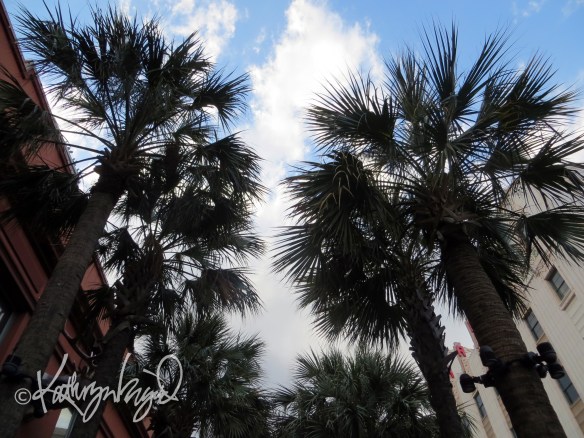
Photo: Palm Trees 1No matter what the reasons, the weather is different these days than both what I grew up with (all those centuries ago!) and what the locals in most places call ‘the usual’—really, really different. It’s not that Toronto has suddenly become the center of the tropics or San Salvador is now an iceberg floating along the edge of a glacier, it’s just different. The highs and lows have become both more pronounced and more prolonged in many places, from what I can see.

Where I grew up in Seattle, for example, its mythic status as Rain City and the region’s fame as being constantly wet were exaggerated, much of the truly soaking rain happening on the Olympic Peninsula as a result of the mountains’ effect on traveling clouds, weather fronts, and so forth, and thus less of it eventually reaching Seattle’s sheltered spot on Puget Sound. Instead, there were lots of grey, overcast days and light drizzling ones, but the measurable rain was moderate. In fact, the region generally has had plenty of rain to sustain, in its temperate climate, a stupendous variety of plants year-round, from the great towers of evergreen trees to their tiniest replicas in forest-like carpets of moss.

There were, as anyone anywhere knows, secrets and surprises in this unique climate. In the neighborhood where my grandparents had their apartment when I was young, right next to the shores of the Sound, I was awed by a few yards sporting healthy palm trees. These were not native to the northwest, nor even the slightest bit common—hence, my amazement at their exotic punctuation of the expected landscape—but they grew there without requiring any particular magic, because the microclimate along the West Seattle shoreline has remained remarkably sheltered and coddled by Mother Nature.

Now, it’s a more frequent phenomenon to see all sorts of semitropical plants creeping into the Seattle area landscape, and at the same time, more and more xeric plants. The hot weather of summer does, in reality, get a little hotter and stick around a little longer than it did in years past. It also tends to be drier. The total annual rainfall average hasn’t fallen into a chasm, but it’s creeping lower gradually, and this winter-spring cycle has been a record-setter for low snow pack, sending a fair number of ski resort owners into early and/or even permanent closure and more than a few homeowners into rethinking their home sprinkler systems and dispatching lawns in favor of water-saving raingardens. A few years down the road, it wouldn’t surprise me especially to see yards that look remarkably like the iconic ones of Las Vegas popping up on many northern properties as well.

Some of this change in nature’s attitude toward us is bound to change how we can and should live our lives. The watersheds that once supplied an abundance of cheap, readily available drinking and gardening water and hydroelectric power to wide swaths of the country are shrinking and already being bargained for more aggressively, even disputed. The world is already water-poor, despite newly over-watered and flooding regions, and I wouldn’t be entirely shocked if at some point water becomes the basis of more wars than oil and politico-religious reasons are today. I hope I’m not around to see the day.

Meanwhile, it’s still something of a novelty, never mind those long-ago days of perhaps two or three landmark palm trees in West Seattle, to see what’s happening in the gardens and seasons of this changing world. Never thought I’d see things the way they are, and that’s not just talking about the weather. Maybe I’ll get a grass skirt and celebrate it with a neon-colored summer drink served with its own paper mini-umbrella while it lasts.Photo: Palm Trees 2

Long May It Wave

Photo: Scar-Spangled BannerToday, the day Americans celebrate this nation’s incorporation as an independent country, there are and will be a lot of fireworks, eat-drink-and-be-merry parties, solemn salutations of admiration and thanks addressed to the people and acts that led to the establishment of America, and “patriotic” speeches of allegiance and fealty to whatever each speaker or audience relishes as the greatest rights and privileges of living in this place. We don’t all agree, not remotely, on which things are Rights and which are merely privileges, never mind which are to be relished. We don’t share a single, singular point of view defining patriotism or our national identity or strengths.

That, in fact, is what I see as one of our greatest strengths. We are a country that prides itself on individualism, if not individuality. And that, in turn, we define differently, each of us. As little as I know about the country I call home, my sense of it says that the name United States suits us well: a collection of wildly, wonderfully, weirdly differing entities—both states and persons—pulled together into one larger whole. It doesn’t homogenize or even blend us. We remain diverse and divergent. And that is the strength that our founders hoped, as I understand it, to cultivate.

We tend to fail, nationally speaking, more than we succeed at this delicate and complex effort. We mess it up pretty (no pun intended) royally both out in the wider world and within our own borders. Often. But there are frequent gleams of starry hope, as well. There are those among us who will stop and truly listen to each other, who will negotiate, counter-propose, parlay, parry, and persist, in the pursuit of better solutions. Those who choose to recognize differences without letting their own beliefs in the matter condemn their fellow citizens as second-class or unworthy.

It’s funny how often many of us Americans get mighty excited, thinking that somebody else is busy trying to impinge on our personal Freedoms (apparently we are historically hysterical when it comes to that) merely by valuing different aspects of the legal freedoms we all enjoy here or by wanting an equal share of the same ones; we’re past masters, too, at howling injustice over others’ intolerant narrow-mindedness, which of course translates directly as “any thinking, belief, or experience different from mine” and thus is equally self-definition, should we think through it carefully. We each obsess over how to make the rest of the nation see our individual points of view as the simple and clear logic they embody, and as the obvious morally and ethically correct way to think, live, and be, whether any of our own choices and decisions are in truth logical, moral, or ethical, let alone demonstrably so. But that difference, too, is part and parcel of the multifarious and colorful country we call home and of its hard-won foundational tenets.

So while I spend the Fourth of July, like any other day, in mindful and slightly irritable worry over all that could and perhaps should be better about my native country, not to mention about me as one of its inhabitants, I also cling to the hope and optimism that continue to reside here. People are still kind to each other, from holding open doors to donating large quantities of time and other resources to the health, education, safety, and well-being of others, and more importantly, some even do this without requiring that their beneficiaries support and adhere strictly to the donors’ worldview. That, to me, is a great assurance that this nation does still hold dear some of the essential characteristics on which it was founded, even if with a noticeable amount of ignorant hubris stomping on the extant good on this new shore. We remain flawed and selfish and foolish, each in our own ways, but for the most part, this is also a country full of people who, through hard work and goodwill and the desire to fulfill the promise of our forebears, native-born and otherwise, mean to keep becoming better.

May this better part of each of us become a great banner of Peace, Justice, and Hope. May the winds of the future send it curling around those who are in need of the wealth with which we, corporately, are gifted, and give them not only enough resources and courage to be lifted up but a share of that same peace, justice, and hope. And long, long may that banner wave.

Just Another Oddball Day in Paradise

Digital illo: Got It Made in the ShadeIt was a day of superb weather. As expected. It’s only that it was the kind of weather expected at entirely different times of the year, or at least in entirely different parts of the world. At least, by me.

In that way, it was par for the course in the modern world’s weather, at least. One doesn’t really know what lies ahead further than a few minutes, though now it’s less for the reason that weather forecasting is such an inexact art (it’s far less so than it used to be, anyhow) and more that previous centuries’ patterns have apparently been twisting and turning and emerging in wholly new directions and shapes. Exciting stuff, to be sure. Not so easy to manage our lives within it, given the difficulty of knowing whether the rain that’s begun requires a light, windbreaker sort of slicker or the building of an ark.

Meanwhile, superb weather at the “wrong” date and place.

One could spend plenty of time and energy trying to figure out why, or what it might mean in the grand scheme of things, and surely, thousands of smarter people have done so. I am not the one to solve those puzzles. I went for a walk, enjoyed the superb weather, and when it grew too hot for my taste, found a few trees in whose shade I could continue to enjoy the weather without being quite so warm.

It’s a weird world, this, and not quite like the one I thought I’d known all these years. But it still has some mighty nice shade trees here and there, and if I’m not too silly to take advantage of those, I can still think of it as a great home planet. Works for me.

Fragile Beauty

We mortal beings are such a breakable bunch. The only part of my being that I can imagine ever neared perfection is my imperfection. It galls me that I am so intolerant of what I view as intolerance in others, so upset by the seeming obviousness of opposing viewpoints’ being illogical and insupportable, and so easily brought to a boil by anyone else’s anger or violence. It disappoints me that I am so easily cowed into silence when I see what seems the most flagrant of wrongs being committed against the defenseless, and I’m horrified by my inability to articulate what I believe is my wonderfully reasonable understanding of the facts of a case so as to persuade a single person of their validity.

The sorrow and fear I feel about this only intensify when I remember my suspicion that most other people experience some of these same phenomena. My failings are not entirely limited to me. It’s no wonder the world is such a complicated place.

Yet wisdom, love, justice, hope, and peace do seem to prevail at times. I know that every person alive will never agree on when and how those moments occur. Deeply studied scientific experiments and conclusions don’t convince everybody. Political, philosophical, and religious arguments, discussions, and declarations don’t convince everybody. The deepest emotional commitment and conviction, expressed in gloriously poetic prose, cannot convince everybody. We will still be weak, messy mortals. We will still be intolerant, illogical, angry, stubborn, and inarticulate. We will fall into these traps and sinkholes at the most inconvenient times, and escape from them only temporarily.

Yet wisdom, love, justice, hope, and peace do seem to prevail at times. We are incredibly imperfect and fragile, yes, but we can be beautiful, too, when we rise above our self-centered view of perfection and seek wisdom, love, hope, peace, and justice that should belong and apply not to only our own selves and favored persons but to everyone. If I can’t stoop to lift up someone else from the depths, maybe it’s because I need to reach up from my own depths to raise him. Maybe wisdom, love, justice, hope, and peace can prevail. Maybe they can begin today.Photo: Fragile Beauty

We Imagine Ourselves Great

Digital illo from a photo: MonumentHow did We Get Here?

In our dreams, we were hip-deep in cotton picked by willing, happy, high-paid underlings and we smiled with satisfied benevolence

We were standing in the shade of magnolias and wearing our widest-brimmed Sunday hats and crisp seersucker and poplin even on Tuesday

We nibbled tiny toast points dabbed with pimiento cheese while a string quartet hummed like honeybees up at the portico

We fanned ourselves to keep cool as the sun sank, listening to mourning-doves serenade the arrival of the winking fireflies

We drank our bourbon out of snifters, neat, and never got more than a little bit hazy, what with having well padded ourselves with roast pheasant over a very long suppertime

We spoke in soft, lilting tones and said kind words to our mothers and children just because that’s how it was done

In our hearts, we were the pathfinders, the athletes who carved a road of freedom and justice across the plains to make new territories ring with accomplishment

We stood tall in the evergreens and set down mighty roots of dedication in lines running from the lakes to the mountaintops

We shipped on the seas and shouted joy with the birds of the air, and of an evening we were wont to watch the stars for signs of adventure yet ahead

We called ourselves hardy stock for braving the cold and wrapped our red-cheeked children in woolen blankets after a day spent in the bracing light of education

We wrestled with bears for the salmon that we ate, but then sat down to dine on it with all the gentility of our many foreign forefathers

We called our politics piety and our egalitarian philosophies a revelation even if everyone who didn’t qualify might not agree

And here we are today, being All-American but half-savage…

We live in the same states of grace but relish our superiority with self-congratulatory rudeness that would shame our imagined selves

We sneer at gentility as outmoded and write polemical pieces about each other with no sense of irony left in the spaces between the hard-edged words

We forget the flaws that taught us our cultured best’s fragility and instead of learning from the mistakes, we widen them as far as our waistbands and pockets can stretch

We turn a critical eye on the wounded world and manage to keep it keen despite the moral blind-spot toward our contributory, if not our sometimes causal, role

We are a nation of would-be saints dressed in brutes’ clothing…but perhaps in that, we may not be entirely alone…

If there is hope, it’s that we’ve gotten here at all, for surely those in our hearts and dreams must have been real somewhere to seem so tangible in imagination

We might still embrace the justice and benevolence we thought we had, if we are willing to strip away delusions of grandeur and the lust for power

We could take a moment, while nibbling our toast points and standing conqueror on our latest promontories of success, to offer a meal to the hungry and a foothold to the poor

We ought to care less about self-image, and more about wholeness and devotion to the betterment of those people and privileges we say we love so well

We are capable, if we watch the exemplars before and around us whose courage and kindness walk arm in arm instead of standing on opposing distant shores

We may yet become the greats that we imagine we should be, if only we stop pretending we are so and humbly take to walking toward it on the faint horizon instead…

Between Worlds

Photo: Not the Last RainThis strange new climate we’ve been experiencing in north Texas lately, never mind on the west coast where drought has reentered the vocabulary for the first time in eons and the northeast where winter and massive storms have ruled in a newly lengthy way, makes me think I’m on another planet. Or perhaps a parallel reality. Whatever it is, it seems a bit surreal and decidedly unfamiliar.

In the last number of days we’ve had more rain, more thunder-and-lightning, and more windstorms—even a small tornado or two touching down not far from our home—than many past years have seen altogether locally. We’ve driven along what are normally pastures and meadows and bone-dry fields and low runoff gullies and seen what looks like  it should have the iconic airboats of the southern swamps speeding through: trees and brush sticking out intermittently from extensive marshes where we’ve only ever seen dry land. The phenomenal density and lushness of the grasses and trees, wildflowers in rampant carpets blooming for weeks on end instead of days, and swarms of early insect madness all explode around us in unprecedented extremes.

Then, today, a brilliantly sunny, rather hot, almost cloudless day; it was exactly as I would expect here in a typical mid-May. The rosebush behind the kitchen, shorn before the last storm of its spectacular but doomed bucket full of blooms lest they be beaten to death by the ongoing rain and hail, decides to pop out a couple of fireworks to celebrate the sun’s return. The birds are sunning themselves on every branch and power line as though to soak up rays as quickly as they can. The local lawn crews dash madly from house to house.

Because the weather forecast says we should expect about 7 or 8 days, at least, of rain and thunderstorms to begin again tomorrow.

And isn’t that the way things go? We decide we know how the world will operate, how we expect life to move forward, what we will do within it, and immediately we are given a firm reminder that nature will do as it pleases, that change is inevitable, and that we are small jots on the map of history. The sun will blast its way through a wall of weeks-long storming and then the storms will drop their dousing movable sea back down over the landscape for another round. We make our predictions and forecasts and duck and weave to move through it all as best we can guess we should, and it all changes again.

For now, I am content to adopt a wait-and-see attitude. All of it is rather exciting and surprising and even, welcome. And there’s nothing I can do to stop change. So I’ll just enjoy the weird phenomena as best I can, soak up the rain and then stop and smell the roses between times again when the opportunity arises.Photo: Not the Last Rose

DIY Survivor

Do or Die

The ancient Archaeopteryx had never turned a wing

Or lifted her substantial claws to help with anything;

She wielded her impressive bill, but only to express

Disdain for any task but what advanced her happiness

Exclusively, for she believed herself the focal point

Of all existence on the earth; her nose got out of joint

When anyone would question her supremacy as Queen.

You’ll notice, now, that she’s extinct, and never since been seen.Digital illo: The Archaeopteryx's Mistake