Dear Ones All

Photo: Bouquet of the Day 1I have my own Theory of Relativity, and I hope you’ll find it useful, too, as you grow from the tiniest curl of humanity to a venerable old woman. No claim of scientific knowledge here, only an observation on what I think really matters in my small corner of the universe: relationships between people.

Relationships, regardless of economic or social, religious or political status, can be begged, borrowed, and bought; they can be stolen, stumbled upon, forced or freely given; there are also, of course, the clearly genetic sort or the biologically driven. All are valid, and many of them necessary, but none of those fully encompasses the best of what I think defines Family.

For starters, none of those aspects can guarantee a relationship’s ultimate failure or success. Human connexions, like living creatures, can suffer from Failure to Thrive, whether through damaging acts or events or mere neglect. Estrangement is, I think, the perfect name for a lost relationship: what was familiar has somehow changed, become alien. Whether birth, common interests or goals, affinity, or contract is its basis, a relationship can still fail. Or it can flourish.

Family is, for me, the height of relationship, the pinnacle of human interaction. Bloodlines, religion, and legal bonds don’t own it. My view of the ideal, when it comes to family, is that it should spring from an ongoing will to maintain and foster the connection; just keeping it plugged in is useless unless all involved see that it’s well-oiled, reboot it when in need, and occasionally, polish it to a high gleam and rediscover its original beauty.

In my heart and mind, family as that highest form of relationship is an earned status, a privilege. If it doesn’t work in mutuality, with both parties contributing, it’s a different sort of transaction. I don’t see it as a constantly equal balance; in fact, the level of need versus the level of resource and capability in any individual varies greatly over time and situational changes, and the more people in the equation, the more the possible iterations. Sometimes the crisis is virtually universal, everyone called to extraordinary service for each other’s good. The established bond helps bridge those gaps between need and sparse resource in the moment. Happier times and better circumstances, when life is more gracious again, will replenish the void for more balanced give-and-take in days to come. Ebb. Flow.

The crucial elements in all of this have, for me, much more to do with respect, mutual values, friendship, and delight in one another’s company than with lineage, contracts, or societal expectations. I’m a rarity in having both born relatives and married ones that do meet and surpass my standards for true family. Further, I’ve a remarkably expansive extended family, acquired over the years through shared ideas and experiences and the love and respect that grow out of them. I know that with all of these joys, I’m beyond blessed. I have a world-sized circle of good people, both related by DNA and not, surrounding me and, through that, one of the largest and most wonderful of familial relationships possible. I’ve spent years discovering just how wide caring arms reach to embrace me, and how deep open hearts’, minds’, and hands’ resources go, regardless of physical proximity, when anyone anywhere treats me like family.

It is a wonderful world, my beloved, and there is always room in it for more like us, if you are willing to take on the role and cultivate the larger Family too.Photo: Bouquet of the Day 2

Death and Perfection

My friend said to me not long ago something that got me thinking about death, specifically about the way that love and other relationships are affected by it. What I was thinking about was, mainly, that until any of us dies, we not only cannot but perhaps should not be perfect; if it were possible, what would be the point of continuing? I hear people talking, often enough, about how there might be people alive today who will live to be 150 years old, perhaps even twice that, and my immediate reaction is Why?! Is there really so much important stuff any one of us is going to accomplish in two or three of our current life-spans that we ought to crave living several lifetimes?

I certainly have no desire to live extra long if it means that I will have to get another job or six in order to afford it, and retire, if I’m lucky, when I’m 215 years old. Or if it means that I outlive whole swaths of people I have liked or loved or admired and have to struggle to make friends over and over again. Or, most especially, if it means that my slow-aging compatriots and I live in a world full of people who can survive all sorts of diseases and previously life-threatening injuries, but not necessarily with a very desirable quality of life, or worse yet, we exist like crammed masses of crawling and buzzing insects in an ever-decreasing amount of space relative to our numbers, scrabbling and battling for resources that couldn’t possibly expand to enrich all of us, let alone with any sort of fair distribution or generosity. If the current chatter ever gets a whole lot more encouraging about the long-lifers spending equal attention and energy on making the world more peaceable and the people in it healthier, kinder, happier, more generous, and a whole lot wiser, then I might consider living “forever” of greater interest.

My friend’s comment also prodded me to think about how death has affected my own life and the relationships within it. To revisit the many what-ifs about whether I could be better than I am, had I cherished and understood my long-gone relatives and friends more wisely and profoundly. About whether I can still garner the strength and intelligence to improve if I pay attention to the lessons I did learn, or maybe can still learn, from them. Certainly, I have wondered enough times what my life’s sojourn, and I within it, would have looked like if various loved ones had lived longer, not to mention how different the whole world could have been. Something in me always eventually rebels at that thought, however sorrowfully, for there is a large part of me, too, that knows how easily I become fixed in my thinking about even living persons I know and forget to reevaluate our relationships, to renew my commitment to them. And I know very well that those who have died remain perpetually frozen ever after in the way that I perceived them and our living interactions. It’s so much easier to be a devil or a saint when you’ve ceased living and can never again do or be anything new to change the balance of the known and the imagined.

And this path of contemplation returns me, of course, to wondering whether it will matter especially to anyone else that I did exist. I have no children to carry on my genes in a direct line, for better or worse. Most of the people who fill my days, no matter how valued in the present time, will continue on their life paths and I on mine, and the majority of us will lose contact and even forget each other, and that is natural enough and no terrible thing, either. But when my dust rejoins the remaining carbon of this known planet, will it matter?

And will I live in memory as devil or saint, or simply and satisfyingly, as an ordinary mortal being, fixed, perhaps, in the amber of another person’s memory just as he or she knew me and never more or less? I can’t answer. I don’t need to answer. I’ll go the way of all living and dying things. I will mingle my dust with all of my fellows’, and with everyone who has gone before or after us, and if any spirit lingers on, may it be—for all of us—the best that is remembered, and the rest forgotten and trodden into our survivors’ own life paths, going wherever they, in turn, may go. If the mountains of our remains raise them up any higher, then so much the better that we both lived and died.Photo: Enfold Me in the Green

Enfold Me in the Green

Enfold me in the green breast of the earth

And gently speak my name with love once more,

Then turn and take your way to what’s before

You now, that all the world will know your worth

As I was blessed to know it in my time—

That hand, unstinting in its tender care,

The scent of rain around you everywhere,

Your slightest whisper in my ear sublime—

That now you’ll speak to other waiting ears.

For now I sleep; let earth be the embrace

To keep me kindly in my newer place

While yours will others bless in coming years.

I thank you, now I need no more the sun

That shall be yours until your day is done.

Careening toward Excellence

Digital illo from photos: Psycho-Zydeco 1There is no chance, however infinitesimally remote, that I will ever be perfect in any way. Olympic scores of 10 notwithstanding, I suspect that quantifiable perfection is beyond human reach altogether. My reach, however, I can guarantee unequivocally will remain ever short of the absolute.

And I make no apologies for it. Argue the possibility for human outliers if you will, I am no such exemplar.

This doesn’t excuse a perpetual state of lying down on the job. Corpses are already better at that task than we are while still alive, no matter how expertly lazy. And you know that I do speak as a highly skilled practitioner of that art. Not being a corpse, just yet, thank you. Laziness.

I also know, however, that from play, serendipity, accident, and even out of the occasional non-life-threatening disaster can come growth and inspiration. We improve more by learning from our mistakes than from thinking, “Nailed it!” and settling comfortably into what we hope is an easy formula for repeating the success. This, however counterintuitive it may seem, gives me hope.

Perhaps as I go bouncing through life in my random, attention-deficit-slanted, cheerily inefficient way, I may well stumble upon my better self, eventually. Don’t look for me in the Hall of Fame, let alone among the stars. But if my fine intentions and a healthy dose of good fortune should, like mythic planets, align at some heroically splendid place and time, you can certainly find me in the shining company of the wonderfully, luckily contented.Digital illo from photos: Psycho-Zydeco 2

Not in Our Stars

Methinks Shakespeare’s man Cassius, saying that ‘the fault…is not in our stars but in ourselves,’ spoke to a much broader expression of fault than that of his moment. I’ve seen many people apply this aphorism to support their private or corporate ambitions; to excuse their chosen ways of achieving that preferred brand of greatness, to defy what they thought was their fate or any law standing in their way, and certainly without much regard for the effects on others. If any god or philosophy can be interpreted to endorse, whether overtly or semantically, that an individual or group should hold privilege or power, why then, whatever it takes for that party to take over is entirely permissible, if not necessary. It’s a central reason, I think, for most human strife, whether petty divisions or all-out wars: my beliefs tell me that I should run the universe, and anything that stands in the way of that is wrong, evil, and must be stopped. Exterminated, if need be.

Digital illo: Not in Our Stars

Does claiming that wickedness is all an external construct absolve me?

What a frightening world. What a sad, ugly, and pusillanimous philosophy. I suspect that if we allow that we ourselves might be the cause of the problem, and look into our hearts and minds to see how we might turn, instead, toward finding and contributing toward the many possible solutions, we will find that our stars shine more brightly on us and our fellows all around this little hunk of terrestrial rock and water that we call home.

Digital illo: The Fault Lies Within

What if I can’t pretend to be anonymous and powerless? Maybe I do have both responsibility and, perhaps, even, some little tiny bit to offer…

NSFW / mature audiences only: the band Honningbarna‘s short video, filmed in Kabul in January, says through punk music and visual images that we might do well to pay less attention to fear-mongers and more to what makes us all more human, more happy to be together and alive. I think it’s a raucous, raw, rowdy, and ultimately mightily uplifting piece of admonishment.

Think about taking a look into the benevolent businesses/social causes mentioned at the end of the video, too, if you will: Skateistan and the producers of Afghan Mobile Mini Circus for Children. There is peace and goodness in the world, even in places we might never imagine. Perhaps we all need to expand our thinking beyond how we can bend the universe to our individual, personal benefits and toward larger things like a small child’s joy in juggling or the great youthful freedom and camaraderie found in a skate park.

Digital illo: We are the Circus

Maybe *I* am the clown in this circus…

Reverence for Beauty

Photo: Blissful NothingnessThe whole of nature has its ways of reflecting perfection, when we take that momentary pause in which we can step back to appreciate such things. Even, as I posted yesterday, in death there is room for new life; out of captivity, freedom. In silence, I come to better appreciate the small and unobtrusive ways, not just the large, noticeable ones, in which sound enriches my world: water burbling down a ditch, breeze-stirred grasses, bees that sing soft love songs to their golden pollen treasures. In stillness, I relish each breath and every tentative movement as the wind kicks up a little and sets the empty park swings in motion again. Out of wintry darkness and overcast days, I more consciously embrace a bright afternoon and its combed, silky clouds.

In a moment of quiet reverence, I, too, can reflect such perfection better and am made more whole and beautiful.Photo: A Brilliant Day

No Greater Gift

Digital illo: The Greatest GiftLove is the answer. Not romance, not lust, not preferential treatment; love. Real, tangible, spoken and expressed with clockwork regularity and with kindness and clarity. The sort of love that fills your car’s gas tank before you leave for work and gives you snow tires for an anniversary gift, that calls Tech Support and sits around on hold for forty minutes before the ninety-minute-long session of troubleshooting to fix your confounded computer’s latest case of the hiccups. The sort of love that silently reaches over and holds your hand when there are no possible words for the occasion, good or bad.

Love is forgetful and fretful, persistent to the point of irritating, deaf in one ear and hard of hearing in the other, and demands, without realizing it, a high percentage of return—and all of this is absolutely nothing in exchange for the comfort, companionship, reverence, and acceptance received before any of these minor shortcomings are called into account. This kind of love transcends human norms so far that I can only assume it derives from some larger, more stable and powerful force than our own desires and whims. Love is what makes me sorrowful for the sorrows of a kindred soul, joyful in her joys, and comforted by a deep sense of her presence when she’s absent.

Love is, too, the act of sending a hand-written note, in this age of technology, that says “I’m thinking of you” and carries with it great personal weight in and between the lines. My second mother, the one I acquired so fortuitously and blessedly through marrying her son, sent just such a note recently. It wasn’t long. It didn’t cover a lot of ground. It said little that she doesn’t say to us in our regular phone conversations. But it was so sweet, so heartfelt and unexpected, that it brought happy tears to my eyes and I was flooded with a renewed sense of how deeply glad I am to be immersed in such love. And it reminded me that I will be all the more deeply blessed if I can find ways to pass along such love, no matter how small or simple those ways might seem at the time, to all of the other people I possibly can, for as long as I possibly can. Amazing how these things can multiply. That, of course, is one of the reasons that love, in all its forms, is such a powerful gift.Digital illo: The Amazing Multiplier

Cowboy Comforts

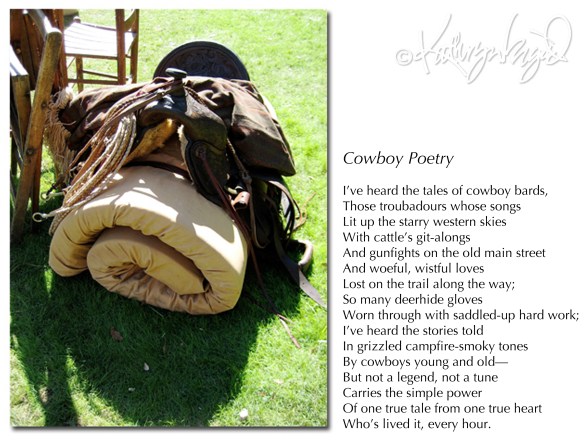
Time for another dose of Texas-inspired meditation. Because  I live in Texas. And I got to meditatin’. And I have been known to think—as American Thanksgiving Day approached, for example, but pretty much whenever it comes to me too—that one of the things I am perpetually impressed by and immensely grateful for is the soulful dedication of those people who do all of the difficult and endless and mainly unsung tasks, at often invisible jobs, to make life bearable and beautiful for the rest of us.Photo + text: Cowboy Poetry

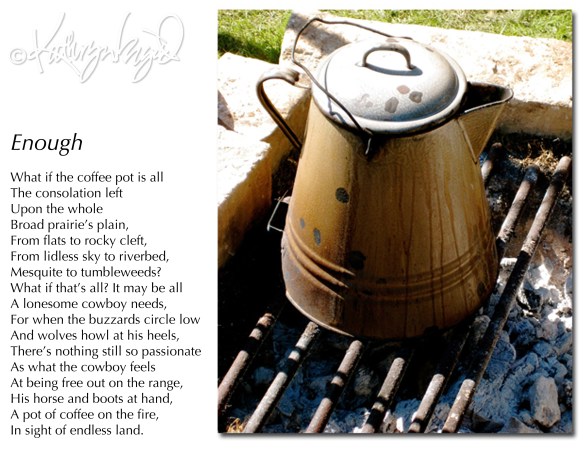
Photo + text: Enough

It would be an exaggeration to claim that My Heroes have Always been Cowboys, but I do indeed respect the role they play in this pantheon of working-class wonders whose gifts are so much-needed and so often unheralded by the rest of us. I thank you sincerely, all of you independent gas station owners, ditch diggers, restaurant servers, car wash detailers, dry cleaning operators, factory workers, day laborers, and all of your committed fellow-men and women who carry us all on your backs.

Just a Second

Photo: Newness 1

What do you see? It’s not a trick question, only an invitation to look for the small and temporary delights right at hand. Newness and beauty are present all around us.

For all that we think of lives as finite and fleeting and time, constantly racing by, I don’t think we take it so seriously when we tell someone who’s waiting for us, “just a second.” After all, so much can happen in a second or less, yes, evening in a millisecond, as we can now measure it. Races are won and lost by the tiniest increments of time. On one side of the little mark signifying a clock’s second-long increments is the Now, and before the very thought of it is completed, Now already resides on the other side of the mark.

Photo: Newness 2

Dead stems of the past give birth to lively leaflets for the season to come…

No matter how protracted the process leading up to it, one nanosecond is the last one I will spend alive, and the next one will be the first one in which I’m dead. The thought has no moral value one way or another, and not much emotional value either, since as soon as it is likely to seem fully important to me in the most urgent of terms, it’ll be all done.

The only real value for me, in practical terms, is if I invest enough thought in this very moment of being still alive to commit to being wide awake as well: deeply present, and grateful for all of the good that is in my life at every piece of time I’m granted along the way. Whether it’s thanks to honoring spiritual values in the practice of mindfulness or it’s because I’m keenly aware of those lives that, however brightly they’ve burned, were far too short, it matters little unless I take advantage of the perspective these afford me and live my own life more richly because of it. Regardless of how I choose to spend this magnificent currency of breath and sentience and health and hope, even if it’s on sitting on a park bench and holding hands with my beloved (one of the highest and best things I know how to do, to be sure), making a conscious and committed choice is well worth the effort, and following through, all the better.

Just now, the value of mindful living in the present is particularly lovely because we are on the cusp of spring here in north Texas. And if you’ve read even a few of my locale-related posts, you can appreciate just how fleeting and tenuous is the very idea of springtime and how ephemeral its joys. I would be a fool to be so encumbered by longing for things past or worrying about things yet to come that I don’t pause, however briefly, to savor the wonder of what these treasured nano-joys can bring to my existence.

Photo: Newness 3

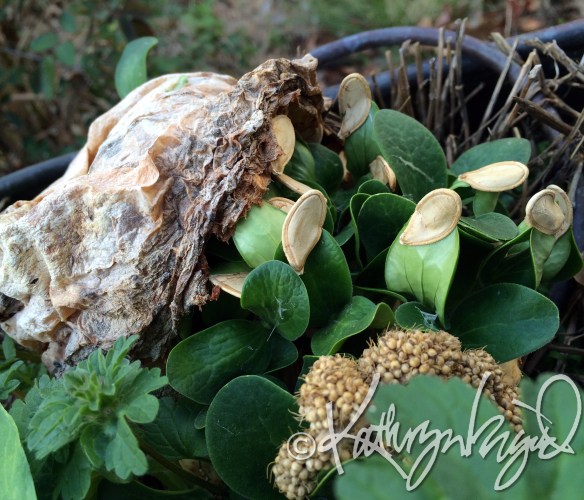
Out of death, life. The cheery pumpkins and gourds brightening the fading allure of the autumn garden have in turn rotted, dried, and decayed—but from their secretive hearts, the burst of seed and greenery returns to begin it all again…

There was a Time…

For everything in life, there might indeed be a season. When it comes to the normal and quite predictable shift in relative values or availability, of course, I’m as skilled as the next person in forgetting to renew, rearrange, or simply release that which is no longer fulfilling. It might be an object of utility or beauty I’ve treasured and utilized until it was worn or a new and better one supplanted it. It could be a handed-down family treasure whose receipt over the years went from being an honor to onerous. It is even, occasionally, a relationship with a person that was exactly the right thing at the right time but has either shifted as our personalities and needs grew apart or has been taken from me by death or distance. The question, after any of these, becomes how and when I am able to distance my own self from them without fear of losing what was wonderful in having had them.

I worried about this each time I moved from one home to another, despite knowing it was impractical to take every single thing I owned with me to my next locale every single time, and with no surety about what would fit the new place or how I lived in it. When my husbandly person and I decided to downsize some years ago from a house to an apartment and simplify a little by getting rid of lots of what was essentially unused stuff, even though we’d both collected and enjoyed much of it happily over the years, this question arose yet again. I’ve not once regretted the off-loading of so much, even many family heirlooms, in that process. As we sorted and packed it off to new lives/homes, I decided to photograph not only the house and garden as they were but also all of the best-loved Things, thinking that if I could look at the photos when I got wistful and nostalgic later I would be comforted by the stroll down memory lane.

In the end, I almost never even looked at the photos afterward; just knowing that I could was enough, and made it quite easy, really. The very process of ‘documenting’ the stuff helped me remember it and my feelings about it even better than having it still in hand. In practice, I found that much of what I do keep around is easily forgotten simply because it’s not in constant use, so why have it at all? Somebody in need of such a thing will love it all the better, and I’ll feel more contented that the right person and the right object came together and I’m relieved of caring for something I too rarely appreciate. Out of sight, out of mind, and better out of sight in someone else’s appreciative hands than in the back of some cobwebbed cupboard.Photo montage: Stuff & Things

Rules of Travel

Photo montage: Rules of TravelFrom my first days of international exploration, when I was still a wide-eyed college kid meandering Europe with my older sister, I recognized that whatever differences I see and experience in each place and on each expedition, there always seem to be threads of very familiar commonality as well. My sister and I dubbed these rather predictable elements of the journey our Rules of Travel. There is often a noticeably preset quality to certain places, events, and happenings that can make me feel, simultaneously, utterly out of my element and surprisingly at home wherever I roam.

For example, personal comfort is the lens through which I always view my current place in the world, so it’s only natural that such things as temperature, relative safety, quantity of elbow room, and other such characteristics always feel slightly less ideal than, well, my ideal. So one of our Rules went a bit like this:

Degrees of ambient temperature in the waiting area for a winter train are inversely proportional to the number of minutes before the train arrives.

That wonderful three-and-a-half month trip happened to be in the year of a record cold winter, when typically easy-rolling European trains were stranded or derailing, never mind having trouble keeping to a tight schedule, when towns that normally were undaunted by modest drifts of snow became isolated spots on a vast white map, unconnected by their accustomed transport and communications alike and filled with a cohort of folk ranging from the slightly mystified to the miffed, who were parked there perforce until such time as a bit of thaw or an intrepid snowplow should free them again. Needless to say, our itinerary moved in unpredictable fits and starts that found us standing for rather extended periods shivering on train platforms, huddled in our entire inventories of clothes layered together with a few sympathetic donations from relatives’ and friends’ closets, wondering not just when but if our train would ever arrive, and finding that it was essentially up to chance no matter how everyone tried.

Dashing through many a train station, airport, and tourist venue over the same trip, we had plenty of opportunity to observe a number of other repeated elements.

One obvious constant of student travel like ours was that funds were ever seemingly flush only in currencies not applicable in our present location; the corollary to this rule was that we always managed to arrive in said location on a Saturday evening, when the banks would not be open again for the exchange of funds into the local currency until Monday morning. By that time at least one of us was actively considering whether the peeling wallpaper in our shabby flophouse-du-jour had been applied long enough ago to have wheat-based paste behind it for the licking. Okay, that part was literal only once that I can remember, thankfully. The rest of it was pretty frequent, though, the Saturday arrivals happening oftener than they should to a couple of people who had somehow managed to get accepted for university studies. Sometimes, at that, arrival was on the tail-end of a marathon train trek meant to avoid overnight hostel fees en route but where we’d also regrettably neglected to pack more than one lunch for the whole two or three days, as the trains didn’t take our current currency either.

You see where this is going. Natural, practical brilliance, at least on my part, was never actually part of my traveling kit.

Another Rule: Escalator and pedway handrails are precisely calibrated to move at a rate relative to the underfoot surface that guarantees anyone holding a steady position of both hand and foot will arrive at the end of the stair or passage fully prone. For greater variety and increased adventure, some engineers build variable speeds into both surfaces’ mechanisms, providing the options of both ventral and dorsal arrival positions on the same equipment. It’s similar to the knowledge that all shopping carts worldwide are produced to assure that one wheel will consistently aim fourteen degrees further to the right, the east, or the direction of Purgatory than whatever direction the other ones are headed.

You might think from reading this that I am not fond of travel, or at least that I’m quite awful at it, but I’m really just more tolerant of uncertainty and willing to subject myself to chance than I generally give myself credit for being. In a way, I realize that I’m a living miracle. I am terrified of change and newness, easily intimidated, I have no natural compass sense, I’m forgetful and quickly confused, and I abhor discomfort. I stumble around, blundering little animal that I am, and forget all of the smart Rules I’ve ever known. But I’ve gotten to go gallivanting in a pretty good variety of really wonderful and interesting places, to meet fantastic people and see and do amazing things, and above all, I’m here to tell the tale. If that isn’t a fine endorsement of going with the flow as a traveler, I don’t know what is. That’s the only Rule that counts.