Hail to All Who Labor in Obscurity! . . . and Pay Attention to Your Teachers

acrylic on canvasboard

Lineage and life-stories notwithstanding . . .

While I was working on the art for my master’s thesis exhibition, I reached a sort of critical-mass point and got a bit huffy at all of the people exclaiming that I must be a real fan of Edvard Munch. Granted, my subject matter probably looked similarly dark and dreary to many; I’ve always enjoyed playing around with that black-humor borderland between gritty and witty, where vampires slurp on souls at teatime and skeletons tap-dance a cheery, leering Totentanz of delight long past All Souls’. I’ve always found great amusement and entertainment in the design and crafting of strange monstrous birds and beasts, outlandish costumes, and rickety structures to house the people that exist on the fringes of imagination. Munch’s images and stories derived from a darker real-world observation, probably tinted by his own mental and physical state of health over time, but the outcome was arguably a comparable sort of oeuvre.

Paste onto those superficial connections the knowledge that I am of Norwegian extraction in pretty much every direction if my lineage is traced out of the US, and I suppose no one could be blamed for linking the Nordic-darkness-tinged artist in front of them with the only really famous one that comes readily to mind. I couldn’t complain about being compared to a justifiably well-known and original artist, now could I?

But I did. I didn’t really like Munch’s work, you see. I thought it obsessively gloomy and depressive and I wasn’t particularly crazy about his style. I tried really hard to disassociate myself and my work from this sticky albatross-of-an-ancestor I was being put into artificial family bondage with and get people to think of all the ways in which I differed from him.

Silly. Turns out, though I still credit myself with having a far more uplifting personal history than his was, what with my generally idyllic existence from day one, we do have a lot in common. When I saw the Munch museum in Oslo for the first time, I was beginning to see why folk might make connections beyond simple Norsk blood, from ties between us in some of the fundamental issues of interest topically and right on through to how we might apply our media to paper or canvas, how we both would wrestle through a whole series on the same subject or even remake the same picture in different media and styles over time to see how we could effect a different outcome with each attempt. I started to notice that there were evidences of similar drawing gestures and brush strokes, an impressionistic looseness with paint and pastel, that were more often similar than not.

What did I do? Rebel against it more. Silly. By the time I really started to come to terms with this whole idea of being on a path not so very different from Edvard Munch’s artistically, no matter how unlike in experience and life, it was kind of a fait-accompli, something that everyone else had acknowledged long before I was willing to do so. As I say, I was already winding up my grad school time when I began to come to grips with saying, Yeah, this is all right with me: I do so like green eggs and ham. I mean, just because Munch was Norwegian-rooted and an artist and explored darkish subjects and I could be described by exactly those same terms doesn’t mean I can’t like him or admit to it!

Once I finally leapt that completely unnecessary and self-imagined chasm, it was easy to begin finding common ground in a lot more places, affinities with a lot of different art practitioners, than I had been open-minded enough to see before. Amazing how much more I can learn when I’m not wasting all of my energy on resistance. Which is, after all, Futile (I have it on good authority). The next step, and a very long and winding road of steps at that, is the one of recognizing what can be gained by learning at the feet of the masters and of those whose place in history and the popular mind is perhaps well established, while still being myself one of the multitude who ‘work the middle’–all of us laboring at our art, our craft, learning and honing skills without any particular expectation of fame or longevity or remuneration to follow.

The short answer: everything. Why would I continue to refuse all offers of insight and inspiration and the potential to learn and grow and delight in what my predecessors–living, dead, famous and obscure–can teach me! Yes, I have learned among other things that great resources of such knowledge can be dug up with a bit of persistence on my part, or as in the case of good old Edvard Munch, shoved at me until I quit whining and pay attention. Or, as in the case of Alf Hurum, handed to me on a silver platter.

Hurum remains an obscure Norwegian and unknown to most Americans, indeed to most people outside of a relatively specialized cadre in the art and music worlds with good reason to know of him. But he was, it happens, a fine composer of piano and violin works–and somewhat influenced by, you guessed it, Edvard Munch. His reach was greater than one might guess not only because his compositional work remains both playable and listenable after lo, these many years, but also because, having married a woman from Hawaii and grown interested in her roots, Hurum spent the latter part of his life in Hawaii and there helped to found the Honolulu Symphony, among other things.

My learning of him was quite simple and straightforward: my brother-in-law, a fine pianist teaching at the University of Agder – Music Conservatory in Kristiansand, Norway, arranged for me to have a commission to do a portrait for the school when they were refurbishing their then-concert hall. This led to my studying up a little on several Norwegian musicians over time, including Hurum, and producing a set of portraits from which the administration could choose, and most importantly, to my hearing some really lovely music I’d never have otherwise known. Even better, my brother eventually did a research project that led him to make a marvelous recording of Hurum’s piano music (Eventyrlandhttp://www.rockipedia.no/Vault.aspx?entity=1169501), and now I have the privilege of using that as inspiration whenever I wish to listen to music while making art yet again.

I have no expectation of creating a lasting legacy and occupying any spot as a well-known character like Edvard Munch. I don’t even fantasize about lingering for generations in the ken of a refined and fortunate circle in the way of a lesser-known but also gifted artist like Alf Hurum. But I can surely perpetuate what joys there are in simply making art and learning from those betters who have preceded me in it, from here in my own quiet little corner of existence, and that is glory enough for anyone.

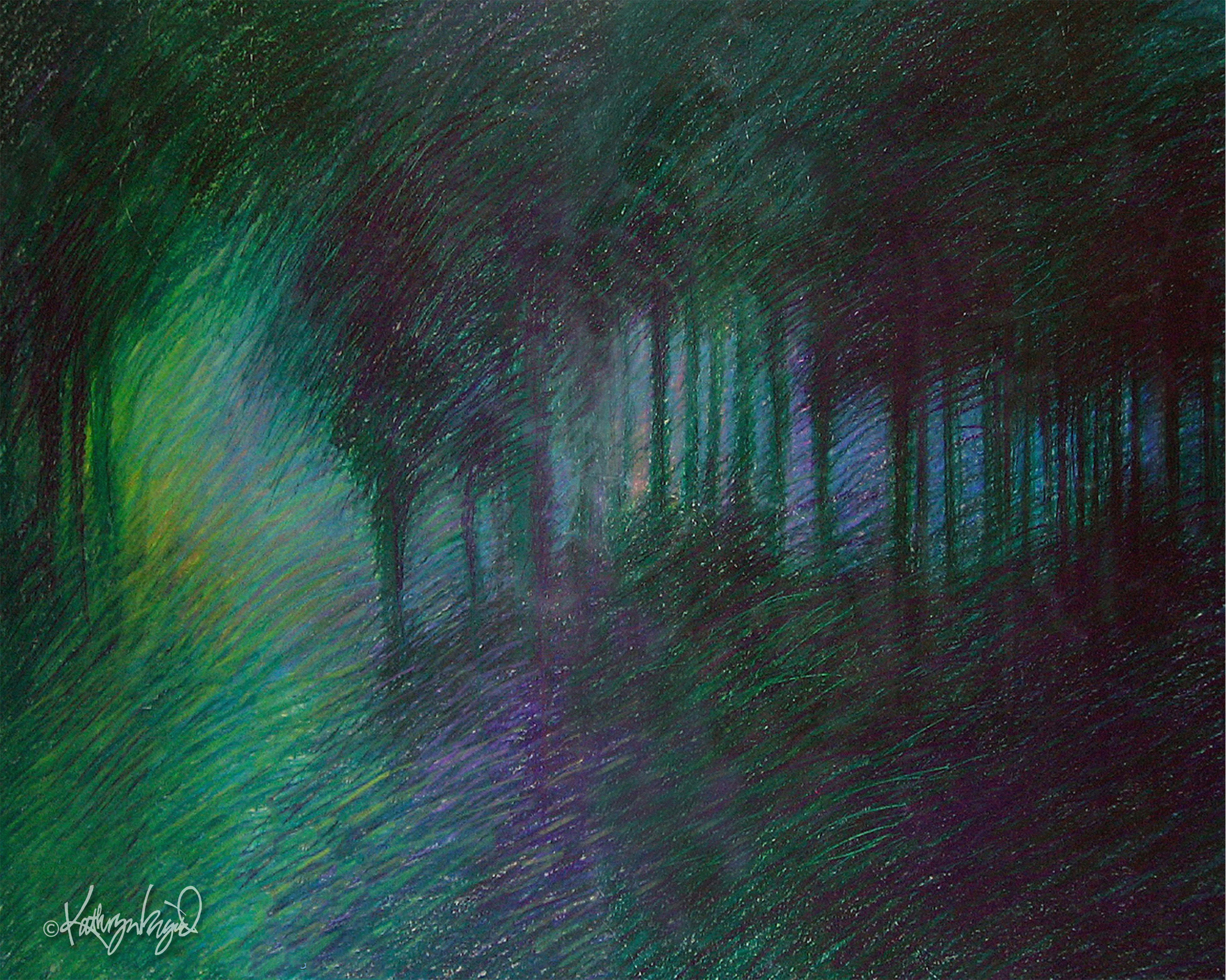
acrylic and colored pencil on paper

Little known, but not unsung . . . influential, but almost secretly so . . .
Another Kind of Safety

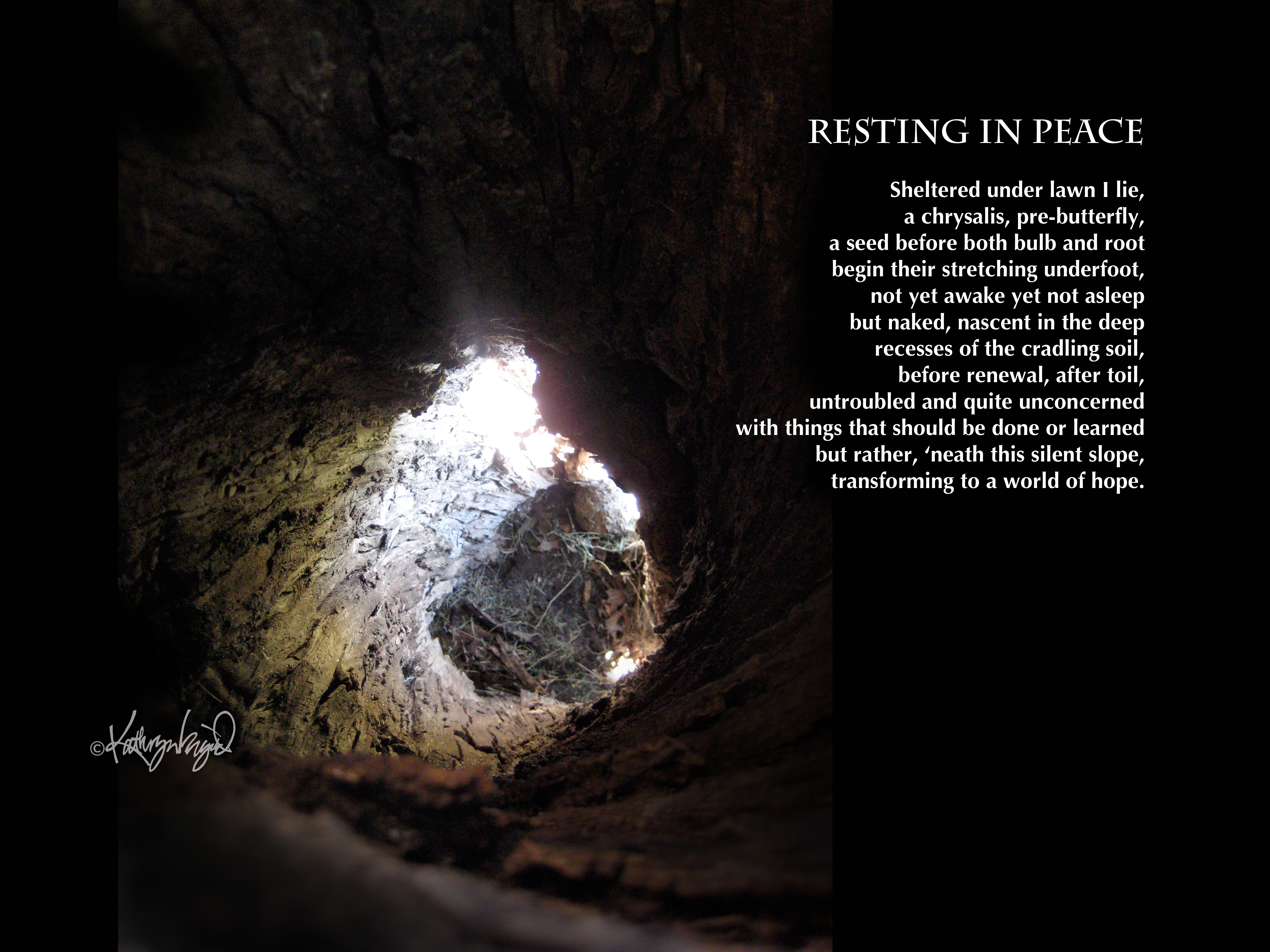
tree hollow + text

. . . always lurking . . .

It’s not only in the comforting arms of cute-and-cuddliness that I feel secure. While yesterday’s post can hold no shocking revelations for anyone who knows the least bit about me, today’s will have no greater surprises when I say that I am also in love with the dark. Not just literal, opposite-to-light dark as in nighttime and dense drawings made with compressed charcoal and velvety mezzotints. Meta-darkness. Scary stories and crumbling skeletons, underside of reality, unsolvable mystery, doom and despair darkness. Never fear, I am still Miss Goody Two-Shoes and hate the danger and pain that all of those sorts of darkness represent in their actuality.

What I love is the frisson of flirting with darkness through art, at a safe arm’s-length remove, and especially so when I am the puppeteer controlling all of the fun. It might be handled with flat-out gleeful ghoulishness or it might be with a much more lighthearted and jocund approach, depending on my mood, but I’ve long been a known prowler in the territory of haunted houses and haunted hearts.

digital painting

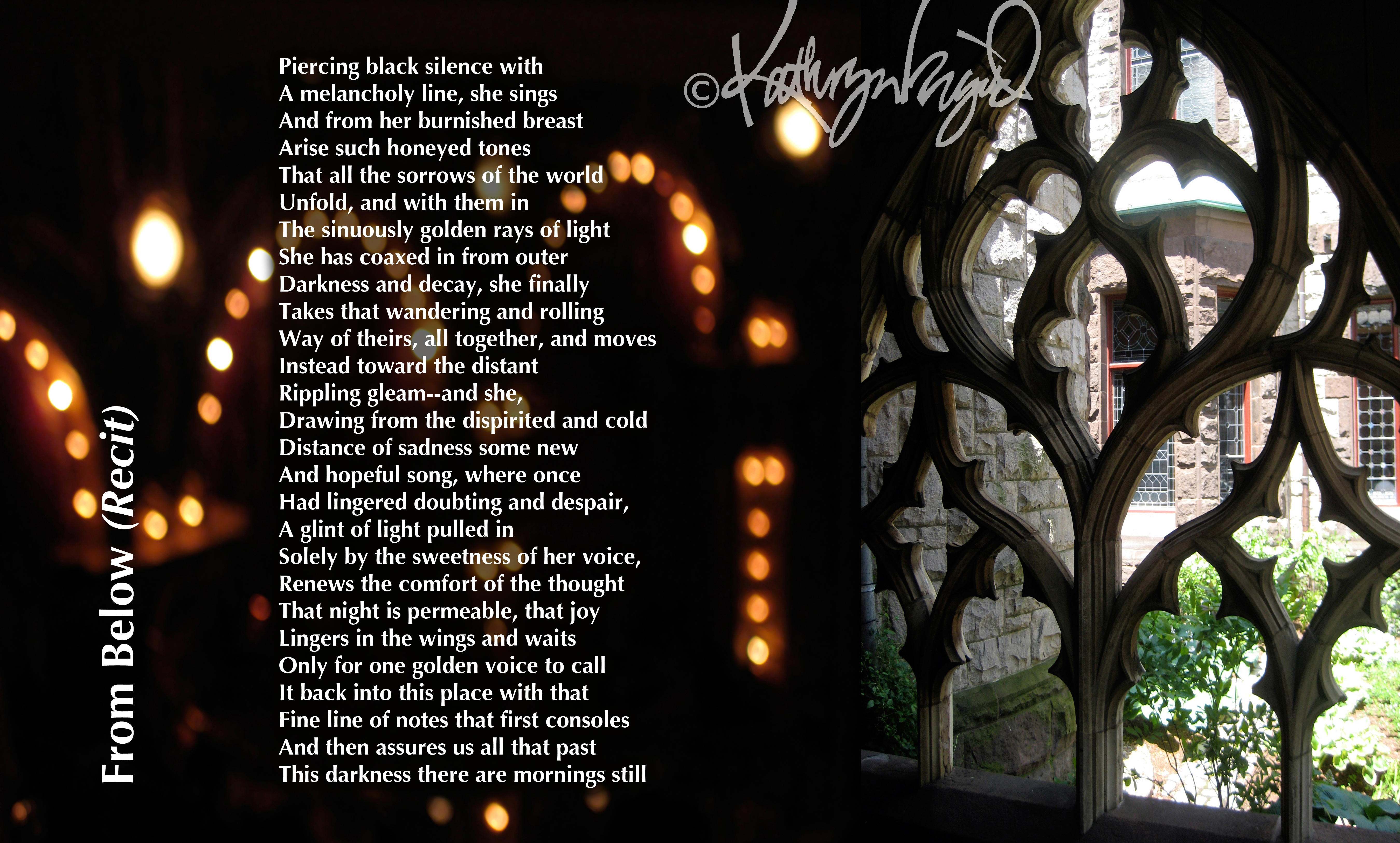
I can sleepwalk these halls or crawl them with wakeful deliberation, but one way or another I always revisit . . .

So whether you diagnose me as a creepy would-be villain or see me as I tend to see myself, a collector of peculiarities and curiosities and the dark inner well in all of us that incubates such things, invents such things–and finds some catharsis in the vicarious observation and manipulation of them. That shallow wading in them and climbing over and out of them unscathed, therein lies entertainment, perhaps–but certainly catharsis and yes, another kind of safety.

night in the park + text

. . . and as she sidled out the door at last, she said in a very soft voice, "Good night" . . .

Sound Advice for the Voiceless

watercolor birds x 2

Singing our little hearts out . . .

I have spoken about having Spasmodic Dysphonia. That in itself, when in the aural forum and not (as in yesterday’s blog post) just the printed format of the internet, is a fine thing in my estimation. It means that having SD hasn’t rendered me either mute or unwilling to let my sometimes goofy sounding voice be heard. It could conceivably be argued that it would be good if I would actually shut up occasionally, or at least not be quite so outlandishly talkative as I can get. I consider that other people’s problem. Egotistical, I know, and I’m not really exaggerating when I say that. What you hear is what you get.

Being fortunate enough to retain the power of speech, I prefer not to stop using it. SD has meant getting over any vanity I may have had about the sound or quality of my voice. Having been flattered by many in my younger years as a strong and clear and pleasant speaker and encouraged to take singing lessons, to consider radio work, to be a lector and to speak at public events, I now have a different sense of my voice and what I do and don’t trust it to do than I did then.

So I find it less comfortable both physically and psychologically to sing, and certainly have no desire to show off my resulting lack of confidence and practice publicly. I was always a nervous Nellie when it came to singing in any group smaller than a chamber choir (Yikes! Someone might hear me!), but even singing along with a crowd is not the same fun it once was. It has in no way diminished my delight in hearing others sing, however; quite the contrary, it transformed my understanding of what it means to be able to sing, and to do so with skill and fluidity and grace. Working on proper vocal technique will help me continue being able to speak, but my own sense of music has been shifted rather firmly into listening to and appreciating and being moved by others’ mastery of their instruments. My own musical endeavor now sits much more comfortably in the realm of written and spoken language and of trying to capture the marvels of rhythm and pattern and color and sound in the confined refinements of print and speech. The potential is perhaps equally profound and potent, but simply takes an entirely different route through the senses in some significant ways.

Just to be crystal clear on this, I say this without any sense of loss or privation. I’m not suffering! Indeed, I consider myself incredibly fortunate. I’m neither summarized by nor limited to a description of my anomalies any more than I am defined by the ways in which I conform to any norms. SD is something I have or experience, not who I am or what I’m capable of doing. I could go through the list of potentially problematic quirks that help to shape my daily experience and my present self and sound like either a professional victim or a hypochondriac, or I can find–as I most decidedly do–that while each of those oddities has enough effect on my health and capabilities to be worthy of treatment or accommodation of some sort, each brings awareness of deeper gifts and the drive to overcome not only the irksome ills themselves but anything else I might be letting hold me back.

Yes, I am a lily-livered scaredy-pants of the first order as well as a lollygagging and procrastinating and self-sabotaging ignoramus, able to match pretty much any other arguably normal person around in those foolish and unhealthy arts. But at the same time I am so gifted as to understand that my true limitations are all self-imposed and even self-created, and that not only do people with far greater difficulties and far fewer resources live far more impressive and productive lives than I, I can grow up and into a better version of myself by taking notes on how they do it. Being a somewhat lazy and under-motivated student, I have to actively counter the urge to hide behind the couch until all inspirations and moments of willing effort pass, but on certain miraculous occasions I find that, well, I actually get up and do something.

When I do manage to pull myself up by my nearly invisible bootstraps, I find that despite having familial tremor (mainly in my hands) since who-knows-when, I can draw a straight line or a pretty fine freehand circle when I’m focused enough to make art. When I’m not, I have learned to hold my drinking glass with both hands if need be, or to keep kettle and bowl nearly overlapping when ladling soup. When all else fails, spill cloths and laundry detergent are mighty handy things. I may chill easily, thanks to my slightly off-kilter thyroid, but I’ve got layered-clothing styles down to a -40 Edmontonian nine-layer art form that I can still pack in my carry-on baggage. Wanna learn how to do nearly any basic survival task without an inner compass? I have virtually every dyslexic and perceptually dysfunctional talent I’ve ever heard tell of, from the ever popular reading-related visual chaos to spatial, directional, numerical and probably even temporal displacement. So without even knowing or trying to do it, I learned most of the affected skills upside down, backwards and sideways, doing everything with my own inevitably inimitable flair. Once I started treatment for them, my clinical depression and anxiety stopped holding me back and instead informed more of my interaction with other people as well as with my art. My lack of physical stamina and athleticism may have prevented my becoming a famous basketball player or dancer or a three-meter platform diving star, but I figured out early that leverage and a little logical logistical ingenuity could make up for a largish quantity of strength and skill in things physically challenging. Blazing alternative trails isn’t glamorous work but it’s done useful things in my life, and gives me an appreciative slant on those whose achievements outshine mine.

And when it comes right down to it, my ‘substitute’ versions of reality have served me quite nicely. I don’t sing in the way of the magnificent-voiced soloists and choral artists whose offerings have so richly embellished my existence, but there’s nothing stopping me from using the alternate voice I have in words and images to sing in my own way, and mainly for sheer happiness.

spring green flora + text

There are so many ways — and so many reasons — to sing . . .

The Sound that Defeats Death

It is audition season. Living surrounded by musicians of all the possible performing and conducting and recording and just-because-I-can’t-help-it permutations, I am aware of the slight change in barometric pressure that in turn sets hearts and metronomes aflutter at this time of year. It’s connected to the academic calendar, to the symphonic season, and undoubtedly at this point in history, to the fiscal cycles that wax ever more weakly with every palpitation of the stock market and downgrade of company pension plans. The undercurrent of electric excitement and the frissons of impending artistic adventure so intertwined with the notion that one is about to embark on a new, or renewed, relationship–or is about to gird oneself in black bombazine and the hair-shirt vestments of the rejected–is giddying and tooth-chatteringly awful all at once.

How apropos that I find myself interviewing for new employment at this very time. I feel every bit the whispery, under-powered and imperfectly skilled performer when singled out for that one-on-one moment with the deities of HR. I want to open my mouth and hear sparkling coloratura, but am glad and relieved enough at being able to merely cough out a modestly coherent thought without accidentally spitting on the interviewer, falling off of my chair, or (the most likely misadventure in my repertoire) having my voice seize up on me and stop dead mid-word. I have Spasmodic Dysphonia. The term sounds both ominous and ridiculous, and in my life, the experience is both. Many people with SD have a far worse time than I do; I’m one of the lucky ones. SD is a subset of Focal Dystonia, as I understand it, and both names group together sets of symptoms and physical oddities that present differently in each patient, depending upon the collective group of expressions that person has combined in his or her experience. I use the word patient advisedly, knowing as I do that what is most needed in dealing with the condition, either as one’s own or as it affects another person, is patience. Not really something I was born with an abundance of, but there you have it.

To oversimplify, possibly at the risk of misstating, Focal Dystonia is a broad generic term for when a localized group of nerves stops talking to the muscles for which they’re responsible, or sends them incomplete or inappropriate messages, and the muscles respond by failing to do what the brain was signaling the nerves to tell the muscles to do. Playground chaos ensues. The fingers that used to so nimbly traverse the keyboard curl up into an angry stump and refuse to admit to ever having met this Mr Shostakovich person. [Know the amazing story of Leon Fleisher? Visit http://en.wikipedia.org/wiki/Leon_Fleisher.%5D The arm that flexed in a perfect imitation of Diana-the-Huntress’s draw goes from sinewy and smoothly controlled elegance to a clenched and twisted limb that would rather drop the bow and go for a nice bit of hydrotherapy, thank you.

Spasmodic Dysphonia, as you’d guess from its title, is the version of neuro-recalcitrance in which the vocal cords or folds don’t get their nerve-transmitted memos correctly and so go off on their own merry tangents, usually by vibrating excessively. The outcome is an uncontrolled voice, a weakened voice, or, literally, no outcome. While many with SD have no apparent causative markers in the neurological system, obvious lesions on the brain, tell-tale medical historical events, or the like, most, like me, do find that certain elements can exacerbate ‘attacks’. My good luck is that my case is fairly mild and I can go for rather long stretches between my times of being worst affected. But like most of the other SD patients I know, any situation that puts stress on my voice increases both the likelihood and the severity of episodes; the longer the stresses last, the more effect they have. So being in a loud reception where I have to raise my voice to be heard for a couple of hours is a pretty good trigger; being in a loud classroom (whether it’s caused by the HVAC blowers or being near a busy airport or just having over-exuberant students) five days a week is definitely a tougher influence to resist.

Being depressed, being ill, going through any of the textbook-irritant life changes you can name: those are all potential villains in effecting recurrence or regression or whatever you like to call it. Since I’m generally a very happy and healthy person and most of the life stressors extant are surmountable with a little help from my circle of superhuman supporters, I’m more susceptible to common noise-environmental twinges than to emotional ones these days.

But sitting in an unfamiliar office in the Interviewee chair is a quick reminder that I have to activate my “manual controls” and not just talk on autopilot when the tension stakes are raised a little bit. If and when SD gets particularly persnickety I will lope back over to my kindly specialist and have Botox injected into my vocal cords. It sounds hideous, doesn’t it. It’s not exactly something I’d do for sheer fun, but it’s not the most gruesome or painful treatment imaginable and it beats the daylights out of having my voice stop unceremoniously on me three times in a single sentence. People that don’t know me very likely notice nothing wrong at all and just assume that I, like William Shatner, have developed my own distinctive style of delivery for artistic or dramatic purposes, but since the frustration of literally not being able to ‘spit it out’ until I regroup, retune and/or start over entirely is accompanied by a feeling of being gripped around the throat by a mugger, I’ll get in there and sit up and beg for the shots like a good little patient until some nice mad scientist discovers an actual cure for SD.

In the meantime, I am all the more cognizant of the plight of all those voice-dependent folk putting their hearts on the line as they stand up to the test these days. Dysphonics, wherever you are and whatever you do, I wrap you in my arms in an embrace of solidarity and hope. Teachers, returning to the classroom after a luxurious (if short and jam-packed with non-academic duties) respite from lecturing and verbally leading daily sessions: I salute you. Preachers faced with a re-filled nave after the relative quiet of the summer season: I will light a candle for you. Public speakers back on the circuit for the height of the season after the relatively fallow holidays of vacation time: I applaud you. And singers, you who transport us to different worlds with every flexion and inflection, to you most of all do I genuinely genuflect. It is the sonic wave of music on which I am borne to higher and deeper planes, transported to places of joy and despair, moved by otherwise indescribable anguish and awe and beauty. I may not sing along, but I am listening.

theatre lights and leaded glass and text

. . . and the echoes fade without ever ceasing . . .

Rachmaninoff Plays Rachmaninoff

album cover portrait

You old romantic, you!

In my early record collection was a lovely, only slightly scratchy LP, with an equally well-aged photographic portrait on its cover, of Sergei Rachmaninoff playing his own compositions. Needless to say, if you’re a big gooey fan of sweeping, high intensity passionate music like I am and you’re going to have a limited audio selection, it’s beyond stupendous to have such a jewel in it. I undoubtedly increased the mileage on that piece of vinyl tenfold, listening to it in a virtually continuous loop at times, before the era of CDs rendered my old faithful stash of LPs–at least the equipment on which I played them–obsolete. I’m no sophisticated audiophile, able to detect the finer distinctions between LP and CD, let alone to wring the delicacies out of super-duper-HD-splendiferous solid plutonium audio wire with sprinkles on it. But I know gorgeous and moving music when it smacks me upside the head. So of course I’ve always been a sucker for Sergei.

My fabulous blogger friend XB at ‘In Search of My Moveable Feasts’, offered a 25 July rumination on Rachmaninoff and the question posed in some circles as to whether he should be considered a second-rate composer. In some ways, asking me that particular one boils down to what is always treated as quite the prickly question: whether there is a direct relationship, either as equivalents or as antagonists, between popularity (wide public approval, say) of an artist or his work and their level of critical acceptability and the kind of greatness that somehow transcends the current stamp of approval. I’m not entirely sure I buy that these are mutually exclusive evaluations. But at bottom, the very happy obsession to which I confessed earlier answers the question for me far enough for my purposes: Mr. Rachmaninoff makes music that moves me deeply and without which I would be loath to spend any great length of time, and that’s my brand of critical success.

Meanwhile, the portrait above, which was based on the album cover photo, was a surprise to many. It was made as part of a portrait show honoring many of my favorite influences, particularly artists of every stripe, each of whom has played some role in pushing me ahead artistically. It wasn’t until the show was hanging in the gallery that others pointed out and I saw for the first time the marked resemblance between Sergei Rachmaninoff and the also marvelous Vladimir Horowitz in profile, all the more intriguing considering how well known Horowitz is for playing the compositions of fellow eastern Europeans like, say, Rachmaninoff.

In a final confessional note, I will say that an additional major source of my attraction to this great Rach star is his glorious choral music, most notably the exquisite Opus 37, the All Night Vigil (in popular parlance, his ‘Vespers‘). That my life-partner was in the midst of rehearsing an upcoming production of that miraculous piece when we came together could possibly be blamed in part for this addiction. The Sweet Nothings he whispered to me in his sleep being Church Slavonic seemed plenty romantic! As it has transpired, I have now been blessed to be immersed in this piece several times again as he’s conducted it in rehearsals and concerts with an array of different choirs. Given my experience, if Greatness is partly defined by the sophistication and complex subtlety that grows and changes with repeated exposure, never losing but rather increasing in richness over time–I would call Rachmaninoff decidedly first-rate. Whether anybody else buys that as valid or not, I’ll happily wake up any day to a faint humming of ‘Bogoroditse Djevo’, whether it’s from the CD player or from the other side of my bed.

Be Still and Listen, Thou Big Dope

run-down beauties

It's there, if you use your six senses . . .

Just because I believe that inspiration and the skill to fulfill it are best bought with persistent and focused labor doesn’t mean I don’t think it lies all around for the taking, too. There’s just so much astounding and strange and beautiful and fun stuff in every imaginable cranny of the world that the real charge here must be to keep all senses twitching at all times, not least of all the antennae of intuition. And I also lean toward the ‘it’s all been done already’ theory of creative endeavor, wherein pretty much every grand idea in history has very possibly already been had and it’s our pleasure and somewhat difficult responsibility to somehow recombine the DNA of our arts into something new and wonderful that’s now our own. So I have no hesitation about going shopping amongst all kinds of artworks extant for a better chance of gathering useful inspirations from them to move me toward my own next project.

When I go to an art exhibition I’m not only basking in the inherent attractions of the works hanging on the walls and filling up the galleries but also filing away molecules of inspiring marvels and, not least of all, building up a slight head of steam that makes me antsy to get into the studio again myself. When I attend a concert, dance, play or other performance, I’m absorbing whatever tremendous artistry, craft, skill, design, and magic came together to make the moments possible, and on the side, I’m mentally revising, redesigning, rehashing and reinventing on my terms every aspect I can imagine, making it mine. It need not diminish my admiration for the work in hand, but rather tends to let it bloom in every direction as an expanding universe of potential artistry. Granted, I am no dancer, haven’t acted since high school (unless you count acting competent, or like I’m not scared, when the occasion requires), and I’m certainly no great shakes as a musician of any sort. But I’ve attempted each just enough of each to appreciate the fineness of what I’m seeing when I sit at the feet of masters.

Even when I dine, the food and its preparation and context can provide a wild cornucopia of not only tasty satisfaction and belly filling sustenance but also another source of artful inspiration of every sensory variety. It might lead to more food (a grand enough goal, to be sure), might lead instead to some seemingly unrelated object’s invention.

Most directly of all, reading stuff that makes me shiver with happiness or shock or reverie or any other sort of appreciation has a strong tendency to get the creative juices flowing–specifically, toward my pen point.

Boston photos + text

Now let me lie between the pages of a fine book . . .

It’s all, and always, research as it happens. Right down to the purposeful hours I spend staring into nebulous space after the fact, looking for that miraculous confluence of thought word and deed that will combine all of my life’s experience into the right synchronous process of art-making to produce my next inspired work. Luck, be thou a true lady . . . tonight, tomorrow, forevermore. Muse, approach.

The Feast that Never Ends

Thanks to our kind friend Joelle, I met fellow blogger XB tonight over dinner. Her blog, ‘In Search of My Moveable Feast’ at http://www.xiaobonestler.com/, is a wonderful melange of food and culture spiced with her delightful wit. I’m also reminded by both blog-mate and the friends around the dinner table tonight–composer hosting, saxophonist and pianist and conductor gathered around the table with me as we all enjoyed the meal and conversation–that shared love of culture and other naturally crazy things is an endless banquet of marvels and wonders.

ratatouille ingredients + blackboard text

To dine is divine, and among friends the conviviality never ends . . .

Is the conversation inspired by the food? The food by the gathering? The gathering by the conversation?

Of course all three happen. In the case of a tableau like tonight’s at table, there can be so many possible tangents to pursue. Avidly swapping bits of life-story over splendid bowls of creamy cool beet soup with yogurt leads to thoughts of yet other meals, stories, and gatherings. Discovering common interests with newly met friends over a glass of wine: how can that not lead to further tales (tall and otherwise) and onward to inspire more the pleasure of dolmas and Greek salad, these then becoming sustenance for other hungers for knowledge and enjoyment?

It is, clearly, an infinite table, this one where strangers sit down to untasted treats and rise up as well-filled and newly minted fellow sojourners. Art is the avenue where all of these fine riches intersect: thought and music and speech and history and language and hope and hilarity and the sharing of ideas in inspiring new ways.

I don’t doubt that the cats, from their respective corners, were moderately bemused by our various enthusiasms, but I for one found in all of it great nourishment.

Mr. Mussorgsky Makes Good Medicine

Since I mentioned the mystical powers of restoration held by food and music and art, I suppose I should fill you in on a couple of details. I will begin with my youth, when a day home from school on account of germ infestation was made tolerable by only two things: Mom’s serious talent for coddling, and the range of treats she willingly provided in order to speed the healing of an underage invalid. While I was swooning dramatically on the living room couch, bereft of sisters (they had the nerve to flounce off to school without a thought for keeping me company in my miserable state), I was given the choice between some prized medical treatments to speed my cure.

My selections were usually as follows: macaroni and cheese, preferably neon orange and from a royal blue box–this was long before I’d discovered the delights of Amy Sedaris-inspired artery-destroying deliciousness of the sort I make nowadays–accompanied or followed by Green Jello. Apparently, there is always room for it, because after ginger ale and soda crackers, that was the first thing I craved, and it had to be green, though I don’t know exactly why, even after my body was in a state of complete food rejection.

Meanwhile, there needed to be distractions to help me survive the long hours of my desertion and recuperation. The best possible, and this will date me among all of you tender readers who have to GoogleLP” to know that it doesn’t only refer to Licensed Practitioners, was to listen to favorites from among my parents’ record collection. When I was well enough, it was a real delight to lie on the floor with my sisters in a darkened living room and listen to the recording of Basil Rathbone reading Edgar Allan Poe stories, but sans strength and sisters both, it would be music I chose.

High on the list would be David Oistrakh playing ‘The Swan of Tuonela‘ or perhaps Dvorak‘s evocative ‘New World Symphony’, maybe (if I had the energy to laugh along a little) Saint-Saens‘ ‘Carnival of the Animals‘. But probably my favorite was to get my catharsis from my good friend Modest Mussorgsky in the form of ‘Pictures at an Exhibition‘ and especially the wonderfully histrionic ‘Night on Bald Mountain‘. In fact, the first LP I remember buying when I got to college and didn’t have access anymore to my parents’ collection was an album with ‘Pictures’ on it.

The hut on hen's legs, graphite drawing

Baba Yaga by moonlight, or in a darkened living room . . .

It’s obvious from the aforementioned, if it wasn’t in every way so before, that I’ve always had a fondness for the dramatic in music, whether it’s some fabulous ethnic dance-demanding stuff or my old friends the story-based symphonic pieces or Russian choral riches with the basses fine-tuned by some necessary quantity of good vodka (whether they drink it or I do doesn’t necessarily matter, I suppose). In any event, I was very pleased a couple of years ago when my good friend Alvin commissioned me to provide the “missing” illustrations for ‘Pictures at an Exhibition’ when he was premiering his wonderful new arrangement of it with slides of the original set of artworks by Viktor Hartmann that had inspired the piece in the first place.

On this note, I suggest you make all haste to your nearest music collection, library, or other source of great storytelling and refresh yourself with a plunge into Mussorgsky, the tale of Baba Yaga, Edgar Allan Poe’s delectably dark yarns, a nice trip through Dvorak’s comforting cloudburst, or if you have other storytime favorites in music, art or written form, go to them and immerse yourself in their magnificence yet again.

Happy Place


MDW's landscape, composited

Matins to Evensong

When the world is showing its extra cruel side, it’s time to find the peaceful center of my personal universe. I will keep mourning the lives and loves lost, the battles still raging, the injustices not yet righted, and the imperfection of a reality where children still starve, books are still burned, and toxic waste is still piling up around our midriffs.

Solace isn’t a solution, but it’s a balm that eases the troubled spirit. And what is my solace? A quiet moment calming my thoughts. The love of my nearest and dearest ones drawing me close, or building a safe perimeter around me when I need one. Music, music of almost any kind, has enormous palliative power. Writing a little something or a little nothing. Making a photograph, a drawing or a painting or a mixed media concoction of some sort: while the end product may have some measure of use in righting my inverted innermost, it’s the process that matters. The practice. The act of making–creating, bringing newness into being, starting afresh. That’s what carries the healing and renewing power. What carries me through the cold hard world when it’s not catering to my taste.

For such resources I’m endlessly grateful.