


Naming things is an endlessly fascinating and complicated way of creating and better understanding our relationships with them. Different cultures have even devised quite distinct ways of classifying and identifying the kinships within them, to the extent that families and relations in the different cultures affect the very ways people interact and consider themselves connected, responsible for each other, and much more.
One of the appealing (or appalling) quirks, depending upon one’s view, of the American traditions of familial identification and the names given them in English is the way we use the word Great to specify layers of distance from ourselves. This photo, for example, is of one of my sets of great- and/or great-great grandparents (my maternal grandfather’s forebears), if I am not mistaken, and there is much to pique my curiosity in this image.
First, of course, is the question of whether I have identified them correctly at all. But then, in what ways—besides the nominal—were they great? Clearly, being among my ancestors is an easy in to that category. [Ba-dum-tsssssssshhhhhh!]*
Seriously, though, what distinguished these people? Safe to assume, from what little I do know of my relatives in Norway, these two lived on a small farm, and they worked hard. I mean, incredibly hard, by my standards. I’m inclined, actually, to think that the gent is my great grandpa and the lady next to him is his mummified mum, but having seen many a portrait from that era whose subject I was shocked to discover was eons younger than I’d have imagined, I can’t be sure. If this is a couple, I am extra, extra glad I have such a lazy and comfortable life. I may be no spring chicken, but I like to think that people will be able to tell whether or not I’ve already died, and when it does occur, won’t be able to make work boots out of my hide without tanning it further.
This could be the great-grandfather who was a tinsmith. A pretty skilled one, at that. The hands I see here could easily be tough enough to have put metal in its place. As for the farming, what little I’ve gleaned [enough with the shtick! I’ll try to behave myself]* from the various family stories and photos indicates that my family were subsistence farmers, growing what produce would feed their own households or be swapped with neighbors for further goods, and raising enough sheep and goats, chickens and cattle to keep them in meat, eggs, hides and bones as needed. Agrarian life, until more recent decades, was generally a far more solitary and jack of all trades kind of existence. My grandmothers, great and otherwise (and I can only assume all of the neighbor women of this ancestress’ approximate vintage) did such work as probably made them all look equally leathery.
I would like to think that the sober, if not condemnatory, expressions in the photo sprang from the typical problem of holding still for the interminable exposure time a photograph required in those days, not to mention doing so while squinting in the sunlight. But I also suspect that a combination of that hardscrabble life of theirs and the grimly perdition-obsessed brand of religion to which many of my relatives have subscribed means that these two generally took life mighty seriously as well. They probably didn’t see so much to joke about or room for fun and games in their daily lives.
What I can safely assume about my relatives still gives me some hope. Obviously, they knew enough about how to survive and yes, thankfully, to procreate, that I am here generations later to tell the tale. I consider my existence a fine thing. Although they weren’t either wealthy or showy, they are dressed in well made, tidily kept clothing and lo, my mustachioed male relative even sports a watch chain, so theirs was not, even from the perspective of my privileged and cushy life, a torturous life of pure privation. So I don’t feel enormous existential guilt for their suffering. But I’m not inclined that way like they might have been, anyhow.
My late Norwegian relatives lived and labored in a landscape and climate rather like where I grew up in the American northwest, so I know that even if their daily work was hard they did it surrounded by beauty and nurtured in a mostly benevolent natural environment. They raised children who were able to go out in turn into the wider world and make their ways, eventually finding own their paths, making their own livings, and raising their own families, and eventually crossing many mountains, borders, and seas. I think all of this a fine, if modest, sampler of human existence with [dang it, I just can’t help it!]* relatively little grand tragedy or overblown drama. Most of all, I am glad that the long-gone beings who posed for this rather inscrutable image contributed to the production of a line of pretty good folk, culminating in my immediate family. That’s greatness enough for me, and makes me very thankful indeed. Happy Thanksgiving, my friends.
Beloved, let us sit down together in the shadow of the oaks; let us take deep draughts of fresh water from the clear, swift stream. In the scorching heat of the middle of day, let us take refreshment like the dragonflies that skim the water’s edge, and be restored by the caroling of birds in the distant shade.
The days are long and our work makes wearying and seemingly infinite demands, and we know that this will not soon change. There is change of many sorts ahead, this we know too, but what it will be is yet beyond our imagining. Thus it has been, and so shall it ever be: we travel our paths, seldom knowing quite where they lead, and we labor in darkness the while. Some days, the destination is sparkling joy, and on others it is marred by sorrow and strife; at times, the mists of uncertainty part and the way ahead becomes clear, and at others it remains quite fully obscure.

What I know, Beloved, is this—that no matter how hard or easeful is the road and no matter what the destination holds for us, we walk our way together, you and I. We may long for clarity and even for the strength to wait for it, but in the meantime we will take our stops for breath along the way, sitting in shade when we may and drinking deeply from the icy stream, traveling always hand in hand no matter what the journey brings.
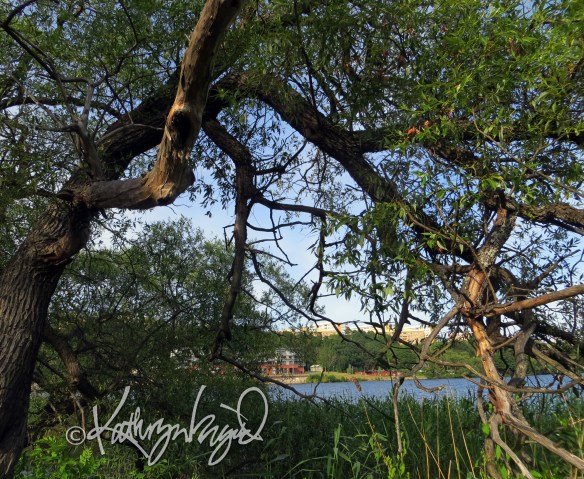 Under the Willow Tree
Under the willow tree, her shade my calm,
I see so bent by storms her trunk, how far
The winds have twisted every limb, each scar
Where lightning struck; yet there’s a quiet psalm
Of gratitude that whispers in her leaves
Each time another rainfall comes to spend
Its quenching kindness on her and to send
New hope down deep—for anyone who grieves
Or wonders how to pass through life’s travail
Finds shelter in her shadow—knows the limbs
That seem to weep are only singing hymns,
Embracing in their gentle sway the frail.
So one fine sapling, tended with such care,
Becomes the home for all who shelter there.
And now her roots are deep, her branches wide
Enough to draw more birds to them to nest,
Assured, secure and loved, and full at rest,
No matter what the world is like outside—
Just as I am, beneath the willow’s arm
Of graceful comfort, grateful for her wise,
Kind lesson to look upward to the skies
For blessed rain, and sun to keep us warm,
For sweet reminders of the Gardener
Who made the willow grow, and gave her strength
To nurture others in her shade, at length,
Upon the graces planted there in her:
So one fine sapling, tended with such care,
Becomes the home for all who shelter there.
 Thank you, Mom, for the nurturing, the love, and the will to live as an example of bending but not breaking in the storms. Happy 80th Birthday!
The world is truly full of overlooked and underpaid laborers.

This is a story as old as human community, and yet it’s notable how little it’s changed. The ugliest, dirtiest, the most physically demanding and unpleasant tasks, the ones that no one in his or her right mind would usually choose to do, let alone without any recognition or reasonable pay, these jobs don’t cease to exist because nobody likes them. They simply get done by people who have no other choice. And do we thank them for it? Do we give them public honor and paychecks commensurate with the knowledge and patience and back-breaking effort and yes, specialized skills that are required of them?
You know the answer. In this country, we spend more time and energy on vilifying the working poor as nuisances and a weight around the necks of their higher-taxpaying richer neighbors, at best. At worst, we accuse them of criminality, many of coming into the country illegally—which they may well have done—to snatch bread from the very lips of our own better educated and better protected children through their stealing jobs from the local citizenry. Which, of course, they rarely do, considering that neither we nor said children are willing and able to do without the jobs that the working poor do for us, let alone perform those tasks ourselves. Never mind that those we abhor for daring to come across the nation’s borders unseen are doing precisely what the vast majority of our own ancestors did, and out of the same desperation for survival, but now with the additional barrier of laws designed more out of fear and hatred than out of specific plans to better the safety and welfare of any of the parties involved.
If immigrants could remotely afford the risky business of taking a national day of “working poor flu,” the way that unionized workers go on strike or recognized organizations march in protest, just imagine what that day would look like across the United States. I don’t begin to think that there’s an easy solution to the problems of regulating this country, protecting individuals and the nation from the very real danger of criminal activity and the bane of individualism gone rogue. The latter being, in my opinion, a far larger risk to the rest of us from among native-born citizens who take their American privileges as the right to do as they please, even by force and against US governmental “interference” with their personal sovereignty. But I can’t believe that the draconian and targeted proposals many suggest these days are the right solution, either.
Let our internal renegades, our legal complainants against immigrants, and all foes of the “lazy” or “problematic” working poor themselves take up the labor and care required to ensure that every one of their fellow Americans has enough food to eat, education to navigate life and progress beyond restrictive ignorance, health care to prevent the spread of diseases and unnecessary pain or early death, and a safe, clean place to sleep without fear of exposure to the elements, destruction of their environment, or unfriendly intruders. Then I might start thinking we can narrow the gates to allow in only primly approved new neighbors able to contribute equally to the cause. Or would anybody out there like to see what happens on that imagined Flu Day, when all of the orderlies, cooks, construction workers, landscape maintenance crews, sanitation workers, child- and elder-caregivers, and all of their fellow underpaid workers lay down their tools and lie down on the job for even 24 hours?
I surely don’t know the solution to any, let alone all, of the problems that roll up into this one massive puzzle we have sitting on our doorstep. But I know that I will try to do better at giving proper respect and thanks, and a hand up when possible, to anyone who does what I can’t or won’t do myself. My life depends upon it.
 I listen to the mourning doves that coo and call in the shadows nearby and think that they do indeed sound ineffably sorrowful. The low, guttural sounds they make seem to my ear quite melancholy and, no matter how musical, to convey a kind of tragic news that makes me wonder just what it is that they say to one another. In my mind, they are exchanging the saddest of sad information, a litany of lachrymose lugubriousness.
In addition, I fear that I don’t give them enormous credit for wit and intellect, so if you’ll pardon the expression, I suspect that what conversation they do have is probably akin to what we American human-types sometimes call pidgin English—any actual content of worth being marred by the lack of intelligible vocabulary and syntax. But, to paraphrase what someone wiser than I has also said, if pigeons are the arbiters of intelligence in the same way that we humans are when we assume ourselves to be the wisest and brightest beings in creation, then all other creatures will by default be found wanting. No wonder the pigeons deign to unload their critiques on the heads of our celebrated effigies in the park.
The truth, I imagine, is that mourning-dove conversation is no less and no more wise and scintillating than our own, at least in the context of pigeon society. Heaven knows that anyone who translated my quotidian chitchat into ‘pigeon English’ would probably be violating the Columbiformian (I just made that up from their Latin name, thank-you-very-much) Geneva Conventions by boring them to death with my inanity and my extreme dull-wittedness when it comes to where to find the best yucky trash to eat, how to maintain the pecking order in the flock, or why one must always look for the shiniest surface on an automobile for proper deposition of one’s automotive excretions. So no matter how tragic the tone of the mourning-doves’ vocalizing sounds to a mere humanoid like me, it could be that they were just discussing their plans for world domination and the swell soirée with which they intend to celebrate it.
There’s nothing like a long stretch with a too-busy schedule to remind me how important it is to slow down and do some meaningful Nothing once in a while, even if it makes me miss one or two seemingly crucial other things. Every time I remember to take that kind of break, I notice that no matter how much I think I was letting go of, leaving undone, and missing out on doing, the world has not once ceased to turn. Civilization has not only not ended while I was ‘off duty’ in a moment of relaxation, but has very likely been somewhat improved by having a little break from my ignorant interference in its progress.

Sometimes it’s really useful to deliberately put my head in the clouds. Or to stare at the floor, for that matter. When I stop gazing exclusively at the stack of paperwork in front of me, thinking only of the next three items on my to-do list, or listening merely to the rattling of the voices on TV, telephone and in email correspondence that are all demanding my attention, I can notice that I’m walking across incredibly worn but still vibrant Majorcan tile in a room full of paneled walls and acres of ancestral portrait paintings, and that’s just en route to some other thing entirely. I might get to that Other Thing and find that it’s only a small courtyard, but one full of sunlight split into dazzling rays by a fretwork of wrought iron artistry that may very well have been behind deadline in its production because the artisan thought it was more important the work be done well and beautifully than that it arrive on time.

Why do we persist in making little things mean so little when they can make a great change in our perspective? Don’t we fuss enough when we think the universe is treating us so neglectfully and with such unwarranted disdain? I think it’s only fair that if I want to be treated with any sort of respect by the universe, perhaps I ought to give it some of the same attention and admiration as well. Far better than wasting my precious life resources on endless effortful chores that will only wait for my return anyway, is to spend a bit of that time instead on admiring the goodness of a threadbare Turkish rug and relishing the thrum of steady conversation about unimportant yet interesting details of the day’s quiet events, talk between real people who stand on that very same carpet at the very same moment and, amazingly enough, listen when I reply.
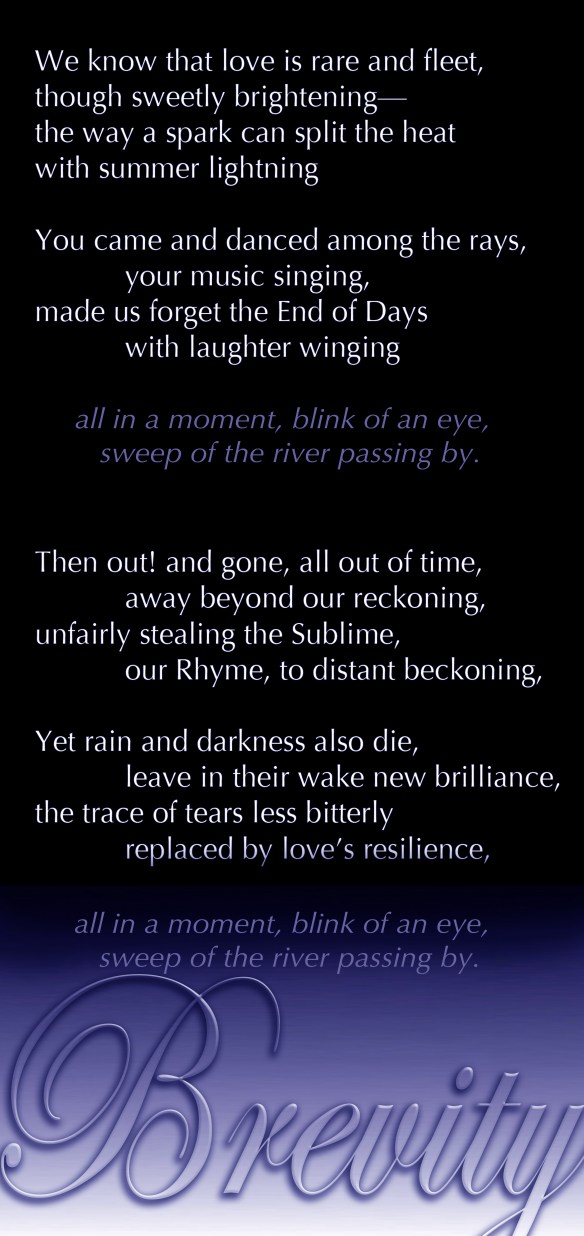 Just because there are designated days (All Saints, Memorial Day, Defence Day, Anzac Day, Volkstrauertag, Poppy Day) for recalling those we’ve lost doesn’t mean in any way that we restrict our respectful, loving and admiring remembrances to those days. Those whom we hold in our hearts remain there, living or not, forever. That’s our path to peace.
The guarantee that we will die, and that all of those we hold dear will die too, means we will do best by finding ways to embrace and recall, most of all, the good and the uplifting things from their lives and ours, and expand on such things for the sake of our finest predecessors’ honor, if not our own.
This is a day designated by the Christian church for the remembrance of all the good, fine people who have lived, illuminated our lives, led the way for the rest of us, and now are also gone before us in death. Recollection, commemoration and admiration of those who have lived as great-hearted souls on the earth and set an example, large or small, of excellence for those of us who follow is, I think, a practice that anyone of any stripe, religious or not, can embrace; we are certainly all made better by such meditations, especially if and when we are made stronger by their guidance to follow in our honored loves’ radiant footsteps.
Spending a day in remembrance of loves lost is bound to be bittersweet, of course. When the bond has been close in life, it remains so in death, and however the pangs of loss may subside over time, on a day devoted to thoughtful recognition of our trusted and beloved friends, mentors and avatars of all things great and good, the pain can be as sharply new again as in the first sweep of sorrow. But if I am genuinely mindful and respectful of their gifts in life, I think that this can be transformational and healing and comforting, too.
Can I live as a reflection of my most-admired angels? It’s too tall an order for any ordinary mortal, I know. But that’s exactly why I think we have these living and loving models among us: to show that in community and mutual, loving support and with determined and patient growth on our own, greater things can happen than if we try to do significant and meaningful things independently. We are raised up by the waves of support around us. How can I not be grateful for that! This realization sweetens the day perceptibly. Do I wish that I could have my lost loves back again? Who would not! But I wouldn’t trade one tear, one iota of the hurt and anger and grief I’ve felt over any of their losses, to miss out on recognizing the beauty and joy and brilliance that they brought to this world in their too-short tenure here, and I know that some lights seem so bright in life that they can blind me at close range to what’s more easily discerned, when seen from this greater distance, as having the distinctive shape of an excellent soul.
The spookiest thing about Halloween? That its frights and frissons are based on a simple and scary truth: we humans are the source of the villainies that pose the gravest dangers to us, as well as being the easiest mark for them. Be very afraid!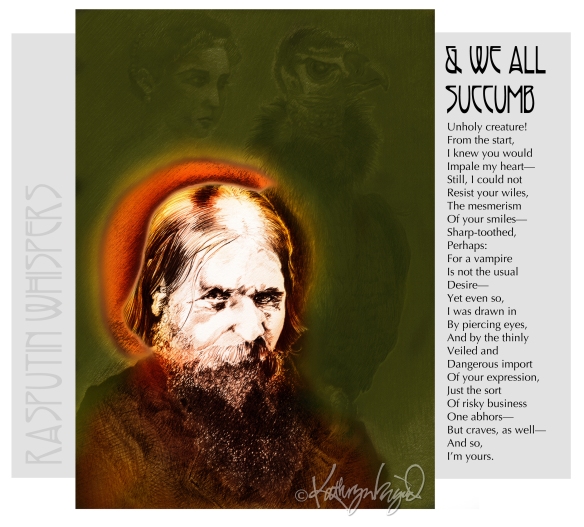
 Art-Colored Glasses