The Library for People Who Don’t Read and Other Miracles

Perspective. Point of view. Scientific experimentation. Verifiable, empirical knowledge. Assumptions. Imagination. Proof.

photo

The School for Skeptics always has room for more . . . but should we be listening?

Who gets to define these? How, why, and for how long? How many centuries did it take for the earth to “become” round? I learned a wonderful thing about Truth and reality from my grandma when Alzheimer’s disease changed her from an ordinary human into a particular and new to me kind of visionary. I suppose I’d been around plenty of people before who, whether through illness or anomaly, through some life episode or misadventure or merely through the self-guided development of ingenious discovery or delusional ideation, saw the world and its verities quite differently from the majority of us others. But I don’t think I’d paid very close attention to what that might mean, before ‘meeting’ the new and different version of Grandma.

photo

Grandma grew blurry . . . or was it only that the borderlands between our reality and another began to thin perceptibly?

She had already been moved into a lovely and much safer residence than her solo apartment, a place where she was fed properly, kept safe from rambling until lost, and tended like a well-loved family member, and she had begun very tenuously to adopt it as her home when I went along with my parents to visit her. Since she had acquired a roommate now and their quarters were modestly scaled, the other four of us strolled down to a pleasant sitting room nicely made for visiting. That is to say, Mom and Dad and I strolled, and Grandma rolled, now that she had completely forgotten she knew how to walk–except for rare occasions when, the staff informed us, she would simply get up and do whatever it was she wanted to do, then go back to her wheelchair and promptly forget again that she was quite fully ambulatory.

In the sitting room, which was comfortable and softly lit, there were several wing chairs and a small table with side chairs where guests could set cups of coffee or tea while socializing or perhaps play a game of cards if they wished; there were old-fashioned painting reproductions on the walls and dated but sweet wallpaper and there was a little arrangement of eternal, artificial flowers. There was also a bookcase, a fairly small one but basically empty, possibly because the residents in the dementia ward of the home didn’t quite know how to handle books gently enough any more or simply wandered off with them. We were curious and a little nonplussed by the place’s bothering to keep an empty bookcase around, but my grandmother wasn’t the least bit disconcerted. It was a quiet room and had an empty bookshelf because it was a Library for People Who Don’t Read. And that was that. It was funny, yes, but in addition it seemed, well, a little bit childish and decidedly more discombobulated than anything my former grandma, my actual grandma, would ever have said and I felt slightly embarrassed and more than a little sad.

photo

There are innumerable soft places for landing, but dare we visit them? Dare we stay?

She chattered a little, mostly in a nonsensical stream of short non-sequiturs, and eventually, grew a bit tired and weary and disappeared from the effort of conversation more and more until we thought she might just be falling asleep. So it was time for us to toddle off down the hallway to her own room again and make her cozy there. Her identification of the family photos on the wall was tenuous at best, and wholly disconnected from anyone in the room who happened to be represented in the photos. She told short stories that were part memory of long-ago times, part yesterday’s lunch, and part spontaneous fiction. She was quite taken with the tall evergreen outside her second story window. It turned out, she was mostly attracted to the man she saw sitting up in its branches there.

By then I was very tired too. It was mighty hard to follow these oddly disjointed and intermingled sentences and thoughts enough to attempt interaction with her anymore, and I was already sure that any comments I made or efforts to connect with what she was saying or thinking were pointless and soon forgotten anyway. I was very unhappy with myself for being so impatient and distracted and unable to just love this new and strange person living in Grandma’s shell. When the man outside her window was clearly more interesting to her than to me, I also became glumly frustrated with her lack of presence in reality.

It was then that I realized that Mom and Dad carried on the conversation with Grandma pretty much as though they could see the man up there too. They didn’t necessarily bait her or make things up willy-nilly, but they gently followed where she led and made no move to contradict her anywhere along the way.

I’m no genius. I think I’ve made that abundantly clear many and many a time. But it did finally occur to me that there was a perfectly reasonable reason to treat this whole interaction as though it were the most logical and natural thing in the whole wide world. Gently, my parents confirmed this bit of cosmic brilliance that had accidentally leaked into my small and putty-like brain. Which is, very simply, that we have no proof that there wasn’t a fella up in that cedar tree that Grandma could see, maybe even converse with somehow. Our failure to see him or understand what he was working to make known to us may very well have been purely a symptom of our being limited to our dimension or aspect of reality or interpretation of the universe, whereas my changed grandmother was now free to traverse the tesseract, leap the boundaries and see through the veil of human limitation at will.

Are all of the people who see, hear and believe things that others cannot see, hear or believe by definition wrong or damaged? Or is it just possible that there are realities and truths that we ordinary mortals of the majority haven’t the proper senses necessary for apprehending, that we can’t yet comprehend those particular particles? Something tells me it’s about time we come to our senses and allow that there may be a whole lot more going on than meets the human eye.

photo

What do you see, now that you are so far away?

Not So Deadly Serious After All

photoTerms of Interment

I’d like to twine my limbs among

great roots beneath an oak,

eternally embracing there

but not before I croak.

I want my grave within a grove

of alders, at the least,

so plant me deeply in the trees

but wait ‘til I’m deceased.photo

Cheer up; it could Happen to You

The shrinking shrubbery betrays the end-of-season, last of days,

that comes—enfin!—to suck and drub the lushness out from every shrub,

to make it sere and small and sharp, and leafless, stringy as a harp;

to drag the desiccation on until all fruitful life is gone,

and while it’s shrinking, to remind me salad days are left behind me;

so I, too, will shrink and shrivel: I’ll dry up, as all who live’ll.photo

Roland Stone Gathers Moss

Roland was a rascal

Roland was a scamp

Roland gave his children

A trip to summer camp

The neighbors thought it generous

But never did they guess

He moved away and left the kids

No forwarding address

The kids were smarter than he thought

And found him anyhow;

They gave him a nice funeral, though:

The joke’s on Roland now.

Foodie Tuesday: My Salad Days are Not Behind Me

photo

Is it salad or crudites when it's deconstructed? Do I care, or am I just *really* hungry? Is salad so hard to eat unabashedly that it must be disguised as something else to pass muster? Is Vilma secretly seeing Ernesto at his nightclub El Gallo Llorón while she thinks Juan Maria is away on vineyard business?

Sometimes I think that Salad has a little bit of a stigma in the popular mind, even though ‘some of my best friends eat salads’. There’s just a hint that if one is too obviously fond of salads one must be (a) stuck in the 1970s–don’t get me started on alfalfa sprouts–(2) trying to lose weight and hopelessly clueless about all of the better miracle diets out there, or (lastly) some sort of chlorophyll-blooded alien. Despite the widespread knowledge that there are endless kinds and combinations of foods that can be classified as salads and that the vast majority of them are both rather tasty and potentially nutritious, there’s always some naysayer out there who thinks that there’s something just a tiny bit off about people who embrace frequent salad-eating.

I would find it seriously boring to eat salad often, too, if all salads were born alike, but that is far from the case. There are all sorts of recipes and inspirations available from every quarter, and definitions galore of what constitutes a salad. The origin of the salad construct is arguably that of a simple collation of a dish or meal, in antique times, consisting simply of raw, fresh vegetal matter seasoned with salt (the ‘sal‘ of salad), and occasionally, with vinegar and oil. The idea has expanded over the centuries gradually to include cheeses, meats, fish, eggs and nuts, and at some point probably around the latter nineteenth to regularly include mixtures of warm ingredients and often grains, legumes, and their offspring of breads and pastas as well. If you can’t figure out how to keep a salad interesting then you are as sadly unimaginative as the average politician and probably deserve to go hungry for a while to contemplate your sins.

All the same, I have no objection to a rather staid and standard sort of salad, a plain bit of greens or greens with a few ‘classic’ add-ins–juicy sweet tomato; a bit of diced avocado, perhaps–and maybe a splash of good dressing, either as a light meal or a side dish. The much-maligned ordinariness of even a wedge of supposedly flavorless iceberg lettuce can sometimes add an exceedingly welcome and refreshing bit of mild crunch and hydration to offset an otherwise heavy or over-the-top sort of meal. There’s a perfectly good reason the ‘Wedge Salad’ has remained wedged onto the menu of virtually every standard American steakhouse for so very long, in between the slabs of highly seasoned beef and the creamed This and butter-slathered That and deep-fried Other, all quite delicious indeed but occasionally in want of one coy kiss of contrast or brightness in some fashion.

photo

In our hearts, we're all kind of plain, but is being ordinary a *bad* thing? Or is it mostly just comforting? Is a salad comprising only common uncooked vegetables and dressed abstemiously with a squeeze of lemon juice and a slurp of olive oil anathema, or can it be loved for its pure, taste-able simplicity? Honey, do deer eat salad in the woods? (Or just salal?)

I suppose I could be said to be more fond of or partial to salads that take the trouble to stand out from the crowd just a little bit, or at least less likely to become jaded by them since they vary the input on the palate. Why not jazz up the greens with a bit of roasted vegetable or bright fruit, with some shredded or crumbled cheese, some toasted nuts? Give the dressing a little boost of unexpected flavor. Make it a meal by putting some handsome protein in that invitingly verdant nest. But let’s not get crazy here! At some point, a concoction too complicated ceases to be a salad and becomes either a circus sideshow not very enticing as actual sustenance or more about ideas than about taste, and I find that tiresome in any part of a meal. If food is entertaining, great, but if entertainment is inedible, don’t try to tell me it’s dinner.

For that’s what it all means to me, finally: does what I’m serving genuinely satisfy hunger? Does it actually taste good? Does it express hospitality by being sensitive to the tastes and health of guests at the table? If it doesn’t meet those criteria, all of the artful towers of constructivist salad art and all of the impressive molecular gastronomist foams and gels and powders, the foodie-swooning truffles and caviar and smoked duck ravioli and balsamic-martini dressings in the world won’t save it from death-by-silliness. Let’s hear it instead for a thoughtful, pleasurable combination of flavor, texture, color, scent and sensibility that balances the needs of the diners and plays nicely with whatever else is brought to the feast.

Lately, my salads have been fairly basic again, combining the wonderfully homely base of romaine lettuce leaves or shredded cabbage with whatever array of old-fashioned but still tasty partners I happen to have on hand and be hungry to devour and topped with a lick of some complementary dressing for the big, if unsurprising, finish. I’ll be hungry soon enough for a hit of pizzazz in some part of the salad equation, whether it’s a whole new salad or just a garnish I’ve not enjoyed in a while. Because I’d hate for the old-familiar to become dull and unappealing. That is the very definition of being too far gone to recapture one’s salad days.

photo

A salad certainly needn't be fussy, only friendly, to enhance the dining experience; it's more important to balance the other characteristics of the meal than to show off what wild and weird tricks a salad can be made to perform. Unless you happen to know how to, say, make yellow tomatoes turn into red tomatoes when you put the dressing on the salad or how to make origami swans out of butter lettuce leaves.

Being beautiful, after all, is more about attitude than pedigree, so I’m more concerned that my salads be composed of flavorful fresh ingredients, play a proper supporting role to the stars of the meal (the people, first, and then the entrée), and in true Coco Chanel style, always be appropriately dressed. Even Coco, I feel certain, would admit that certain occasions require tasteful nudity, but she would know better than anyone that most events are best served by a well-designed and appropriate ensemble and careful accessorizing. With that, I scratch out here a couple of my thoughts about salad dressings, which like salads themselves seldom require an actual recipe–if they need one, they may have gotten too complicated for their own good.

I think of salad dressing as a marvelous way to distinguish the beauties of a particular salad. Something astringent works better with salad than with nearly any other course of the typical meal, so if the meal needs a little flash, that’s a great place to create it. For milder needs, despite my love affair with heavy cream, I know that creaminess in salad dressings is rarely best accomplished by incorporating actual dairy cream. A better partner with salads is an emulsion, generally two liquids that want to hate each other being brought into détente by mechanical means. Typical examples would be an acid ingredient like vinegar or citrus juice and a fat-centric goodie like oil or egg yolk, the two ingredients being beaten into submission by gradually incorporating the fat into the acid with a vigorous, airy, steady whisking. Sort of like a cranky teacher putting the harsh reality of thoughts into my fat head by forceful means. Not that any of my own teachers was ever like that. (Cough! Mrs. Finley!) Once I have (or a persnickety teacher-like person has) made the dressing’s basic parts behave properly together, there are endless sorts of herbal, spicy or other flavors that can be invited to play along with them for individuation and to better suit all of the dinner’s other ingredients.

Here’s a little combination to try: 1 part ginger juice (freshly grated ginger root will do, if you don’t have bottled juice), 1 part soy sauce, 2 parts maple syrup or raw honey, 2-3 parts lime juice, 2-4 parts macadamia or coconut oil (or any mild flavored oil you like). Put them all together in a tightly lidded jar or bottle and shake vigorously. Adjust to taste. Dress the salad just before serving or let guests dress their own salads. Fitting add-ins or add-ons for this sort of dressing are toasted or black sesame seeds, ground black pepper, toasted sliced almonds or pine nuts. Well suited to mixed green salads with sweet orange segments, diced dried apricot, ripe avocado, grated myzithra cheese, kale, thinly sliced jicama or daikon or sweet radish, or . . .

What? You can’t hear me over the crunching? Well, then, grab your salad fork and join me. I won’t tell anyone you’re one of those, you know, salad eaters.

I Left My Car in San Francisco

photo

Edmonton

Many cities are best appreciated on foot. No matter how plush or sexy a car you have, sitting in it immobile in ugly traffic is just as unattractive as ever–maybe more so, if you’re thinking that somewhere in the next six blocks, if you can ever traverse them, is the bling-swinging pedestrian, high-speed messenger’s bicycle or runaway shopping cart with your pretty car’s number on it, and nowhere in the next eighteen blocks is there such a thing as a parking space for under $40, should you negotiate the next six unscathed. Life in a car is rough enough.

But there’s so much you can see and do on foot anyway that is unattainable or at least seldom noticed from inside a car. Window shopping while driving is no safer or more successfully accomplished than texting at the steering wheel. People watching, one of the best entertainments and learning tools known to observant persons, is at best a fleeting glimpse while driving past, not like the pedestrian’s opportunity to slow down and say hello or, more covertly, sit on the nearest bench and watch the whole human show parade along its way. Some cities, like San Francisco and Prague, Seattle and Stockholm, have enough narrow hilly streets that you can’t see halfway along the block, let alone what’s up over the hill’s crest or down around the next curve.

But if you were trying to operate automotively anyway, how would you be close enough to smell the smoke of a wood-fired oven drifting out a cafe window, to peer in and notice a gilt coffered ceiling behind the revolving door of an old bank building, to catch the eye of the shop proprietor who winks at you out of the dim interior so slyly that you can’t resist going in to see the hand-woven silks so ravishingly gleaming under the curved glass of that ancient mahogany display cabinet? What chance would you have of getting ever so slightly jostled off your straight walking path so that you notice that in the almost invisible gap next to you, between the bent copper drainpipe on the left and the broken rusty post-box on the right, a narrow cobbled alley appears, with sunlight spilling into it in ragged patterns created by its tiny balconies swathed in brilliant yellow and red and purple flowers?

photo

Denton

I’ve always preferred in-town meanders of the bipedal variety over wheeled ones, especially those exploratory ones in a new town or just a new part of a familiar town. If there’s not too much ground to cover, I covet the freedom I have to stop and gape, to slow down, take sudden unplanned tours and detours, to take pictures of the quirky oddity that almostescaped my eye. The fitness that comes from walking certainly beats that of planting my posterior in a car seat, no matter how tensely city traffic might make me perch there, and if I do get weary there are not only refurbished old trams, pedicabs, monorails and water taxis to deliver me from my exhausted state to my actual destination if necessary, or better yet, a nice leisurely cafe break at a sidewalk table with a sparkling mineral water in hand and dark sunglasses on so I can see all of the action nearby without appearing to stare too disconcertingly while I catch my breath and give my aging parts a little welcome recovery time. I’m just grateful to have two functional legs, no matter how modest my fitness level happens to be.

photo

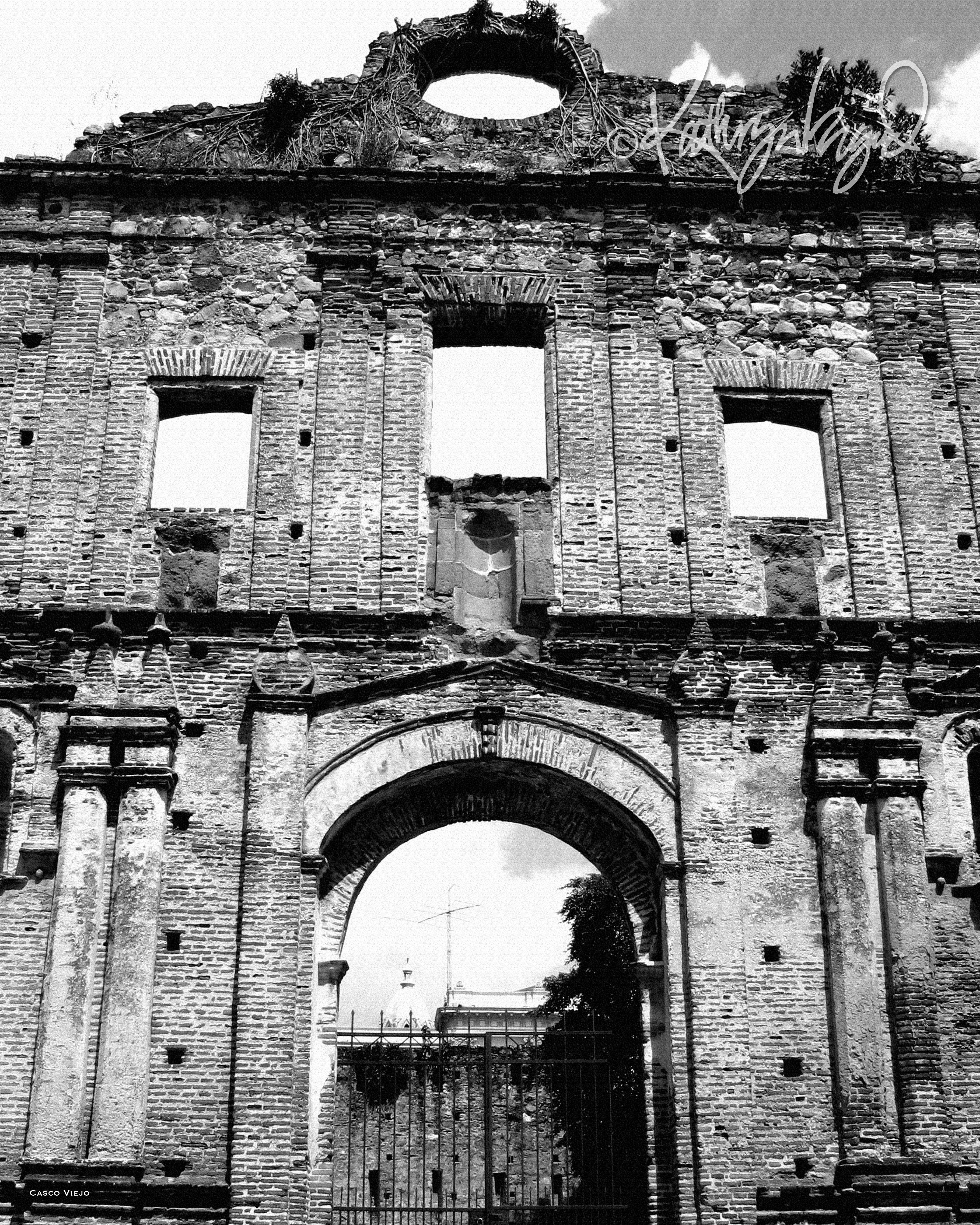
Casco Viejo

Since my dyslexic gifts (yes, I just spelled it dsylexic before editing) include complete lack of an inner compass, one of the particularities of strolling wanders for me is that I must always allow plenty of time, and assume a fair likelihood that I will be well and truly lost at least once per outing. Including in my home town. Possibly in my own yard. But so far I’ve always found my way back again, like the proverbial Bad Penny, and remained alive and unharmed. I’m reasonably canny about not going into dicey areas alone or after dusk, taking off without an emergency cell phone (now that I finally have one, though it really is strictly for emergencies thankfully), or going for a genuine who-knows-where expedition without telling someone. But beyond that, plus some welcome good luck and guardian angel accompaniments, I can say with a certain amount of pleasure, surprise and/or pride that many of my best adventures have happened as a direct result of just staying close to the ground and taking advantage of the fortuitous events that occurred along the way, embracing the goodness of the fun and fascinating people who cross paths with me in those fine and serendipitous ways that happen when you let them. They can’t put that stuff in tourist guidebooks.

So I’m glad that I got out and left behind any car in so many grand places, or I’d never have loved them so well. Munich, New York, Verona, Chicago, London .. . would any of them have been a tenth as lovely from a car as on foot? It’s possible, I suppose, but I wouldn’t take back a single pair of my worn-out soles to find out for certain. I suspect more truly that it’s because I get up and leave my car in all those wonderful, fantastic places that I end up leaving my heart in all of them too.

photo

Boston

Anything Worth Doing is Worth Overdoing

There was a boy . . .photoHe was remarkable, special and fabulous in every way . . . by his own admission. That sounds like a pretty smart-alecky remark from his bratty second daughter, doesn’t it, but you know, he’d be the first to tell you that it simply never occurred to him to doubt himself. Teflon ego? Naive puppy? No, he’s just a pretty cool guy and didn’t see any need to worry about it along the way.

People liked him; he liked them back. One thing leading to another, as they always do, he grew up and became, in various turns, a college graduate, a husband, a father, a seminary graduate, university board chairman, bishop, hospital board chairman, and oh yeah, all those other things. You know: the keynote speaker and community activist constantly playing both conscience and jester to the complacent. The nutty uncle who accidentally fades his snappy burgundy deck shoes to a flashy candy-colored light purple that becomes his infamously funny family trademark and then makes them the coveted trophy passed down from one to the next of all his nieces and nephews as they graduate from high school. The pastor who tells wacky tales from the pulpit that actually explicate complex biblical concepts and help to untangle earthly Issues for everyday humans. The bishop who travels with a phalanx of fellow bishops to act as bodyguard for their danger-exiled brother Bishop of El Salvador in Guatemala and escort him safely for a visit to his people at home. The respected administrator who sees a busy hospital through the building of a whole new hospital campus. The husband who woos his ever-tolerant wife with anniversary gifts of snow tires and garden manure but always remembers a card with an actual romantic note to accompany it. The dad who sends excuse notes involving kidnap by Green Gremlins to the principal’s office after his daughter’s flu absence from school.

My father’s stated policy, from a rather early time in his life, was that Anything Worth Doing is Worth Overdoing, and if it was spoken with a jovial wink, it was and yes, still is pretty much his modus operandi, whatever the endeavor. Underachieving was never an option and half-hearted efforts the same as not trying at all. This insight of his came long before the appearance of the modern day’s sloganeering cheerleaders insistence that one Go Big or Go Home.

photoDad brought along with him from his earliest years that sense of ease with himself and his place in the world and built it into an expansive view of what he could and should do and what the world could be with a little effort. As much as he indulged his playful and witty side (surely one of his most endearing qualities in his every field of action in life) he has always harbored a tender heart as well. Any practical tendencies of his that might be seen as hardheaded or stoic, serving him excellently in his many leadership roles as they did, were at their root driven by a deeper need to look out for others’ best interests and work to keep his own in check. All of this shapes a man who manages to maintain the unusual duality of a highly accomplished Type A leader and the Class Clown, a rare and gem-like formation indeed.

And today is that remarkable, special and fabulous man’s birthday.

photoAs it happens, he’s right, you know: anything worth doing really is worth doing to the nth degree and then just a little bit more. He didn’t get to be this advanced in age and yet still a ridiculously charming kid just barely beneath the gloss of grown-up-ness without having practiced that art well and truly. Happy birthday, Dad!

Order & Disorder

P&IMost of us seek order in our lives, or at least a sense of order. We want to believe that there are things we can assume and expect and even, if we’re really fortunate, control. Yes, those whose lives full of action and unpredictability and chaos would seem to exclude the possibility–extreme sports aficionados, high-powered businesspeople, rodeo clowns, astronauts, oil-rig roughnecks and those raising toddlers–look for order in their own ways so as make sense of their place in the universe. It might be in simple things like organizing the spice cabinet or sock drawer with obsessive neatness; it might be in the form of how they interact with people outside of the job, or it may be entirely internalized because inside is the only place they can see where they can exert their own opinions and desires and beliefs to the fullest extent.

In art, it’s often what differentiates in its subtle ways between the immature and the mature artist or designer or craftsman. It’s expressed as the creation of thoughtful balances or deliberate imbalances that succeed in creating the visual unity or tension in a composition, between colors, textures, distinct subjects and objects, or other elements of the work. While it’s undeniably true when disgruntled viewers look at abstract and non-objective artworks or some kinds of highly quirky contemporary designs and say “My five-year-old could’ve done that”, it’s equally true that the most sophisticated five-year-old will likely only do so by chance, and then only once, whereas the mature artist usually had a purpose, a process by which he was tweaking the tools and techniques to achieve something that might have as little chance of connecting with any individual viewer as that smarty-pants kid’s work but has a thousand times better the chance to succeed in what the artist intended and is, to boot, repeatable. To live on the less visibly ordered side of the equation is to risk losing communication with a potential audience, but for some artists, that is a worthy risk, most especially because the audience they do reach will be the more attuned to their visual language and will respond in kind.

In truth, the most conventional and marketable of artists and designers may have broader appeal, but can be just as off-putting to some viewers and would-be customers as any avant-garde members of the species. Order, as it happens, is in the eye of the beholder at least as much as is attractiveness in art.P&IConsider the Desk. Nearly everybody who owns or works at one creates his own environment there, because it’s somewhat controlled, controllable space. For some, the orderly desk is a perfect puzzle, each single item in a particular position on a particular bit of real estate thereon or therein. Some are always en route to that Ideal but never entirely there. And some have desks that look remarkably like bomb sights. Yet never assume that this is truly disorder. I have known people with desks whose archaeological depths of debris and deconstructivist demolition could easily hide the crown jewels, a body, or a small automobile and yet who, when they wanted a particular piece of paper or the mini-stapler, instantly knew the precise spot from whence it could be excavated. That’s order of a higher order.

What all of this means in the grand scheme of things is that it’s merely a set of constructs or ideals that varies so greatly from person to person and time to time that we’re all probably best served by finding whatever forms work for us individually and then allowing ourselves the flexibility to understand and tolerate others’ sense of order or disorder, whether we approve of it or not. Mostly, it won’t lead to apocalypse–and if it does, who among us will remain to worry about it? Maybe the ones with the monstrous, mountainous desks, if they can duck and cover under them fast enough. More likely, we will all muddle along as we’ve always done, some of us fascinated with baskets and boxes and cubbyholes and patterns and polish and others delighting in their weirdly convoluted and inscrutable tangles of Stuff.

And nobody Wins or Loses–except if you count losing that one danged Thing that you’ve been hunting for in the pile forever and ever (usually until realizing it is in your left hand pocket).

Come on in, the Water’s Fine!

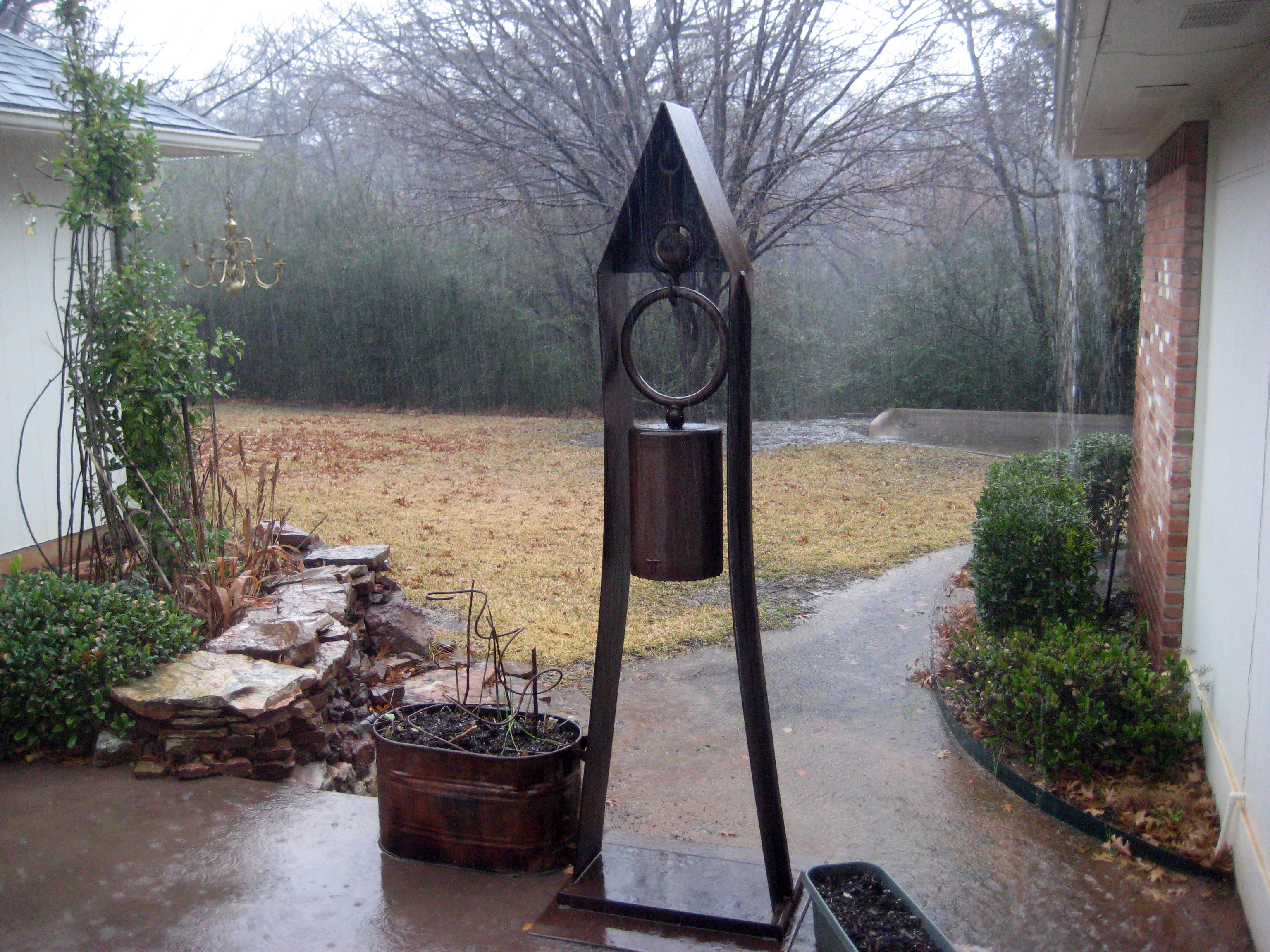
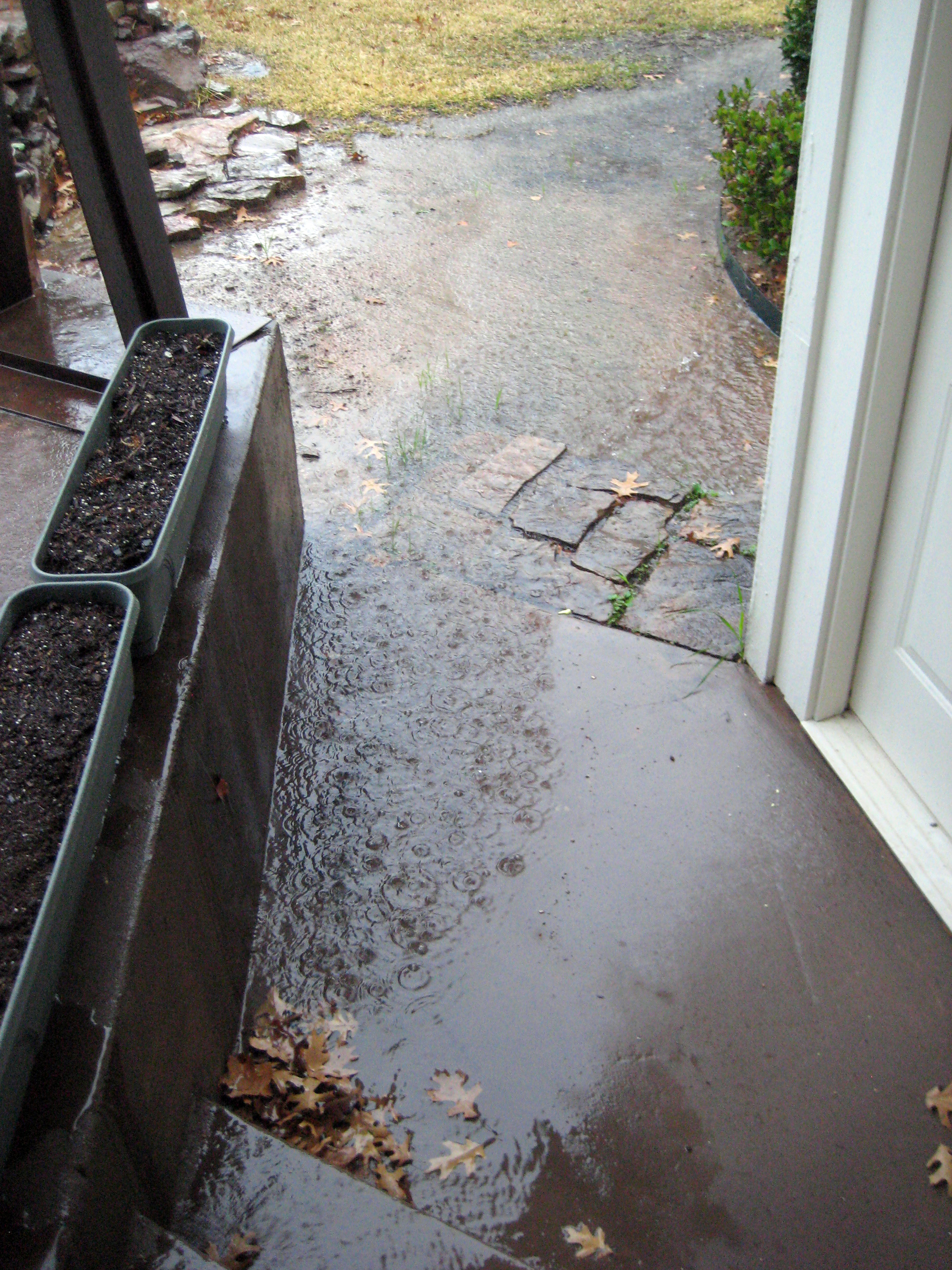
Since rain has been scarce here in the last year, today is a day for being happy to see ‘too much’ of it–it’s pouring out here. Texas style. And what, pray tell, is Texas style? If you haven’t already heard, Texans pride themselves on everything they have or do being big, bigger, biggest, and the weather is no exception: when it’s hot and dry, let’s just git on out there and set all time records, like last year’s string of almost unbroken triple-digit temperatures that exceeded all previous years’ totals. That, of course, is hard to maintain with an accompaniment of rain, so the skies simply curled up into an impenetrable ball like a li’l ol’ armadillo and gave up nary a drop of water until the whole state finally retreated into official drought. Our county was the last to comply, being somewhat feisty and all, but we finally dried up too like last year’s roses.

So today’s pelting, while it won’t miraculously restore the lake levels and revive the dead trees, goes a long way toward soothing shriveled spirits. It will, of course, drown some of the poor little sprouts that fought their way to life after the heat relented, and that’s just the way things go in a land of thorny mesquites and tough hombres. So far we haven’t had to build an ark, and that’s a pretty good tradeoff as these Texas-sized weather happenings go. So today I’ll leave you with a little photo-essay and a link to a bit of YouTube rainy-day fun I posted last year, with a little help from my good friends Joe and Eddie.

photo

The view from the kitchen is decidedly watery today! Hurray!

photo

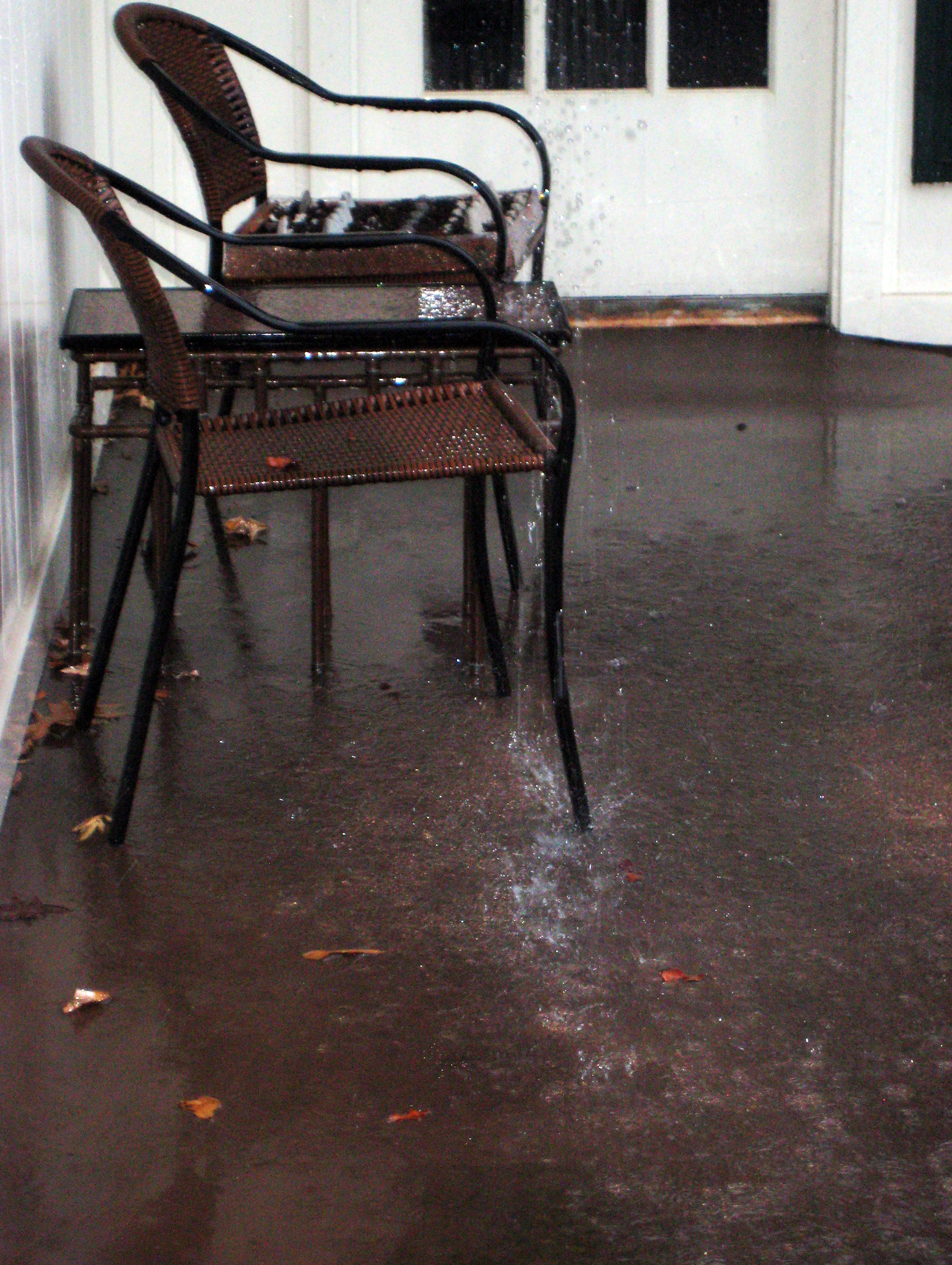
No worries about whether the little seed tray I prepped yesterday (sitting on the farther chair) will get watered . . .

photo

Maybe I should consider installing a koi pond at the foot of the patio steps . . . "Just Add Fish" . . .

photo

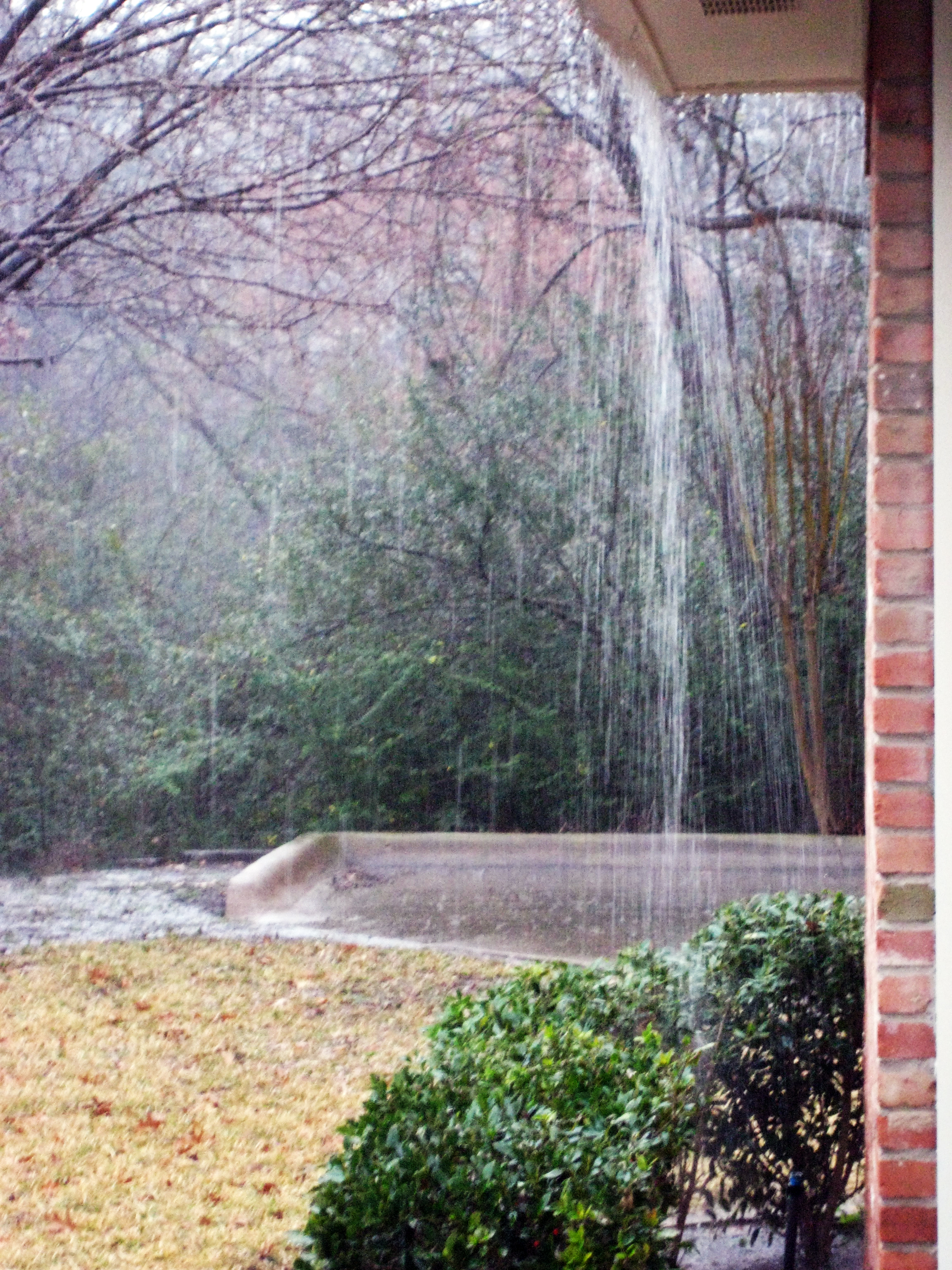
*Now* do you know what I mean by "eavesdropping"? Doesn't really matter if the gutters are clean or not; when it rains around here, they can't keep up with the rivers coming off the roof, so we just have Instant Water Features all 'round the perimeter of the house . . .

photo

. . . and who doesn't like the soothing sound of a lovely waterfall?

photo

From the shelter of the front porch, there are new "waterfront" views of ponds, rivers, small lakes and more cataracts showering off the roof . . .

photo

I suppose the Texas Sage babies I picked up at the nursery yesterday won't drown, at least, because I hadn't set them in the ground yet, so they're still safely raised up in their pots for now . . .

photo

. . . the little coreopsis I'd nursed through the winter indoors, however, is tucked in and now inundated. We'll see how that fares, never mind the rainbow chard sprouts (microcsopic green specks in the upper right of the photo)--I hope they turn out to be aquatic plants!

So this is how it goes here. Dry as a bone for months on end, and then an outpouring so generous that it might well cause new mutations of several plant species into amphibious forms in one fell swoop. I hadn’t realized we were moving to drought-and-monsoon country, but here we are. The slope of our property has definite ideas about where the water should go, and ultimately it does head for the little rivulet in the ravine behind the backyard, but in the meantime, I do think that directing the flow a bit on our actual lot will go a long way toward making the yard happier, if I can do it right. I was considering a moat around the house, since that’s the level spot where the water from up on the road naturally settles before wandering down-slope again, but I’m afraid the alligators I kept in there would eat too many of the neighborhood pets–or the neighbors–and that just wouldn’t be very sociable of me I suppose.

So I suspect a wiser thing might be to terrace a bit, put in some raised beds, and amend the living daylights out of the impermeable, gluey clay earth here, for starters. In the meantime, I’ll just say that it’s a good sump test for the property to tell me where the natural flow patterns and self-designed ponds like to go and see where it all leads. Good thing I got me some nice, tall, silly polka-dotted, ultra-waterproof gumboots. ‘Cause it’s rainin’ like nobody’s bidness out they-ah.

Nuclear Winter Descends on the Kitchen

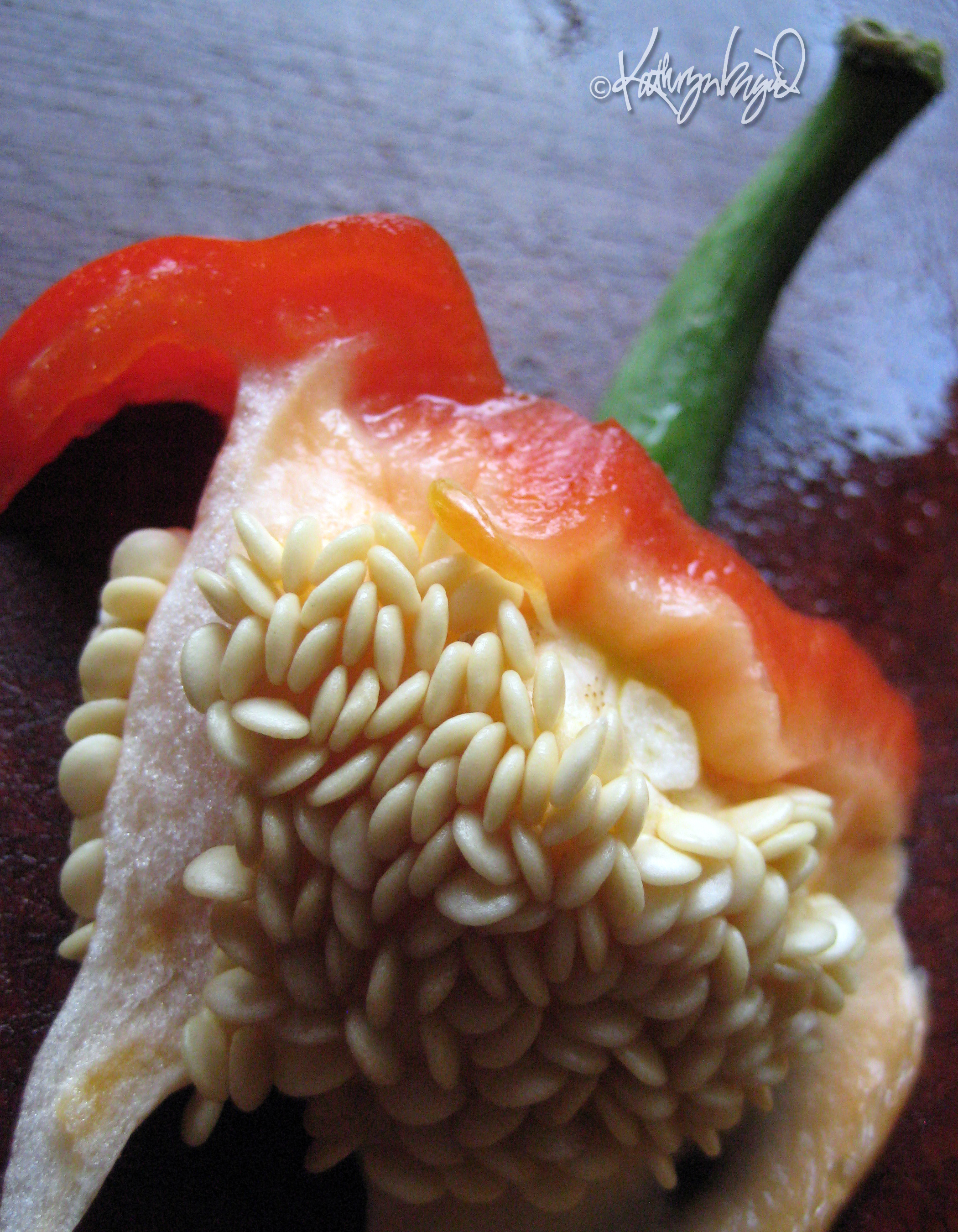
I am so not that blogger. You know, the one who makes stupendous, dazzling, dream-fulfilling, frenzied dance inducing deliciousness every time I enter the temple of cookery and take skillet in hand. The artiste-de-cuisine whose documentation of each morsel of impending salivary serenity is preened and primped into further gleaming gloriousness and photographed more glossily than a phalanx of supermodels in swimsuit season. The doyenne of dining, the poet of pumpernickel, the queen of quenelles, writing elated paeans to the plate that stimulate the appetite and soothe the spirit simultaneously, every word a twinkling, perfectly faceted gem of gustatory wisdom and love.photoSee, what my heart is cooking and what my hands and brains are genuinely capable of producing are not necessarily identical in nature, not wholly synchronous. I start out with a perfectly innocent yellow capiscum, intending nothing more sinister than to slice it into tidy segments and give it a friendly saute in a spot of sweet butter, and I think to myself, Why, that’s a mighty pretty bit of golden sunshine! I really ought to take its portrait. And sometimes it cooperates moderately well, and at other times it becomes something of an extended exercise in abstract thinking to even discern that the resulting portraiture is indeed of a sweet pepper, and a rather tasty one. It refuses to be anything other than a poor defenseless bell pepper mauled malevolently by bad knifework and lying listless, awaiting its ultimate destruction in a frying pan. I mean well, really I do.photoThere was, for example, an incident the other day involving an attempt to make (for the first time in a verrrrrry long time, mind you) crepes for supper. I wanted to make them without flour, since I’m making a sincere effort to battle an addiction to wheat and offset the unkindness it seems to do to my stomach. So to the eggs I added only a splash of cream to thin them a bit, a pinch of salt and a touch of vanilla for depth of flavor. So far, so good. But of course, not having made crepes in eons, I made the first one so far too thick that it morphed quickly into a leather-thick omelette of unwieldy proportions and promptly subdivided into continental shapes and semi-detached crevasses when I attempted to force it to wrap around the roast-chicken chunks anyway. The second was more successful, but given that the crepes were already going to be fairly huge and there were only two of us coming to the table, I’d only made enough batter for two crepes, so one remained a geographical disaster area when plated.

It’s hardly the worst sin I’ve committed in the cooking realm, but even the vegetable-mushroom medley in herbed tomato cream sauce being lapped over the top and sprinkled with shredded mozzarella to melt couldn’t exactly disguise the rocky profile of the crude assemblage underneath. Ah, well! It tasted fine enough that (given the huge portions) chopping up the remainder in a little casserole with some added tomatoes and more sprinkled mozz and cheddar to melt in made a perfectly serviceable (and actually, prettier) pseudo-lasagna for brunch the next day. I keep reminding myself that aroma and flavor, not good looks, must always remain the chief arbiters for the biters of the dish.

photoBut I can’t help but judge a dish on its beauty, still, and neither do any others unless they’re genuinely starving. Christmas Day’s standing rib roast of beef (above) was as tender and juicy and flavorful as any I’ve made, and in fact the gravy was a delicious simple reduction of beef juices and Cabernet finished with a bit of butter, but they didn’t impress with their devilishly handsome appearance as much as they might have done if I’d more intelligently plated the meat on top of the sauce, especially in the company of such homely looking side dishes as sweet coleslaw and brown-butter mashed potatoes. Presentation remains elusive, and capturing it on camera even more so. I must continue to learn!

Meanwhile, back at the oven, there are more serious disasters, ones that if compounded one with another and another as they were last week for some infernal reason beyond my ken, verge on apocalyptic. The centerpiece of one such Perfect Storm of kitchen failures was the day in which I managed to mis-set two crucial cooking elements at once. The end result of the first was that the wrongly timed egg boiling created not the expected hard-boiled eggs (a simple enough thing!), not even soft-boiled eggs mind you, but implosive mutant mush that was unsalvageable and decidedly unpalatable and went straight from kettle to compost in a trice. I was relieved that the Dutch oven finishing its long time in the sauna at least held a nice batch of broth that had been simmering overnight–that would cheer me up–relieved, that is, until I discovered that I had apparently jostled the lid out of place the night before and left just enough gap that not only did the liquid all vanish in a beautiful cloud, it left behind such a blackened, smoking pile of bones and charred vegetables and meat bits that I not only had to chisel out what I could and soak the pot for two days, continuing the excavations until I could scrub it back to a recognizable enamel surface, but I could also literally not photograph it at all. It was the perfectly even black of deep outer space, offering not a single change in surface that could reflect the light required by a camera lens for recognition. The smoke released when I opened the pot took days to clear from the house, and the only upside I can think of is that the pot was too tough to die despite its trial by fire.photoSo any time you are feeling a little blue, a little inadequate as a chef or depressed as a foodie, take heart. I have not only managed in spite of myself to keep self and fellow diners alive and un-poisoned for all of these years, even without resorting to the antique cure-all elixir waiting on the apothecary shelf, but have even occasionally risen above my faults and produced some memorably tasty, yes, even prettily presented, treats that people who didn’t even owe me money complimented. I’d show you the best of them and preen a little, but documentation still remains my weakest suit, and of course there’s that perpetual problem where the really good stuff gets eaten before you can say Photo Op! and dash for the camera. Later, perhaps. Dig in!

Cracking Open the Cracked Mind

oil pastel on paperJoyriding

I’m thinking of driving

Up on the sidewalks

On the way to

Work today

And up

The sides of buildings,

In the

Tops of trees;

I’ll probably drive

Across the bay—

It calls for

Some extravagance

On peculiar

Days like these.oil pastel on paper

Convulsions, Convolutions

I’m thinking baroque

Thoughts today,

Internecine and wild—

As weirdly Machiavellian as

The daydreams of a child—

As Byzantine as psychotropic

Drugs could make them be—

But you need not be worried for

My safety: that’s just me.digital photo

Remember the Living

I had meant to post this later, but given my earlier note to you this morning I think it’s the right one for today after all. Food posting can wait.

A little while ago I posted a pair of poems memorializing our beloved friend Jim, one of them (Keyboard Position) honoring a fine teacher of his, whose graceful playing as accompanist to a vocal colleague, when I heard them, was so evocative of Jim’s that I was instantly flooded with remembrance–and a few fond tears–on recognizing the source of so much of his comportment at the piano: his posture on the bench, the curve of his hands, the distinctive action in his wrists and arms. The second poem (Nocturne) was more specifically about Jim’s playing and, especially, the powerful sense that his music lingers around us, as evidenced of course, in that earlier performance of his professor’s.

P&I

The Organ at Trinity Chapel, one of the many we heard Jim play so magnificently.

Some folk were understandably curious about the backstory of those poems. I’ll start with the “front-story”, if you will. It was a decidedly more recent performance of keyboard magic that brought all of these simmering memories bubbling so actively to the surface. I chronicled it in another poem, posted here slightly earlier. While my husband, as Interim Choirmaster of an Episcopal church, was preparing a pair of Lessons and Carols services in December with choir and strings and organ, the guest organist who had already been engaged for the occasion by my spouse’s predecessor arrived and began both rehearsing and endearing his charming, avuncular self to us. We had some foreknowledge of this guest, and were prepared to hear his spectacular playing, not least of all the amazing improvisational skills for which he gained much of his fame, so it wasn’t terribly shocking that hearing him play was so powerfully evocative of our late friend Jim, also a gifted organist and improvisational artist. What we weren’t prepared for was this dear guest organist Gerre Hancock’s death a few days ago. Needless to say, we are saddened by his loss but immensely grateful we had the chance to spend a little precious time with him and hear him play.

P&I

Jim commissioned some Bach portraits from me for a program we did together, music and readings and projected artworks, chronicling the life and work of Johann Sebastian Bach.

There are so many unfathomable mysteries in life and death. How is it that our paths in life cross with those of just these particular people at just these particular moments and have such unimaginable depth in just these particular ways?

I can’t begin to believe that it’s all coincidental or purposeless, most of all because I know how much I myself have gained from knowing all three of these magnificent keyboard artists. I am deeply glad that Jim’s beloved mentor and professor, subject of Keyboard Position, is still among us. He is a kind, gentle and wise spirit whose mere presence in the community still infuses us with the warmth of his long service as a fine educator and the depth of his skills at the keyboard. Gerre, though not so very old at his death, had a long and celebrated career and rich life.

Jim didn’t get so many years to accomplish any of this. He was murdered at 40 by a suicidal gunman. There can be no sense made of it at all. Like so many horrors in this world, it ought never to have happened. That it happened to a man my husband and I both considered an intimate friend as well as colleague, one who indeed played a part in bringing us together and then stood up as a member of our wedding party while also acting as organist and hymn-writer for it; who with his wife joined us on our honeymoon; who collaborated on projects with each of us at the university and elsewhere professionally and who celebrated together with my spouse when they both finished their doctorates–needless to say, his cruel death was earth-shaking.

But that is precisely how terrible things unfold in the real world, time and again. For some of us there are mercifully few such monstrous events, and for others they seem a constant deluge. One or a thousand, there is no pretty way to decorate such grief and darkness and make them logical and palatable, or even tolerable. So how to do we go on living?

Jim taught me the answer as much as anyone ever did. He had had his share of sorrows and trials in his own brief life, but he also managed to live one of the fullest and richest lives, in his 40 years, of any person I’ve ever known because his constant focus was on seeking, embodying, and passing around every form of goodness he could encompass. His almost limitless capacity for loving and sharing those gifts with others was clearly reflected in an enormous host of dearly loved friends, people whom he claimed as family and who took to heart his lessons of generosity, hospitality, inclusiveness, and determined hope. He created an army of sorts, and one more powerful in its quiet, almost stealthy, way than most, of people like me who, while we remember him every day with both love and loss, move forward through it more determined to embody some little part of the wisdom and patience he had at his best, the passion, persistence, and relentless efforts to better not only himself and his own considerable skills but the lives of the people around him.

charcoal on paper

Among the artworks Jim commissioned from me over the years were a series of lighthouse images because he was captivated by the idea of lighting the way for those in need.

So when I think of him, I don’t constantly revisit the hideous memory of his death and grief at the gaping wound left in this world by his loss–no good comes of lying deep in those fixed, implacable sorrows. I am moved to remember, to be immersed in, the deathless love of a friend and companion; his admiration for lighthouses, which for him symbolized the shedding of more important kinds of light than the mere incandescent; in the many graces he worked so hard to polish to excellence* and what they ought to do for the wider world; in his shouts of laughter at whatever deserved a good laugh; and most deeply, in those still fresh melodies that his magnificent musical gifts keep alive in the one simple medium that will outlive all of our astounding technologies for music-playing and listening: the heart.

Only in remembering to treasure the wealth of living that Jim wedged into his brief sojourn among us, and in living out the best of his legacy that I’m able to do, can I keep the joy that he was alive. By continuing to hear and be moved by–and move to–the music that Gerre and Jim both (and now, Anders) left eddying around us, whether from their instruments or from those lives lived with arms open wide and laughter ringing among the stars, I remember best how to keep living my own life.

P&I

Jim's memorial sculpture on the university campus where we'd all worked together was my final commission for our dear friend. This image, with commemorative text, is etched in glass and set in a steel frame, and the piece is called, simply, 'Excellence'*.