Much as I’m drawn to wondering what lies ahead, guessing, inferring and even betting on probabilities, am I in danger of defining-by-divining? It’s easy to get so immersed in the practice of my prognostications that I start to believe in them as the appointed future and let them become my default reality. What a pity if by over-enthusiastic crystal gazing and navel gazing and pseudo-scientific extrapolations I manage to constrain my life to what I expect it to be rather than letting it unfold and taking full advantage of what I’m able to create out of those things with which life presents me as I roll along.
Candling eggs and reading ultrasounds of one’s innards and charting historic patterns–divination by trusted means–that’s all well and good, but only as a thought-provoking guide for what may be, and after all, if I don’t like the sound of the predictors, why on earth should I sit around and mope instead of defying the gravity of the situation! If I am to have any true resolutions for the future–the new year now unfolding or indeed, anything more than that–I’d like to think they will be about living that future in full, about being present in my present as it comes. I hope to be sometimes engulfed in the sweep of current life and sometimes embracing the immense and bracing Possible contained in every living moment with openness and imagination, hanging on for truly dear life. Let me dare to be fully, wildly, passionately alive while I live and not entangle in what-ifs more than is actually useful.
Everything we do with our days and with our hearts and minds and skills and nerve can be spent on worrying and wondering, if we take ourselves and our powers of prediction and over whatever mysteries lie in wait too seriously. Or there can be enormously exhilarating challenges and opportunities and blessings blooming in abundance, scattered around and waiting for recognition and engagement. I hope that I am growing wise enough at long last to let go of fear and inhibition and the fungus of fatalism encroaching on assumptions of a fixed and implacable future, to instead spend much more of myself on the kind of work and action and play that happen gladly in the moment of their discovery. Time, I say, to get moving and try those wings.
2011 in review
The WordPress.com stats helper monkeys prepared a 2011 annual report for this blog.
Here’s an excerpt:
A New York City subway train holds 1,200 people. This blog was viewed about 6,300 times in 2011. If it were a NYC subway train, it would take about 5 trips to carry that many people.
“Thank You” is an Excellent Exit Line. Or Opener. Oh, Both, of Course!
So I shall begin with a resounding Thank You. To another three gracious and inspiring bloggers who have nominated me for the Versatile Blogger Award. Thank You, amazing Eve and marvelous ‘Nessa and sweet Peaches! Eve’s poetry and prose move me so deeply I sometimes think she reads my mind–but with better compositional and editing skills than I have. ‘Nessa inspires me with her old-soul attitudes and resilience in the face of committed creative work in such a public forum as a blog at what seems to this aging lady like a tender age indeed, putting out fine and fiery writing as well. Peach Farm Studio is a lovely land whose mistress creates fabulous letterpress art and, as inspiration and adjunct to that, plays with beautiful and wonderful text, music, imagery and any other ingredients that can be combined to make the Studio’s output a joy.
Another heartfelt Thank You to the incredible Cecilia. She who presented me with my first VBA has now passed the Reader Appreciation Award my way as well. There is probably no irony at all in the fact that one of the rubrics for proper reception of this award is that one should pass it along to one’s own six most faithful commenting bloggers, but not to anyone who’s already received the award–and you guessed it, she’s been easily among the six most frequent and thoughtful and uplifting commenters here from Day One. One of my first frequent-flyers, period. And a constant source of gracious good-humored help and outsized compassion and good sense to push me ever upward and onward.
Now, in case I needed an extra boost, ‘Nessa popped back over to my place to tell me she’d also nominated me for the Kreativ Blogger Award, and that deserves yet another moment of humbling contemplation of my embarrassment of riches and the great aid lent me by all of you, to which I add Thank You again, no less joyfully and with equal amazement at my good fortune.
All of these are among my cloud of muses and angels, my support and drive and comfort in the form of family, friends, and teachers–all of whom are represented among you, my gracious and ever-encouraging, in the deepest sense of that word, readers. So I Thank You all particularly and sincerely for all of the strength, wisdom and joy you have shared with me since I began this blogging adventure. It seems far more than mere months ago that I began to meet you all–you have become so much a part of my world that I move through my days buoyed by the mere knowledge that you are ‘out there’ thinking up innumerable ways to brighten and improve my life, even when you don’t quite know it. That, you might well note, is what family and friends and mentors do, and oh, you do it very well indeed.
At the end of the year I can look back and be thankful for so many fine things, and one of them is clearly the great experience that my dive into the untested waters of the blogiverse has turned out to be. Thank you for making it not only painless but a great pleasure, a steeply upward learning curve, and generally smooth sailing to new and delightful places. I cannot begin to tell you how much I look forward to seeing those places with all of you.
For the moment, I shall wrap up here by recognizing those others who have so sustained me with their commentary. There’s the wonderful ChgoJohn, who also has already received this award himself because he’s always out offering wit and succor and freshly-sauced pasta to everybody around these parts; the sweet cfbookchick, so tender-hearted, poetic, quick with praise and generous with clever commentary as well as being a fellow ooh-sparkly-objects human magpie; the gentle, celestially-inclined Barb of Just a Smidgen, who consistently provides far more than a smidgen of encouragement and sunbeams and shared love of music hereabouts; the warm and open-handed Marie in her Little Corner of Rhode Island, who nurtures all while slyly tickling our ribs and funny-bones, stealthily adding bits of great practical advice all the while; and the self-effacing fairy godmother of Ireland, Our Lady of Just Add Attitude, who eschews awards (luckily for me this one officially doesn’t require her responding to it at all unless she so chooses) despite producing award-worthy posts of her travels and thoughtful ruminations on all sorts of good food and pretty things and then turns around complimenting everyone else as though she’s never heard of such talent. All of you, whether you know it or not, have been an amazing and unexpected joy in your sharing yourselves with me here.
It could but most certainly should not go without saying that these are all joined in my field of heroes by such fine characters as Ted and Nia, the two bardic Dennises, Raymund and Caroline, Desi and Lindy Lee, Anyes and Bella, Neil and Geni and oh so many other worthy and outstanding blogger colleagues and friends. And of course there is that particular fella who patiently shares me with my magical laptop kingdom and who works to keep the roof over our heads as well as still making me glad every time he spontaneously yells out “I LIKE YOU!” and gives me a big goofy wink.
Farewell, good 2011. Come on in, great and glorious 2012! And to all of you out there reading this, may you have a year full of peace, love, joy and ridiculously fun creative living.
The Only Useful Retrospective Operates on a Pivot
If examining history–on a grand scale or on a very tiny personal one–doesn’t ultimately result in turning around to move forward from that study, it is of no use. I find the obsession at the end of a calendar year with reviews, retrospectives and rehashes sometimes entertaining and even intermittently informative, but at the end of the day (or year) what I want is to know: where do I go from here?
There are plenty of fine reasons to revisit what has gone before. It’s meaningful to honor those things, events and especially people we hold dear when they are no longer part of our lives. We can recognize past mistakes, uncover gaps in our experience or behavior or education. We take inventory of what we have accomplished, what we have gained, how our world has expanded, and those valuable objects and attributes that have accrued to our accounts over the past part of our lives. But if it stops there, it can serve no great purpose in the long term, I think.
The deeper honor for recognizing losses must lie not only in coming to terms with them–acceptance, if possible, but if not, then some sort of détente that makes us able to separate that grief and pain from the necessity of not only continuing to live but to grow and thrive. It is no gift to those causes and persons we have loved if we do not continue in our own new ways to seek and become those things we admired in them, to share them with the rest of the world that missed the chance to know them in their own right. If we dwell on mistakes and do not seek amends for them, no one is made better, least of all ourselves. Failure that leads to learning, improvement, reconciliation or higher goals for the future is in fact a beautiful and curable disease. Real progress–growth–almost never comes without the forerunner of Failure. Most of us miraculously able to accomplish something grand on the first try can’t replicate such an accomplishment or even ‘get’ how to achieve the next one, because there has been no passage through the great human experiment of trial and error, of practice and repetition to drive us to the point where we can deliberately and even repeatedly do such fine things.
Certainly, recognizing the great and good things that have been granted us in the past is given its true value and meaning both by our showing appropriate gratitude and then by our turning to the task of making wise and joyful use of whatever wealth we have, whether it’s a piece of bread we can share or it’s the Nobel Prize that sets a foundation for a whole new field of research or it’s a solid investment that paid off well so that we can afford to reinvest in the company or it’s being experienced enough to teach a kid how to ride a bike. Having something of value isn’t really all that impressive if it sits and collects dust while we too sit and collect dust. Unless, perhaps, one is a connoisseur of actual Dust. That is another Issue altogether.
Meanwhile, here I am at the end of another calendar year, taking inventory with everybody else and wondering what it means for my future. What, after all of that, do I want to do with my baggage, good and bad? There are some specifics, I suppose.
I have been a slug, growing more and more sedentary and finding more and more plausible (to me, at least) excuses for doing so, and I intend to get fitter. Not as fit as in my days of hefting a 60-pound bag of Quikrete on my shoulder or scrambling up a scaffold three stories to haul five gallon buckets full of paint up for work. That Me is long gone. But I am going to find a much fitter 50+ me, and that will be satisfying work. As I’ve grown more dedicated to writing in the last year or so, I’ve shelved my previous commitment to practicing drawing regularly that was satisfying as a process and led to some equally pleasing improvement in agility and technique and even end product. So I’m going to re-balance my work to engage in creating more visual art again, whatever the mode or medium.
There, I’ve said all of that out loud, in public, in front of all of you grand people whom I admire for so many attributes that I won’t be able to replicate, and I know you’ll hold me to my promises, because you’re that kind of encouraging and inspiring folk and, yes, a little bit intimidating in your gifts. And the more so in your accomplishments, because after all, that’s what I’m really talking about here: not what we already are, but what we strive to become, however gradually and through whatever study and practice and love of progress it takes to close in on those horizons.
A bit of challenge? Oh, YESSSSS. So it will always be. Mysterious, sometimes frightening, certainly adventure-filled in many ways. But that’s what the past should be teaching us to do. Today was made possible by all of the yesterdays that shaped me, coupled with the will to move forward from them. Tomorrow will be made that much more possible by adding what I’ve learned and accomplished today and letting it help to push me another notch onward. If looking backward thoughtfully can do that, I can barely imagine what looking forward will do. But I’m going to lean into it and see.
Into Tomorrow, Endlessly Singing
You all know by now that I am not a singer. I get asked all the time, since I’m married to a choral conductor (who happens to also be a lovely singer himself) and I hang out with an enormous cadre of the vocally talented. When I demur, I get asked what kind of musician I am, then, because after all, so many denizens populating the rest of our joint life are outstanding composers, instrumentalists, conductors, and all of the rest that, well, it just seems so obvious. In truth, I did take the obligatory childhood music lessons–about five years at the piano, if you remember–ending with a certain rueful amusement on my teachers’ part but no great skill on mine, plus a brief period of voice lessons from a well-meaning coach who’d heard my sisters and me sing and gave the elder two of us a go. Where again, my failure to learn to read music with any ease was further complicated by my inability to understand and make use of the very important concept of singing with a head voice. Having become accustomed over my earlier years to being mistaken for Dad on the phone, or for an older girl because I was extremely shy and therefore more reserved than many kids my age plus having a relatively deep voice for a girl, or for a more skilled singer than I really was because I was willing to sing any part–and did, at one point, sing in all four choral sections because that was how the need was distributed in my various school and church choirs–well, it all probably let me learn a whole array of bad vocal habits that pretty much put the kibosh on my becoming an actual skilled singer. The likely absence of a notable native vocal “instrument” wouldn’t’ve helped either, had I tried to force the issue, but by the time that I hit high school and time management demanded that I narrow down my interests a bit, choir fell off the list other than occasional singing at church. Who knew I’d end up partnered with this guy!

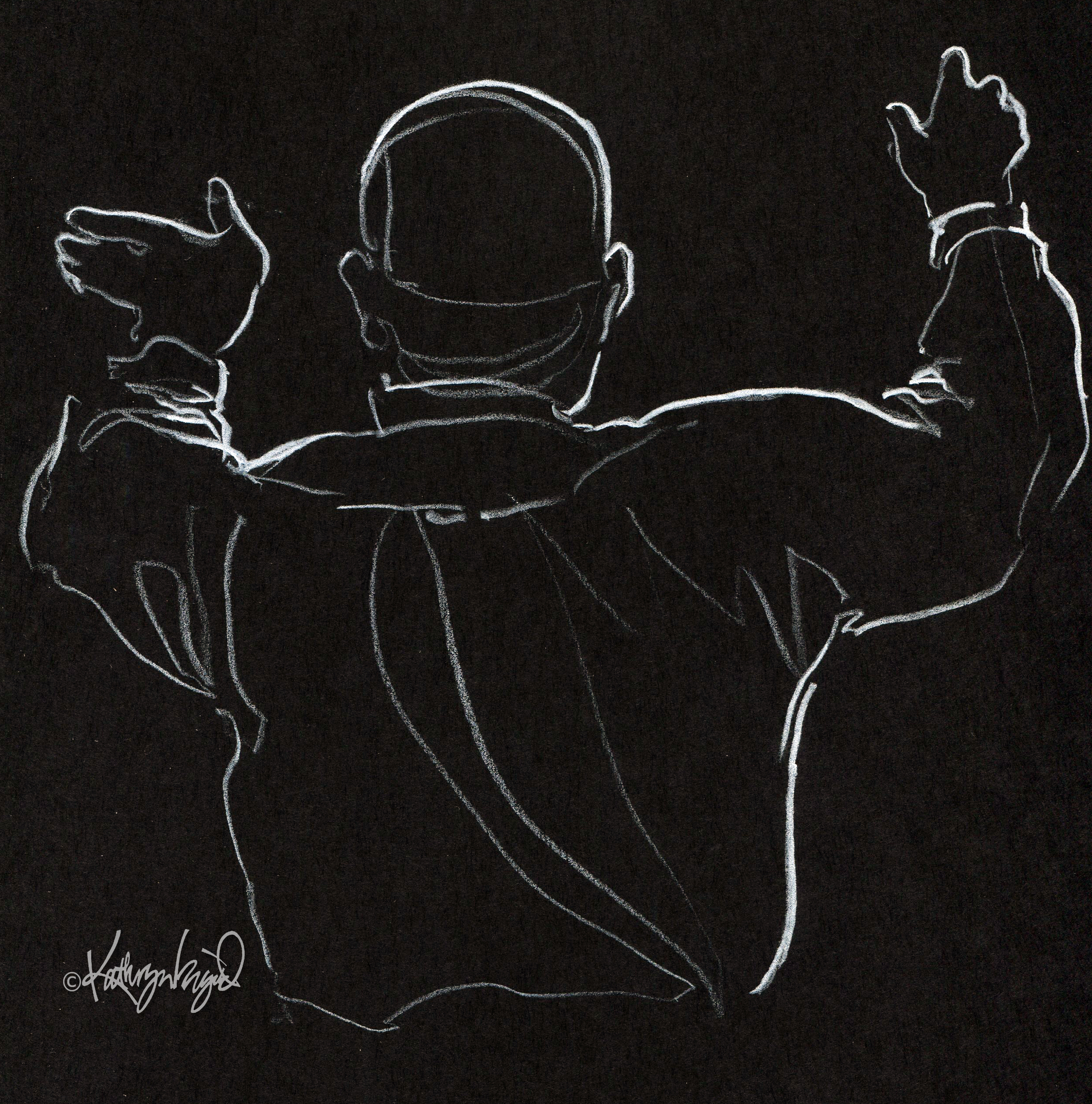
Sketches from a Swedish Radio Choir rehearsal, my husband conducting (if you've seen him conduct enough, you can recognize even the rough sketch of his hand positions) . . .
But as I also pointed out some time ago, the influence of music and of singing remained large and happy in my life, even if I was not destined to be a producer of them. I continued to love listening, cultivated many musical friends who provided the sonic tapestry that was the backdrop of my happiness, and even collaborated with musicians on projects where they provided the aural elements of a performance and I the visual imagery to accompany it. For a few years, I served on the Concert Committee that produced a reasonably ambitious season of musical offerings at our church, which was conveniently located just across a university campus from the music department where many of my fine-musician friends happened to work. It must be added, in fairness, that the draw of being on said Committee was not purely musical but also deeply social, what with all of the musicians and music-lovers therein, and also exceedingly delicious, because most of the musicians I’ve known are committed eaters if not foodies and so the Committee’s meetings quickly evolved into elaborate gustatory events as well.
And that’s precisely why music has remained so largely writ in my life, if not burgeoned and positively exploded, over the years since: music is so intertwined with so many parts of what I love in life that I can’t separate one happiness from another. If music be the food of love, play on! What hasn’t followed for me is what followed for Duke Orsino, because I never found either that I became surfeited by listening to good music or that I became surfeited with love by loving life with musicians–one in particular. Tough luck, your Grace! So I am not dutifully following, wagging my tail obsequiously, as I go to a rehearsal and sit in the darkened hall while choirs work their repertoire into their voices and souls to prepare for performance; I am both absorbing the inner workings of music that don’t exist in me innately or by scholarly wisdom, so to appreciate and bathe in the final production all the more, and also having the beauty of the practice itself wash over me in waves that can inspire me to write, to draw or paint, to design my better garden bed or concoct a more delectable dish for dinner. Waves that, at their best, lift me out of myself and let me feel the singing pass through me as though I, non-musician-non-singer that I am, with spasmodic dysphonia that presumably means even if I ever figure out my head voice and/or learn to read music, I won’t become a great singer–as though I myself were singing.
So, though I may struggle to sing a simple ditty nowadays, I have this magnificent vicarious experience available to me that few are privileged to share, and in this rather out-of-body experiential way expect to sing my way through the rest of my very happy future. As I do the usual end of the year assessments and look ahead to what I imagine and hope for the year soon to come, the imagery is suffused in every possible way with music. I am immersed in song. I write lyrics because I cannot sing them. I listen to rehearsals because I cannot read music well and don’t know the inner workings of music preparation the way performers and conductors do. I attend concerts because the kinds of beauty and grief, daring and humor, poignancy and brilliance that come through well made music embrace, interweave and transcend all of the other parts of my life so that I feel transported, changed to a better self. As though I too am singing in a song that may never have to end.
Improvisation Leads to Reverie
Improvisations in the gold-lit nave, where I sat as of old,
Among the candle flames and greens, the paraments and carven screens
And incense-laden night, these scenes of ceremony were the means
Offsetting those surprising, bold improvisations that you told
The sanctuary’s lofty lair, and all of us who huddled there
So mesmerized by new-made tunes, to which our souls were not immune,
Since you were writing down the runes
–as you have done these many moons–
You marked this newness down with care, though improvised out of the air;
I bent to listen to the way that old pipe-organ seemed to say
Something, in whispers, of a time–long past, I thought–in which sublime
Rhythms and patterns like your chiming play of Tierce en Taille, were, I’m
Quite sure, shaped as a different lay, wherein another love did play,
A love now gone to other stations of the Cross than these relations,
Playing something sweet and deep across the borderlands of sleep,
Across your grand recital; sweeping through the memories I keep:
Those evening organ-conflagrations, candlelit improvisations.
Foodie Tuesday: Lefse as History
Mama’s Justifiably Famous Potato Lefse
[This is a recipe she developed in collusion with a group of faithful Old Norskies in Puyallup, Washington, one of whom added the strict instruction that the lefse must be rolled “so thin you can read a faded love letter through it”. I’ve spelled out the procedure here in my own words, so Mom can’t be blamed for that part of the recipe!]
8 c. cooked and finely mashed potatoes
1/4 lb. butter
1/2 T salt
1/4 c. potato cooking water plus 1/4 c. evaporated milk
2-3 c. flour + more for rolling the lefse
Take a gallon bowl filled with 8 cups of riced cooked Russet potatoes, still hot, and press 1/4-pound piece of butter into the middle of it. Put a generous 1/2 tablespoon of salt on top. Pour a mixture of 1/4 cup of the potatoes’ cooking water plus 1/4 cup of evaporated milk over the top of the salt. Mash everything together thoroughly and mix it with 2-3 cups of flour. This makes enough dough for 20 lefse. [Yes, Mom was likely to make a triple recipe or more for many occasions. Eat one piece and you’ll know why.]
The flour amount should start out as small as possible and only get the potatoes into a very light dough-like, rather spongy consistency, and not stick to your hands as you mix. The more flour added, the tougher and drier the finished lefse will be. Mom almost always did the potatoes the day before their appointed baking day, rolled the tender dough into logs about 3″ in diameter and wrapped them in cling film, storing them in a cool place. The fridge is forever too crowded at the time when you’re lefse-baking for festivities of any kind, so if the weather was cool enough, the potatoes usually waited overnight on the workbench in the garage in that state for their final apotheosis.
Baking day is invariably messy and laborious, particularly on the days of multiple batch preparation. One does best to have the correct tools for the occasion, and they are many and specialized. First, you really ought to have a lefse griddle, which is a flat, circular electric griddle about 18″ in diameter and capable of reaching around 500º F in temperature. You’ll also want some nice old flour-sack dish towels or linen tea-towels to stack freshly baked lefse between on the counter as you take them off the griddle. You’ll find it helpful to have a pastry rolling cloth on your work surface, because not only will it keep the lefse from sticking as easily to the countertop, it’ll also help hold the lovely texture of the lefse’s surface that is so ideal for carrying oodles of melted butter and other fillings.
Make sure to have not just a rolling pin but an actual lefse rolling pin, a wooden pin whose roller surface is scored to create the optimum texture: some are simply grooved with parallel lines around the circumference of the roller and others, like Mom’s, textured with a full crosshatch of about 1/16th-inch grooves). Most people using the lefse rolling pins also like to use a soft cloth sleeve over the roller, because (and you can guess how I know this), a very soft, tender and potentially super-sticky dough will create a remarkably gunky agglomeration in the grooves of the pin, and lemme tell you, it’s a serious undertaking to get that concrete out ever again. Think about how many of those little grooves are on a whole rolling pin. Think fondly of an early death. Nahhh, just cover the pin.
Last and not least, it’s good to have a really fine lefse turner. Yes, the person who will flip the lefse when it is appropriately birthmarked on one side with light brown speckling to give the other side its chance for equally pretty freckling, that person will be an important part of your equipment. But even more important is the modest sword-like object known in our household as a lefse turner. It’s a flat stick around a yard/metre long. Yes, it would probably be entirely possible to use an actual sword for the purpose, but if you did, what would you use to fend off the ravening lefse-starved Viking invaders whilst baking? You could probably use a yardstick. Then you might well benefit from the ability to measure your lefse’s circumference in the very midst of moving them from griddle to stack. My mother has two lefse turners of both great practical beauty and artful grace. Gramps handcrafted them from fine-grained wood, making a 3/16″ thick x 2-1/2″ wide handle end pierced with a hanging hole and tapering them down to a soft ovoid tip less than 1/16th” thick, each turner sanded down to perfectly smooth softness so that it feels as sweet in the hand as that aforementioned sword ought to do in a master swordsman’s, and able to slip its narrowest point easily under a magically tender hot lefse to lift it from the griddle to the cooling stack.
With your mise en place, off you go. Slice the log of soft potato dough into evenly measured pieces that, when you pat them gently into shape, are about the size and shape of a slightly smaller diameter, slightly thicker than typical hamburger patty (twenty pieces from a whole batch, if you remember). Keep them rather cool, so that they don’t become more difficult to roll–they’re sensitive enough as it is. Gently flour the outside of a piece of dough, pop it in the middle of a small handful of flour in the center of the pastry cloth and roll the lefse out into a circle of delicate, ethereal, dainty, lightly textured sheerness as big as you can fit on the lefse griddle–even a tiny bit too big, because it’ll retract a tad and shrink to fit the griddle as soon as it hits the 450-500º heat; test to see how quickly your griddle bakes the flatbreads without either scorching or drying them out.
You don’t want the baked lefse’s spots too dark brown–lift an edge and check occasionally as they cook. You don’t want too much flour flying around–always use the smallest amount you can get away with using. You don’t want the lefse too dry–they’ll dry a bit as it is, when they’re awaiting use. As you can imagine, during the baking day one works hard, gets hungry, and smells buttery mashed potato dough cooking, so some of the lefse will not live long enough to worry your pretty little head about any real drying-out problems with them. Some will have to be rescued from their intended wait immediately for slathering with beautiful melting butter and eaten instantly. After all, there are always some lefse that resist the most valiant efforts to make them into a perfect circle and choose instead to replicate maps of various continents, and once you get too far away from Australia-looking they’re just not going to fold into even quarters for the standard packaging and serving format and it’s best to destroy the evidence. It’s sort of like James Mason’s delightfully dry remark in ‘11 Harrowhouse‘ when he’s found apparently in the midst of removing the contents of a diamond safe: “I’ve eaten the inventory.”
What else is there to say? Roll. Bake. Lay a freshly-minted lefse flat on a clean towel and cover it with another towel. Roll. Bake. Lay the next lefse on top of the first and cover it with that top towel. Repeat until all of that carefully crafted dough is baked into giant, tissue thin circles of lightly moist flatbread. When the whole batch is done, either eat it all for supper or let it cool under its towel, carefully fold each piece into quarters and then package small stacks of the finished lefse in zipper bags for the counter, refrigerator or freezer, depending on how long until they will be eaten.
And what is all of this enormous effort for? Some, including members of my own family, would say as Grandma W said regarding lefse’s cousin kumpe (Norwegian potato dumplings) that it was “a lot of work to spoil potatoes”. Others revere them as the Norsk version of the Mexican tortilla, Middle Eastern pita, South/Central Asian naan, or any other culture’s soft flatbread. Making lefse is of course potentially a fine way both to preserve the Norwegian culture in both country and family, as well as a social event. You know me, though: Lazy Girl helped only when I had to other than in the devouring of the finished product. It was usually other relatives and friends that pitched in with Mom in the manufacturing of lefse. And it’s so fragile, both as a tensile object and in its moisture content, that it doesn’t taste good for very long.
So in my opinion, what this labor of love is about is, well, love. Secondarily, it’s about a great potato flatbread best hot off the griddle and smeared with fresh butter only, as it always was preferred in my family. Others like it best with sugar and perhaps some cinnamon sprinkled on it before it’s folded up and jammed into their mouths, and we would sometimes, if the day had grown extra long and laborious over multiple batches of lefse, make a heartier meal of it by making a sort of quesadilla out of a hot lefse with some cheddar or Jarlsberg cheese and thin slices of good ham folded and warmed inside, not a bad “sandwich” at all.
In any case, I can tell you that there are many who will vouch for Mama’s inimitable lefse as the archetype of all potato lefse. But then, you already knew that Mom is pretty much the archetype of moms, so what would you expect! As for Grandma W, she may be forgiven for thinking potato dumplings, and possibly lefse as well, too labor-intensive for their meager culinary payoff since she grew up in her immigrant father’s grocery store and might have considered it better to enjoy prepared foods in that Modern, American way.
That’s Grandma, by the way, the little barefoot girl in white, Christmas-tree-tipping Auntie Ingeborg behind her, with their parents and little brother and an employee (haloed in window light) in Great-Grandpa’s grocery store. Lefse or no, they apparently did have some fine food on hand! May all of you dear readers eat well–whatever you’re eating!
Hurray, Hurray, It’s Boxing Day!
Christmas was a genuinely Big Deal in my family’s household when I was a mere stripling. Not only were there the churchly obligations and celebrations inherent in a pastor’s (that would be Dad’s) profession but there was being in a Norwegian-American extended family quite fond of eating, partying and jamming into one or another of the aunts’-and-uncles’ homes, all thirty or forty of us, to mark the occasion with the annual family gathering of the season. There was the feasting, of course, with mountainous platters of lovingly baked Hardanger and potato lefse*, meatballs, and all of that tasty stuff, not to mention all of the traditional cookies–rosettes, fattigman, sandbakelser, krumkaker and the like–enough to get kids and adults alike surfeited with sugar for the rest of the week. There were the much-anticipated visits from Julenissen, who in a stunning development was a dead ringer for Gramps at his jolliest and arrived bearing a big burlap sack full of surprises stuffed into other surprises, and all secreted in a multitude of newspaper-mummified little packets that had to be carefully unrolled, unwrapped, unfolded and unwrinkled from the mass in the sack, one by one, to reveal anything from a single nut in its shell to a dime-store toy to a larger gift earmarked, one for each specific kid among Granny and Gramps’s–ahem, I mean Julenissen’s–much-loved passel of holiday-hyper children.
At home, Christmas Eve was the biggest day of the season, thanks to the Norsk roots on both sides of the family, and always included the midnight candlelight service but also usually had its own bit of household festivities, not least of them the opening of the gifts; only the Santa stockings were reserved for that “lesser” festival of Christmas Day morning. Perhaps the most distinctive Christmas Days were in the years when we would have some of the family, often from Dad’s side, at our house since they weren’t always at the big gathering of Mom’s much more extensive family. Then, if Dad’s relatives were with us on Christmas Day we might well do another post-Norway-inspired deed, moving the Christmas tree into the middle of the living room and circling it slowly, hands joined, while singing a couple of old Norwegian Christmas carols. Lest you get the wrong idea here, we were so far from the von Trapp family as to mostly stumble around in our circle, forgetting half of the songs that we only half understood anyway (the pantomime bits that went with the songs were the best part, for all that), and on two occasions our beloved great-Auntie Ingeborg tipped the tree right over. But of course it was entirely worth it to get through that ritual to reach the package-unwrapping mania that followed, so we dutifully did our attempted tree ‘song and dance’ without too much impatient grumbling. After all, the tree might get tipsy yet again if Auntie was with us, one hoped.
Christmas Day, if it risked being anticlimactic after the big splashes of family visiting and diet-busting and gift-giving on and before Christmas Eve, wasn’t without its own attractions. First and foremost, it was a day when we were allowed to recover somewhat quietly from all of the foregoing extravagances, always rather oversized and glamorous in our eyes because of the time spent with our crowd of cousins and the general extremity of differentness from the rest of the year. Not that we slept in, I imagine, because despite the family focus on Christmas Eve we young twerps certainly didn’t object to getting a morning surprise from the depths of those stockings we’d hung up by the fireplace, along with the expected in-shell nuts, coins and orange, the latter best enjoyed by rolling the fruit against a hard surface to release its juices, cutting a small square opening in the side of the orb and stuffing a sugar cube in the hole through which to suck sweetened orange juice. After the hurried discovery of the stocking-stuffers we could concentrate on Christmas breakfast; the best and most traditional of the offerings on that morning would be a big pot of Julegrøt, a sweet milky risotto-like rice dish best enjoyed with plenty of melted butter and cinnamon and sugar, with a blanched whole almond buried somewhere in the pot to provide the lucky recipient with a particularly excellent year to come.
All of this tells you that I came from family traditions with no special recognition of the Feast of Stephen, let alone a clue to the existence of the great traditions of Boxing Day. When I first heard that name I might be forgiven for having thought it was a reference to the fisticuffs that followed less congenial families’ stressful Christmas Eve and Day events, and later for thinking it a reference to the pugnacious behavior of those returning and exchanging imperfect or disappointing Christmas gifts to a thousand thousand overworked retailers. It was both a pleasant surprise and a relief to discover that while both of those aspects were undoubtedly real in some unfortunate lives, Boxing Day was happily celebrated in many more households than those where it was feared.
This year’s Boxing Day at our house will be spent in rejoicing at the chance for a peaceful recovery from the unusually busy return this fall to a combined university-plus-church choral season of ‘all choirs all the time’ for my conductor husband, as we’ve been happily immersed in that good craziness now since September. So I think it’s time to introduce yet another optional definition for the day’s name, perhaps, something along the lines of a ‘Day for willingly Boxing ourselves into the house incommunicado and attempting to reverse the effects of all the wild busyness and cheerful excess that has gone before’. With that, I bid you all Peace!

See the Blazing Yule Before Us! Or just past, or a year away . . . or, well, see the coziness and great pleasure of holidays well spent!
* Tomorrow: a recipe for Mama’s Justifiably Famous Potato Lefse
Fanfare
My friends, whether you celebrate Christmas or not, between that and the coming of the New Year this is certainly a time of year in the western world when the presence of Christmas and New Year advertisements and discussions and preparations are ubiquitous to the degree that many of us still get drawn into the whole element of assessing our lives and our places in both the temporal and our inner worlds. It’s not a bad practice to do a bit of examination and evaluation from time to time anyhow, I think. Regardless of beliefs and philosophies, hopes and dreams, politics and projects, we can all benefit from a bit of gentle thinking-through about what matters to us. Somehow, for me that makes the end of a calendar year a cleansing time and a happy one in which I can look forward to a grand and hopeful entrance into the year just ahead.
With that in mind, I wish all of you great happiness in this time. I hope that you can find all the friendship, healing, comfort, peace and joy you desire, now and in the year ahead. And if you do celebrate Christmas, I wish you a truly happy one. If it’s Hanukkah for you, L’Chaim! If you’re preparing to celebrate any other holy days or holidays or are simply going forward full steam ahead with life, I send you my most heartfelt wishes for these delights to fill you now and in the year to come.
As the midday bells are sounding,
Morning light sharpens to blue,
Quiet moments find their grounding;
Thought needs no more things to do
To resolve all unsolved queries,
Weary, troubled, trying times–
Now thoughts rise to higher aeries
In the bell tower, where chimes
Ring new peace, and calm awaken,
Where new joy can sweep away
All the old thoughts, now forsaken,
At the bright noon of the day.
With trumpets blazing bright as stars
The grand procession moves apace
To urge us from a darker place
Into the light no shadow mars
Nor chill cuts in; no drop of gloom
Can enter when this day springs forth
And blossoms cross the secret north
And leave no sorrow any room—
Let each take up the pageant’s pace
To follow at the trumpets’ call
And sing their joy to one and all
The One Person More Lost than Me
Mom has taught me a whole lot of things. One of the most useful is how to turn one of my most frustrating shortcomings into a strength. It’s a skill I’ll still spend the rest of my life polishing, but having been taught the basics, I know what I need to practice, and that is a tremendous boost.
My lifelong shyness and social anxiety rose to a not-at-all-surprising high level when I started college. The small university I attended was hardly an unknown element to me, as my parents and a couple of other relatives, as well as some friends, had attended there and my older sister was already starting her junior year there when I arrived. But being predisposed to fear and intimidation as my responses to all social situations, I was guaranteed to struggle with extra doses of my old hauntings by the terrors of interpersonal experience in the new to me surroundings, with a roommate I met the day we moved in to our shared dormitory space, all new classmates, new teachers and administrators and a neighborhood where I’d never more than visited briefly before.
For the most part, I muddled through just as I’d done since I was old enough to know how to be afraid of new people and situations, and even had, as always, plenty of the enjoyment I was capable of having. I did acquire a number of grand new friends, including my roommate, who turned out to be a fantastic companion and like-minded girl. I took classes that challenged and intrigued me and I dragged up enough courage to participate in some events and extracurricular activities that broadened my scope significantly. I was surrounded in my living quarters in an all-female dorm by a cadre of terrific young women who bolstered my puny sense of self and cheered me on like the best of good neighbors.
But one day, as the first year progressed, I was visiting informally with a handful of those girls and we got into a discussion (as college coeds still often do, from what I’ve seen) about First Impressions. One of the girls, to whom I will be eternally grateful, let it slip that on first meeting me she had thought, and had since learned that others had too, that I was Stuck Up. That’s the simple classification among my tribe of someone who thinks herself superior to others and disdains and dismisses them. I was dumbstruck.
She went on, hastily, to add that on getting to know me she had realized that the reason I often refused invitations, that I didn’t look people in the eye, and that I evaded interactions and conversations instead expressed a defensive retreat into my giant ossified shell of shyness and my fear of all things new and unknown and that, in fact, she and others really enjoyed my company. That was some consolation, but realizing through her honesty that I projected an image far less benign and far more distancing than I guessed, I knew I’d have to somehow wrest my way out of the armor I’d built around myself and at the very least learn to act the part of someone with social skills even if I didn’t have them.
Naturally, I went whimpering off to Mom. And she surprised me by going beyond the sympathetic and consoling mother needed in the conversation. I’d never imagined that this person I’d always known as having not only a mother’s authority but a certain status as both the recognized Favorite Mom among all of my friends over the years and a kind of built-in First Lady of all of the organizations in which she participated, not least of all as the pastor’s wife–that she had another side, one not so entirely different from my own. That she had been deeply intimidated by being expected to play the roles of guide, hostess, chief female church member, community do-gooder and cheerleader, and all of the other philanthropic and social leadership parts inherently assumed by others to be part of her place in the world. And that, when Dad was busy being the speaker, preacher, chairman, boss and whatever his role of the moment happened to be, she was stuck in meetings and receptions and services and classes full of strangers who expected her to carry not only her own weight but that of whatever they thought was required for the occasion.
I almost wilted, thinking of what it must have been like for her.
But then she imparted the piece of wisdom that ‘cracked the case’ for me. I got the MacGuffin: social anxiety and extreme shyness assume that I am the center of the universe. That the rest of the world is watching me and is dependent on my doing or being certain things for its success and happiness. And that I am suffering the most for the cause. She put it in much more tactful terms, I’m quite certain, given that I was a flimsy excuse for an ego, a fragile not yet twenty year old still unable to see my path in everyday life clearly.
I think what she really told me (from which I extrapolated the above) was the incredibly handy ‘trick’ she’d learned for coping with all of these unreasonable social and activist demands. When you arrive, immediately look for the one person in the room more uncomfortable and more out of place than you. Even when you’re absolutely sure it’s not possible, there’s always someone more scared, more intimidated, more inexperienced or at the very least, who thinks that they are. It’s true, by the way; I’ve seen it proven over and over since. Go and gently introduce yourself and ask this person about him- or herself. Make this person the most interesting part of your life while you’re there.
That’s it, really. Suddenly, it’s not my job to be perfect or achieve the goals of the event or even to be interesting or brave; it’s my job to make another scared person feel more welcome and at ease. I don’t have to spend any energy on worrying about how I look to others or whether I’m doing what I’m supposed to be doing, because nobody with an ounce of sense is going to argue that taking care of someone in need isn’t what we’re all supposed to be doing, that recognizing that there’s someone whose need is greater than our own isn’t precisely the most attractive thing we can accomplish, and that a friendly smile isn’t the most fashionable item anyone can wear for any occasion.
I fall down on this effort often enough, still, and do my well practiced imitation of an additional pillar holding up the dimmest corner of the room. I haven’t Saved anyone else from the brink of doom through my heroic attempts to cheer them up for a half hour. I still have impressive dramatic skills in making faux pas and pratfalling my way through the day and then doing my best to make the earth swallow me whole.
But afterward, I remember to quit imagining myself the cynosure of Creation, let go of my need to be correct and impressive and likable and spend my energies on helping someone who doesn’t know Mom’s useful little technique to feel more correct and impressive and likable. I will put on my shiny smile and play the role of somebody better than me and hope that someday, if I practice it hard enough, it will become second nature and I won’t even have to work at it at all. It makes me smile just thinking about it.
If you happen to be headed to yet another office holiday party or first-of-the-year reception any time soon, you can test this theory yourself. Thank my mom. Or, if you happen to subscribe to a certain story that is commemorated on this very night, thank the Person who became most vulnerable of all in order to protect and rescue everybody weaker.