Better Off as Compost


digital image from a photoSnaking Suspicions
Bartholomew’s bones are now buried
In a bag in a box in a berm,
And when he has fully recycled,
He’ll become a new breed of a worm.
In life he was lousy and lurid,
Licentious and lickerish he;
Bartholomew Bogle was wicked
As one creepy creature could be.
So down in the dirt he is digging
New depths better suited his sin,
Alive, quite the snake, let us make no mistake,
Now interred, he’s the same in new skin.
Let Bartholomew go to the devil,
Worming down to the deep for his due,
And at least we can bless in our hearts the good lesson:
I won’t be a Bogle–will you?digital artwork from a photo

Animal Behavior

Little Beasties’ Escapade

Raccoon, Armadillo and Possum set sail

In a galvanized bucket, the teeth of a gale,

On the reservoir lake in the midst of the night,

Under cloud-obscured stars and without the moon’s light,

For they were on a mission requiring the dark,

At imperative speed, wildly searching the spark

Of a glimmer ashore on the lake’s farther side,

Where they’d scramble the banks and find somewhere to hide–

And what was their mission, to act like scared squirrels?

Escaping, of course, from the amorous girls

Of the possum, raccoon and ‘dillo persuasions.

Run and hide’s all one can do on just such occasions.digital artwork from drawings

Drawing on Your Beginner’s Luck

The nice blogger from Zara–A Writing Story stopped by recently and her post said she is working at starting to draw. I’m delighted to have another person join the ranks of happy visual artists via drawing–a collection of skills that come in quite handy (no pun intended, especially since there are artists who use their mouths or their feet to make artworks) for far more than strictly a pleasurable activity or visual entertainment. Drawing, a foundational skill in all sorts of visual art, is also a means of communication that differs from and can work in wonderful tandem with writing, singing, signing, and any number of other ways of personal interaction and transmission of information. In addition to the practical application of the end product of the process, the practice of drawing itself has great power as a mnemonic device, a tool for problem-solving, and the training of the brain in such useful skills as eye-hand coordination and (as I know from experience) the correlated motor control of working through tremors to achieve refined movements.

But beyond that, as I said to my blogger colleague, the act of drawing has elements of physical pleasure in the mere action of arm and hand and body that can be worth the pursuit, not to mention the mental and/or emotional pleasures possible. The act of drawing as a form of meditation, even without regard to any possible ‘product’, is quite desirable on its own.

As I said to my correspondent, she needn’t be intimidated in the least even if she’s a rank beginner: By even making the effort to learn, you’re worlds ahead of lots of others! A book I often referenced when teaching my beginner students in college was Betty Edwards’ classic Drawing on the Right Side of the Brain–it has exercises that aren’t too hard even for someone who’s never attempted to draw before, and because her focus is on how the brain works in visual activity, she offers insights into the process and possibilities that few others do. There are, of course, innumerable excellent how-to books for those who want to draw, many of them favorites of mine as well, but because of Dr. Edwards’ [then] ground-breaking work in recognizing the character of right-vs-left brain function and how it played out in drawing, I always found her work particularly helpful.

Because drawing can engage so many diverse cognitive processes like this, it can be complicated and overwhelming to know just where to start learning how to draw. As I remarked in my note to my fellow blogger, All of that aside, simply making marks on a surface is the beginning of drawing. Sometimes the least intimidating way to begin is to take a piece of paper, make some totally random marks on it, and then see where that takes you. Even if all it does is make you comfortable making the arm movements for a start, that’s helpful. If, as with most people, you look at it and think ‘that looks like . . . ‘ or ‘that doesn’t look quite right . . . ‘–well, then, you’re already making editorial decisions that can help you move toward drawing the way you want to draw.

The bottom line, if you will, for me is that I feel more alert, more attuned to potential solutions when everyday problems arise, and generally just plain happier when I draw. It’s not because every drawing turns into something fabulous–far from it–but because the process of drawing opens up my brain and spirits in useful and unexpected ways. Many times, my drawing produces nothing more than scratches that are shorthand for bigger and more complex and, I hope, better things to come. But the exercise itself is valuable to me, and a glance back through my sketches can often kick-start me into drawing a work that is more successful than the twenty previous ones.

line drawing

Exploring pattern in a sketch.

line drawing

Playing around with volume.

line drawing

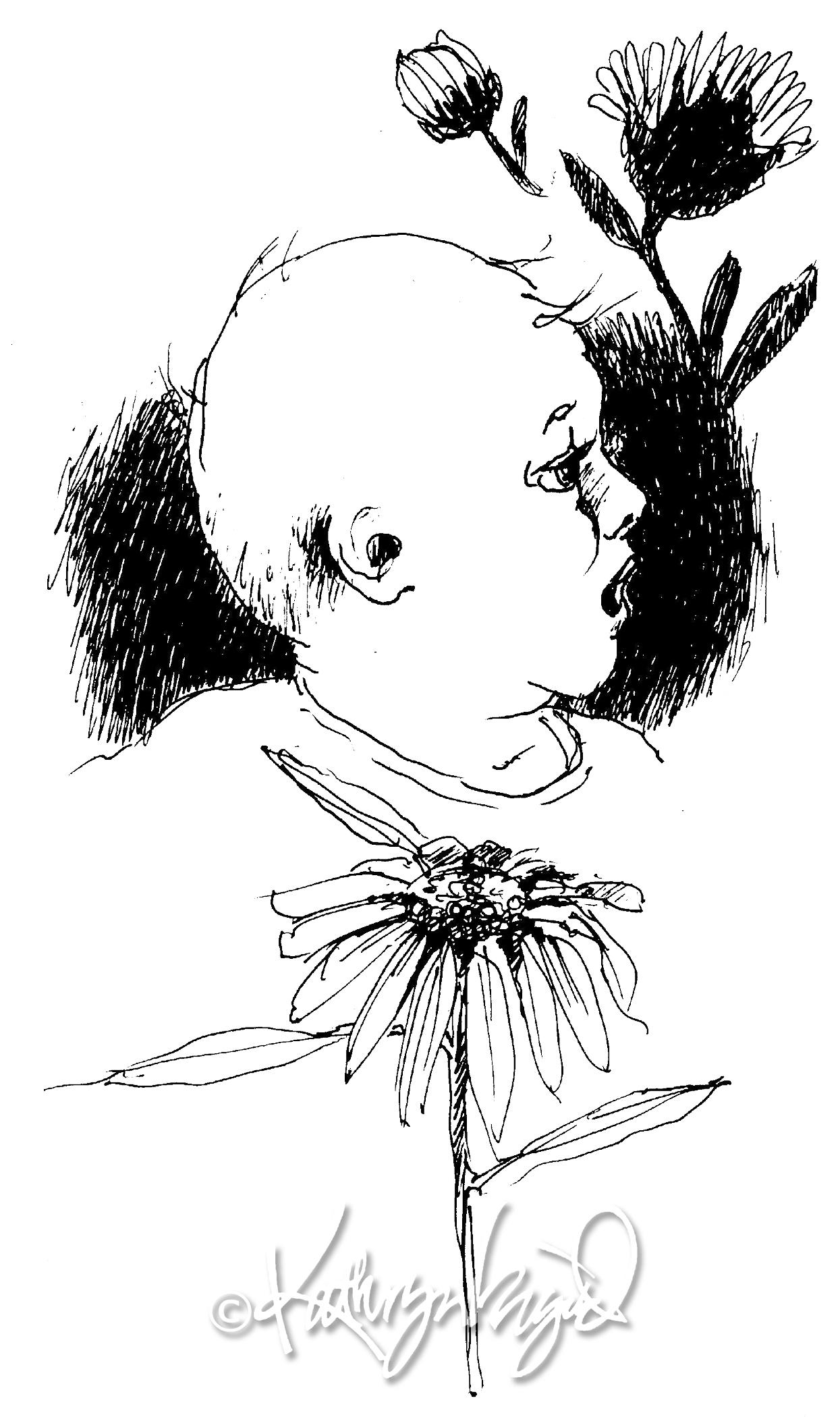
Faces and flowers show up often in my sketchbooks.

line drawing

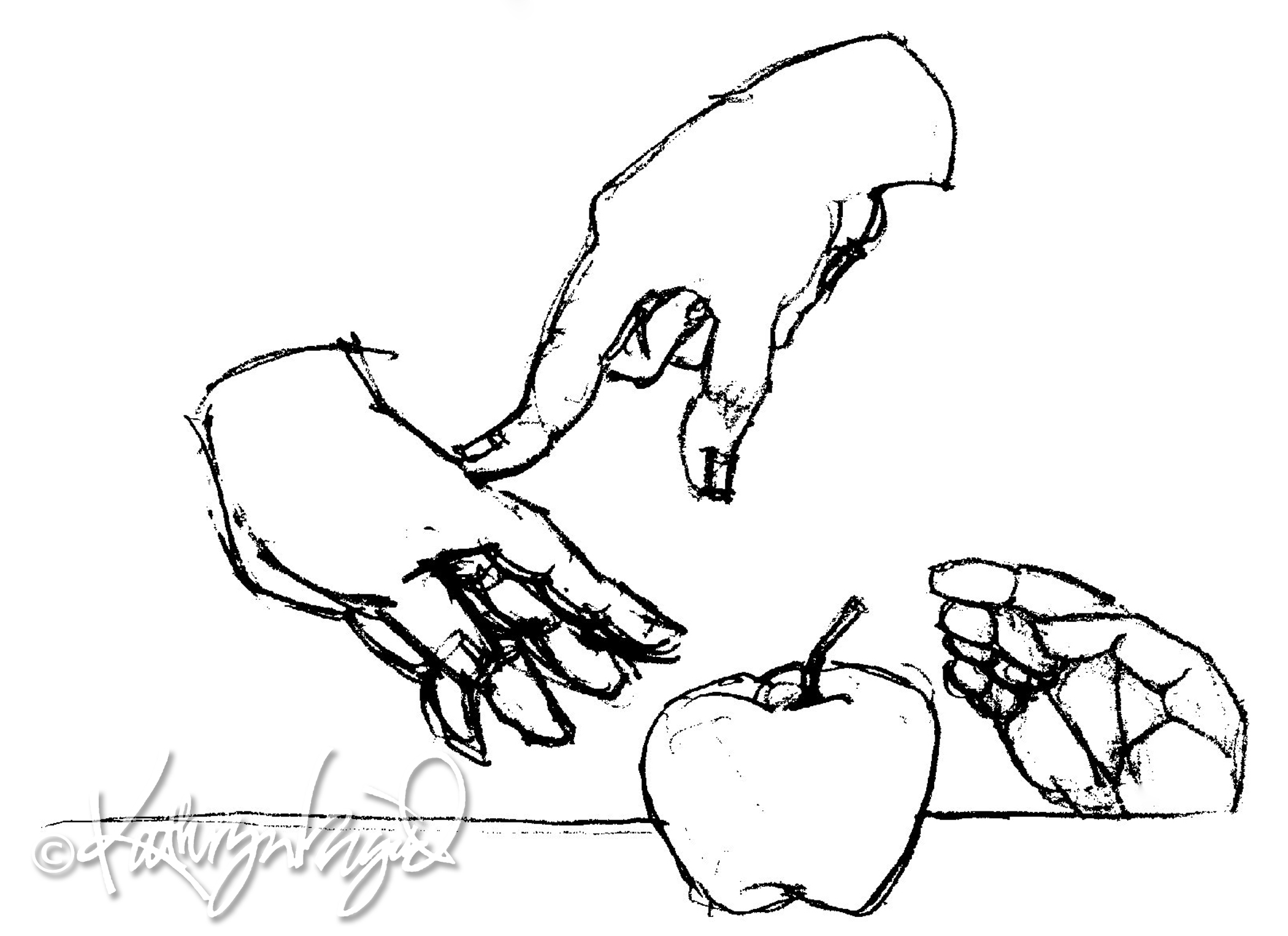
Hands can be pesky subjects, so I play with sketches of them frequently too.

line drawing

Any little vignette that pops into my mind is worth scribbling at least a few times.

Ultimately, whether I’m in gear for serious drawing or just fiddling with a pen or pencil to pass the time, it’s good practice and feels worthwhile. If nothing else happens, at least I have given my brain some thinking-room between the lines and I might figure out what to make for supper, how to cut through the piece of metal that is in the way of my completing a repair in the garage, or who knows–I might even remember where I set down that book I was reading days ago before it ‘disappeared’. It’s doubtful I’ll come up with any Nobel Prize-worthy inspirations while drawing, but then again, if I don’t draw, I’ll never find out!

Animal Rescue

Thanks to my handsome and perspicacious canine pal Rumpy over at rumpydog.com I was reminded again when I last visited his site of the complicated and, when it’s well-managed, fantastic relationships between animals of the human and non-human kinds.

The notion of animal rights and their humane treatment was enough of a fledgling concept in the broad public sense when I was a mere hatchling myself that it was represented in all of its wimpy glory almost exclusively by the catchphrase Be Kind to Animals. It’s not that no one had given a single thought to the necessary deeper commitment to conservation or species protection or rehabilitation or research or any of those other lofty and positive things, but they weren’t as widely recognized and commonly discussed as they are now. Does that mean we’re good at this stuff these days? Hardly. Progress is slow. Still, any progress is better than none, and gives me hope that we can continue to learn from each step forward.
photo

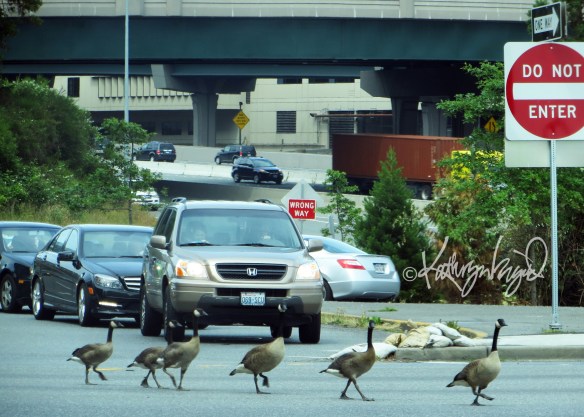
We humans are such silly geese; before we can fully serve other species, we need to get our own ducks in a row.

I myself make no pretense of being an animal rights lobbyist or animal care practitioner of even the most minimal sort. I haven’t been a biologist, nor have I ever farmed or been a veterinarian, or even, save in very brief intervals with housemates’ companions, shared my home with pets. My entire personal contact with animals beyond any local wild critters has been limited to meetings with so-called ‘domesticated’ animals–those whose lives and well-being are dependent upon the other humans who house and keep them in homes, on farms, and in zoos. And I must admit that I have always relished these times of interaction. Most of all I enjoy it when the animals, whatever their sort, are appropriately respected and properly cared for so that they, in turn, are healthy and content to do what comes naturally without being aggressive, destructive or self-destructive, because they don’t need to be in order to get along in life.

I wouldn’t have the remotest chance of saving a species, even a single needy animal, other than by means of supporting others in that work. I am, in fact, an omnivore, far from being a vegetarian or vegan; I don’t lobby actively for animal rights (or anything, being far from a political animal myself) and have no skills whatsoever in caring for animals. All I can say in my defense is that I think I understand pretty clearly the animal participation in this world of ours that makes the life of even a human like me with my exceedingly limited contact not only so much better but, frankly, possible. And I am beyond grateful for it.

This other bit of useful wisdom with which I credit my uninformed self could be simply translated as a recognition that the phrase Animal Rescue, commonly used to describe the magnanimous salvation of non-humans by humans, is more aptly applicable when used to describe the opposite. They save us.

The green earth that provides for our survival could never do so without the animals that keep its lovely recycling services operational. Animals, even those domestic beasts treated the most kindly, account for a large slice of the labor force that keeps our world operating on a practical basis. Animals act as medical and physical guardians and assist persons with sensory deficits or health challenges to let them live in a world that’s not otherwise adjusted to meet their needs. Animals have been and are part of police forces, search and rescue teams, security operations, transportation teams and more; they contribute to all kinds of research and behavioral studies and provide wool, fur and hair used for a wide variety of woven, filled or lined coverings, many of them over long productive lives.

Top of the list, if you ask me is companionship and comfort. These are the characteristics that we admire most in our fellow Homo sapiens. We look for warmth and unconditional acceptance from friends and loved ones and even from acquaintances and colleagues, and many kinds of animals willingly give us these in return for very little demand on their part as well. This gift alone makes me grateful for animals as much as all the other great treasures with which they grace our lives.

For all that I’ve had little animal presence in my life–or possibly, because of that limitation–I learned very early that each happy time spent in the company of contented, healthy animals makes me feel immediately new-and-improved. I don’t know if other folk would confirm that I am any better than I was before, but I feel better inside. It’s as though every five-minute increment in company with animals makes my blood pressure drop, my spine straighten up and my mind clear of unhappy junk and fill with peaceful, more meaningful, more creative things. Suddenly, thanks to having a goat come up to me in a field and beg for a good head-scratching, I’m thinking the sun got brighter and my lifespan just got extended, stretched another two days’ length or so; because a dog lay quietly by my feet while I was taking care of the day’s correspondence I gained not only the direct warmth of him against my shins but also, the warm glow of his trust and calm confidence in being around me makes me feel more trustworthy and confident myself and strengthens me to get my task wrapped up well and swiftly.

What I take away from this contemplation is twofold: I sincerely believe that I must do any and every small thing I can to improve the lives of animals by avoiding thoughtless approaches to them and simply by treating them appropriately whenever the opportunity arises. And I need to learn from them as well. I know I can benefit from being more, if you will, ‘beastly’ in this way–by approaching life a little less cynically, not thinking of the rewards I expect or desire in return for my actions but rather of the pleasures that being kind, just, helpful, hopeful or appropriate can give me in and of themselves. If the very act of making others happier can make me happier, how could I not love that? Seems to me like we can all benefit from ‘behaving like animals’ in this sense.

A wonderful daily photography blog, PhotoBotos, just published the spectacular photo that won the prestigious National Geographic contest in 2012, and besides being a truly distinctive and powerful photograph of a gorgeous tiger, the image marks a significant story (included in the post and comments) regarding people’s contentious attitudes toward others of the human animal when it comes to how we treat non-human ones. I find it sad, surprising, maddening and poignant that sometimes those who are sincerely motivated by a desire to protect and conserve wildlife are so unwilling or unable to see a need to extend the same courtesies to their fellow human creatures and the animals whose lives intertwine in less wild circumstances with theirs. It’s just possible that we ought to be learning better–as creatures with the ability to consider the needs of others in a supposedly rational way–to rescue ourselves and our fellow humans before we can more truly accomplish the care of and respect for other animals. They enrich our existence without any particular expectation in return. Imagine the possibilities when we do the same.

photo

Perhaps when we treat both humans and other animals with the proper respect and love, we will all soar like eagles.
The Center of Attention

When I am making artworks I am the ruler of all I survey. I get to invent my reality and decide how much of it I want to reveal to you, and even (to a certain extent) how I want you to experience this particular reality. I do know that you will bring your own point of view and that my art, this Empress having invented it or not, will tell you a story that exists in its own unique way within your personal context.graphite drawingHowever, like all storytellers visual or otherwise, I still control how much I’m willing to reveal to you of the whole project in the end. Do I give you the ‘whole story’ or choose to share a scene, a snippet, and then let you extrapolate from that to decide what the storyline is in the image, not to mention all of the possible storylines extending beyond the image in every direction? I choose the window; you interpret what you see through it.

In the case of this drawing of a lady with her fat pony, I’d say that a cropped version of the picture gives plenty of information about both characters and their relationship but mercifully deletes some of the evidence of my horribly sloppy parody of equine physiology, something that’s far more painfully exposed in the larger version of the piece. Yes, there I go, showing you my ‘underwear’ again. But don’t you agree that the image is improved, its focus stronger and its flaws somewhat mitigated, by the cropping?

graphite drawingUltimately, of course, I’m still Empress around here. I get to choose whether I’ll show you my process and share my behind-the-scenes action like this, let alone whether an image is finished or not, whether I’m going to use it for a post or not, and whether I’m going to tell a whole large story or a tiny bit of one. It’s good to be the Empress.

Depends on Whom You Ask

What’s happening in any given scene? Everyone who answers the question is sure to have his own answer. Point of view is colored and skewed every which way by one’s position at the moment, by the context of experience, by taste and beliefs. Is this a drama? A comedy? Every actor in the event might well give you a different answer.

The other day when I was hearing a delightfully humorous arrangement of the old western song ‘Blood on the Saddle’ (arranged by Trent Worthington) I couldn’t resist adding a silly illustration of my own to the music. In my sketch, the horse whose saddle has presumably been bloodied stands still enough now to act as a comfortable perch for a vulture that stopped by to survey the fallen cowboy as a potential buffet–though as the vulture has just landed he’s more interested in a short rest first. The horse, now riderless and not forced to buck, has no particular remaining interest in the fellow who until recently expected him to lug around the cowpoke‘s weight and kick his heels in the rodeo arena for a living. The cowboy, now just a flat stain in the dust of the ring, is of no more interest to the horse and little yet to the buzzard (not ripe enough yet, presumably). In fact, when I cropped the cowboy out of the picture altogether, it struck me that the horse and bird looked pretty peacefully contented just lounging around together.graphite drawingSo, whose point of view matters here? The cowboy’s, not so much. Having croaked, he’s now short on both opinions and feelings, so we’ll leave him out of the equation. The bronc, of course, has got to be somewhat relieved at the current situation; while he did participate in the squashing of the aforementioned rider, it’s a pretty safe bet that having the guy pile on his back and goad him to buck was hardly the horse’s idea in the first place, so he can hardly be blamed for, well, bucking the buckaroo off into the dirt. Falling over the fallen fellow, I feel it’s safe to say, wasn’t the horse’s idea either, but just a natural consequence of being thrashed around unwillingly in a dirt arena for someone else’s amusement. Fictional or not, this poor horse deserves a break after all he’s been through.

The buzzard, on the other hand, is just a passing freeloader. Of course, that’s what vultures are designed by nature to be and do: the cleanup crew following food-related disasters. Some days, the sacrificial mammals are less human than in this instance, but regardless of the source, nice dead things are made to be Vulture Chow. And the upshot of the dining experience is that the buzzards will leave the scene a much spiffier one than when they arrived on it. Seems to me that this vulture, too, deserves his moment of happy contemplation and repose before hopping down to dine. I’m guessing, then, that his view of the whole scene is rather–if you’ll pardon the expression–sanguine. Unlikely he’d care how the meal arrived at his ‘table’ so long as it arrived. He sits on his equine throne and surveys what, to a carnivorous bird, is a royal feast indeed.

And what of me, the observer and, partly, inventor of this scenario? How am I to respond to it? I bring my own baggage to the occasion. I’m not a lifelong fan of vintage Western songs, having come to appreciate them as a piece of Americana and folk music culture later in life but still from the remove of something like an anthropological observer. This song itself has had a number of covers from the period-traditional to playful takes like Mr. Worthington’s above-mentioned arrangement, and each iteration adds new aspects to the folklore of the story, tingeing it further with tragedy or humor, history or fiction. The story of a cowboy riding a bucking bronco until thrown and crushed by the horse is swiftly told but can grow and change with each retelling. Do I feel sorry for the cowboy? Insofar as I get involved in the lives, loves and losses of fictional characters (and I do), I will admit his story has its sorrows. It’s arguably a tragedy in the classical sense, since it was through his own choices and actions and the consequences thereof–one could even conceivably see his fall as a direct result of hubris–but death of anything other than comfortable old age still strikes most of us humanoids as just plain sad.

I guess you can tell from my earlier remarks that my sympathies lie more with the horse in this equation. He was put into an untenable situation and responded in true horse fashion to the best of his ability. Too bad for the cowboy that horse logic says the correct response to being strapped into bucking gear is to buck, and that, as hard as you possibly can. The horse in this tale got lucky and knocked that unwelcome irritant off his back. Tough luck for the irritant. It really is all about perspective when it comes to assessing the situation. What it boils down to for me is a recognition that being the cowboy may appear more exciting and impressive, but sometimes it’s better to be the horse.digital image from a graphite drawingWho knows? I might even root for being the buzzard: none of the hassle, all of the free booty. Say, I might be a vulture already! And I’m okay with that. Stop by and find an already made idea for a drawing? Why, sure. I am a shameless scavenger. But I prefer the term ‘artist’, if you please. And all you others are free to agree or disagree, just as you wish.

Natural Antipathies

digital imageFrenemies

When cat and dog and sheep and goat, yea, fox and hen and hog and stoat

Befriend each other, work and play like boon companions, night and day,

It’s time to question if the world as we have known it is unfurled,

Unraveled, undefined, undone–if we should pack our bags and run–

For such behavior’s a disgrace and flies in Mother Nature’s face.

So, be alert! The fox and hen, sheep and the goats, like gods and men,

Belong apart; the stoat and hog must not be friends, nor cat and dog.graphite drawing

Little Dragon with a Big Appetite

Ever feel tiny? Like everyone and everything else in the world is, by comparison, huge and powerful and towering and you can’t begin to compare, let alone compete? Have you let yourself be measured in comparison with anyone or anything else? Yeah, me too.graphite drawingBut isn’t it worthwhile to break out of that miniscule self-containment somehow? Isn’t the most valid measure of my worth found more truly in what I do as my best self, in what I become over time by growing into a finer and grander version of me? What you see is what you get–for now. And then I plan on continuing my progress as well as I can manage, for as long as I live. That’s all I can promise. With one little [ahem] caveat: I know that the best defense against seeing myself as inadequate to any task is the blessed ignorance of my true inadequacy. So I promise as a small [ahem] part of the larger issue that I will do my best to forget that there is such a thing as the improbable, let alone the impossible, and just get on with living my life, however insignificant it may seem likely to be. [Come on along.]

Rancho Romantico

digital painting from a photoIn a Sentimental Mooed

Oh, pretty little heifer cow, I think you’re cute but know not how

Appreciation paid in full to such sweet charm could seem but dull

Poor compensation for my plain bland bullishness; am I a drain

Upon your dewy calf-eyed ways; am I so silly in my craze

For you, adorable and fine, that I’m a fool to wish you mine?

Nay, let us frolic and cavort and caper ’round for joy and sport,

Let us delight in being calves and neither shrink from fun by halves

Nor ever find we’re short of hay in pasture, or get sent away,

Or be penned up, for these things, too, would make a poor calf cry Moo Hoo!

No tragedy besmirch our wooing and leave us sadly this way mooing;

Let us, instead, just take a vow to stay together, bull and cow.

Trouble in Texas

photoDangers Just out of View

Do not pursue the missing sock,

The partner to your single shoe;

Though losing either one may rock

Your sense of balance, don’t pursue,

Unduly, missing treasures: wide

Their unwed wanderings may flee,

And you might quite unsettled be

To see on capture what’s inside.

Remember as you, hunting, run,

That warmth and dark like boot or sock

Is favored as a sun-baked rock

By spider, snake or scorpion.photo