‘Social Activist Art’ is *New*, You Say???

drawingA recent New York Times article reminded me that, no matter how I might classify myself as anything but an activist, I have always been one, of a sort. It’s true that I’ve always assiduously avoided conversation, let alone physical action, tied to politics, religion, social policy and pretty much any ‘hot topic’ you can name unless I sensed I was in the safest possible environment to do so–generally, amid a comfy flock of like-minded partisans. The article is chronicling the US uprising of a relatively new breed of American artists and their support systems dedicated to, as the title bluntly states, social activism; the author gives appropriate reference, of course, to the practice being a long-standing one in other parts of the world, but shares the view that it’s still rather fresh and new here on American turf.

I’ll grant that the forms and formats may well have changed, and that there might be a larger collective sense among those who would embrace this title of being dedicated to the purpose more specifically than others, but I will step right out on my own tiny soapbox now and assert that, insofar as art is seen as a form of communication–and this might well include virtually all art except that created and performed in private and without any wish or expectation than anyone other than its maker will know it exists–it is inherently activist. The decision to create something I intend to be art and allow it to be known to others says a whole lot of things about me, the subject of my work, and my general worldview, and if I am allowing others to experience these in the art, assumes that they will respond through and with their own worldviews to it, effectively in a social interaction, whether we converse directly about it somehow or those who have interacted with my art turn around and respond to it in the continuation of their lives.

Who knew I was such a rabble-rouser? But truthfully, even by making those ‘meaningless’ little doodles that don’t turn into full-blown drawings or paintings, I am making something of a statement, am I not? I scribble, therefore I am. By doodling, I am not only using my energy to do that rather than anything else, I am also creating a portal through which my thoughts can emerge; if they turn, via this scrawling, into a concrete idea it may lead to the completion of an artwork expressing it more openly. This, in turn, suggests that I have a thing or two to say and I’m willing for others to hear it, see it, feel it–to interpret it and respond to it, even. I never think of myself as daring, but I think it’s fair to say that letting my inmost thoughts and imaginings be seen and analyzed by others through their own filters is at least a little brazen, if not occasionally foolhardy.

One of my late mentors, Lawry Gold, wrestled with the supposed divide between art and function, and he was anything but shy about being an outspoken activist, albeit a very kindhearted and generous one. He was a boldly countercultural person in a great many ways, and yet he seemed to me to reach the peak of his own overt rebelliousness when he began working on a body of art that was deliberately and unabashedly functional (beautifully art-covered, distinctively designed tables, lamps, clocks and the like) for sale through his gallery agents. This was something I know he enjoyed at least a little as cheery cheekiness to tweak artist snobs who were apparently so benighted they couldn’t accept the marriage of form and function thus, or so rich they could afford to sit around waiting for other equally rich people to buy their non-functional work, no matter what the state of the economy. Besides that these were among his most gorgeous and sophisticated works, to me they spoke of the recognition that art, besides taking so many different forms, speaks to us in many different ways, and that breadth and depth has great value.

At the same time, my friend never stopped making ‘non-functional’ art, because he of all people also had a tremendous desire to communicate, whether it was by visual storytelling in his often humorous, whimsically imaginative artworks or by making a more specific point with his illustrative and symbolic works. And he never hesitated to engage in the discourse that followed anyone’s viewing of his work. He and I had a joint exhibition of our artwork once, and as I was curating and installing the show I objected to one of his pieces that he wanted included, thinking it was not in keeping with all of the others we had selected, and he patiently steered me toward a clearer understanding that it was indeed very well suited; even though I never liked that piece as much as the others, I found that it carried an important part of the ‘conversation’ made up by the whole of the exhibition, and in fact that one interaction changed the way I curated many an exhibition of others’ work in the years that followed.

Ultimately, I see in the creation of art–of any form–an act that if it isn’t in open defiance of the social norms, allows or even invites the examination of and discourse on them. So even though much art is not made, like Lawry’s, to function in an obviously practical way, it all serves a purpose; ‘merely’ being beautiful or compelling may be purpose enough in adding layers of pleasure or relief or catharsis, but many works go far beyond that in opening new vistas to our contemplation, influencing our beliefs and even challenging us to change our behavior. All art is potentially advertisement or propaganda, for good or ill. And if that isn’t social activism, I think my encyclopedia needs some new illustrations.

digital illustration from drawings

Is all art crowd-sourced?

On Thin Ice (Advice to the Peewee Hockey Player)

With special love to all of my Canadian friends!digital image from a photo

Out Cold

Do not the hockey puck invite

Your flaxen brow to cleave

By wearing not your shining helm;

And do not tear your sleeve

Upon the blade of someone’s skate;

And don’t assay to test

Opponents’ blows, save if you wear

A Kevlar hockey vest;

Avoid, if you are able to,

A stick thrust at your sternum,

For whacks like this are undesired

Even by those who earn ‘em;

Above all things, I recommend

You not enrage the goalie:

Though wounds are bound to happen here,

Some risks are just unholy.digital image from a photo

Under the Shawl

digital artworkShrouded

What is the measure of sorrow’s depth? A mile, a fathom? Soullessness?

Is it a silent suffering or screaming agony? Or less

Than nothing? Is true sorrow deep as midnight? Is it fiery? Cold?

Is’t a return to youthful helplessness, or falling instant-old?

Who knows the grief in its extreme that tells how deep sorrow can grow?

Only the ghosts of doubt can guess at this: I hope I never know.

Dream Dancers

digital artworkCountdown to Dreaming

What sprightly sprites, by noon and night, what fairies of the air

Dance in my dreams? To me, it seems there’s always someone there

To twist and twirl, to whiz and whirl, to pirouette, jeté,

To bow and bend and to transcend mortality this way.

No one can see this dance but me, and only when I slumber,

When forty winks or nap, methinks, begins to unencumber

The dancing denizens of sleep, my own replacements for mere sheep,

And I must count them, lest my deep repose should lose their number.

The Green Man is on the Move

digital artwork from a drawingThough he may well have sprung from the roots of ancient earthbound deities, the Green Man remains alive and well and, at this season, inhabits garden and woodland alike, filling sun and shadow with his mischievous magicks. And this presence is a very welcome thing indeed. Few things can compare with the appearance of those tender sprouts, however miniscule and vulnerable, that bring new signs of life to the winter’s loamy floor, unfurl their banners on the tiniest twig of the smallest shrub. The mere sight of one small tip of leaf can bring an upsurge of life to the dormant veins of even a hardened person who’s waited through the dark and chill for newness to arrive.

Did the long freeze of January kill that little sapling that I found? No, here’s the faint, alluring swelling of a bud, the blushing edge of a leaflet, soon to open wide in exuberant yellow-green shouts of Spring. Has the ice of the short days and long, long nights wholly buried and killed my favorite herb, both branch and root? No, I see a hairline stripe of promising verdure in the bony bark of its woody little stem. Life is a bold, determined act, and with its brazen call brings out the denizens of Earth, first the bud and then the bloom, one small broken seed shooting out a multitude of growing things at the conjuring wave of the Green Man’s hand. Like him, I cannot help but grin when the world begins again to wake in leafy laughter.

Sneaking Upward

Snaking Upward

I’m not a caterpillar, no,

I’m just a humble worm;

I have my aspirations, though

Ambitions make me squirm;

I like to keep a secret how

I wish for fame and wealth;

I know to climb’s not bad, I just

Prefer it done by stealth.

graphite drawing

Rattlesnake Wannabe

Hot Flash Fiction 5

The Duchess was inordinately fond of animals. Though her courtiers would never dare say so to her face, they imagined she ought to have been born a zookeeper, or at the very least a farmer. This idea was strengthened, especially, by the fact that it always fell to the housekeepers and servants to make the palace tidy enough for Her Ladyship’s dainty passage through life and to freshen the air when the royal menagerie had pranced, prowled or otherwise paraded through its rooms and left unseemly gifts along the way. The Duke, who was as allergic to all things animal as the Duchess was attracted, considered for some time whether he oughtn’t to have a team of expert taxidermists and artisans solve this problem once and for all, creating a large display of preserved zoological beauty that might be both lower maintenance and less powerfully scented than the living creatures populating his estate indoors and out, day and night.digital collageUnfortunately, the Duchess’s sisters who lived in the east wing of the palace did not support the Duke’s enthusiasm for the design, making noises of disapprobation at least as loud as the Duchess’s favorite dogs’ barking or donkeys’ braying. Perhaps, the Duke thought, he had been a little incautious in discussing this artistic concept with his secretary while within earshot of the sisterly ladies-in-waiting, for they both appeared quite ready to dash off squealing with rage to their unsuspecting sibling, or at the least, to imitate the household fauna in some other impolite fashion.digital collageAs it fell out, the Duke, however incautious he may have been in heat of the moment, was not without the wit born of hard experience. Working swiftly with his retainers, was able to resolve the situation quickly and suitably merely by shifting the subject of the new art to a slightly different one featuring the Duchess and her sisters. As an added benison of this resolution, it was discovered that he wasn’t allergic to winged or four-legged pets after all. The palace staff found maintaining the menagerie surprisingly less onerous afterward as well, even with the added curatorial duties of dusting off the Duchess and polishing her sisters from time to time.

It’s Good to Set a Poor Example

photosI’ve been looking through a batch of old photos, ones taken at the home where my partner and I lived in our first years together, and find it quite striking how time changes my attitudes. Yes, of course, my tastes change dramatically as time goes by, like everyone else’s, and sometimes when I look at old photos (of house, hair, habit–) I am mortified, sometimes I’m mystified, and much of the time I’m just too busy falling all over myself laughing at my ridiculousness to worry much about it all. This time, however, as I looked at my pictures I was struck rather pointedly by another aspect of surprise in revisiting what had once been familiar almost to the edge of invisibility.photosThe photos looked remarkably foreign. It felt a little odd that I’d forgotten so much so completely in a relatively small number of years; is my personal fad-of-the-moment so shallow that it’s obliterated from my memory the instant it’s not in front of me anymore? Well, yes, probably so. I know when we downsized significantly to move from that place we sold or gave away tons, including beloved antique and heirloom items that I feared I’d regret losing, yet in truth hardly ever even thought about again afterward. But the stronger effect was that I am amazed to remember now, on seeing this former home of ours, how much of its DIY character and even the design choices I made were directed and colored by the modesty of our income. Just as I had never clued in when growing up that my family wasn’t rich because I wanted for nothing truly important (thanks, Mom and Dad, for the choices you made!), I never thought of it in those terms either when my husband and I lived in our first together-house–au contraire! I was happy that not only did we live in a place that reflected our tastes and comfort level and our own labors but our friends and family seemed to enjoy visiting there, feel at ease there too, and even admire it as a nice place. No one would ever have mistaken it for upscale, palatial or a showplace, but its humble charms seemed to be more than enough for us to feel glad of it.photosPeople even hired me to do design (interior, objects, exterior and garden) projects based on what they liked of my work in, at and on our home. I was asked to allow a garden club to tour our yard the year after I had it bulldozed and reinvented it to my own tastes. I got hired to redecorate and consult on homes and offices and churches. Was it the swanky air of chic pouring out over every windowsill and sprouting in every flowerbed of our home, the hipness of our up-to-the-minute styling? Certainly not. But would I ever hesitate to invite any trustworthy person who came to the door to come in and make him- or herself at home or fear that I would be unkindly judged or seem uncool? No, even in my shyest and most anxiety-ridden moments, my insecurity never moved outside of my own being: I have always been confident of the niceness of my nests.photosThing is, I was most taken aback by recognizing in these old pictures a home happily occupied by a couple of people getting by on teachers’ incomes and setting up our grand estate on the masses of free time afforded by our having two full-time teaching jobs, his having two additional ‘outside’ choir gigs and my doing extracurricular commissioned design and art projects. As an adjunct faculty member I was in the familiar position of working over a decade full-time before getting to the pay level of the New Kid who came into the department that year straight out of grad school into an assistant professorial position (and I got to argue plenty for a huge percentage raise in my paycheck just to scrape up to that point)–those of you who have worked in higher education know full well what I’m talking about and also why teachers rarely work ‘only’ the fabled nine-month year of the academic calendar without having to supplement by taking side and summer jobs. Still, we were most certainly affluent compared to many, just not in that fairytale way of Having Money to Throw Around.photosSo the intriguing thing I saw in these photos was that much of my fanciful decorator achievements were then, as now, created by use of the designer’s equivalent of sleight of hand, smoke and mirrors. DIY. And lots of throws, slipcovers, repurposed and recycled and upcycled goodies of every sort. All of this to say that, far from being ashamed at the obvious poverty of my resources, I was and am proud of finding ways to make whatever I do have the best it can be and making my surroundings better with what I can manage. Nowadays I tend to think in those terms less because I actually can’t afford the more extravagant approach and more because I’d rather do it in a way that conserves and respects the resources more fully. And because I’m enough of a snob to know by now that what rich people consider Simplifying or Conservatism or Mindfulness is a far cry from the poor person’s point of view. The beauty of Home lies far less in decorative statements than in clean, secure shelter, in warm hospitality and kind hearts. If being impecunious can be motivational, then why indeed not do it well!photos

‘On Pouvait Dire . . . ‘

‘Ah! non! c’est un peu court, jeune homme!
On pouvait dire…Oh! Dieu!…bien des choses en somme…’

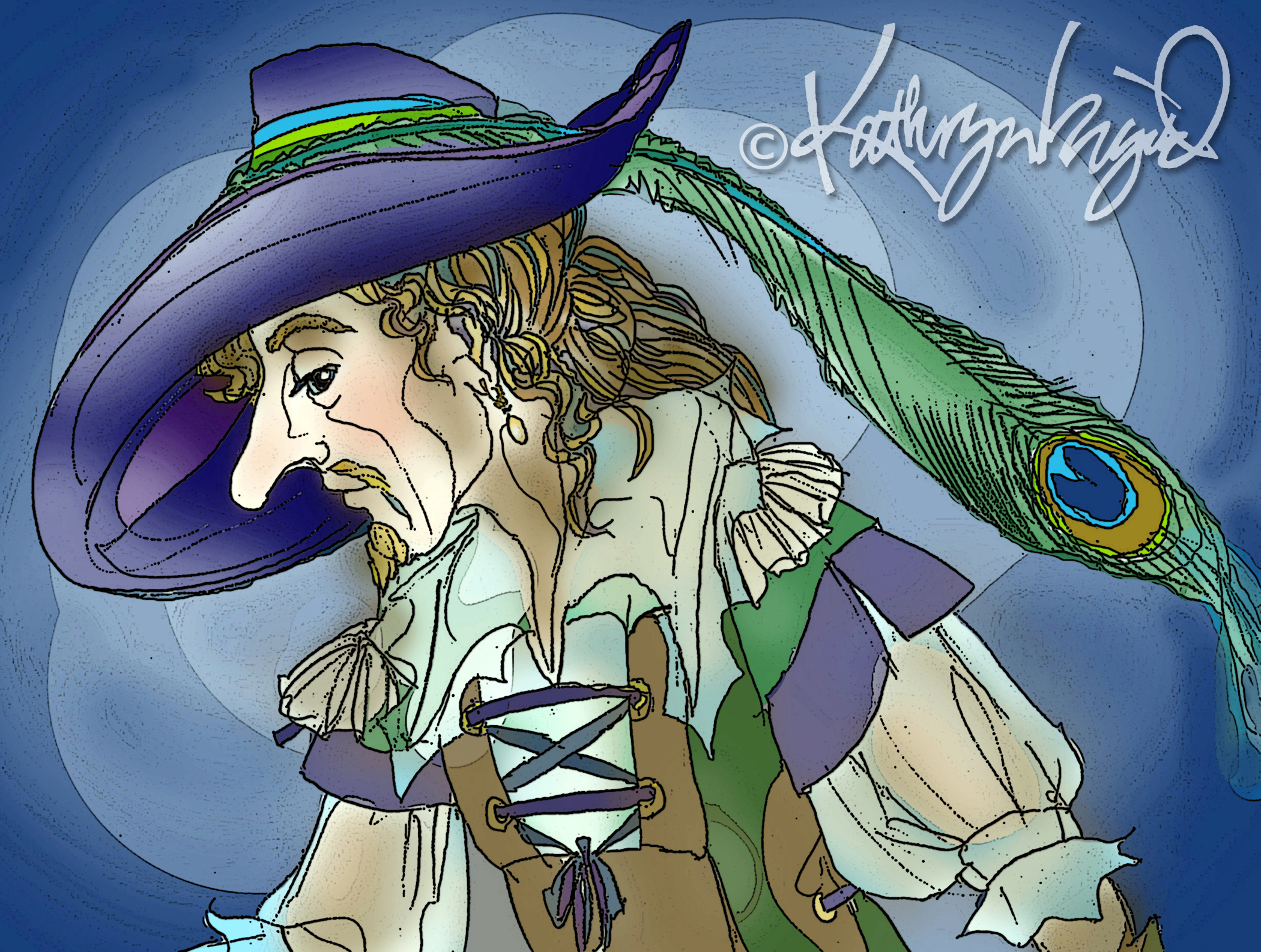
digital artworkWould that I had the miraculous gift of the silver tongue–it’s said that the genuine Cyrano de Bergerac, the writer and duelist enshrined in fiction as some sort of demigod of dramatic speech, was in life something quite near to it as well. As a youthful admirer of the romantic dream, I memorized Rostand‘s most famed soliloquy of Cyrano’s (in English, naturally), but what remains after so many years have passed is not so much the poetry of his slick speech; it is instead a deeper sense that for all my staring at his nose along with everyone else I managed to miss the point.

The story is told in fictional form to so exaggerate the majesty of his nasal promontory that all we see in most readings and performances onstage is a caricature or cartoon man, led by a nose of bowsprit proportions and foolish improvidence to oversized action and wildly improbable joys and sorrows as a result. These kinds of things do happen to real people in real life, of course; even the real man behind the character was larger-than-life in both nose and existence, according to what we know. He did, if his contemporary portraits are anything near the truth, have a substantial prow, and we have his writings–satirical pieces to classical tragedies–to prove that his wordplay was quite substantial too.

But what perhaps ought to be said of him–whether real or imaginary–is that he was a bit of an outsider by virtue of looking Different, and his response was to fight for respect, both with his rapier and his rapier wit. [Given the historical man and the possibility that he was (not surprisingly, given the era and culture and his reputed exploits) syphilitic, he may well have experienced life completely without a nose if he lived long enough.] It’s easier to label and classify others on the basis of unpopular appearance or differing from the currently decreed norms than it is to cultivate what we have in common. Yet we can learn from some of our outlier counterparts if we will stop, for a moment, being so mesmerized and distracted by what makes them seem unlike us, what it is that we have and value in common. Best if we do that before losing the duel.

Though at least, if the duel is purely verbal, there can be some entertainment inherent in getting taught a lesson. I can live with being the unarmed woman in a battle of wits, as long as I get to keep living long enough to laugh about it. I may not be a genius, but that, my friends: c’est mon panache!

That which is Seen

graphite drawingThat which is seen by the untrained eye of the casual observer is an older man, an elderly man, perhaps a shell of his former self. Not someone with a lot of use and life adventure left in him. Handsome, perhaps, in his latter years, with this silver hair and these pale clear eyes, with his faintly stooping posture before a window where no single thing that’s new is seen; elegant in his quiet way, and maybe wise. But not more.

What cannot be seen is the forty-two years he spent working for the postal service, learning the business from the bottom up and eventually teaching not just the next generation that would follow him but the next after that as well. There is no way to know at merely a glance that he tended a beautiful garden on Sunday afternoons where he grew too many vegetables for his own table so he shared the rest around the neighborhood. Invisible, too, is the love he keeps alive for his long-dead wife of thirty years, except for the small bouquet of flowers he picks from that garden of his and gives to their son and his wife every Monday because they were her favorite blooms. Yes, the flowers and the kids.

In the plain little vase where those flowers live for the week, there is room for all that can’t be seen in one quick look at the profile of a man who sits and meditates beside a window. Only by taking the time to appreciate the fulness of that humble bunch of flowers and all that they have to tell can anyone really know what to see when looking toward that window’s light. It takes a certain clarity to see what’s right in front of you.graphite drawing