Apparently I Executed the Secret Handshake Wrong or Something

digital artwork

Cinderella Opts Out

From your assessment of my deportment,

I must ask what the statement “of a sort” meant–

Oh, was I, I wonder, a shade improper,

Not brass perhaps, but a hint of copper?

Did I stand out from the regal crowd

By being a decibel too loud?

When I met the Queen, did I rudely greet her

With a curtsey too small by a millimeter?

Did I jostle the King, or step on his toes,

Or remark on the magnitude of his nose?

Have I shocked the royal entourage

With an unplanned glimpse of décolletage?

Say, what have I done in these latter days

To occasion such backward, lukewarm praise?

Do tell me where this prejudice starts

That substitutes etiquette for hearts!

I’ll not be one of the prince’s bijoux

Knowing I can’t have the wit to please you–

I’m off for home, where they make no sport

If my manners are only “of a sort”.digital artwork

The Vast American Landscape


digital image from a photographAs November approaches and the always-tedious white noise of political ravings grows ever louder in the US atmosphere, I find myself musing once again that so little is what we think it to be. Clearly, if you read my post the other day, I am seldom content to accept the appearance as the reality, but it is never more significantly the case than around the time of elections. For all that Americans love to crow about being the truest democracy in the world and having the power to determine our own destinies and that of our nation (never mind our meddling globally), what’s most notable around voting time is how little anyone really does his or her research and how thoroughly gullible, petty and narrow-minded most of us are on our best days. It’s really kind of miraculous that, young as America is in the way of being a nation, it still exists as one. We’re all on our own paths, wavelengths, and possibly planets around here.

And those who rise to power in our country are no less prone to manipulating that sort of foolishness than those we claim to abhor elsewhere. We give things whatever ‘spin’ we prefer and, by golly, hordes of similarly spun fellow denizens jump right into the vortex with us, leaving reason and, ultimately, hope far behind. One might think that the current age of electronic wizardry would make us more aware, if not more cautious, of all sorts of trickery and monkey business, but alas, we cling to our ignorance and wilfulness with just as much dimwitted fervor as always. Knowing that the camera sees only what the photographer aimed it at and the recorder hears only what the engineer had it turned on to hear–and that the results of both operations can be almost endlessly manipulated after the fact so as to be something entirely new and different from the initial truth, however truncated that might have been, we still choose to stand with facing our own chosen suns while right behind us, out of frame, utterly different realities are carrying right on with their appointed happenings.

So in honor of this form of deception, whether imposed upon us or self-inflicted, I give you my image of the Grand Canyon. Or, as it was before a little Photoshopping hocus-pocus, a dirt pile under the freeway overpass, whose ‘magnificent agaves’ are small tufts of grass, whose brilliant coloring is all hand-applied, and whose vast open sky is a digital blanket pulled down to cover the abandoned storefronts looming behind the little hillock. What you see is what I get, my friends. Keep it in mind on the way to the voting booth, won’t you?


Treasure Knows Neither Time nor Place

photo

A memory-driven image by my great-uncle Rolph Bolstad . . .

I have been scanning and digitally restoring a number of photos out of our family’s trove, a heap that resembles the disorganized and neglected stores of many other families. I make a small dent in the stack from time to time, then get distracted by everyday life and often don’t revisit the project for quite a while again. While many of us obsess over parting with beloved memorabilia of any kind, the truth is that the majority of us don’t do much with it when we have it.

All good things are that way, I suppose: love, joy, peace and happiness of both the material and the intangible sorts are seldom given their full respect when we have them, only mourned when we think they’re out of reach. And from what I’ve seen and heard from friends around the globe, this is a foolishness that transcends all sorts of differences and makes us more alike than not–no matter what our location or culture, our beliefs, hopes, and dreams, we all seem to wrestle with this forgetfulness about appreciating what we truly value that we have right in hand, and the minute that we suspect we’re about to lose our grip on those gifts, whether by our own decisions or perforce, we get panicked and become certain that it’s a sign of apocalypse. Surely the end of our own self and sanity, and very possibly, that of the universe as we know it.

I come across that box of yet-to-be-scanned photos from time to time and get a pang: what if I don’t get back to this project before I forget who’s in the photos, where the shots were taken, before the images are too faded or decayed to be rescued at all?

Well, what if?

Honestly, I know full well that it will not be the end of the world. Not even the end of my pleasurable revisiting of those memories–what’s more significant than retaining this flimsy physical repository of memories is whether I use the versions of them in my head and heart while they last (head, heart and memories, all three). Once gone from there, the data held in a picture is only cold, meaningless data after all, and it never contained the warmth and soul of anyone or anything depicted in it. It’s merely a shadow-play version of the husk that is my human form and will no longer be me when I die.

So I’ll keep leafing through these paper and binary mementos of mine as long as it pleases me to do so, remembering mostly that what is seen therein is always more beautifully carried inside me. Change is indeed the only constant, yet in the photograph my great-uncle took, probably in Johannesburg, around sixty years ago there is the ephemeral prototype of the photograph I took in New York less than a decade ago. Fifty years or fifty centuries, it matters little if we learn to respect and rejoice in what remains true and crosses the boundaries of place and time as long as we keep it alive inwardly.

photo

New York City lives in my own memory as much as in a physical place . . . its beauties, like all things loved and valued, lies in me, in others’ hearts, far more than in itself or any image we can conjure of it . . .

The Royal Whee!

digital image from a photo


It IS All About Me, Really

To see the main

objective of the game,

It helps if one can

keep the goal in frame

And focus on it clearly,

deeply, truly,

But not to lose all

other sights unduly,

So if you’d like to

keep ambition near,

I recommend you stare

at me, my dear.digital image from an antique print

What of the Day After the End?

digital illustration from a photo + textAfter All is Said and Done

What will I do when at the end of time

The story folds back on itself and calls

On me to follow down those darkened halls

Of memory to revisit sublime

Past lives in fact and fiction ’til I’ve turned

Empty as much as is the hourglass

And all the strange bygones that had to pass

Before this book called History was burned?

What will this end extend to me, my kin,

my life and loves and all the world abroad?

Whether it’s silence of the touch of God,

Salvation of a sort will bathe my skin,

And on that gleaming day I’ll wake anew

Because I loved, and I was loved by, you.

Will You Sing in My Stead?

graphite drawingWhen I can Sing No More

When I am weary, worn beyond all reckoning,

My breath is gone and voice has ceased to sound,

The darkness draws me in, its silence beckoning

And luring me to lie down on the ground–

To fall asleep; perhaps to melt there into death,

Because I can no longer coax my throat

To speak of joy, or yet to longer draw a breath,

To sing a song as long as one fine note–

Beloved Friend, how sweet if you will stand for me

And draw the air that lifts the lark to wing

Its way across the sky–if you will kindly be

My voice, and raise your own aloft and sing–

For in my silent darkness I shall never die

Long as your voice goes on and in your song I lie.

Real-Life Mysteries

While I’m on the subject of mystery stories (see yesterday’s post), there’s a true one that I hadn’t ever heard of until recently that almost defies imagination, even generations later. But that’s what true mystery stories do, isn’t it.

The story of a female immigrant serial killer/mass murderer, born in Norway but made in America, was a hideous and irreconcilable tale of horror and crime in the 19th Century and remains one today. Belle Gunness, who is believed to have killed all of her own children, two husbands and a handful of suitors, not to mention an accomplice or two of her own along the way–possibly executing as many as forty people in her lengthy crime spree–is surprisingly little known nowadays. I fear that this may be because we have so many other hideous and oversized monstrosities and real-life mystery stories handy to horrify and mesmerize us that many likely get pushed out of memory by the current ugly news. Undoubtedly the advent of World War I‘s dreadful specter was a factor in overshadowing a single murderer’s story rather immediately on its discovery.

All the same, once I knew of it, I found the woman a compellingly repellant subject for another mystery story illustration, being a subject worthy of an Edgar Allan Poe style drama or, yes, a true-crime cinematic epic. Though it was one of those news stories that ‘rocked the nation’ when uncovered a hundred years ago, the tale of Belle Gunness is relatively obscure nowadays. There have been a few generally tepid and mostly heavily fictionalized stories, books and movies based on the horrors wrought by this one woman’s apparent sociopathy and the trail of blood left in its wake, but it’s remarkable to me that such a grim, terrible story is scarcely known on a wider scale anymore.

Frightening, dark, and perhaps an indictment of the worst of human nature in general, yes–but I think perhaps part of the reason I find mystery stories so gripping is because I think they remind us–again in that somewhat ‘safe’ and detached format of past-history or fiction–that brilliance and the abyss are constantly in conflict in the human heart and only by understanding this and being willing to examine it in ourselves can we have a chance of rising to beauty and shunning the grotesque urges that we might have–and, if we’re truly fortunate, catching up the would-be wrongdoer in humane and forgiving and healing arms before she can ever fall so far. That’s my hopeful fiction, and I’m sticking to it.

digital collage

La Belle Dame sans Merci of the prairies, Belle Gunness. What fearful horrors shaped this woman’s inner darkness?

Today, I present Belle Gunness, a truly fallen woman and black widow whose mystery may never be fully unraveled, for your contemplation. May we never see her like again.

Mystery Story No. 1

I don’t know when, where or how the first fictional mystery story came on the scene, but since I thoroughly enjoy a good puzzle of the not-going-to-affect-me-in-real-life sort, I do like a good mystery story. So sometimes I like to create mysteries of my own. Mostly, visual puzzles. Pictures that invite interpretation, participation and invention on the part of the viewer. Images that demand a second look, or a two-hundredth one, because there might be clues in there, tales to be uncovered, plots to be discovered, fun to be made from the gossamer webs of pictorial intrigue custom-made for playtime. So here, for (I hope) your delectation and mystery-mongering, is a collage created with puzzling in mind. Enjoy!

And don’t forget to tell me if you devise the novel of the century after being so deeply inspired by it. Wink, wink.digital collage

Matters of Perspective


photo

Stormy skies can bring destruction . . . or the rains of growth and promise . . .

I’ve said before, and in ever so many ways, I’m a firm believer that we all live our lives wearing our own very distinctive glasses. By that I’m not referring to the glass-half-full vs. glass-half-empty attitude–but that’s indeed part of the whole idea. It’s about how we see the world through our individual filters.

In a fairly concrete fashion, that means that the quality of my actual eyesight–my acuity, ability to detect and distinguish colors, textures, shapes, depth of field aided by stereo vision, and all of that sort of thing does, in fact, have a profound effect on my world view and how I experience my passage through it in life. As a longtime visual artist, I am dependent upon all of this stuff for my very sense of self.

But I’m also convinced that each of us has a life history that includes our adventures from birth to the present, our nurturing or lack thereof, our environment and resources and social contacts and political influences and educational progression, and that whole reality is so distinctive for each of us, right down to a cellular level, that I can’t quite imagine how even the closest of kin could possibly have identical points of view.

I’ve been reminded of this in the last few days as I’ve been reading the latest Oliver Sacks book on which I’ve laid hands: The Mind’s Eye. Every book of his that I’ve read thus far is, since he’s a neurologist, a humane and humorous thinker, a deeply curious scientist, and a citizen of the world with wide-ranging interests, bound to be an adventure. Given the visual theme of this particular collection of case-studies (including his own discovery of and treatment for an ocular tumor), it is indeed a confirmation of my sense that such complex inventions as human bodies, multiplied by the almost infinite variants those influences I mentioned above can infuse, create and incubate an incredible range of possible ways to see and experience life in this world and whatever we can conceive of beyond it.

Yes, I am enjoying this latest Sacks book as immensely as I have all of his thus far. It’s been rather striking, too, to add to the layers of my own filters, many of which I’ve only come to recognize rather more recently in my life. I have sussed out and confirmed to my own wildly non-medical satisfaction that I am very probably distinctly dyslexic or cognitively ‘different’ in a whole bunch of ways, and having looked at this good doctor’s descriptions of face-blindness, or prosopagnosia, I’ve a feeling that my realization sometime not long past that I might have a degree of face-blindness might well be accurate. I’m certainly no less inclined to believe it since immediately before the book arrived on scene at the local library, I was working in our front yard when a car pulled up and the nice driver called me by name and conversed with me pleasantly until I could identify by her voice, questions and comments that she is the neighbor who lives directly across the street from me. Sigh. Sometimes the ol’ filters do get a little blurry.

More importantly, though, I’m convinced that how we respond to our life experiences and our histories–the choices we make and what we do with what we’re given and who we are within it–those are the truly telling filters. They’re the things by which we’ll be known, be remembered (if we’re remembered), and that offer us ways to define ourselves and our place in the world. So while I’m happy as an artist to play (as you saw in the last couple of posts) with my reality in the artificial world of visual imagery and how I attempt to show others what it’s like to see through my lens, I realize that my moods and attitudes are a part of that process too. Can I get others to understand or accept my point of view? Rarely, if I’m mighty fortunate. Can I help them to see it? More likely, if I work hard. Can I give them happy access to their own filters that might improve their moment or their day? That, I hope, I can do if I am true to the better of my instincts in responding to the world as I know it and expressing, the best that I’m able, with passion and with compassion. With love and joy.
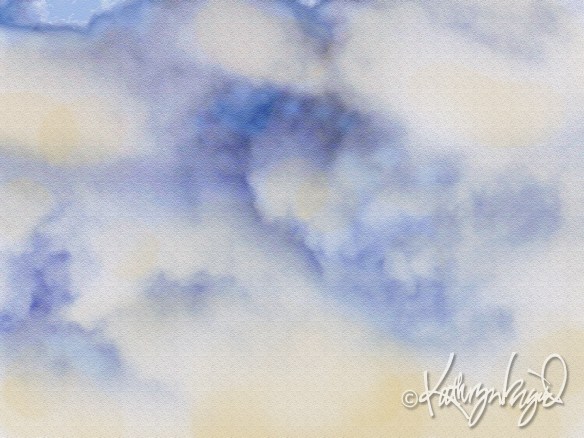
digital painting from a photo

Heavens! What started as a grim and ominous day can become something bright and hopeful . . .
 

Art, Before & After

graphite and markers on wood panel

Today, another little glimpse of artful goofing to re-imagine an existing piece of my work. I almost never tire of reworking/revisiting my old artworks from time to time. In part, it’s a way to critique and edit my stuff and see how I can grow and change over time. Mostly, it’s just good technical practice–a little bit of re-training my eye and hand and, when I get lucky, learning a new skill or two. In this instance, I took another of my pipeshade designs done in 2007 in preparation for Martin Pasi’s carving the wooden screen panels for his Winnetka instrument and I did some Photoshop playing with it to turn a pair of the panel designs into a merged single image and then ‘hand coloring’ it digitally to redefine it as a wholly new looking picture.

The whole Winnetka project was based on the church’s part of the collaborative team’s desire to have their organ artwork reflect local character. Since Congregational churches don’t tend to wish to fill their worship spaces with traditional religious iconography but rather prefer a more generally meditative space, so it made sense to aim for a design more simply nature-based and reflective of regional beauty. I decided to incorporate some of the Illinois state symbols into the design. This pair of panels featured the state bird, Cardinalis cardinalis–the Northern Cardinal. Is a cardinal too religious a symbol? Oh, that’s right: not a Roman Catholic church. Okay, cut me some slack.

Not really necessary to elaborate, is it. I just decided to show you the Before and the After versions today, and dispense with the intermediate steps–they’re not entirely thrilling to see, being a series of steps mainly devoted to converting the graphite drawing to a crisp black ink-outline appearance (only moderately laborious with the help of Photoshop) and then using my digital ‘coloring crayons’ to fill in the blanks to create a full-color version. This time, I opted for something much more cleanly graphic than yesterday’s reworked image. Who knows what happens next time? That, in fact, is the fun of both making art in the first place and then, in having the option of revising it, maybe even more than once. Can you say, mercurial? Nahhh, we know that I’m still just a big kid with a short attention span. No need to dress it up. I’ll just spend the dress-up energy on the art, if you don’t mind too much.digital artwork from an original drawing on wood panel