Being the Down-Home Sort of Fella that I am

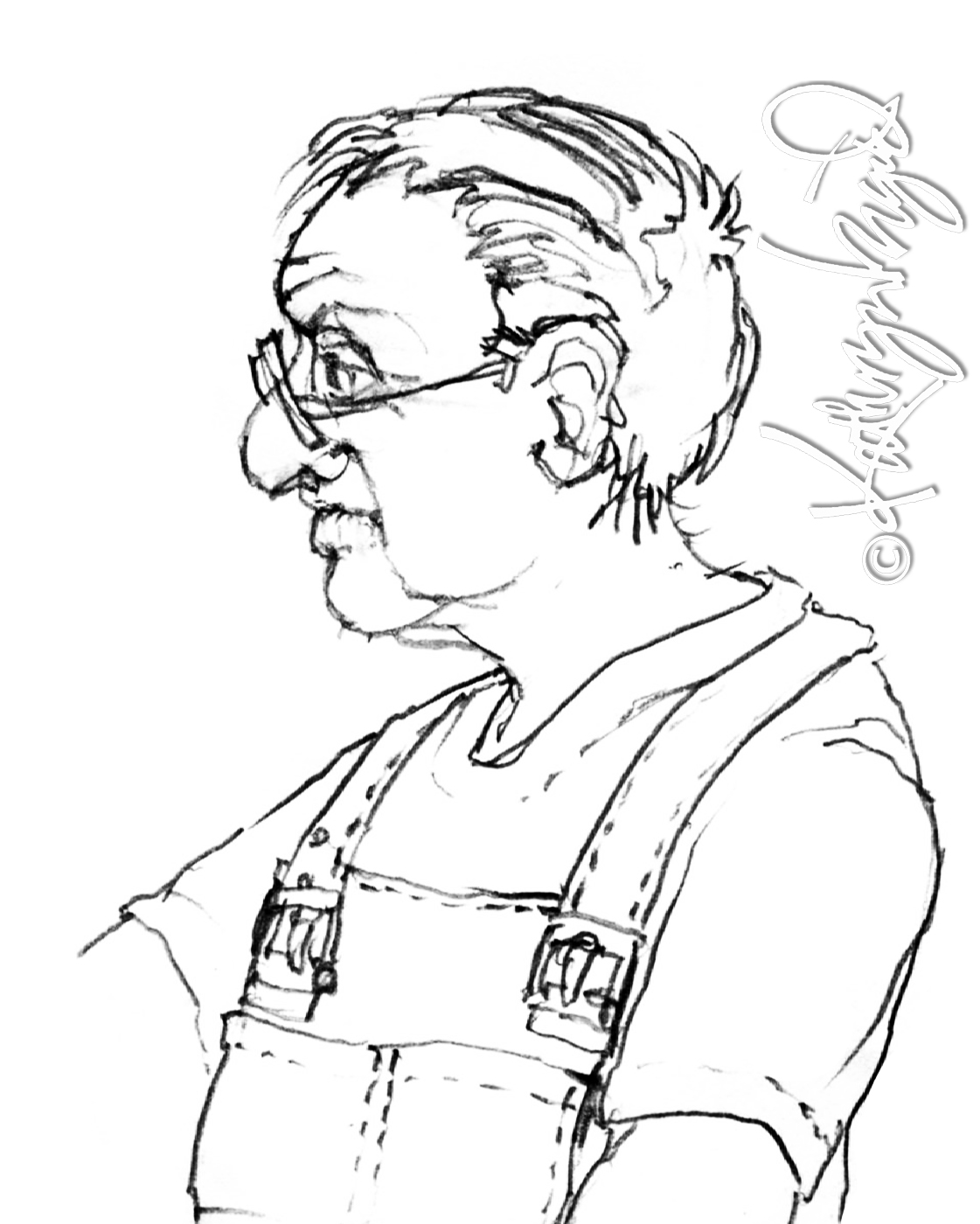
A Little Antsy Now

If I could do just as I wished and not a nickel more,

I’d not sit still just listening to any tiresome bore,

But I’m in well-bred company (I’m told), so I must stay,

Attempting to pretend it’s deep engrossment I convey—

Meanwhile, my nostril starts to itch and twitch, and I suppose

No one will take much notice if I subtly pick my nose.line drawingBumpkin’s Comfort

I am not wholly ignorant

Of what a fool I am

But if you’d keep me happy

Just give me a slice of ham

A piece of cheese a bit of bread

Some butter, if you will

And I’ll continue happy fool

Slumped up here by the still

Natural Affinities and Others

digital photoCats are nature’s hate-seeking missiles. If there’s a houseful of guests, only one of whom dislikes or is wildly allergic to felines, everybody knows that’s where the household cat will make a speedy beeline and glue itself to the ankles of whichever sufferer would rather the cat were somewhere about a thousand miles away. As it happens, when they choose to do so, cats can also sense affinity. Some are so quick to attach to the humans who will indulge their every whim that they must probably have a sense transcending the dimensions we with our merely mortal five senses perceive.

In both, I have seen parallels in human form. There are some who manage at every turn to recognize quickly and attach themselves instantly to others who will love and appreciate them and all their gifts—and some, conversely (or perversely) who have only the knack of finding and sinking their hooks into people who would rather they were about a thousand miles away.

If Only They Would Use Their Evil Power for Good!

digital illustrationWounding Wonders

One needn’t be a Visigoth or Hun

or carrying machete, poison, gun,

or be eight Samurai with flashing swords,

to do the deeds of such marauding hordes–

Supposed lovers, intimates and friends

have other weapons to achieve such ends,

devising and divining fresh new schemes

for making misery on endless themes–

Have irritating nettles, needles, knives

plus-perfect for the ruining of lives–

Imagine if invention, by intent

so much the sweeter, how life would be spent!digital illustration

I Won a Zillion Dollars! SERIOUSLY???

photoScams are as old as human interaction. I can only assume that among the first hunter-gatherer people wandering this great globe there were some who quickly discovered that if they used certain diversionary or distracting tactics or played the Needy card even when they’d just been gnawing on a good fat hunk of food, some softhearted other would hand over his or her hard-earned goodies. The more purportedly sentient and sophisticated we get, the more elaborate the flimflam. Bamboozling and outright fraud and thievery are well honed skills among those so inclined. And we who live in Bloglandia know better than most what rich tillage is available for such nefarious labors if the tricksters and crooks are even the least bit techno-savvy.

As a blogger I am the not so proud owner of a spam filter that scoops up as many as several dozen phishing and monetary theft attempts in any single day. One of the aspects that makes me especially irritated is the irksome knowledge that unlike promotional and advertising spam–tiresome enough–scam emails offer no possible way for me to Unsubscribe from their persistent and pernicious pestering. If I should be so foolish as to respond with an angry Unsubscribe letter of my own, and yes, of course I’ve done it just to let off steam, odds are astronomically against there being a human at the other end of the equation rather than the helpfully designed automation that considers any reply a positive one and an invitation for further encouragement to Send Money to the phisherman or woman on the other end of the hook, line and sinker.

Bad enough that I should have to waste my time cleaning out multitudes of junk emails. I know, too, that sending along any evidence of this sort of thing to any kind of authorities is futile, and of course the perpetrators of the intended crime also know it full well. As soon as there’s the slightest hint of danger, such lurkers dart off to new pseudonyms and reroute their emails, disappearing without a trace until the next move is necessitated, leaving a wake of idle dalliances and false promises broader than any black widow‘s.

photoThat comparison, though, is apt enough, since the intent is to play upon vulnerable people’s sympathy, greed and loneliness just far enough to get them to surrender the largest amount of cash and personal information the con artist can manage to accrue before leaving like a sneeze: at high velocity and with the victim left covered only in his own shame and sorrow. That these scams work best against the elderly, the young, the inexperienced and the poor is certainly one of the greatest of sins committed by Scam Scum. The amount of creativity involved in developing their villainous schemes, while it could of course be put to higher and kinder uses, seems to me to be lessening with the ease of perpetration offered by anonymous technology.

What quickly became known years ago as the Nigerian scam, for example, has veered only so far as to another part of an equally fictional version of Africa, as my current roster of letters almost always references Benin rather than Nigeria–but the rest of the content remains constant. Plug in new names and change two or three of the variables, and surely someone, even one who knows by now to be wary of references to Nigeria, will respond, and all’s well in the world of easy money. Those who use the cloak of putative widow- or widower-hood, political or religious persecution, or just plain blind trust to approach strangers and ask for help in securing and using massive funds do the very same. I can cite in particular one ‘Mary Mohomed’ who has continued to send me variations on her theme of pretend benevolence repeatedly, even under the same name, claiming an intimacy with me that even in my dotage of 50+ is hilariously impossible to believe of a total stranger. ‘She’ and her obvious relatives ‘Mrs. Rose Daniel’, ‘Mr. David May’, and ‘Mrs. Grace Ike’, along with numerous others–remarkably friendly Doctors, Ambassadors and (lest I be suspicious) officers of various trustworthy government agencies here and abroad, all love me and care for my welfare so deeply that they are willing to seek me out without introduction and invite my participation in ever so many worthy causes, all to be remunerated beyond-generously. And all for a teeny, tiny, infinitesimal, nominal, negligible fee on my part to get the party started.

Now, I will admit to a certain level of entertainment inherent in reading these letters, if and when I occasionally stoop to do so. Besides the intriguing effort to vary the plot line (a transparent practice that results in the virtual equivalent of visible panty lines or the Mad Libs sort of method certain serial novelists are said to use to rework one story into multiple books) email scam letters are loaded with typos, bad grammar and incorrect usage that, while it perhaps does reflect badly on the current state of language in the US and other English speaking locales, often provides hilarious unintentional asides. Today’s prizewinner in this phishing derby is the following letter, which clearly presumes that I would believe that the Federal Bureau of Investigation has an interest in seeing that I, an unknown but obviously well loved citizen of the Bureau’s own country, receive a sum of money won at random (yes, without my even trying) outside of its own jurisdiction from a lottery in a country not named and the coffers of a generically named pretend gaming Company, and discovered by, I am supposed to suppose, the purposeful working of the Bureau’s own fantastic newfangled machine whose purpose is apparently to monitor activities that are, again, outside of its purview. If that isn’t catchy and convoluted enough for a really cheesy Movie of the Week, I don’t know what is. But I’m glad I’ll have my $2.4million USD handy now to fund the making of said movie. Thanks, FBI! So glad it’ll only cost me $96 of my own money up front to get all of this in perfect order.

Anti-Terrorist And Monetary Crimes Division
FBI Headquarters, Washington, D.C.
Federal Bureau Of Investigation
J.Edgar Hoover Building
935 Pennsylvania Avenue, Nw Washington, D.C. 20535-0001
http://www.fbi.gov

ATTENTION: BENEFICIARY

This e-mail has been issued to you in order to Officially inform you that we have completed an investigation on an
International Payment in which was issued to you by an International Lottery Company. With the help of our newly
developed technology (International Monitoring Network System) we discovered that your e-mail address was automatically
selected by an Online Balloting System, this has legally won you the sum of $2.4million USD from a Lottery Company
outside the United States of America. During our investigation we discovered that your e-mail won the money from an
Online Balloting System and we have authorized this winning to be paid to you via INTERNATIONAL CERTIFIED BANK DRAFT.

Normally, it will take up to 5 business days for an INTERNATIONAL CERTIFIED BANK DRAFT by your local bank. We have
successfully notified this company on your behalf that funds are to be drawn from a registered bank within the world
winded, so as to enable you cash the check instantly without any delay, henceforth the stated amount of $2.4million USD
has been deposited with IMF.

We have completed this investigation and you are hereby approved to receive the winning prize as we have verified the
entire transaction to be Safe and 100% risk free, due to the fact that the funds have been deposited with IMF  you will
be required to settle the following bills directly to the Lottery Agent in-charge of this transaction whom is located in
Cotonou, Benin Republic. According to our discoveries, you were required to pay for the following,

(1) Deposit Fee’s ( IMF INTERNATIONAL CLEARANCE CERTIFICATE )
(3) Shipping Fee’s ( This is the charge for shipping the Cashier’s Check to your home address)

The total amount for everything is $96.00 We have tried our possible best to indicate that this $96.00 should be
deducted from your winning prize but we found out that the funds have already been deposited IMF and cannot be accessed
by anyone apart from you the winner, therefore you will be required to pay the required fee’s to the Agent in-charge of
this transaction

In order to proceed with this transaction, you will be required to contact the agent in-charge ( Mr. Nicholas Smith )
via e-mail. Kindly look below to find appropriate contact information:

CONTACT AGENT NAME: Mr. Nicholas Smith
E-MAIL : revnicholassmith1@yahoo.com.tr
PHONE NUMBER: +22996334110

You will be required to e-mail him with the following information:

FULL NAME:
ADDRESS:
CITY:
STATE:
ZIP CODE:
DIRECT CONTACT NUMBER:
OCCUPATION:

You will also be required to request Western Union or Money Gram details on how to send the required $96.00  in order to
immediately ship your prize of $2.4million USD via INTERNATIONAL CERTIFIED BANK DRAFT from IMF, also include the
following transaction code in order for him to immediately identify this transaction : EA2948-910.

This letter will serve as proof that the Federal Bureau Of Investigation is authorizing you to pay the required $96.00
ONLY to Mr. Nicholas Smith  via information in which he shall send to you,

Mr. Robert Mueller
Federal Bureau of Investigation F B I
Yours in Service,Photograph of Director
Robert S. Mueller, IIIRobert S. Mueller,
III Director Office of Public Affairs

And if you believe all that, I give you free of charge this magnificent bank vault in which you too can store all of your wealth. Enjoy!photo

Cow Punchlines

photoI’ve No Beef with Your Cultural Identity

Being a female or male Croatian

Is no more determined by your location

Than eye-color, height or weight, or sex is

By where you were born in the state of Texas

But I will admit Texan regions do

Determine the skew of your barbecue,

And can also say, since it ain’t no tattle,

That many are mighty fond of cattle.photo

My Baroque Gesture

The first time I heard Early Music performed in period-appropriate style I experienced, not surprisingly I suppose, a full mixture of amusement, bemusement, mild horror and deep curiosity. It was in a performance of Claudio Monteverdi’s seminal opera Orfeo at the English National Opera; I was a mere college stripling who had probably not even heard the phrase Early Music at the time let alone known what it might mean, and ‘performance practice’ was in something of a time of transition. Anthony Rolfe Johnson sang the title role with, if I remember properly, a rather nice overall sound, but a straight-tone and senza vibrato style and a strangely stuttering kind of ornamentation that might well have been an authentic recollection of the opera’s original character and an accurate and historically informed version of the way it would have been presented by its composer and first performers. I, having never been taught such things, merely heard sounds quite foreign not only to my ear but to my concept of skilled and artful performance, let alone prettiness. I do remember thinking that either this was all far over my head (entirely possible) or it was a pointless and poor imitation of what the ENO imagined the average amateurish opera company of Monteverdi’s day must have been capable of doing (less likely), or poor Mr. Johnson, who later went on to receive his OBE, just plain wasn’t up to the job despite a naturally pleasant voice.

Years later, I may not be much smarter than the young squirt of those days, but I’m far more experienced and have heard worlds more music, both the great and the terrible and, of course, a massive quantity in between. And I’ve been taught a thing or two about the fine points of what is beautiful and magical when it comes to singing or playing with any amount of vibrato–or none–and the many elements that combine to create tone and color and variety and character in a performance. I’ve learned some useful stuff that changes how I perceive both the level of virtuosity in playing or singing and its aesthetic appeal, two aspects that do not always coincide in my ear, mind and heart but when they do, that combine to create a kind of joy that is virtually unattainable in any other way.

When my husband conducted a production of Orfeo over a quarter century after the first one I’d heard, I had a whole different understanding and appreciation for what the many performers were doing and why the stage director would expect them to do so both from a visual standpoint–training them, along with other coaches, in appropriate ways of moving and posing and gesturing as well as in those of vocal ornamentation, since she is a superb and well-trained Early Music singer herself–and an historically suited musical one. Just as there are countless styles and types of music known to us nowadays, which you can multiply by the number of individual teachers, performers and audience members to get a rough sense of the variety you’ll encounter, there were historical strictures and structures and stylistic trends and ideas that shaped earlier generations (centuries) of music and musicians and listeners, and while some have perhaps remained relatively unchanged since their inception, many more evolved over the ages. Our expectations of music have certainly changed, and our guesses as to how it was first conceived and perceived are only as good as the lines of scholarly inquiry and oral tradition can attempt to make them.

In all, it makes rich fodder indeed for both the ear and the imagination, and I for one am mightily pleased that I have had the opportunity to live a life immersed in all kinds of music and to learn along the way. I still like much of what I heard, whether ignorantly or not, in my younger days, and much of what I like now I learned to love along the way. While my form may be far from historically accurate or artistically impressive, I will still happily bow and curtsey to all the musicians who have shared their gifts with me in my life, and to all of those who work and are inspired to play more, to sing onward.graphite drawing

Alone Together

graphite drawingIsn’t it intriguing how easily we have (supposed) conversations without actually interacting at all? I confess that I have refined these abominable skills as much as anyone: listening without hearing, talking without saying anything, being in a room full of people yet in my self-centeredness, remaining utterly alone. This, I fear, is a nearly universal art among the human denizens of earth, something we began to create and cultivate as soon as we first attempted to interact, no doubt. We may want to do better, to mean something and be of value in ourselves to the rest of the world, but it’s hard to rise above the urge to feel more important and focus on self for long enough to accomplish any such thing.

Our only hope, I suppose, is to do what little we can, each of us, in the tiny moments when we are sufficiently distracted from our narcissistic whims to stop staring, if only for the blink of an eye, at self and realize the beauty and value of the rest of the company. What was a faint whisper at the remotest edge of consciousness could indeed prove to be a word of great and precious wisdom from a true sage. That little wink of light over there on the far, far horizon might actually be a flash of beauty or the light of kindness or even the warming blaze of a loving heart somewhere not entirely out of my reach if I’d only open my heart to it. I’ve fallen short of reading these signs and responding in proper ways so many times over the years.

But perhaps it’s not too much to say I’ll try, and try again. I know in reality I am not at all alone.

‘Social Activist Art’ is *New*, You Say???

drawingA recent New York Times article reminded me that, no matter how I might classify myself as anything but an activist, I have always been one, of a sort. It’s true that I’ve always assiduously avoided conversation, let alone physical action, tied to politics, religion, social policy and pretty much any ‘hot topic’ you can name unless I sensed I was in the safest possible environment to do so–generally, amid a comfy flock of like-minded partisans. The article is chronicling the US uprising of a relatively new breed of American artists and their support systems dedicated to, as the title bluntly states, social activism; the author gives appropriate reference, of course, to the practice being a long-standing one in other parts of the world, but shares the view that it’s still rather fresh and new here on American turf.

I’ll grant that the forms and formats may well have changed, and that there might be a larger collective sense among those who would embrace this title of being dedicated to the purpose more specifically than others, but I will step right out on my own tiny soapbox now and assert that, insofar as art is seen as a form of communication–and this might well include virtually all art except that created and performed in private and without any wish or expectation than anyone other than its maker will know it exists–it is inherently activist. The decision to create something I intend to be art and allow it to be known to others says a whole lot of things about me, the subject of my work, and my general worldview, and if I am allowing others to experience these in the art, assumes that they will respond through and with their own worldviews to it, effectively in a social interaction, whether we converse directly about it somehow or those who have interacted with my art turn around and respond to it in the continuation of their lives.

Who knew I was such a rabble-rouser? But truthfully, even by making those ‘meaningless’ little doodles that don’t turn into full-blown drawings or paintings, I am making something of a statement, am I not? I scribble, therefore I am. By doodling, I am not only using my energy to do that rather than anything else, I am also creating a portal through which my thoughts can emerge; if they turn, via this scrawling, into a concrete idea it may lead to the completion of an artwork expressing it more openly. This, in turn, suggests that I have a thing or two to say and I’m willing for others to hear it, see it, feel it–to interpret it and respond to it, even. I never think of myself as daring, but I think it’s fair to say that letting my inmost thoughts and imaginings be seen and analyzed by others through their own filters is at least a little brazen, if not occasionally foolhardy.

One of my late mentors, Lawry Gold, wrestled with the supposed divide between art and function, and he was anything but shy about being an outspoken activist, albeit a very kindhearted and generous one. He was a boldly countercultural person in a great many ways, and yet he seemed to me to reach the peak of his own overt rebelliousness when he began working on a body of art that was deliberately and unabashedly functional (beautifully art-covered, distinctively designed tables, lamps, clocks and the like) for sale through his gallery agents. This was something I know he enjoyed at least a little as cheery cheekiness to tweak artist snobs who were apparently so benighted they couldn’t accept the marriage of form and function thus, or so rich they could afford to sit around waiting for other equally rich people to buy their non-functional work, no matter what the state of the economy. Besides that these were among his most gorgeous and sophisticated works, to me they spoke of the recognition that art, besides taking so many different forms, speaks to us in many different ways, and that breadth and depth has great value.

At the same time, my friend never stopped making ‘non-functional’ art, because he of all people also had a tremendous desire to communicate, whether it was by visual storytelling in his often humorous, whimsically imaginative artworks or by making a more specific point with his illustrative and symbolic works. And he never hesitated to engage in the discourse that followed anyone’s viewing of his work. He and I had a joint exhibition of our artwork once, and as I was curating and installing the show I objected to one of his pieces that he wanted included, thinking it was not in keeping with all of the others we had selected, and he patiently steered me toward a clearer understanding that it was indeed very well suited; even though I never liked that piece as much as the others, I found that it carried an important part of the ‘conversation’ made up by the whole of the exhibition, and in fact that one interaction changed the way I curated many an exhibition of others’ work in the years that followed.

Ultimately, I see in the creation of art–of any form–an act that if it isn’t in open defiance of the social norms, allows or even invites the examination of and discourse on them. So even though much art is not made, like Lawry’s, to function in an obviously practical way, it all serves a purpose; ‘merely’ being beautiful or compelling may be purpose enough in adding layers of pleasure or relief or catharsis, but many works go far beyond that in opening new vistas to our contemplation, influencing our beliefs and even challenging us to change our behavior. All art is potentially advertisement or propaganda, for good or ill. And if that isn’t social activism, I think my encyclopedia needs some new illustrations.

digital illustration from drawings

Is all art crowd-sourced?

The Seal of Approval

What shall I say when I am asked my opinion and I think it would be best not to give it? I feel a little like I should perform a circus act, give the impression of cheery appreciation while keeping the less charming truth to myself. Not a little, really–I think I’m actually quite the liar at heart when it comes to people asking for information I’m pretty sure they would not actually like to receive. There are indeed those who want an honest and purposeful breakdown of the situation in question, but they are in my experience rather few and far between. In real, day-to-day life, what people are generally seeking is reassurance and affirmation, encouragement and support, not really a critique, when they ask for opinions.

So excuse me if I put on my happy face and do a little tap-dance of diversionary niceness when asked. If it’s strictly entertainment you seek, I’m here for you and will do my little tricks as best I can, but I hope you won’t decide to ask me for any touchier information. The only thing I’ll willingly admit your pants make look big is my discomfiture on hearing the question.photo

Hijacking Happiness

digital artwork from a drawingTrouble, as we all know, is highly contagious. I was reminded of this recently both by a television character and by a couple of real-life incidents involving real live people (who shall here remain nameless), and all of them, real and fictional, have a number of similarities, the chief one being their apparent unshakable belief that their suffering is greater than anyone else’s, is incurable, and is probably the fault of everyone else too.

My life is pretty fantastically good, when you get right down to it, so to people who don’t know me very well it might appear that I have no business criticizing anyone else’s way of handling sorrow and pain. But that’s just it: even the most wonderful of lives is touched by trials now and then, and struggle or strife isn’t fairly measurable in the moment. My paper cut seems as dire as your childbirth pangs when I’ve just gotten paint thinner on my hand. I know this to be logically ridiculous in the extreme, but don’t tell me the paper cut doesn’t hurt like boy-howdy at that moment. That would be tantamount to me telling you that since your labor pains will probably be over in short shrift, they don’t compare in any way to another’s battle-for-life with esophageal cancer, so you should just get over yourself. Whatever agony each of us is undergoing is more than enough and not to be belittled. And frankly, since each of us has a history that is tinged here and there with darkness, we do all have a sense, however small, of what it means to accept our griefs and cope with, live with, and go forward with them still present. Real sorrows never truly go away.

And for all of us who can feel empathy, or even more than that, can feel sympathy without having experienced the fulness of another’s troubles, life after infancy (when memory, like the lifespan thus far, is short) can be a perpetual bombardment of such troubles even when they’re not entirely our own.

I, of all people, will readily grant you that some people are far better equipped than others to find ways to survive pain and suffering and to continue living a full life without resorting to out-and-out acting. But that’s just it, isn’t it: barring full mental incapacity, don’t we owe it to ourselves, anyway, to try every possible avenue of becoming whole and happy (and of course I don’t mean that superficial kind of happiness that is either fully false or simply stupid); don’t we? When my personal apocalyptic horsemen appeared at the intersection of a group of the classic stressors (job-related problems, health challenges and the sudden death of a close friend converging on me at the same time) and plunged me into clinical depression, I was fortunate to not only have some of the significant tools (support from family and friends, a great doctor and a good therapist, and ultimately, medication that worked for me) for doing battle with those monsters but also the sense that there was no other acceptable option but to try to do that battle.

I won’t lie; there were times–and will probably be more of them over the years–when I did have to take the tack of that ‘fake it till you make it’ mode, when I simply wanted to quit and lie down and just hope it would all miraculously fix itself, or when I was as sulky and whiny and crotchety and pessimistic and tedious as unhappy people can be. We humans are good at all of that stuff, better than at being sunny and charming. But finally, even in my worst state I knew that was no way to live, and that the important people around me would suffer at least as much as I did, if not more. Thanks to the aforementioned helpers, I am here to tell the tale. More importantly, I don’t dwell in that darkness, even though there’s not much I could prevent or even fix about the troubles that led to such a state of existence. Things just happen. It’s how I deal with them that’ll likely make or break me.

That television character–and the many real-life imitators I referenced–stays so focused on how traumatized and maltreated she feels (albeit by genuinely distressing events and problems) that they become her one-note existence. She has a hard heart because it seems less trouble to close it to others than to be vulnerable to further hurt, but of course the actual effect is that she treats everyone around her like dirt, riding roughshod over their feelings and regarding any trauma or maltreatment they may suffer, often at her hands, as inferior or nonexistent. In turn, after being stomped on repeatedly by her seeming egotism, narrow-mindedness and refusal to set her hurt aside, the people around her disperse as speedily as that unlucky drop of water hitting a sizzling skillet explodes into mist. Those who tolerate her constant vituperation, impatience with their perceived stupidity or lack of sympathy, and her seeming wish to continue forever wallowing in her fury and self-pity, those characters ultimately become uninteresting or even unsympathetic themselves to me; after the ninety-ninth offense anyone sits back and takes without a fight, they tend to my eye to look like either enablers or equally fixed in victim mode.

I think we all have the power to steal others’ health and happiness, at least as much as the reasonably healthy among us should make every effort to take charge of our own. Doesn’t mean perfection is expected, but c’mon, people, if there’s really no going forward with life, perhaps a retreat to a very quiet hermitage would be more apropos than imposing our worst on the rest of the world. Yeah, I said it: get over yourself, Kathryn. Even if it might occasionally require brief periods of kindly deceit, times of returning to fighting off the dark singlehandedly, and the ordinary moments of being a jerk. It’ll mean equal demand on me for repentance, amends-making, and getting back on the wagon. There’s too much life left ahead, I hope, to spend it mired in a grim and terrible past, let alone impose it on others.

The upside of all this is that there is a possibility of turning this kind of thievery to good. Very simply, if I have to I can borrow my equilibrium and contentment from others. Put myself in proximity to saner, happier people than me until I can manufacture my own, and quietly absorb what I can of their good graces. I, at least, don’t want to be the one who steals the joy of anyone else; that only becomes the reason for new sorrows all ’round. Happiness and health can be contagious, too, if we let them. And so we all should, my friends. So we should.