I Wish…

If you spend any time here, you already know how I fear any political, religious, social, or philosophical position that claims to have all of the concrete answers about who we are, what our purpose is for existing in the first place, and how we are supposed (or not) to accomplish it all. I, limited in my capacity as I will readily admit to being, cannot fathom how there would be any point to having invented creatures with brains and character like ours let alone the will and sense of individual privilege and/or responsibility that we humanoids have, if the astonishing Force that invented us didn’t expect us to actually use all of those incredibly complex and admittedly imperfect attributes to find our way forward from birth to death, from initiation to completion. That we are here as a hugely diverse populace rather than as one or two measly individuals says to me that it takes a whole colorful, widely differentiated, bunch of us to have any hope of getting the job done. Whatever the job really is.

I long for the day when the wider world will get tired of telling each other how a “normal” person must look, feel, and think, or what is “natural” and acceptable in one’s sense and definition of self. These judgements are based on generalizations that fit remarkably few with exactitude; the Sun King‘s male courtiers and any number of Victorian era boys grew up wearing frilly little white gowns very like their sisters’ and were no less, or more, likely to be LGBTIQ as a result; high heels and cosmetics and elaborate jewelry and clothing haven’t been exclusively feminine accoutrements from very early recorded history onward, any more than it was ever true that only men could build houses or repair cars, or farm, hunt, and fish. No gender or sexual orientation predetermines what one loves or is good at doing or automatically consigns the person to any magically specific role in the universe, any more than there is any clear rubric in any of the literature, scientific or religious, that I’ve read or heard discussed that proves to me with any conviction that our bodies are and must remain our destinies.

While not a scholar or living exemplar of Christianity by any measure, I did grow up in a mainline Christian household and do a reasonable amount of reading and study over the years, enough to convince me that anyone claiming to be a Christian but promoting the idea that any race, sex, age, intellect, or social status confers special Goodness and sanctity (or the reverse) upon anybody has conveniently forgotten that, according to what Biblical and historical records anyone has, Christ was not white, clean-shaven, conformist, English-speaking, well-behaved (according to the standards of his day and community), immune to anger and other human failings, or unwilling to consider the value, even the occasional urgency, of change in the longtime beliefs of his compatriots. I certainly didn’t see any injunction of his to Go Forth and Hate Others.

While not willingly a declared member of any political party—I suspect lots of politics have little or nothing to do with the good of the ruled masses—I consider myself a very tiny step left of center. Yet I don’t doubt for a second that anybody who assessed my lifetime’s voting, let alone the details of my actual personal views, would gladly challenge my self-definition, thinking themselves obviously more liberal, more conservative, more centrist, or more what-have-you, than I am. I don’t find much use in any of the labels so often applied for political recognition these days, any more than I do religious ones, social or cultural or intellectual ones. We are who we are, and I can only imagine we’d do best if we simply acknowledge it, try to keep learning, and move forward.

What a lot of pointless, counterproductive hangups and sorrows we design for ourselves. I think, wish, and hope we can, could, and should instead be experiencing the true Normal and Natural of differing and disagreeing without hatred, uniqueness without fear, and love and compassion without boundaries. Including the bounds of my own shortcomings.

Digital illo: Psycho-delic

Somewhere, rainbow or no rainbow…we might find a meeting point in a better place in human history. We’re wonderfully, wildly different. But different can be a great thing, if you ask me.

Oliver Sacks & Other Friends I have Never Met

Digital collage illo: RIP Oliver SacksRIP Oliver Sacks (1933-2015).

Many of you who have been visitors to my blog for some time know that Oliver Sacks has for many years been one of my heroes, a deeply admired person because of his almost superhuman intelligence, his incredible breadth and depth of interests in a miraculously polymath-painted life, and most of all his quietly humane character. He lived a life so full of remarkable adventures, of openness to thought and passion, and seemingly endless ability to express his unique insights and experiences in language that was both approachable and lyrical that it seems ridiculous to believe all of this was only part of the substance of one single person’s life.

He died yesterday after a life that he self-described most aptly as that of being a perpetual Explorer, and I think that he will always, even in death, in some ways remain unchanged from the otherworldly spirit that he was on the terrestrial plane. His interests, while so many of them were decidedly practical and rational in his approach to them, were at bottom more genuinely in the philosophical realm of How, Why, and What-if than strictly scientific, a matter all the more notable because of his stated distaste for the perceived veils and distractions of organized religion. He was, indeed, sometimes criticized by fellow scientists, particularly in neurology (his central area of study), for being more interested in writing about and even, supposedly, exploiting the experiences of his patients and subjects than in performing and documenting the hard science that might explain and even cure them, but that, to me, was precisely his greatest strength and gift: that by translating the coldly factual into story form and making a simplified narrative both more approachable by and engaging to a wide readership, he made all of these disparate character studies and discoveries—both his and others’—far more meaningful and important in the lives of a whole generation who would otherwise have no reason to concern ourselves with or even grow to love this strange inner world of neurology and what it means to our being human.

All of this is only a small part of what endeared Dr. Sacks to me, as it clearly did to the tens of thousands who wrote him letters, consulted him, and studied and lauded his manifold accomplishments during his colorful life. Most of all, because he more and more fearlessly allowed us into his own inner life, to see how he himself experienced this complex, lovely, infuriating, and mysterious existence of ours, we were allowed to see him as a peer and a flawed, eccentric, humorous, and daring person all at the same time. This kind of intimacy is rare, for most of us, even with our closest companions, so being given so freely, vividly, this relatively unvarnished view into his inner workings made me join those thousands in thinking him a unique brand of Friend. We will all bear this loss. Yet we will all continue to benefit from the wonderfully ethereal quality of our presumptive Friendship, as well; he will remain with us in his books, the documentation of interviews, film, and all sorts of other recorded parts of his life and work, and of course, in the intense spirit of exploration that he fostered in himself and admirers alike.

I say these things here not only because of the unparalleled character I think Oliver Sacks shared with so many of us in his life, nor merely because I always found him a rollicking, endearing, and thought-provoking Good Read. It’s because his life and his death, for me, underscore what I have found to be profoundly true and increasingly obvious in my own smaller sphere of living: that what is universal in us transcends simple explanations or first person contact and allows us to befriend and treasure others who may share in daily life very little strong commonalities but remain in this larger and more complicated universe unimaginably interconnected. I have friends through this very blog who, though I have not met you and may never have that privilege on this earth, feel as bound and happily related in our mortal way to me as those who keep my physical company and speak to me face-to-face each day. I understand these connexions, however slightly, better because of the work and words of Oliver Sacks. It seems to me that his peculiar genius, despite his own avowed struggle with emotional incoherence or remoteness at times, was to find through studying, learning, expressing, and teaching others about the supposedly quantifiable attributes of the brain’s workings, a sweet, lasting, truly human kind of love.Digital collage illo: Oliver's Rainbow

Rough & Ready

Photo: Rough & Ready 1

Feeling ragged as an old mop lately? I rely on my cadre of kindly supporters to help me untangle my life.

If you’ve been reading the posts hereabouts in the last few days, you know I am no tough customer. I quailed as much at the thought of waking my poor sleepy spouse up in the middle of the night as at having him take me to the emergency room, let alone facing the fear of the unknown pain in my guts. And that was all for what might be the least horrific attack from a kidney stone in history, for all I know. Certainly I am as stunned (albeit happily so) as the follow-up caller from the surgical center when I say that I haven’t taken so much as an over-the counter mild painkiller since emerging from the happy haze of anesthesia yesterday afternoon.

The mountains of incredibly, indelibly kind and compassionate notes and calls I’ve received since airing my tiny miseries to you all are a true embarrassment of riches. I am grateful beyond your imaginings for the uplifting warmth and steadiness of your collective response to my discomfort and fears, and I treasure that surrounding goodness more than I can ever adequately say. But I feel more than a little sheepish, too, for being such a baby when I know that many, many who have offered such sweet and patient care and thoughtfulness to me in my weakness have also suffered far worse pain, deeper trials, and greater danger than anything I’ve faced in my whole charmed existence.

I look around me at the heroics of the people I love and admire, the friends, neighbors, and  companions who go about your business in the guise of ordinary mortality and hiding your bravery and strength behind the rugged facades of everyday occurrence, and I am slightly abashed. Slightly abashed, and very moved. You lay down your work and take time out of your already busy days to send off a word of comfort, an ethereal hug, a generous thought in my direction, and suddenly I feel myself filling with strengths and hopes that were not my own to begin with, and I am touched to the core with joy at my wealth and good fortune.

I am not nearly bold enough to manage the easiest of lives without endless help. You, who are so much more rough and ready in spirit, are always there to offer it to me. I thank you.

Photo: Rough & Ready 2

Whenever I feel like I’ve been tied to the railroad tracks, my friends come riding in to save the day.

Short & Sweet

Digital illo from photos: Dark Waters

Waves of sorrow will pass soon enough…

The interlude between uneasy emergency-room visiting and the expected, probably not too fun, Expulsion of a certain little hunk of rock from the Paradise of my innards is a brief one, but it’s amazing how lovely it is to feel pretty good in between times. The stone has kindly opted to not move during this intervening couple of days, and I am grateful! It meant, among other things, that I felt well enough to deal with a heap of post-hospital laundry, tidying up the general wreckage of a house neither of us has been free to visit much in the last week, and just admiring how lovely it is to have an ordinary day. I fully intend to be a poster child for pain-free, speedy resolution to kidney stone fun, but I have to be fair and say that I’ve already had about the shortest and easiest passage through this little form of bedevilment anybody could have. And I am cognizant, more than ever, of how incredibly fortunate I am not to face the chronic or the deepest forms of pain.

Remind me of that when I’m whingeing about my suffering later. Because, being human, and being a pretty unspectacular specimen of the species as it is, I will. I apologize in advance. But I really, truly, and with all of my heart thank everyone who has been so stupendously kind and supportive when I do get all misty-eyed over my supposed sorrows and tribulations, because it’s you who make any and all of it bearable. And keep it, despite my foolish self-centeredness, in perspective.

Joy for the day!

Digital illo from photos: Time to Make Waves

Let the happiness and love wash over us all!

I Hate Politics

There. I just came out and said it, right in front of everybody. Do I need to be clearer? I’ll say it again, more slowly this time: I…hate…politics.

Photo: Wisdom Sleeps

Is it my imagination, or has wisdom gone to sleep?

In general, I would like to never even think of myself as a person who Hates anything, but of course, that’d make me more than human, and I’m not. I certainly prefer not to be a person who dwells on my hatred of anything, let alone advertises it, but lately I’m finding it more difficult than usual to show that kind of restraint. A large part of my resolve (and I’m confident that this is a relatively common trait) is highly susceptible to external cues. I prefer to keep my head in the sand about things I don’t like, disapprove of, and fear, but that’s easier to do when those things aren’t pouring down on me as though run through a hose, and let’s face it, sand is water-permeable. The omnipresence of political nonsense on the American scene these days is drowning me.

Contemporary America is a highly politicized land. Everything is treated as political fodder and the subject of constant shouting, most especially those ideas to which we impute moral or ethical value, and the number of such ideas seems to grow exponentially by the minute. Additionally, we allow less and less room for anything other than Right and Wrong, Yes and No; everything worth discussing is a matter of polar opposites, and if Your answer is not like My answer, then it’s not only an obvious falsehood but patently evil and an attack on my person. Probably on my race, my culture, my sexual identity, my religion, my favorite football team, and my country. This is the environment in which all discussions must be arguments, and all arguments, wars.

If it weren’t real, it’d be hilarious.

The way we treat each other over differing viewpoints is bad enough. The way we treat each other over differing beliefs is worse. So if what began as a discussion about fiscal responsibility gets turned instantly into the idea that ‘Your Party’s thoughts on what’s wrong with the national economy and what would be better are Evil and My Party’s are Holy’—which has nothing to do with the demonstrable facts in the matter, let alone with either side offering any suggestion of how to fix what both could have agreed were the biggest problems—then why not just skip the discussion and appeals to reason, and get right on with punching each other’s lights out? And what should begin with the recognition of each other as fellow humans, all susceptible to our imperfections yet all, potentially, respected equals if not allies or friends, instead starts out with an assumption of all others as our inferiors, as damaged, or as willfully wicked. Even some of the most well-meaning politicians and their supporters often cross the line between being opposed to a practical, legal, or political precept and condemning all those who fail to fully agree with or support them as being immoral and/or stupid.

Photo: Masked Marauder

No matter how we may try to mask them, our true natures come out when politics get going.

I understand about passionately held beliefs and feelings. And I understand that many people in my country equate their passionately held beliefs and feelings, since these have often been arrived at by means of heartfelt thought and study or even, frequently, by what they are sincerely certain is some form of direct communication from a Higher Power, also know in their hearts and minds that these must be the governing directives of the nation. But as much as they might love to live in a theocracy, this country is officially not that, and in fact was founded in fear of and opposition to the idea that one specific religion should not only dominate but control or outlaw all others. As much as those whose beliefs and feelings tell them this should be officially a godless country might wish it so, that too would oppose the founding precept that one’s religious inclination, or leaning entirely away from religion, was not the defining factor that should govern the nation. I don’t hate religion or religious people, nor agnostics, nor atheists. What drives me crazy is people who confuse or conflate their moral systems with the functions and dysfunctions of American law. And that it gets in the way of what could so often be less hostile, more productive discourse.

Along with deistic religions and anti-religions, we are a country full of secular religions, which in my view (!) comprise not only the commonly referred to ones like ‘alternative belief systems,’ say, non-theistic philosophies, but also major social and educational and fiscal ideologies, and most especially, the pursuit of power and wealth. Whether the latter two come through the romanticized American ideal means of being honest, hard-working, and clever or by means of being successfully manipulative and lucky may again be the matter of much debate, most of it driven by our own takes on morality. But we give great leeway to those who achieve one or the other, and most of all, to those who garner both. And then we revile them for having risen too high.

Photo: Not to be a Big Pig about It...

I can’t help feeling like we’re a bunch of wild pigs, and I, the worst bore among them.

So we find ourselves in the throw-hat-into-ring stage of pre-election politics, as we get to do every four years in this country, and are more than ever inundated with that outpouring of purulent political sputum and venom that makes us all resemble some kind of hideous mutated hybrid, Homo sapiens Ultimate Fighting x Grand Theft Auto, rather than reasoning rhetoricians in debate and the pursuit of a nation’s better future. I suppose that it’s only natural we Americans should so commonly say that candidates for public office here have thrown their hats into the ring, given the phrase’s pugilistic origins. But it’s an unpleasant characteristic of ours, to say the least, that we seem to prefer combativeness to dialogue and action to diplomacy or contemplation.

We’re even expert at redefining all sorts of things; it makes it easier to take sides when we make sides. So not only do we have a supposed bipartisan political system—a concept problematic enough, if anyone actually intended to encourage and support any attempt at accurate representation of a wholly diversified national population—but the reigning parties are called Republican and Democratic. At face value, sensible enough, considering that this country is theoretically a constitutionally limited democratic republic, by definition. Yet neither party’s identity is fully congruent with the concept for which it’s named, nor perhaps was it ever so. The present version of each party is dramatically different from its own historic identity in many ways, too, because the national population’s majority and minority concerns and desires have continued to change over time. And don’t get me started on how different, how varied, are the definitions both parties and individuals give to words like Conservative and Liberal in pursuit of political ends. No worries; masses of us who are too lazy or foolish to examine the evidence or question the sources will simply fall into line and start passing on the same stuff as though it had any validity, spreading it on thickly and dispersing it far and wide.

Photo: All We, Like Sheep

Follow the herd, or you’re un-American!

What it all means to me is that my normal level of intense distaste for all things political ratchets up higher and higher with every moment that puts us closer to any election, but especially, to presidential ones. Every day seems to add another clownish, insecure, angry, prejudiced, reckless, self-aggrandizing, high-powered fool of one sort or another happy to thoughtlessly throw gasoline on the fires with word and action, without regard for all of us other clowns. Keep a good thought for all of us: this country, that we might somehow rise above all of our petty normalcies, and yes please, for me. That I don’t just go crazier than usual myself before all of this quiets down a bit again.

Photo: It's a Real Head-Scratcher

Am I crazy, or is this whole thing just a serious head-scratcher?

Foodie Tuesday: My Choice of Chowders

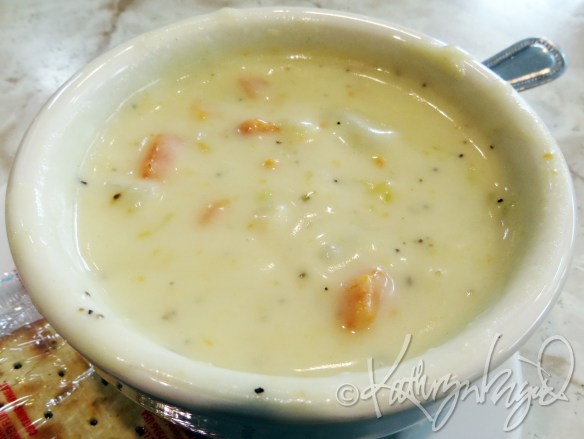
Photo: Clam Chowder 1

Lots of flour thickener = a chowder too glutinous for my taste. Good for installing wallpaper, but not light enough to show off the glam of its clams.

This summer’s travels in the American northeast offered perfect opportunities for me to revisit a dish that is a longtime favorite, be reminded of how much flexibility lies within its simple framework, and how much beauty comes from keeping it relatively uncomplicated in the first place.

Photo: Chowdah 2

Better broth still doesn’t win the day if the clams are hiding under so much greenery I think I’m being served a bowl of lawn trimmings. Herbs are great, but too *many* fresh herbs can still overpower those dainty little fellas.

Not that I have anything at all against varying and playing with food. If it’s a great item, why, it’ll withstand any number of fiddling fools in the kitchen. Sometimes one even invents yet another reason to love the dish. There’s room at the table for as many delicious versions of goodness as there are diners.

For my own taste, I’ve had great Manhattan-style (red broth based) chowders and many fantastic variants of clam, fish, and mixed seafood stews and soups and chowders, a top favorite among them my brother-in-law’s salmon-rich bouillabaisse. Lacking immediate access to that, though, I may be fondest of all of a bisque or a light, creamy New England-style chowder. There are few things I like less than dense, floury heaviness in chowder, but that can easily be avoided by thickening the soup with little or no wheat flour and not using one of the other popular approaches (also wheat-based), that of thickening the chowder with saltines or oyster crackers. I see no reason to include any in it, because another traditional ingredient I do love, potato, adds enough starch itself to keep the chowder from being too thin. If I want mine thicker, I wouldn’t hesitate to mash a bit of the cooked potato into the broth, or simply add a tiny amount of potato flour.

But there is a standard set of ingredients that make bisques and New England style clam chowder the beloved icons that they are, and these give them more clear identity than any technique tends to do. Seafood, obviously, is central, and should be tender and fresh and sweet. Many who make chowder boost the ocean-fresh flavor by adding bottled clam juice, and while I think it tasty, I don’t think it absolutely necessary. If I don’t have any of that, I’m happy to boost the broth with whatever reasonably subtle umami-buzzing jolt I might have handy.

You already know I am far from a purist about practically anything food-related. And while I try to be rigorously appropriate about avoiding the offending blends or ingredients when feeding friends with kosher, vegan, halal, allergic, or other dietary concerns, if none of these are present I am not averse to mixing seafood or dairy ingredients with meats, and so on. First choice for seafood chowder liquid? Uh, is there any question? Seafood broth. If I happen to have seafood parts handy, the shells, skins, and/or bones of assorted fish and shellfish make a marvelous addition and the perfect flavoring agent for the broth.

Lacking that but wanting the flavor to be a bit more complex, I’d still look around my kitchen for inspiration. So if I have it and want to use it, I wouldn’t be afraid to enhance clam chowder’s broth flavor by adding some of my homemade chicken broth to it. Meatless vegetable broth, especially roasted veg broth, might be better, though, mightn’t it. I’ve found that roasting meat bones for my non-vegetarian broth is generally an unnecessary step, since the ingredients tend to rise and caramelize over the long, slow cooking time, so they get browned enough to intensify the flavor if I just give a good stir to redistribute the less-cooked ingredients every once in a while. But vegetables, requiring less simmering time than meaty ingredients, don’t necessarily get quite as well browned this way, so it can be better to go ahead and roast or sauté them.

Imagine the depth of flavor possible when you use the liquid made from simmering a pot full of fragrant, chopped and slow-roasted celery, onions, and carrots, perhaps some shallots or garlic cloves; possibly even sweet corn, red capsicums, and/or mushrooms, along with bay leaves, thyme, perhaps a little dill, and a toss of black peppercorns, then straining it. I prefer to roast veg with a bit of good fat, too, of course, being who I am. If I want to keep the soup meat-free, I’d keep it very mild in flavor, choosing something like avocado or palm oil for the fat. But if I want the intensity of it, this is the one spot where I’d likely cast my vote with those who find bacon an acceptable or even desirable addition to clam chowder.

See, I don’t like the texture of bacon itself when it’s been cooked into wet foods. Might as well be raisins. The latter are, to me, too often bloated and slimy when cooked or even baked. I know, I’m a jerk, hating on poor, defenseless raisins. The flabby and listless look and bite (or lack thereof) of bacon cooked and left in wet food like a chowder doesn’t thrill me, either. But that flavor can be a great complement to chowder, if you’re a bacon fan. So roasting vegetables for veg broth is a perfect way to take advantage of the flavor without the texture, simply by giving the veggies a goodly slick of bacon grease before their roasting. If the broth is being used strictly for seafood chowder, you could even add bottled clam broth to the vegetables right along with the water for the later slow simmer into soup base.

All of this is a kind of long way of saying that what I really crave, when I’m in the mood for chowder, is seafood in a creamy soup base. Not much else. So: broth. Russet or Yukon Gold potatoes, celery, and carrots that have been diced fairly small (about 1/2 inch pieces) and oven roasted or sautéed until crisp-tenderly caramelized in butter, then thrown into the strained broth to bubble into toothsome tenderness throughout. Seafood added, just long enough to cook through (or if precooked, to warm through). Cream or half-and-half added and warmed. For those who don’t mind alcohol, a tot of sherry or brandy is fabulous added now, at the last, or even served at table as a condiment, along with the mill for grinding out fresh black pepper.

Saltines and oyster crackers bore me a little and just get in the way of good chowder. If I want an accompaniment, I’d rather have a nice crispy Parmesan tuile or two, or some straight-from-the fryer homemade potato chips alongside. And a big spoon, so I can sit and inhale tantalizing steam while I wait just until the chowder’s cooled enough to eat.

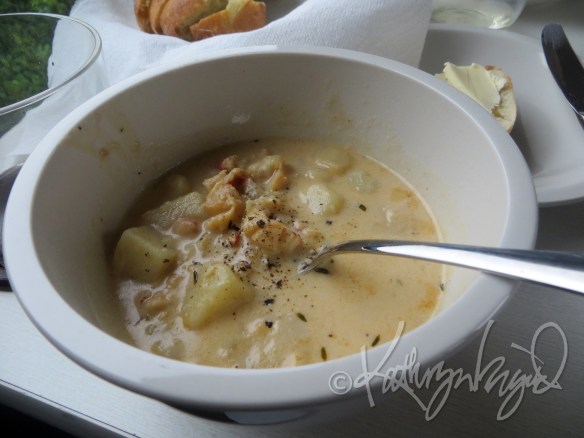
Enough dream-state ‘cookery’. I’ll end this episode of food fantasizing with the magnificent real-life seafood chowder we ate over the weekend with our superb hosts on a beautiful coastal sightseeing drive from Halifax to Peggy’s Cove, Nova Scotia, and back. Our friend Catherine cooked up a truly gorgeous chowder full of Canadian Atlantic-style goodness—homemade lobster-shell-based broth with white wine and cream and full of perfectly cooked russet potato cubes, tender scallops, chunks of haddock, meat from that freshly prepared lobster, and thyme. Little else. Exquisite. Served with some more (locally produced) white wine, warm bread, and cool butter, it was a spectacular treat. No, it was better than that. It was a spectacular treat in superb company. The genuine ‘secret ingredient,’ of course, that last one. A taste of perfection.Photo: Chowdah 3: Catherine's

A Parenthetical Life

What exists between brackets is an odd collection of addenda and afterthoughts, of accidentals and coincidentals. Bookended by parentheses, em-dashes, and pages of drama and comedy in the history of the universe as it plays out are tiny dust-motes and cobwebs, and hidden in these, all of the second fiddles, bit players, and walk-ons who create the background of the scene almost without being noticed.

It’s that almost, though, through which we ‘members of the company’ enter into the action. We may sneak, erupt, or even fall backwards through the portals, but without us, the action can grind to a halt and intermission become interminable. If a night janitor doesn’t unlock the executive washroom when the evening’s repairs on it are finished, the dyspeptic CEO might be late to that morning meeting wherein he was supposed to sign papers finalizing the corporation’s lucrative sale. If the pest inspector doesn’t notice that one little corner of the house’s foundation has a few carpenter ants surveying it hungrily, in a short while the home will be in ruins. If the air traffic controller, invisible in her tower, delays the landing of a medivac helicopter for a moment too long, the patient waiting for his heart transplant dies. So much potential lies in the smallest acts or failures-to-act.

A tombstone or obituary won’t determine my worth. Headlines and spotlights won’t, either. Most of us crave a sense of being valued and wanted, even if we don’t desire fame—but many will never know what genuine impact they’ve had on others, or others on them, being unsung and unannounced. I am at peace with that. I firmly believe that if we are to be judged, it won’t fall to the people immediately around, to a popular vote, or to any authority present on the planet to determine our impact, or more specifically, our value.

I, for one, will keep lurking and living in the interstices between the stars, content in doing and being my generally invisible best, modest as that might be. When I’m gone, others will fill in the gaps. And probably do so with better style and grace, having learned from my traipsing across the stage, lines or no lines. That’s my role, to set the stage for the starring actors and support their grander parts in history.

(Yes, even if my character remains forever nameless on the marquee.)

Photo: Plumbing the Depths

Not needing to blow my own horn doesn’t mean I’m not a necessary part of the show.

I’m Dying to Know

Do you dare to think about your own death in reasonable, detached terms? Do you think that’s morbid and grotesque to even consider, or do you find it easy? If you find it easy to contemplate in the abstract, is it because you suffer from depression or are suicidal, or is it simply that you recognize living as an inherently terminal condition?

This is big stuff. Even the clinically depressed are sometimes able to recognize, on those tiny instants of light in the midst of the abysmal dark, that their death, no matter how insignificant and unworthy they may think themselves, will affect others. I know this from experience, and from lots of reading and conversation and observation. I know that even when I was at my lowest—thankfully, not as hideously low as that reached by many, as I know in retrospect—my rational moments told me that no matter how they felt about me, or even if they didn’t notice me at all, when I was alive, everyone who was peripheral to me in any way would have some tidying-up to do after my death. Physical, perhaps, for those to whom body removal and disposal fell, but whatever tiny tasks I was not present to perform anymore would either default to another’s To Do list or leave a gap, incomplete. I realized that I am the butterfly effect, in human form. You are. Every living, breathing being has a space in the universe, a purpose, and however unnoticed in life, has an impact both by living and by dying.

All the same, I feel especially fortunate that in my family, talk about death and dying were far from taboo. It wasn’t all that uncommon to find the dinner table talk veering in that direction, if somebody we knew was unwell or had just died. We didn’t need euphemisms and pussy-footing to protect us from the reality of death. It’s nothing more or less than the inevitable cessation of life, and if we can’t talk about that, we’re stuck dealing with all kinds of petty and logistical nonsense just to get through the process when we’d rather be spending time living and loving each other and getting through the complexities of the occasion with a modicum of grace and humanity.

So my family already knows that I would prefer they donate what they can of my organs or remains to someone who has a better chance of survival and health if I give it to them, or to scientists who can learn how to give future patients that better chance. In fact, the government know this: I’m on the organ-donor registry, should I die unexpectedly or with usable parts intact. My loved ones also know that I’d prefer a minimum of fuss disposing of whatever remains of my physical shell after that, the cheapest and quickest cremation and scattering of my ashes being my top choice. I figure that any Supreme Being capable of inventing the human creature from scratch can easily put me into another, newer shell if and when it’s my turn to exist in any other form, and as for the current body, it’s a good source of recyclable carbon and nutrients to replenish any part of the earth that enjoys a good, tasty meal of ashes, say, my long-loved flowers the irises.

Those close to me also know that I have far less interest in what they do to celebrate or mourn my passing than the still-living will. If the occasion of my death can be used as an excuse for a marvelous concert to raise awareness or funds or mere pleasure for the sake of a musical group, whether my spouse is still alive to conduct or attend such an event or not, that would be lovely. But hey, I’ll still be dead, so y’all can do whatever it is that makes sense to you and I promise I won’t roll in my grave or be a pesky poltergeist or complain in any other way. Still dead, if you didn’t catch my drift.

And that, in fact, is a beautiful thing, and a great comfort to me. I don’t look forward to the actual process of dying or the moment of my death. I’d happily live a long, long life in great health and an approximation of sanity that seems cheery enough to me, before dying for real. But once I do, I feel genuinely confident that none of this worldly stuff will matter to me in the slightest, so as much as I like to “plan” ahead to keep my survivors from any terribly fussy practical matters in the event, I’m not worried. Go ahead and dance on my grave, if there is one. Keep on living. Don’t worry about me; I’ll be fine. Really.

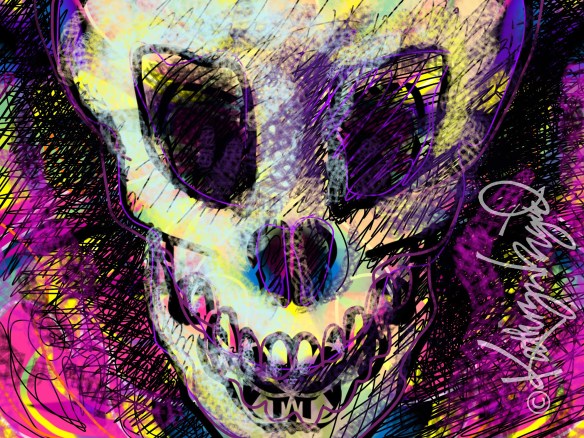
Digital illo: Mine was a Death's Head

Long May It Wave

Photo: Scar-Spangled BannerToday, the day Americans celebrate this nation’s incorporation as an independent country, there are and will be a lot of fireworks, eat-drink-and-be-merry parties, solemn salutations of admiration and thanks addressed to the people and acts that led to the establishment of America, and “patriotic” speeches of allegiance and fealty to whatever each speaker or audience relishes as the greatest rights and privileges of living in this place. We don’t all agree, not remotely, on which things are Rights and which are merely privileges, never mind which are to be relished. We don’t share a single, singular point of view defining patriotism or our national identity or strengths.

That, in fact, is what I see as one of our greatest strengths. We are a country that prides itself on individualism, if not individuality. And that, in turn, we define differently, each of us. As little as I know about the country I call home, my sense of it says that the name United States suits us well: a collection of wildly, wonderfully, weirdly differing entities—both states and persons—pulled together into one larger whole. It doesn’t homogenize or even blend us. We remain diverse and divergent. And that is the strength that our founders hoped, as I understand it, to cultivate.

We tend to fail, nationally speaking, more than we succeed at this delicate and complex effort. We mess it up pretty (no pun intended) royally both out in the wider world and within our own borders. Often. But there are frequent gleams of starry hope, as well. There are those among us who will stop and truly listen to each other, who will negotiate, counter-propose, parlay, parry, and persist, in the pursuit of better solutions. Those who choose to recognize differences without letting their own beliefs in the matter condemn their fellow citizens as second-class or unworthy.

It’s funny how often many of us Americans get mighty excited, thinking that somebody else is busy trying to impinge on our personal Freedoms (apparently we are historically hysterical when it comes to that) merely by valuing different aspects of the legal freedoms we all enjoy here or by wanting an equal share of the same ones; we’re past masters, too, at howling injustice over others’ intolerant narrow-mindedness, which of course translates directly as “any thinking, belief, or experience different from mine” and thus is equally self-definition, should we think through it carefully. We each obsess over how to make the rest of the nation see our individual points of view as the simple and clear logic they embody, and as the obvious morally and ethically correct way to think, live, and be, whether any of our own choices and decisions are in truth logical, moral, or ethical, let alone demonstrably so. But that difference, too, is part and parcel of the multifarious and colorful country we call home and of its hard-won foundational tenets.

So while I spend the Fourth of July, like any other day, in mindful and slightly irritable worry over all that could and perhaps should be better about my native country, not to mention about me as one of its inhabitants, I also cling to the hope and optimism that continue to reside here. People are still kind to each other, from holding open doors to donating large quantities of time and other resources to the health, education, safety, and well-being of others, and more importantly, some even do this without requiring that their beneficiaries support and adhere strictly to the donors’ worldview. That, to me, is a great assurance that this nation does still hold dear some of the essential characteristics on which it was founded, even if with a noticeable amount of ignorant hubris stomping on the extant good on this new shore. We remain flawed and selfish and foolish, each in our own ways, but for the most part, this is also a country full of people who, through hard work and goodwill and the desire to fulfill the promise of our forebears, native-born and otherwise, mean to keep becoming better.

May this better part of each of us become a great banner of Peace, Justice, and Hope. May the winds of the future send it curling around those who are in need of the wealth with which we, corporately, are gifted, and give them not only enough resources and courage to be lifted up but a share of that same peace, justice, and hope. And long, long may that banner wave.

My Word on It

Photo: Early MusicBEMF. Road trip. Wedding. Dad’s Day. Arguments. Home. Adventures. “I love you.”

What do they all have in common? One word.

Family.

I’ll bet you were going for: Love. And of course, you would also be correct, because that’s the very definition of family for me, as you well know. It’s not biology; it’s not pedigree and legal contracts and historical ties. It’s love. And love is not, for me, dependent on any of the aforementioned characteristics and descriptors, though it may—and I hope it does—have a close relationship with them more often than not. It’s respect and trust, support and kindness, even in the middle of stress and disagreement, illness, injury, confusion, and chaos. I am so very, very fortunate and blessed and grateful to find myself in the midst of an extraordinarily big, rich family network that comprises biological and legal relatives, yes, but also much more than that: a wide range of dear friends and comrades who are more than mere acquaintances or colleagues can ever be, each one tying me further to the next.

BEMF [the Boston Early Music Festival] was the beginning of the most recent two-week series of family events for me and, as in my previous times there, a joy from start to finish. As an arts event, it has very few peers in the world, being a week-long gathering of superb artists and dedicated audiences who converge for the love and celebration of Early Music and all of its many concomitant delights and beauties, all in a magnificent city. This biennial visit was a typically lovely one, starting with the gathering of our Early Music family from around the continent and overseas, especially the wonderful singers, players, producers, conductors, and other aficionados of the genre; they hailed from the university where my spouse works, well-loved Canadian spots, and many of the states and companies in which we have connected with such marvelous people. On arrival in Boston, we settled into our rented digs with a pair of our dear adopted kin and began the week with the rehearsal and performance of the university’s Collegium Singers and Baroque Orchestra friend-colleague crew whose concert was the impetus for the BEMF visit. And a wonderfully successful one, at that.

What followed was a week packed with beautiful music of all kinds set into the interstices between superb performances of the trilogy of Monteverdi operas and his 1610 Vespers, one of the most significant and exquisite foundational parts of the whole Early Music oeuvre and experience. The weather treated us all remarkably kindly, the food was as always inviting, varied, and delicious, and the historic and aesthetic pleasures of the city and immediate area renewed my love of being a happy observer and tourist there.

Next came renting a car and road-tripping to the Maine and Connecticut coasts, places I’d never been before and my partner, not in many years. Wandering gorgeous little towns and seaside regions like Brunswick and Bowdoinham, Maine, and Stonington and Mystic, Connecticut, and all sorts of big and little cities and towns around them with little specific agenda other than the rooting out of great seafood and scenery (more about both will surely follow here in many posts to come) was great post school year stress relief and entertainment in large measures. Spending time simply meandering in the wonders of the American northeast with my beloved, even better. A great time to reinforce why I love the guy so much and feel immeasurably blessed to live with him for the long run.Photo: Traffic Jam

Was there stormy weather and bad traffic in our two-week outing? Yes, both real and metaphorical. Nature dictates the occurrence of these things around us, and human nature, within us. We’re all designed to need rebooting from time to time, if not a good boot in the booty. Just before heading home after the whole two-week extravaganza of beauty, wonder, love, happiness, and unbelievably good things, I got into an argument with my most beloved spouse—really angrily, ridiculously angrily. Over absolutely nothing. We were both very tired, at the end of a whole school year of huge commitments and busyness plus two weeks of (great and glorious fun notwithstanding) travel and social events and the demands inherent in both, and knowing we’d come home to huge lists of chores and catch-up tasks for both of us.

I’m not lying when I say we are not a fighting couple. But we do disagree, and frequently. One friend cheerily calls us the Bickersons for our style of daily communication, and I’m sure is not entirely feigning his worry that we’re going to don boxing gloves and just duke it out any minute, being an equally balanced pair of supremely stubborn and finicky people. Most of the time we equably agree-to-disagree, because what we do argue about is virtually always, as in the above case, nothing. Often, it’s mere semantics, each of us saying pretty much exactly what the other is saying but in such different personal language that it sounds like we’re worlds apart, and when we really are on different pages, it’s not about anything crucial to the foundations of our marriage. We share our core values, no matter how the day is going.

So by the end of the hour yesterday, tempers cooled down, and by today, I was firmly reminded that I would do well to keep my trap shut long enough to realize how petty and pointless the disagreement is before wasting any energy on arguing a non-point. I never feared that we didn’t still love each other or that a grave emergency was going to occur if he didn’t see the light and agree with me forthwith, but you’d not have guessed that from the way I was talking. How silly of me, and how pointlessly rude. How sorry I am.

I’ll at least give myself the concession that this is how things go sometimes with those we love the most, our family. We put on the proverbial boxing gloves because we love and care too much to just stomp off into the sunset and never get back to I’m Sorry and I Love You. It hurts, yes it does, to argue, and perhaps the more so pointedly when I know in my heart it’s over something idiotic and meaningless, but I suppose it’s far preferable to not having enough passion to vent and relent.

This misadventure was followed by not only reconciliation but remembering that it was, of all things, Father’s Day. We weren’t in one place (with cell reception, anyhow) long enough to call our two fabulous dads right on the day and give them the fervently felt thanks and love they deserved on the occasion—though, arguably (no pun intended), we could have made a pretty quick call to at least one in the time we wasted arguing. Being longtime family members of the truest sort, Dad W and Dad S will undoubtedly forgive our tardiness and just be glad we get around to calling tonight with belated greetings for the occasion. They are both past-masters at the whole Real Love thing, anyway.

Which brings me back into the middle of the story. I haven’t forgotten that way back in the first line of this post I mentioned a wedding. It was the excuse for our road trip after leaving Boston…why fly home to Texas and then back north within a week if a week’s holiday in between beckons? It was also, and no surprise, one of the clear and dazzling highlights of the whole fortnight’s expedition. Two other dear members of our extended family (both former students of my spouse’s) now uniting in the contract of marriage, in a fairytale sort of wedding held in the bride’s parents’ garden where the long threatening rain consented to abeyance, not because to do otherwise would have been a crime against the sweetness of the day but because it was probably more appropriate that the tears being shed were all joyful ones by various members of the wedding party and fond attendees.

There was visual gorgeousness throughout, just as with last year’s wedding of another such pair of adopted-kin sweethearts that took us to Puerto Rico, and as in that instance, also perfectly thought out and enacted to fit and represent the couple in question. The settings were spectacularly prepared, music exquisitely performed by musicians near and dear to the marrying couples, the wedding parties looking like some kind of ethereal Hollywood-designer versions of how wedding parties usually look, and the after-parties a couple of ones guaranteed to be recounted for ages by everyone who attended. And the friend who performed the marriage ceremony for this week’s bride and groom, for whom I am told this was her first such duty, spoke simply and eloquently in the most appropriate of ways for the occasion.

The centerpiece of her brief address of the bride and groom was recognizing their deep and remarkable commitment to family. To the community of care and comfort and love found in people who have chosen each other and stand together willingly, if not willfully, through thick and thin. Those present on the day were a clear part and example of this way of life. And it was impossible not to respond in kind, to acknowledge the connection and delight in it, and promise together to continue to seek it out.

I promise. You have my word on it. That word, you know—Family.Photo: The Family Dance