Oops.

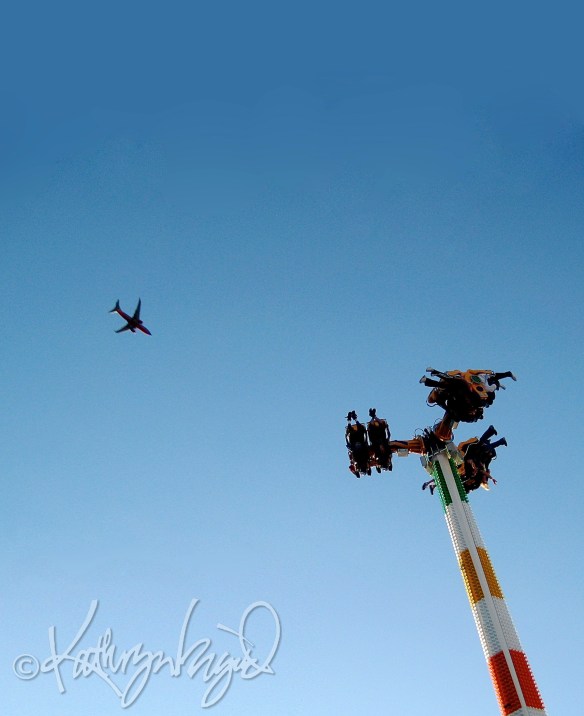
What if science were all subject to a completely innocent, ignorant childlike approach? I can imagine there might still be people attempting flight by means of getting into a big slingshot of some sort and expecting to be transported into a plane, rocket, or shuttle by unknown magical means from there. Talk about missing the point!
Photo: Oops. Or not.

Then again, what if there were no childlike naïveté in the sciences? No one would dare to ask what seemed at first like ridiculous questions or to assume that the apparently remote outlandishness of an idea could prove to be possible, with some study and experimental investigation. No one would fly, other than perhaps falling off a cliff, where the landing is inevitably so much less desirable in form than otherwise. I suspect that taking chances and inquiring about what could be dangerous or at least foolish topics will always appear slightly immature and entirely risky to those who don’t dare to dream, but I’m mighty glad that there are others on this earth who brave the unknown with the heedless enthusiasm one might have expected from a kid.

I Made It Myself!

Funny, isn’t it, how proud we are of things we think we have accomplished, no matter how silly and shoddy they may turn out to be. As often as not, we are the engineers of our own destruction; whether we stubbornly and hubristically fail along with our ridiculous doings and inventions or not is sometimes a matter of mere luck and circumstantial adventure.

Digital illustration from a photo: I Made It Myself

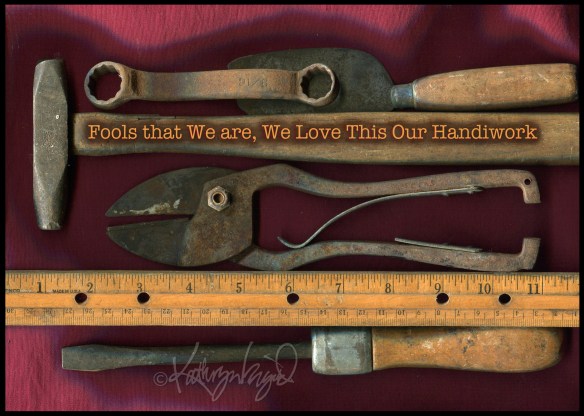
Digital illustration + text: Engineers of Folly

Fugue State in the Studio

It’s not always the case, but sometimes I find that I can lose track of time and self rather thoroughly when I’m deeply engrossed in making art. Writing even a simple email can take ages, if it’s about something or to someone I consider important; an essay or poem can take hours or days, if I get involved and forget where I am. It’s a bit like driving a familiar route; when I’ve been on the same track enough times, I am occasionally startled to realize that I don’t remember passing through the last number of miles, because my brain is so used to noting what is or isn’t as it’s expected and supposed to be that it operates nearly on autopilot, though thankfully if I examine my memory I can indeed recollect noticing real details along that ostensibly missing section of the trip. With making visual images, I can (and sometimes, I think, absolutely should) let go of and turn off my editorial mind for a good period of the work time. If I’ve practiced enough and prepared enough, inwardly, for a session of art-making, letting my attention take a back seat to my instincts and actions before returning to critical mode is at the very least going to produce some worthwhile, thought-provoking, challenging Stuff that will either lead directly to an artwork or, as a bit of not so fabulous yet earnestly glimmering potential, lead to something on the next try.

No matter how that part of the process goes, I’m quite sure that an easy 90% of what I do to make art, whether it’s textual or visual, happens internally and not externally, so it’s no wonder if I wander off at times.Digital illustrations from photos + text: Work Patterns

10 Terrible Words that Shouldn’t Exist in Any Language

Digital text-illustration: 10 Terrible WordsOne person who hates is a Weapon of Mass Destruction. One who cares and shares? Perhaps the only antidote.

As I recently said to my friend Maryam: poverty—both of concrete, material resources like food and shelter, and of intellectual and ephemeral resources (education, spiritual enrichment, the arts, community engagement, etc)—seems to me to be perpetrated and perpetuated more by selfishness than by an actual shortage of any of those resources. The rich and powerful always want more riches and power, and what they do have makes them able to afford and acquire more and to keep their feet firmly on the backs of the have-nots. Plenty is never enough. The resulting imbalance is as old as history, and rotten as ever. Only those who will speak up and resist entrenched inequities and injustices will have any hope of making change.Photo montage: Wolverine & Badger

The badger and the wolverine have a reputation for being among the most tenaciously savage brutes of all the mammals. Yeah, Honey Badger even has his own meme to show for it. But let’s be honest: no beast of earth, air, or sea has a capacity for vile, rapacious cruelty rivaling that of the human animal. Even creatures of the natural enmity of predator and prey compete, fight, kill, and are sated. They have little apparent ideation of hatred and war to match people’s. A wolverine or badger will fight to defend, or to kill for food, but unlike the human, doesn’t seem inclined to attack indiscriminately outside of its primal needs for safety, shelter, and food; when the skirmish is done as efficiently as possible and the need assuaged, the sharpest of tooth and reddest of claw among them doesn’t do an end-zone dance to celebrate its pleasure in winning but will usually depart the scene or go to rest for the next time of need. The remaining food and shelter and other resources stay in place for whatever creature comes next, hunter or hunted, cousin or not.

Can we humans not learn from such a thing? I’m pretty sure that if we destroy each other and ourselves in our constant self-righteous, self-congratulatory belief that we deserve everything we can get our hands on, Honey Badger won’t be the only creature that doesn’t care.

PessimOptimism

Graphite drawing: Self-Inflicted“Prepare for the worst but hope for the best.” It’s part of my credo, I guess, and may well have been aided in its development by doing those hilariously futile duck-and-cover atomic bomb drills of the Cold War era. And the air raid drills—we lived in a Ground Zero area near several military bases, strategic coast, and a handful of Nike missile sites in those days—fire drills, earthquake drills, tsunami drills, and later when we lived in the midwest, tornado drills. You’d think we’d all have grown up incredibly paranoid after such stuff in childhood. But I think that besides being remarkably resilient, kids use logic on such daily puzzles far better than they remember how to do when they hit adulthood and have been taught their prejudices, and are much more easily distracted and blinded by grey areas.

I don’t remember ever believing that crouching under a flimsy little wood-and-steel desk would save me even from the shrapnel of shattering windows and imploding walls in the event of an attack or large-scale disaster, particularly since I imagined the desk itself would become shrapnel along with everything else in the atomizing roar of a bombing. Little and naïve though we were, we had gleaned hints of the enormity of such things from our beginning school studies of the world history of war (skewed to our own culture’s view, of course); no matter how grownups think they’re shielding kids by sanitizing and limiting the information the wee ones are allowed to see and hear, children are quick to notice the blank spaces where redacted information interrupts the flow of facts, and no adult is more curious than a child to hunt for clues as to what was redacted. Frankly, if there really is any use for an institution like the CIA in this day and age when practically anyone can find out practically anything with the aid of easily accessible tools like the internet, cellular phone, and, apparently, privately owned drones, along with all of the more traditional tools of spy-craft, I suggest that the crew best equipped to uncover any facts not in evidence would probably be a band of children all under the age of about twelve.

Meanwhile, we still have large numbers of people who think it prudent to withhold or skew the information passed along to not only kids but even fellow adults, giving out misguided or even malevolent half-truths or remaining stubbornly silent and in full denial about things considered too dark for others’ knowledge. And what do we gain from this? Are there truly adults among us who still think that even smallish tots can’t quickly discern the differences between a fable or fairytale, no matter how brutish and gory it may be, and the dangers and trials of real-world trouble? Does delusion or deception serve any purpose, in the long run, other than to steer us all off course in search of firmer, more reliable realities?

As I just wrote to my dear friend Desi, it seems to me that the majority of humans always assume a fight-or-flight stance in new or unfamiliar circumstances before allowing that these might be mere puzzles to decipher, and more importantly, we assume the obvious solution to be that whatever is most quickly discernible as different from self IS the problem. Therefore, if I’m white, then non-white is the problem; if I’m female, then male. Ad infinitum. And we’re generally not satisfied with identifying differentness as problematic until we define it as threatening or evil. This, of course, only scratches the surface—quite literally, as the moment we get past visible differences we hunt for the non-visible ones like sexual orientation, religious or political beliefs, and so on.

Unless and until we can change this horribly wrongheaded approach on a large scale, we’ll always have these awful problems, from petty playground scuffles right into the middle of the final mushroom cloud. The so-called justice systems of the world are set up and operated by the same flawed humans who make individual judgements, so the cycle is reinforced at all levels. Sometimes it truly makes me wonder how we’ve lasted this long.

Can we learn from kids? The younger the person, the more likely to blurt out the truth, whether it’s welcome or not. The subtleties of subterfuge are mostly wasted on children, who unless they’re engaged in happy storytelling for purposes of amusement and amazement, would rather be actively puzzling out the wonders of life than mucking about in search of evasive answers and duck-and-cover maneuvers. We might gain a great deal by reverting a little to a more innocent and simplistic view of the universe, one that blithely assumes that others are not always out to get us, that direness and doom aren’t lying open-jawed around every blind corner, and that the great powers of the internet and cell phones might just as well bear cheery tidings of goodness and kindness, and drones be removed from deployment as spies and weapons to work instead at delivering birthday presents to friends and packets of food to hungry strangers.

I’m not fooled into thinking any of this is easy to do, any more than any savvy kid would be, but I’m willing to believe it’s possible if more and more of us will commit to such ideals.
Tiger Time

If you remember anything about primary school (and I do, if little) you hopefully have a few memories of one or more of the fantastic sort of teachers who were the virtual equivalent of extra aunties and uncles and grandparents, but neatly spun into the form of educators whose wise teaching made you learn things without even knowing you’d worked at it, and want to learn things you hadn’t even known you wanted to know just because they were such fine pedagogues that they made it seem possible, if not easy.

You undoubtedly also have a memory or two of teachers who were quite the opposite. My personal least-fave was the third grade teacher who had no compunction about excoriating and humiliating a student in front of the rest of the class regardless of the infraction or any of their previous achievements or behavior, even cracking a yardstick onto desktops to make a point when she was het up, regardless of whether there might be some small knuckles in the way of the stick. At the very same time, she apparently thought it perfectly logical and beneficial to ‘level the playing field‘ and make all students feel they could accomplish something in her class, lest the PTA or school board think her not supportive and informative enough, and this she would do by sitting and doing the weakest students’ homework for them.

I knew nothing of this until one time when I was the unlucky receptacle for her ire, having failed a penmanship test in the first weeks of school because that school required students to learn cursive writing in the end of the second grade and the one in another state where I had spent my second grade did not. Had she asked us all to sing a song in Spanish, I might have been the star of the class, because my second grade teacher Mrs. Mosqueta let us learn a little elementary Spanish from one Señor Ybarra, who taught by the ultra-newfangled medium of televised classes, and I don’t think my new classmates in Illinois had yet had access to such magicks themselves. But there I was, little miss Goody Two-Shoes, who had never gotten anything but perfect scores because I was too prim and much too afraid to not do my homework to the nth degree—if I had any actual training or homework to prepare in the event—flunking my attempt to make Pretend Cursive when that mean lady in her sausage-casing dress didn’t even ask whether I’d ever been trained to write that way. If you think I still sound remarkably bitter about such a small thing from so long ago, well, I probably ought to let it go but I tend to enjoy my little revenge fantasies more than is entirely good for me.Digital illustrations + text: Tiger TimeThis is all in jest, of course. I wouldn’t be so cruel as to want to give any poor innocent tigers indigestion.


FutuRetro

One of the things I so love about travel and touring is getting a much more powerful sense of history; standing in and on the places where events and lives long past have happened, whether grand or insignificant, utterly changes my understanding of those people and occurrences. My first trip overseas, that Grand Tour I was so privileged to take in college with my older sister, was an awakening I never expected. I hoped the trip would be a cure for my sophomore blues, and indeed it was, beyond anything I could have planned or dreamt before, but more than that I was startled by how connected I felt to history.

The drizzly and cold autumn day when we visited Canterbury Cathedral was atmospheric enough in its way, but I remember standing on stone steps worn into a soft bowl by the thousands of footsteps that had passed over them in the centuries of its existence, looking up into a palely gold ray from a lamp, seeing the motes of dust whirling in it, and feeling that time itself was floating down around me in delicate pieces, that the spirit of every person who had ever set foot on that same smooth hollow in the stone was present there with me in that very moment. It was almost as though I could hear their voices and see the scenes of the past play out in the faint gloom around me, all overlapping and yet perfectly present. I felt my own place in the whole of the human timeline in an entirely different way than I ever expected, tinier than ever, yet surprisingly more concrete and tangible.

This was reinforced later in the same journey many times, as we passed through or visited (not necessarily in this order) England, Italy, France, the Netherlands, Switzerland, Austria, Germany, Denmark, Sweden, Norway, Wales, Scotland, and Ireland and stood in the very footprints of many a person, going down the winding passages and cobbled side-streets that had seen multitudes of significant moments long since fled. As this was the first time I visited Norway, the rooting ground of my ancestors from every branch of my family tree, it is no surprise in retrospect that many of those potent realizations came to me in that place—but as usual, hindsight is ever so much clearer than was my youthful wisdom in those days. It was moving, more meaningful than I can express, to get to know the relatives in Norway with whom my family had maintained contact: my maternal grandfather’s sisters and brother-in-law, nieces and nephew. These were days before cheap telephonic long distance, let alone email and internet communiqués, so we had only briefly even met most of these people when they visited America once in my younger years, yet they not only took us in as visitors, Tante Anna and Onkel Alf kept my sister and me with them for a full month and took us to see the family’s two longtime farms, the graves where many of our ancestors were sleeping underfoot. This was incredibly touching, a genealogical history lesson, but the more so because it was taught by the eldest of our remaining family there.

What moved me the most, in fact, was when on arriving in Oslo at our mother’s cousin’s home before we even came down south to be with his parents, we explored the great city a little on our own during the days, while he was at work and his wife and children off having their own day of adventures. It was all so humbling and so magical to feel for the first time that I understood a tiny bit more of my own family lineage and how our people fit into the larger world. We did visit many of the obligatory and famous tourist sites, knowing that there was no direct link to our ancestors, only cultural ones. So I was quite stunned when we visited the Viking Ship Museum and, standing before these ancient vessels, I was absolutely electrified with a sense of shared history coursing through my veins. My forebears were undoubtedly humble subsistence farmers, not the bold and violent and adventurous Viking strain we know through film and television, never mind through the great Sagas—but I felt for the first time something connecting me to those long-gone people all the same.
Photo: Enter the Time Machine

By now I have traveled a fair amount more. I have been on this planet more than twice as long, and I think I might even be a little bit wiser through my experiences in that life than I was back then. But I approach every narrow stone passageway, every weathered door, every window with its rippling antique panes presenting everything that’s beyond them like a warped post-impressionist fiction of itself, I expect to learn something not only about what is there in front of me and around me, but what is inside me. And I know that I will learn something, too, about how I fit into that larger, and ever so mysterious, world if I am wise and patient and alert enough to notice it. So much has gone by. So much remains ahead, yet unknown.

Who’s the Wisest?

I give myself credit for being smarter than I am. I suspect, given what I see around me in this wild and woolly world, that I am far from alone in the practice. Even owls, a favorite symbol of wisdom, are not likely as perfectly ingenious as we imagine them, but they might still be more intelligent than the half of us.
Digital illustration: The Owl King

The Search Continues

Parsing paragraphs to find

The author’s complete state of mind

Is no more useful than to ask

A Word how it performs its task,

If we assume we’ve read aright

What’s only there in black and white.


The Long and the Short of It

How quickly pass the hours and days

and weeks and months and years,

And yet, how slowly pass our worries,

paranoiac fears;

This is the great conundrum that

presents in mortal time,

And quite enough of food for thought

in one quick, measly rhyme.

Foodie Tuesday: Medium Rare

I know all thoughts hereabouts turn to turkey at this time of year, but not everybody (even the meat-eaters among us) craves turkey, whether they’re celebrating Thanksgiving or not. Why ever eat something that you’re not wild about or hungry for just because tradition seems to dictate it? You’re free to be just as thankful for a fabulous steak dinner as for a roasted turkey, especially if you consider how little our modern image of Thanksgiving turkey dinners probably resemble the original feast they’re meant to commemorate.

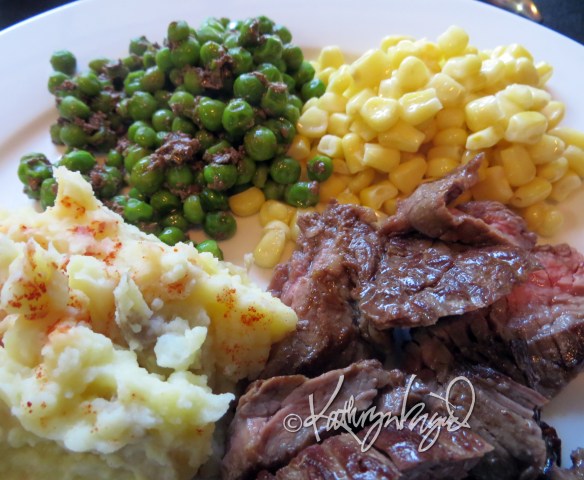
And a good steak needn’t be a terribly rare thing. I used to avoid serving it not out of dislike but because I was sure it was too hard to prepare it nicely. Somewhere along the line, fortunately, somebody set me straight on that. If I can heat a pan to just slightly over medium high heat and own a timer, there’s not much excuse for being fearful about it.Photo: Medium Rare

What I learned was so simple that it seems laughable, but then that’s how I operate in the kitchen. This self-educated cook has a doofus for her teacher. Here are the incredibly easy things I learned to do that make steak dinner—with a fairly perfectly medium rare steak in the midst of it—a possibility simple enough I don’t hesitate anymore.

Let the steak be the star. Get the nicest quality cut you can afford for the occasion, at best a well-marbled 1 to 1-1/2 inch (2-3 cm) thick grass-fed beauty; pat it dry, coat it liberally [no matter what your political leanings] with salt and coarsely ground black pepper, or a spice rub if that’s your wish, and let it sit a few minutes absorbing that seasoning while you heat up your heaviest skillet on a middling-hot flame or burner. I love my cast iron skillets best of all for doing steaks. Melt a big dollop of good fat to coat the already fabulously seasoned skillet, and when it’s rippling with heat (but not smoking), gently lay in those steaks. One massive one that almost fills the pan can of course be cut up afterward for sharing, or several smaller ones put in together; just make sure that whatever’s in there has room—if it’s crowded in the pan it’ll steam rather than sear. That would be sad.

When the skillet has been made hot enough for the fat to shimmer in it and the steak is in place, expect it to act like a slightly irritable cat: that steak and the frying fat will hiss and spit a little. You might want to stick a splatter screen on top if you’re fussy about stovetop cleanliness, but it’ll wash off easily enough later if you don’t care in the meantime. What fat should you use? Avocado oil is great, if you can get your hands on some, as it has a high smoke point; for straight-up beefy flavor, you can hardly beat clean beef tallow, but it’s not too common to have that on hand (I keep the skimmed fat from my bone broth for such things at times); bacon fat is a flavorful alternative. Ghee or clarified butter is probably my favorite. Whatever you choose, I recommend something with a high smoke point to give you the ability to get a good, caramelized sear on the exterior of the steak without turning the inside of your house into a smelly barbecue pit full of tarry smoke.

But enough about heat and smoke and fat! The steak, still, is your starring player. What to do with that loveliness? Not much. Leave it alone! When it’s in the skillet, let it sit and sizzle completely untouched for about 4 or 5 minutes. The bottom edge should show you just a hint of the beautiful dark brown crust building below, and you’ll flip it over and do the same thing. The next thing you do is: some more Nothing. When you get a whiff of that superb, incredibly tempting scent of beef perfection as both sides have browned gloriously, you will want to stick your fork right into it, but don’t. Wait. Take the steak out of the skillet and let it rest on a warm plate for at least five or ten minutes while it finishes cooking from residual heat, and reabsorbing the juices that will all run right out of it if you cut into it too soon.Photo: Skirt Steak

When you think you have suffered enough, wait thirty seconds more, and then you can pounce on that steak. While I’m waiting for my steak to be ready, I distract myself to prevent premature steak attacks. I deglaze the pan with a splash of Jack Daniel’s black label tastiness and a smack of salted butter, as often as not, to pour every bit of remaining goodness back onto the steak with a lagniappe of kindness. I make sure the salads, sides, and other accoutrements of the meal are all at table and all ready to play their supporting roles to the marquee meat. If all of that hasn’t kept me in check for quite long enough, I’ll just have to risk it, because I’ll have been sniffing the air like an unchained werewolf, and y’all had better get out of my way now and settle down to your own plates of steak and we’ll all be safe and happy, at least until the next full moon. Or steak dinnertime.

Unnaturally Lightfooted

We’ve long since established that I can’t dance. I couldn’t dance well enough to stay in a second-grade dance class; heck, I couldn’t even be trusted to remember whether we were supposed to show up wearing tights with our tutus or not, for the class picture before the big recital. Though it’s only fair to give myself credit for having been obsessed with the ugliness of our getups to such an extent that I forgot the part about the stockings, and I promise you, they were hideous costumes.

But you also know that I am enamored of beautiful dancing of nearly any kind, if allowed to watch it from a safe distance. So I think I can be forgiven for letting others take to the floor in real life and only doing so in my imagination and, occasionally, in my poems. I think any creature, real or imagined, that can dance beautifully deserves my attention and admiration (as long as it wears the correct tights with its tutu).Graphite drawing: Swinging Dragonflies


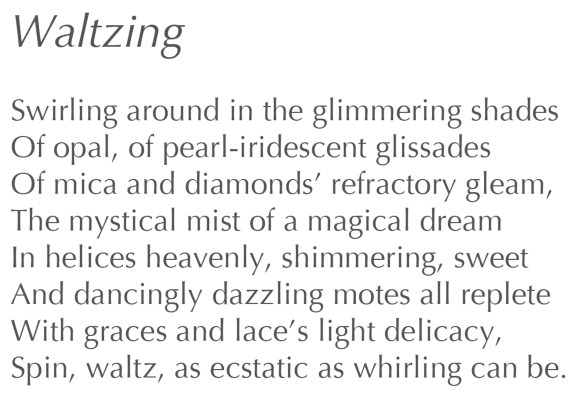
Text: Waltzing