Everybody needs a break. Not everyone gets one or is in the position to take advantage of it, but when the opportune moment arises, it’s a gift that should be savored. After all, it gives us far more energy for going forward with style.
Category Archives: Education
Beginning with the Very First Night
Those distant notes of smoky, sighing dusk
That underlay and raise the early moon
Draw mystery from earth, as if its musk
Were growing far too fecund, far too soon,
To lie a moment longer there in wait
And hide the heart of what was made for strength,
The time when reinvention is so great
It imitates Creation, and at length,
Renews its potent primacy and grows,
Becomes, designs, accelerates, empow’rs
All who would build, each being here that knows,
The inspiration of the nighttime hours—
So break the stars of newness in the night
Discretionary Fun
I get the impression that some people treat non-work times as the only times when they’re allowed to be happy. I do understand the need for income that can drive one to spend time in a job that doesn’t fulfill any other need or desire in life, and many of those are in the least-compensated positions at low-paying employers’ as it is. Been there, done that.
But I can say, too, that the greatest misery in my work life was attitudinal, and the more I did to discover and avoid the things that made me unhappy in my work, the less miserable I was. The more I sought to learn what I enjoyed in work and chose ways to magnify that, the closer I got to contentment both at and out of the workplace.
I grew more cognizant, at the same time, of not wanting to waste precious time on work that challenged my inner playfulness or threatened my general sense of joy and purpose. I was given a great gift in being able recognize the longing and accept and pursue it by choosing a much lower-paying job (on paper, at least) with a great happiness-quotient. I’ve seen, over the years, that many of us are easily misled when we try to calculate what we think we need for our daily expenses, and how much it costs us to earn that. Yes, we get those paychecks, but if the job requires, say, clothes that we wouldn’t wear other than at work, child care, transportation, professional training and memberships, and that sort of thing, how much pay on an annual or monthly or hourly basis does it really cost to go beyond paying for those, at least far enough to keep a roof overhead and food on the table as well?
Nobody knows this awful kind of math better than the working poor. I’ve been in that category more than once in my life, but have always had safeguards others lacked—like friends or relatives from whom I could rent living space more cheaply than I could even a minuscule, run-down apartment in a scary part of town—so I also know that I am luckier than most. Now, when I am married to a person who is not only able to make enough income to support both of us but is willing to do so, I am among the most privileged and fortunate of creatures, and I know that, too.
But one of the best things I learned along the way when I was living on a very slender, sometimes sporadic, income, remains valuable to this day: if I spend so much time and energy on just ‘getting by’ in life and don’t put forth equal effort to enjoy, live, and love my life along the way, all of the pennies I earn are of little value at all. And while I can’t always afford the most thrilling and glamorous ways of keeping myself amused, especially when I do need to be working at any task or job, I had better find the simpler and cheaper ways and the most reliable ones to fill my life with happiness and contentment, I know by now that surrounding myself with people I love, admire, enjoy and respect is the very best solution. And if my job doesn’t allow for that kind of happiness and contentment, then it is costing me more than it pays, in the end.
The Strangest Kind of Strangers on a Train
The old tale of complete strangers meeting in transit, discovering they have identical problems, and “solving” the problems by trading crimes to eliminate the people they see as the root of their unhappiness, makes for a striking mystery drama, in fiction. Ask Patricia Highsmith and Alfred Hitchcock fans! But I was reminded recently that we give too little credit to our commonalities as a positive solution to our problems, and end up missing crucial opportunities as a result.
The filmic version takes as its thesis that the two strangers who meet can find not other, or at least no better, solution to the problem of having bad relationships with inconveniently incompatible people than to murder them, and by ‘exchanging’ murders with each other they hope to escape detection by each having no apparent connection to, or a motive for killing, the other’s nemesis.
While this makes for startling and even compelling imagined mystery, it’s horrific if imagined in real terms. Yet we do similar things all the time in this world, don’t we? Because I tend to agree with a particular point of view in general, say, a specific philosophy or political party’s policies, or my country’s traditions, does that mean it’s wise or humane or practical or generous to follow along without question, no matter what my group, party or nation says and does? We mortals are remarkably good at noticing and magnifying our differences, as genuine and large as they may be. But we’re frighteningly weak, in opposing measure, when it comes to recognizing, focusing on, and building upon our true kinship. This, I believe, easily outweighs in both quantity and importance, our separating characteristics. 
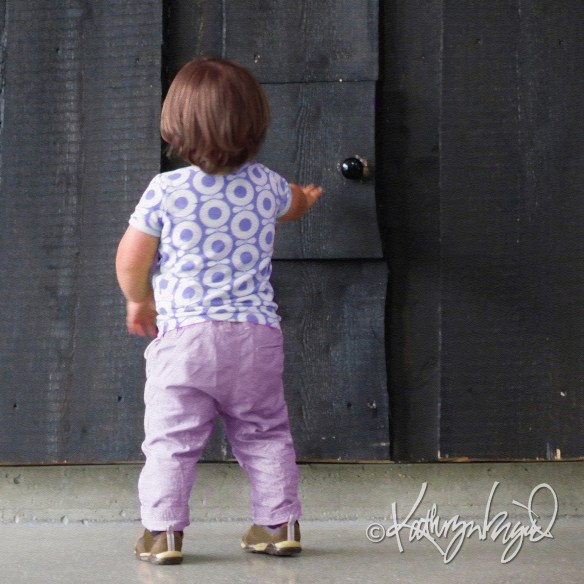
The recent train outing in Sweden that reminded me so pointedly of this also confirmed my belief that it’s an area where youth is wiser than experience. In a railcar where a young father, not a local or a native speaker of the language, was keeping his fifteen-month-old daughter occupied and contented during the trip by helping her practice her tipsy walking, she made her way with his help to where another family, also foreign but not of the same culture as father and daughter, was sitting together. That group was of two adult sisters and their four or five school-age children. The toddler was naturally attracted to the friendly and spirited older children, and as soon as they saw her, they too were enchanted. What followed was perhaps twenty minutes of delighted interaction between them all, with occasional balance aid from Papa and photo-taking by the Mamas. And barely a word was spoken, much less understood by any of the participants, during the entire episode.
The greatest among the many beauties of this endearing one-act was that the conversation essentially began, continued and ended with the kids reaching toward one another with open hands, waving and gesturing and generally putting on an elaborate pantomime together, and above all, giggling and chortling with peals and squeals of ecstatic laughter.
Needless to say, all of us adults in the railcar grinned, giggled, chortled and otherwise became happy kids right along with them. Resistance was an impossibility and a pointless attempt, at that. And isn’t that an excellent lesson for all? Adults are too busy being territorial and fearful and downright feral to remember that the open hand of welcome and sharing is as quickly reciprocated as any gesture, and a smile of greeting and acceptance is contagious beyond any language, age, or cultural barriers. We can nurse our terrors of the unknown as supposed adults, or we can choose to laugh together like children.
The Only Magical World
There’s only one plane of existence that is guaranteed to seem perfect and right to you at all times, and that’s the one in your dreaming heart. But the place in the real world that will come closest to that kind of mythic perfection is the one where you can dwell in the center of real, constant and generous love. On the third of August, every year of my life, I get to celebrate such a love because it’s the anniversary of my parents’ marriage.
Their love for each other has withstood many tests and trials over time, but because it was genuine and down-to-earth love from the beginning, the tests and trials have tended to be more externally made and less harsh, perhaps, than they might otherwise have been. And in its best and least challenged days, it shines the brighter because it feeds and is fed by a larger love—for life, for those articles of faith and those people they hold dear—and I, as one of their offspring, get to share in that care and affection, friendship, respect and kind generosity.
This is the sort of beauty and distinction that transcends fairytale happiness and is, instead, steady and sure. Better than supposed Magic and miracles, it is so dependable that even when the sun isn’t shining quite right or the cogs of the world aren’t turning exactly as one might wish they would, it’s possible and natural to have assurance that what needs to be will return; goodness will prevail, and we will all get back to the constant and comforting business of loving and being loved by one another. It’s a potent blend of companionship and concern and hope that aren’t dependent on spells and manipulations but reside in the everyday promise, and every third of August I get to celebrate it anew because my parents taught me what this kind of love can be.
Happy anniversary, Mom and Dad.
Just Press this Button and Be Amazed!
I’ve told you that I am enamored of digital photography. How could a person who loves taking pictures—but is too confused by the functions and uses of a ‘real’ camera, and far too lazy to do anything like the intensive study required to become skilled with said functions and uses, let alone learn how to process photos afterward—how could I not love digital cameras and photo processing?
One of the bonuses of the ability to revise and improve my photos digitally is the element of surprise that comes when I’ve taken very dark photos (at night or in poorly lit places), open up what looks like an entirely black image in one of my favorite editing programs, brighten it and change the contrast, and voila! there’s that thing I was looking at and had entirely forgotten by then. Sometimes the photo turns out to be something I had no idea I’d shot, too, but even those pictures can be interesting in their own ways.
Take this particular black rectangle from our recent time in Prague. I knew I’d taken photos on a couple of evenings when we were out and about with our compatriots, but couldn’t necessarily say exactly what the subject of them had been. A little tweaking brought the memory out of the dark.
Gnats! There was a flurry of gnats flitting around a lamppost and making a tiny but lovely little display of sparkling fireworks, and when I took the photos I had no clue whether they would actually show anything at all, given the intensity of the surrounding darkness. But my hopes were rewarded, if not with a magnificent set of photos, at least with a welcome memory of that beautiful evening that even a clueless picture-taker like me could enjoy.
It Speaks to Me
What attracts us to certain artworks? Whether book or stage production, painting or photograph, dancing or theatre, singing or instrumental music, there has to be something with which we can connect for the work to have any meaning for us as individuals.
Some of those connections are obvious: an author with whose philosophy or politics I tend to agree is more likely to produce a book or script I enjoy than one whose beliefs are wildly different from mine; if I favor a specific style or period or medium, I’ll probably always find the works within them resonating in my heart more often than those from unfamiliar or less loved types.
Other attractions might be more tenuous or less overt. I read a whole lot online nowadays, both factual and fictional, but I still enjoy reading magazines and books, and there is no digital substitute quite yet for the fine roughness of antique paper pages in my hands and the musty scent of old books.
My One and Only
Despite its title, this post isn’t about my marvelous spouse. But it could be. After all, like the actual topic of the day, marrying him is one of the most meaningful, fun and satisfying achievements in my life, and an act I intend to perform exactly one time ever.
But don’t we all have those? There are certain life experiences that we are so glad happened or are so pleased we did, yet there’s no intention whatsoever of our repeating the episode. Whether it, like my marriage, simply cannot be replicated in all of its fabulous fantastic-ositude-inous-ness, or it’s too expensive or difficult or ephemeral to do more than once in a lifetime, there are just things that will only occur once in our lives.
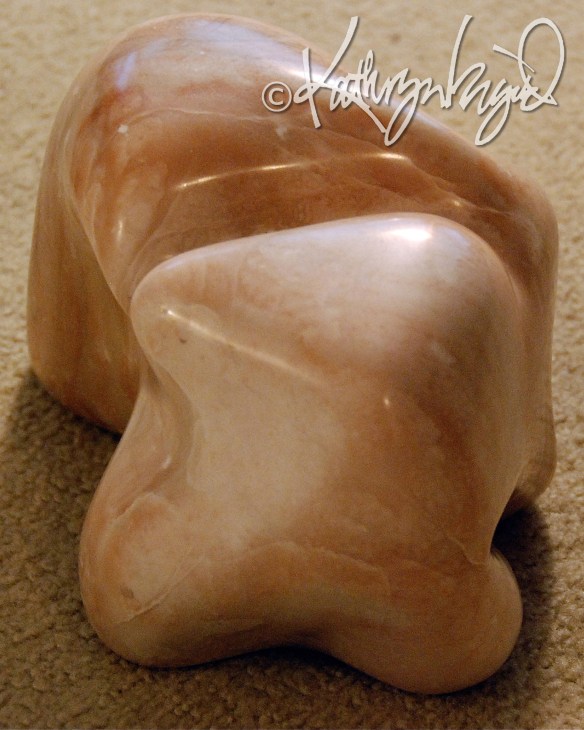
Making a stone sculpture is one such thing, for me. It was a required project somewhere along the course of my art studies, and I am glad it was required, because I doubt I’d ever have attempted it if the materials hadn’t been put right into my hands, the techniques taught to me on the spot, and the work necessary for me to fulfill the requirements of the class. I’m old enough by now to have figured out that there are a whole lot of activities and things in life I’d never have dared try, let alone figured out how happy I was to pursue them, if I hadn’t had to do them. Stone sculpting is one of those things that fell into the been-there-done-that category, finally, but besides having a decent little piece of art to show for it I am glad there was that one chance in the beginning.

My very own [Untitled] alabaster sculpture, the one and only. Approximately 7.5″ (19 cm) H x 8″ (20.5 cm) W x 11″ (28 cm) W.
In the case of the rock sculpting, there were a few particulars that [ahem] shaped my attitude about the experience. One was that when the pile of alabaster hunks appeared on the table in front of my sculpture class, I chose a piece, lone among the heap as far as I remember, that had no major, unavoidable fissures in it. This allowed me to make a piece that was not a lot smaller than the original stone without having large parts of it crack and fall off. And my bit of alabaster had some nice coloration, attractive pale veining, and a natural overall shape that guided my sculpting choices. So all I did was refine the existing form and exaggerated it, and that led to the abstraction I made in the end. I just aimed for a sort of rounded Henry Moore-ish sculptural curvaceousness to showcase the silky, milky beauty of the alabaster as best I could. It was a slow and fussy process to chisel out an alabaster sculpture, and it made me ever so much more appreciative of and awestruck regarding the accomplishments of all real stone sculptors throughout the ages. Also, glad not to put my perpetual laziness into extended servitude to stone carving.
So, yeah. I made an alabaster sculpture, and I kind of like the result. And I’m happy that I did it, that I had the experience and learned a deeper appreciation of that art form. And yes, I am also pleased that I don’t ever have to make another alabaster sculpture, with the possible exception of the if-and-when instance of my deciding someday to have another go at it. Meanwhile, I have a decent memento of the experience. And if I get tired of it as a decorative object, it’s big and heavy enough to make a decent doorstop. If not beauty, then utility: that’s kind of how those once-or-more decisions can go.
Changing Directions
Do I move at the whim of the slightest breeze? Often enough, I suppose. But what really changes my direction in life? Chance? Passion? Accident? Will?
I’d say it’s been one or another of all of those at various times, and perhaps occasionally a combination of elements. What I would say most definitely and commonly is that I have rarely known very far in advance what direction my life would be taking, let alone exactly when. Living with uncertainty is at the heart of the human condition. We can’t know (nor would I wish to know) much of what lies ahead for us. Being an artist, and married to an artist, I have made some choices that guaranteed perhaps an even deeper and more frequent susceptibility to wondering what comes next. While both of us have taught at times, an occupation that has a degree of predictability and dependability absent in most other employment that involves our artistic skills and training, it never prevented the question from arising in other ways.
For me, as a longtime adjunct at the university, it meant that though I’d been there for nearly seventeen years (most of those, full-time) before I stopped teaching, I never had a contract in hand for more than a year at a time, nor was my class load or schedule in any way predestined; I taught what I was asked to teach, when I was asked to teach it. For my spouse, a tenured full professor and director of his division, he still had questions about how he might change and grow as a teacher, never mind whether to apply for or take any of the other positions on offer at other places from time to time.
We are, I think, pretty much the ordinary pair when it comes to that sort of thing. Even now, after many years of doing particular kinds of work at specific places and getting plenty of satisfaction from those various tasks, it doesn’t in any way stop us from asking, What next? Will we continue on the present path exactly as we are just now? Do we opt to make any kinds of transitions, either changing the way we do what we do or the venue for doing it, or does something entirely new entice and draw our interest? If it does, is it attainable? Is there some utterly unimagined thing lurking just around an unsuspected corner, waiting to draw us in?
At times, it can make me feel as though I can never quite catch my breath or my balance. I tire of asking myself all of these whys, hows and what-ifs, yet I can’t resist scratching at the questions the minute I thought I’d put them to rest for a while. Even when I’m most happy and fulfilled and contented, I always wonder what lies ahead.
And that, of course, is the very heart of that human condition. We know that change is inevitable. We know that some of it will be by our choice, and much of it will be thrust upon us or sneak up subtly and surprise us all the same. And we know that, in some ways, the only guarantee we have is that we will all die wondering. It’s what we do, and it’s who we are.
Shadowy Façade
There are endless supplies of guides on How To do something-or-anything; I’m more concerned with How Not to Do It. Much of the how-to tutorials seem aimed more at giving us a gloss of respectability in the subject, a sort of facade of excellence, than actual, practical depth. Expertise is, obviously, a relative thing, after all. It’s not all that hard to be considered an expert in or at something that is very rare or an extremely new discovery or invention: lack of exposure guarantees that few can have mastery. A whole lot more, however, is skill or knowledge that takes a dedicated effort to master to any level of real expertise.
My greatest expertise, if I can be said to have any, is probably in the category of performing ‘filler’ duties in most of the activities I try. Work as I may, I’m not likely to become great at most, and I seldom find learning anything all that easily or swiftly done. Being naturally lazy, I’m even less often found pursuing new knowledge and skills with great rigor and vigor just for their own sakes. So at best, I tend to end somewhere in the middle of the pack. I like to think of myself as the necessary delineator between the great and the mediocre.
All silliness aside, this seems to me an age in which we, collectively, have lost our appreciation for true expertise. Maybe it’s my imagination, but I get the sense that somewhere between the assumption that a speedy dash through Wikipedia will provide all the wisdom we need on any topic and our fascination with outliers—finding the novelty of savants and overnight sensations far more exciting than hardworking earned-doctorate intelligence—and the sense of entitlement our privileged modern existence gives us, we lose touch with the value of elbow grease and passion.
I wasn’t born either brilliant or extraordinarily gifted, and I’m not ashamed of that. But it’d be a pity to go to my grave without having tried to improve on what few bits of intelligence and invention I do have. If I manage to do my best in the present and keep moving toward an elevated horizon, I may not change the world for the better by a single degree, but I will certainly have bettered myself and I might have the slightest chance of shedding a little light around me as I go.
Looks like I’d better get moving!