
Singing Our Song

Photo + score cover: Singing Our Song: Rach Vigil

The original ‘our song’ I shared with my true love, because he was in the midst of rehearsing his choir for its performance when we came together—so intensely rehearsing, in fact, that in pretty much the only time I’ve ever known him to talk in his sleep, he whispered dreaming sweet nothings to me in Church Slavonic. Good times!

The expression ‘they’re singing our song’ refers, generally, to recognizing a tune or lyric that carries particular personal weight for a pair or occasionally, slightly larger group of people. It’s our school’s version of Alma Mater, the theme song of our organization, the song that accompanied a memorable first date, first dance, first kiss. Because of its power as a connective tool in communication and in recollection, music is bound to evoke potent responses and pull us into the examination of them, regardless of their current context. I’m one of that lucky class of people for whom music is a pervasive and positive element of my daily life, but I still have some specific favorites not only for what I find appealing about them musically or in their mood, style, and character—and yes, those range pretty widely—but also for the few that stand out in mnemonic and sentimental ways.

There are songs that reconnect me instantly with my childhood, something I suspect is quite a different experience for the younger generations than for mine and earlier ones. Until my youth, childhood songs came not exclusively from radio, films, television, and other distant, anonymous, fixed, or recorded sources but first from the relatives, friends, and teachers who shared them with us and often expected us to sing along. When my family sang in the car on a road trip, it might have sometimes been along with whoever was singing or playing the radio’s pre-packaged tunes, but as often as not it was singing folk songs we’d learned by rote, silly playground songs and game-narrative ones, bits of summer camp songs, rounds, and easily harmonized songs that were popular long before I ever stretched my little pipes to sing. I don’t imagine there’s so much of a lingua franca of family and playground singing not derived from Disney scores and downloads nowadays. There’s lots of delightful and even sophisticated stuff in those, to be sure, but I would guess that there’s a whole lot less that would be in any way distinguishable as historic, traditional, or regional, let along cultural, landmark music that’s just sung for fun anymore unless it’s loaded with undercurrents of market- or message-driven content. Is Mrs. Grady‘s daughter even known, let alone adored, by anyone under a half-century of age anymore?

It’s not strictly old-lady cantankerousness or being prudish, prune-ish, and nostalgic for what may be rose-colored memories that makes me sad for this sort of loss, though there are assuredly elements of those. It’s also a bit of longing for the subtle societal glue that resides in knowing a song: if I spontaneously start to sing an “old familiar lay” under my breath, will there be anybody within earshot who will hear, remember, and join in the song? Are all such endeavors relegated to prearranged flash mobs now? I had a couple of reminders of this urge, recently, and they renewed my quest for an expanded casual-singing culture of the kind that doesn’t require sets, costumes, death-defying choreography, and Auto-Tune.

The first such occasion was, unsurprisingly, in a church setting. Western churches of many sorts are still places where communal singing is common and many songs known to many of the participants by heart. I was at a Protestant church service where, as is typical during communion, the church choir sang anthems and the congregation then sang a hymn or two as well; when the high attendance at the service made communion stretch far longer than expected, the experienced organist got right on the task of keeping the flow going by playing an old hymn. After a few seconds, choristers started softly humming or singing the lyrics along with him, then grew bolder and harmonized, and gradually a number of congregants in the pews were joining in as well. It was really quite sweet, and I certainly thought it perfectly appropriate to the whole concept of a Communal event. But even there, I quickly realized, the truly familiar old hymn couldn’t quite be carried in the old way, because even the choir members clearly only knew one verse by heart, and while it was a lovely bonding experience for everyone, it was fleeting; at the end of Verse 1, a collective dive for hymnals to search for the words (what’s that eponymous first line, again?!), then the resignation to repeat the first verse or fall silent.

Another reminder came in one of the places where such random burst-into-song things do still exist beyond the borders of the performance hall but are perhaps not exercised as often as they used to be: a choral convention. The regional and national gatherings of musicians devoted to choral music—the composing, conducting, rehearsing, singing, performing, and yes, enjoyment of music made for groups of singers—are a great source of education, entertainment, and vivifying energy for me as the partner and follower of a choral musician. And even at these, it’s not as though I hear people breaking into song together, unless they’re rehearsing to perform for each other. Attending an enormous regional musicians’ convention recently, followed ten days later by an equally huge national one, was both exhausting and energizing. And at such events, I don’t often find people gathering to sing together outside of the so-called All Sing sessions, which are of course organized, arranged, led, and regulated nearly as much as any choir’s regular rehearsals.

The point of such conventions isn’t necessarily to build ‘casual relationships’ with singing. But mightn’t it be a fine thing, really? I would guess that the expectation that singing just because, at unplanned moments, with other people, could in fact lead not only to greater interest in and better understanding of more formal choral experiences but also to a more connected social world than social media alone can provide. As the 1971 Coca-Cola advertisement—yes, a commercial jingle—encouraged such idealism and eventually did indeed manage to build into a hugely popular, ex-post-brand-name sing-along song, I [would] Like to Teach the World to Sing. But obviously I can’t do it alone.

Photo + score: Singing Our Song: Nance 'Seal'

This is, in a unique way, truly Our song, because Richard Nance composed it as an anthem for our wedding, and it both became widely popular as an exquisite modern choral piece and remains deeply personal as a gift to my beloved and me from one of our dearest friends.

I Dream the World

I dream the world will learn to sing ‘Til joy suffuses everything—

When peace and happiness abound, I dream a song will be the sound

Most widely heard by every ear Around the globe that longs to hear

A note of kindness, care; of grace, When melody wraps its embrace

Around us like an angel’s wing—I dream the world will learn to sing!


I dream the world will learn to sing And make earth’s darkest corners ring,

Will throw aside all warring ways, Mend brokenness, take up the phrase

That calls to harmony all souls The way a carillon bell tolls,

First, lone and softly, then a pair Joins in, and more, and then the air

Is filled with song, like bells a-swing—I dream the world will learn to sing!


I dream the world will learn to sing And this, the message it will bring:

We must not wait in silent nights, Unsung ’til happiness alights,

‘Til care and kindness, sweetness, peace, Miraculously buy release

And save us from our voiceless state: If we don’t sing, it is too late,

So let our song rise up and ring—I dream the world will learn to sing!

Foodie Tuesday: Are You Growing a Mustache, or Is That Chocolate on Your Lip Again?

Photo: Spiced Chocolate Power Pudding

With sprinkles. Because, Sprinkles. You have to ask?

If you’d told me years ago that I would become such a chocolate addict, I’d probably have snorted and chortled my way right onto the floor. I always found it okay, but if given a choice would undoubtedly have chosen any number of other flavors as my preference over chocolate. So I’m still occasionally a little bit surprised at myself and my evolution into a veritable chocolate fiend.

Be that as it may, practically every time I put up a dessert or sweet-related post on this blog, it seems to include chocolate in some form or other. Why resist, eh! There are worse compulsions to have.

Spiced Chocolate Power Pudding
Beat 4 eggs thoroughly and set aside. In another bowl, set
1 avocado
1 ripe banana
1 splash lemon juice
Pinch of salt
1/2 teaspoon pure almond extract
1 teaspoon ground cardamom
2 scoops vanilla whey protein powder
Mash them together thoroughly! In a saucepan, pour
2 cups whole milk
Heat just until steaming.
Melt in 1/4 cup coconut oil and
5 ounces chocolate (I used Ibarra Mexican chocolate).
When it’s all melted together smoothly and
back to steaming (not scorching) temperature,
pour it in a thin stream and stir it carefully into the eggs.
Put this blend back in the saucepan and stir it constantly
over medium-high heat until it thickens.
Let it cool to room temp. Mix the egg blend and the
avocado mixture thoroughly and refrigerate the total until
well chilled and set. Overnight is good.
Deliciousness abounds.

Weather Report

Digital illo from a photo: Boon CompanionAn afternoon with you
What splendid light comes blazing from the blue
No matter what the promise of the day
When one sweet presence chases drear away:
The prospect of an afternoon with you!
How do you change the climate to such ends
Effortlessly, it seems, with one small grace,
Bringing your cheering spirit to this place
And on its strength, inviting full amends
For every sting of sorrow or of pain,
For any old frustration or regret,
Making the clouds all part, and me forget,
I thought I’d never see such sun again?
All afternoons with you become blue skies
Simply because love shines out of your eyes!

I Am Not Alone (Part 3 of a 3-part series)

Disclaimer: I’m no doctor, therapist, counselor, or genius. If this post about hope in the midst of depression and anxiety and related mental-health experiences is in any way true for you, know that it might be uncomfortable to read in the first place, but much more importantly, that reading it will not, cannot save you from your troubles. What you need is not a word of empathetic support from a fellow mortal with related experiences but genuine professional help, just as it’s what I needed first. Come back and visit me if and when you’re ready. If you don’t have any such problems, hurray for you! And read on anyway, because you might be able to help another person if you know better how she or he is living. Everyone’s truth matters, even when we don’t agree with or share it.

I’ve said it before, and I’ll shout it again and again from the rooftops: ♥♥♥♥♥♥♥♥♥♥♥♥♥♥♥♥♥     ASK FOR THE HELP YOU NEED!     ♥♥♥♥♥♥♥♥♥♥♥♥♥♥♥♥♥

When you’re feeling strong enough to do it, fellow struggler, I want you to ask for, and find, the help you need. A friend wrote me after reading the previous two parts of this post series, quite rightly asking: “As someone foreign to what you describe here, I’m wondering whether you’ve ever found it beneficial for two people who are both despondent to work together. Can the shared despondency do some good, like two negatives making a positive?” My short answer (strictly my opinion, of course) is, Yes and No. Feeling alone in sorrow is, ironically, almost universal, but the feeling ignores the reality. Being reminded we’re ‘all in it together’ can help. Mutuality of support and dependence can be useful, but only if genuinely committed on both sides to the wellness and well-being of self and other, and only in partnership with those qualified to help. Wallowing and giving up hope together is no better than doing so alone. Find the counseling, student resources center or person at your school, workplace, or community services center, and get in contact. Do a little research to find out what’s affordable or free, and accredited, in your area. Make an appointment, and be sure to tell the person with whom you make the appointment that your need is anxiety and depression related and therefore time sensitive.

Stand up for yourself enough to insist on getting the help you need. I was really, really lucky that the counseling center my doctor sent me to visit had trained ‘triage’ telephone operators who could determine how urgent it was that we patients get in and guaranteed an appointment within a week or even 24 hours, depending on the situation. We all know that for anyone who is suicidal, only genuine emergency care will do: a suicide prevention hotline, phoning 911 [the American universal emergency phone number], or heading to the hospital is essential. But knowing that the assessing operators at my local mental health center were trained to spot the differences gave me a little needed comfort and the strength to wait 24 hours more.

Meeting with this counselor won’t be an instant solution for you, though, honestly, getting through the first step of making the contact was for me by far the hardest, bravest thing I ever did, so everything after that seemed progressively easier! I cried and sniffled and howled through the phone call, through the days (weeks) leading up to the appointment, through the drive to the appointment—wondering if I could go through with it, though I’m delighted, if that’s the right word, that I was too afraid and embarrassed to cancel and inconvenience the stranger I was going to see—and I wept through the majority of the first appointment, too, even though I had little that I believed was so urgently, impressively scary or important-seeming to say or do. That’s the nature of the beast, isn’t it. I think it’s useful, when you decide you’re in need of help, regardless of feeling ready or courageous enough to seek it, to have a few little strategies for taking the starting steps. A checklist, if you will, can make the attempt at something so large ever so slightly less daunting. From my own perspective I can offer some possible options.

Think of others. The world shrinks incredibly when one is depressed and anxious. It’s all I can do, in the midst of it, to consider that I’m not the lone creature in the entire miserable universe. But realizing that my misery spreads invisibly to others, like any kind of infection, helped me, albeit incrementally, to decide I had to make a change somehow. I could at least drag myself to strive toward health for others’ sake when I couldn’t muster it for my own sake. The one ‘trick’ that still helps me the most often is one I suggest you try even before you manage to go out and get professional help: Focus your energy, however infinitesimal it may seem, on doing whatever itty-bitty-teensy-weensy thing you can do to help someone else through a struggle. I wrote about this technique that my mom taught me in a previous blog post, and it still regularly saves my shaky hold on sanity in stressful situations where I’m not actually alone, especially at social events, which are big stressors for me. Give it a shot a couple of times, and give yourself permission to ‘play the part’ of somebody cool and confident (at least cool enough to admit to a stranger that you totally lack confidence) and you’ll be amazed, almost invariably, how much it can help you. I’ve managed to get through events crowded with intimidatingly high-powered, celebrated politicians, artists, and social giants, in countries where I spoke little or none of the local language, by doing this. I’ve also learned along the way that many of the aforementioned intimidatingly powerful persons turn out to be just as needy and insecure as I am, merely better disguised!

Build a DIY support network. It’s a network only if you think of it going out as well as flowing in: you’re not only asking for help but offering it, and though you don’t believe you have enough resources for your own puny self, working to give some to others will show you better what you can do. It’ll be a hard slog, since so many depressives, like me, also fight social anxiety, and either (let alone both) can make it mighty hard to openly discuss deeply personal things like our mental health. Doesn’t even sound possible, does it? But it is. Dare to test the theory; you already know that you’ve got nothing to lose.

Commit to wellness. Sit down with at least one supportive person, preferably a loved and trusted one if you have any such thing. A fellow struggler, a professional, even a total stranger whom you deem trustworthy, might offer support, and that can be useful, too. Find one, or make one. Say to your supporters how much it means to have them on your side and that you will do whatever you’re capable of doing to help each other go through this process, knowing that you’ll all fall down on the job but you will not quit trying, because you owe it to each other as much as to yourself. You might not believe that fully yet, but I promise you it’s true. Even those who think themselves insignificant and invisible aren’t; what affects them for worse or better affects all of the lives around them similarly. If you can’t seek health and happiness for your own sake, try to do it with the idea that you can aim to improve the lives of those around you by being happier, healthier, and better able to assist them through their own difficulties. Imagine your improved health and well-being first as a fantastic, romantic ideal, then as a remote possibility, and then as a goal, and you’ll have a better shot at accomplishing this amazing thing than you might guess.

Take a first step. Make the first appointment you need, even if you don’t yet know how deeply you do, with the mental health counselor or resource person. GO. If this is someone who can see you and your supportive companion together, it might make it easier for you to approach at least the first meeting if you’re there to encourage each other. The first session or two will likely be little more than figuring out your current state of being and understanding your “baseline” in any case. Be bold, and assume that you will be helped by this process, even though it might not seem so at all times, and persist doggedly. Fight for your life. Ask your professional helpers straightaway: Please tell me about all of the FREE resources you can share with me [us], refer or recommend for my needs, so I won’t have the added anxiety and depression of finding something that helps, only to be denied it for financial reasons thereafter.

Commit to continuity. Follow up, whether it’s with this same person/center, or someone/where else that’s recommended. Do your homework. A counselor should be teaching you how to assess your own situation and what you can do to have a positive effect on it, whether it’s through making lists, keeping a simple journal (your blog or diary will certainly qualify, in many instances), doing some reading, learning to meditate, doing a small amount of exercise, adjusting your diet, listening to music, or something else entirely. Do the work. It might be laborious or even painful, but every bit you get through will be something you can cross off your list of struggles.

Reward yourself with your healthiest and most affordable pleasures every single time you feel you’ve made one atom’s-worth of progress. Don’t worry about falling down on the job again tomorrow, because you will. Know that when you’ve rewarded yourself with an honest “hey, I didn’t think I could manage that until now, but I DID IT!!!!” followed, perhaps, by doing the Snoopy Dance or wallowing in an hour of reading from that really trashy, sappy book that always makes you feel like hugging the universe a little, you will be more inclined to get back up and do the work again as soon as you’re able. Keep hunting for your Happy Place among your matrix of matrices. [Have I just coined a phrase?]

If all else fails, take the time to look at your reflection in a window or mirror on occasion and practice smiling ever more genuinely and convincingly, while saying to yourself in your silliest Stuart Smalley impression: “Kathryn Sparks thinks I’m cool. And she’s really amazing, so who am I to argue with her?” Because I really do know how tough it is to be one’s best self and I truly admire all who manage to do the hard work it can take to move in that direction in difficult times.

You do matter. Your well-being matters. Your relationships with fine people (me, for example) matter. Peace and joy to all of us.

♥♥♥♥♥♥♥♥♥♥♥♥♥♥♥♥♥♥♥♥♥♥♥♥♥♥♥♥♥♥♥♥♥♥♥♥♥♥♥♥♥♥♥♥♥♥♥♥♥♥♥♥♥♥♥♥♥♥♥♥♥♥♥♥♥

Photo: I'm Only Human

I’m in the Support Group for “I Can’t Help being Human” (Part 2 of a 3-part series)

Disclaimer: I’m no doctor, therapist, counselor, or genius. If this post about hope in the midst of depression and anxiety and related mental-health experiences is in any way true for you, know that it might be uncomfortable to read in the first place, but much more importantly, that reading it will not, cannot save you from your troubles. What you need is not a word of empathetic support from a fellow mortal with related experiences but genuine professional help, just as its what I needed first. Come back and visit me if and when you’re ready. If you don’t have any such problems, hurray for you! And read on anyway, because you might be able to help another person if you know better how she or he is living. Everyone’s truth matters, even when we don’t agree with or share it.

♥♥♥♥♥♥♥♥♥♥♥♥♥♥♥♥♥♥♥♥♥♥♥♥♥♥♥♥♥♥♥♥♥♥♥♥♥♥♥♥♥♥♥♥♥♥♥♥♥♥♥♥♥♥♥♥♥♥♥♥♥♥♥♥♥

Digital illo from a photo: Depression & Anxiety Cloaked the GardenI’ve recently met a new friend who is dealing with levels of anxiety and depression that sound like where I stood about a decade ago. It makes me both sorry for her struggles and incredibly glad I don’t have that same weight to carry consistently anymore myself. Depression and anxiety, especially the kind of chronic or recurring stuff, both work differently for everybody I know who deals with them, but one characteristic that I see pretty universally is that they can’t be cured or solved purely by smart practices. Real anxiety and clinical depression are inherently opposed to logic. They flatly refuse to listen to reason, and that is what makes us feel afraid, angry, useless, and without options.

It doesn’t help that some people who have never dealt with similar things can be ignorantly dismissive and believe that if we just shut up, pull up our socks, and get over ourselves all will be right in the world. I may know a perfect solution to my mental health problems, or a whole slew of solutions, and be able to imagine myself accomplishing the rescue flawlessly in my mind, but even if the means to that end is sitting less than an arm’s length from me I don’t have the clarity, will, or energy to make like a Nike commercial and Just Do It, not even if I sit staring at the conveniently available means all week long. Another classic and frustrating aspect of deep depression is that it saps us of energy, strength, and will to such a degree that we’re robbed of both clarity and the drive to do what we long most to do, even for the sake of those we love most dearly. It’s no wonder depressed people feel useless—they have been robbed of all of their power and hope, and worst of all, the culprit lurks right inside and can’t seem to be evicted.

When one’s brain or biochemistry can’t process the facts of the situation in sensible ways, the natural instinct is to curl up in a fetal position and hide from everything/one, including oneself. For me, when I’m in the middle of an acute anxiety attack or even a period of general anxiety, my rational brain can still assess the present situation quite neatly and spell out all of the logical explanations—what I could do to solve what’s making me anxious, and why I would be perfectly safe to just let go all of that discomfort—but I’m immobilized by anxiety instead and only feel more afraid, sick, confused, and as a bonus, tremendously guilty for “not taking my own good advice.”

It sounds, frankly, ridiculous to anyone who’s never experienced it, and even to me when I’m not stuck in an attack. But it’s the reality, and it’s awful. It has absolutely nothing to do with whether your life is good, with whether you’re smart, lovable, or desirable, or are surrounded by supportive people or wealth or any other grand resource you can imagine; you can have all of those things in abundance and still fight depression and anxiety. I have had a great life, with very few major causes for even normal kinds of sadness (you know, those well-known major stressors like the death of a loved one, changing jobs, moving to a new home, and so forth), yet when I finally ‘crashed’ with clinical depression in my 40s, I learned that I had probably had not only previous periods of severe depression in my life but also chronic anxiety all of my life. The lack of obvious causes or catalysts for the existing state in an otherwise pretty charmed life only further confirmed my doctor and therapist’s diagnoses—in my case, of an inherent chemical imbalance that various “triggers” simply helped bring to the surface periodically and that, over time, became harder to manage without both counseling and medication.

This may all be TMI for a non-sufferer or casual passerby, but I think it helps explain a few rather useful things. Again, these are my own thoughts and experiences, not yours. Only you can find your way through them.

Those who do experience various forms of mental illness are far from alone. I happen to believe that mental health, along with all sorts of other aspects of personal health and identity, is not merely a ‘spectrum’ of states or conditions, but a cloud of them, a thick and rich matrix in which each of us is created. That in any one person, his, her, or my place in all of the matrices of physical and mental health, skills and interests, sex identification, attitudes and beliefs, and the many other aspects of humanity that make us our individual selves shifts gradually but constantly, however the pace may vary from one time or characteristic to another. If I multiply all of the changes within one such self-identity matrix by how many different matrices of personality can make up the whole and how much they are likely to shift their Me point of intersection over a lifespan, it seems entirely probable that everybody hits the occasional crossroads of whatever for them qualifies as less than prime mental health and well-being.

I’m a firm believer in daring to ask for help, whenever/wherever you possibly can, starting with your counselor and/or doctor; find better suited ones, if the ones you have aren’t helpful! I know as well as anybody how near-to-impossible it is to ask for help, and it doesn’t matter if the reason is insecurity or lack of self-worth or sheer tiredness. It’s just that I also know that my life and sanity have been saved more than once by those little moments of supreme effort it took for me to humble myself and crawl toward help. I could sit around singing infinite maudlin verses of ‘Nobody Knows the Trouble I’ve Seen‘ or, as I always tended to do, wear a mask of pretension that everything was just spiffy, but no matter how much anybody else loved or cared about me, they couldn’t read my mind—how I expected them to when I couldn’t read it myself, I don’t know—so nothing would have happened if I hadn’t just let go of all my ‘should’ ideas and asked.

Treatments vary just as much as bodies’ and minds’ uniqueness differentiates us. It’s hard work to find strategies that help us individually, but it’s the only path I’ve seen whose light at the end of the tunnel isn’t that of an oncoming train. Somebody else’s quick fix or longterm “cure” isn’t necessarily what will serve my needs. I love life in a whole different way nowadays than in my earlier years, thanks to stumbling into and muddling through the process of finding what was best for my situation.

It is a lifelong process, make no mistake. For me, it means I will probably always be on medications in addition to checking in with my doctors occasionally. One of my doctors opened my eyes about this, first overcoming my resistance to medicinal intervention by explaining to me how much the current varieties differ from earlier forms of antidepressants and their ilk in terms of long-term safety and efficacy, and then keeping close watch to insure a good ‘fit’ for me.

On one visit, I asked the doctor whether, feeling so much healthier and better, I should start weaning myself from the medication. “How do you feel?” she asked. “Great!” “Do you want to feel different from ‘great’?” [Me, grinning and shaking my head NO.] “Then why would you stop taking your medication?” Duh. “Come and see me if things change for the worse.” Ten years later, I noticed I was slipping and feeling the old, familiarly dark fears and discomforts creeping in on me and suffusing my sense of self. My current doctor—we’d moved to another state, meanwhile—agreed I could add incrementally to my current dose. Barely ten days later, back to my New Normal. My sense is that depression and anxiety, like alcoholism, are states of imbalance that aren’t curable but can and may be managed over time with consistent care.

I understand very well the resistance to meds that comes from feeling like one has lost a certain amount of emotional depth or dulled some personal distinction when medicated. Yes, I have experienced deep, and superb, lasting joys from my earliest years when not in the abyss, and sometimes I do think that my emotions since ‘entering recovery’ might be slightly duller in general than before, but I would not trade a single second of what I have now as a healthier person for that tiny, shiny bit of edge, if it really is gone. Once the right meds kicked in for me, and it wasn’t instantaneous, I knew that I was my REAL self in ways that I had never, ever experienced before: able to feel normal pain, fear, sadness, or worry without the absolutely constant sense that they would never pass or that each one meant sure disaster.

I could ride in a car without the conviction that every other car approaching mine was aimed directly for me. I’d always known, objectively, that they weren’t, but I couldn’t stop that irrational inner sense from warning me endlessly that they were. I could now plan to meet a new person and not have to spend a number of days before it feeling physically ill and crying and being sulky and short-tempered because I was so terrified of meeting her. If I tried to learn or do a new thing and didn’t get it perfectly on the first try, it wasn’t an indictment of me as a human but a teachable moment of setback.

Now, when I shed tears, they’re not in the uncontrollable flow of incurable grief but born of a sadness that even in its midst I know will abate in time. Or, thank goodness, they’re sometimes tears of joy. Because not only is my life still good, now I can genuinely feel it. I wish the same for all people. It’s why, as an avowed non-expert, I still feel responsible, compelled, to answer when asked out of the darkness, ‘Is there anyone who knows me?

More tomorrow, friends…

On a Windy Day of Blue

Digital illo from photos: Ripples

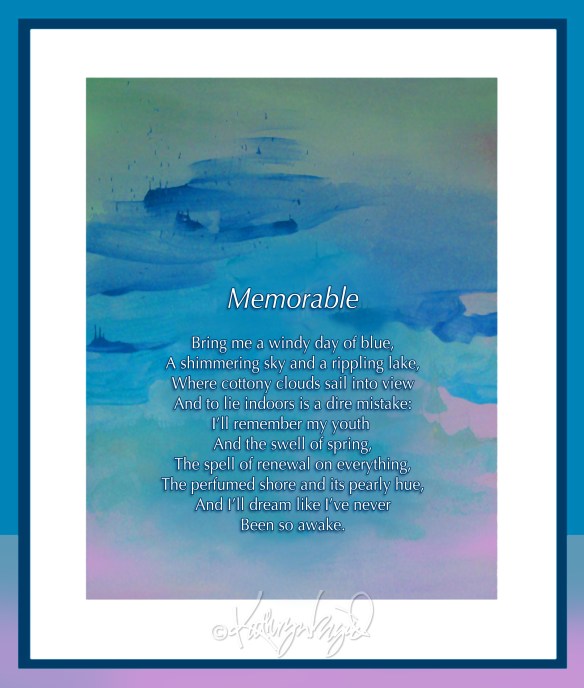
Digital illo + text: Memorable

For Guiding Us All

We learn how to live, in many ways, mostly by accident. But those of us who learn to live well, whether as better scholars, more skilled laborers or artisans, or simply as more loving and kind and generous and good-hearted people—that growth and knowledge is gained best of all through the care and guidance of those who serve as our teachers and mentors. Parents and relatives can do this, friends and neighbors and co-workers. We who are most fortunate of all have many such positive influences come into our lives and help to shape us and bring forth our best selves.

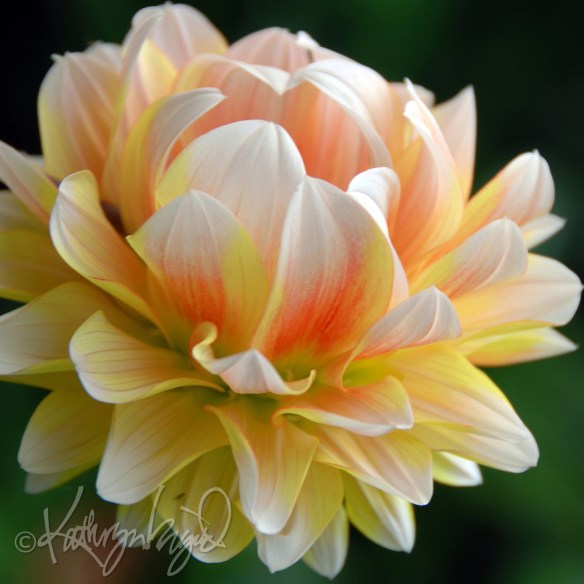
And those who are best at being this sort of careful, patient, challenging, and giving tutors in one other person’s life tend to be so naturally inclined to raise up the best in anyone within their reach that they serve as mentors to many, regardless of any plan or intention. We who have been the beneficiaries of this largesse owe a debt of gratitude, and perhaps too, our own best efforts to pass the gifts along to another circle of influence in the great, rippling pond of our connectedness, to a further acre or two of young and beautiful growth that waits between today and our own eventual horizons. Life is brief, and best enriched in its short seasons by propagating mutual help and guidance. I am thankful to have been gifted with a number of superb guides and examples, friends and mentors, in my own life. May you all be as well.Photo: A Dahlia for Neil

Bright Dahlias

The autumn came too soon, and left a pallor on the pretty paint

of those tall dahlias that you had nurtured faithfully, their saint;

It turned them into shadows of

themselves too soon, shadows of love…

Frost cut them down and took them in its bony hands to steal their dance

the graces you had tended there so tenderly, by circumstance,

From shoot to bud to blooming beds,

by stealthy ice that bowed their heads…

And you saw early autumn, too, too soon—were bit untimely by

the frost and plucked from gardening, the sun still in your sky-blue eye

Made winter’s sparkling snowy air

of beauties we were loath to spare…

Yet all this theft you had foreseen, and readied us to stay and tend

bright dahlias, each, our own; to go on gardening, and so amend

Our sorrows in your still-wide gaze

by passing on your gentle ways…

The rich inheritance you gave still grows like dahlias among

us all, your heirs, and in their turn, those we raise up as happy young

New imitators of your gift

for singing to give hearts a lift…

In loving memory of Neil Lieurance, and with deep and abiding gratitude for the treasure that is a true mentor in any life.


The Façade isn’t Worth It

Ask for help. Short phrase, simple concept. Really, really hard to execute sometimes. We place such high value on ‘keeping face’ or seeming tough and cool and untouched by mere human foibles, trials, and concerns that many of us are perversely frightened at the idea of doing what should be the one easy thing. Ask for help.

It doesn’t pay to play the brave one or the willing martyr when your world is caving in on you, and even less so when you consider the ripples through the host of people who—though you may forget it at times—count on you, whether for equally small and simple things or for being the love and joy of their lives. It doesn’t do any good to sit and wait for help to come to you: remember how hard it is for you to know your own mind, let alone read anyone else’s, and know that they can’t read yours any better. Even if they realize how deeply in need you are, they may be fearful of offering their assistance because of that very mask of competence and courage you’re hiding behind, and you both lose.

There might not be help enough in the universe to fill your need, never mind your desire. But there’s no Maybe, if you ask that from yourself alone; you will fall. You will fail. When you feel you have nothing further to lose, there are really no such things as “acceptable losses.” Accept, instead, the handout, the hand up, whatever it is that anyone at all can offer you, and with it the hope of better things. It might mean nothing more significant than lightening your mood, and that is important enough. It might save your sanity, or your life. Ask.Digital illo from a photo: Nine, Ten, a Big Fat Hen

A Place Full of Love

Photo: Timeless ITimeless I

Great friendship leads to kindling of a kind

Unknown to lovers who have never spent

Nights they devoted purely to content

Intimate intercourse strictly of mind—

Love is expansion, at its best, of souls’

Learned connectivity in friendship first,

And then the cultivating of the thirst,

Pursuing stronger wine, and then the coals—

Embers long banked as friendship had begun—

Light into fire new brilliance from a spark

Lifting great stars from the eternal dark,

Exquisite as a newly blazing sun—

Rich is the love that from such friendship springs,

Kisses of wine—and of more stellar things.Photo: Timeless II

Timeless II

In morning light, the palest leafy shade

Of birches’ green is cast upon the wall

Where portraits hang, ancestral friends who all

Keep silent watch on what the years have made

Of their descendants and their memories;

The secretary, small and staunch, remains,

And in its graceful curving shape contains

What documents can speak these histories;

Oft, in this room, the whisper of that sense

Of timeless care embracing present love

Reaches so gently from its great remove

That love fills up the room itself, immense.

When I am here, I know love so begun

Will flourish to the final setting sun.Photo: Timeless III

Space Cadet

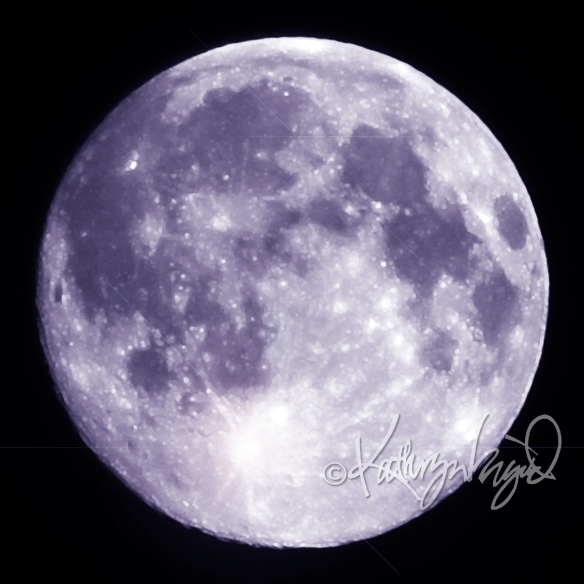
Pardon me for mooning you. [If my backside looked this fabulous, I might show you that, too. You are very lucky things are the way they are.] Lacking such stellar assets myself, I look to the sky for my inspiration yet again, because, well: that moon!!! It’s been showing off a lot lately, giving us so much indulgent, up close and personal, viewing of that wildly handsome face that I begin to wonder whether the moon doesn’t have a crush on us. Given the seeming frequency of supermoon approaches these days and this apparent increase of mutual attraction, I begin to wonder if, instead, it would like to crush us.
Photo: Space Cadet

But I prefer to think that I’m living in a time and place where I can enjoy to fuller than usual advantage the beauty that is that big old hunk of reflective rock out there. To me, it’s a candy-coated, opalescent, crazily pretty artwork stuck up in the canopy of the sky just for my pleasure and amusement. It’s big enough, bright enough, and grand enough that we can all share it, so don’t be shy, you can gaze upon it too. And I will enjoy thinking of the silvery light shining on me being the same silvery light that’s shone on you.