More Myths about Inspiration & Creativity

photo

Don’t accept a falsehood for your reality–if you have to create your own, then do it!

Back on that old topic of whimpering: of all the [wonderfully dire and woefully valid] reasons I can’t possibly do the enormous amount of work required by this assignment, there’s none simpler or more honest than Number 11:

11         BUT I DON’T WANT  TO _______________ (you fill in the blank)!

            Boo Hoo.  It’s not always optional, is it. Just keep firmly in mind that sometimes doing the required thing leads to unexpected delights in the end product. Not to mention the thoroughly predictable delight of having it done, finished, off the To Do list and out of nagging territory. Just get it out of the way now and you’ll be ever so relieved. Maybe even pleased with yourself!

12        ALL CREATIVE PEOPLE ARE (take your pick):

Eccentric; loose; savants; savages; radical; anti-intellectual; uncontrollable; fluff-headed; egocentric; snobbish; smelly…

Everybody is one or more of the above at some point; look at all of our pop-culture idols who get hung out to dry on a daily basis, not to mention all of the religious, educational and political Saints who irk the multitudes so regularly.  So imperfection is hardly a reasonable excuse for avoiding being (or being in the company of) an art maker.

13        IT’S SELFISH &/OR IRRESPONSIBLE TO BE AN ARTIST.

How about how selfish and irresponsible it is to be good at something that enriches lives and shapes culture and to refuse to exercise, to share, those gifts.  How unkind it is to stifle your true self and passions (and spend your life unfulfilled or with a chip on your shoulder) so that you live a half life and cheat your friends and loved ones out of your rich complexity.  How about that for selfish and irresponsible, huh? Choosing a ‘safe’ path never guaranteed anyone’s actually being safe, anyway.

14        NOBODY (read: Not Everybody in the Universe) WILL LIKE IT.

If you find anything that everybody likes, let me know.  For that matter, if you find anything NOBODY likes, I’ll be mighty surprised.  So, isn’t it good enough for you if you think your work has some value?  It may not make you a market mogul, but it’s amazingly fulfilling to be an artist, and (other than food, which is admittedly desirable) practically no other wealth compares.

15        THE GREATEST!!!

Who says?  There is no single Greatest of anything that everyone will agree on yet, and the odds are pretty good that they won’t all agree anything you do is the Greatest—or worst—ever, so why lose sleep over an untried concept.  Do your best and be done with it.

16        IF YOU CAN’T SAY (do) ANYTHING NICE (or well), DON’T SAY ANYTHING AT ALL.

A half-baked effort is usually better than no effort at all; no effort guarantees a lack of (or negative) result, and misguided or incomplete efforts can occasionally be rescued or luck into a better-than-deserved result.

digital artwork from a photo

Think beautiful thoughts!

17        IT ISN’T AS GOOD AS _________________’S.

Probably nothing anybody else ever does will be as good as my work, but aside from that impossibly high standard, you have as good a chance as any of doing work better than somebody’s, at least occasionally, as long as you do work.

18        ALL GOOD THINGS COME TO THOSE WHO WAIT.

But they don’t come to all of the specific people who desire them, or ‘on time,’ or in the desired form.  Your dream might end up in someone else’s stash of prizes if you don’t put up a fight for it.

19        I CAN’T DRAW A STRAIGHT LINE.

No, but a computer can do it for you, or you can use a straightedge, or you can hire a stand-in to draw your straight lines.  Don’t tell me your whole oeuvre as an artist/designer is going to be straight lines.  Sheesh.

20        CREATIVITY = INTUITION.

Intuition is an indefinable sense or sensation that can bring soul and emotional depth to the work (both process and product), but true creativity takes that nebulous touchy-feely power and combines it with study, effort, logic, research, skill and courage and synthesizes all of the elements of an artist’s knowledge and experience and passions into a concrete Work of Art (process and/or product).

21        THERE’S NOT ENOUGH TIME.

True.  We’ll never be given enough time for everything that’s important.  So it’s up to us to TAKE the time.  And MAKE the time.  There’s no real alternative.  It’s called Making Choices (and living with them).

22        YOU CAN’T FAKE INSPIRATION.

Maybe you can’t, but I can.  Seriously, folks, most people won’t know the difference if you substitute delirious hard work and enthusiasm and use all of your know-how to its limits.  If that isn’t quite Inspiration, at least it’s mighty inspirational.  When in doubt, review Item Number 10 in Tuesday’s post (linked above).

digital artwork from a photo

Go ahead: try your wings!

If It’s Wednesday, This Must be Foodie Tuesday Deja Vu

Shall I compare thee to a summer’s day? Why, yes, if you are a fresh berry. Those sweet little nuggets of juicy goodness are the very epitome of summertime’s joys, and the longer we can extend the berry adventure by means of preserved, frozen or baked goods, the merrier. I’ve already rhapsodized about my mother’s justly famed raspberry pie (the mystic quality of her ethereal pie crusts a deservedly notable part of the equation, in the interest of full disclosure), and she made many a jar of equally brilliant raspberry jam over her wildly productive years of canning and preserving. I will never be her equal in either of these arts.photo

I do, however, have enough fondness for some berries that I will gladly binge on them while their season lasts, and far beyond, in whatever forms are available, because I can practically feel the vitamins rushing into my cells when I do, and more importantly, because they taste so fabulous and are such great utility players on Team Food. On their own, they are magnificent and refreshing. In salads, a divine break from any leanings toward excess of greens. Think, for example, of a marvelous mix of butter lettuce, Romaine, toasted sliced almonds, shavings of fine Reggiano cheese and a generous handful of raspberries all happily commingling with a light creamy fresh thyme dressing. Transcendent! Fruit salad melanges practically insist on having a handful of berries gracing them when the season is right. And I’m told by those who eat blueberries that no berry surpasses them for muffin or pancake making. Me, I’ll gladly stick with Swedish pancakes piled up with whipped cream and fresh strawberries when it comes to the breakfast berry-ations. And of course there are endless possibilities in the universe of fruit smoothies when it comes to berries, whether you’re in the camp that must strain out the seeds or among those who appreciate the fiber therein.

And don’t get me started about desserts! The natural affinity fruit has for sweet foods is showcased wonderfully in so many after-dinner or coffee-time treats that a mere post could hardly suffice to even skim the list. But some goodies do come immediately to mind: strawberries dipped in chocolate; cloudberry cream, as I learned to love it when prepared in the seconds-long fresh season by my brother-in-law’s late mother; blackberry tapioca pudding. Pies, tarts, and crumbles, oh my. A heap of berries and a gentle sluicing of vanilla custard atop a slice of toasted pound cake. Honestly, few ways to go awry.

Still, the berry, with its pristine, bright, zingy flavor, and the hints of sweetness underlying it, makes a superb foil for savory dishes too, not least of all meats and seafoods. One of those ways to slip berry-liciousness into the main dish is to pool any of the multitude of possible berry-enhanced sauces and purees under, over or alongside a portion of entrée. I’m fond of Beurres Rouges ou Blancs made with wine, butter and berries cooked down to dense, flavorful stupendousness. Hard to argue with, say, a blackberry-Cabernet sauce served with lamb or duck, and I can only imagine that a dry, red-fruity Rosé would pair gracefully in such a sauce with raspberries or, dare I say it, salmonberries, to accompany a roasted filet of salmon or breast of pheasant or grilled chicken. Champagne Beurre Blanc is hard to resist with shellfish; why not top that with roasted strawberries and a quick grind of black pepper?

As you can see, what happens when I get the mere image of a berry into my tiny brain is that it plants the seeds for extensive food fantasizing. And that is hardly a bad thing, my friends. Bury me in berries. I could do much worse.

photo

Simplicity Itself


photoSimplicity, I think, is like most of the virtues and values that we humans might hold dear–those who have it don’t necessarily appreciate it, and those who talk the most about it tend to know the least about it.

The rich and comfortable are so obsessed with the idea or ideal of simplicity nowadays that there are magazines, fashions, classes and whole philosophical movements devoted to its study and cultivation. People will expend massive quantities of energy and spend large quantities of money on trying to simplify their lives and themselves, when very likely simply giving up the energetic striving and letting go of the amassed money would do the trick in a trice. (Perish the thought!)

The poor and underprivileged have ultimate simplicity forced upon them, and tend to choose whether to embrace the unsullied earthiness and quietly hardworking ways thrust on them by their circumstances or to battle against them. Probably a majority of people, both poor and rich, will always think the grass greener where they are not, and hardly give thought to how hard the next person is trying to get over the fence onto their own enviably other property. Dissatisfaction may be an essential part of humanity’s natural state of being, much as it naturally chafes us to think so.

On the other hand, looking at what dissatisfies us with as unsparingly honest a glare as we can might in fact shed some light on how to find better contentment, not necessarily by having more or less of something (tangible or ephemeral) but by giving it all its appropriate due and then saving our true love for the most meaningful virtues and values of all. At the very least, that narrows down the field for most of us. At its best, it frees us up to say that life is remarkably livable where we exist right here, right now, regardless of the shade or tint of the lawn. The simple presence of any one particular leaf of grass or bud of bloom in the one square foot of soil nearest to hand may be quite enough, at least for one simple day.photo


Another Good Thing about Waving One’s Arms


Waving my arms is something I may think about more than the average person does. From when I was pretty young I was conscious of arm movement as being mighty significant in a seriously diverse series of ways. First of all, there was that childhood training we all enjoy, if we’re well inducted, in the art of waving hello and farewell. I have almost always preferred the former to the latter, but in either case, whenever the occasion was deemed genuinely worthy of such a gesture, I knew that it was a sign of love or affection, and that made it pretty darn worthwhile.

Then again, I also had an early fondness for wagging my crayon-gripping fist over a piece of paper (or whatever flattish surface was convenient) to make squiggly lines and, if I got lucky, get them to coalesce into picture-like concoctions. I  might be sitting off in a cozy corner at Grandma and Grandpa W’s, scribbling away, with the faint sounds in the background of parental and grand-parental chatter as they sat drinking their coffee intermingled with the slight chattering sound of Grandpa’s cup doing a little jitterbug against the saucer, because he had a mild tremor in his hand. Of course, his arm-waving was hardly dramatic, but it was one of those delicate underpinnings of my early memory that became part of the whole subtle weave of my perceptions.

Sometime in my early teens or thereabout, I found that the family resemblance extended to my having my own familial tremors, occasionally in my head and neck but mostly in my hands and arms. There have been times when it was more pronounced than was entirely convenient for a person wanting to draw, but fortunately it’s rarely been at problematic extremes, more often merely requiring that I find ways to compensate for or control or use the tremors to advantage in my art-making. In any event, keeping my hand in (no pun intended) as an artist has tended to keep the inevitable interactions of these two kinds of arm-waving present in my attentions. Meanwhile, my other grandmother had her own kind of arm-waving to lend to the family skill-set: Parkinson’s Disease.

Typically, Granny had the wit and will to battle her Parkinsonism not only with great tenacity in staving off the ravages of the illness for many more years than is typical but also with a lot of good-natured humor, because that was her style. So whenever we had a family gathering, she was the first to offer her services for tossing salads and making milkshakes. That my mother has followed in the Parkinsonian lineage would make her forms of arm-waving far worse to behold, knowing that the same sort of insidious progression lay ahead for her, and to be fair, including the knowledge that the odds are a bit higher for me than for some that I will eventually join the parade, but she too has maintained a bright attitude about it all. Besides that, I am very slightly suspicious that her particular skillfulness when it comes to shaking the dice gives her a unique edge in the evening board games.

But the top of the list when it comes to magnificent ways and reasons to wave one’s arms has surely got to be the one I’ve been witnessing so much now that the concert season is well underway again: conducting. Bands, orchestras, operatic performances, choirs. No matter what the form of the musical art, if there is a conductor up there waving his, her (or, particularly, my beloved husband’s) arms, the love that fills the air is what makes all of the arm-waving a worthy and beautiful thing. It brings hearts and minds into focus and, often, into community, and it makes the world a more wonderful place to be.

And that makes me want to stop waving my arms altogether, just opening them wide enough to embrace that better world and anyone I can in it.digital image from an acrylic painting on canvas


Treasure Knows Neither Time nor Place

photo

A memory-driven image by my great-uncle Rolph Bolstad . . .

I have been scanning and digitally restoring a number of photos out of our family’s trove, a heap that resembles the disorganized and neglected stores of many other families. I make a small dent in the stack from time to time, then get distracted by everyday life and often don’t revisit the project for quite a while again. While many of us obsess over parting with beloved memorabilia of any kind, the truth is that the majority of us don’t do much with it when we have it.

All good things are that way, I suppose: love, joy, peace and happiness of both the material and the intangible sorts are seldom given their full respect when we have them, only mourned when we think they’re out of reach. And from what I’ve seen and heard from friends around the globe, this is a foolishness that transcends all sorts of differences and makes us more alike than not–no matter what our location or culture, our beliefs, hopes, and dreams, we all seem to wrestle with this forgetfulness about appreciating what we truly value that we have right in hand, and the minute that we suspect we’re about to lose our grip on those gifts, whether by our own decisions or perforce, we get panicked and become certain that it’s a sign of apocalypse. Surely the end of our own self and sanity, and very possibly, that of the universe as we know it.

I come across that box of yet-to-be-scanned photos from time to time and get a pang: what if I don’t get back to this project before I forget who’s in the photos, where the shots were taken, before the images are too faded or decayed to be rescued at all?

Well, what if?

Honestly, I know full well that it will not be the end of the world. Not even the end of my pleasurable revisiting of those memories–what’s more significant than retaining this flimsy physical repository of memories is whether I use the versions of them in my head and heart while they last (head, heart and memories, all three). Once gone from there, the data held in a picture is only cold, meaningless data after all, and it never contained the warmth and soul of anyone or anything depicted in it. It’s merely a shadow-play version of the husk that is my human form and will no longer be me when I die.

So I’ll keep leafing through these paper and binary mementos of mine as long as it pleases me to do so, remembering mostly that what is seen therein is always more beautifully carried inside me. Change is indeed the only constant, yet in the photograph my great-uncle took, probably in Johannesburg, around sixty years ago there is the ephemeral prototype of the photograph I took in New York less than a decade ago. Fifty years or fifty centuries, it matters little if we learn to respect and rejoice in what remains true and crosses the boundaries of place and time as long as we keep it alive inwardly.

photo

New York City lives in my own memory as much as in a physical place . . . its beauties, like all things loved and valued, lies in me, in others’ hearts, far more than in itself or any image we can conjure of it . . .

Foodie Tuesday: I’m Roasting! No, I’m Frying!


photoOh, I know, you all thought I was having hot flashes again. [Not that I wasn’t.]

But it’s Food Fun day again, and I’m referring to cooking edibles this time. Old broads still gotta eat.

And since much of the time I am thermostatically challenged myself, I generally try to find ways to make the hot foods I’m preparing require the least possible amount of time putting me in near contact with the oven or cooktop. Why risk further overheating, of either myself or my preparations, should I need to stray far afield from the heated zones of the kitchen.

One fairly easy solution, though it seems somewhat counterintuitive to me, is to roast or fry food. Yes, they’re relatively high heat methods of cookery. But by using them, I can usually evade the stand-and-stir duty: do all of the prep before even turning on the oven, then tuck the food into the would-be fiery furnace, set the temperature and timer, and head off to cooler climes until the alarm sounds for my triumphant return to check and/or finish the dish, and serve and/or eat it. Simple as that.

Roasted beetroot, for example, a nice way to enhance the flavors and textures of a cool late-summer salad, gets cleaned and quartered and then needs nothing more than a small amount of fat and perhaps a tiny bit of seasoning before it pops into the tanning booth. Goat cheese is delicious when lightly coated and shallow-fried, even if like me you’re not quite the culinary artist to present it with perfect Cordon Bleu pizzazz, and it takes no more than a couple of minutes, tops, at the cooker to brown that fine crumb crust.photo

Roasted Beetroot and Goat Cheese Salad

Scrub and quarter a handful of medium-sized beets. (Clean and save the greens and stems.) Toss the beetroot pieces with a little fat (oil or melted butter; I used coconut oil to keep its noticeable flavor to a minimum), salt and pepper and scatter them in or on a baking or roasting pan. Since I was making such a small (2-person) meal, I just made a pseudo-pan out of heavy aluminum foil to keep any juices from dripping around the oven. Roast the roots at 350°F just until tender–10-20 minutes, depending on your oven and the size of the beet pieces.

Meanwhile, pat 1/2-cup batches of cold chèvre (goat cheese) into patties and coat them with coarse almond flour, pressing it in on all sides. Quick-fry these in a little butter in a nonstick pan over medium heat. You can see from my photos that I am far from adept at this part, so mine look less like haute cuisine than like something unearthed at Herculaneum, but I assure you, they taste quite fine.

Using in tandem these two homely yet highly edible items plus a small assortment of others, you can quickly assemble a presentable version of some hotshot chef’s beetroot-and-goat-cheese concoction and your stomach will not be critiquing the view anyhow. My version, this time around, consisted of a few of the tenderer, prettier beet greens pared down to the leaf and laid on the plate, a bit of peeled cucumber slices arranged in a green frame around the rest of the plate, and all topped with the chèvre rounds and roasted roots and a sprig or two of fresh dill. I’m sure that roasting any sweet enough veg or tuber–sweet potato, carrot, pumpkin, parsnip for example–would make a similarly fine complement to the bright, fresh taste of the cheese, which in turn could be substituted for with any nice salty/sour cheese, undoubtedly.

Which of course leads me to another hot-weather or hot-mama advantage of this preparation: the leftovers (if any) lend themselves to innumerable variant cold, cool or room temperature dishes that can be popped out of fridge or freezer next time the climate or one’s overheated innards require such things. Behold tomorrow’s dish: minced beet greens and stems, steamed quickly in the microwave while the beetroot was roasting, and now blended with that remaining diced vegetal goodness, some leftover quinoa, some diced dried apricots, a few pine nuts, a little orange dressing . . . and the beet goes on . . .photo


Call Me Thomas–No, *Really*


graphite drawingIn some areas of experience, I am admittedly as credulous as a baby, but generally I suppose I tend toward the skeptical. If American political, religious and social rhetoric can’t turn anybody into a skeptic I don’t know what can, but I find there’s plenty of fodder for the mill in endless other realms. ‘The Most Delicious Boeuf Bourgignon You’ll Ever Eat!’ Truly? Then why does your [self-] acclaimed dish look so convincingly pre-digested and taste exactly like I would imagine cheap dog food to taste? (Just so you know, the idea that I’ll never want to eat Boeuf Bourgignon again after yours doesn’t count as its being the best I’ll ever eat.) No such thing as Climate Change? Feel free to run around in your skivvies while half of us are bundling up for the lowest temperatures in forty years and then mummify yourself in a zeppelin-sized parka while the rest of us try to keep a modicum of cool somehow–all I can say is, I learned how to read a thermometer when I was smallish, and the patterns on that alone have changed plenty in my brief time stomping around the planet to convince me that the weather’s different from what it once was.

‘Organic’ food? Great! But know thy USDA regulations–and what many needful things they may well lack. ‘Green’ energy from windmills? Well, yeah, I am fully persuaded that the simple movement of our breathable atmosphere is far more reliable and consistent and predictably present for generations than, say, vintage Pleistocene joy-juice (a.k.a. stinky petroleum-based fuels)–as long as we also keep in mind that there are offsets: the parts for contemporary wind farms are produced and serviced in very few locales yet and are often therefore shipped across the continent by truck–teams of semi tractor-trailer drivers plus guide cars are required for shipping a single giant blade of one of those behemoths several days cross-country–both to their workplaces and to be repaired. Yet I wouldn’t say wind power isn’t one of our better currently available alternatives. I just think the inquiry must be made, and honesty and transparency are useful all along the way.

Question authority? How about questioning everything and assuming nothing!

All the same, none of us is equipped to investigate every single experience, idea or item that comes our way so thoroughly as to fool ourselves we’re magically well-informed. We must assume, trust, take chances and hope or we will surely stultify and die. Not to mention that it’s very easy, especially for those who, like me, have any tendencies toward insularity, NIMBY attitudes, fear of change, anxiety disorders, allergies or eccentricities that don’t fit nicely with the communal norms to simply hole up and hide from unpleasant and unpredictable reality. And when you boil everything down, I find I’m not actually the least bit attracted to being a conspiracy theorist, aggressive activist for or against anything, or to adopting the kind of narrow, mean-spirited and curmudgeonly attitude that I find repellent in other people.

So I may pry a little bit at the lid of the shipping crate to see what’s really inside it or nag you a little to justify your claims that you’ve invented the world’s most astonishing miracle product, but beyond that, I’m content to believe that the universe is generally fairly benign and most of the people in it rather pleasant and honest, after all. Clearly, you needn’t take offense at my insistence on your being straightforward with me and my preferring to be forthright with you, although I still believe in the value of a certain few little white lies, so you’ll never know absolutely whether I do or do not think those summer pants of yours make your backside look like the White Cliffs of Dover.

Meanwhile, you may call me a bit of a Doubting Thomas, or better yet, just call me Thomas, which was in fact the name my parents had reserved for me in case I turned out to be a boy-child. Because, let’s face it, their previous one-child history of producing girls didn’t prove anything, and their doctor certainly wasn’t able to guarantee my girly-tude in those ancient days, so it was more practical to assume that the little Kathryn Ingrid sprout could possibly show up and be a Thomas Lauren instead, or even have the personality of a Katrina (another option they kept open) rather than a Kathryn, whatever that meant. It’s just best to know that we can’t always guess how things are going to turn out and we don’t always know everything, at least unless we do the homework and get lucky. And if it all catches us by surprise, that might not be an entirely terrible thing, either.graphite drawing


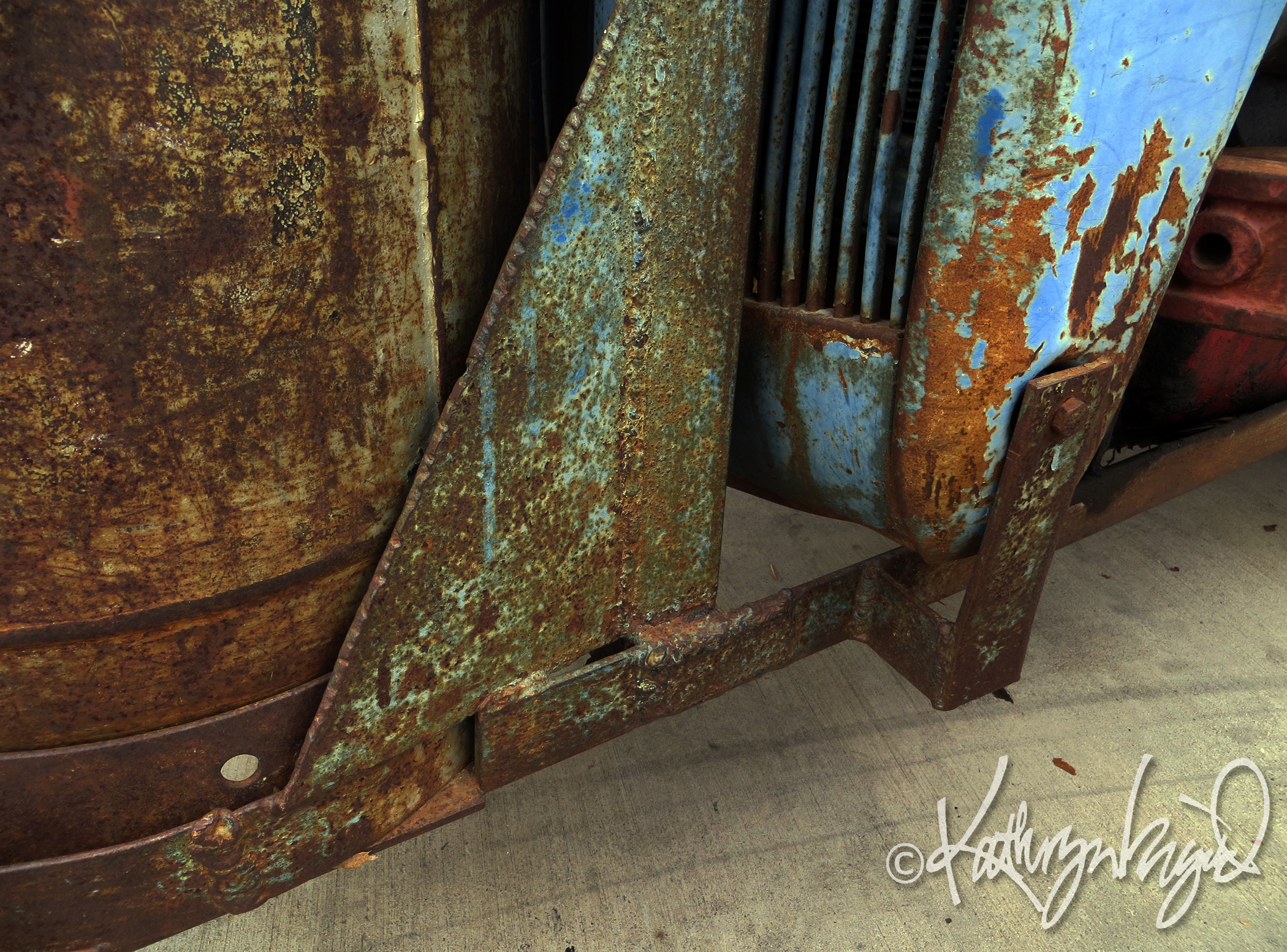
Rust in Peace


I flatter myself that I am improving with age. This morning’s Wordsmith offering from the fabulous Anu Garg of A.Word.A.Day was ‘crepitate’–one of my very favorites, thanks to the also fabulous S.J. Perelman‘s introducing it to me in the context of one of his typically scintillating, outrageously funny tales. I was reminded that crepitation refers to the creaking cracking popping grinding and other percussive noises of dusty old age, and that, not at all surprisingly, Perelman used it in self-deprecatingly hilarious description of his own antiquated joints as he gave what one must assume was–despite his stated intent of dash and panache–a dance demonstration to his date that was more rusty than rakish. Having done the requisite amount of damage to my own human machinery over the years by falling over and off of things, lifting things I had no business hefting, and in turn, turning, squeezing, smacking and otherwise torquing various portions of myself just enough more out of sync and syncopation that it’s remarkable if I only creak and don’t fall into syncope or crack up altogether.

So, whether dancing or just shuffling my slippered way around the hallowed halls of home, I consider myself  very fortunate only to ‘boop, whoosh, queel and grake‘ like another of my pantheon of fabulous wordsmiths, James Thurber‘s, old family car, and not to simply disintegrate wholly on the spot. Grey hairs? Bring ’em on! (Best color of hair I’ve ever owned by nature, as it happens.) Wrinkles? Oh, my, yes. Smile creases are only a badge of honor reserved for people who’ve had long and happy enough lives to earn them. Aches and pains will generally come and go, with more of the comings than the goings as time passes and I forget to accommodate my crepitude a little, but by golly it beats lying around and dissipating into a dust bunny of boredom.

And honestly, lots of things get more beautiful not just in spite of but because of their evident age, so why shouldn’t I give it a try?photo

photo

photo

photo

photo

photo

photo


Matters of Perspective


photo

Stormy skies can bring destruction . . . or the rains of growth and promise . . .

I’ve said before, and in ever so many ways, I’m a firm believer that we all live our lives wearing our own very distinctive glasses. By that I’m not referring to the glass-half-full vs. glass-half-empty attitude–but that’s indeed part of the whole idea. It’s about how we see the world through our individual filters.

In a fairly concrete fashion, that means that the quality of my actual eyesight–my acuity, ability to detect and distinguish colors, textures, shapes, depth of field aided by stereo vision, and all of that sort of thing does, in fact, have a profound effect on my world view and how I experience my passage through it in life. As a longtime visual artist, I am dependent upon all of this stuff for my very sense of self.

But I’m also convinced that each of us has a life history that includes our adventures from birth to the present, our nurturing or lack thereof, our environment and resources and social contacts and political influences and educational progression, and that whole reality is so distinctive for each of us, right down to a cellular level, that I can’t quite imagine how even the closest of kin could possibly have identical points of view.

I’ve been reminded of this in the last few days as I’ve been reading the latest Oliver Sacks book on which I’ve laid hands: The Mind’s Eye. Every book of his that I’ve read thus far is, since he’s a neurologist, a humane and humorous thinker, a deeply curious scientist, and a citizen of the world with wide-ranging interests, bound to be an adventure. Given the visual theme of this particular collection of case-studies (including his own discovery of and treatment for an ocular tumor), it is indeed a confirmation of my sense that such complex inventions as human bodies, multiplied by the almost infinite variants those influences I mentioned above can infuse, create and incubate an incredible range of possible ways to see and experience life in this world and whatever we can conceive of beyond it.

Yes, I am enjoying this latest Sacks book as immensely as I have all of his thus far. It’s been rather striking, too, to add to the layers of my own filters, many of which I’ve only come to recognize rather more recently in my life. I have sussed out and confirmed to my own wildly non-medical satisfaction that I am very probably distinctly dyslexic or cognitively ‘different’ in a whole bunch of ways, and having looked at this good doctor’s descriptions of face-blindness, or prosopagnosia, I’ve a feeling that my realization sometime not long past that I might have a degree of face-blindness might well be accurate. I’m certainly no less inclined to believe it since immediately before the book arrived on scene at the local library, I was working in our front yard when a car pulled up and the nice driver called me by name and conversed with me pleasantly until I could identify by her voice, questions and comments that she is the neighbor who lives directly across the street from me. Sigh. Sometimes the ol’ filters do get a little blurry.

More importantly, though, I’m convinced that how we respond to our life experiences and our histories–the choices we make and what we do with what we’re given and who we are within it–those are the truly telling filters. They’re the things by which we’ll be known, be remembered (if we’re remembered), and that offer us ways to define ourselves and our place in the world. So while I’m happy as an artist to play (as you saw in the last couple of posts) with my reality in the artificial world of visual imagery and how I attempt to show others what it’s like to see through my lens, I realize that my moods and attitudes are a part of that process too. Can I get others to understand or accept my point of view? Rarely, if I’m mighty fortunate. Can I help them to see it? More likely, if I work hard. Can I give them happy access to their own filters that might improve their moment or their day? That, I hope, I can do if I am true to the better of my instincts in responding to the world as I know it and expressing, the best that I’m able, with passion and with compassion. With love and joy.

digital painting from a photo

Heavens! What started as a grim and ominous day can become something bright and hopeful . . .


Foodie Tuesday: Getting a Menu Transplant

photo

Sticking to my ribs, yes, but maybe with the barbecue sauce twisted into a (Southern) peach chutney style to suit the Basmati rice alongside . . .

It’s not what it used to be, moving to a different place. The world is so much smaller than it once was! We talk via computer and cell phone as though we were sitting right next to each other–and sometimes when we’re sitting next to each other. Language and culture and history are all getting a good mash-up in this shrinking world where we live.

One genuinely wonderful aspect of this not-entirely-perfect scenario of homogenization is that we have access to so much that was once unreachable to everyone but the most extremely far-flung intrepid explorers and have commonalities that our ancestors could never have dreamed remotely possible. Not least of all, we can indulge in the joys of cuisines and ingredients from places we can’t even pronounce, let alone afford to visit.

Most of these regional, national, racial, cultural treasures, by virtue of being intermingled with and sampled by so many others to such a degree that sometimes it seems something learned from the Chinese by the Dutch traders and then passed along to their colonial outposts in the south seas, who in turn brought it along when they immigrated to North America, well, these ideas and arts and recipes have been so transformed along the way that they, like the initial message in the old game of Telephone, are utterly new inventions by the time the Chinese ever experience them again. And yet, in a happy twist, we who create and share the first iteration often fall in love with it and repeat and refine it until it becomes part of who we are, so it’s not wholly lost in the translation, either.

For someone who grew up in one part of the vast American patchwork of a country and experienced East Coast specialties, Southern cooking, Midwest traditions, and Southwest cuisine as being no less foreign in their ways to my Northwestern experience and palate, it’s always been a pleasurable study to try out the fabled deliciousness of Other Places. So while I’ve long loved Chinese and Dutch and Polynesian and Italian and German and Thai and Indian and North African foods of various kinds, it’s no less exotic and thrilling and delicious to sample the comestible culture of different regions of my own homeland.

photo

Fajitas today, quiche tomorrow . . .

photo

. . . but you only have to switch from a Coronita to a Trappist ale to suit the occasion, right?

Still, it’s been an entertaining and tasty part of the adventure of moving from Washington state to Texas that I’m experiencing Tex-Mex and Southern and cowboy cuisines in places of their origins and that’s mighty rich learning and dining, too. So I’m more than happy to indulge in all of those special items here anytime I can. But you know me, y’all: rarely do I go into the kitchen without bringing my own machinations and deviations to the party, so I am more than likely to emerge bearing platters and bowls filled not only with classic Texan foods but also with Texan foods as filtered through Washingtonian hands, perhaps with a hint of Chinese cookery here, Dutch baking there, Polynesia and Italy and Germany and Thailand and India and North Africa and all of my other palatable favorites making inroads and appearances whenever I see fit.

photo

A Texas-sized pork chop can also be cooked sous-vide, even if it’s getting classic Southern sides like bacon-sauteed sweet corn and coleslaw . . .

photo

. . . and if you want to shake things up a little in a more cosmopolitan way, you can always make the slaw a variant of Waldorf Salad while you’re at it by adding chopped apples and celery and sliced almonds . . .