Let us look for our peace wherever we can. Let us embrace it and rest in it. And let us always share that peace with whomever, whenever and however we are able, inviting them all into our places of peace so that they and others all around the world, too, can find and disperse the sweetness of true and deep repose.
Category Archives: History
Mocking, Ever So Gently
What’s-in-My-Kitchen Week, Day 6: Good Reading
I used to have a large bookcase full, top to bottom, of just my favorite cookbooks (and a few choice cooking magazines). Then we moved into an apartment half the size of our previous house. Guess what. I discovered that even most of my favorites were dispensable in exchange for the good trade in housing. The ones I parted with had to go to good homes, of course, and were a fine cause for bonding with family and friends over food in a new and different way–conversationally rather than via consumption, for a change. Still, there are some things one values above open shelf space, and a few of the ‘basics’ and a few of my personal favorites really did call out for rescue from the give-away goods enough to move with me–to all of my various domestic locations since then.
Cookbooks are far from Legal Documentation to me: I rarely follow any recipe to the letter. But they are instructional all the same, and highly inspirational. Since I depend on them so much for acting as kitchen muses, two things tend to happen–I almost always prefer cookbooks stuffed with vivid pictures as well as the recipes and descriptive tutorials, and I love cookbooks as bedtime reading and coffee-table books even more than as technical guides for my cookery, when they can stir my imagination without my being distracted by my stirring the pot. Still, I have a good number of cookbooks that are more pedagogical than pictorial and rely on them for my factual education whenever I’m in need.
My kitchen operations aren’t generally terribly sloppy, so I don’t tend to have grease marks and mustard stains all over my cookbooks. However, I am such a mad-scientist in their use that recipes not only get tweaked endlessly as I work but instantly forgotten in their current iterations if I don’t write them down, so I do desecrate my cookbooks by writing in them. They’re the only books I can think of that I have ever written in directly, but when I used to jot notes and stuff them into the pages, pretty soon I had a cookbook with a broken spine from my fattening it too much–if the book was really any good.
I’m very fond, when traveling, of finding local cooking magazines as well, because like any good picture book, they’re well enough illustrated so that I can pretty quickly translate what’s being said–okay, the Hungarian and Czech magazines are not so quickly conquered, but I can still suss out what’s going on eventually. And I love getting a taste of either the local traditions or what’s trendy there as opposed to what’s current here. Talk about tasteful souvenirs of my wanderings.
So, what are my favorites? Betty Crocker, that maven of miracles in the kitchen, is an icon of my childhood and so still keeps her place in my heart and home. For truly basic kitchen science, I’m still attached to the Joy of Cooking (Rombauer & Becker), but I like Alton Brown‘s playful yet factual approach to the chemistry and physics of it all, too. I’ve got a superb Swedish compendium (Mat Lexikonet, above) that a friend edited, not just because she’s such a dear but because in spite of having very little illustration it’s a very thorough encyclopedia of the tools, terms, dishes and ingredients commonly used in the Swedish kitchen, including all of the foods adopted and adapted from other cultures that have become part of Sweden’s rich heritage as a result of their delicious wonders. From our times spent in Sweden I have a few other great cookbooks, a couple of them also edited by our friend Birgit, and chose them primarily because while editing she would sometimes prepare the dishes for photo shoots or, better yet, test them on us who were lucky enough to visit during one of those preparatory periods. America’s Test Kitchen is also a fine source of scholarly information, and the organization’s focus on developing recipes through multiple trials and experiments makes them truly a litmus test for quality control; even though I still play with substitutions constantly I know the science behind my choices better.
For specifics that I love, I go back to a very few books regularly. For breads, I couldn’t beat Bernard Clayton‘s old standard that always gave me the right technique and proportions (in baking, of course, this is a far more fussy matter than in many other practices in the kitchen) and I could play with my variations on a theme as long as I knew precisely where and when and how that should work. My other baking go-to has remained the beautiful Country Desserts. Lee Bailey’s attention in it to lushness and depth of flavor is matched so exquisitely by the glorious photography, and frankly, I love that he emphasizes in this a laid-back approach to the dishes’ presentation that is much more in keeping with my fix-it- and-chomp-it-down mode of operation than any of those dainties that may cause me such heart palpitations when others do the decorative work but keep me waiting too long in my panting desire when they’re in my own hands in preparation. Donna Hay‘s photographers always make her cookery look even more desirable than the descriptions can do (and they can do a lot, I find), so hers are cookbooks and magazines I love to peruse for artful ideas any time.
As I do have a deep affection for pigs, living or cooked, and my kind friend Ellen knows it, she presented me with the lyrical Pork & Sons, which though filled with delectable recipes indeed, is even more a gorgeous photo album of and paean to the French farmers, chefs, butchers and eaters who revere the pig in all of its glory. International love of food–that’s half the reason for reading about it as well as eating it. And as a great admirer of the cuisines of many different cultures, I have always enjoyed reading cookbooks as a form of cultural and social and political as well as culinary history and often enjoy a meander through the tasty pages of books of Indian, German, Thai, Jewish, Italian, Japanese, Polish, Spanish or whatever other places and peoples capture my imagination at the moment. Probably one of my other greatest favorites in that realm is to peruse the local Junior League or church or social club’s cookbooks from American small towns and obscure organizations, because they too have such colorful and thought-provoking takes on what makes them who they are. I will always adore the late, lamented Ernest Matthew Mickler‘s classic White Trash Cooking as both a terrific piece of artistry and one of the most truly compassionate and funny documents of rural American cookery and culture ever to come off a press. Heart-stopping foods, perhaps, but well worth the danger for the love and laughter with which they’re garnished.
Maybe my enjoyment of that book and its cousins is really just because I’m a little trashy myself and feel so at home among the people whose crusty, hardscrabble, can-do, make-do good cheer and affections would accept pretty much anybody at the table, so long as I eat what’s put in front of me gratefully and don’t spit on the floor. White Trash is one cookbook I could never bear to write in, come to think of it, so perhaps there is something with a whiff of the sacred about great cookery books. All I know is, they’re close to my heart and so I keep ’em close to my kitchen too.
Home and Deranged
A Particular Kind of Homesickness
The road we ride is an old back road, a highway that goes nowhere fast,
and as we drive and drift and dream, we see the present meet the past,
the way that it has always done from cities to the countryside,
the way we know that history recycles us, and far and wide,
we all return to what we’ve known and circle back to home and hearth
whether together or alone, to best-loved places on the earth.
Is it just crazy, that we long to find ourselves in Mama’s arms,
in childhood’s safety, in our fondest corner of our homes, our farms,
our gardens, houses, classrooms, fields? Is this insanity, or just
finding our life and hope and heart in best-loved places, as we must?
Return to rooted, distant loves, become simplicity and grace,
and find the fields of gold we seek in each his own familiar place.
For So Many Reasons
Every Fourth of July I am filled with ambivalence. I feel so deeply fortunate to have been born in a country where I live a very privileged life: I can afford to live in a spacious, comfortable house, own a car that I can drive when and wherever I choose, eat (yes, too much, and that I have the choice of changing as well); more importantly, I can vote in any election–though I have sincere doubts that we are as close to a ‘one man, one vote‘ nation in effect as we are on paper–and I can say what I believe, and believe what I wish, and choose my own friends and live as I please.
At the same time, I am constantly troubled by the many self-proclaimed ‘patriots’ whose views of freedom translate what I see as privileges into their personal Rights without regard to how they might impinge on the health, safety and happiness of the people directly around them; who preach (because they are free to do so in this country) against the rights of the poor, the downtrodden, and especially of those who simply differ from themselves because they believe (and are free to do so) that the poor, downtrodden and different are inherently wrong or evil and that what applies as a Right to oneself is an undeserved privilege to another. It frightens me that the very freedom to think and decide for oneself is applied to people I would disagree with vigorously and even think dangerous in their views, even while it pleases me that I am free to oppose them.
What is called the United States of America is far from a land of wholly united people–this present time is no different from our past, if perhaps a bit more polarized than some eras in that regard. I’m constantly hearing the language of ‘freedom’ morphed into the language of making others change to suit our own personal ideals of how to live a good and just and proper life, not just here on our own soil but around the globe, and this too is not new but is no less fearsome a characteristic of our frailty as both individuals and a nation. We are spoiled, self-centered and arrogant in so many ways.
Yet the general goodness of living in a widely varied, opportunity-loving, favored land never leaves my heart and mind, either. Even if I define its better qualities differently than any number of my fellow citizens would do, I am aware of my good fortune in living in a place where that is both legal and generally acceptable, and where the very spirit of the country’s foundation says I should actively participate in making it as bold and just and generous as it can be. So though a part of me withers at the very idea of anyone needing political, legal or military systems, I am grateful to those people who throughout our history have committed with sincerity to their thirst for justice and making things right in the land and done those kinds of work to make it possible.
I just heard someone say a variant of the (true) old saw about ‘the guy who wrote the manual isn’t the one that actually does the job’ and am reminded that those who framed our constitution and envisioned as the nature and future of our nation could never have known exactly how it would unfold in practice and over time, even though they did live, work and die under that constitution as well. We all only do the best we are able, and as it happens, those of us who now live, work and die in America have a setting in which it’s possible for more of us to do so at an acceptable or even high level if we, too, commit to it and live our many-colored versions of the dream the best that we can.
Show of Fireworks
Across this piece of Texas sky,
Local alchemists and
Magisterial teenagers are casting
New and sparkling stars, comets,
Blazing suns shot out of
The hands of these earthbound gods
Into the deepening blue-black night
And turning the sky of the
Lone Star State into great
Galaxies of momentary stars
Notes on the Fourth of July 2010
Bedazzled
All through this night, a sparkling sky shouts out in dazzling handmade stars
of hopes and dreams, of glories past; what we believe makes the future ours–
our splashy, gleaming, naive wants, our bold wild brashness, sweet with pain
at the memory of what all this cost, this wealth of joy–this the faint refrain
as the night grows cold and the ashes drift: that our predecessors paid with life
to buy our present comfort, give us our privileged pleasures free from strife–
this tinge of sorrow underlaid still cannot dim, and never mars,
our gladness that that price was paid, so we fire our dazzling handmade stars–
our banners raise with collective pride, with staunch salutes and our boastful hymns–
at least until we wake up unchanged, long after the final firework dims.
We should still remember, when dawn returns and celebratory displays will cease,
that it’s best for us to light the skies with our stars for prosperity–and peace.
The Song Rises above All Else
When the night is long and the day after it dawns dark and grim, sing.
When winter is colder than the inmost heart of death and is finally supplanted by the least promising spring, empty of graces and starved for new, green life, sing again and sing out loudly as you can.
When age and infirmity and dangers of every kind are buffeting all the lovely youth and strength they can find in this sad world into terrible dust-devils of desiccated sorrow, sing with all your heart and soul and make the most tuneful, joyful, glorious prettiness that you can float into the air, and know that your song, no matter how wholly alone it may float up, is powerful enough to rise above it all. This is the only way that any of us will rise above it all. And that we will, so long as we sing.
Walk a Mile in My Baby Shoes
I’ve been thinking about childhood. The freshness and innocence, the naiveté and helplessness, the curiosity and amazement at every new thing–and everything is new–and of the naturally self-centered universe one forms because self is all one knows. I’ve been thinking about how all of these qualities, so clear and natural in childhood, repeat throughout our lives in cycles. Varied by age and circumstance, and certainly by our own personalities as they develop, but there and recurrent all the same.
I’ve been thinking about how little we are all aware of these cycles and patterns in ourselves over time. We humans, though we congratulate ourselves as Homo sapiens, intelligent beings, are poignantly–sometimes poisonously–unwilling and even unable to truly see ourselves all that clearly. It’s not terribly hard to be self-aware, to know the good and bad of one’s personality and character and style, but it’s amazingly uncommon that we choose to acknowledge it, let alone are able and willing to do anything useful to control or change what we can or should. Most of us are rather childlike, if not infantile, in that respect. We want forever to be loved and be the center of the universe in that way we sensed we were as small children, before knocking up against whatever form of reality dented that illusion for the first time.
For the very fortunate (like me) it’s easy to look with a critical eye on those who are in the midst of childlike neediness because of their poverty, ill-health, lack of education or resources, old age or difference from the popular norms. Easy to forget that I don’t have the same obvious petulance or beggarly qualities only because I am so fortunate, so well off and well fed and loved and young and-and-and. I am the lucky center of my universe for now. It’s simple to be placid when I’m so rich.
I can only hope that this good life not only continues to keep me content, but that it affords me the leisure and good grace to look a little less harshly on the struggles of others. To be more patient and understanding when someone else is in that childlike state of need, whether for the starkest, plainest of dignities–sheer life not being at imminent risk–or for food and shelter, for health and wholeness, for peace and hope. If I can’t be an agent of change, bringing those gifts to those who need them, at least I must try to remember what it is to be in that fragile state and know how much I depend upon the rest of the world myself for being, by contrast, not in my childhood of utter need.
Starring Roles
Malignant or Maligned?
Are pigeons the oppressors or the oppressed? Having been a-traveling a bit recently, I was reminded of the omnipresence of pigeons, those birds noted as the comforting signatories of nature’s profound adaptability and variability, and less kindly but perhaps a bit more succinctly, as flying rats. Yes, I have seen a pigeon perch with apparent deliberation on the roof edge over a family’s picnic table, point its posterior in their general direction, and release a firehose-worthy arc of nastiness that sent the poor humans scattering for shelter. While I’ll readily agree that pigeons are known disease-carriers, that they tend to crowd out less aggressive and smaller birds from their habitats, and that they are notorious painters of streaky badness upon all and sundry within their aim, I still harbor a fondness for them in small doses–and preferably from a safely higher position.
Part of the sympathy stems from knowing that their widespread propagation was partly human-driven, as growing and/or roaming anthropoid populations gradually displaced native ones over time (also human, among many other creatures), and as people also on occasion deliberately imported various kinds of pigeons to new locales for other reasons. Certainly part of the feeling stems, as well, from knowing that we people-types are largely responsible for the decline and sometimes extinction of whole species–the rule rather than the exception, when it comes to pigeon families. The Passenger Pigeon is only the most obvious example of what has happened and is happening still among pigeon-kind, and no coy and cuddly images of how we embrace the Dove of Peace can counter that fact.
But let’s face it, this is neither a scientific treatise nor a polemic indicting all mortals for such depredations. We are a merciless lot, generally, and I am not in the least exempt from all ignorance or guilt. No, honestly, what struck me as I was pigeon-watching along my way on this latest outing was a much shallower, yet still pleasing and even, intermittently, refined aesthetic appreciation of the breed. I simply like watching their fluttery interplay. Their tumbling and stumbling acrobatics in a pool of water. I like watching how they quickly establish a pecking order whenever a group assembles, how they strut around preening and showing off for each other with a certain amount of pomposity and frivolousness, and turn instantly to blurry streaks catapulted into the air if they sense any danger, which includes the slightest movement of air around them or a change in the light. In short, I like anthropomorphizing them and being amused at how like them we are, squabbling and flirting and showing off and taking wicked potshots at each other and everything around us. I like watching them fly in such smooth synchrony when they circle their way through an updraft, and burst into chaotic motion when anything disrupts the flow. And of course, magpie that I am, I like looking at the myriad colors and patterns and iridescent gleaming streaks that paint the birds into something less commonplace than such a common creature ought to be.
In the Shadow of The Mountain
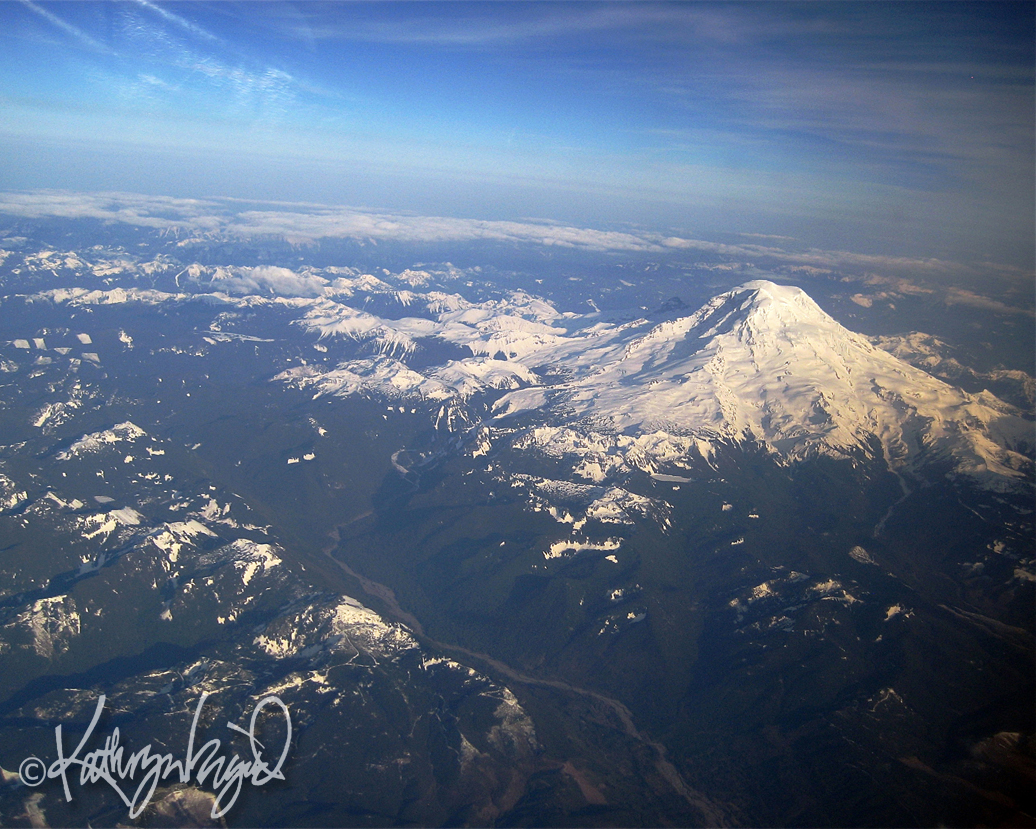
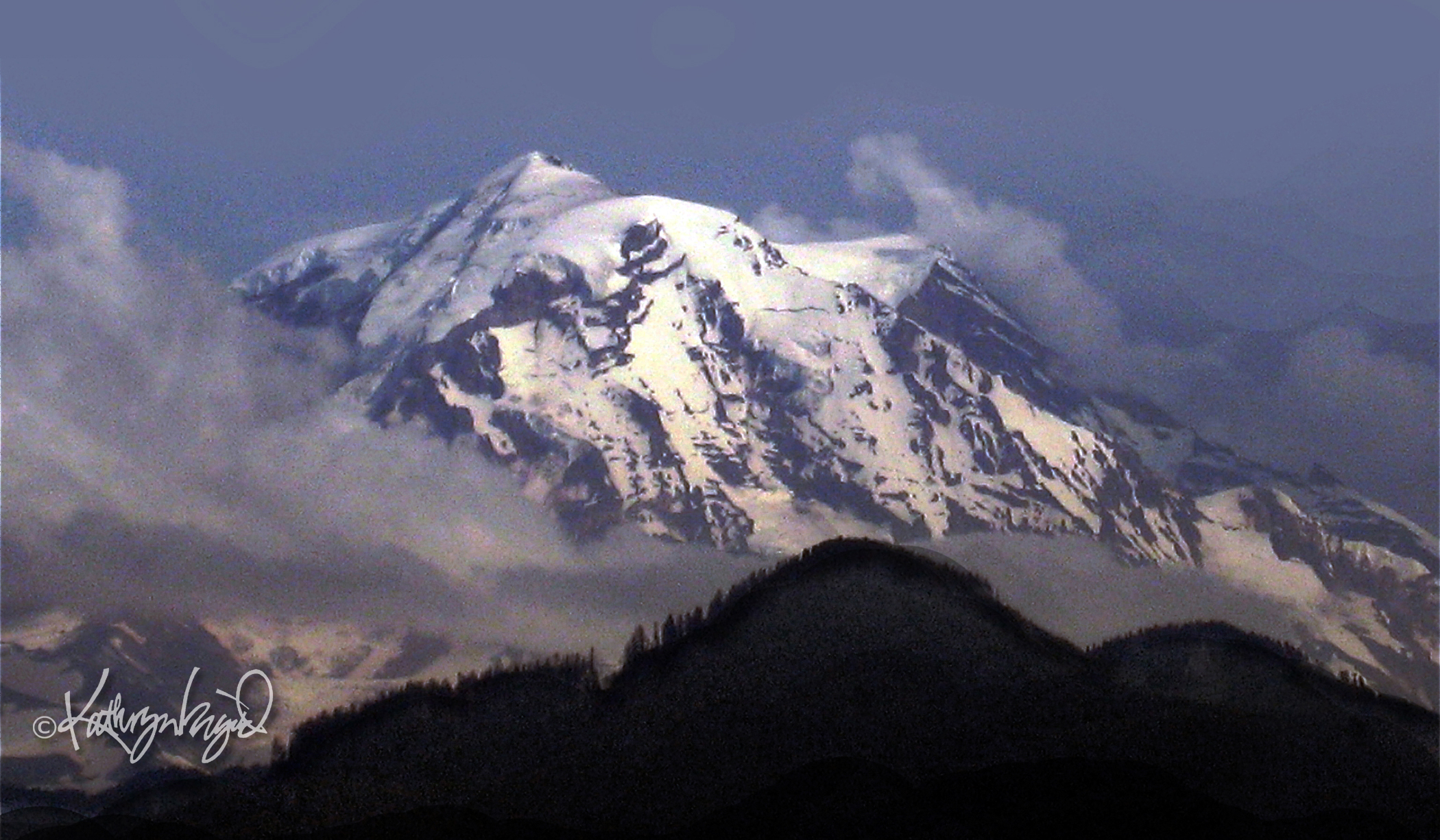
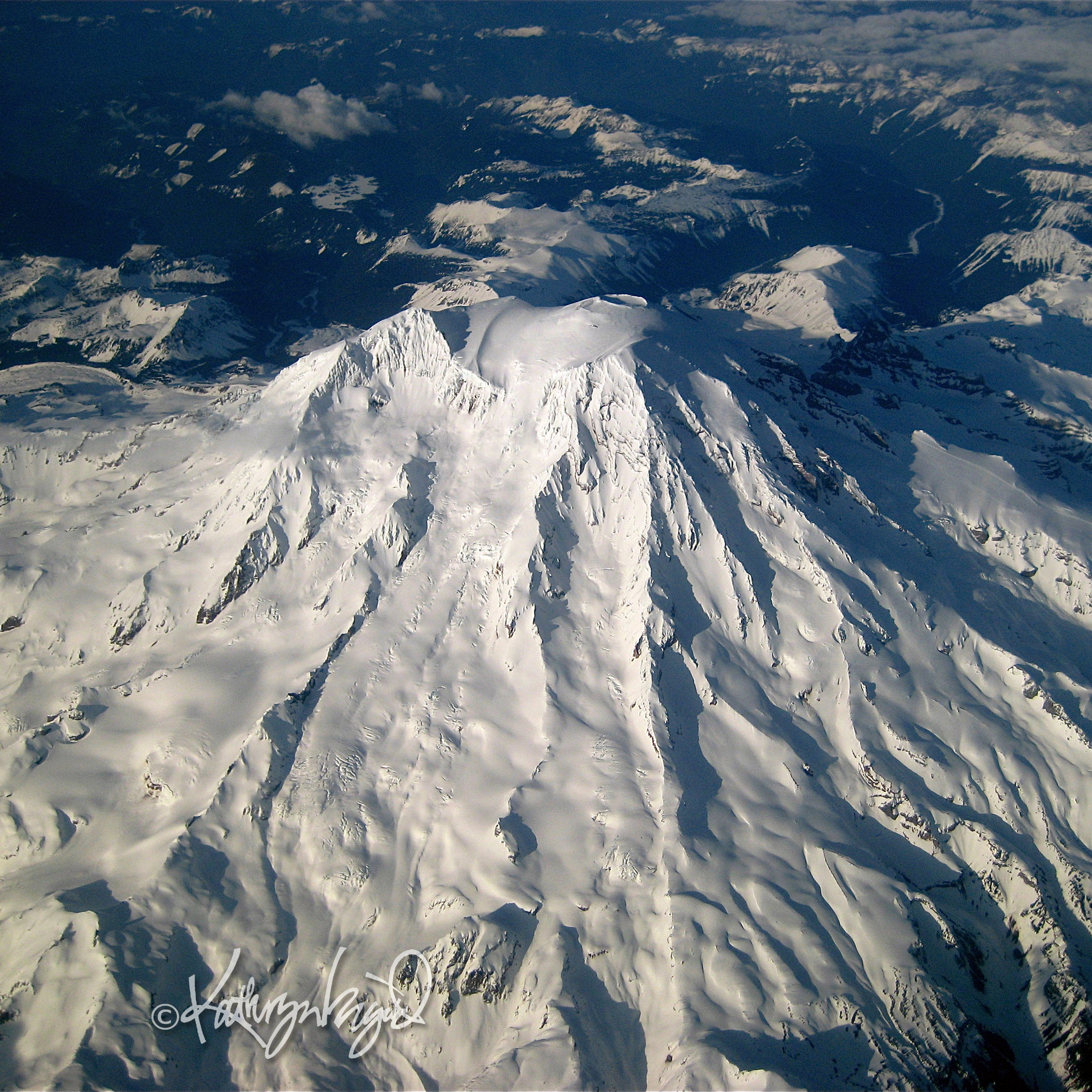
Perhaps this is true of other places, but I only know my hometown’s version of it: in Seattle, or pretty much anywhere in southwest Washington, Mount Rainier is frequently known simply as The Mountain. Yes, we call it by its full name, or by its ‘patrinomial’ ID of Rainier, and sometimes even by its graceful older name Tahoma. But its dominance of the skyline when visible, and of the ethos–the spirit–of western Washington thanks to its potent influences on geography and geological and meteorological character, not to mention the power it has to wipe out half the state should it decide to wake from its long dormancy, all mean that whether in plain view or not it has a hold on the hearts and minds of the locals like no other single force, natural or otherwise.
Sometimes when flying in to SeaTac airport the mountain is not only clearly visible but brilliantly etched and jutting boldly through the clouds, if any. SeaTac International Airport sits between Seattle and Tacoma, and the zone so called for its equidistance was finally officially given that insipid and cheap-sounding name some years ago–don’t get me started on it–but it’s well worth flying to a place with any ridiculous name you could conjure if and when you get the right weather, enough sunlight, and an accommodating pilot who appreciates Mt. Rainier’s beauty enough to tip a wing to the mountain’s flank and give the passengers a clearer view.
Truth be told, we’ve seen precious little of the mountain on our current visit. It’s been pretty overcast much of the time, including when we flew in, so yes, the photos here are from other times. I’ve known of visitors who left disbelieving we even have a Mount Rainier, never having glimpsed that big white heap of sugar in weeks and weeks of waiting. The fabled wet weather of the Northwest can indeed curtain off our magnificent totem from view for seemingly interminable times and make us long to be reminded ourselves that it wasn’t all an hallucination or a passion-fueled fantasy. Even when visible, Rainier very often sports a ‘hat’ or veil that keeps a little mystery close by; being large enough to create its own weather, this geological behemoth seems to be quite often crowned with a companion cloud that rarely moves very far off or disappears entirely.
Despite all of this hide-and-seek, the imminent danger we all know quite well as natives makes us bolt, strap, glue and otherwise thoughtfully position many of our tall or breakable belongings as though to protect them from a petulant child, because we’ve been through enough minor earthquake shakers in our lives to know preparedness pays. Still, while rainy Washington makes floods a real and frequent possibility, if that dormant volcano in our midst gives the really big belch geologists tell us is historically overdue, whatever isn’t swept off in the violent and instantaneous post-blast lahars [pyroclastic mudflows] that will likely submerge the surrounding valleys (the primary lahar channel of which was home to my family for most of my youth) will be treated pretty much like a snow-globe being handled by a curious Godzilla. Game over.
So we have a certain amount of respect for The Mountain, never mind it being such a fixture in our existence. No, I don’t know anyone who’s ever grown jaded about seeing it, no matter how long he or she has lived in its shade. This is not your typical mountain, looking pretty but losing its allure gradually as you realize you’re rather close and it’s stopped looming higher. It’s set in a fairly impressive range of mountains yet is so much bigger and more prominent than the rest that once the sky clears you just plain can’t miss it, and that sight quickly makes its mark on you. In snow-time, its blue-white flanks rise up to pierce the sky and look so sharply delineated you think you could stick your hand out and grab a fistful of super-vanilla ice cream from just behind that house over there across the street. As the snow melts, streaks made of billions of evergreens and a few exposed rocky prominences reflect sun and sky and passing clouds’ shadows in a changing array of colors that tease you with seeming first as near as your own breath and then suddenly as far distant as a too-sweet dream. Driving there can nearly drive you mad: you look to your left and it’s sitting right across the closest pasture; round the curve and it has shot away as far as the moon; over the next hill, in an instant it almost seems you’ll crash into the bank of snow just ahead of your front bumper.
Eventually you get onto the foot of Mount Rainier, yes you do, and you realize it’s so huge that you can still have a view of the peak that seems remarkably like the distant view of the whole that you had from an hour and a half’s drive away. The flora and fauna of this glorious bump on the earth have changed relatively little in millennia, and just being in their midst for an afternoon’s traipse along the trails makes you think both that your own sort might go on forever and that if the mountain is really going to blow, perhaps its taking you along for the ride in instant smithereens might not be altogether the worst thing. That’s how magical The Mountain is, even after all of these years of living at its foot. It might kill me, but if it does it will have fed my spirits incredibly well for a very long time indeed. That mountain there, she may keep her chapeau of a cloud-let coquettishly low on her brow for long periods of time, but when she finally does doff it, Holy Mother of Gleaming Glaciers, she’s a beauty.