The Mythology of Inspiration

photo

Whatever your vehicle, Ladies and Gentlemen, start your engines!

In another lifetime I was a teacher. Not a fabulous one, mind you, but one who took what I did seriously and did my best to give my students, if not the actual practice that would make them more productive and skillful and happy in their making of art, at least the idea of what might be possible for them and perhaps the instigation of the will to develop over the longer term. Like every other teacher in history, I knew that most of the burden of improvement fell on my students and had surprisingly little to do with what I could or couldn’t, would or wouldn’t, should or shouldn’t give them. And like every other teacher, I heard from my students every excuse in the book about why they would inevitably fail to accomplish any of this, how they were powerless against the forces that conspired to keep them from making the assigned efforts or finishing their work. Having used most of the excuses myself, I had plenty of fuel to argue my case after spending the intervening years (or minutes) rethinking it all as I moved from student status to teacher. And I knew too that I would have to keep re-learning it all as long as I lived, since every teacher is only a different breed of student and Life is the biggest, craziest, toughest and most creatively optimal classroom of all.

So I made up a little page of possible excuses and a smidgen of food-for-thought responses to them–perhaps mostly for my own enlightenment and prodding–that I shared from time to time with my students if they happened to be getting a little too enamored of creating excuses to spend their creativity on drawing, design, writing, painting, studying, researching, making mixed media installations, critiquing or any of the other topics I was attempting to encourage them to learn. Here are a few items from my little list, because I am well aware that I still need to remember them myself and keep trying to blow past them with determination and, I hope, a pinch of wit.

1          GREAT THINKERS THINK ONLY GREAT THOUGHTS

               (and I’m not a great thinker).

If this is true, explain why the Old Masters painted over or destroyed canvases, Einstein was virtually dismissed as a pea-brain by some in his school days and our early experts on astronomy believed the earth was flat.

2          GENIUS IS BORN, NOT MADE.

This may actually be so, but untended and un-exercised, genius has no value whatsoever, and many a great achiever has acknowledged beginning an illustrious career ignominiously and becoming expert through sheer will and work.

3          EXCELLENT IS GOOD, GOOD IS AVERAGE &

               AVERAGE IS TERRIBLE.

               (Corollary: Good is excellent, average is good, terrible is average!)

Creative and inventive people often have a penchant for self-disparagement and perfectionism that leads them (and often others) to devalue work of quality; it’s also a common temptation to simply fall back on the platitude of ‘beauty is in the eye of the beholder’ and accept mediocrity because one is too fearful or lazy to be honestly critical and opinionated.  Accept it and get on with things.

4          IT DIDN’T TURN OUT THE WAY IT WAS SUPPOSED TO.

Oh, come on.  Almost nothing does.  Sometimes it just isn’t finished yet when it seems to have Not Turned Out.  And more often than not, the real result is an improvement on the original plan anyway.

5          IT CAN’T BE DONE.

It’s better to go down in flames of glory, for having tried, than to prove only that  you couldn’t (or just wouldn’t) do it.  And what if it does work?!  Don’t you just love those rare chances to say I Told You So, anyway?

6          ALL THE GOOD IDEAS ARE TAKEN.

            All of the good ones haven’t been invented yet, Silly.

7          I CAN’T THINK OF ANYTHING.

You don’t have to.  Steal ideas all over the place.  Just remember to cite sources, give references, and wherever possible, to thoroughly revise and synthesize things into your own particular combination or version of them.

8          WHY SLAVE TO HAVE IT ALL WHEN YOU CAN SETTLE FOR LESS.

            Perhaps because apathy is as dangerous to existence as the threat of annihilation.

9          IT COSTS TOO MUCH.

Some of the same people who whimper over buying a five-dollar sketch pad and two ninety-nine-cent pencils (two weeks’ supply, say) think nothing of adding four dollars’ worth of popcorn and soft drinks to their seven-dollar movie tickets: that’s Whiners’ Math.  But most art supplies can be hideously expensive, especially for those productive enough to use masses of them.  So it’s a necessary and healthy part of the solution-oriented artist’s life that analogs and alternatives be a constant study.  What can legitimately serve as a substitute for the too-expensive?  Often the product of such inventiveness proves more exciting than the work as first conceived.  Sometimes it’s important to make the commitment to spend the real money for the real thing, too: how serious are you?

10        I’M NOT INSPIRED!

Genuine inspiration occurs ZERO times in the average artist’s life. WHAT!!! Heresy! But truly, if we’re talking spiritual/mystical magic, most must instead rely on a painstaking and passionate process of trial, error, adventure and eventual coalescence to allow artistic completion and quality to arise.  Don’t wait around to be inspired, in case it’s not in the cards: deadlines and opportunities wait for no one.  If you’re the incredibly lucky one inspiration smiles upon, have conspicuous spasms of joy, make feverish use of the favor while it lasts, and get ready to work hard on the next thing when you become a mere mortal again.  We’re lucky enough just to be able to be the real thing, Working Humans.  Don’t knock it.  There’s joy enough in that.

Stay tuned . . .

photo

. . . for being tuned up and ready to roll is more important than knowing where the road will take you . . .
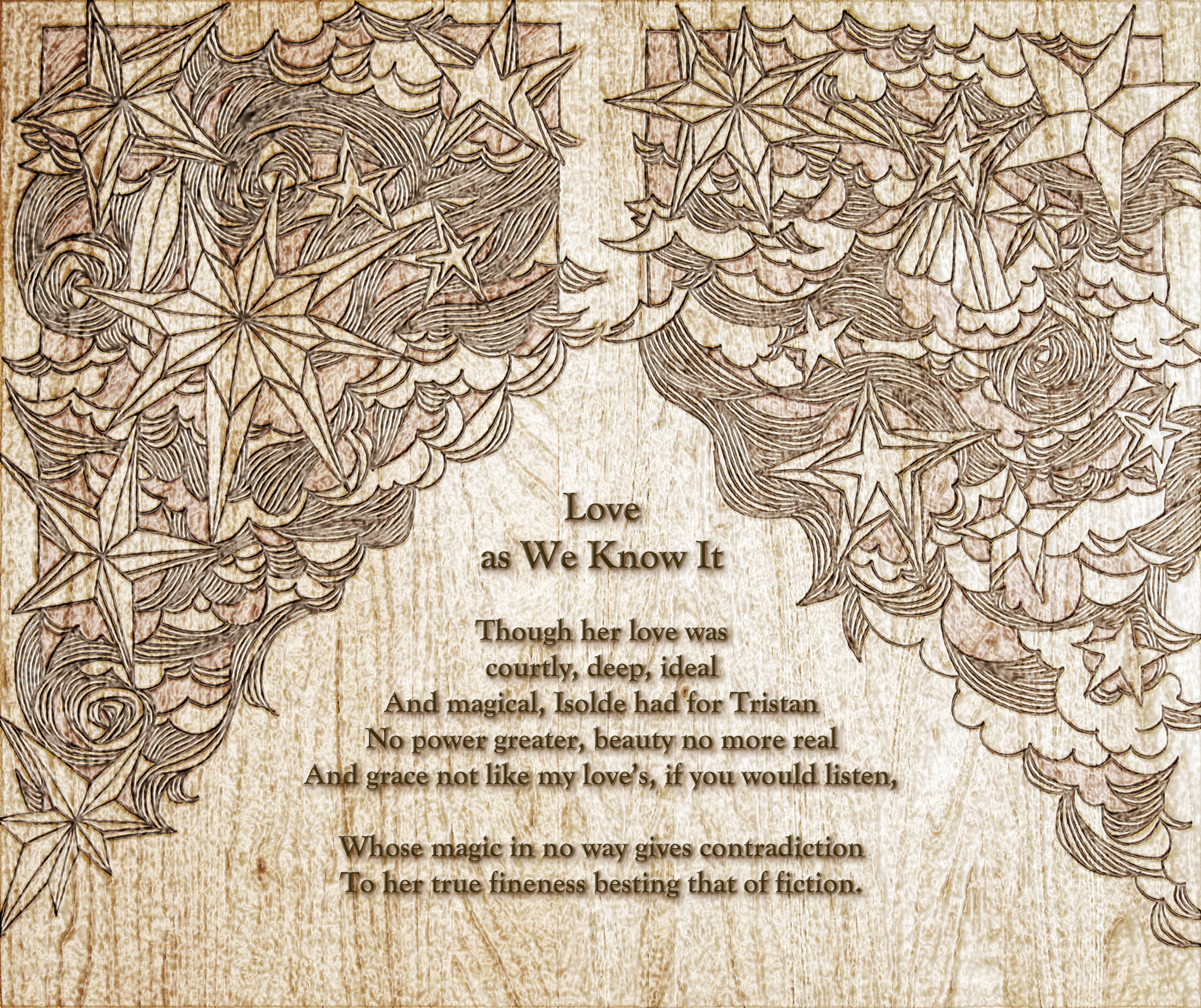
 

Love, Always Love

Image

digital artwork + text

Simplicity Itself


photoSimplicity, I think, is like most of the virtues and values that we humans might hold dear–those who have it don’t necessarily appreciate it, and those who talk the most about it tend to know the least about it.

The rich and comfortable are so obsessed with the idea or ideal of simplicity nowadays that there are magazines, fashions, classes and whole philosophical movements devoted to its study and cultivation. People will expend massive quantities of energy and spend large quantities of money on trying to simplify their lives and themselves, when very likely simply giving up the energetic striving and letting go of the amassed money would do the trick in a trice. (Perish the thought!)

The poor and underprivileged have ultimate simplicity forced upon them, and tend to choose whether to embrace the unsullied earthiness and quietly hardworking ways thrust on them by their circumstances or to battle against them. Probably a majority of people, both poor and rich, will always think the grass greener where they are not, and hardly give thought to how hard the next person is trying to get over the fence onto their own enviably other property. Dissatisfaction may be an essential part of humanity’s natural state of being, much as it naturally chafes us to think so.

On the other hand, looking at what dissatisfies us with as unsparingly honest a glare as we can might in fact shed some light on how to find better contentment, not necessarily by having more or less of something (tangible or ephemeral) but by giving it all its appropriate due and then saving our true love for the most meaningful virtues and values of all. At the very least, that narrows down the field for most of us. At its best, it frees us up to say that life is remarkably livable where we exist right here, right now, regardless of the shade or tint of the lawn. The simple presence of any one particular leaf of grass or bud of bloom in the one square foot of soil nearest to hand may be quite enough, at least for one simple day.photo


Another Good Thing about Waving One’s Arms


Waving my arms is something I may think about more than the average person does. From when I was pretty young I was conscious of arm movement as being mighty significant in a seriously diverse series of ways. First of all, there was that childhood training we all enjoy, if we’re well inducted, in the art of waving hello and farewell. I have almost always preferred the former to the latter, but in either case, whenever the occasion was deemed genuinely worthy of such a gesture, I knew that it was a sign of love or affection, and that made it pretty darn worthwhile.

Then again, I also had an early fondness for wagging my crayon-gripping fist over a piece of paper (or whatever flattish surface was convenient) to make squiggly lines and, if I got lucky, get them to coalesce into picture-like concoctions. I  might be sitting off in a cozy corner at Grandma and Grandpa W’s, scribbling away, with the faint sounds in the background of parental and grand-parental chatter as they sat drinking their coffee intermingled with the slight chattering sound of Grandpa’s cup doing a little jitterbug against the saucer, because he had a mild tremor in his hand. Of course, his arm-waving was hardly dramatic, but it was one of those delicate underpinnings of my early memory that became part of the whole subtle weave of my perceptions.

Sometime in my early teens or thereabout, I found that the family resemblance extended to my having my own familial tremors, occasionally in my head and neck but mostly in my hands and arms. There have been times when it was more pronounced than was entirely convenient for a person wanting to draw, but fortunately it’s rarely been at problematic extremes, more often merely requiring that I find ways to compensate for or control or use the tremors to advantage in my art-making. In any event, keeping my hand in (no pun intended) as an artist has tended to keep the inevitable interactions of these two kinds of arm-waving present in my attentions. Meanwhile, my other grandmother had her own kind of arm-waving to lend to the family skill-set: Parkinson’s Disease.

Typically, Granny had the wit and will to battle her Parkinsonism not only with great tenacity in staving off the ravages of the illness for many more years than is typical but also with a lot of good-natured humor, because that was her style. So whenever we had a family gathering, she was the first to offer her services for tossing salads and making milkshakes. That my mother has followed in the Parkinsonian lineage would make her forms of arm-waving far worse to behold, knowing that the same sort of insidious progression lay ahead for her, and to be fair, including the knowledge that the odds are a bit higher for me than for some that I will eventually join the parade, but she too has maintained a bright attitude about it all. Besides that, I am very slightly suspicious that her particular skillfulness when it comes to shaking the dice gives her a unique edge in the evening board games.

But the top of the list when it comes to magnificent ways and reasons to wave one’s arms has surely got to be the one I’ve been witnessing so much now that the concert season is well underway again: conducting. Bands, orchestras, operatic performances, choirs. No matter what the form of the musical art, if there is a conductor up there waving his, her (or, particularly, my beloved husband’s) arms, the love that fills the air is what makes all of the arm-waving a worthy and beautiful thing. It brings hearts and minds into focus and, often, into community, and it makes the world a more wonderful place to be.

And that makes me want to stop waving my arms altogether, just opening them wide enough to embrace that better world and anyone I can in it.digital image from an acrylic painting on canvas


Apparently I Executed the Secret Handshake Wrong or Something

digital artwork

Cinderella Opts Out

From your assessment of my deportment,

I must ask what the statement “of a sort” meant–

Oh, was I, I wonder, a shade improper,

Not brass perhaps, but a hint of copper?

Did I stand out from the regal crowd

By being a decibel too loud?

When I met the Queen, did I rudely greet her

With a curtsey too small by a millimeter?

Did I jostle the King, or step on his toes,

Or remark on the magnitude of his nose?

Have I shocked the royal entourage

With an unplanned glimpse of décolletage?

Say, what have I done in these latter days

To occasion such backward, lukewarm praise?

Do tell me where this prejudice starts

That substitutes etiquette for hearts!

I’ll not be one of the prince’s bijoux

Knowing I can’t have the wit to please you–

I’m off for home, where they make no sport

If my manners are only “of a sort”.digital artwork

The Vast American Landscape


digital image from a photographAs November approaches and the always-tedious white noise of political ravings grows ever louder in the US atmosphere, I find myself musing once again that so little is what we think it to be. Clearly, if you read my post the other day, I am seldom content to accept the appearance as the reality, but it is never more significantly the case than around the time of elections. For all that Americans love to crow about being the truest democracy in the world and having the power to determine our own destinies and that of our nation (never mind our meddling globally), what’s most notable around voting time is how little anyone really does his or her research and how thoroughly gullible, petty and narrow-minded most of us are on our best days. It’s really kind of miraculous that, young as America is in the way of being a nation, it still exists as one. We’re all on our own paths, wavelengths, and possibly planets around here.

And those who rise to power in our country are no less prone to manipulating that sort of foolishness than those we claim to abhor elsewhere. We give things whatever ‘spin’ we prefer and, by golly, hordes of similarly spun fellow denizens jump right into the vortex with us, leaving reason and, ultimately, hope far behind. One might think that the current age of electronic wizardry would make us more aware, if not more cautious, of all sorts of trickery and monkey business, but alas, we cling to our ignorance and wilfulness with just as much dimwitted fervor as always. Knowing that the camera sees only what the photographer aimed it at and the recorder hears only what the engineer had it turned on to hear–and that the results of both operations can be almost endlessly manipulated after the fact so as to be something entirely new and different from the initial truth, however truncated that might have been, we still choose to stand with facing our own chosen suns while right behind us, out of frame, utterly different realities are carrying right on with their appointed happenings.

So in honor of this form of deception, whether imposed upon us or self-inflicted, I give you my image of the Grand Canyon. Or, as it was before a little Photoshopping hocus-pocus, a dirt pile under the freeway overpass, whose ‘magnificent agaves’ are small tufts of grass, whose brilliant coloring is all hand-applied, and whose vast open sky is a digital blanket pulled down to cover the abandoned storefronts looming behind the little hillock. What you see is what I get, my friends. Keep it in mind on the way to the voting booth, won’t you?


Treasure Knows Neither Time nor Place

photo

A memory-driven image by my great-uncle Rolph Bolstad . . .

I have been scanning and digitally restoring a number of photos out of our family’s trove, a heap that resembles the disorganized and neglected stores of many other families. I make a small dent in the stack from time to time, then get distracted by everyday life and often don’t revisit the project for quite a while again. While many of us obsess over parting with beloved memorabilia of any kind, the truth is that the majority of us don’t do much with it when we have it.

All good things are that way, I suppose: love, joy, peace and happiness of both the material and the intangible sorts are seldom given their full respect when we have them, only mourned when we think they’re out of reach. And from what I’ve seen and heard from friends around the globe, this is a foolishness that transcends all sorts of differences and makes us more alike than not–no matter what our location or culture, our beliefs, hopes, and dreams, we all seem to wrestle with this forgetfulness about appreciating what we truly value that we have right in hand, and the minute that we suspect we’re about to lose our grip on those gifts, whether by our own decisions or perforce, we get panicked and become certain that it’s a sign of apocalypse. Surely the end of our own self and sanity, and very possibly, that of the universe as we know it.

I come across that box of yet-to-be-scanned photos from time to time and get a pang: what if I don’t get back to this project before I forget who’s in the photos, where the shots were taken, before the images are too faded or decayed to be rescued at all?

Well, what if?

Honestly, I know full well that it will not be the end of the world. Not even the end of my pleasurable revisiting of those memories–what’s more significant than retaining this flimsy physical repository of memories is whether I use the versions of them in my head and heart while they last (head, heart and memories, all three). Once gone from there, the data held in a picture is only cold, meaningless data after all, and it never contained the warmth and soul of anyone or anything depicted in it. It’s merely a shadow-play version of the husk that is my human form and will no longer be me when I die.

So I’ll keep leafing through these paper and binary mementos of mine as long as it pleases me to do so, remembering mostly that what is seen therein is always more beautifully carried inside me. Change is indeed the only constant, yet in the photograph my great-uncle took, probably in Johannesburg, around sixty years ago there is the ephemeral prototype of the photograph I took in New York less than a decade ago. Fifty years or fifty centuries, it matters little if we learn to respect and rejoice in what remains true and crosses the boundaries of place and time as long as we keep it alive inwardly.

photo

New York City lives in my own memory as much as in a physical place . . . its beauties, like all things loved and valued, lies in me, in others’ hearts, far more than in itself or any image we can conjure of it . . .

Foodie Tuesday: I’m Roasting! No, I’m Frying!


photoOh, I know, you all thought I was having hot flashes again. [Not that I wasn’t.]

But it’s Food Fun day again, and I’m referring to cooking edibles this time. Old broads still gotta eat.

And since much of the time I am thermostatically challenged myself, I generally try to find ways to make the hot foods I’m preparing require the least possible amount of time putting me in near contact with the oven or cooktop. Why risk further overheating, of either myself or my preparations, should I need to stray far afield from the heated zones of the kitchen.

One fairly easy solution, though it seems somewhat counterintuitive to me, is to roast or fry food. Yes, they’re relatively high heat methods of cookery. But by using them, I can usually evade the stand-and-stir duty: do all of the prep before even turning on the oven, then tuck the food into the would-be fiery furnace, set the temperature and timer, and head off to cooler climes until the alarm sounds for my triumphant return to check and/or finish the dish, and serve and/or eat it. Simple as that.

Roasted beetroot, for example, a nice way to enhance the flavors and textures of a cool late-summer salad, gets cleaned and quartered and then needs nothing more than a small amount of fat and perhaps a tiny bit of seasoning before it pops into the tanning booth. Goat cheese is delicious when lightly coated and shallow-fried, even if like me you’re not quite the culinary artist to present it with perfect Cordon Bleu pizzazz, and it takes no more than a couple of minutes, tops, at the cooker to brown that fine crumb crust.photo

Roasted Beetroot and Goat Cheese Salad

Scrub and quarter a handful of medium-sized beets. (Clean and save the greens and stems.) Toss the beetroot pieces with a little fat (oil or melted butter; I used coconut oil to keep its noticeable flavor to a minimum), salt and pepper and scatter them in or on a baking or roasting pan. Since I was making such a small (2-person) meal, I just made a pseudo-pan out of heavy aluminum foil to keep any juices from dripping around the oven. Roast the roots at 350°F just until tender–10-20 minutes, depending on your oven and the size of the beet pieces.

Meanwhile, pat 1/2-cup batches of cold chèvre (goat cheese) into patties and coat them with coarse almond flour, pressing it in on all sides. Quick-fry these in a little butter in a nonstick pan over medium heat. You can see from my photos that I am far from adept at this part, so mine look less like haute cuisine than like something unearthed at Herculaneum, but I assure you, they taste quite fine.

Using in tandem these two homely yet highly edible items plus a small assortment of others, you can quickly assemble a presentable version of some hotshot chef’s beetroot-and-goat-cheese concoction and your stomach will not be critiquing the view anyhow. My version, this time around, consisted of a few of the tenderer, prettier beet greens pared down to the leaf and laid on the plate, a bit of peeled cucumber slices arranged in a green frame around the rest of the plate, and all topped with the chèvre rounds and roasted roots and a sprig or two of fresh dill. I’m sure that roasting any sweet enough veg or tuber–sweet potato, carrot, pumpkin, parsnip for example–would make a similarly fine complement to the bright, fresh taste of the cheese, which in turn could be substituted for with any nice salty/sour cheese, undoubtedly.

Which of course leads me to another hot-weather or hot-mama advantage of this preparation: the leftovers (if any) lend themselves to innumerable variant cold, cool or room temperature dishes that can be popped out of fridge or freezer next time the climate or one’s overheated innards require such things. Behold tomorrow’s dish: minced beet greens and stems, steamed quickly in the microwave while the beetroot was roasting, and now blended with that remaining diced vegetal goodness, some leftover quinoa, some diced dried apricots, a few pine nuts, a little orange dressing . . . and the beet goes on . . .photo


Call Me Thomas–No, *Really*


graphite drawingIn some areas of experience, I am admittedly as credulous as a baby, but generally I suppose I tend toward the skeptical. If American political, religious and social rhetoric can’t turn anybody into a skeptic I don’t know what can, but I find there’s plenty of fodder for the mill in endless other realms. ‘The Most Delicious Boeuf Bourgignon You’ll Ever Eat!’ Truly? Then why does your [self-] acclaimed dish look so convincingly pre-digested and taste exactly like I would imagine cheap dog food to taste? (Just so you know, the idea that I’ll never want to eat Boeuf Bourgignon again after yours doesn’t count as its being the best I’ll ever eat.) No such thing as Climate Change? Feel free to run around in your skivvies while half of us are bundling up for the lowest temperatures in forty years and then mummify yourself in a zeppelin-sized parka while the rest of us try to keep a modicum of cool somehow–all I can say is, I learned how to read a thermometer when I was smallish, and the patterns on that alone have changed plenty in my brief time stomping around the planet to convince me that the weather’s different from what it once was.

‘Organic’ food? Great! But know thy USDA regulations–and what many needful things they may well lack. ‘Green’ energy from windmills? Well, yeah, I am fully persuaded that the simple movement of our breathable atmosphere is far more reliable and consistent and predictably present for generations than, say, vintage Pleistocene joy-juice (a.k.a. stinky petroleum-based fuels)–as long as we also keep in mind that there are offsets: the parts for contemporary wind farms are produced and serviced in very few locales yet and are often therefore shipped across the continent by truck–teams of semi tractor-trailer drivers plus guide cars are required for shipping a single giant blade of one of those behemoths several days cross-country–both to their workplaces and to be repaired. Yet I wouldn’t say wind power isn’t one of our better currently available alternatives. I just think the inquiry must be made, and honesty and transparency are useful all along the way.

Question authority? How about questioning everything and assuming nothing!

All the same, none of us is equipped to investigate every single experience, idea or item that comes our way so thoroughly as to fool ourselves we’re magically well-informed. We must assume, trust, take chances and hope or we will surely stultify and die. Not to mention that it’s very easy, especially for those who, like me, have any tendencies toward insularity, NIMBY attitudes, fear of change, anxiety disorders, allergies or eccentricities that don’t fit nicely with the communal norms to simply hole up and hide from unpleasant and unpredictable reality. And when you boil everything down, I find I’m not actually the least bit attracted to being a conspiracy theorist, aggressive activist for or against anything, or to adopting the kind of narrow, mean-spirited and curmudgeonly attitude that I find repellent in other people.

So I may pry a little bit at the lid of the shipping crate to see what’s really inside it or nag you a little to justify your claims that you’ve invented the world’s most astonishing miracle product, but beyond that, I’m content to believe that the universe is generally fairly benign and most of the people in it rather pleasant and honest, after all. Clearly, you needn’t take offense at my insistence on your being straightforward with me and my preferring to be forthright with you, although I still believe in the value of a certain few little white lies, so you’ll never know absolutely whether I do or do not think those summer pants of yours make your backside look like the White Cliffs of Dover.

Meanwhile, you may call me a bit of a Doubting Thomas, or better yet, just call me Thomas, which was in fact the name my parents had reserved for me in case I turned out to be a boy-child. Because, let’s face it, their previous one-child history of producing girls didn’t prove anything, and their doctor certainly wasn’t able to guarantee my girly-tude in those ancient days, so it was more practical to assume that the little Kathryn Ingrid sprout could possibly show up and be a Thomas Lauren instead, or even have the personality of a Katrina (another option they kept open) rather than a Kathryn, whatever that meant. It’s just best to know that we can’t always guess how things are going to turn out and we don’t always know everything, at least unless we do the homework and get lucky. And if it all catches us by surprise, that might not be an entirely terrible thing, either.graphite drawing


The Royal Whee!

digital image from a photo


It IS All About Me, Really

To see the main

objective of the game,

It helps if one can

keep the goal in frame

And focus on it clearly,

deeply, truly,

But not to lose all

other sights unduly,

So if you’d like to

keep ambition near,

I recommend you stare

at me, my dear.digital image from an antique print