Foodie Tuesday: Some Things Never Change. And Why Should They, Eh!

It’s unclear where the phrase ‘if it ain’t broke, don’t fix it’ originated (though it can easily be believed attributable to Texans before its wider popularization), but the precept is in my mind particularly apropos when it comes to foods and eateries that reach a particular stage of development that makes them Classic. Every town seems to have a diner, joint, cafe or pub that has essentially congealed into a certain form and is revered to the point that its regulars and even unattached fans will gladly rally in defense of its remaining unchanged forever. Where else would we go?photoGreatness is not essential, but being the paradigm of whatever it might be that the place or food represents gradually becomes codified as something very nearly sacred. The comfort in being able to revisit one of these places any time and find the familiar favorite food, drink, decor and ohyespeople, people is pretty much a saving grace in the midst of a dull or dark spot in life, whether it’s been a bad day or a bad decade–or just a time when you’re hungering for something more than just calories.photoMe, I’ve got a passel of favorites from all of the phases and places my life has crossed thus far, and doubtless I’ll find new ones as long as I do live. That speaks less to my personal obsession with food, good food, lots of food and equal amounts of fun and atmosphere than it does to the wide availability of tremendous cooks, distinctive and colorful rooms, buildings and locales, and fantastically personalized recipes for nearly everything imaginable. The fundamental dish, drink, dining space or clientele need not be genuinely unique or even world-class (not that that hurts!)–it’s about the combination of them and the way that the parts all strike one on the occasion that lures her back. And then back again.photoAll I should really say on the occasion of such fond reminiscences is that if you don’t already have favorite spots that you’ve visited often enough for the people running them to recognize you, exchange information about life outside the eatery, and then bring your order with all of its weird customized combinations and/or deletions without batting an eye, you had better get moving and find one or ten.photoAnd further, I should say Thank You, Tea Leaf and Harbor Lights [here, if you read the critic’s linked review of the recent renovation and its early results, is living proof of my thesis, should you be interested], Ranchman’s and Miko Sushi, Anglea’s and Mi Ranchito and 42nd Street Cafe & Bistro [an example of a place that has kept a fantastic balance between changing over time and maintaining high quality food and great people]; Thank You, Dave and Hallie, Francisco and Tony, Blaine and Cheri, Teresita and Allessio and Abuelita and all of you other wondrous souls who have been keeping the rest of us contented and coming back over all these years. Yeah, you too, you people over there in England (ohhh, that fabulous Chinese hole-in-the-wall with Sizzling Lamb, and the suave Indian place across from the V&A) and Sweden (I’m looking at you guys making us shrimp pizzas in the wood fired oven in the Stockholm train station and the people creating amazing steak frites with cognac and green peppercorn sauce in Gamlastan) and Panama (Italian salmon pasta in Central America? Oh, yes! Oh, boy!) and so many, many more. Thank You.

All This and an Open Floor Plan Too

photo

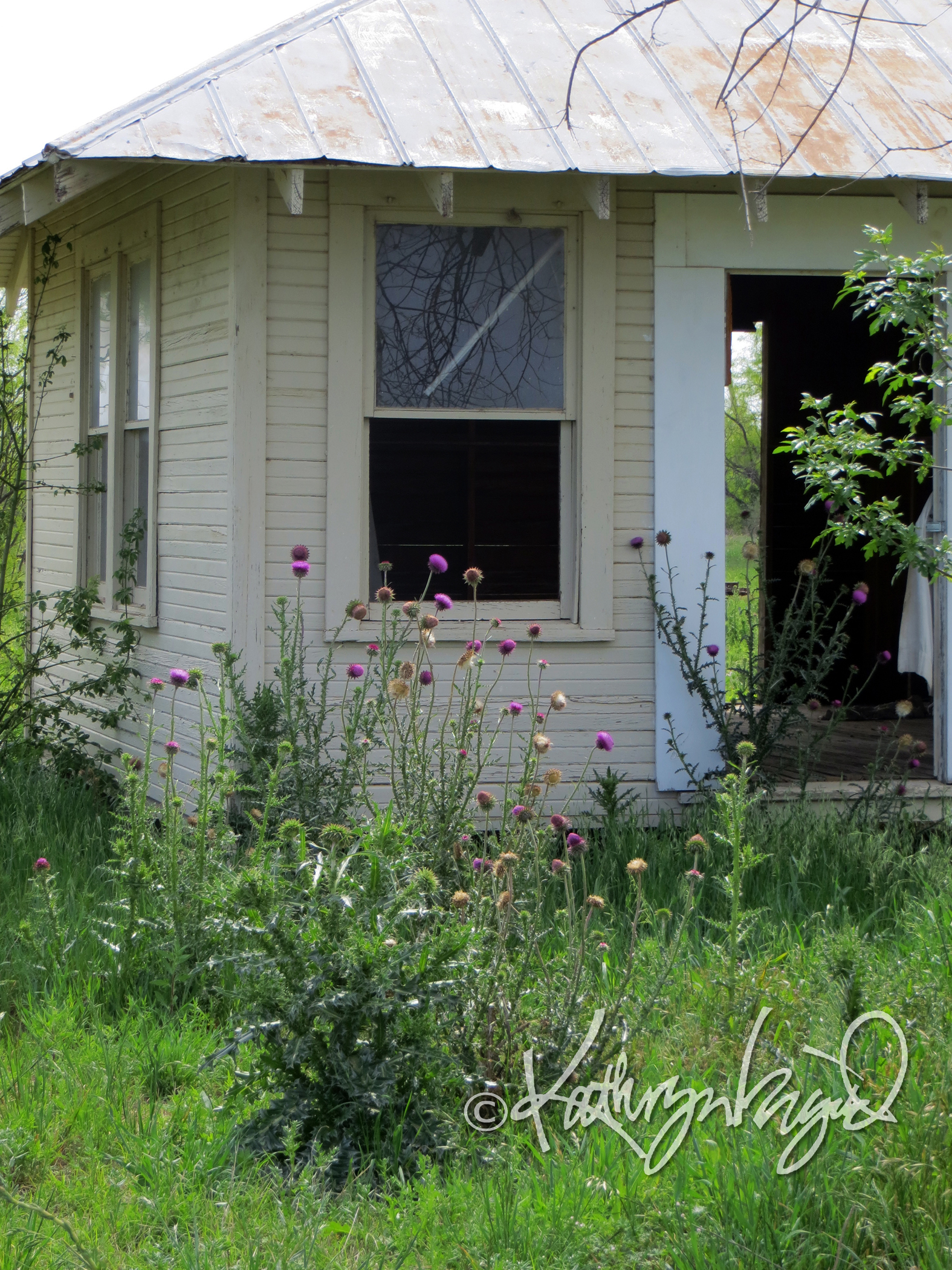
Lots of natural light, established yard, easy access to transportation (railroad across the street), air conditioning included.

I love a good ruin. While I understand the urgency of need for shelter among the homeless of the world and I generally don’t condone waste, the beauty of a derelict and decaying building speaks to me of history, mystery and longing. The reclamation of the ruin by nature, so astoundingly quick in geological terms, appears in the lifetime of a human to be perversely slow, creeping up and catching observers unawares. Deferred maintenance–a term that has taken on a modern oxymoronic twist I despise, given that such deferral is really deference to eventual wrack and ruin of a very irresponsible sort–becomes dire in what seems to have been the length of the watchman’s single circuit, and when we come back to the front door of the property we thought we’d only just circumambulated, it’s already hanging by one rusty hinge.

The character in and inherent fairytales posed by ancient ruins are naturally enhanced and perhaps exaggerated by their superior age, so a once-fine castle or cathedral, stone cottage or pillared temple has an advantage in terms of potential drama. But I am equally fond of a tumble-down shed or an industrial derelict, for nothing in its skeletal state lacks the piquant possibility of backstory as the mind attempts to re-flesh it with purpose and activity. Given half a chance, I might attempt to revive the corpse in the way that I went with cousins and undertook the rehabilitation of an abandoned cabin near our grandpa’s when we were young, because the romance of emptiness is that it’s always seemingly waiting for something special to happen. On the other hand, spending time in a ruin only to contemplate what did or might happen there can be just as alluring.

In this regard, I suppose I think of ruins as endlessly optimistic, though it may seem quite contradictory: the sense of their potential, whether for new life or for telling their stories of what has gone before, tends to outweigh the sense of sorrow that is in their current state of dishevelment and disrepute.

photo

I wonder, then, how I so often forget to see imperfect looking people in the same way.

The Icing on the…erm…Chair

Being Crafty is something other people do. I admire the feats of those who can crochet spectacular Afghan blankets seemingly out of thin air or decorate their homes for the holidays with recycled coat hangers and tuna tins and somehow make them look like a magazine cover. People who have the know-how, skill and patience to embroider babies’ bonnets, build palatial birdhouses out of scavenged fence pickets and carve perfect portraits of great historical figures out of turnips impress me greatly.

I, on the other hand, have been known to abandon ship mid-craft, or at the very least change directions radically when I feel I haven’t a hope of getting the hang of what my project was initially intended to be. My youthful embroidery days were ended when I spent a lengthy evening working on the details of some would-be floral tea towel‘s featured bouquet, stood up to gather my sewing and head off to bed, and discovered I’d embroidered through both the tea towel and the lap of my nightgown. My candle-making artistry had only its propensities for melting and burning (and thus, quickly, disappearing) to recommend it. Unlike those who are able to make fabulous sand mandalas with the grains arranged perfectly meditatively into millions of delicate otherworldly patterns would be, if not appalled, then at least mystified and probably saddened, by the strange mud-pies that would be the only produce of my efforts in that direction.

Pretty well any craft that takes any real focus and attention, let alone proficient control of the medium, is likely to remain out of my reach.

There are, however, certain tools, materials and proficiencies in the land of Craft that I can and do manage. One of the media I have enjoyed manipulating for playful, if not crafty, purposes at times is lightweight spackling compound. This stuff, made initially for repair of wounded wallboard and the filling of trim gaps by builders and handy-persons, resembles cheap bake-shop frosting so strongly in texture (and, I daresay, probably in taste, though that’s moot here) that it goes through an icing bag and tip wonderfully well. So it’s great for not only creating faux frosty baked goods but also all sorts of the same kind of detail work that plaster and woodcarving and metalworking artisans have used to create architectural accents and furniture details for eons, especially in combination with other small sculptural elements. Thinning the spackle just enough with water to go through a pastry icing tip and retain its proper density and texture and shape while drying is virtually the only difference. In fact, the spackle can be tinted in many of the same ways as frosting, too, though it may be painted and colored in many ways after the fact.photoIn any event, I’ve had fun with this magical past on occasion. I’ve made customized and personalized ceiling medallions with it. I made a nice big window valance that had all kinds of pieces and parts–food and cookery gadgets and the like–blending its own form and meaning with the rest of the dining room in which it hung. I’ve used it to create baroque picture frames and mirror frames. Probably the most fun project with it so far was making a couple of very rococo side chairs by upholstering them with tapestry-like fabrics and then building equally over-the-top sculptural frames and backs out of small objects, some pre-made and some of my own making from plasticine or wood, bone or clay or metal, and then faithfully infilled with spackle ‘frosting’ before I gilded it all with metallic paints.photo montageWhat’s next? Who knows. But there are boxes full of fun waiting for me to make them into something new, and that little yet persistent itch returns from time to time, so undoubtedly there will be a next thing. Just you wait and see.

Under the Influence

mixed media drawingWhen I hear that phrase, of course I’m immediately reminded of its use to describe those persons, so much dimmer witted than a barnyard fowl, who drive or operate heavy machinery or otherwise behave inappropriately (and most likely, quite dangerously) because they are under the influence [UTI] of drink or drugs. Personally, I would go further, with my concept of UTI encompassing other, equally dangerous things like ignorant social, political, religious or philosophical views that give their disciples delusions of superiority, imperviousness, entitlement, and so forth.

But it behooves all of us to remember that the phrase isn’t inherently negative, for one can be under positive influences as well. Even better if one can manage to be a positive influence. It’s notable enough in a long and active life if one succeeds in generally doing no serious harm (intentional or otherwise, and to be in fact benevolent and able to enact good and fine things, why, that’s remarkable and admirable stuff indeed. I know people who can do so right here in the blogiverse, teaching and leading us all to do and be better versions of ourselves, and doing so not only by sharing their stories but by being living examples of what they teach. My years of classroom teaching proved to me that I was better suited to being a student than a leader, yet tutorial and mentoring settings gave me a much greater level of comfort in that they allowed me to operate as a fellow learner and thus engage more deeply and without as great a fear of steering anyone (myself included) astray.

The bloggers I most admire, immensely entertaining and humorous and dramatic and artistic in ever so many ways, are always, at heart, teaching, whether it’s overtly and with carefully designed pedagogy and prescriptions or it is so inherent in their natures that it comes fully interwoven in the fabric of their posts. These favorites include, but are not limited to, logophilic, ecological, travel-oriented, cuisinal, community-building, arts-centric, historical, and in many cases, wildly multitasking blogs. Some bloggers are small fry like me, known only to a cozy circle of great friends who come by to read and sometimes comment, and some of those I greatly admire are large-scale bloggers, people with lots of published work elsewhere or major accomplishments in their fields (whether related to their blogging topics or not!); a few have multiple blogs and the amount, whether on one blog or many, of posts published varies from one every few weeks to daily. There may, in fact–given electronic media of all kinds nowadays–be people putting up posts every few minutes, but I haven’t the time and energy to keep visiting such volcanic sources and tend to keep to my group of favorites with an occasional foray outward.

So who are my influences among bloggers? Friends who give us invitations to visit them at places like The Bard on the Hill, Spanish-English Word Connections, and Year-Struck, Just a Smidgen, The Valentine 4, David Reid Art, and The Complete Cookbook, like Bardess DM Denton, The Kitchens Garden; like the blogs Cooking-Spree, O’Canada, Nitzus, Peach Farm Studio, and  Bishop’s Backyard Farm, like Blue Jelly Beans, One Good Thing by Jillee, Road Tripping Europe, My Little Corner of Rhode Island, Promenade Plantings, L Scott Poetry, Poetic Licensee, and Gingerfightback, and blogs like From the Bartolini Kitchens, Rumpydog and The Human Picture. There are many more I enjoy and admire, but each of these, whether longtime blogging friends or a site new to me, have proven to be influential and inspirational for me in many ways, both as bloggers themselves and often as encouraging and educational commenters here at my own place. We don’t always agree, which is part of what’s so powerful: the diversity of the world and its ideas and passions and hopes and loves, this potent brew is what makes the fellowship of bloggers such a joy.

That we can share it with so many, most of whom we know only in and through this forum, is a great gift indeed. Also shared among fellow bloggers: awards and recognitions. Some accept them and participate with great alacrity in sharing them, and others are happy to be complimented thus but have no interest in or simply no time for such things. All quite acceptable responses. This post, in fact, is in response to my having been ‘tapped’ by the gracious and yes, influential blogger Samina Iqbal, whose Forum for police support is a notable effort by one passionate blogger to garner greater recognition and appreciation for those who serve and protect the populace as members of the police force–indeed, a job few of us would dare or relish, yet most have great reason to be grateful that there are the admirable folk who do so on our behalf. She was named a Most Influential Blogger and has passed the torch here.

While I think she is over-generous in her estimation of what happens here at my blog, I am happy to carry out the task of sharing the aforementioned blogs and their authors with you, because they really do deserve the attention and I hope you’ll visit as many of their sites as you’re able; you, too, will find many things to influence you: ideas and passions, skills and arts, love and human drama and many a good belly laugh in the mix. Best of all, under the influence of these luminaries you will likely pose no additional danger to the general public if you should, say, get behind the wheel of a car. With the possible exception of the belly laughs, which could cause you to steer right into the ditch. But at least you’d be guffawing all the way to the emergency room, possibly accompanied by some helpful police officers. And don’t blame me!mixed media drawing

Way Out Back

The ever-marvelous Celi, she of the sustainably-farmed wonders at The Kitchens Garden, challenged all of us to share what we see from our back porch, patio, stoop, door, window or patch of land, and the images pouring in have been a delight. Each so different, each from some other far-flung locale around the globe–but each seen from the home turf of a person joined together in this fantastic community of blogging and readership that makes the otherwise disparate styles and locations seem we are all next door neighbors. What a superb thing, to shrink the world down to a size that can easily fit into a single embrace!photoSo I give you a glimpse of what I see behind my home, too. Our house is situated on a city lot (about the typical suburban US standard of 50 x 100 feet), but it feels both less like a suburban place and much bigger because it backs on an easement, a small ravine for rain run-off and city/county service access. The ravine’s seldom wet (this is, after all, Texas) or used for services, so it’s mainly a tree-filled wild spot and a refuge for local birds, flora, insects, and an assortment of critters that have at various times included not only squirrels and raccoons but also rabbits, opossums, armadillos, deer, foxes, coyotes and bobcats. There have certainly been, along with the delightful bluejays and cardinals and wrens and chickadees, doves, grackles, hummingbirds and killdeers and all of those sorts of small-to mid-sized birds, plenty of hawks and vultures and, I suspect (since I know others not so far from here who have had visits from them) wild turkeys, though I’ve not seen the latter.photoWhat I have seen recently that is infrequent if not rare, is some very welcome rain pouring down on us here, so I’m showing you slightly uncommon backyard views today. The second picture is taken from our raised patio, but the first is the view as I most commonly see it: through the kitchen window, where I can stand safely out of the lightning’s reach (as on the day shown) and more comfortably in air-conditioned splendor than in the 90-105ºF (32-40ºC) we experience so often here. Believe me when I tell you that the intense green of this scene as shown is rather unusual for this time of year, when we would more often have much more brown and bedraggled plants all around us. But we also have the luxury of a sprinkler system, so if the ravine begins to droop in dry hot weather, we’re generally protected from terrible fire danger and can still be an inviting spot for the local wildlife to take its ease. To that end, and because I generally prefer the beauties of the more native and wild kinds of landscapes to the glories of the manicured, I have my new wildflower swath in place and it’s just beginning to show a variety of the flowers and grasses I’ve planted there; seen to the left of the grey gravel path in the second picture, it stretches from the patio all the way back to the ravine.

It’s Good to Set a Poor Example

photosI’ve been looking through a batch of old photos, ones taken at the home where my partner and I lived in our first years together, and find it quite striking how time changes my attitudes. Yes, of course, my tastes change dramatically as time goes by, like everyone else’s, and sometimes when I look at old photos (of house, hair, habit–) I am mortified, sometimes I’m mystified, and much of the time I’m just too busy falling all over myself laughing at my ridiculousness to worry much about it all. This time, however, as I looked at my pictures I was struck rather pointedly by another aspect of surprise in revisiting what had once been familiar almost to the edge of invisibility.photosThe photos looked remarkably foreign. It felt a little odd that I’d forgotten so much so completely in a relatively small number of years; is my personal fad-of-the-moment so shallow that it’s obliterated from my memory the instant it’s not in front of me anymore? Well, yes, probably so. I know when we downsized significantly to move from that place we sold or gave away tons, including beloved antique and heirloom items that I feared I’d regret losing, yet in truth hardly ever even thought about again afterward. But the stronger effect was that I am amazed to remember now, on seeing this former home of ours, how much of its DIY character and even the design choices I made were directed and colored by the modesty of our income. Just as I had never clued in when growing up that my family wasn’t rich because I wanted for nothing truly important (thanks, Mom and Dad, for the choices you made!), I never thought of it in those terms either when my husband and I lived in our first together-house–au contraire! I was happy that not only did we live in a place that reflected our tastes and comfort level and our own labors but our friends and family seemed to enjoy visiting there, feel at ease there too, and even admire it as a nice place. No one would ever have mistaken it for upscale, palatial or a showplace, but its humble charms seemed to be more than enough for us to feel glad of it.photosPeople even hired me to do design (interior, objects, exterior and garden) projects based on what they liked of my work in, at and on our home. I was asked to allow a garden club to tour our yard the year after I had it bulldozed and reinvented it to my own tastes. I got hired to redecorate and consult on homes and offices and churches. Was it the swanky air of chic pouring out over every windowsill and sprouting in every flowerbed of our home, the hipness of our up-to-the-minute styling? Certainly not. But would I ever hesitate to invite any trustworthy person who came to the door to come in and make him- or herself at home or fear that I would be unkindly judged or seem uncool? No, even in my shyest and most anxiety-ridden moments, my insecurity never moved outside of my own being: I have always been confident of the niceness of my nests.photosThing is, I was most taken aback by recognizing in these old pictures a home happily occupied by a couple of people getting by on teachers’ incomes and setting up our grand estate on the masses of free time afforded by our having two full-time teaching jobs, his having two additional ‘outside’ choir gigs and my doing extracurricular commissioned design and art projects. As an adjunct faculty member I was in the familiar position of working over a decade full-time before getting to the pay level of the New Kid who came into the department that year straight out of grad school into an assistant professorial position (and I got to argue plenty for a huge percentage raise in my paycheck just to scrape up to that point)–those of you who have worked in higher education know full well what I’m talking about and also why teachers rarely work ‘only’ the fabled nine-month year of the academic calendar without having to supplement by taking side and summer jobs. Still, we were most certainly affluent compared to many, just not in that fairytale way of Having Money to Throw Around.photosSo the intriguing thing I saw in these photos was that much of my fanciful decorator achievements were then, as now, created by use of the designer’s equivalent of sleight of hand, smoke and mirrors. DIY. And lots of throws, slipcovers, repurposed and recycled and upcycled goodies of every sort. All of this to say that, far from being ashamed at the obvious poverty of my resources, I was and am proud of finding ways to make whatever I do have the best it can be and making my surroundings better with what I can manage. Nowadays I tend to think in those terms less because I actually can’t afford the more extravagant approach and more because I’d rather do it in a way that conserves and respects the resources more fully. And because I’m enough of a snob to know by now that what rich people consider Simplifying or Conservatism or Mindfulness is a far cry from the poor person’s point of view. The beauty of Home lies far less in decorative statements than in clean, secure shelter, in warm hospitality and kind hearts. If being impecunious can be motivational, then why indeed not do it well!photos

Outlets for Creativity

The bane of poorly placed or unattractive light switches, outlets, thermostats and other mechanicals is one of the great challenges to the average homeowner’s creating truly cohesive and attractive decor. Frankly, I’ve never understood what could be so hard about putting all of the functional and utilitarian elements of any building into very easily accessed and yet unobtrusive locations throughout, but that’s never happened in any building I’ve seen let alone in the houses where I’ve lived. Home design is generally pretty dimwitted in terms of simple practicality. But then, it offers a dandy problem-solving adventure to those of us who like such things.

So I say, if you can’t lose it, use it.photosExposed under-sink plumbing but not a lot of room for real cabinets? How about a half-height set of portable drawers and a counter skirt that fills the gap and hides the plumbing? It’s cheap, especially if you can use a ready-made window valance as I did in this instance, which also means that when your tastes change, changing the treatment won’t take a major investment either. A nasty old tile countertop that’s set in such hard concrete that it can’t be removed without demolishing half the room can be overlaid with a simple piece of laminate and a hardwood facing raised to be level with the edge of the top. Again, a cheaper fix than demo and new tile or stone, and easier to replace when the time comes even if you’ve still not saved up enough for the super-cool high-end stuff.

Another problem that’s pretty common in modest homes is a den (in this case the spare bedroom) where you want to be able to sit among your books and read but can hardly fit in your little old slipcovered sofa and still allow enough room for the adjacent door to clear, and then run out of space for the actual bookshelves. One fairly easy way to deal with this problem is to mount the bookcase on the aforementioned door. When I did this, I did install casters at the bottom of the case so the door hinges wouldn’t have to bear the weight of all the books as well, and ended up not only with handily located books for our cozy little reading nook but just a touch, however modest, of the secret thrill of a hidden doorway, even if this one only went to the attic. Add an old highboy dresser with some drawers removed for extra shelf storage, and for tucking away additional materials, there’s no end table or footrest like a stack of old trunks and suitcases. Voilà! A small and comfortable snug for reading, with a lot more stored in it than would seem probable or meets the eye.

With no space for a sewing room, I got a little creative finding a spot for that work, too. I found an inexpensive storage cabinet, the white laminate particle board kind, in about a 6’H x 2.5’W x 1.5’D configuration, at the local builder’s supply store, installed a hinged pull-down bench I could put my sewing machine on (or when it wasn’t in use, put behind it), added small weight-supporting posts in the middle of the shelves, and had a simple little sewing center that I used easily for quite some time. By setting my serger on the shelf adjacent to the pull-down bench, I had a comfortable corner where I could sit in my cheap swiveling office chair and go from one machine to another while I was working on my projects, reaching up to the stacked fabrics stored on the top shelf or underneath to the other tools and notions and sorting boxes on the bottom shelf. Finish work, push the sewing machine back in the cabinet and fold the bench up in front of it, latch that in place, and close the cabinet doors. No sign of Sewing Central in the guest bedroom until next time.photosThat house was more than big enough for the two of us, but in typical older-house style the space was divided oddly and not quite a perfect design for us as-is. What was not typical of the place’s vintage was that it had quite a high proportion of windows to wall space, a very nice thing but also a little limiting when it comes to placing furnishings and hanging art. That drove the placement of the antique china hutch (whose back side, happily, was finished in the same rustic style as its front) as a room divider to frame the dining room without overlapping either of its flanking windows. Having a wood-stove could have been a delight, but since the area where we lived had frequent burn bans because of the local microclimate, we hardly ever had the chance to play with it. Eventually I traded the stove to a friend and fellow artist in exchange for helping me redo the flooring and counters in the kitchen, but in the time while the stove crouched there using up real estate in the living room, it got a customized cover of lined taffeta (made at my little sewing station, of course) that made it into an extra end table with a hint of insulation. The living room itself was quite spacious for a house of that vintage, so with its location practically next door to the campus where we both worked, it was a handy post-concert gathering place for debriefing the concert over a glass of wine.

That meant we wanted to put as much seating as possible in the place without making it feel like one of those seedy recliner showrooms where salesmen lurk in the shadows and try to sell you chairs that look like poseable hippopotami. We already had a couple of heavy mid-eighties pieces of furniture that needed a little touch of camouflage for their portly nature (the white-draped tub of a chair on the left of the first photo above was later ‘darkened’ with multiple shades of purple into the equally chunky but less omnipresent chair on the right of the second photo, and its variety of textures and shades helped at least marginally to distract from the bulk of the whole. To get a slightly airier feel among the furniture occupants of the room, I took my grandparents’ old Jenny Lind double bed and made it into a little post-Victorian settee that kept us company for a goodly while after. That way the frame was virtually free (the seat slats were pickets salvaged from backyard fence repair) and all I spent was on the fabric and padding for upholstering the piece.

Still, I was irritated that the first wall anyone approached on coming through our front door was ‘decorated’ with an inconveniently placed thermostat. Never mind that the thermostat was located directly downwind of the only exterior door in the area, it was just plain an eyesore and a pest to hide. So I made it part of the art arrangement, ‘gilding’ it with metallic ink to match the background of the small icon and the frames of the larger artworks with which it was prominently grouped. It may still have been a pig, but I liked its looks better with the lipstick on it.

Now, I told you that I think virtually every place has some of these irksome ill-placed or hard to disguise quirks in its construction, and those I’ve dealt with were hardly limited to the one house. Our current place has them, too, and I’m working my way through them bit by bit, like the hideously ugly and out of date but perfectly functional doorbell box in the front hall that now lives behind a small basket that I think was originally meant to be an office Inbox but is mercifully less attention-getting than the egregious original bell cover. And it’s ‘breathable’, so there’s no worry about the sound being muffled or the mechanism overheating in a closed box.photoFurther episodes must wait for another day. The hunt for better, easier, more practical and attractive but less expensive solutions never ends. There will always be another touch of decorative deceit needed, as long as there are builders who don’t think through the way their buildings will actually look and work when, wonder of wonders, people live in them.

I’d Rather be Clean than Tidy, & I’d Rather be Tidy than Frustrated

It’s possible that, given my genetic descent from a pair of neatnik parents, I keep a slightly fussier house than average. But I must emphasize the word ‘descent’, because the Czarina of Creative Chaos and the Lama of Laziness are my spiritual parents too and often win out in the balance between controlled environment and bombing aftermath. What this means in practice is simply that I often settle (and therefore, my housemate and our guests must, too) for ‘clean enough for safety’. I don’t like any sense of living in the bottom of a rubbish tip, let along canoeing a sewer [the kind with appalling effluents in it, not the kind that makes things out of fabric]. So I think I can fairly claim that I have never–barring being bedridden–let my environs fall into utter wrack and ruin, but there are times when I’d rather let sleeping heaps lie and be satisfied with relatively germ-free untidiness than spend all of my energies on a pristine home.

photo

Use every tool around, and you may find sufficient space for everything. Shelves, hooks, boxes, crates, and so much more can coordinate to make everything fit together. Pretty is nice, but pretty practical suits me better!

I can’t imagine wanting to have a ‘show house’ anyway. If I can’t slouch around a bit and put my feet up on the furniture (yes, dining surfaces excepted), it doesn’t feel comfortable enough for me to call Home. All the same, I enjoy those times when I’ve been in my cleaning-tornado mode enough to find whatever I need to find without pulling all of my remaining hair out by the roots, and to have the house all spiffed up and looking its prettiest beyond merely being generally non-toxic.

photo

Plastic milk crates, bound together and bolted to the wall, lined with clean cardboard salvaged from packing boxes, make handy closet shelves that won’t trap dust and can easily be moved and reassembled.

For that reason, deep cleaning is not saved exclusively for the Spring, and a few spates of active reorganization throughout the year are not only helpful but refreshing. When those bouts result not only in unearthing and offloading unused, excessively worn, dated, or redundant things from closets, cupboards and spaces that ought by rights to be airier or at least better used, that is exceedingly pleasant. When the result is more practical organization, it also means that not only are things pleasanter than before in the short term but they will be easier to maintain in that state and even to return to it when the busyness of the everyday has overridden good intentions and available time for a while. I may never have that DIY-goddess glory of everything in pretty and cute and magnificent containers, all labeled alphabetically with gorgeous calligraphy and stored so beautifully that the cabinets should remain forever open and on display, but I have what I want where I want it. At least for the time being. My putative parents of Chaos and Laziness do come calling, and they’re ever so much more trouble to have around the place than my biological ones. Ah, well; I’ve learned to live with them.

photo

Necktie hangers and clothespin-style clips work for holding all sorts of other things and can tuck behind the clothes so no extra space is required–and all of the ‘trimmings’ are easily visible.

Will the Blooms Return?

I’m thinking about flowers. [I’m not talking about my cousin’s family, though they’d be a welcome sight in this part of the world as much as any!] Perhaps it’s because, here in Texas, signs of sprouting, budding and even outright blooms are beginning to show all around us: the flowering pear trees are starting to burst like giant batches of popcorn, my infant fringeflower is sporting a deep fuchsia-colored tassel or two, and even the local redbud trees are bravely showing off glimpses of their own hot pinks and purples. It may also be that the influence of a few days spent recently on seasonal cleaning and prep in our yard brings, along with the seasonal sneezing and watering of the old eye-bulbs, the welcome scent of earth and sightings of green specks that seem to increase in size while I watch, reminds me of spring and summers past and favorite blossoms I eagerly await on their return. The recent speedy trip to San Antonio, just enough farther south from us to be a week or two ahead in the race to renew its flora, certainly enhanced my longing for the sight of flowers while it was giving me its own preview. And of course, there’s simply the persistent infatuation with all-things-growing that grips me year-round that might be one of the main instigators of this present hope.

No matter what the cause, my heart is yearning for floral happiness these days.Blog.02-28-2013.1

Too Early to be Called Springtime

Leaning back into the shade

Next to a mirror foxed with age but

Gleaming still with that low glint,

Mercurial, that holds onto its ghosts—those

Pale vapors that have passed

Through the pavilion and its garden greens,

Have dreamed while leaning in

This selfsame shade

Of fading memory and of

Incipient bloom, in this

Just-waking secret garden—

Here I will stay at rest, a shade myself

In the pale green gloaming

photo

Yes, the redbuds are arriving, bees and all; I’m not the only one humming with happiness.

Drawing on Your Beginner’s Luck

The nice blogger from Zara–A Writing Story stopped by recently and her post said she is working at starting to draw. I’m delighted to have another person join the ranks of happy visual artists via drawing–a collection of skills that come in quite handy (no pun intended, especially since there are artists who use their mouths or their feet to make artworks) for far more than strictly a pleasurable activity or visual entertainment. Drawing, a foundational skill in all sorts of visual art, is also a means of communication that differs from and can work in wonderful tandem with writing, singing, signing, and any number of other ways of personal interaction and transmission of information. In addition to the practical application of the end product of the process, the practice of drawing itself has great power as a mnemonic device, a tool for problem-solving, and the training of the brain in such useful skills as eye-hand coordination and (as I know from experience) the correlated motor control of working through tremors to achieve refined movements.

But beyond that, as I said to my blogger colleague, the act of drawing has elements of physical pleasure in the mere action of arm and hand and body that can be worth the pursuit, not to mention the mental and/or emotional pleasures possible. The act of drawing as a form of meditation, even without regard to any possible ‘product’, is quite desirable on its own.

As I said to my correspondent, she needn’t be intimidated in the least even if she’s a rank beginner: By even making the effort to learn, you’re worlds ahead of lots of others! A book I often referenced when teaching my beginner students in college was Betty Edwards’ classic Drawing on the Right Side of the Brain–it has exercises that aren’t too hard even for someone who’s never attempted to draw before, and because her focus is on how the brain works in visual activity, she offers insights into the process and possibilities that few others do. There are, of course, innumerable excellent how-to books for those who want to draw, many of them favorites of mine as well, but because of Dr. Edwards’ [then] ground-breaking work in recognizing the character of right-vs-left brain function and how it played out in drawing, I always found her work particularly helpful.

Because drawing can engage so many diverse cognitive processes like this, it can be complicated and overwhelming to know just where to start learning how to draw. As I remarked in my note to my fellow blogger, All of that aside, simply making marks on a surface is the beginning of drawing. Sometimes the least intimidating way to begin is to take a piece of paper, make some totally random marks on it, and then see where that takes you. Even if all it does is make you comfortable making the arm movements for a start, that’s helpful. If, as with most people, you look at it and think ‘that looks like . . . ‘ or ‘that doesn’t look quite right . . . ‘–well, then, you’re already making editorial decisions that can help you move toward drawing the way you want to draw.

The bottom line, if you will, for me is that I feel more alert, more attuned to potential solutions when everyday problems arise, and generally just plain happier when I draw. It’s not because every drawing turns into something fabulous–far from it–but because the process of drawing opens up my brain and spirits in useful and unexpected ways. Many times, my drawing produces nothing more than scratches that are shorthand for bigger and more complex and, I hope, better things to come. But the exercise itself is valuable to me, and a glance back through my sketches can often kick-start me into drawing a work that is more successful than the twenty previous ones.

line drawing

Exploring pattern in a sketch.

line drawing

Playing around with volume.

line drawing

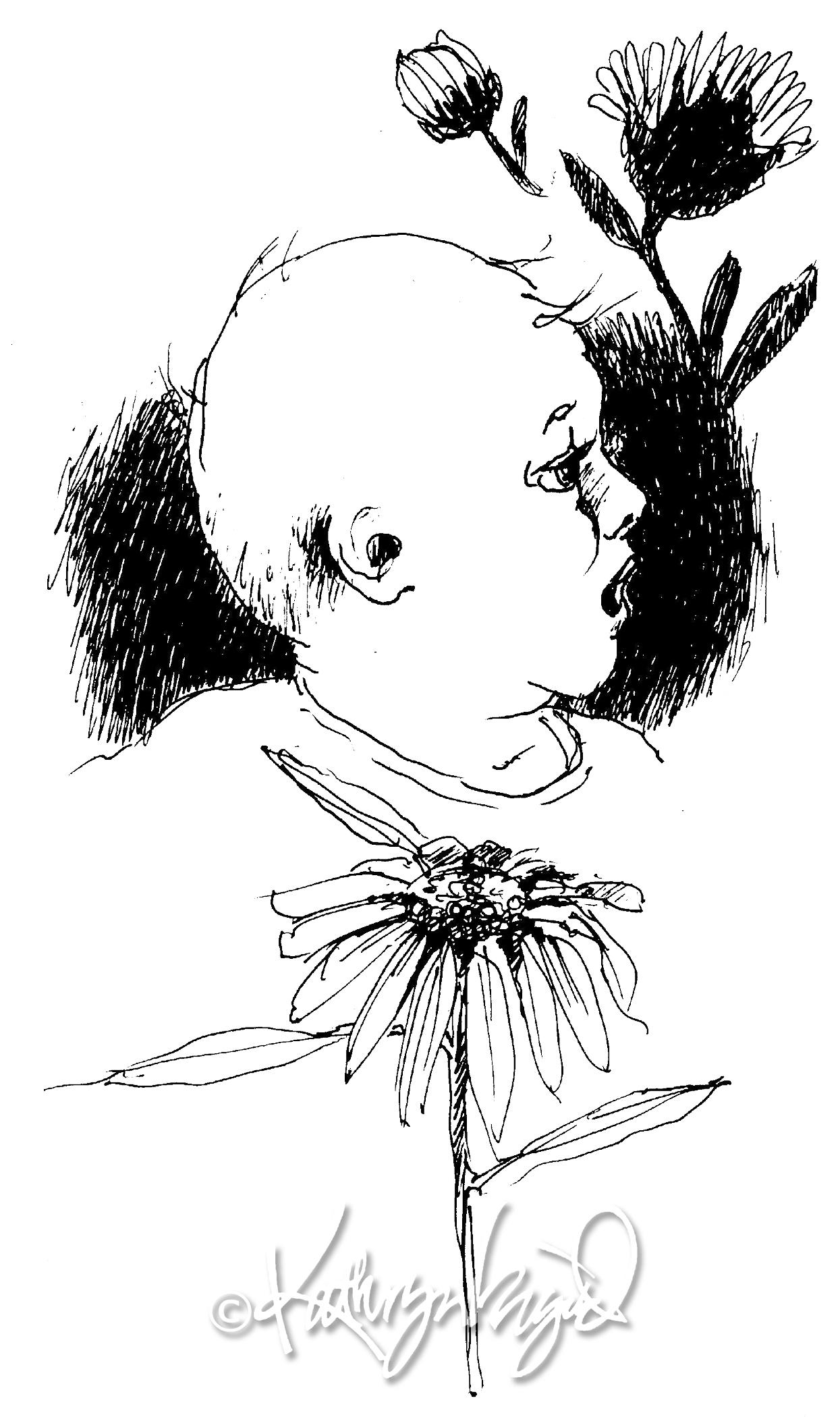
Faces and flowers show up often in my sketchbooks.

line drawing

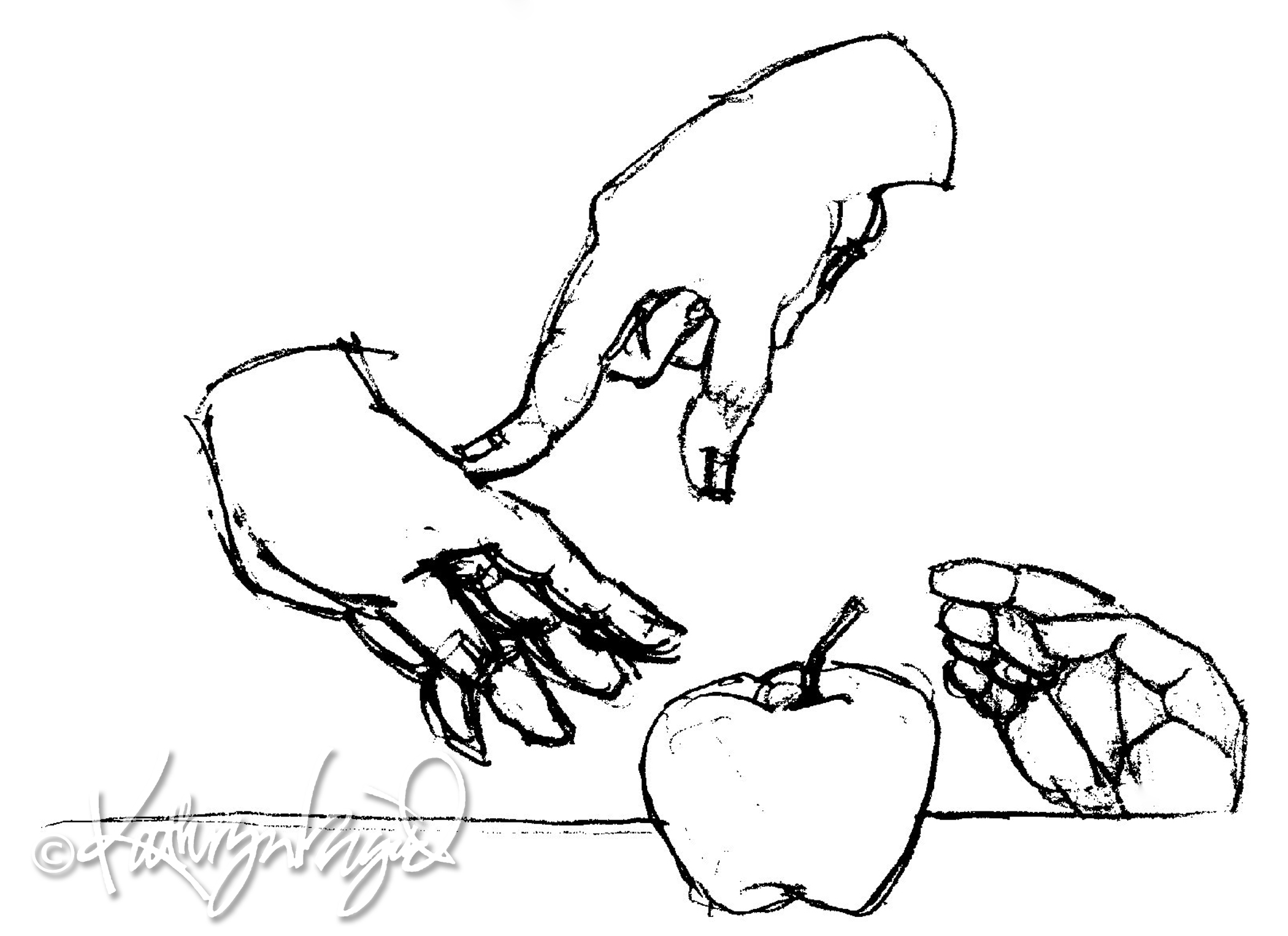
Hands can be pesky subjects, so I play with sketches of them frequently too.

line drawing

Any little vignette that pops into my mind is worth scribbling at least a few times.

Ultimately, whether I’m in gear for serious drawing or just fiddling with a pen or pencil to pass the time, it’s good practice and feels worthwhile. If nothing else happens, at least I have given my brain some thinking-room between the lines and I might figure out what to make for supper, how to cut through the piece of metal that is in the way of my completing a repair in the garage, or who knows–I might even remember where I set down that book I was reading days ago before it ‘disappeared’. It’s doubtful I’ll come up with any Nobel Prize-worthy inspirations while drawing, but then again, if I don’t draw, I’ll never find out!