Through the Cracks

Photo: Gears GrindingI wrote this post a few days back, but stuff like this happens with great frequency in this day and age, I think you’ll agree.

How is it that, in this era of hyper-communication, so little information gets transmitted to the right person at the right time? I’m sitting in the doctor’s waiting room contemplating this, not sure if I’ll get in for a simple annual eye exam that’s a couple of years overdue, because last time I came in this doctor’s office, had supposedly been sent the required referral but it wasn’t in my file. Today, same story. I confirmed my appointment with a person in this office, who assured me that the referral had arrived, over a month ago—yet now it’s “not in my file.”

I got here immediately after listening to my spouse go through an incredibly convoluted and tedious rigamarole on the speaker phone to pay a bill for an account that had long been operating smoothly with automatic payments on the exact same credit card, only to learn that the bank that issued the card (despite owing us on its account at this moment) had refused payment on it. All of the numbers and dates were correct and no reason given for the refusal. So my patient partner had to re-register the very same card for the very same auto-pay system, and because there’s a 30-day wait for such registrations to be confirmed, he also had to make the present payment individually. Even the poor billing department employee walking him through the transaction was so confused by and even embarrassed at the silliness of the mess and how many long pauses on hold it took to unravel it all that he kept trying to make small talk to pass the time before it was resolved.

Meanwhile, at various other points in my quotidian wanderings, I frequently watch bosses make decrees that they would know were impossible to enact or enforce if they only asked the underlings who are expected to perform them. I regularly see parents and children, housemates, siblings, spouses, and others talk at cross (sometimes very cross indeed) purposes, all the while with the deeply held belief that they are offering great wisdom and well-planned solutions, yet never quite hearing each other or considering that the person with whom they should be conversing may have already solved the problem in hand. And I have watched employee-representative committees without number at work when they have neither consulted the employees they supposedly represent for their input, nor told them what is being negotiated, how, why, or with whom.

Anybody else feel like you’re sitting right outside the Cone of Silence from Science Fiction Theater? It’s as though I can see gears turning and mouths moving and messages of obvious importance flying back and forth, but can’t see the text of the communiques, let alone read lips or minds.

I sit and wait. I get agitated and then frustrated. I get so irked and itchy that I have to hunt for clues and try to set things on what I hope will be a clearer and better path. And just when I think I’m getting my pulse back down to a practical pace, the documentation I sent out at yet another company’s request six weeks ago magically disappears into the ether, presumably now sandwiched between the pages of somebody else’s documentation in the middle of their file. I’d ask the company to email or phone me when they locate my materials, but I’m pretty sure that if the message to do so doesn’t also disappear in the meantime, he who took the message will have retired by then and the new guy won’t know what was requested and will pass on the request to yet another trainee, who will in turn bury it in another wrong file for later discovery by a random office cleaner. I’d promise to let you all know how it turns out, but I’ll probably forget, anyhow.

At least I can tell you that after one more phone call today, my doctor’s office did agree to fax the ophthalmologist a repeat of my appointment referral, so I got to visit the eye doctor after all and get my eyeglass prescription updated. Until I get those new lenses, though, I can’t be certain I’ll be able to keep an eye on the prescription slip. So disappears another useful piece of data, drifting through the cracks of the information highway.Photo: Geared Up

The Effects of Gravity

It’s wonderfully simple. Physics. Science. Gravity pulls us down. It’s a force that draws everything to it. Living creatures, all of us on the planet, are pulled toward the dense center of the earth just as we go along through our lives toward the time when we will reach the end, die, and be buried in the earth, drawn at last more fully toward its heart.

But along the way, it’s possible to pull against gravity, too. What happens if we choose to resist for a bit in life? How high can we rise? Any one of us rises to our highest point of all, I’ll be bound, when we choose to raise up someone else. It’s in elevating others that we ourselves are best elevated.Digital illustration: Against Gravity

Going Ahead Blindly

Digital illustration from a photo: Blurred LinesWhat if my eyesight should fail? Could I ever have enough insight to compensate for eyesight? Others do it all the time, both those blind from birth and those who lose their eyesight. I’m visually oriented, if not obsessed. Does that mean that as a visually impaired or blind person I’d be lost? Ruined? Hopeless? Other people manage to navigate a rich, full world without ever seeing it, and to have a deep, powerful sensory life without relying on eyesight.

One of the real questions here is how I live with change. Do I roll with it, or roll over and capitulate? The other underlying query is, from what do I derive my sense of self? Is it dependent on what I can see, and what I can do with it, or does my inner vision determine much more usefully who I am and what I value, and perhaps even what of value I can still bring to the rest of the world? If others have so beautifully managed to see the great and good whether they had functional eyes or not, I like to think—I hope—that I too will successfully adjust and adapt no matter what my life brings. May it be so. May it always be so.Digital illustration from photos: Vegetal Vision

Quieting My Heart

Graphite drawing + text: Needful Quiet


Namaste.

Audience of One

Photo: Plenty of Room for More

Those of us who are artists of any sort are mostly destined for one extreme or another: fame or invisibility. There are a fair number who manage to become something in between, of course, making enough money or garnering enough notoriety with their work to evade complete obscurity, but by virtue of that very existence in between, they too remain generally unknown by the broader world.

I have neither the skills nor the ambition to make myself successful in the business aspects of being an artist, so it’s a virtual lock that I’ll never be rich or famous, let alone both. That means, for me, that to be a success I must focus on working to please an audience of one. Even those who love and support and care about me have no obligation to admire and delight in my artistic output, and they can’t, without a large number of less-connected persons, make me a resounding financial success. My loved ones do seem to like my work, often enough, a fact that defies logic in its own special way, but that still doesn’t make those who adore me, singly or en masse, rich enough to make me rich, even if they sincerely wanted to own passels of my creative output, another reality which would not necessarily represent great intelligence or aesthetic taste on their part, even by my loose standards.

I can and do self-publish, and though that’s clearly an unnecessary and unbusinesslike indulgence, it makes the process of writing and drawing, painting and composing more entertaining for me and less of an invisible feeling enterprise. It doesn’t change the business end of the equation other than endorsing the probability that nobody in his right mind will pay me for things I’m giving away for free anyhow, but it motivates me to do something, anything, more than I might otherwise.

So where does that leave me? Knowing that I am working on my art, first and foremost, to please myself. I am and always will be heartily glad if and when others genuinely share my enjoyment and appreciation of what I consider my share-worthy artistic output. It’s a huge thrill when anyone deigns to spend actual, legitimate, government-recognized currency of virtually any national origin on the purchase of any of that work. But since the latter sort of happenings are rare as hens’ teeth, I will do best to enjoy my sporadic glimpses of small-scale fame when anyone expresses pleasure in my art, and the rest of the time, relish the process of production and any end products of it that I like, all as president, primary cheerleader, and sole permanent member of my own fan club, the way most of us artists are nature-made to be. Is that the sound of one hand clapping I hear, or did somebody just smack me to try to knock some sense into me?

Fugue State in the Studio

It’s not always the case, but sometimes I find that I can lose track of time and self rather thoroughly when I’m deeply engrossed in making art. Writing even a simple email can take ages, if it’s about something or to someone I consider important; an essay or poem can take hours or days, if I get involved and forget where I am. It’s a bit like driving a familiar route; when I’ve been on the same track enough times, I am occasionally startled to realize that I don’t remember passing through the last number of miles, because my brain is so used to noting what is or isn’t as it’s expected and supposed to be that it operates nearly on autopilot, though thankfully if I examine my memory I can indeed recollect noticing real details along that ostensibly missing section of the trip. With making visual images, I can (and sometimes, I think, absolutely should) let go of and turn off my editorial mind for a good period of the work time. If I’ve practiced enough and prepared enough, inwardly, for a session of art-making, letting my attention take a back seat to my instincts and actions before returning to critical mode is at the very least going to produce some worthwhile, thought-provoking, challenging Stuff that will either lead directly to an artwork or, as a bit of not so fabulous yet earnestly glimmering potential, lead to something on the next try.

No matter how that part of the process goes, I’m quite sure that an easy 90% of what I do to make art, whether it’s textual or visual, happens internally and not externally, so it’s no wonder if I wander off at times.Digital illustrations from photos + text: Work Patterns

10 Terrible Words that Shouldn’t Exist in Any Language

Digital text-illustration: 10 Terrible WordsOne person who hates is a Weapon of Mass Destruction. One who cares and shares? Perhaps the only antidote.

As I recently said to my friend Maryam: poverty—both of concrete, material resources like food and shelter, and of intellectual and ephemeral resources (education, spiritual enrichment, the arts, community engagement, etc)—seems to me to be perpetrated and perpetuated more by selfishness than by an actual shortage of any of those resources. The rich and powerful always want more riches and power, and what they do have makes them able to afford and acquire more and to keep their feet firmly on the backs of the have-nots. Plenty is never enough. The resulting imbalance is as old as history, and rotten as ever. Only those who will speak up and resist entrenched inequities and injustices will have any hope of making change.Photo montage: Wolverine & Badger

The badger and the wolverine have a reputation for being among the most tenaciously savage brutes of all the mammals. Yeah, Honey Badger even has his own meme to show for it. But let’s be honest: no beast of earth, air, or sea has a capacity for vile, rapacious cruelty rivaling that of the human animal. Even creatures of the natural enmity of predator and prey compete, fight, kill, and are sated. They have little apparent ideation of hatred and war to match people’s. A wolverine or badger will fight to defend, or to kill for food, but unlike the human, doesn’t seem inclined to attack indiscriminately outside of its primal needs for safety, shelter, and food; when the skirmish is done as efficiently as possible and the need assuaged, the sharpest of tooth and reddest of claw among them doesn’t do an end-zone dance to celebrate its pleasure in winning but will usually depart the scene or go to rest for the next time of need. The remaining food and shelter and other resources stay in place for whatever creature comes next, hunter or hunted, cousin or not.

Can we humans not learn from such a thing? I’m pretty sure that if we destroy each other and ourselves in our constant self-righteous, self-congratulatory belief that we deserve everything we can get our hands on, Honey Badger won’t be the only creature that doesn’t care.

PessimOptimism

Graphite drawing: Self-Inflicted“Prepare for the worst but hope for the best.” It’s part of my credo, I guess, and may well have been aided in its development by doing those hilariously futile duck-and-cover atomic bomb drills of the Cold War era. And the air raid drills—we lived in a Ground Zero area near several military bases, strategic coast, and a handful of Nike missile sites in those days—fire drills, earthquake drills, tsunami drills, and later when we lived in the midwest, tornado drills. You’d think we’d all have grown up incredibly paranoid after such stuff in childhood. But I think that besides being remarkably resilient, kids use logic on such daily puzzles far better than they remember how to do when they hit adulthood and have been taught their prejudices, and are much more easily distracted and blinded by grey areas.

I don’t remember ever believing that crouching under a flimsy little wood-and-steel desk would save me even from the shrapnel of shattering windows and imploding walls in the event of an attack or large-scale disaster, particularly since I imagined the desk itself would become shrapnel along with everything else in the atomizing roar of a bombing. Little and naïve though we were, we had gleaned hints of the enormity of such things from our beginning school studies of the world history of war (skewed to our own culture’s view, of course); no matter how grownups think they’re shielding kids by sanitizing and limiting the information the wee ones are allowed to see and hear, children are quick to notice the blank spaces where redacted information interrupts the flow of facts, and no adult is more curious than a child to hunt for clues as to what was redacted. Frankly, if there really is any use for an institution like the CIA in this day and age when practically anyone can find out practically anything with the aid of easily accessible tools like the internet, cellular phone, and, apparently, privately owned drones, along with all of the more traditional tools of spy-craft, I suggest that the crew best equipped to uncover any facts not in evidence would probably be a band of children all under the age of about twelve.

Meanwhile, we still have large numbers of people who think it prudent to withhold or skew the information passed along to not only kids but even fellow adults, giving out misguided or even malevolent half-truths or remaining stubbornly silent and in full denial about things considered too dark for others’ knowledge. And what do we gain from this? Are there truly adults among us who still think that even smallish tots can’t quickly discern the differences between a fable or fairytale, no matter how brutish and gory it may be, and the dangers and trials of real-world trouble? Does delusion or deception serve any purpose, in the long run, other than to steer us all off course in search of firmer, more reliable realities?

As I just wrote to my dear friend Desi, it seems to me that the majority of humans always assume a fight-or-flight stance in new or unfamiliar circumstances before allowing that these might be mere puzzles to decipher, and more importantly, we assume the obvious solution to be that whatever is most quickly discernible as different from self IS the problem. Therefore, if I’m white, then non-white is the problem; if I’m female, then male. Ad infinitum. And we’re generally not satisfied with identifying differentness as problematic until we define it as threatening or evil. This, of course, only scratches the surface—quite literally, as the moment we get past visible differences we hunt for the non-visible ones like sexual orientation, religious or political beliefs, and so on.

Unless and until we can change this horribly wrongheaded approach on a large scale, we’ll always have these awful problems, from petty playground scuffles right into the middle of the final mushroom cloud. The so-called justice systems of the world are set up and operated by the same flawed humans who make individual judgements, so the cycle is reinforced at all levels. Sometimes it truly makes me wonder how we’ve lasted this long.

Can we learn from kids? The younger the person, the more likely to blurt out the truth, whether it’s welcome or not. The subtleties of subterfuge are mostly wasted on children, who unless they’re engaged in happy storytelling for purposes of amusement and amazement, would rather be actively puzzling out the wonders of life than mucking about in search of evasive answers and duck-and-cover maneuvers. We might gain a great deal by reverting a little to a more innocent and simplistic view of the universe, one that blithely assumes that others are not always out to get us, that direness and doom aren’t lying open-jawed around every blind corner, and that the great powers of the internet and cell phones might just as well bear cheery tidings of goodness and kindness, and drones be removed from deployment as spies and weapons to work instead at delivering birthday presents to friends and packets of food to hungry strangers.

I’m not fooled into thinking any of this is easy to do, any more than any savvy kid would be, but I’m willing to believe it’s possible if more and more of us will commit to such ideals.

Sailing Ahead, Wherever That May Be

The only time I’ve ever been on a sailboat was to sleep. There’s a great Tall Ship converted into a youth hostel in Stockholm where my sister and I bunked for a couple of nights on our college gallivant across western Europe. [Which hostel appears to have been recently renovated, and very nicely, if any of you should be interested.] While there may have been the faintest of motion rocking us to sleep in our on-board berths, I doubt it replicated very accurately the sensation of actual sailing. My next opportunity was during graduate school when I got a fan letter (one of the very few in my life, as you can imagine!) from a stranger who’d liked a gallery art installation I made so much that he offered to take me out sailing to the nearby islands. I don’t think there was anything predatory about him, but besides my still having a grandiose case of social anxiety in those days, there is the fact that the art show in question was entirely a walk-through, life-sized illustration of an espionage thriller; while I am doubtful that was his inspiration, I didn’t take him up on the offer.
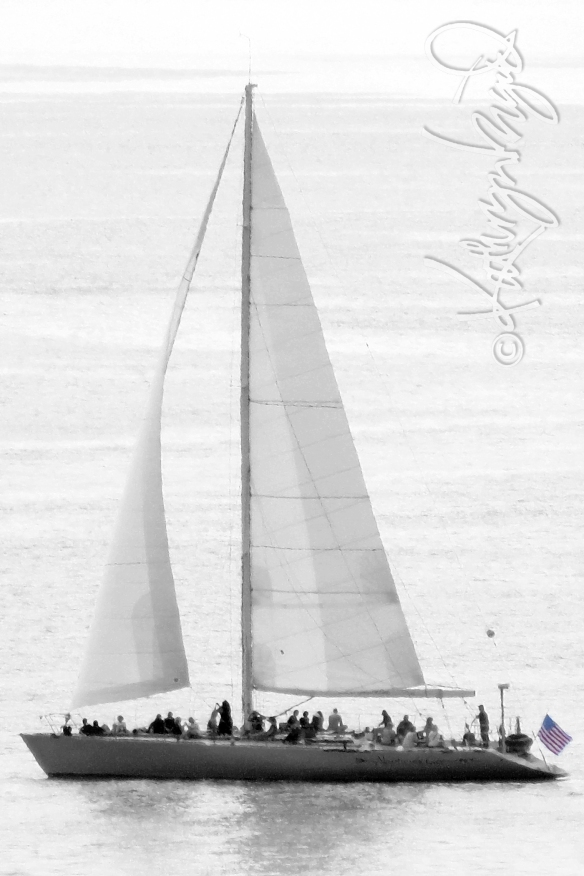
Photo: Adrift on the High Seas

But whenever I see a sailboat, I do think it’s a beautiful representation of a genteel form of freedom that captivates my imagination all the same. Yes, I know plenty of tales of grueling trials on the high seas, no matter the size of the craft; even some of my close friends and relatives have such stories to tell, thankfully, having survived them. And I know, too, the old joke about testing one’s real interest in boat ownership by dressing up in a rain slicker and standing under an ice-cold shower for a couple of hours while flushing hundred-dollar bills down the toilet. But I also know that a vast number of people who could jolly well choose to spend their money and time on less demanding, safer, and far less expensive pastimes still choose boating. There’s clearly a strong pull to counterbalance any such negatives.

I, too, have spent some happy times on boats, just not sailboats. As a coastal kid, after all, I grew up thinking time spent on the ferries was as much pleasure and sightseeing as it was commuting or transport. I have been fairly miserable on a North Sea ferry in stormy seas while I was recovering from the stomach flu, but it did not so permanently scar either my psyche or my stomach lining that I didn’t look forward to the next time I got to be on a slow boat cruising along the shore, or perhaps best of all, in a rowboat or canoe, dipping the oars or paddle in with the rhythmic soft splashing that accompanies my reveries.
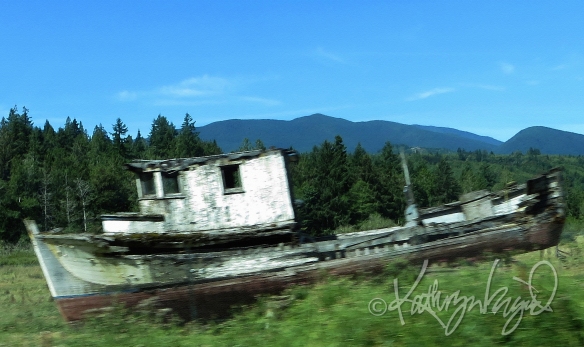
Photo: All Ashore

Living far from any natural body of water as I do these days, I am beached like an old craft whose hull is no longer seaworthy. But like those old boats I see, dry-docked on the beach or alongside the tumbledown barn or in a weedy field, I keep in my soul a firm and loving memory of every good time spent with the waves rocking me softly from below, telling me stories of their own and inviting me forward, ever forward, wherever that might take me.

Crashing through the Snow

Few things are as visibly expressive of joy as a dog bounding excitedly through deep snow. Except, possibly, a whole bunch of dogs, plus a whole cadre of little kids, leaping, tunneling, floundering, grinning, and generally exploding their way through the same drifts.
Digital illustration: Snowflake

The problem with being an adult human is that we become so conscious of our creakiness and increasingly inflexible bodies, so obsessed with the dangers of having an infarction while shoveling or being speared in the forehead by a forty-pound icicle from the eaves, so hung up on our supposed decorum and dignity, that we stop risking not only true dangers but the possibility of gleefully tipping arse-over-teakettle into a billowing heap of powdery snow. It’s really too bad, because an occasional tumble from the pedestals we prop ourselves on, a momentary reminder of our own foolish frailty, and a smart whack on the overly fixed sense of reality is well worth a little bruising on ego and elbow. It might just teach us a renewed appreciation for the beauties of snow and nature. Why, if one were to be exceedingly incautious in the event, it might even turn out to be fun.