Röda tråden (The Red Thread)

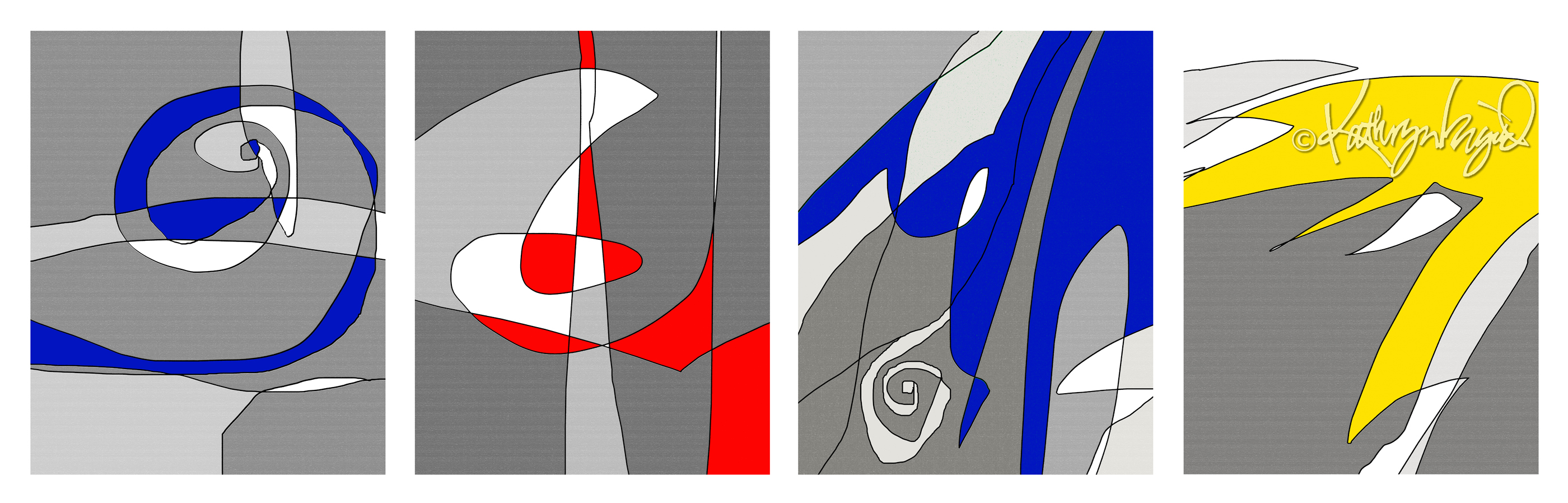
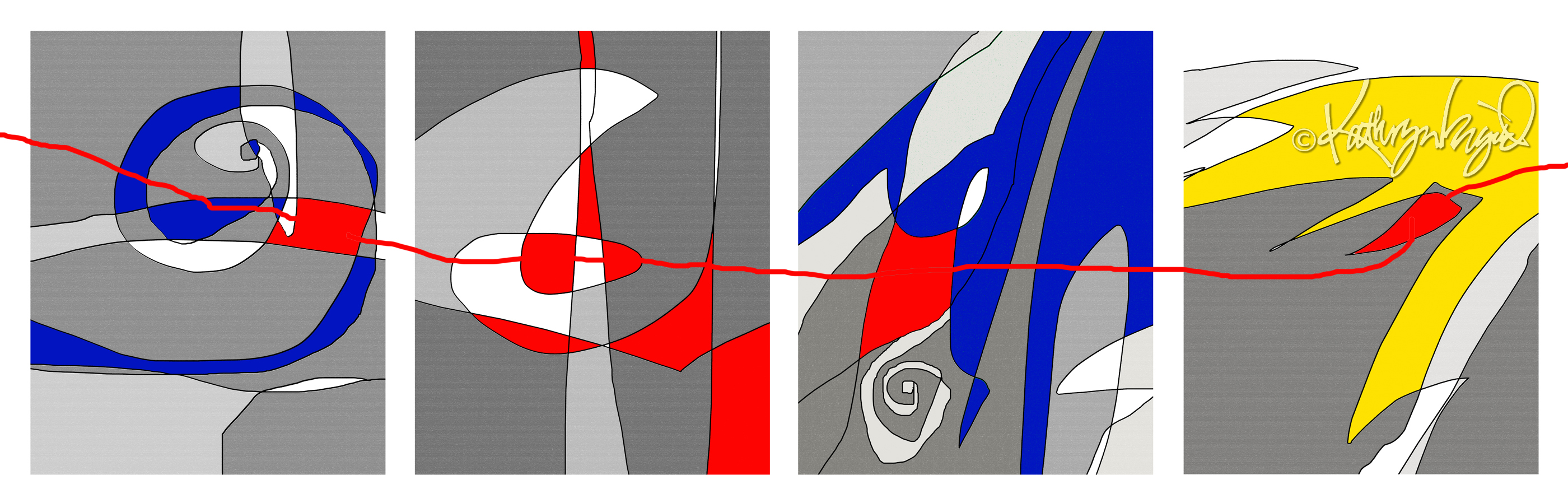
Röda tråden is the Swedish phrase for connectivity. I learned it from my husband, who in turn learned it during his dissertation studies on modern Swedish choral history, and in a way it’s the perfect encapsulation of what his research revealed: that the astonishingly deep and broad influence of such a small country, in such a short time, on such a large field as Western choir singing and music came about primarily because of the remarkable and unique confluence and joining together of a huge number of events, people, ideas and resources in that little land at the end of the Second World War. As unimaginably terrible as war is on any scale, it’s all the more a testament to connectedness that at the end of one of the largest we’ve known, such good and meaningful and positive elements were all drawn into one significant, beautiful growth spurt in the art of singing together.digital illustrationAs a miniature of String Theory in the arts, this surge of the choral art in Sweden is notable (no musical pun intended) not only because it posits a reasonably substantial explanation for the larger choral sector’s modern expansive development amid the general devastation and struggle following the end of WWII, but also because in doing so it illustrates wonderfully how the intertwining of all sorts of seemingly disparate elements such as safe havens from political unrest and postwar reevaluation of norms, personal and professional relationships and experimentation with new media could come into contact and interact to create a new mode of thinking, acting, composing, teaching and singing. In turn, this is a striking model of how people from distinct cultures, educational backgrounds, economic resources and political systems and of widely varying personalities, unified by the one tiny thread of choral music, could be pulled together into a complicated system that, though still colorfully messy and imperfect, led to a potent common end that has had lasting and marvelous influence for long and fruitful decades since.
I am, of course, grateful on a personal level because this Swedish postwar influence on Western choral culture has not only enriched my husband’s professional and artistic endeavors–not to mention was the basis for his award-winning doctoral dissertation that in turn opened a lot of friendly doors to us both in Sweden–but because it produced so much spectacular music and inspiration for so much more.
digital illustration

Röda Tråden is the Swedish version of the idea that–indeed literally–fascinates so many of us: the connecting thread–that which binds one thing to another. I can think of nothing greater than to spend life seeking the Red Thread that shows us our commonalities and binds all people together as well.

Further, though, I am grateful that such an otherwise inexplicable event as the ‘Swedish Choral Miracle‘ seems to me ample proof that all things and people really are connected. And that through recognizing and making good use of those connections, however, odd or tenuous they may appear, there is hope for new and better songs to be sung everywhere.

If I needed further proof of this, last night’s concert gave it amply. My spouse conducted the combined forces of the Chancel Choir of the church where he’s currently interim choirmaster plus their excellent hired pro orchestra in performing Haydn and Dvorak’s two settings of the Te Deum text as the concert opening and closing, respectively, bookending the extraordinarily lovely and moving Missa Brevis of Kodaly. I came in to sit for the concert among strangers and acquaintances from the church and discovered a friend from another parish sitting across the aisle from me, then learned from one of the choir administrators that a friend of hers in attendance turned out to be a long-ago colleague of my husband’s from another state, and finally went up to greet my guy after the concert and found him speaking with a group of ladies in the front row, one of whom was the wife of a former US president. What brought all of us divergent people together in this moment? Music. Beautiful singing and playing. Chance, kismet, divine intervention. Call it what you will, the slender but unbreakable thread that connects us all drew us into one place for a time of basking in the inscrutably beautiful harmony that is beyond craft, beyond art. That is a concert without peer.

To Find Balance: Open the Book to a New Page and Begin Again

digitally edited photoI’m never quite satisfied that I’m getting as much done as I want to do, doing it as well as I wish, improving at the rate I think I ought to manage. I’m hardly a perfectionist, nor am I particularly obsessive (at least about things that I think truly matter)–I’d guess I’m just a fairly typical person who thinks I’m always running just a bit behind the pace and always crossing things too slowly off the To Do lists. But I don’t think that’s grounds for quitting or even for not trying at all.

It just requires that I take a step back and regroup–reassess my priorities–once in a while. Hence my recurrent list-making and all of those times spent sitting and, to all outward appearances, staring off into space, when what I’m really doing is having a long hard look at what’s in front of me that I’d forgotten how to see, or what’s inside that’s not quite getting its message heard clearly enough anymore.

photoFor one thing, my time-management method, if any, is often the old familiar one of doing what appears right in front of me, often leading to that state I’ve mentioned many a time wherein I set out to do one task, get diverted from it partway through by something else that catches my attention, veer off from that toward another thing that drew my eye, and so on ad infinitum but rarely ad finitum. That’s hardly the end of the world, because of course the short and simple tasks that pop up midway do get taken to completion and crossed off the list, and eventually the original plan will recapture my attention. It’s just wonderfully inefficient and sometimes I prefer to reevaluate whether those bigger tasks aren’t better broken down into groups of manageable smaller ones, ones that might perhaps get finished if stumbled upon tangentially in this habitual way.

All of this is a rather sidelong way itself of saying that I haven’t reestablished my drawing habit as firmly and regularly as I’d like, so I’m revisiting my intention to create a specific schedule or plan that encourages me to focus better on drawing, even a little bit, more often again. I know that I will do this; I can do it and have done so before. But I must choose to do it, and how, and that’s the agenda of the day. Other things (like, oh, blogging, f’rinstance) have stolen my attention and intentions away from drawing, and I would like to rebalance my doings a bit.

Needless to say, this has led to a fairly large overhaul of my household Fix-it lists, because I always prefer that there be at least the possibility of my getting those things done that will keep a solid roof over our heads and a comfortable living environment in which to do things like drawing and blogging surrounding us. That list is as big as always, full of everything from essential repairs to the rearrangement of rooms to better reflect and accommodate how we actually use them, to long-range and perhaps highly fantastical proposals for things I might attempt to build, create or accomplish sometime down my long and wayward path of homemaking.

photo of graphite drawing in progressBut there is also this quick-fix remembrance that what I always advocated to my students had better be usable advice for me: To begin drawing again, make a mark. Waiting around for the Inspiration Fairy to appear and bonk me with a magic wand of fully fledged ideas and a baptism of heartwarming motivation makes for delightful internal pictorials, but not an iota of drawing to show for it. The best cure for a staring, empty piece of paper is A Mark. Directionless and indecipherable as any random thing, it may well be, but it’s amazing how very brief the time usually is between seeing a dark scratch on an otherwise pristine piece of paper and my hyperactive editorial mind kicking into gear and critiquing that mark as something that ought to have purpose and attempting to decipher what that purpose is, steering my hand to further scribbling or erasure, and either way, toward something specific and concrete, even if entirely abstract and nonobjective. That’s what’s going to happen, for starters. Where it goes from there, I’ll have to report back to you when it begins.graphite drawing

State of Abstraction

digital image

Foiled again! Or not, if I grab the reins . . .

Yesterday’s post still stands: I am gradually renewing myself in a seasonal fashion of sorts, regaining my typical Spring-like attitudes as I begin what is for me a long and gradual process of Spring Cleaning in home and heart. I never realize I’ve been letting myself get quite so cobwebby until I’m nearly mummified. But I usually recollect my senses eventually, as now, and begin removing all of the crust and crumbs and detritus and down-dragging inhibitors I’ve been collecting over the last while. So, out with the old tinfoil (above) that is best recycled when it’s no longer leak-proof. Out with the burned out porch lights and in with the new (hurray for the companies now making those oddball shapes and sorts in LEDs). Out with my overcast persona and back to my native optimism.

This is not to say that all is perfection and clarity in my little corner of the universe, only that it’s once again slanting toward an upward trajectory as it should be. I also find, in these times of slewing back ’round to my intended direction and sweeping out the junk, that as I begin and jump in, I can get a little confused, overwhelmed or just plain distracted by the plethora of perfectly acceptable but sometimes competing directions I can take or the complexity of attempting to sort and stratify the tasks. But rather than turning into an emotional hoarder and becoming either unwilling and unable to do one single part of the heap of projects and therefore unwilling and unable to begin, let alone attempt the whole–or, worse yet, getting so bogged down in the process that I am entombed in my own attempt–I find it’s reasonably helpful to let my mind wander a bit and pick at bits and pieces. A zone of blurry, abstract thinking is quite all right with me at the moment. It’s the pseudo-zen that allows me to blandly go about picking up a stray button or used cup here and there, set them down as I pass their proper places, and along the route-to-nowhere, discover the manageable task that I can tackle for this few minutes of my time, all the while letting my brain meander until it lights on whatever else it deems necessary for the next bit of progress.

digital image

Slanted and distorted as the point of view may be for the moment, the calm in this unfocused state allows me to safely unbar the windows that had become clogged with cloudy thinking and blocked by barriers of other kinds . . .

So while it may look to anyone else as though an event of Random Nuclear Catastrophe has taken place in the house, I’m actually accomplishing a lot of tiny deeds that had stacked up both on my lists of incipient doings and in unseen corners that evaded such evaluations. I’m pulling out the one straw here or there that opens a peephole through the big haystack that has been surprisingly stealthy in building up, removing one brick of rubble from the demolition that lets a ray of daylight through. And yes, each peephole or ray reveals yet more loose straws and bricks until I feel like a Big Good Wolf about to knock down the piggish house that’s been unnecessarily but inevitably building up in secret, because all of its weaknesses have been revealed bit by bit, button by cup, task by task. All on a sort of hazy autopilot wherein I can let my mind wander, so seemingly relaxed but as it caroms around in slow-motion also more astute than large amounts of frustrated puzzling.

It may look fairly directionless and mildly crazed in mid-process, but strangely it’s quite calming to me and gives me a greater sense of purpose and direction after all. It all begins to take shape, swirling around as it does and gathering speed, and at some point, coalescing into more sensible plans. But until then, I can go along with the current of this abstract flow and while my mind is relatively free from restrictions in it, maybe come up with some surprising new reasons to be content just living in the moment and letting go of my worries.

digital image

The beauty of structure is that it can evolve out of seeming randomness quite naturally--if I let it be so . . .

Order & Disorder

P&IMost of us seek order in our lives, or at least a sense of order. We want to believe that there are things we can assume and expect and even, if we’re really fortunate, control. Yes, those whose lives full of action and unpredictability and chaos would seem to exclude the possibility–extreme sports aficionados, high-powered businesspeople, rodeo clowns, astronauts, oil-rig roughnecks and those raising toddlers–look for order in their own ways so as make sense of their place in the universe. It might be in simple things like organizing the spice cabinet or sock drawer with obsessive neatness; it might be in the form of how they interact with people outside of the job, or it may be entirely internalized because inside is the only place they can see where they can exert their own opinions and desires and beliefs to the fullest extent.

In art, it’s often what differentiates in its subtle ways between the immature and the mature artist or designer or craftsman. It’s expressed as the creation of thoughtful balances or deliberate imbalances that succeed in creating the visual unity or tension in a composition, between colors, textures, distinct subjects and objects, or other elements of the work. While it’s undeniably true when disgruntled viewers look at abstract and non-objective artworks or some kinds of highly quirky contemporary designs and say “My five-year-old could’ve done that”, it’s equally true that the most sophisticated five-year-old will likely only do so by chance, and then only once, whereas the mature artist usually had a purpose, a process by which he was tweaking the tools and techniques to achieve something that might have as little chance of connecting with any individual viewer as that smarty-pants kid’s work but has a thousand times better the chance to succeed in what the artist intended and is, to boot, repeatable. To live on the less visibly ordered side of the equation is to risk losing communication with a potential audience, but for some artists, that is a worthy risk, most especially because the audience they do reach will be the more attuned to their visual language and will respond in kind.

In truth, the most conventional and marketable of artists and designers may have broader appeal, but can be just as off-putting to some viewers and would-be customers as any avant-garde members of the species. Order, as it happens, is in the eye of the beholder at least as much as is attractiveness in art.P&IConsider the Desk. Nearly everybody who owns or works at one creates his own environment there, because it’s somewhat controlled, controllable space. For some, the orderly desk is a perfect puzzle, each single item in a particular position on a particular bit of real estate thereon or therein. Some are always en route to that Ideal but never entirely there. And some have desks that look remarkably like bomb sights. Yet never assume that this is truly disorder. I have known people with desks whose archaeological depths of debris and deconstructivist demolition could easily hide the crown jewels, a body, or a small automobile and yet who, when they wanted a particular piece of paper or the mini-stapler, instantly knew the precise spot from whence it could be excavated. That’s order of a higher order.

What all of this means in the grand scheme of things is that it’s merely a set of constructs or ideals that varies so greatly from person to person and time to time that we’re all probably best served by finding whatever forms work for us individually and then allowing ourselves the flexibility to understand and tolerate others’ sense of order or disorder, whether we approve of it or not. Mostly, it won’t lead to apocalypse–and if it does, who among us will remain to worry about it? Maybe the ones with the monstrous, mountainous desks, if they can duck and cover under them fast enough. More likely, we will all muddle along as we’ve always done, some of us fascinated with baskets and boxes and cubbyholes and patterns and polish and others delighting in their weirdly convoluted and inscrutable tangles of Stuff.

And nobody Wins or Loses–except if you count losing that one danged Thing that you’ve been hunting for in the pile forever and ever (usually until realizing it is in your left hand pocket).