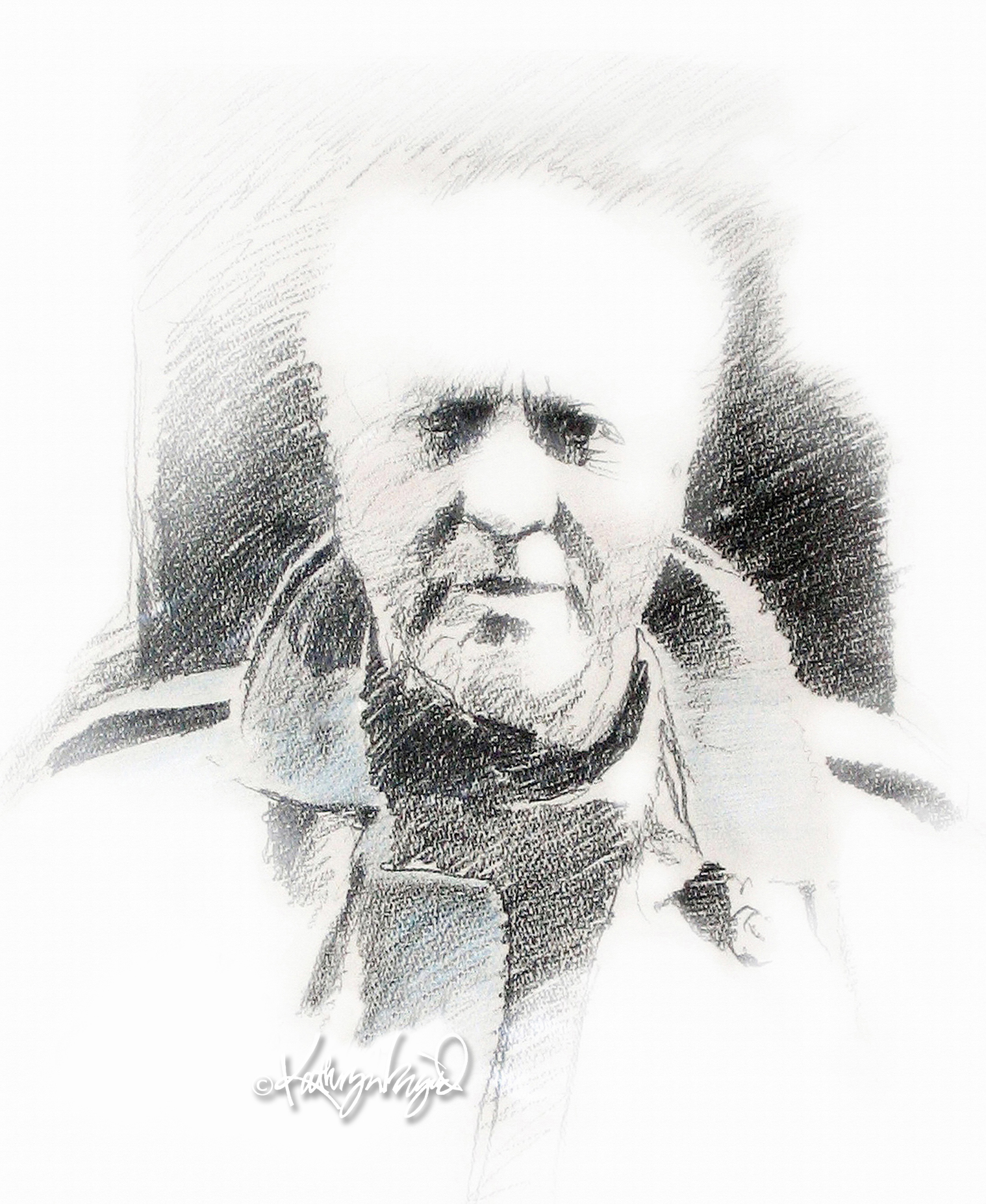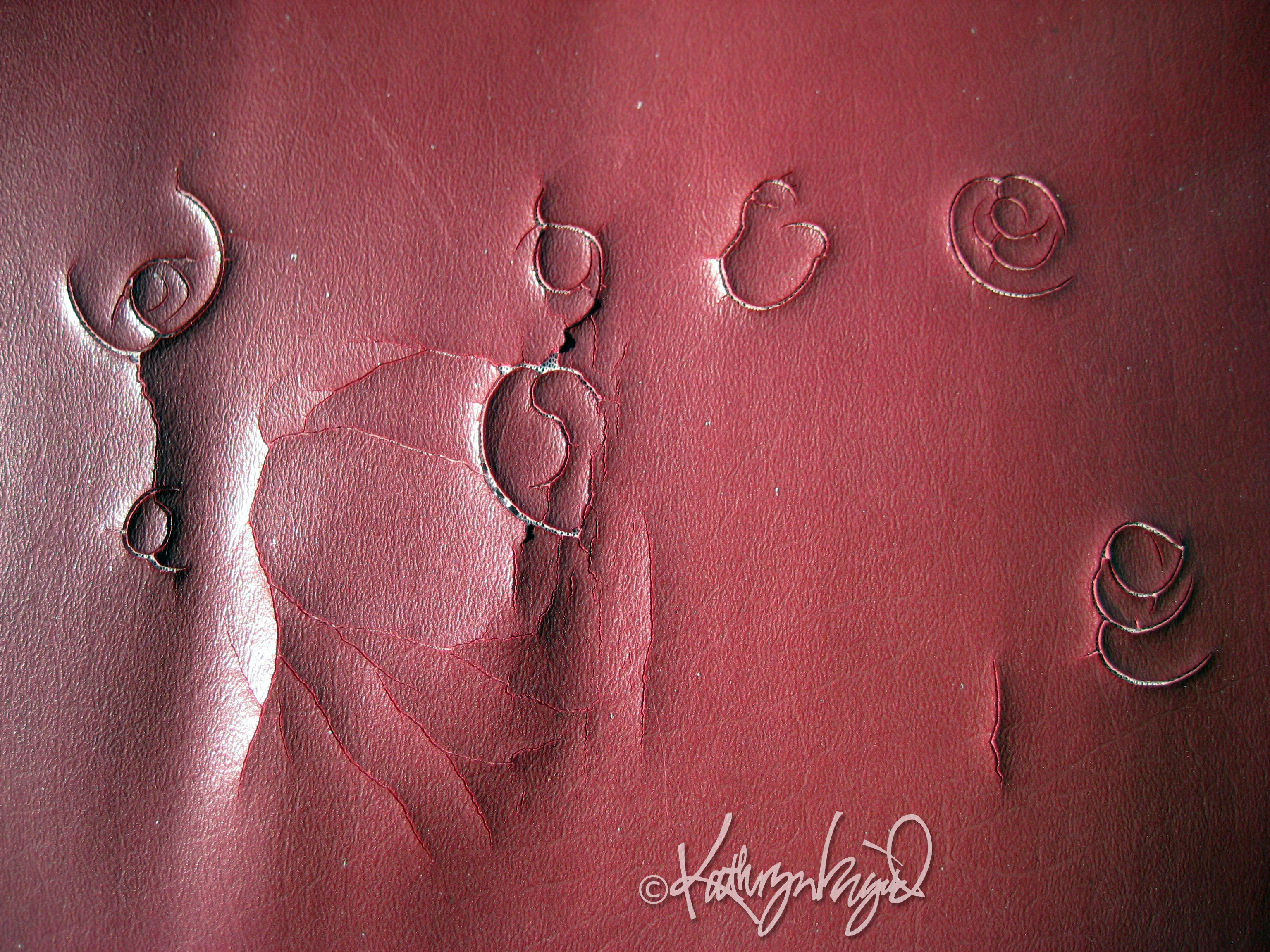
Order & Disorder

P&IMost of us seek order in our lives, or at least a sense of order. We want to believe that there are things we can assume and expect and even, if we’re really fortunate, control. Yes, those whose lives full of action and unpredictability and chaos would seem to exclude the possibility–extreme sports aficionados, high-powered businesspeople, rodeo clowns, astronauts, oil-rig roughnecks and those raising toddlers–look for order in their own ways so as make sense of their place in the universe. It might be in simple things like organizing the spice cabinet or sock drawer with obsessive neatness; it might be in the form of how they interact with people outside of the job, or it may be entirely internalized because inside is the only place they can see where they can exert their own opinions and desires and beliefs to the fullest extent.

In art, it’s often what differentiates in its subtle ways between the immature and the mature artist or designer or craftsman. It’s expressed as the creation of thoughtful balances or deliberate imbalances that succeed in creating the visual unity or tension in a composition, between colors, textures, distinct subjects and objects, or other elements of the work. While it’s undeniably true when disgruntled viewers look at abstract and non-objective artworks or some kinds of highly quirky contemporary designs and say “My five-year-old could’ve done that”, it’s equally true that the most sophisticated five-year-old will likely only do so by chance, and then only once, whereas the mature artist usually had a purpose, a process by which he was tweaking the tools and techniques to achieve something that might have as little chance of connecting with any individual viewer as that smarty-pants kid’s work but has a thousand times better the chance to succeed in what the artist intended and is, to boot, repeatable. To live on the less visibly ordered side of the equation is to risk losing communication with a potential audience, but for some artists, that is a worthy risk, most especially because the audience they do reach will be the more attuned to their visual language and will respond in kind.

In truth, the most conventional and marketable of artists and designers may have broader appeal, but can be just as off-putting to some viewers and would-be customers as any avant-garde members of the species. Order, as it happens, is in the eye of the beholder at least as much as is attractiveness in art.P&IConsider the Desk. Nearly everybody who owns or works at one creates his own environment there, because it’s somewhat controlled, controllable space. For some, the orderly desk is a perfect puzzle, each single item in a particular position on a particular bit of real estate thereon or therein. Some are always en route to that Ideal but never entirely there. And some have desks that look remarkably like bomb sights. Yet never assume that this is truly disorder. I have known people with desks whose archaeological depths of debris and deconstructivist demolition could easily hide the crown jewels, a body, or a small automobile and yet who, when they wanted a particular piece of paper or the mini-stapler, instantly knew the precise spot from whence it could be excavated. That’s order of a higher order.

What all of this means in the grand scheme of things is that it’s merely a set of constructs or ideals that varies so greatly from person to person and time to time that we’re all probably best served by finding whatever forms work for us individually and then allowing ourselves the flexibility to understand and tolerate others’ sense of order or disorder, whether we approve of it or not. Mostly, it won’t lead to apocalypse–and if it does, who among us will remain to worry about it? Maybe the ones with the monstrous, mountainous desks, if they can duck and cover under them fast enough. More likely, we will all muddle along as we’ve always done, some of us fascinated with baskets and boxes and cubbyholes and patterns and polish and others delighting in their weirdly convoluted and inscrutable tangles of Stuff.

And nobody Wins or Loses–except if you count losing that one danged Thing that you’ve been hunting for in the pile forever and ever (usually until realizing it is in your left hand pocket).
Happy Chinese New Year, Y’All!

That’s Texan for 新年快樂 and today is the start of the Year of the Dragon! So in addition to being a big year for my youngest sister thanks to her year of birth, this should be a year of power and prosperity for all, as the dragon is symbolic of not only royalty but is the only truly rare creature in the Chinese zodiac, being supposedly mythical and all. I happen to know where one or two hang out, but then I am kind of special, being a Rat (we Rats won the Emperor’s race between the twelve great creatures, for those of you not in the know).

And why should an old Norsk-descendant-living-in-north-Texas like me care about Dragons and Chinese calendars? Because I find all sorts of cultural treasures from all sorts of rich cultures fascinating, and why wouldn’t anyone. It’s an ecumenical sort of thing with me: most cultures have at many levels interests, beliefs and strengths that are not only worthy of examination but surprisingly held in common by many, if not most, others–simply under different names–and I think it’s tremendously impressive and endlessly intriguing to learn how our seemingly diverse nationalities, languages, customs and faiths ultimately intertwine.

Have you ever looked at a piece of Folk Art and thought that it might come from East Africa somewhere–but then thought that it might equally have come from the hands of Inuit artists or Suomi ones, dwellers in Oceania or Croatia or maybe somewhere in the heart of Syria? It’s amazingly frequent that one comes across such remarkably strong commonalities across cultures and borders that it takes a veritable forensic investigation and examination to determine a thing’s true origins. In many cases we learn along the way that in fact the point of “origin” for a single word, object, or idea as we know it was the end point of a long and winding journey through many cultures and across many borders.

That’s a mighty long-winded way of saying that it’s only natural in my view that I should be happy to learn more about and celebrate other nationalities’ and other people’s most fabulous and fascinating attributes.

The other aspect of my personal interest is simpler, perhaps: some of my Norwegian ancestors lived and worked in China in pre-Communist years and founded a school that is still flourishing under the care of Chinese teachers and administrators. For all that I deplore about the darker sort of “evangelism” practiced by many missionaries under the guise of Christian faith (and perhaps others), this kind of mutual interchange of ideas and contribution of efforts strikes me as among the best in any relationship and one I’m happy to recognize. My mother’s cousin, at the time the Norwegian Ambassador in Beijing, took my visiting aunt to the school a few years ago and they were welcomed like some sort of heroes returning from the mists of time on their arrival merely for being descended from the school’s founders, so I think it safe to say that this was seen as a more positive influence than some.

And finally, my love of things Chinese comes from wonderful friends who either are Chinese by birth or descent themselves or have spent joyful time immersed in China and Chinese culture. One such couple would be my “extra grandparents” the wonderful Talbert and Ella, who had also lived with great happiness for years of missionary work in China. Again, I know both from their deeply gentle and thoughtful natures as surrogate grandparents and from the fact that they were in the first party of Westerners actually invited to return to the Chinese interior after the flowering of détente, that this was a true love for them. The plain yet happy upshot in my middle-American life was that as a young girl I was taught by Talbert how to hold my chopsticks properly, grew up eating genuine and very humble stir-fries in my Norwegian-American home because Ella shared her know-how with Mom (long before Americans ever knew of any Asian foods more authentic than Chop Suey and Egg Foo Yong as defined by westernized restaurants), and I was regaled with tales of a magical kingdom that was surprisingly real.

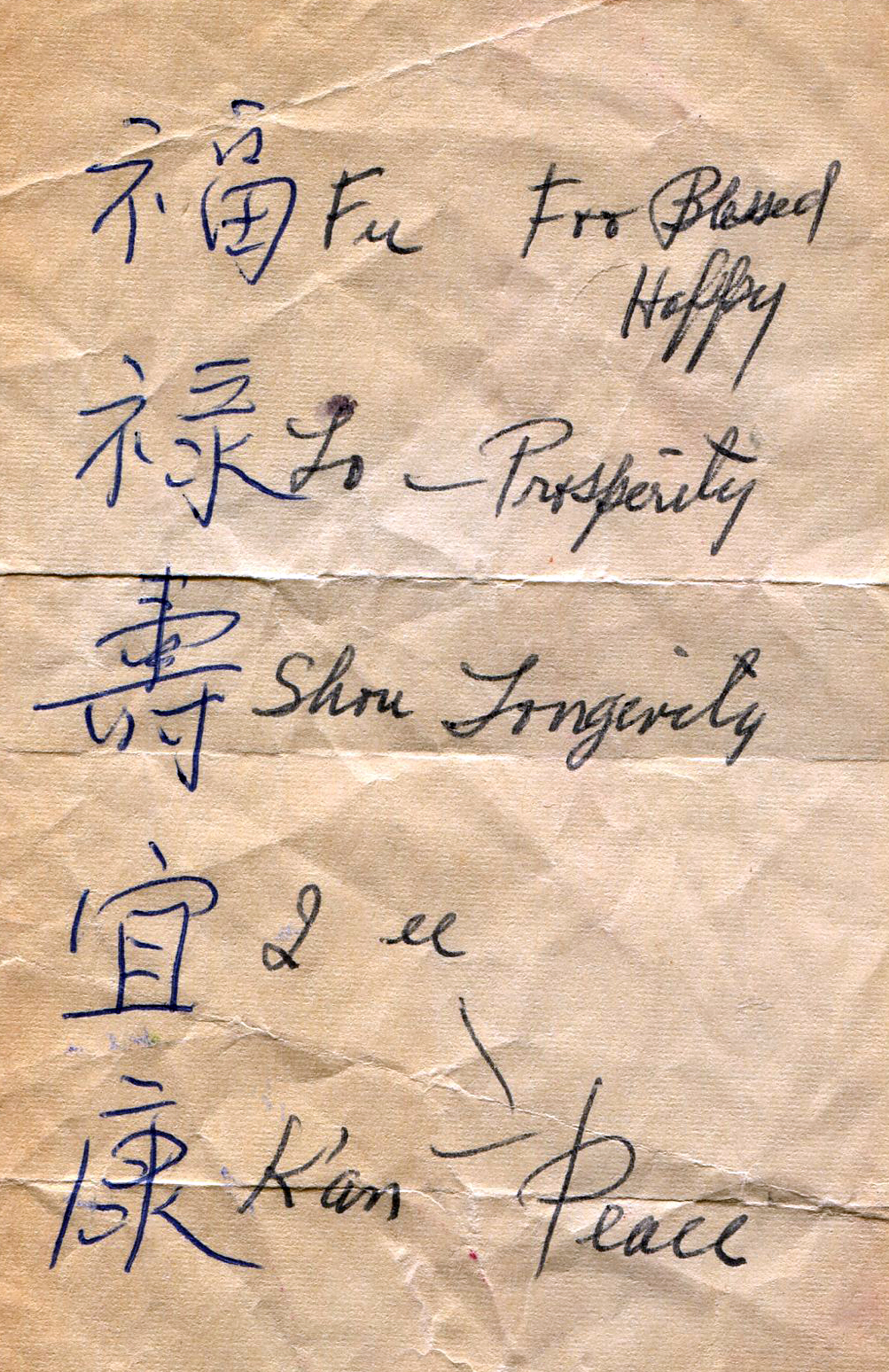
When we lived outside Chicago for a couple of years during that time, a highlight was a dinner Talbert and Ella took us to at a classic hole-in-the-wall Chinese restaurant of the truly authentic sort, where Talbert chattered in Mandarin with the delighted owner and ordered us an unforgettably delicious feast. The owner was so taken with us that when he discovered that our party there was coincidentally on my (11th?) birthday, he came out and very ceremoniously presented me with a whole packet of chopsticks bearing a series of characters meant for good fortune, and even wrote them down. Such was the delight of the occasion that I can still show you that slip of paper. I made a little graphic out of the characters too, and will share that with you as well, as a token of my good wishes to you for this year. And most of all, because China, through its beauties of people’s shining souls, its art, its rich and almost infinitely ancient culture, its fabulous food and its dreamlike diversity has been such a gift to me all of my life, I wish all of you a very Happy Chinese New Year!

documentdigital graphic


Happiness! Prosperity! Longevity! Peace!


And since I know you’re still wondering, yes, I did go and look up the local dragon. It’s not so much that they’re shy, but being both rare and royal, they’re understandably a little bit protective of their privacy. This particular dragon was lounging around with a unicorn friend and just let me have a quick peep, seeing that it’s His Year, so I could report back to you with confidence that it’s going to be a grand one indeed.digital image from a P&I drawing

High Baroque in Low Places

Craftsmanship is not one of my greater strengths. I credit myself so far as to say that I have a pretty good eye for fine craftsmanship. But when it comes to my own work, I’m impatient, short of attention, and lazy enough that I’m always that dilettante rushing through to get the job done and hoping it’s enough to hang together as long as needed. Until the homework is graded; until I can hire a professional to come and do the job properly; until I have escaped notice as the maker of said shabby construct.digital photocollageI have an honest recognition of the limitations of my skills, I think, if it is perhaps slightly magnified by my lack of gumption toward improving them in numerous areas. I could argue that I’m doing my part to support true craftsmen in their arts by not competing with them unduly, but anyone would see through that excuse, I’m afraid. Still, I am awed quite genuinely by the beauty inherent in passionate craftsmanship, whatever the cause. I love the artistry of beautifully handmade or hand-finished objects, whether they are intended as art or meant as humble functional things, everyday items that we might pass over in their daily use but for the marvels of their refinement and Fit.photoI’ve long been equally taken with the ridiculousness of both badly designed and foolishly impractical objects that were intended to be functional. Perhaps it’s the extreme contrast they have with fine craftsmanship. It’s silly enough to make something that by virtue of its careless design does not or cannot accomplish that for which it was meant, but often that very malfunction is trumpeted by the sheer ugliness or oddity of the object: one can see by simply looking at it that it won’t work or will be seriously flawed. It takes no time or effort to amass quite the collection of weirdly inept designs, from Patent applications right on up to the failed products remaindered and forlornly dusty on store shelves, and one can be endlessly entertained by the verbal autopsy of such strange husks from top to bottom–gadgets and gizmos meant to do so many unrelated tasks that they were too obviously cumbersome and ill-integrated to accomplish a single one of them. And dressed up in badly applied finishes of bizarre colors probably in hopes of distracting the customer from all other evident failings, but only drawing attention to the inherent cheapness and outlandish impossibility of their ever working as promised.

But there are so many things of the opposite sort that I think it’s too easy for us to gloss over what’s right in front of us or under our very fingertips as beautifully conceived and crafted objects worthy of our admiration for both a thing and its maker. Yes, it’s natural to admire the loveliness of the bow made for a Baroque Violin or the delicate carving on a lute, for a painting or sculpture or print made with evident and painstaking care. But it ought to be equally impressive to any of us when we pick up a dinner fork that is perfectly weighted and fits smoothly in the hand, to eat a marvelously tasty meal that has been made with such loving attention that the addition or removal of any tiny thing would be superfluous to its elegance–even if that meal is a profoundly rustic stew.

When we sit in a chair, do we notice not only how pretty, how well suited it is to the general character of the room, but also how the height of the arms supports our elbows just so and the curve of its upholstered back is designed to magically adjust to the lumbar spine of each individual sitter? Do we ask ourselves, Who made those helicopter blade fittings so exquisitely that after sixty years the contraption not only still flies the way it was made to fly but is a supremely wonderful geometric confluence of sweetly fitted parts, a sculpture of its kind, as well? Do we remember to look at the window sashes on that old house and be moved by how the intensely focused care of their making has enabled those ancient wooden single-pane mullioned windows to keep the home’s dwellers snug through 150 winters and summers?digital photocollageI hope that I, for one–as poorly equipped as I am myself to create that kind of grandeur in simple things, and too impatient to strive for better as often as I should–will always take the time at least to pay homage to the real craftsmen and women among us. To notice the attention to detail and graceful touch that they have applied to rebuilding stone porches, stitching a brocaded lining for a coat, painting a portrait of an old woman because her lined face is marked with history and pain and beauty and not because she is famous or has the money to pay for a portrait. To say Thank You to those who have made something fine and elegant and Right simply because it was what they were compelled to do.

Thoughtless Thursday

Since a number of Web Wanderers post wonderful Wordless Wednesday items, and I’m always behind the times in oh-so-many ways, I’m posting my own version a day late (and undoubtedly a dollar short), giving you here a highly abbreviated visual history of my life as an artist. Since I’m only middle-aged, I let it end at the Middle Ages for now, though you’ll notice from some of the costumes in the last frame that I’m looking for a Renaissance to appear fairly soon. Can’t hurt to hope, can it?

P&I

I was no prodigy, and I certainly took an early interest in shortcuts and easy techniques when it came to making images, but I did always have an eye for a good juicy and dramatic storyline . . . P&IAs I grew more seriously interested in art, I was also reaching an age where one wants to Fit In, so I did my part of stylizing my imagery and making it seem, I thought, more palatable to the critics (teachers, relatives) . . .P&IThen, of course, there was that awkward age when I started to think for myself, to develop my own philosophy of what my art should or could be, and what I wanted it to be. Presumably, the reason I lost my reason entirely. You just can’t make your own art without giving up at least a little of your already tenuous hold on reality . . .P&I. . . and here you find me, wandering from village to village in the vast land of Internet, telling my tales and making my pictures without much regard for the safety and comfort of those around me, but perhaps in that most of all being at last quite true to myself, the mildly crazed artist in your midst . . .

Tools and Techniques, Ingredients and Inspirations

ink drawingSometimes the best way to get started with something new is to jump into something old and rethink it. Writing letters–really, reeeeeeally long and extravagantly detailed letters–to my friends and loved ones was a favored pastime for me in my youth, and only transmuted (rather than muted) over time. It’s not necessarily that I had so much to say, nor that it was terribly original, it was simply a pleasant way to keep my sense of the connection between us open and flowing freely. It was Relationship Anticoagulant for me, in its way. Most particularly because I happened to have friends and loved ones who indulged me by writing letters back in my direction.

Yes, the telephone had already been invented when I was young. (I heard that!) My letters weren’t even delivered by Pony Express, let alone chiseled on stone tablets, though those would’ve made nice doorstops, once read. But as I have never liked telephone chitchat overmuch and have always had a slight tendency toward commentary that could perhaps stand a little more editorial restraint, and most of all because I am so defined by my visual experiences, a written, tangible and yes, correctable medium like a letter suited my personality more.

I think it was at least partly that that led to my downhill slide into essays, poems, short stories and the various other Dark Magicks of creative writing. Maybe I thought that developing my fictional skills would make my long letters more entertaining and excuse their verbosity. But of course, when the mystical world of the internet appeared before me, it was inevitable that I should embrace its friendliness towards the mass production of verbiage and the speedy transport thereof unto all and sundry. “All” being my actual known connexions and “sundry” being anybody else who was incidentally caught in the overspray. The latter being people who, if they foolishly responded to my wildly flung words, were likely to get sucked right into the vast vacuum of joining my poor captive audience if I could manage it at all.

ink drawingWhen I figured out how to put visual images along with all of the wordy wonders, then Boy Howdy, I was off on a new tangent. And you’ve all seen just how tangential I can become. Why, just the other day . . . oh, see, there I go again. The additional enhancement of putting pictures with stories need not be examined here. You and I know that the telling of a tale not only frequently requires images for completeness and clarity but sometimes is enhanced and enriched by the presence of visual cues that lead the reader to start thinking about the stories tangentially as well.

I was of course drawn* in immediately by artists’, photographers’, designers’ and other visually rich websites and blogs (*this pun’s for you, yearstricken). Then I felt the magnetic, hypnotic pull of foodie blogs, with their perniciously gorgeous food photography. Glorious gardens and magnificent architectural edifices reached out of the ether to grasp at my ankles as I passed. Tripping, I dropped into the well of travelogues and vehicle- and furniture-restoration sites and aaaaaaaaaaaaaaahhhhhhh! It was the beginning of the end for this visually obsessed fool. Pretty soon I was swapping recipes and anecdotes, recitations and antidotes with all of my new Old Friends. I almost made a Freudian typo there and wrote Fiends, because of course I have been enchanted and enslaved by you all and am now helplessly in thrall, thirsting after the goodies you dangle in front of me on your every post until I succumb and retaliate with posts of my own.

ink drawing

So here we all are, the relatively new digital tools in hand, cooking up marvelous messes of every sort and, far from being penitent, diving ever deeper into the strange and cheerfully dangerous tangles of what we are collectively wreaking upon the unsuspecting of the world. What began as relatively innocent missives to sisters and schoolmates, great aunts and great mentors has evolved into a different sort of Post that explodes with the weird and whimsical, the frightening or florid or sometimes just plain fishy, and whether factual or fictional, wanders the globe and the magnificent bubble of nonsense surrounding it, and the old urge to write a letter is made new again.

Now, I’ll readily admit that it’s every bit as possible to create fodder for the dustbin as it was all those centuries ago when I began writing my small-world tall tales and detailing them with quaint and creaky little scratches of “art”, and I’m quite certain that there’s no more sense and treasure sneaking in the hidden corners of my productions than there ever was. But I do find that the wider range of correspondents who really do have something to say in return, and the pleasures of the process of learning and using new and different tools for the conversation, immensely entertaining, energizing and inspiring. And I’d say that’s a paint pot of a different color.

ink drawing

Pretty Bird!

It was a simple little painting, nice if nothing especially original or fantastically crafted or anything startling like that, but I liked what I saw. It was of a slightly stylized, funny little semi-abstract bird, one of those paintings that always run the risk of being too cute and cuddly and charming for its own good, with a few little bitty splashes of the leftover paint sprinkled about the canvas almost as an afterthought, maybe meant to evoke flowers or stars. Not much to move me or even catch my attention . . . except . . .

mixed media on campus

No, this is not the painting. Not even part of it. I couldn't photograph someone else's artwork (this is mine, as always) and stick it in my blog even if I wanted to do so, because that would be (a) copyright infringement and (b) as ill-mannered as flying over someone and . . . well, you'll see . . .

I liked what I saw because that last little splash, those sprinkly spots–why, they landed smack in the empty space right beneath the birdie’s tail. All of a sudden a foofy little bird that seemed to have been meant to act all pert and prim . . . had pooped. In an eyeblink it went straight from being a prissy little pretty-bird vacant of all meaning to become a faintly twerpish chirper, a vaguely immature and irresponsible and a much, oh ever so much, more real and kindred-spirit creature. “I strafe upon you all!” it cheeped, but all the while with the same blandly friendly expression, almost as if it were a passive-aggressive scalawag of a bird just barely behind that pastel-feathered façade.

So much more understandable and filled with story-time potential, this impertinent little fellow. It’s not that I want to be that bronze-cast personage of the park whereon the pigeons land to ‘take their ease’–life offers plenty of opportunities for humans to feel they’re treated like inanimate objects or public restrooms as it is–it’s just that part of me is pleased that a little cutesy-bird was allowed to go his own way just for the element of surprise, that some painter I might’ve dismissed as boringly sugared-up with too-sweet birds decided, literally, to ‘let this one go’.

Even better to my mind, I’m afraid, is if that same artist never even noticed the obvious implication of that splotch’s placement and so sent out, for show and sale, a scamp of a bird that flicked its tail with devious disdain and dropped its pretty pastel bombs upon the painter’s cozy dainty reputation right along with all the passing world. I couldn’t help myself: I liked what I saw.mixed media on canvasNo, obviously this is not the painting in question either. In the interest of full disclosure, however, I will tell you that my original mixed media painting shown digitally here was titled ‘Ruach‘, a nice juicy Hebrew name meant to evoke the eponymous Holy Spirit. Which, being represented in the narratives generally by a much nicer (if not necessarily politer) sort of bird, would presumably drop kindlier sorts of things upon one in passing. I would hope. And hey, that just makes the earthly, earthy mischievousness of the bird in the other painting that much more amusingly charming by contrast. If you share my childish kind of humor, anyway.

Improvisation Leads to Reverie

photoThought Becomes Deed

Improvisations in the gold-lit nave, where I sat as of old,

Among the candle flames and greens, the paraments and carven screens

And incense-laden night, these scenes of ceremony were the means

Offsetting those surprising, bold improvisations that you told

The sanctuary’s lofty lair, and all of us who huddled there

So mesmerized by new-made tunes, to which our souls were not immune,

Since you were writing down the runes

–as you have done these many moons–

You marked this newness down with care, though improvised out of the air;

digital illustrationI bent to listen to the way that old pipe-organ seemed to say

Something, in whispers, of a time–long past, I thought–in which sublime

Rhythms and patterns like your chiming play of Tierce en Taille, were, I’m

Quite sure, shaped as a different lay, wherein another love did play,

A love now gone to other stations of the Cross than these relations,

Playing something sweet and deep across the borderlands of sleep,

Across your grand recital; sweeping through the memories I keep:

Those evening organ-conflagrations, candlelit improvisations.

photo

Give Me Your Talent and Nobody Gets Hurt!

digitally doctored graphite drawingWhy buy the cow when you’re gettin’ the milk for free? As crass as the expression is, it describes pretty neatly something more dangerously pervasive than ‘easy virtue’: artists‘ consistent problem of being undervalued and, subsequently, of undervaluing themselves. Those who take their creative work seriously are often not taken seriously themselves and their output is treated with the disrespect of being assumed effortless and frivolous.

Interesting, isn’t it, that people will loudly praise and admire successful self-made business owners and talented self-taught tradesmen and not generally assume, on the basis of this entrepreneurial zeal and autodidactic achievement, that those folk will unhesitatingly hand over their goods and services for free. But if the successes in question happen to be in the realm of, say, storytelling (via song, dance, picture or book) or the production of beauty for abstract philosophical purposes–these same admirers have no qualms about asking the artists for freebies on a regular basis, whether supposedly justified by a Good Cause or simply out of egregious ignorance of what it takes to produce these great stories and experiences.

I’m quite willing to explain to well-meaning people why it took me multitudinous years of steady study and practice to get to that level where I can “effortlessly” produce a fairly refined poem or drawing or essay in a couple of hours, never mind all of the expensive materials and grueling hours I’ve gone through en route to that one ‘keeper’. Yes, I’m that version of the proverbial “overnight success”. In this I am not so far different from the electrician that ordinary folk, however grudgingly, know they must pay because otherwise they will either wire their home just sufficiently to electrocute themselves, or to get sued by someone else who does. And then they can pay a $600-an-hour lawyer to assist them in their defense. No, my work is scarcely life-and-death. I am not going to offer anyone cranial surgery–nor am I charging anything like the going rate for that–though perhaps I have occasionally considered doing a free midnight trepanning on people who insisted on demeaning my work, and me through it.

Ultimately, though the personalities most typically drawn to creative fields of work are rarely equally skilled at and fond of marketing, self-promotion and business administration (and are often expressing themselves through creative outlets specifically because other forms of interaction and production are less pleasing and natural to them) it is up to them–us–to defend the arts. To tell the rest of the world that these antique yet constantly expanding and changing forms of communication, documentation, and explication are not merely decorative, though that would be enough, but shape our entire social fabric, our history and our sense of ourselves as humans. They express our cultural sameness and differences. They allow us to imagine and design and build new things that in turn can move all of humankind toward greater health, wealth, safety and comfort. Who do people think invents and designs their shelters, their transportation, their tools, their clothing? Who challenges us at every turn to uncover our darkest failings and to discover our better selves? There may be no other broad area of endeavor or lens through which we see our lives that covers so much needful, practical ground, quite contrary to the typical ‘outside’ view of the arts.

I’ve heard so many sob stories about how much people admire my work but can’t possibly afford it–all of them undoubtedly true enough–from the very people who ought to have a fairly good reason to recognize my equally impecunious state (not least, with my being an artist married to another artist and all) but who plow right ahead without batting an eye at asking me to donate my artworks to their organization’s fundraiser, my graphic skills [Ed: not many non-artists seem to understand the separation between various media and techniques, let alone when complicated by and applied through technology] for their brochure or book, my photographic services to document their special event, and on and on. I know all other artists get this same petitioning constantly.

And we acquiesce. Because the causes are great. Because we love and/or are related to the petitioners. Because we love what we do and we were going to do it anyway and somebody with money might see it and commission us for a serious work or offer to represent us in their gallery or decide to publish our book. For all the right reasons, we give in, over and over, and kick ourselves in the morning when we get up with generosity-hangover. Especially after the third person in line yesterday got our extra-special condescending explanation of Why we wouldn’t give it away for free ever again, even though she was standing right behind petitioners one and two who did get something, and we actually like her better than both of them put together and now we just know we are the biggest creep in the whole wide world and should be burned at the stake.

And here I am telling you to stand firm for the cause. Scurrilous scold that I am! No, do what you must, of course, and more importantly, what you want to do, and not what I tell you to do. Always keeping in mind that the reason you’re asked for these benevolences is because you are good at what you do, and because the persons asking can’t do it themselves but really do want it, and because if it has that much value, why then, you should jolly well be comfortable in expecting them to treat it as valuable and pay accordingly. And I apologize in advance for what a rat it may make you feel you are. Until you finally get a little much-deserved pay and can feed your family, your art, and the causes of your choice.

And for any non-artists out there who might have accidentally read this rant: consider giving a truly welcome and desirable gift that, emotionally at least, really does Keep on Giving: pay for some art. Buy a full-price ticket to a concert or the hard-backed version of a book; pay the asking price for an original painting or a hand-crafted piece of furniture; solicit donations for a fundraiser for the local Art Guild or Poetry Society or Contemporary Dance Theatre instead of soliciting from its membership for someone else’s fundraiser. Give a child a box of crayons and a tablet of paper without any expectation that she must make a picture to pay you for it. Teach a teenager to get music out of an oboe as skillfully as he gets it out of his MP3. They will all be eternally grateful. They will start to make a living and perhaps be able to afford your rates for roof repair, for legal advice, or for Great-Auntie’s home medical visitations. And you, you will thank yourself for enriching the world in so many ways.graphite and colored pencil on paper

“Mama, Where Do Baby Ideas Come From?”

graphite and colored pencil on paper

Ingvar Lidholm

Well, Honey, when a mommy artist and a daddy medium love each other very much . . . .

I can’t imagine that there is an artist or creative person alive who hasn’t been asked many and many a time where he gets his ideas or what inspired her to make this piece of artwork, write that song, take whatever photograph or choreograph any given ballet. In many cases, the answers are hard to condense into sound-bite-sized, manageable pieces for the occasion, because much creative endeavor is the tangible end result of a whole lifetime’s experience and train of thought, and we all know how often and how easily that particular train gets rerouted, redirected, diverted and derailed along the way.

But in general, most of us can point to pivotal moments that shaped our thinking, whether on an individual project or about our artistry as a whole. We can cite particular persons and their artistry that inspired and enlightened us and informed our own work as we grew. And for many of us, even we who are relatively late bloomers, a lot of the fodder for this inspiration begins early in life and creeps up on us subliminally to a certain extent.

I’ve already mentioned my long-ago irritation at being ‘bundled’ with Edvard Munch because of my Norwegian roots–and, of course, how ridiculous I realized that irritation was once I discovered that contrary to my belief, the more I got to know his work the more I actually admired it. Now, naturally, I take it as high praise (if perhaps hyperbolically so, though I’m happy to take it anyway) when my stuff is seen as meriting any such comparison.

My personal Style, if there is one, is defined more by a tendency toward slightly aggressive lines and bold coloration and faintly eccentric leanings when it comes to subject treatment than by any distinctive media, techniques or actual subjects. My affections in art are too fickle and my attentions too fleeting for me to be easily contented with any defined set of materials and topics and applications. But I find ideas and encouragement and guidance in the work of many painters, poets, draftsmen, printmakers, essayists, storytellers, architects, boat-builders, jewelers, botanists, lycanthropes . . . dear me, have I wandered again?

Part of the trick in pinning down who has been an influence on my work and where I’ve gotten my inspirations and ideas is that I’m very much a holistic, integrative and analogous operator, so in true Liberal Arts fashion I pull my many threads together from many divergent and possibly unrelated sources. The only consistent thing is that I try very hard to steal from the best.

My gifts are not musical, but I love music. So although my piano skills are fit only for personal amusement and my singing limited by spasmodic dysphonia and lack of practice to in-car singalongs and serenading my spouse with occasional outbursts of bent versions of formerly-familiar songs, I often work with music as my inspiring accompaniment. My paintings could be said to derive more from Aretha Franklin or Felix Mendelssohn, The Real Group or Tomás Luis de Victoria, than from Munch or Vincent van Gogh, though both of the latter have lent me many of my ideas about brushwork and coloration. My writing is more directly writing-derived, perhaps, but all of the favorite writers that spring to mind (Ogden Nash, Vladimir Nabokov, Dr Seuss, JRR Tolkien, S.J. Perelman, Gabriel Garcia Marquez, Tomie dePaola, Geoffrey Chaucer) are on my hit list because of the lyrical, even musical, qualities with which they treat poetry and prose. I love children’s books as much now as I did when an actual child, because the best of them of course comprise a perfect and literal confluence of verbal and visual imagery, something that becomes more deeply ingrained in me by virtue of drawing the senses together. And in that way, my writing is often led to incorporate certain textures and moods and colors or to carry a particular ambience by either pictures (real or imagined) or simply the weight of a visual experience I’m hoping to evoke with words. I’m no synesthete, but all the same I do depend on the interaction of all my senses to shape each of the creative works I’m developing.

I did once make an entire exhibition devoted to portraits of people (mostly historical figures) who had had influence of some significant sort on my art and my creative life, and perhaps the most telling thing about the gallery besides that I had deliberately filled it with nothing but portraits (a form I’d studiously avoided all along in my artistic journey until then) was that very few of them were of visual artists. Most were of composers, singers, and writers. A few were agents of social change, a couple were people I actually know, and a handful were influential in the philosophical or spiritual realms. The writers and musicians ruled the room. I doubt that would change hugely if I were to do such a survey of inspirational influences again. I do know that there would be a new character added, but I’m not certain how exactly I could represent in a portrait my network of online muses in blogdom.

acrylic and graphite on canvasboard

Igor Stravinsky

Cave Painting for Dummies

photo

Who was it that first looked at a rock and thought, "Now *that'd* make a great TOOL"?

I’m fascinated by pioneers, inventors and explorers. Such minds are truly alien to me; how is it possible for a person to look at the same world that every other person has been looking at for ages and see something entirely different, something new? It’s nothing short of astounding that, when presented with what might be the deeply familiar, one person’s distinctive set of synapses suddenly makes a new constellation from the assorted bits of seen-before information to create a completely new idea–and out of this there is a new object or a new skill or a newly discovered country, in that one event changing the known world into a whole different thing.

I’m quite excited but not intimidated by doing that sort of inventive stuff artistically–in imaginary terms–but it’s quite another thing to consider pulling that sort of stunt to get a practical outcome. Those people able to envision a useful and purposeful way to take advantage of existing stuff have provided innumerable advances for human culture. I’m especially amazed by the intrepid andcourageous (or foolhardy) folk that break trail, build roads, cross unknown oceans and so much more, to open up new concepts and ideas to shift our entire understanding of our universe.

photo

Who stacked the stones that made the very first wall? The first road between walled places? The first trek that plotted the course of the road?

What gives me courage is that not only are there stronger and braver souls than li’l ol’ me to do all of the serious exploring and adventuring and discovery, but that somewhere along the line someone had the inspiration to make melodious sounds and so, sang. Made a drum from a log. Painted with blood or powder or crushed plants on a cliff side or a cave wall. It’s a wonder and a grandly glorious gift that these superlative scientists-of-delight chose–or were compelled–to create dance and drama and song and pictorial beauty, and the more so because they decided, somewhere along the line, to pass along their newly discovered links to yet more undiscovered worlds. They taught the next generation to do the same. On the strength of this wonder, we are the long-time beneficiaries of these marvels, and as it happens, the torch-bearers by whom this will be carried into the future.

So I’m not the heroine who’ll be discovering an unknown species of beneficial insect, finding the previously unseen river, designing the DNA modification that cures Alzheimer’s, or changing the course of history in any way, shape or form. But I will be using shape and form, along with color and texture, character and text, to see what I can bring to this world as we know it, to see how a measly twerp with less sophistication than your average cave-dweller might be able to be an inventor and discoverer of my own sort of thing.

photo

. . . and I'll keep my eyes open for inspirations wherever they may be . . .