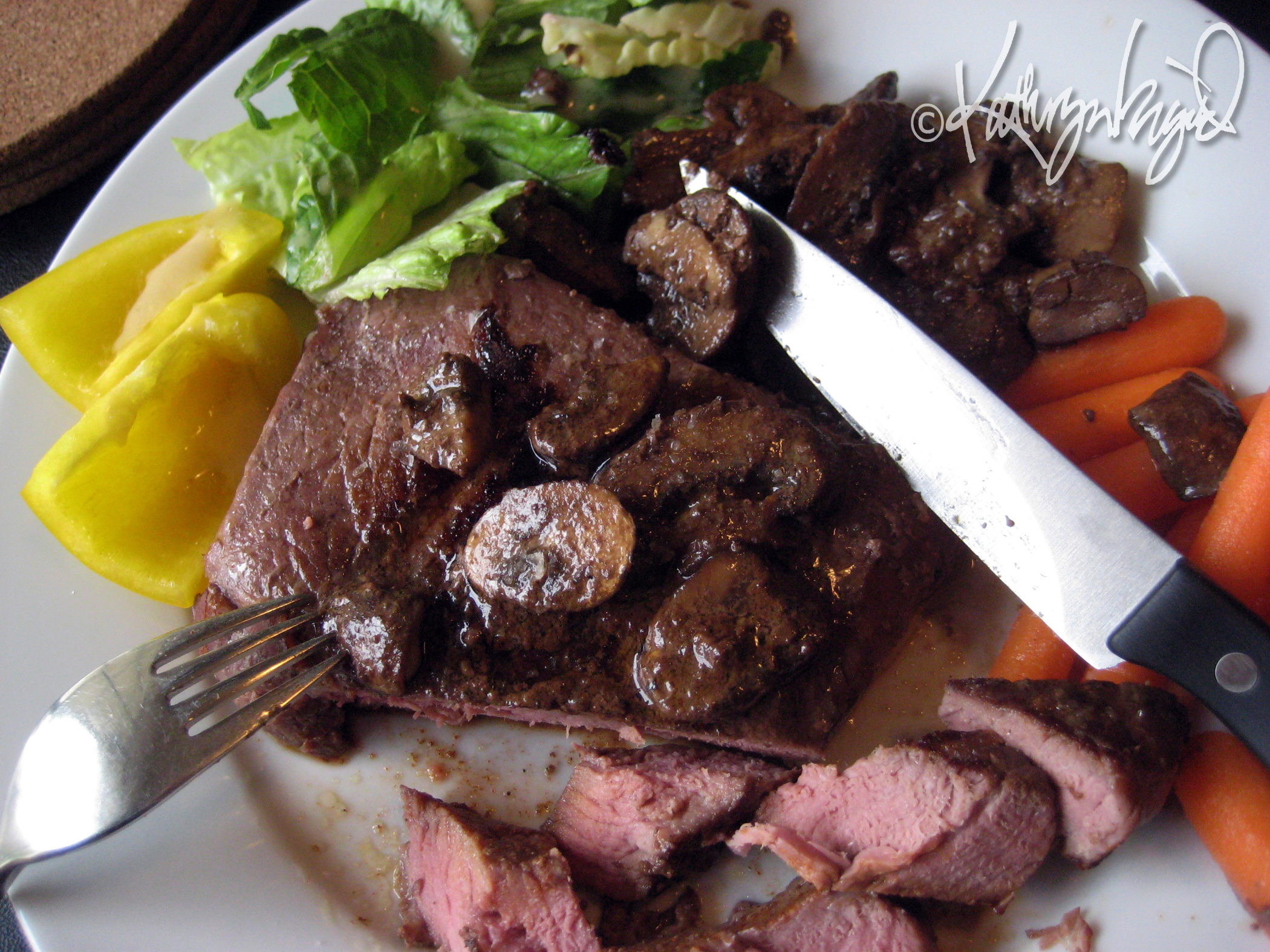
When lots of Americans ask 'What's for dinner?' they want to know what *meat* they're getting as a main course, not hear a recitation of all the fabulous accoutrements you are painstakingly preparing for their delight and delectation.
I am antique enough to remember the time when what Americans knew as Chinese food was ‘Chop Suey‘ in a glutinous and sickly-sweet sauce, followed by fortune cookies filled with good-luck predictions that were exciting and interesting only when recited with the popularly immature addendum ‘between the sheets’. When Italian food meant spaghetti, cooked until ‘al dente‘ only to infants under six months of age and smothered in characterless tomato puree with some insipid approximation of a meatball-like object swimming in it and perhaps a halfhearted sprinkling of pretend Parmesan cheese granules from the canister that sat on the shelf until nearly archaeological in quality. And French food was just plain weird, some sort of girly, foofy stuff that, if any man would be caught eating it, he had better be wearing a beret and a pencil-thin mustache and sticking his pinky finger out while wielding his tableware.
Then there was a bit of an awakening. It was slow, to be sure, but meant that people might actually admit that their ancestral foods from the aforementioned regions were ever so much more varied, colorful, flavorful and exciting than the paltry offerings that had been dumbed down to virtual nothingness and blandness and predictability, supposedly to suit the American palate. Of course, that completely ignored the reality that the vast majority of the American populace originated in other countries, on other continents, and eating anything but boring cuisines. And not just Chinese, Italian and French either.
At some point, some wit decided that the US simply needed to be reeducated one dish at a time, choosing the humble yet incredibly versatile vehicle of the quiche as focus, et voilà! The 1970s became the era of the quiche-eaters. Thankfully, many of the quiches promoted were perfectly edible and did in fact counter the myth that ‘Real Men Don’t Eat Quiche‘ (originating in Bruce Feirstein‘s book poking fun at masculine stereotypes) because they were good, tasty, and ultimately satisfying concoctions. Even better, the idea that being a fledgling foodie nation was permissible, even laudable, meant that suddenly a whole host of other delectable cuisines became gradually more familiar, dish by dish and restaurant by restaurant. That’s not to say that every flavor is for every one, by any means.

For some, anything spicier or more exotic than an oven-roasted potato is too wild for the table.
But quiche, as it happens, is such a simple and endlessly variable dish, being pretty much an egg base used to bind and carry any combination of vegetables, meats, starches and other flavors suitable to one’s own taste, kitchen contents and the occasion. Quiche, omelette, tortilla española, frittata; whatever you call it, if you’re not averse or allergic to eggs, the possibilities of a wonderful, simple-to-make meal are endless. If you happen to be an old Texas ‘Cookie’, watching the hungry horde of cowboys close in on your chuck-wagon from across the lonesome plains, it might not be a bad idea to throw whatever you’ve got on hand into those trusty cast iron skillets and pots with some stirred-up eggs and get ’em cooking over the camp fire as speedily as a jackrabbit can dodge your shot. Use some of your biscuit dough for a dumpling-style crust, or just serve the stuff without crust–no one will complain, as long as the food’s hearty and ready when the dust settles around the corral.
Being in Texas, I do take advantage of the ready availability of good beef pretty often, so I end up with a little left over from time to time, and the egg-based dish is a perfectly easy way to make good use of all manner of leftovers. Heck, I even live in a ‘ranch-style’ house, for what it’s worth. So, since I had a whole lot of good eggs on hand at the moment and a very meat-and-potatoes, manly-man sort of collation of ingredients lurking in the ol’ refrigerator, I cooked up a crustless quiche fit for any sturdy appetite, Tex-Mex or plain cowpoke, from hereabouts to, say, Paris, Texas. Being so all-fired Frenchified and all.
Cowboy Quiche
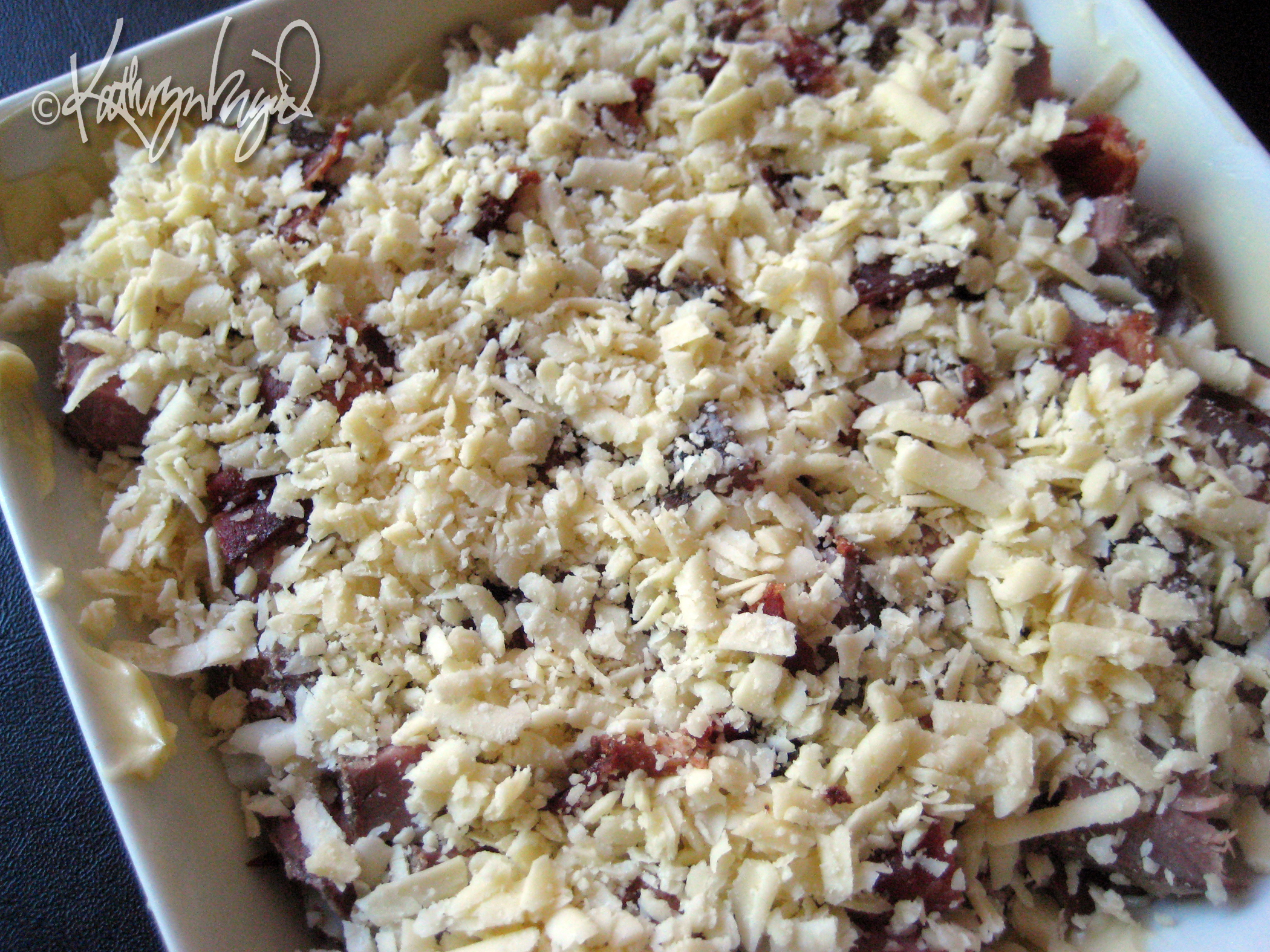
You can layer the solid ingredients for a quiche and pour the egg mixture over them, as I did (wanting the cheese all on top), or you can throw it all together and stir it right up. The end result tastes just as fine either way.
The base, in this case, is nothing but about a half-dozen eggs (I like plenty) and a half cup of thick plain yogurt, stirred together and thinned with a little tiny bit of water as needed to coat the other ingredients well. The rest of the filling comprised about a cup and a half of 1/2″ diced leftover lean beefsteak, two small leftover oven-baked potatoes in their jackets, diced about the same or a little smaller (skins and all), three slices of crisp-cooked bacon, broken into pieces, and a good half cup of grated sharp cheddar cheese.
Between the bacon, the cheese, and the salt with which both the steaks and baked potatoes had been prepared, I didn’t think there was much necessity for added salt (you may gasp with amazement at this salt-aholic’s abstemiousness now), but I seasoned the mixture with a good dose each of chili powder and smoked paprika.
This crustless quiche got baked in a small, well-buttered ceramic casserole, and today it was cooked in a newfangled microwave oven, because even though it does just fine in a conventional oven I was really hungry, cowboy on the plains hungry–somehow breakfast and lunch got forgotten in the midst of other doings today–and I didn’t want to wait any longer than I had to. I’d made up the quiche beforehand and put it in the fridge, so all that was required was to pop it in the oven and hot it up until it wasn’t too wiggly and jiggly anymore. I’m never entirely certain on timing and temperature, so in the microwave I just cooked it for 4 minutes to get the initial cooking underway and then several 2-minute intervals after, cooking it on High for about 8 minutes total and then letting it rest and set up for another five minutes or so.

The quiche comes out of the oven just slightly quavery in the middle, but a few minutes cooling on the counter (so as not to scald your diners) will thicken and set it up further.
To serve it, I went with Tex-Mex favorites, because I like them well and so of course I had them handy. Guacamole, which in our house is nothing more than mashed ripe avocado seasoned with fresh lime juice, salt, pepper, chili powder and lots of ground cumin, lasts longer in the refrigerator than you might think–but only if you make a big batch, because we do eat it in quantity when the mood strikes. Salsa must always be on hand. As I’ve said before, we like a mild chunky-thick salsa, spiced up at home with a chipotle en adobo or two well blended in. Some fresh, bright Mexican crema. A few black olives. I think all I left out of the meal was a nice chilled cerveza, but not every day calls for it. Or does it? I forget. Anyway, there were no other fruits or vegetables today, because that would just be too girly, wouldn’t it!

This'll fuel up any tough hombre for another day out punching the dogies, or wearing the ten-gallon hat of a CEO, or whatever.
You know, even with such a frilly sounding French name, a quiche like this ain’t half bad after a long day running the ranch.

 Art-Colored Glasses