Drawing on Your Beginner’s Luck

The nice blogger from Zara–A Writing Story stopped by recently and her post said she is working at starting to draw. I’m delighted to have another person join the ranks of happy visual artists via drawing–a collection of skills that come in quite handy (no pun intended, especially since there are artists who use their mouths or their feet to make artworks) for far more than strictly a pleasurable activity or visual entertainment. Drawing, a foundational skill in all sorts of visual art, is also a means of communication that differs from and can work in wonderful tandem with writing, singing, signing, and any number of other ways of personal interaction and transmission of information. In addition to the practical application of the end product of the process, the practice of drawing itself has great power as a mnemonic device, a tool for problem-solving, and the training of the brain in such useful skills as eye-hand coordination and (as I know from experience) the correlated motor control of working through tremors to achieve refined movements.

But beyond that, as I said to my blogger colleague, the act of drawing has elements of physical pleasure in the mere action of arm and hand and body that can be worth the pursuit, not to mention the mental and/or emotional pleasures possible. The act of drawing as a form of meditation, even without regard to any possible ‘product’, is quite desirable on its own.

As I said to my correspondent, she needn’t be intimidated in the least even if she’s a rank beginner: By even making the effort to learn, you’re worlds ahead of lots of others! A book I often referenced when teaching my beginner students in college was Betty Edwards’ classic Drawing on the Right Side of the Brain–it has exercises that aren’t too hard even for someone who’s never attempted to draw before, and because her focus is on how the brain works in visual activity, she offers insights into the process and possibilities that few others do. There are, of course, innumerable excellent how-to books for those who want to draw, many of them favorites of mine as well, but because of Dr. Edwards’ [then] ground-breaking work in recognizing the character of right-vs-left brain function and how it played out in drawing, I always found her work particularly helpful.

Because drawing can engage so many diverse cognitive processes like this, it can be complicated and overwhelming to know just where to start learning how to draw. As I remarked in my note to my fellow blogger, All of that aside, simply making marks on a surface is the beginning of drawing. Sometimes the least intimidating way to begin is to take a piece of paper, make some totally random marks on it, and then see where that takes you. Even if all it does is make you comfortable making the arm movements for a start, that’s helpful. If, as with most people, you look at it and think ‘that looks like . . . ‘ or ‘that doesn’t look quite right . . . ‘–well, then, you’re already making editorial decisions that can help you move toward drawing the way you want to draw.

The bottom line, if you will, for me is that I feel more alert, more attuned to potential solutions when everyday problems arise, and generally just plain happier when I draw. It’s not because every drawing turns into something fabulous–far from it–but because the process of drawing opens up my brain and spirits in useful and unexpected ways. Many times, my drawing produces nothing more than scratches that are shorthand for bigger and more complex and, I hope, better things to come. But the exercise itself is valuable to me, and a glance back through my sketches can often kick-start me into drawing a work that is more successful than the twenty previous ones.

line drawing

Exploring pattern in a sketch.

line drawing

Playing around with volume.

line drawing

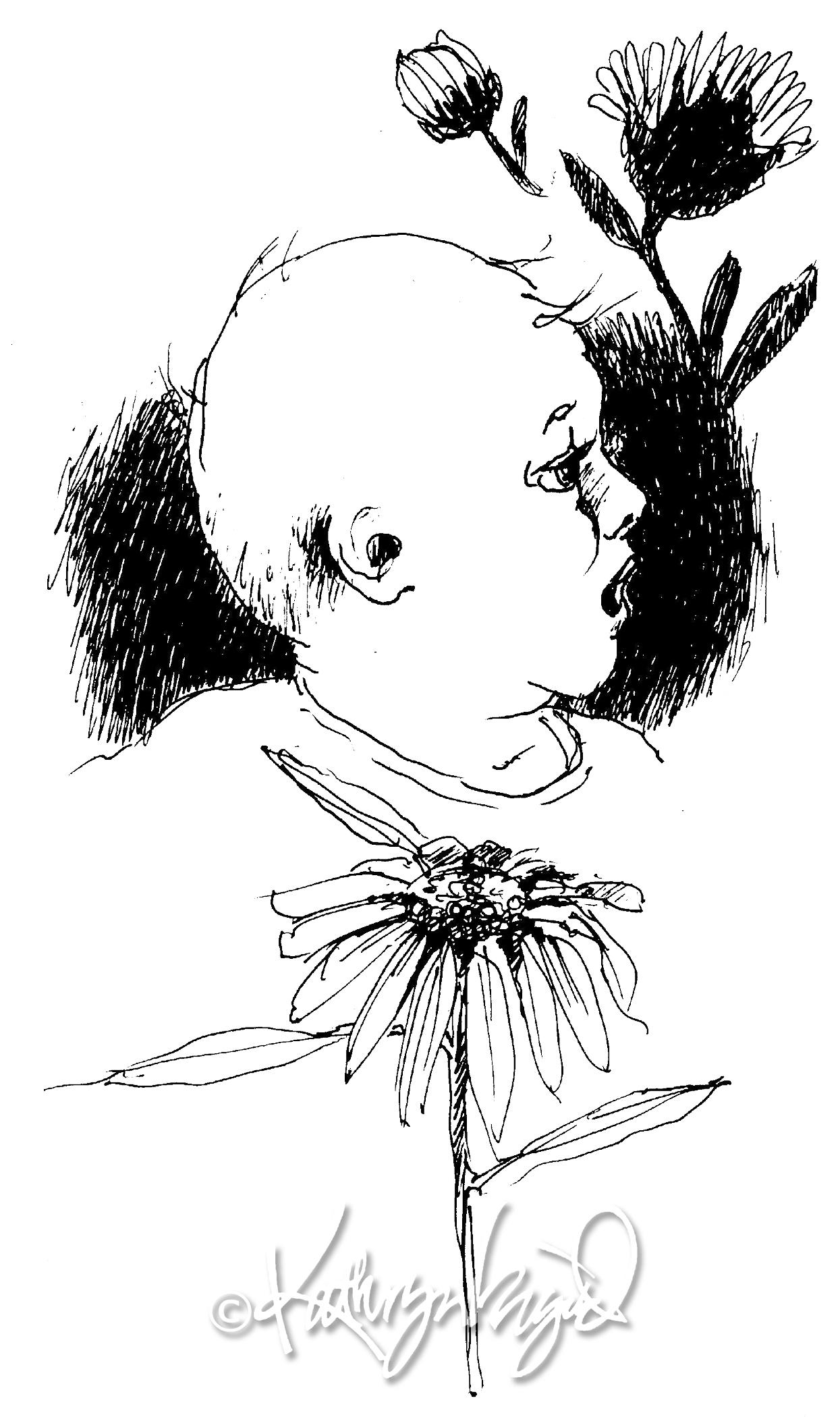
Faces and flowers show up often in my sketchbooks.
line drawing

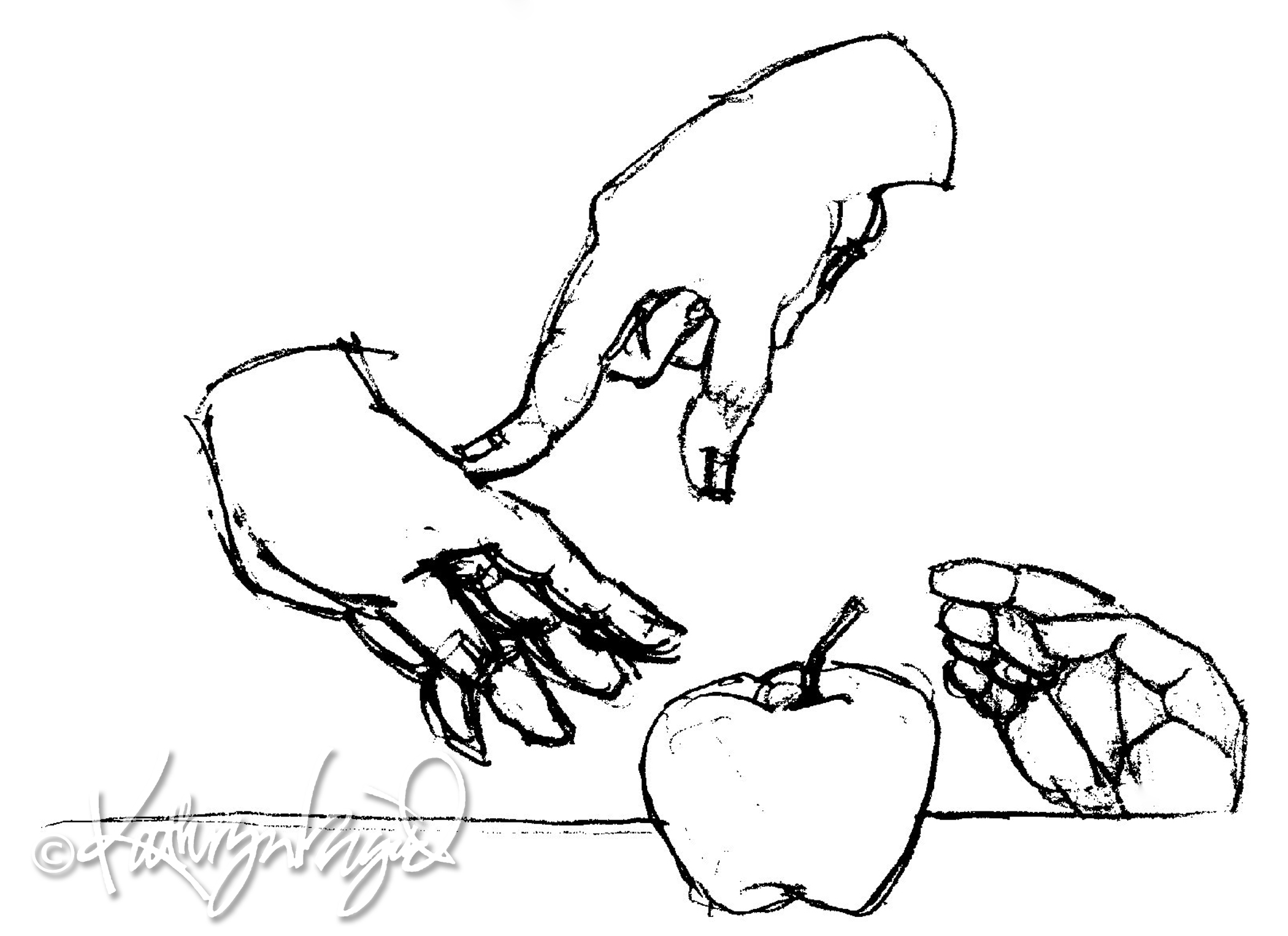
Hands can be pesky subjects, so I play with sketches of them frequently too.

line drawing

Any little vignette that pops into my mind is worth scribbling at least a few times.

Ultimately, whether I’m in gear for serious drawing or just fiddling with a pen or pencil to pass the time, it’s good practice and feels worthwhile. If nothing else happens, at least I have given my brain some thinking-room between the lines and I might figure out what to make for supper, how to cut through the piece of metal that is in the way of my completing a repair in the garage, or who knows–I might even remember where I set down that book I was reading days ago before it ‘disappeared’. It’s doubtful I’ll come up with any Nobel Prize-worthy inspirations while drawing, but then again, if I don’t draw, I’ll never find out!

The Center of Attention

When I am making artworks I am the ruler of all I survey. I get to invent my reality and decide how much of it I want to reveal to you, and even (to a certain extent) how I want you to experience this particular reality. I do know that you will bring your own point of view and that my art, this Empress having invented it or not, will tell you a story that exists in its own unique way within your personal context.graphite drawingHowever, like all storytellers visual or otherwise, I still control how much I’m willing to reveal to you of the whole project in the end. Do I give you the ‘whole story’ or choose to share a scene, a snippet, and then let you extrapolate from that to decide what the storyline is in the image, not to mention all of the possible storylines extending beyond the image in every direction? I choose the window; you interpret what you see through it.

In the case of this drawing of a lady with her fat pony, I’d say that a cropped version of the picture gives plenty of information about both characters and their relationship but mercifully deletes some of the evidence of my horribly sloppy parody of equine physiology, something that’s far more painfully exposed in the larger version of the piece. Yes, there I go, showing you my ‘underwear’ again. But don’t you agree that the image is improved, its focus stronger and its flaws somewhat mitigated, by the cropping?

graphite drawingUltimately, of course, I’m still Empress around here. I get to choose whether I’ll show you my process and share my behind-the-scenes action like this, let alone whether an image is finished or not, whether I’m going to use it for a post or not, and whether I’m going to tell a whole large story or a tiny bit of one. It’s good to be the Empress.

Gypsies at Heart

Becoming Gypsies

Freedom’s a romantic notion we imbue with pretty joys,

Dreamed escape from life’s commotion and the race’s worldly noise,

Endless travel, music, dancing, and the heat of thrumming hearts,

But though sweet, the dream’s entrancing magic’s only where it starts–

Gypsy life is what we make it, rich as fantasy can be,

Only when we reach and take it: yes, it’s up to you and me

To create this liberation and its joys for which we long–

Life becomes a celebration when we fully join the songphoto


Reaching Backward to Move Forward

graphite drawing/collage

Family mementos and personal memories can be full of torture--or treasure . . .

I’m one of those lucky dogs that has few tragedies notched on my past. Mistakes, oh yeah, I’ve made plenty. I’ll get to that later. But I can understand if you think the general ease and happy-face niceness of the vast majority of my life makes me a poor judge of how to deal with doom and disaster. Mostly, you would be right. But it seems to me that the very cataclysmic contrast of a life spent virtually skipping through copses with a basket full of violets with the few moments of direness is precisely what makes me think extra hard about what to do with such beastly times. The only benefits that I’ve been able to drag out of horrors (real and imagined) are that (a) the stark contrast with the larger part of my life makes me appreciate that happy-go-lucky stuff all the more, and (b) there is always, however hidden in the miasma of awfulness, something to be learned.

Trust me, it’s not the sort of learning I seek or relish. But if I can’t find some useful atom of how to move ahead more meaningfully and joyfully in my existence from what’s happened, then I must either perish from the agony forthwith or I had best figure out how to compartmentalize the bad and leave it wholly behind as an untouchable Pandora’s box of unwanted nastiness. There’s simply no going on if the worst of life is allowed the power to rule the rest of life. You must understand that I am not remotely advocating suicide or even gloomy wallowing here. Wallowing is only useful if you’re a pond-dweller and can appreciate a good spa-like mud bath to soothe the soul. Fellow bloggers and authors and pundits all over have preceded me in saying it, but I will doggedly (being a lucky dog I’m allowed) insist as well that happiness is a choice. So what I’m advocating here is finding the mode by which you are able to imprison the useless or defeating monsters in your own life, learn a better and more gratifying way to operate, and get on with more joyful living.

hand-altered lithograph

Every bit of leftover history holds the key to some new door to adventure . . .

What the over-arching pleasantness of my personal history tells me, especially when I dig deeper into my ancestral, cultural, and human roots, is that all of my predecessors had similar choices to make when it came to living a full and fulfilling life. They often had rockier paths to travel, greater obstacles to overcome, more suffering or illness or sorrows along the way, than I have on the whole, yet many of them are remembered as having been people full of life and light in their own ways. Clearly if it isn’t instantly easy and obvious for a pampered person like me to find the way to the fabled land where one is always (in my celebrated brother-in-law’s phrase) Maximum Happy, then these people chose their paths to contentment and pleasure carefully and willfully–and somehow succeeded. So I’m always on the lookout, when I pore over their stories and artifacts, to find any clues about the native intelligence, serendipitous grabbing of good luck, and clever plotting that took them up, over and through to a more glorious outcome.

collage

Even the things that seem fixed and eternal are subject to the vagaries of time . . .

The main truth I’ve found consistent through all of this is that, since each moment of triumph or tragedy is utterly unique and each of our individual experiences of it all the more so, learning and making choices and moving forward gets done in small increments. Time, as the piece above is titled to remind me, Changes Everything, and my being willing to move forward with the passage of time, ready or not, depends on my choosing to do so with a personal determination to find whatever wisdom, peace and happiness are possible for me, wherever I happen to find myself in the grand timeline.

Yes, I am smiling just thinking about it. How wonderfully shallow of me, eh? How lucky I am that little things can go so far to please me!