Another Good Thing about Waving One’s Arms


Waving my arms is something I may think about more than the average person does. From when I was pretty young I was conscious of arm movement as being mighty significant in a seriously diverse series of ways. First of all, there was that childhood training we all enjoy, if we’re well inducted, in the art of waving hello and farewell. I have almost always preferred the former to the latter, but in either case, whenever the occasion was deemed genuinely worthy of such a gesture, I knew that it was a sign of love or affection, and that made it pretty darn worthwhile.

Then again, I also had an early fondness for wagging my crayon-gripping fist over a piece of paper (or whatever flattish surface was convenient) to make squiggly lines and, if I got lucky, get them to coalesce into picture-like concoctions. I  might be sitting off in a cozy corner at Grandma and Grandpa W’s, scribbling away, with the faint sounds in the background of parental and grand-parental chatter as they sat drinking their coffee intermingled with the slight chattering sound of Grandpa’s cup doing a little jitterbug against the saucer, because he had a mild tremor in his hand. Of course, his arm-waving was hardly dramatic, but it was one of those delicate underpinnings of my early memory that became part of the whole subtle weave of my perceptions.

Sometime in my early teens or thereabout, I found that the family resemblance extended to my having my own familial tremors, occasionally in my head and neck but mostly in my hands and arms. There have been times when it was more pronounced than was entirely convenient for a person wanting to draw, but fortunately it’s rarely been at problematic extremes, more often merely requiring that I find ways to compensate for or control or use the tremors to advantage in my art-making. In any event, keeping my hand in (no pun intended) as an artist has tended to keep the inevitable interactions of these two kinds of arm-waving present in my attentions. Meanwhile, my other grandmother had her own kind of arm-waving to lend to the family skill-set: Parkinson’s Disease.

Typically, Granny had the wit and will to battle her Parkinsonism not only with great tenacity in staving off the ravages of the illness for many more years than is typical but also with a lot of good-natured humor, because that was her style. So whenever we had a family gathering, she was the first to offer her services for tossing salads and making milkshakes. That my mother has followed in the Parkinsonian lineage would make her forms of arm-waving far worse to behold, knowing that the same sort of insidious progression lay ahead for her, and to be fair, including the knowledge that the odds are a bit higher for me than for some that I will eventually join the parade, but she too has maintained a bright attitude about it all. Besides that, I am very slightly suspicious that her particular skillfulness when it comes to shaking the dice gives her a unique edge in the evening board games.

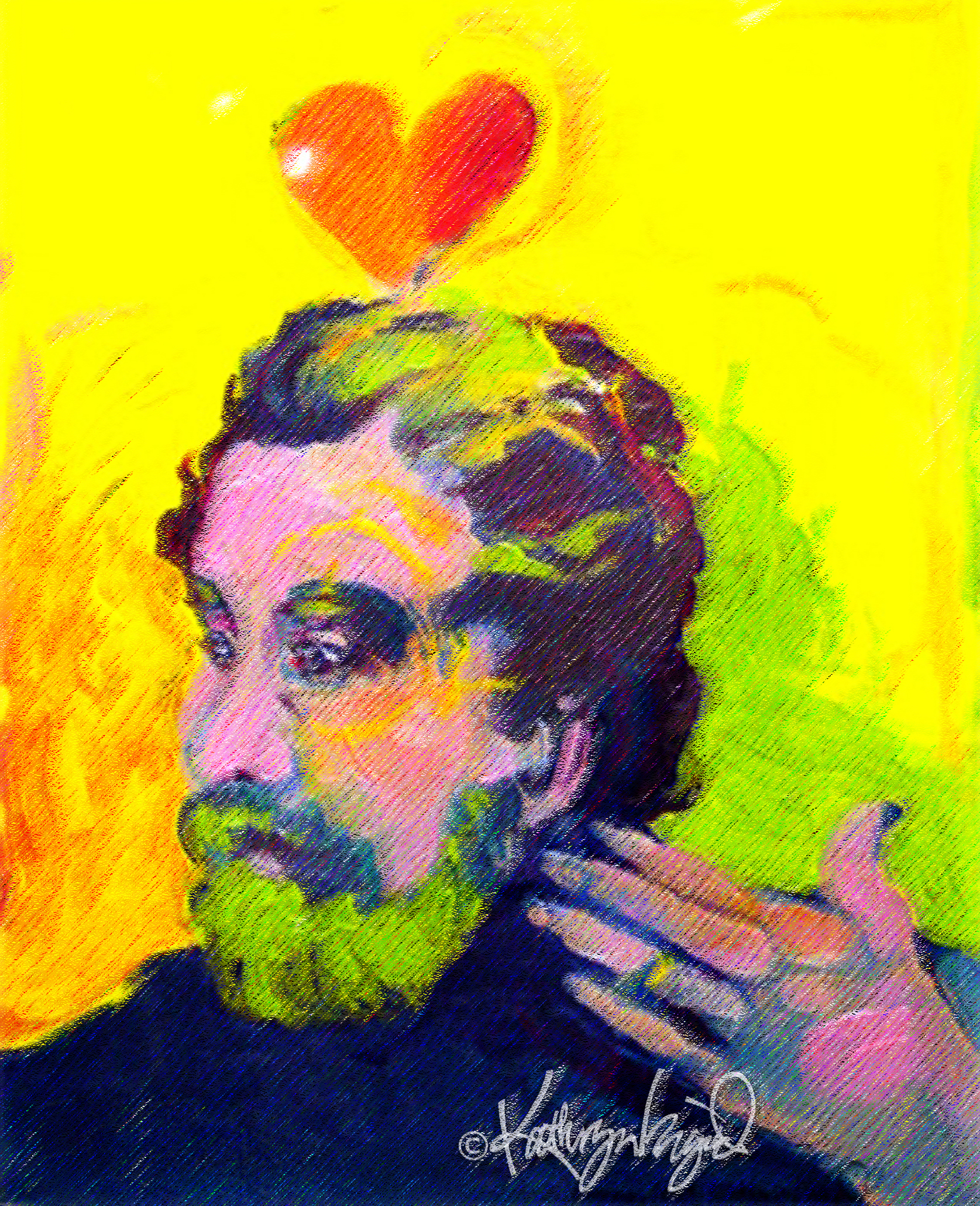
But the top of the list when it comes to magnificent ways and reasons to wave one’s arms has surely got to be the one I’ve been witnessing so much now that the concert season is well underway again: conducting. Bands, orchestras, operatic performances, choirs. No matter what the form of the musical art, if there is a conductor up there waving his, her (or, particularly, my beloved husband’s) arms, the love that fills the air is what makes all of the arm-waving a worthy and beautiful thing. It brings hearts and minds into focus and, often, into community, and it makes the world a more wonderful place to be.

And that makes me want to stop waving my arms altogether, just opening them wide enough to embrace that better world and anyone I can in it.digital image from an acrylic painting on canvas
 

Matters of Perspective


photo

Stormy skies can bring destruction . . . or the rains of growth and promise . . .

I’ve said before, and in ever so many ways, I’m a firm believer that we all live our lives wearing our own very distinctive glasses. By that I’m not referring to the glass-half-full vs. glass-half-empty attitude–but that’s indeed part of the whole idea. It’s about how we see the world through our individual filters.

In a fairly concrete fashion, that means that the quality of my actual eyesight–my acuity, ability to detect and distinguish colors, textures, shapes, depth of field aided by stereo vision, and all of that sort of thing does, in fact, have a profound effect on my world view and how I experience my passage through it in life. As a longtime visual artist, I am dependent upon all of this stuff for my very sense of self.

But I’m also convinced that each of us has a life history that includes our adventures from birth to the present, our nurturing or lack thereof, our environment and resources and social contacts and political influences and educational progression, and that whole reality is so distinctive for each of us, right down to a cellular level, that I can’t quite imagine how even the closest of kin could possibly have identical points of view.

I’ve been reminded of this in the last few days as I’ve been reading the latest Oliver Sacks book on which I’ve laid hands: The Mind’s Eye. Every book of his that I’ve read thus far is, since he’s a neurologist, a humane and humorous thinker, a deeply curious scientist, and a citizen of the world with wide-ranging interests, bound to be an adventure. Given the visual theme of this particular collection of case-studies (including his own discovery of and treatment for an ocular tumor), it is indeed a confirmation of my sense that such complex inventions as human bodies, multiplied by the almost infinite variants those influences I mentioned above can infuse, create and incubate an incredible range of possible ways to see and experience life in this world and whatever we can conceive of beyond it.

Yes, I am enjoying this latest Sacks book as immensely as I have all of his thus far. It’s been rather striking, too, to add to the layers of my own filters, many of which I’ve only come to recognize rather more recently in my life. I have sussed out and confirmed to my own wildly non-medical satisfaction that I am very probably distinctly dyslexic or cognitively ‘different’ in a whole bunch of ways, and having looked at this good doctor’s descriptions of face-blindness, or prosopagnosia, I’ve a feeling that my realization sometime not long past that I might have a degree of face-blindness might well be accurate. I’m certainly no less inclined to believe it since immediately before the book arrived on scene at the local library, I was working in our front yard when a car pulled up and the nice driver called me by name and conversed with me pleasantly until I could identify by her voice, questions and comments that she is the neighbor who lives directly across the street from me. Sigh. Sometimes the ol’ filters do get a little blurry.

More importantly, though, I’m convinced that how we respond to our life experiences and our histories–the choices we make and what we do with what we’re given and who we are within it–those are the truly telling filters. They’re the things by which we’ll be known, be remembered (if we’re remembered), and that offer us ways to define ourselves and our place in the world. So while I’m happy as an artist to play (as you saw in the last couple of posts) with my reality in the artificial world of visual imagery and how I attempt to show others what it’s like to see through my lens, I realize that my moods and attitudes are a part of that process too. Can I get others to understand or accept my point of view? Rarely, if I’m mighty fortunate. Can I help them to see it? More likely, if I work hard. Can I give them happy access to their own filters that might improve their moment or their day? That, I hope, I can do if I am true to the better of my instincts in responding to the world as I know it and expressing, the best that I’m able, with passion and with compassion. With love and joy.

digital painting from a photo

Heavens! What started as a grim and ominous day can become something bright and hopeful . . .


I’m So Worth It

I’ve never understood the horror some people have of others knowing their age. Among other things, it requires endless forms of subterfuge and denial, from falsifying mere statements of age to all of that domino-like cascade of phony documentation and historical records that must be juggled over time–though, according to those claims, that will have stood quite still. In more extreme cases, it leads to a compulsion to alter oneself to fit the imagined character of the mythical preferred age. I find lots of highly stylized and generalized and ‘flawless’ dolls unappealing, weird and creepy, and ever so much more so, living beings who have had themselves altered by cosmetic means (temporary or, in extremis, surgical) to be less age-appropriate or individual.

Yes, I do understand the urge to fit in, to be accepted. But perhaps my having felt, most of my life, that I look pretty average and ordinary–none of me either bad- nor good-looking to any extreme–makes me inured to the pain of those who think themselves terribly, awfully out of sync with others in appearance. Certainly I know that there are many who have had external reinforcement from thoughtless or cruel others that they are unattractive or unfit or otherwise unacceptable. That is one true form of ugliness: bullying. Demeaning and hate-fostering and belittling are as terrible in their way as any forms of torture, because they scar the soul just as effectively as physical abuse scars the body and spirit. And that can make anyone feel old ahead of time.

But when it comes to the simple and petty desire to deny the years spent on earth or the effects of living a full life on one’s body, skin and hair, I still don’t quite get it. I watch those hair-coloring commercials where fabulously primped and preened models assure us that those smart enough, like them, to use X brand are obviously grand and wonderful enough to warrant the expense of that harmless form of self-adornment “because I’m worth it.” Well, good on you! But it so happens that I think I’m worth just as much with my own dull dishwater brown hair sprinkled with hard-earned threads of white. Plastic surgeons are always eager to inform me that I could be smooth, cellulite-free, and have perfectly formed chin, nose, breasts and cheekbones if I’d only let them perform their magic upon me. In addition to my having seen a long parade of walking evidences to the extreme contrary, or at least extremely contrary to my own tastes, I am shockingly content to have a mole practically right in the middle of my face, one ear far lower than the other, shoulders of quite different sizes, stubby hands, remarkably pasty and slightly sallow skin, a couple of scars from clumsiness and carelessness, and–oh yeah–quite the growing collection of wrinkles here and there upon my entire personage.

Get used to it. I’m a used vehicle. I’ve driven this body through a lot of history, which, if not remarkably rough or exotic, takes its toll in bits and pieces, softening up that muscle tissue which once was a tad more taut, stiffening the formerly flexible joints, adding a few pounds here and a lot of freckles and spots there, and all of the other signs of ordinary aging. Beyond beating, as it’s said, the alternative, growing older has some distinctly positive aspects to it in my view, not least of them that I know, like and respect myself and my finer features far more than I appreciated such things in younger years. I am finite, yea, even slithering down the slope of the latter part of my life, and I will die. Before then, I plan to live it up.

And if that shows in my greying, thinning hair, my spotty memory (which was always a hair more colorful than reality anyway) and my thickening waist and glasses, my slowing reflexes and my ever speedier increase of dithering and forgetfulness, so be it. If it shows in my increasingly complex network of wrinkles, why then Good on Me. Literally. I earned all of these insignia of my fine, me-sized-adventure filled life, and if they make me look less than smooth and perfect and doll-like and youthful and conventionally beautiful, I don’t mind one tiny bit. I certainly never liked ironing anyway, and I earned the right to savor my wrinkles just as they are.graphite drawingP. S. I was born in 1960, and I still have hopes of getting a whole bunch older than I already am, if all goes well.