
Memory Palaces

Egyptian carvings + antiques + text

In these quiet moments, in these ancient places . . .

The mind is a miraculous thing. The playground of invention and the laboratory of creativity, the throne of wisdom–if one’s fortunate enough–and yes, the mind houses most of what comprises our whole sense of self, of identity. It is also the storehouse for that matchless tool and gift: memory. There’s the deeply buried sort of memory that is expressed mainly as those autonomic controls and intuitive responses that keep our complex biological machinery running as well as possible at all times, waking and sleeping. There’s that incredibly purposeful (but often tiresome to develop) form of memory that we’re required to hone by the hard work and repetition of study and learning. Indeed, those labors that make most of us crotchety about going to school despite our greatest yearning for the reward of that new-fixed memory and our deepest hopes that it will last.

There’s the sort of memory that transcends individuality and lingers in those places where it came to be. I love to visit others’ memories not just vicariously as they tell tales or teach me of the past but, most especially, when I can take them in through membranes of the spirit, thus: touching an antique piece of furniture and feeling in its burnished grain the passage of every hand that came before my hand; standing in the stained-glass filtered sunlight pouring through a venerable space and feeling the ghosts of history sifting down on me like glittering atomic dust. Most deeply, when I can stand in the places of the ancients knowing in my bones that I connect this way to every one that’s passed before.

And there’s the beautiful, elusive and elastic sort of memory that has the most affinity with creativity and invention and play. It’s the place where the method of loci, or the building of memory palaces, enables those mental competitors that enter memory championships, to erect storage for their knowledge in structures that to ordinary persons might seem astounding and nearly unimaginable in their detail and delicacy and, at the same time, strength. It’s the wonderful seat of those marvelous incidental and accidental memory palaces that despite our lack of practice and training we non-competitors manage to build where our fearful or fondly held sentiments and reminiscences and remembrance of things past can hallow our haunt our dreams, with or without requiring tea-soaked madeleines.

These are the palaces whose halls I wander when in search of things I fear I’ve lost, timidly though I may tread. They are the temples where I look for long-ago learned wisdom, past moments of renewal and respite, and lessons learned that lead me hopefully into the days to come. Most of all, my stately edifice is built to offer shelter to those most treasured of my memories, the parts of the past I want to revisit not from need or for desperation at things I’ve thought destroyed, but for the purest joy and pleasure of basking in their wonders not just on the day when they and I first met, but over and over and over again. That, for me, is the sweetest of those royal gifts bestowed on me whenever I am fortunate to enter in the palaces of memory.

Stories without Words

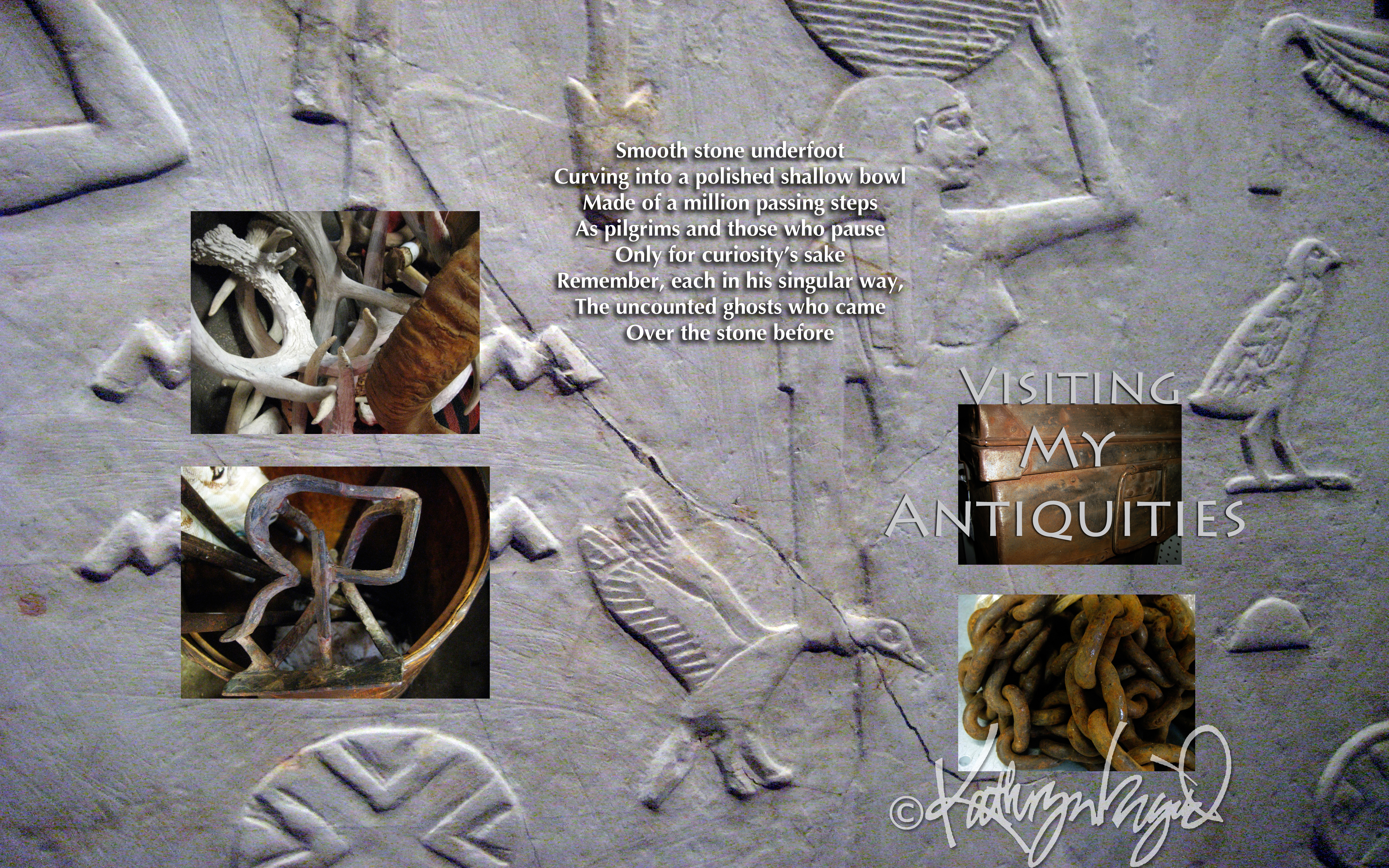
I may have mentioned–some few blog entries ago–that the visual world is full of stories for me. It’s not just me, though. You’ve heard it plenty yourself: “A picture is worth a thousand words.” There’s no end of people inspired to find tales, ideas, inspirations of every kind in things seen, in the real world and in all sorts of visual images, and what we like to imagine they mean, or could mean. So have at it. I give you now a digital collage and know that no one else will see precisely the same collection of Stuff or relationships between the things collected here exactly the way I see them. You might guess why I put some of this together in a single image, maybe even could see some of my motivation more clearly than I do myself (you shrink you), but the fun of the whole thing is the same as what I love experiencing when I have an art exhibition: seeing my own work through others’ lenses and knowing that they always bring something different to it than I did either in looking at the finished piece or in revisiting any part of its birthing.

digital collage of Things

All these things together . . .

Every sighted person “reads” the world through his or her own filters, and for the most part, that’s good. It’s not only what helps us to be ourselves fully in the world but what gives us a large measure of pleasure in existence: we can create the world in which we find ourselves as well. Imagination and interpretation are colorful ways of coping with reality and reshaping it as we go. We can be horribly misled by our crazy or wrongheaded or under-informed explication and conceptualization, and that usually leads to trouble of one sort or another (not least of all making one be a chump, a dimbulb or even a full-fledged jerk). But really, isn’t there a lot of fun in just giving ourselves a moment of fiction to stretch our boundaries and enlarge our existence in some small measure?

Et in Arcania Ego: Weird is Good

I like weirdness. Eccentricity, outsider thinking, silliness and the bizarre–I’m generally repelled by danger and anything remotely aggressive, but I have to ‘fess up and say that my own differences from the so-called norm are not just habits and hints of wilfulness but also deeply ingrained and naturally occurring parts of who and what I am. Yes, I am weird.

But I’ll also say that “weird” is simply, for me, an equally comfortable name for being unique. Every norm is only an average, each with plenty of exceptions to prove and/or flavor the rule. While I’ve grown into embracing [most of] my quirks and distinctions, it isn’t always easy being a quagga in a world of pretty ponies. I woke up again today from a dream I’ve had since my memory began: the details vary, but it’s always about being in a group of people, all earnestly working on some project, and having the leader and my peers try in one way and another to steer me to do it Right and not as I’ve been doing it–even while they all assure me that they approve of and appreciate the excellence of the different thing I’ve been doing. This will sound mighty strange to anyone whose life has gone ‘as planned’.

Wildly convoluted brain-waves

Welcome to my synapses

Those with any little anomaly (physical, mental, or other), however, might sense something familiar.

It was only as an adult that I–having grown up in the Olden Days long before “dyslexia” entered the common parlance, and then as something rather negative or at least problematic–realized that I have a nearly magical variety of dysfunctional characteristics that come under that broad umbrella. My worldview is shaped by all kinds of tweaks that mimic but do not match the ordinary: lexicographically, to be sure, since I have the ability to watch words and letters move around a page in ways that if amusing are not necessarily conducive to fast and accurate reading, so I’ve always had to read rather slowly, and about four times over, through anything to feel I’ve grasped its essence. Despite this sometimes frustrating methodology, I’ve never disliked reading, only been surprised over the years to be classified as reading ‘above my grade level’ if it took so much effort to keep up with expectations.

Along with dyslexia of the most obvious sort I can lay claim to numeric, directional, spatial, and temporal experiences that stray from the ordinary a great deal. Numbers play around on a page just as actively as words and letters. There have been times when I was able to surprise my math teachers with the expected answer to relatively complicated computations, but only after I learned not to admit to the process by which I divined said answer, as it bore little relation to the assigned progression from Q to A but was rather intuited. I have no inner compass, so don’t try to guide me to your cozy home with Left and Right and North and South, let alone Up and Down. I do understand what those concepts mean, but they have no relation to locations in my own being other than perhaps as niggling desires. I can you tell whether I’m located right next to the baseball diamond or up in the cheap seats, but not how to get from one to the other (without flying) nor can I experience the action of the game much more vividly from one point or another. And don’t get me started on trying to discern the details of the play: if it happened quickly enough, I have to mentally freeze the moment of action and stare at the “snapshot” in my head for a while to figure out how, where, or if the ball crossed the plate and what the batter and catcher did about it.

This is all a (perhaps appropriately) convoluted route to informing you that I don’t see the world the way other people see it. But honestly: does anyone? If each of us is genuinely unique, then any norms we’ve posited should only serve as starting points for communication and coexistence, not ends in themselves. I’ve been told countless times by well-meaning Professionals and advisers that if I wish to succeed or gain acceptance in my field (whether as artist, writer, teacher, or any other labeled category of mortal being), I ought to work at fitting in better. It’s always couched in friendly terms but boils down to my being too hard to categorize, define and package because my interests and personality (and therefore my work) wander too far afield and are tangential, at best, to expectations.

My answer at last is Vive la Difference! I’ve spent more than enough of my first half century thinking I ought to redesign myself to please the common demand before realizing that I’m really okay with being uncommon. And I sincerely hope that everybody else not dwelling directly on the dot of Normal finds his-her-or-its contentment and delight wherever and however possible. In that lies endless possibility. Especially if one has the attention span of a gnat, as I do.