
Signs of a Good Trip Ahead

That wonderful invention the GPS is generally a generous gift to a diva of disorientation like me. With my myriad forms of dyslexia all interlocking magically to make it virtually impossible for me to find my way practically anywhere past my own mailbox, it’s nice to have a personal assistant, albeit a computerized one, telling me how to get from Point A to Point B and beyond. And I do love a good road trip, when the opportunity arises.
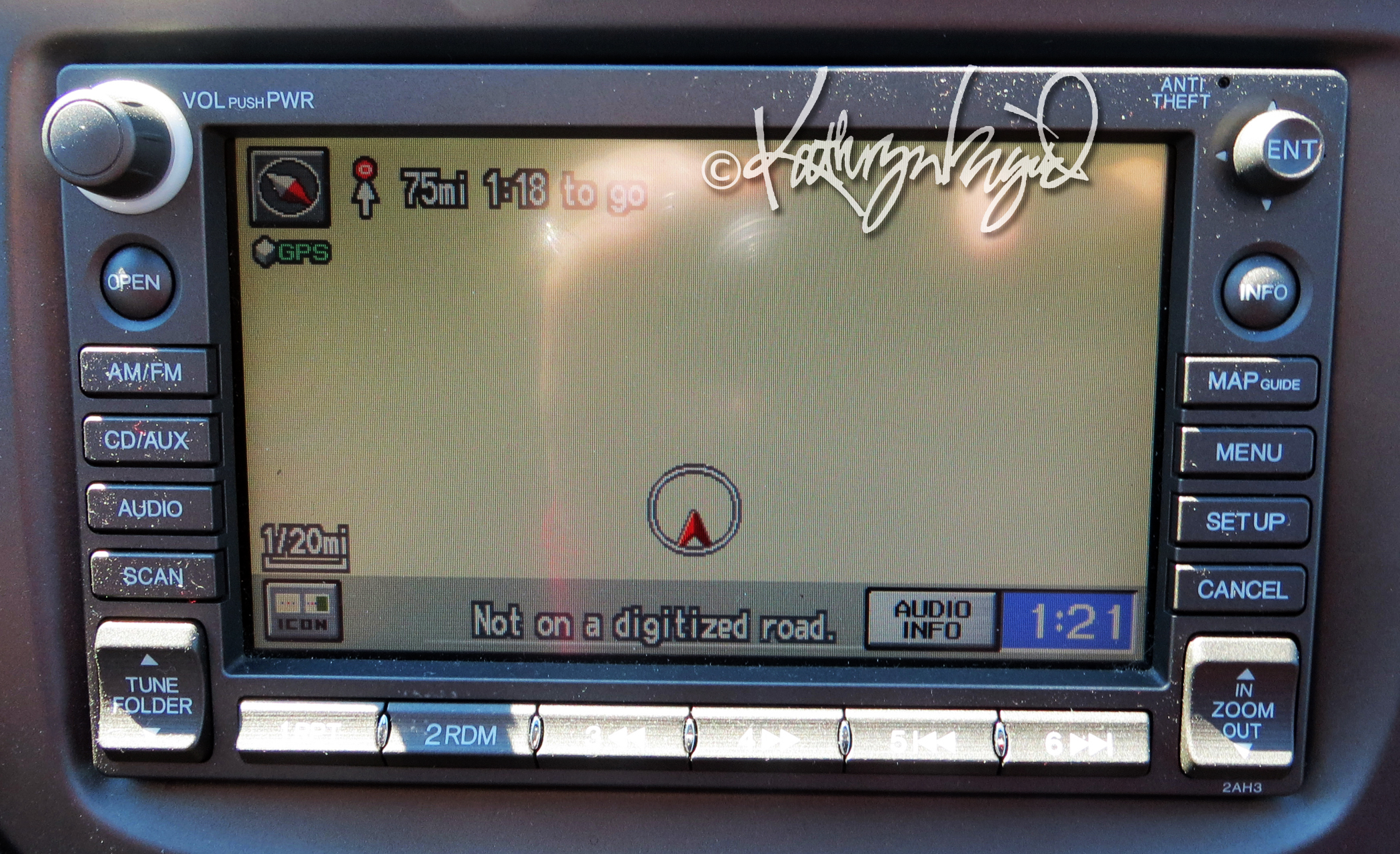
photo

You are Here, but There’s No Here Here

But even our GPS (sometimes fondly called Peggy Sue after the lady who first helped us find our way around our new home, town and state) in all her digital wisdom can’t find everything. Sometimes, as on the above-pictured occasion, she has no more clue where her driver and passengers are than they do. And you know, it’s kind of amusing to me. Not only does it amuse me to look at the GPS screen and see it telling me that I am a little red arrow flying through the air in the vastness of uncharted space, but it’s weirdly reassuring to me that my lack of omniscience is far from unique in this world. All the same, I do appreciate Peggy Sue’s selfless assistance when it’s needed and available.photoOn the other hand, there’s plenty to be said for going forward without knowing what comes next. In life, it’s just plain inevitable–prescience of any sort is in mighty short supply. On holiday, going with the flow is often the perfect way to have a rich and full adventure, and even the occasional mishaps stand a chance of being fodder for both present delight and reminiscent hilarity. On the pictured ‘flight’ across uncharted Texas territory, my spouse and I were so happily absorbed in relishing the sights along the unknown way that we both failed to notice one of our other digital auto-assistants signaling us that the supply of petrol was diminishing, until it was seriously questionable whether we’d make it to a gas station before the tank ran dry. We knew we were in the vicinity of Seguin (a place we’d been through a few weeks ago) and crossed our fingers that following the intermittent signs to town would get us to a refilled tank in time. Not only did we make it in time, we had a trip in a time machine on the strength of that refueling. The little bit we’ve seen of Seguin has a remarkably somnolent sense of being stuck in time, and not even strictly one single point in time but rather as though everyone in the whole town has dragged his or her weathered boots every step of the way through its history, and everyone in turn has stopped off at a different spot in the past before picking up speed and rejoining the flow of time. Past and present meander in and out of each other and the buildings and land around Seguin and beckon us, in our turn, to slow down and enjoy the oddity of being off the map and off the tow rope of time simultaneously.

photoWe didn’t stop quite long enough to buy wrestling tickets, mind you, but the lure of the unique and the mystery of moving ahead without any inkling of what might lie ahead kept us rolling along all the happier when we were securely back on a full tank (once we found one of those vintage petrol pumps that was fully functional and deciphered the toothless ramblings of the guy sitting in his lawn chair ‘instructing’ us through our transaction from across the lot). If we hadn’t been to Seguin, we’d never have experienced its time-capsule marvels, potted around wondering how on earth a town that size could survive with so few gas stations, or gotten to see the World’s Largest Pecan, a sculpture on the lawn of City Hall that is probably really about the second or third largest representation of said nut in the US and possibly about the second or third least decorative sculpture (sorry, Seguin!) upon which any town proudly bases a promotional motto. Strange? A tad. Stuff I could easily have lived a long and healthy life without seeing or experiencing? Perhaps. But I’ve no regrets that our particular turns in the road took us there and led us to all of that fun, plenty entertaining even without wrestling tickets.

Matters of Perspective


photo

Stormy skies can bring destruction . . . or the rains of growth and promise . . .

I’ve said before, and in ever so many ways, I’m a firm believer that we all live our lives wearing our own very distinctive glasses. By that I’m not referring to the glass-half-full vs. glass-half-empty attitude–but that’s indeed part of the whole idea. It’s about how we see the world through our individual filters.

In a fairly concrete fashion, that means that the quality of my actual eyesight–my acuity, ability to detect and distinguish colors, textures, shapes, depth of field aided by stereo vision, and all of that sort of thing does, in fact, have a profound effect on my world view and how I experience my passage through it in life. As a longtime visual artist, I am dependent upon all of this stuff for my very sense of self.

But I’m also convinced that each of us has a life history that includes our adventures from birth to the present, our nurturing or lack thereof, our environment and resources and social contacts and political influences and educational progression, and that whole reality is so distinctive for each of us, right down to a cellular level, that I can’t quite imagine how even the closest of kin could possibly have identical points of view.

I’ve been reminded of this in the last few days as I’ve been reading the latest Oliver Sacks book on which I’ve laid hands: The Mind’s Eye. Every book of his that I’ve read thus far is, since he’s a neurologist, a humane and humorous thinker, a deeply curious scientist, and a citizen of the world with wide-ranging interests, bound to be an adventure. Given the visual theme of this particular collection of case-studies (including his own discovery of and treatment for an ocular tumor), it is indeed a confirmation of my sense that such complex inventions as human bodies, multiplied by the almost infinite variants those influences I mentioned above can infuse, create and incubate an incredible range of possible ways to see and experience life in this world and whatever we can conceive of beyond it.

Yes, I am enjoying this latest Sacks book as immensely as I have all of his thus far. It’s been rather striking, too, to add to the layers of my own filters, many of which I’ve only come to recognize rather more recently in my life. I have sussed out and confirmed to my own wildly non-medical satisfaction that I am very probably distinctly dyslexic or cognitively ‘different’ in a whole bunch of ways, and having looked at this good doctor’s descriptions of face-blindness, or prosopagnosia, I’ve a feeling that my realization sometime not long past that I might have a degree of face-blindness might well be accurate. I’m certainly no less inclined to believe it since immediately before the book arrived on scene at the local library, I was working in our front yard when a car pulled up and the nice driver called me by name and conversed with me pleasantly until I could identify by her voice, questions and comments that she is the neighbor who lives directly across the street from me. Sigh. Sometimes the ol’ filters do get a little blurry.

More importantly, though, I’m convinced that how we respond to our life experiences and our histories–the choices we make and what we do with what we’re given and who we are within it–those are the truly telling filters. They’re the things by which we’ll be known, be remembered (if we’re remembered), and that offer us ways to define ourselves and our place in the world. So while I’m happy as an artist to play (as you saw in the last couple of posts) with my reality in the artificial world of visual imagery and how I attempt to show others what it’s like to see through my lens, I realize that my moods and attitudes are a part of that process too. Can I get others to understand or accept my point of view? Rarely, if I’m mighty fortunate. Can I help them to see it? More likely, if I work hard. Can I give them happy access to their own filters that might improve their moment or their day? That, I hope, I can do if I am true to the better of my instincts in responding to the world as I know it and expressing, the best that I’m able, with passion and with compassion. With love and joy.

digital painting from a photo

Heavens! What started as a grim and ominous day can become something bright and hopeful . . .


Sound Advice for the Voiceless

watercolor birds x 2

Singing our little hearts out . . .

I have spoken about having Spasmodic Dysphonia. That in itself, when in the aural forum and not (as in yesterday’s blog post) just the printed format of the internet, is a fine thing in my estimation. It means that having SD hasn’t rendered me either mute or unwilling to let my sometimes goofy sounding voice be heard. It could conceivably be argued that it would be good if I would actually shut up occasionally, or at least not be quite so outlandishly talkative as I can get. I consider that other people’s problem. Egotistical, I know, and I’m not really exaggerating when I say that. What you hear is what you get.

Being fortunate enough to retain the power of speech, I prefer not to stop using it. SD has meant getting over any vanity I may have had about the sound or quality of my voice. Having been flattered by many in my younger years as a strong and clear and pleasant speaker and encouraged to take singing lessons, to consider radio work, to be a lector and to speak at public events, I now have a different sense of my voice and what I do and don’t trust it to do than I did then.

So I find it less comfortable both physically and psychologically to sing, and certainly have no desire to show off my resulting lack of confidence and practice publicly. I was always a nervous Nellie when it came to singing in any group smaller than a chamber choir (Yikes! Someone might hear me!), but even singing along with a crowd is not the same fun it once was. It has in no way diminished my delight in hearing others sing, however; quite the contrary, it transformed my understanding of what it means to be able to sing, and to do so with skill and fluidity and grace. Working on proper vocal technique will help me continue being able to speak, but my own sense of music has been shifted rather firmly into listening to and appreciating and being moved by others’ mastery of their instruments. My own musical endeavor now sits much more comfortably in the realm of written and spoken language and of trying to capture the marvels of rhythm and pattern and color and sound in the confined refinements of print and speech. The potential is perhaps equally profound and potent, but simply takes an entirely different route through the senses in some significant ways.

Just to be crystal clear on this, I say this without any sense of loss or privation. I’m not suffering! Indeed, I consider myself incredibly fortunate. I’m neither summarized by nor limited to a description of my anomalies any more than I am defined by the ways in which I conform to any norms. SD is something I have or experience, not who I am or what I’m capable of doing. I could go through the list of potentially problematic quirks that help to shape my daily experience and my present self and sound like either a professional victim or a hypochondriac, or I can find–as I most decidedly do–that while each of those oddities has enough effect on my health and capabilities to be worthy of treatment or accommodation of some sort, each brings awareness of deeper gifts and the drive to overcome not only the irksome ills themselves but anything else I might be letting hold me back.

Yes, I am a lily-livered scaredy-pants of the first order as well as a lollygagging and procrastinating and self-sabotaging ignoramus, able to match pretty much any other arguably normal person around in those foolish and unhealthy arts. But at the same time I am so gifted as to understand that my true limitations are all self-imposed and even self-created, and that not only do people with far greater difficulties and far fewer resources live far more impressive and productive lives than I, I can grow up and into a better version of myself by taking notes on how they do it. Being a somewhat lazy and under-motivated student, I have to actively counter the urge to hide behind the couch until all inspirations and moments of willing effort pass, but on certain miraculous occasions I find that, well, I actually get up and do something.

When I do manage to pull myself up by my nearly invisible bootstraps, I find that despite having familial tremor (mainly in my hands) since who-knows-when, I can draw a straight line or a pretty fine freehand circle when I’m focused enough to make art. When I’m not, I have learned to hold my drinking glass with both hands if need be, or to keep kettle and bowl nearly overlapping when ladling soup. When all else fails, spill cloths and laundry detergent are mighty handy things. I may chill easily, thanks to my slightly off-kilter thyroid, but I’ve got layered-clothing styles down to a -40 Edmontonian nine-layer art form that I can still pack in my carry-on baggage. Wanna learn how to do nearly any basic survival task without an inner compass? I have virtually every dyslexic and perceptually dysfunctional talent I’ve ever heard tell of, from the ever popular reading-related visual chaos to spatial, directional, numerical and probably even temporal displacement. So without even knowing or trying to do it, I learned most of the affected skills upside down, backwards and sideways, doing everything with my own inevitably inimitable flair. Once I started treatment for them, my clinical depression and anxiety stopped holding me back and instead informed more of my interaction with other people as well as with my art. My lack of physical stamina and athleticism may have prevented my becoming a famous basketball player or dancer or a three-meter platform diving star, but I figured out early that leverage and a little logical logistical ingenuity could make up for a largish quantity of strength and skill in things physically challenging. Blazing alternative trails isn’t glamorous work but it’s done useful things in my life, and gives me an appreciative slant on those whose achievements outshine mine.

And when it comes right down to it, my ‘substitute’ versions of reality have served me quite nicely. I don’t sing in the way of the magnificent-voiced soloists and choral artists whose offerings have so richly embellished my existence, but there’s nothing stopping me from using the alternate voice I have in words and images to sing in my own way, and mainly for sheer happiness.

spring green flora + text

There are so many ways — and so many reasons — to sing . . .

Et in Arcania Ego: Weird is Good

I like weirdness. Eccentricity, outsider thinking, silliness and the bizarre–I’m generally repelled by danger and anything remotely aggressive, but I have to ‘fess up and say that my own differences from the so-called norm are not just habits and hints of wilfulness but also deeply ingrained and naturally occurring parts of who and what I am. Yes, I am weird.

But I’ll also say that “weird” is simply, for me, an equally comfortable name for being unique. Every norm is only an average, each with plenty of exceptions to prove and/or flavor the rule. While I’ve grown into embracing [most of] my quirks and distinctions, it isn’t always easy being a quagga in a world of pretty ponies. I woke up again today from a dream I’ve had since my memory began: the details vary, but it’s always about being in a group of people, all earnestly working on some project, and having the leader and my peers try in one way and another to steer me to do it Right and not as I’ve been doing it–even while they all assure me that they approve of and appreciate the excellence of the different thing I’ve been doing. This will sound mighty strange to anyone whose life has gone ‘as planned’.

Wildly convoluted brain-waves

Welcome to my synapses

Those with any little anomaly (physical, mental, or other), however, might sense something familiar.

It was only as an adult that I–having grown up in the Olden Days long before “dyslexia” entered the common parlance, and then as something rather negative or at least problematic–realized that I have a nearly magical variety of dysfunctional characteristics that come under that broad umbrella. My worldview is shaped by all kinds of tweaks that mimic but do not match the ordinary: lexicographically, to be sure, since I have the ability to watch words and letters move around a page in ways that if amusing are not necessarily conducive to fast and accurate reading, so I’ve always had to read rather slowly, and about four times over, through anything to feel I’ve grasped its essence. Despite this sometimes frustrating methodology, I’ve never disliked reading, only been surprised over the years to be classified as reading ‘above my grade level’ if it took so much effort to keep up with expectations.

Along with dyslexia of the most obvious sort I can lay claim to numeric, directional, spatial, and temporal experiences that stray from the ordinary a great deal. Numbers play around on a page just as actively as words and letters. There have been times when I was able to surprise my math teachers with the expected answer to relatively complicated computations, but only after I learned not to admit to the process by which I divined said answer, as it bore little relation to the assigned progression from Q to A but was rather intuited. I have no inner compass, so don’t try to guide me to your cozy home with Left and Right and North and South, let alone Up and Down. I do understand what those concepts mean, but they have no relation to locations in my own being other than perhaps as niggling desires. I can you tell whether I’m located right next to the baseball diamond or up in the cheap seats, but not how to get from one to the other (without flying) nor can I experience the action of the game much more vividly from one point or another. And don’t get me started on trying to discern the details of the play: if it happened quickly enough, I have to mentally freeze the moment of action and stare at the “snapshot” in my head for a while to figure out how, where, or if the ball crossed the plate and what the batter and catcher did about it.

This is all a (perhaps appropriately) convoluted route to informing you that I don’t see the world the way other people see it. But honestly: does anyone? If each of us is genuinely unique, then any norms we’ve posited should only serve as starting points for communication and coexistence, not ends in themselves. I’ve been told countless times by well-meaning Professionals and advisers that if I wish to succeed or gain acceptance in my field (whether as artist, writer, teacher, or any other labeled category of mortal being), I ought to work at fitting in better. It’s always couched in friendly terms but boils down to my being too hard to categorize, define and package because my interests and personality (and therefore my work) wander too far afield and are tangential, at best, to expectations.

My answer at last is Vive la Difference! I’ve spent more than enough of my first half century thinking I ought to redesign myself to please the common demand before realizing that I’m really okay with being uncommon. And I sincerely hope that everybody else not dwelling directly on the dot of Normal finds his-her-or-its contentment and delight wherever and however possible. In that lies endless possibility. Especially if one has the attention span of a gnat, as I do.