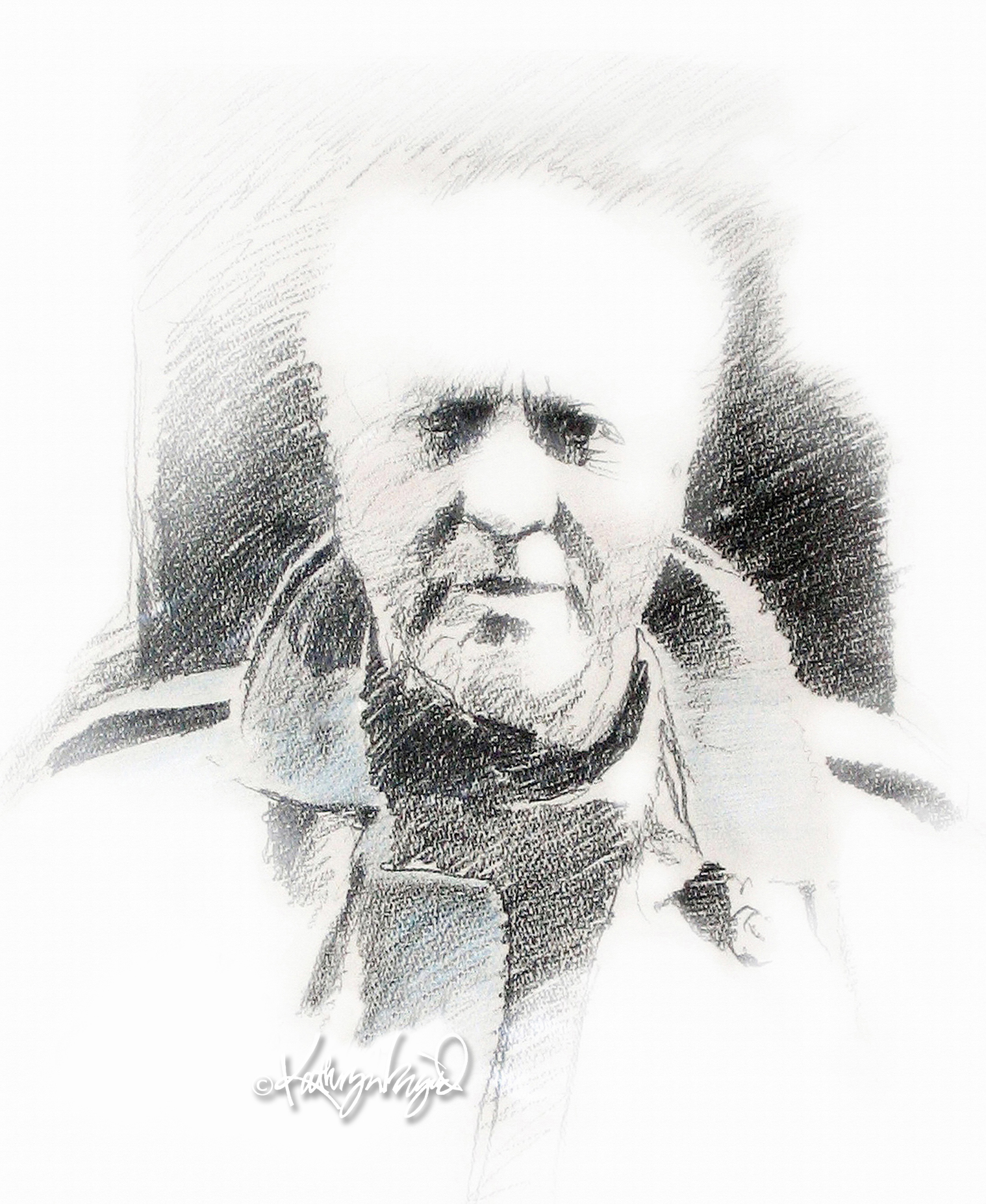
Maybe not Captain of My Own Destiny, but at Least I’m on the Crew

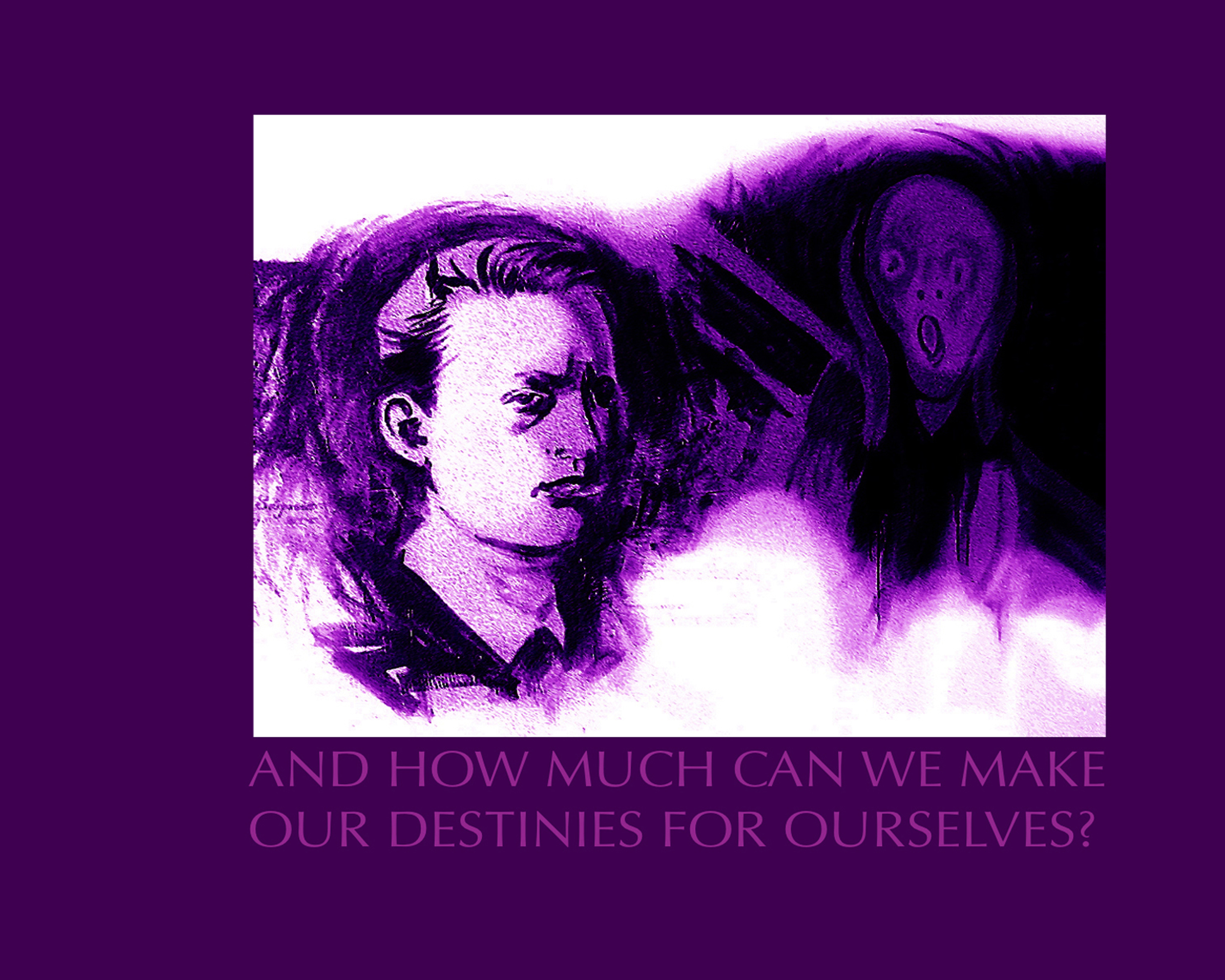
mixed media on canvasboard + textWhen I was a young artist-in-the-making, it irritated me to no end that people who saw my interest in art and knew of my Norwegian roots often instantly assumed that I was a big fan if not acolyte of Edvard Munch, Norway’s best known artist. Besides that my knowledge of Munch’s work was pretty nearly limited to ‘Skrik‘ (‘The Scream’) and what little else I’d seen even in passing was not at all to my taste, I took it as an insult and a frightfully narrow-minded view of my potential. And that, my friends, was the capper, because it implied that I was not in charge of my own future but predestined by my ancestry to be a pale imitation of somebody I wasn’t particularly fond of or impressed by in the first place. I was jolly well going to go my own way and choose my own muses and inspirations and, most of all, I was absolutely not going to be told what to do and when and how to do it by some ghostly abstract borne in my bloodstream.

As a very fortunate young pilgrim, I did manage to get to the Old Country and spend a little time rooting around my ancestral stomping grounds during my undergraduate studies. I got to meet and spend time with my great-aunts and various other relations and visit the house my grandfather helped build for his elder sister, our Tante Anna, and the family farms–the sylvan Ovidsland property with its tidy white house and taller red barn set in among the slender birches, and the more remote summer pastures of Eitland, a smaller and more rustic place on land with a sweet little lake for fishing up dinner. I was able to see the headstones of relatives long-gone, outside the little church where many of the family had attended services for many an age, and walk paths and travel roads where many of them had trod and ridden for ages before that.

oil on panel

Eitland, painted by an unknown family member or friend in the early 20th century.

It was a rich and rare opportunity to both visit the places of my family’s past and to live among my Norwegian family in their current places and way of life, something that few people get the chance to do and that I will treasure for as long as I live. Because it did change me, and change my point of view. It may seem strange, but some of the greatest change happened in completely unexpected ways; I was not especially surprised, though quite pleased, that getting to know family I had not known before and see the world from which my grandfather in particular emerged to live in the States (my other three grandparentsancestors all came from other parts of Norway, where we had less constant and present contact). But I never imagined that simply setting foot in the country of my ancestors would move me as it did. I could never have begun to imagine that I would be so struck, feel such a palpable and somehow heart-wrenching connectedness on standing in front of the amazing Oseberg ship in the Viking Ship Museum of Oslo–but I was; I did.

And I was truly astounded to discover, when I–a little reluctantly, perhaps–went with my sister to visit the Munch Museum that I not only found Edvard Munch’s work much more technically impressive and more profound, his life story and the stories that gave life to and were expressed in his work more impressive and thought-provoking than I had ever dreamed I would allow, but indeed, there was a lot more that I found simply compelling and even, startlingly, appealing. First of all, the guy could draw. He could paint, make prints, tell stories. He was, dammit, gifted and actually worthy of the attention. How very annoying of him, really. Because then I had to come back and re-think what I was doing a little bit. Was it so terrible to reflect something of our however-peripherally-common ancestry in my own work?

I had, if anything, a new appreciation for how much I didn’t wish to emulate his life, with the illness and suffering that marked life for and around him. But to take, as he did, what life presented and put it through the same filters of self and vision and thoughtfulness and surrealist whimsy and passion–that might be precisely what could make me more, dare I say it, myself as an artist. Who knew.

So by the time I set about making the collection of artworks for my master’s degree exhibition, it was an amusing ‘closing of the loop’ to find quite a number of people observing the works in preparation and in the finally installed show coming back to that same old observation that had used to frustrate me so. ‘Has anybody ever mentioned how much your work is reminiscent of Munch’s?’ It was even amusing to me to realize that, though the subjects might stray from his, though the media were sometimes decidedly different and the techniques concomitantly skewed to fit them, and though most of these viewers had no inkling of my ancestry, apparently there was a little something making its way up from my roots to the surface of my art.

Somewhere along the way I had also started to grow up a bit and begun to figure out that we all, inevitably, have less control over our own destinies than we fancy we do, and that that’s not inherently a bad thing–that life will always surprise us and challenge our grand plans and hopeful dreams and carefully charted paths. That the very things we can’t predict or control help to guide and shape us into things we might never have imagined we could plan or wish to do or to be. I guess I just took a longer and more convoluted route to letting my little commonalities with my fellow Norwegian artist Edvard show through; being dead, he could spare the time to wait for me to catch up. And once I got comfortable with the idea of seeing a hint of him in the mirror, I didn’t feel like screaming anymore either.digital painting from an acrylic painted original
“Mama, Where Do Baby Ideas Come From?”

graphite and colored pencil on paper

Ingvar Lidholm

Well, Honey, when a mommy artist and a daddy medium love each other very much . . . .

I can’t imagine that there is an artist or creative person alive who hasn’t been asked many and many a time where he gets his ideas or what inspired her to make this piece of artwork, write that song, take whatever photograph or choreograph any given ballet. In many cases, the answers are hard to condense into sound-bite-sized, manageable pieces for the occasion, because much creative endeavor is the tangible end result of a whole lifetime’s experience and train of thought, and we all know how often and how easily that particular train gets rerouted, redirected, diverted and derailed along the way.

But in general, most of us can point to pivotal moments that shaped our thinking, whether on an individual project or about our artistry as a whole. We can cite particular persons and their artistry that inspired and enlightened us and informed our own work as we grew. And for many of us, even we who are relatively late bloomers, a lot of the fodder for this inspiration begins early in life and creeps up on us subliminally to a certain extent.

I’ve already mentioned my long-ago irritation at being ‘bundled’ with Edvard Munch because of my Norwegian roots–and, of course, how ridiculous I realized that irritation was once I discovered that contrary to my belief, the more I got to know his work the more I actually admired it. Now, naturally, I take it as high praise (if perhaps hyperbolically so, though I’m happy to take it anyway) when my stuff is seen as meriting any such comparison.

My personal Style, if there is one, is defined more by a tendency toward slightly aggressive lines and bold coloration and faintly eccentric leanings when it comes to subject treatment than by any distinctive media, techniques or actual subjects. My affections in art are too fickle and my attentions too fleeting for me to be easily contented with any defined set of materials and topics and applications. But I find ideas and encouragement and guidance in the work of many painters, poets, draftsmen, printmakers, essayists, storytellers, architects, boat-builders, jewelers, botanists, lycanthropes . . . dear me, have I wandered again?

Part of the trick in pinning down who has been an influence on my work and where I’ve gotten my inspirations and ideas is that I’m very much a holistic, integrative and analogous operator, so in true Liberal Arts fashion I pull my many threads together from many divergent and possibly unrelated sources. The only consistent thing is that I try very hard to steal from the best.

My gifts are not musical, but I love music. So although my piano skills are fit only for personal amusement and my singing limited by spasmodic dysphonia and lack of practice to in-car singalongs and serenading my spouse with occasional outbursts of bent versions of formerly-familiar songs, I often work with music as my inspiring accompaniment. My paintings could be said to derive more from Aretha Franklin or Felix Mendelssohn, The Real Group or Tomás Luis de Victoria, than from Munch or Vincent van Gogh, though both of the latter have lent me many of my ideas about brushwork and coloration. My writing is more directly writing-derived, perhaps, but all of the favorite writers that spring to mind (Ogden Nash, Vladimir Nabokov, Dr Seuss, JRR Tolkien, S.J. Perelman, Gabriel Garcia Marquez, Tomie dePaola, Geoffrey Chaucer) are on my hit list because of the lyrical, even musical, qualities with which they treat poetry and prose. I love children’s books as much now as I did when an actual child, because the best of them of course comprise a perfect and literal confluence of verbal and visual imagery, something that becomes more deeply ingrained in me by virtue of drawing the senses together. And in that way, my writing is often led to incorporate certain textures and moods and colors or to carry a particular ambience by either pictures (real or imagined) or simply the weight of a visual experience I’m hoping to evoke with words. I’m no synesthete, but all the same I do depend on the interaction of all my senses to shape each of the creative works I’m developing.

I did once make an entire exhibition devoted to portraits of people (mostly historical figures) who had had influence of some significant sort on my art and my creative life, and perhaps the most telling thing about the gallery besides that I had deliberately filled it with nothing but portraits (a form I’d studiously avoided all along in my artistic journey until then) was that very few of them were of visual artists. Most were of composers, singers, and writers. A few were agents of social change, a couple were people I actually know, and a handful were influential in the philosophical or spiritual realms. The writers and musicians ruled the room. I doubt that would change hugely if I were to do such a survey of inspirational influences again. I do know that there would be a new character added, but I’m not certain how exactly I could represent in a portrait my network of online muses in blogdom.

acrylic and graphite on canvasboard

Igor Stravinsky

Hail to All Who Labor in Obscurity! . . . and Pay Attention to Your Teachers

acrylic on canvasboard

Lineage and life-stories notwithstanding . . .

While I was working on the art for my master’s thesis exhibition, I reached a sort of critical-mass point and got a bit huffy at all of the people exclaiming that I must be a real fan of Edvard Munch. Granted, my subject matter probably looked similarly dark and dreary to many; I’ve always enjoyed playing around with that black-humor borderland between gritty and witty, where vampires slurp on souls at teatime and skeletons tap-dance a cheery, leering Totentanz of delight long past All Souls’. I’ve always found great amusement and entertainment in the design and crafting of strange monstrous birds and beasts, outlandish costumes, and rickety structures to house the people that exist on the fringes of imagination. Munch’s images and stories derived from a darker real-world observation, probably tinted by his own mental and physical state of health over time, but the outcome was arguably a comparable sort of oeuvre.

Paste onto those superficial connections the knowledge that I am of Norwegian extraction in pretty much every direction if my lineage is traced out of the US, and I suppose no one could be blamed for linking the Nordic-darkness-tinged artist in front of them with the only really famous one that comes readily to mind. I couldn’t complain about being compared to a justifiably well-known and original artist, now could I?

But I did. I didn’t really like Munch’s work, you see. I thought it obsessively gloomy and depressive and I wasn’t particularly crazy about his style. I tried really hard to disassociate myself and my work from this sticky albatross-of-an-ancestor I was being put into artificial family bondage with and get people to think of all the ways in which I differed from him.

Silly. Turns out, though I still credit myself with having a far more uplifting personal history than his was, what with my generally idyllic existence from day one, we do have a lot in common. When I saw the Munch museum in Oslo for the first time, I was beginning to see why folk might make connections beyond simple Norsk blood, from ties between us in some of the fundamental issues of interest topically and right on through to how we might apply our media to paper or canvas, how we both would wrestle through a whole series on the same subject or even remake the same picture in different media and styles over time to see how we could effect a different outcome with each attempt. I started to notice that there were evidences of similar drawing gestures and brush strokes, an impressionistic looseness with paint and pastel, that were more often similar than not.

What did I do? Rebel against it more. Silly. By the time I really started to come to terms with this whole idea of being on a path not so very different from Edvard Munch’s artistically, no matter how unlike in experience and life, it was kind of a fait-accompli, something that everyone else had acknowledged long before I was willing to do so. As I say, I was already winding up my grad school time when I began to come to grips with saying, Yeah, this is all right with me: I do so like green eggs and ham. I mean, just because Munch was Norwegian-rooted and an artist and explored darkish subjects and I could be described by exactly those same terms doesn’t mean I can’t like him or admit to it!

Once I finally leapt that completely unnecessary and self-imagined chasm, it was easy to begin finding common ground in a lot more places, affinities with a lot of different art practitioners, than I had been open-minded enough to see before. Amazing how much more I can learn when I’m not wasting all of my energy on resistance. Which is, after all, Futile (I have it on good authority). The next step, and a very long and winding road of steps at that, is the one of recognizing what can be gained by learning at the feet of the masters and of those whose place in history and the popular mind is perhaps well established, while still being myself one of the multitude who ‘work the middle’–all of us laboring at our art, our craft, learning and honing skills without any particular expectation of fame or longevity or remuneration to follow.

The short answer: everything. Why would I continue to refuse all offers of insight and inspiration and the potential to learn and grow and delight in what my predecessors–living, dead, famous and obscure–can teach me! Yes, I have learned among other things that great resources of such knowledge can be dug up with a bit of persistence on my part, or as in the case of good old Edvard Munch, shoved at me until I quit whining and pay attention. Or, as in the case of Alf Hurum, handed to me on a silver platter.

Hurum remains an obscure Norwegian and unknown to most Americans, indeed to most people outside of a relatively specialized cadre in the art and music worlds with good reason to know of him. But he was, it happens, a fine composer of piano and violin works–and somewhat influenced by, you guessed it, Edvard Munch. His reach was greater than one might guess not only because his compositional work remains both playable and listenable after lo, these many years, but also because, having married a woman from Hawaii and grown interested in her roots, Hurum spent the latter part of his life in Hawaii and there helped to found the Honolulu Symphony, among other things.

My learning of him was quite simple and straightforward: my brother-in-law, a fine pianist teaching at the University of Agder – Music Conservatory in Kristiansand, Norway, arranged for me to have a commission to do a portrait for the school when they were refurbishing their then-concert hall. This led to my studying up a little on several Norwegian musicians over time, including Hurum, and producing a set of portraits from which the administration could choose, and most importantly, to my hearing some really lovely music I’d never have otherwise known. Even better, my brother eventually did a research project that led him to make a marvelous recording of Hurum’s piano music (Eventyrlandhttp://www.rockipedia.no/Vault.aspx?entity=1169501), and now I have the privilege of using that as inspiration whenever I wish to listen to music while making art yet again.

I have no expectation of creating a lasting legacy and occupying any spot as a well-known character like Edvard Munch. I don’t even fantasize about lingering for generations in the ken of a refined and fortunate circle in the way of a lesser-known but also gifted artist like Alf Hurum. But I can surely perpetuate what joys there are in simply making art and learning from those betters who have preceded me in it, from here in my own quiet little corner of existence, and that is glory enough for anyone.

acrylic and colored pencil on paper

Little known, but not unsung . . . influential, but almost secretly so . . .