Foodie Tuesday: The Drinks are On Me

photoCold Water

There was a lovely icy drink

Of water, saved my life I think,

One dusty day of heat and dirt

And sweat that soaked right through my shirt,

And if that day should come again

I’ll pray for more ice water then!digital illustration from a photoMeanwhile, there’s so much more to be imbibed as well!

photoIt need not be a special occasion for [metaphorical] immersion in a magnificent drink to slake the spirit as well as the thirst. A pretty glass is reason enough. A dry palate, of course, demands it. Good company makes it lubricate the conversation, whether by dint of mere moisture or by the companionable pleasure of the drink itself.

And Now, to Retire to the Dining Chamber

Let us retire, old friend of mine, and hie to find us there a

Couple sublime cold cocktails on the gold-baked Riviera,

A sunset stroll off-season on the warm Amalfi coast

Accompanied by pork pâté on points of brioche toast;

Perhaps in Brighton lolling near the breezy, rocky beach

With fish-and-chip perfection and a Guinness within reach,

Some spa-time simmering upon the languid Baltic shore

With sparkling water and a plate of pastries, six or more;

At any rate, though I am pleased as Punch to go retire,

I wouldn’t want to spend it only lounging by the fire

Unless something’s a-roast on it, and pleasure in a glass,

For that’s what flavors years and hours with beauty as they pass

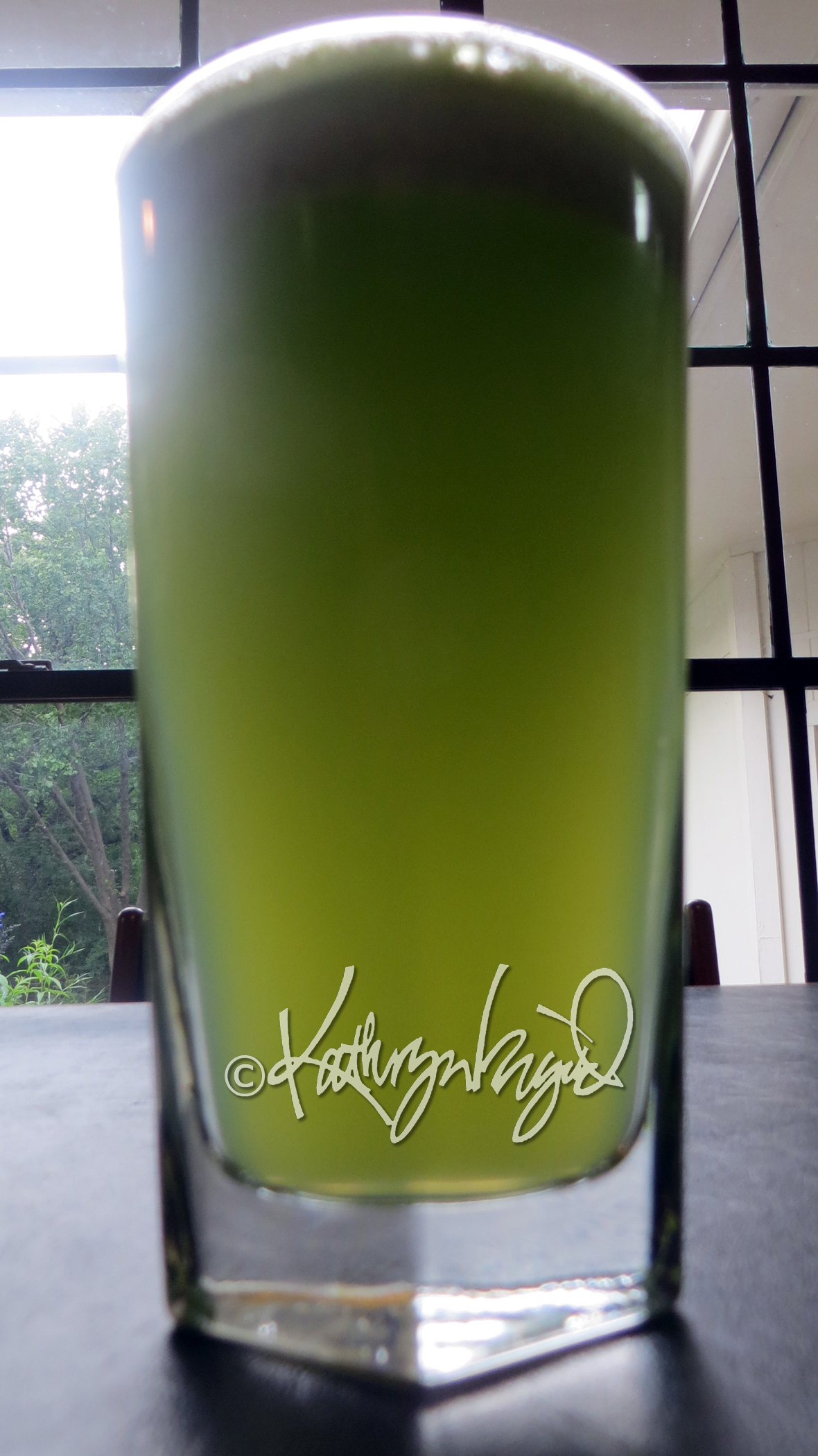
Refreshment can easily be whipped up in a swift, quenching cocktail, or it can just as easily be a thirst-slaking alcohol-free cooler. Today’s has alcohol in it, but a negligible amount, and it can just as easily be left out or substituted for with another ingredient. Drink blends are just as flexible as food recipes can be, and this one scores high for garden-fresh taste and simplicity.photoGarden & Orchard punch

1 bottle Granny Smith hard apple cider (omit or substitute unfiltered plain apple juice to de-alcoholize the punch) (12 oz)

1 bottle Sidral Mundet Manzana Verde (green apple) soda (12 oz)

1 bottle Mr. Q Cumber soda (7 oz)

Pour these together in a gallon pitcher (they make just under 4 cups together) and add (4 cups) fresh limeade to fill. Put a handful each of fresh basil, cilantro and mint leaves into a blender, pour in a cup or two of the soda-juice mix, and blend thoroughly, then strain the liquid back into the gallon pitcher and stir or shake gently. Pour over ice or just chill it in the fridge before serving, and dream happy dreams of shady woodland gardens, birds singing and gentle spring rain. Wet, tasty rain.photo

photoOh, and I happen to know that this punch goes very nicely with Smoked Tuna Dip, vegetables and chips as a light lunch or supper. All it takes, besides the veg and crisps (or crackers) is to fork-blend a tin of smoked tuna (I like Tuna Guys‘) with a big spoonful of Avocado-Roasted Tomatillo salsa (I used Arriba!), a smaller spoonful of mayonnaise, and a touch of dill. Add salt, to taste, if the chips or crackers aren’t salty enough. You’ll always have that nice, juicy punch to keep you hydrated.photo

Foodie Tuesday: What’s the Difference between an Old Smoothie and Desiccation?

photo

What does it matter whether I’m an old smoothie or just desiccated with age?

There’s no time of year that’s wrong for a tasty smoothie. Since these little flavor powerhouses can be packed with vegetables, fruits, dairy or non-dairy liquid goodness, and countless herbs, spices, elixirs and sweeteners of choice, why not occasionally enjoy a few of the day’s nutrients in a deliciously sippable form? And why not, while I’m at it, sometimes enjoy them in an outright ridiculously dessert-sweet version right in the middle of the rest of the meal? Behold the Peach Pie Smoothie. It knows no season, being easy to make with canned peaches–home canned being the loveliest, if one happens to have access to them. Never having embraced the thrills of home canning myself, I’m satisfied with finding ready-made canned fruits that are preserved in fruit juices (their own or mild flavored companion ones) rather than the heavy syrups that merely mask flavor and put the fruits into suspended animation that extends beyond their shelf life.

Peach Pie Smoothie [for one]

1/2 cup canned sliced peaches in fruit juice
1/2-3/4 cup cold water
1/4 cup whole milk yogurt
1 T honey
1/2 tsp vanilla
1/2 tsp Saigon cinnamon
pinch of salt

Blended together until smooth, this combination becomes a potable pie–and probably every bit as sugar and calorie laden as its forebear, so I’d better not make it a habit–that adds a happy note of variety to the meal of the day, whatever it is. I’d add a dollop of whipped cream to the top, given its rich dessert-like nature, but that would surely spell doom for my chances of minimizing the habit. When I say ‘that’s how I roll’ it begins to have a whole different meaning than I’d hope. Meanwhile, I’m too busy slurping to stop and whip the cream anyhow, luckily for me.

Besides this, there’s the sure knowledge that there are other sweet delights out there waiting for me all the time, and they’re not necessarily terrible for me either. The addition of salt–as you know, one of my favorite things on earth–to this smoothie has a specific purpose and reminds me of another grand feature of food that can be captured with little effort when one’s in the mood. Sweetness through the contrast with other types of flavor: sour, bitter, umami, or in this case salt. The enhancement of sweetness can also be relatively easily achieved by means of concentration.

No, I’m not referring to thinking-makes-it-so, though I have been known once or twice to furrow my brow in deep cogitation over whether I mightn’t be able to find more ways to bring out the sweetness of a dish or ingredient. My furrowed brow, however, hints at the other means to which I’m referring, because let’s face it (no pun intended), as I get older and my youthful juices start to dry up, my face does get more creased and crevassed. And desiccation is precisely what I’m talking about. Concentration sounds much cheerier, perhaps, but the meaning and effect are generally the same: to reduce or remove the liquids rounding out an ingredient or dish in order to enhance the detectable presence of the remaining portions. Salt, as a natural desiccant, can do this by means of leaching out juices as well as by its own salinity contrasting with other kinds of tastes. Evaporation, however, is another option and, though it’s a slower process than adding a bit of salt, depends on the ingredient itself to take the forefront, so to speak.

Let me just say that if anyone should call me a prune I would consider it highly complimentary, a tribute not only to my maturity but an indirect admission that I’m sweeter than most of those undeveloped youngsters out there.

Drying fruits in particular is a great way to pack concentrated, deeply flavorful sweetness into them. It seems only in the fads of recent years have we returned to a fuller appreciation of how marvelous that magic is, as evidenced in the skyrocketing prices and popularity of dried fruits of every sort, not to mention the pastes, candies and preserves we can make of them with little further effort. To wit:

OH, DRY UP!

Apricot, apple
Blueberry, banana
Cranberry, cherry, coffee
Date
Elderberry
Fig
Guava
Honeydew
Illawarra plum
Jackfruit, jujube
Kumquat, kiwi
Loquat, lemon, lime, lychee
Mango, melon, miracle fruit
Nectarine
Olive
Prune (plum), peach, pear, persimmon, pineapple
Quince
Raisin (grape), rambutan, rose hip
Strawberry
Tomato, tamarind
Uvilla, Ugli fruit
Valencia orange, vanilla bean
Watermelon (I’ve only heard of compression with this one, admittedly, not outright drying for concentration)
Xocolatl (okay, cacao is a berry that requires a fair amount of processing, but isn’t it highly worth the effort?!)
Youngberry
Zinfandel grape, zapote

photo

Peach Pie Smoothie

SPECIAL ELECTION DAY LINK LOVE!

See my youngest sister (and her good friend Rachel Myr) on Norwegian television being interviewed about being American citizen residents in Norway who still care passionately enough about their home country to pay attention to and vote in the elections. [Both the live/filmed interview and the print one are in Norwegian, but they aren’t terribly hard to decipher, really. Plus, you get to see my beautiful sister. Bonus!]

http://www.nrk.no/nyheter/distrikt/sorlandet/1.8381396

What’s-in-My-Kitchen Week, Day 3: Relishes and Remnants

photoBest way to have a head start on preparing a meal: keep lots of shelf-stable or frozen flourishes convenient–they don’t have to be artificial or toxic, you know–and be kind to the best of your leftovers. It’s important to have the usual dry goods in stock; flour or thickeners, if you use them; spices; rice or oats or that kind of thing, but small prepared items are just as crucial for time and taste’s sake. Yesterday it came in handy to have stashed a few servings of easy-to-serve chocolate dessert items like my homemade nut truffles and almond-flour brownies. Today it was an assortment of fresh fruits that rounded out the meal with no cooking and virtually no prep, unless you count washing and cutting just enough for two plates; I certainly don’t find that onerous compared to prepping and cooking actual side dishes. Tomorrow, who knows? If someone pops by unexpectedly and we sit to lunch or dinner, it’s just nice to know that there’s almost always something in the pantry that can be served up in a trice.

Or in a casserole, if one prefers.

photo

I like to have a variety of types and flavors of oils, vinegars and the like close by me–including a couple of spray-on kinds of oils for pan prep.

You’ve no doubt noticed in any previous food posts, especially if I’ve referenced my pantry shelves, that I’m mighty fond of pickles and toppings and condiments of many kinds. I tend toward the salty, savory and sweet rather than extremely spicy ones, though I’ve been known to crave some good north Indian lime pickle with my Palak Paneer or pickled jalapeños with my Tex-Mex treats. Mostly, I like a fairly wide assortment of olives, vinegar-pickled vegetables like green beans and carrots and asparagus, preserved lemons, mild pickled okra or clove-scented beets; relish, chutney, sweet watermelon rind pickles also tickle my palate, as do pickled ginger and preserved sauces, and so forth ad mortem. Because I do concede that it’s just possible I could eat myself into a happy coma followed by cheery death, given constant proximity to such dainties. Nearly all of these delights, not to mention those aforementioned (okay, I did mention! deal with it) garnishes and toppings, like the ubiquitous southeast Asian fried shallots, salted and unsalted nuts, fried herbs, candied peel and ginger, shaved coconut, and so much more, can be nicely preserved to be either shelf-safe or freezer friendly without too much difficulty.

And yes, there are commercial preparations of those and other easy-to-keep foods and edible accoutrements that I willingly stock and use. Perhaps one of the most favored is tinned tuna, but I admit I don’t like many of the commercial brands, preferring those that can only the tuna itself, usually with a little salt, and simply let it be preserved in its pristine glory and its own juices. There are more and more good guys out there who are trying to do right by the tuna and our tastes, so it takes very little effort to find them out, and the boost in flavor and concomitant decrease in artificialities are well worth it. Canning fruits and vegetables does commonly act as a killjoy, destroying much of their texture and flavor and, not surprisingly, nutrients as well. Now, I know that much of the destructive character comes from mass production and that many people are able to home-preserve beautiful specimens of both fruits and veg, but frankly, that’s almost always too labor-intensive and plodding for my energies and attention span.

photo

Dried fruit: check. Coconut: check. Tinned seafoods: check. *Lots* of good coconut milk: oh, yeah, Baby (throw-it-together curry, here we come)!

So I tend to lean toward decent quality fast frozen green-groceries if I’m keeping some around for quick use. These are often perfectly delish in soups, cooked dishes and quick pickling, where they take up the dressing and seasonings more readily than raw foods because of the slight cellular breakdown inherent in freezing. And there are, for that very reason, also a few commercially canned things besides jam or jelly or pickles that I will concede to stock on my shelves and eat. For example, I wanted a speedy picnic sort of salad the other day, so I took out tins of cut green and wax beans and baby carrots, all of which I admit would be strikingly unappealing to me for straight-from-the-can eating, and bathed them in a light dressing of plain rice vinegar, vegetable oil, orange juice, orange zest, salt, pepper and snipped dill, and had myself a tasty little salad that has fed me all week long, gaining in flavor as it sits but having been quite edible right from the ceremonial Opening of the Tins.

photo

Not quite the traditional Three Bean Salad, but perfectly edible all the same.

Salmon is something I generally prefer fresh or smoked over tinned as well, but having a couple of cans on hand does have its moments. If, as with the tuna, it’s prepared well enough to not taste of the tin rather than of the sea, why it too makes a very useful salad when mixed with good mayonnaise and seasonings and can sit lightly on crackers, in a sandwich or stuffed into hors-d’oeuvres plenty well. I’ve made mine up with Asian-grocery wasabi mayo (another good condiment to keep in the refrigerator, mind you), minced gari, and a splash each of ginger juice and soy sauce, and enjoyed it even more for those uses. When the salmon is not tinned but instead left over from yesterday’s dinner, it can do similar things. We’re not overly enamored of leftover seafood, my spouse and I, in its previously served form, always feeling a bit like it’s sure to have gone bad. But a little change-up can rescue that leftover fish too: the oven roasted salmon, smoked salmon, and a few cooked prawns from the other night’s dinner got mashed to a pate with the stick blender, using some mayonnaise, and then spread on a small Romaine leaf and topped with slivers of yellow capiscum, a curl of gari and a dab of that nice wasabi mayo–whose squeezable bottle charmingly arrives with its own built-in star tip for decorative application–and voilà! Snacks.

photo

Salmon salad–straight from the shelves of the pantry, fridge and spice cabinet.

I’ll grant you that any amount of ‘trim’ kept in the kitchen guarantees nothing like conferring gourmet status on what I make of it. And it’s a virtual miracle when I bother to gussy up my food as much as even that last little snackable item, so presentation isn’t instantaneously improved either. But having the stuff right here at my beck and call is the only way either is likely to happen, even by accident. And who says I can’t eat all of this tastiness right out of the box, bottle, jar or tin, anyway?

photo

Foodie Tuesday: My Salad Days are Not Behind Me

photo

Is it salad or crudites when it's deconstructed? Do I care, or am I just *really* hungry? Is salad so hard to eat unabashedly that it must be disguised as something else to pass muster? Is Vilma secretly seeing Ernesto at his nightclub El Gallo Llorón while she thinks Juan Maria is away on vineyard business?

Sometimes I think that Salad has a little bit of a stigma in the popular mind, even though ‘some of my best friends eat salads’. There’s just a hint that if one is too obviously fond of salads one must be (a) stuck in the 1970s–don’t get me started on alfalfa sprouts–(2) trying to lose weight and hopelessly clueless about all of the better miracle diets out there, or (lastly) some sort of chlorophyll-blooded alien. Despite the widespread knowledge that there are endless kinds and combinations of foods that can be classified as salads and that the vast majority of them are both rather tasty and potentially nutritious, there’s always some naysayer out there who thinks that there’s something just a tiny bit off about people who embrace frequent salad-eating.

I would find it seriously boring to eat salad often, too, if all salads were born alike, but that is far from the case. There are all sorts of recipes and inspirations available from every quarter, and definitions galore of what constitutes a salad. The origin of the salad construct is arguably that of a simple collation of a dish or meal, in antique times, consisting simply of raw, fresh vegetal matter seasoned with salt (the ‘sal‘ of salad), and occasionally, with vinegar and oil. The idea has expanded over the centuries gradually to include cheeses, meats, fish, eggs and nuts, and at some point probably around the latter nineteenth to regularly include mixtures of warm ingredients and often grains, legumes, and their offspring of breads and pastas as well. If you can’t figure out how to keep a salad interesting then you are as sadly unimaginative as the average politician and probably deserve to go hungry for a while to contemplate your sins.

All the same, I have no objection to a rather staid and standard sort of salad, a plain bit of greens or greens with a few ‘classic’ add-ins–juicy sweet tomato; a bit of diced avocado, perhaps–and maybe a splash of good dressing, either as a light meal or a side dish. The much-maligned ordinariness of even a wedge of supposedly flavorless iceberg lettuce can sometimes add an exceedingly welcome and refreshing bit of mild crunch and hydration to offset an otherwise heavy or over-the-top sort of meal. There’s a perfectly good reason the ‘Wedge Salad’ has remained wedged onto the menu of virtually every standard American steakhouse for so very long, in between the slabs of highly seasoned beef and the creamed This and butter-slathered That and deep-fried Other, all quite delicious indeed but occasionally in want of one coy kiss of contrast or brightness in some fashion.

photo

In our hearts, we're all kind of plain, but is being ordinary a *bad* thing? Or is it mostly just comforting? Is a salad comprising only common uncooked vegetables and dressed abstemiously with a squeeze of lemon juice and a slurp of olive oil anathema, or can it be loved for its pure, taste-able simplicity? Honey, do deer eat salad in the woods? (Or just salal?)

I suppose I could be said to be more fond of or partial to salads that take the trouble to stand out from the crowd just a little bit, or at least less likely to become jaded by them since they vary the input on the palate. Why not jazz up the greens with a bit of roasted vegetable or bright fruit, with some shredded or crumbled cheese, some toasted nuts? Give the dressing a little boost of unexpected flavor. Make it a meal by putting some handsome protein in that invitingly verdant nest. But let’s not get crazy here! At some point, a concoction too complicated ceases to be a salad and becomes either a circus sideshow not very enticing as actual sustenance or more about ideas than about taste, and I find that tiresome in any part of a meal. If food is entertaining, great, but if entertainment is inedible, don’t try to tell me it’s dinner.

For that’s what it all means to me, finally: does what I’m serving genuinely satisfy hunger? Does it actually taste good? Does it express hospitality by being sensitive to the tastes and health of guests at the table? If it doesn’t meet those criteria, all of the artful towers of constructivist salad art and all of the impressive molecular gastronomist foams and gels and powders, the foodie-swooning truffles and caviar and smoked duck ravioli and balsamic-martini dressings in the world won’t save it from death-by-silliness. Let’s hear it instead for a thoughtful, pleasurable combination of flavor, texture, color, scent and sensibility that balances the needs of the diners and plays nicely with whatever else is brought to the feast.

Lately, my salads have been fairly basic again, combining the wonderfully homely base of romaine lettuce leaves or shredded cabbage with whatever array of old-fashioned but still tasty partners I happen to have on hand and be hungry to devour and topped with a lick of some complementary dressing for the big, if unsurprising, finish. I’ll be hungry soon enough for a hit of pizzazz in some part of the salad equation, whether it’s a whole new salad or just a garnish I’ve not enjoyed in a while. Because I’d hate for the old-familiar to become dull and unappealing. That is the very definition of being too far gone to recapture one’s salad days.
photo

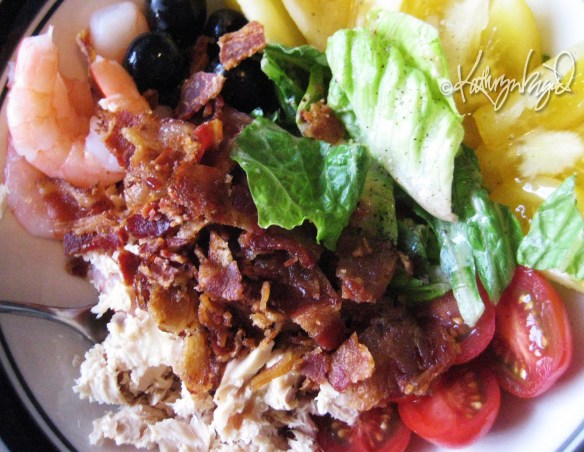
A salad certainly needn't be fussy, only friendly, to enhance the dining experience; it's more important to balance the other characteristics of the meal than to show off what wild and weird tricks a salad can be made to perform. Unless you happen to know how to, say, make yellow tomatoes turn into red tomatoes when you put the dressing on the salad or how to make origami swans out of butter lettuce leaves.

Being beautiful, after all, is more about attitude than pedigree, so I’m more concerned that my salads be composed of flavorful fresh ingredients, play a proper supporting role to the stars of the meal (the people, first, and then the entrée), and in true Coco Chanel style, always be appropriately dressed. Even Coco, I feel certain, would admit that certain occasions require tasteful nudity, but she would know better than anyone that most events are best served by a well-designed and appropriate ensemble and careful accessorizing. With that, I scratch out here a couple of my thoughts about salad dressings, which like salads themselves seldom require an actual recipe–if they need one, they may have gotten too complicated for their own good.

I think of salad dressing as a marvelous way to distinguish the beauties of a particular salad. Something astringent works better with salad than with nearly any other course of the typical meal, so if the meal needs a little flash, that’s a great place to create it. For milder needs, despite my love affair with heavy cream, I know that creaminess in salad dressings is rarely best accomplished by incorporating actual dairy cream. A better partner with salads is an emulsion, generally two liquids that want to hate each other being brought into détente by mechanical means. Typical examples would be an acid ingredient like vinegar or citrus juice and a fat-centric goodie like oil or egg yolk, the two ingredients being beaten into submission by gradually incorporating the fat into the acid with a vigorous, airy, steady whisking. Sort of like a cranky teacher putting the harsh reality of thoughts into my fat head by forceful means. Not that any of my own teachers was ever like that. (Cough! Mrs. Finley!) Once I have (or a persnickety teacher-like person has) made the dressing’s basic parts behave properly together, there are endless sorts of herbal, spicy or other flavors that can be invited to play along with them for individuation and to better suit all of the dinner’s other ingredients.

Here’s a little combination to try: 1 part ginger juice (freshly grated ginger root will do, if you don’t have bottled juice), 1 part soy sauce, 2 parts maple syrup or raw honey, 2-3 parts lime juice, 2-4 parts macadamia or coconut oil (or any mild flavored oil you like). Put them all together in a tightly lidded jar or bottle and shake vigorously. Adjust to taste. Dress the salad just before serving or let guests dress their own salads. Fitting add-ins or add-ons for this sort of dressing are toasted or black sesame seeds, ground black pepper, toasted sliced almonds or pine nuts. Well suited to mixed green salads with sweet orange segments, diced dried apricot, ripe avocado, grated myzithra cheese, kale, thinly sliced jicama or daikon or sweet radish, or . . .

What? You can’t hear me over the crunching? Well, then, grab your salad fork and join me. I won’t tell anyone you’re one of those, you know, salad eaters.