Dream a Little Dream . . . But How to Choose?

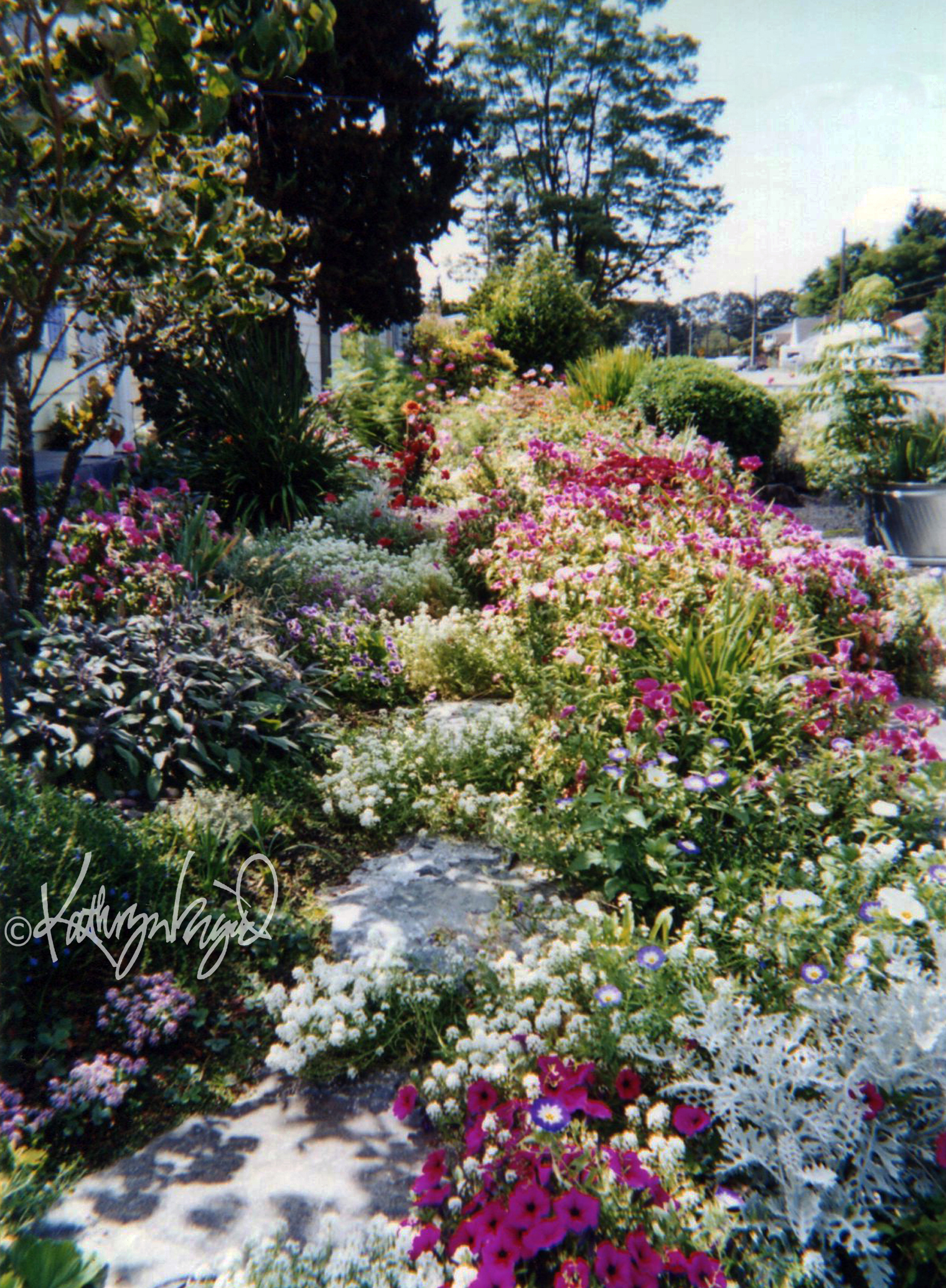
photo-collage + textI never tire of fantasizing and imagining my ideal. But some days it’s really hard to decide what would be better. To be slung sidelong over a rocking chair in the wash of yellow afternoon, watching the lift and ruffle of wisteria where it is teased by currents chasing around me on the old screen porch, drinking Blackberry Acid and reading Evelyn Waugh while the sound of Gershwin laughs its way out the door to shake the sleepy cat into a semblance of watchfulness? Or perhaps I should the rather be curled in a high-backed leather wing chair with Zola, maybe Garcia Marquez, a faint dark stain of Verdi’s Requiem insinuating its way slowly through my brain, the lamp turned barely high enough to read so that it doesn’t fade the firelight or those lights fourteen stories down where the city shimmers below, and with the scent of Boeuf Bourguignon drifting into the paneled room from where it’s simmering down the hall?photo-collage

Yes, I say, sometimes it’s hard, so hard to choose which I should prefer. Would it be finer to be wandering up a quiet path in checkered green light, perfumed with the heady incense of cedar and douglas fir, emerging from their shadows into meadows lapping with avalanche lilies and paintbrush and gentians at my feet as I climb up higher, drowsy with the sun and hypnotized by the river crashing away, just out of sight, to my right, and stopping at last to rest on the stony shore of a glassy lake and slake my thirst, assuage my hunger, with a crisp sweet apple and some salty well-aged cheese? Or should I better like to stride out through wildly waving waist-high grass onto the dunes just as the lowering sky with its mass of high black clouds starts spitting a sand-fine mist of icy rain, but bundled so warmly to the eyes that only my cheekbones feel the chill, and watching the storm blow up a wave so high it seems to engulf the top of the sky before it shatters to smithereens on the bouldered bulkhead there–and just as that cloudbank starts to split to disgorge its mighty gout of rain, tearing up the beach to the safety of the white-painted cottage, where I peel off the layers of storm-proofing down to my jeans, drag the little table to the window to watch the show, cracking the Dungeness crab that I bought at the shop today, to drown it in butter while watching the shoreline also drown, and eat crab sweetness messily to the tune of pelting rain and smashing sea?photo

I suppose if all else fails I could simply ask my butler to make the selection, you see. No, this one I know: I’d rather ask my love, since whichever it is, it’ll be that much better a dream if he will only share it with me.

Place Your Bets and Get Moving

Much as I’m drawn to wondering what lies ahead, guessing, inferring and even betting on probabilities, am I in danger of defining-by-divining? It’s easy to get so immersed in the practice of my prognostications that I start to believe in them as the appointed future and let them become my default reality. What a pity if by over-enthusiastic crystal gazing and navel gazing and pseudo-scientific extrapolations I manage to constrain my life to what I expect it to be rather than letting it unfold and taking full advantage of what I’m able to create out of those things with which life presents me as I roll along.graphite drawingCandling eggs and reading ultrasounds of one’s innards and charting historic patterns–divination by trusted means–that’s all well and good, but only as a thought-provoking guide for what may be, and after all, if I don’t like the sound of the predictors, why on earth should I sit around and mope instead of defying the gravity of the situation! If I am to have any true resolutions for the future–the new year now unfolding or indeed, anything more than that–I’d like to think they will be about living that future in full, about being present in my present as it comes. I hope to be sometimes engulfed in the sweep of current life and sometimes embracing the immense and bracing Possible contained in every living moment with openness and imagination, hanging on for truly dear life. Let me dare to be fully, wildly, passionately alive while I live and not entangle in what-ifs more than is actually useful.graphite drawings x2Everything we do with our days and with our hearts and minds and skills and nerve can be spent on worrying and wondering, if we take ourselves and our powers of prediction and over whatever mysteries lie in wait too seriously. Or there can be enormously exhilarating challenges and opportunities and blessings blooming in abundance, scattered around and waiting for recognition and engagement. I hope that I am growing wise enough at long last to let go of fear and inhibition and the fungus of fatalism encroaching on assumptions of a fixed and implacable future, to instead spend much more of myself on the kind of work and action and play that happen gladly in the moment of their discovery. Time, I say, to get moving and try those wings.

Into Tomorrow, Endlessly Singing

You all know by now that I am not a singer. I get asked all the time, since I’m married to a choral conductor (who happens to also be a lovely singer himself) and I hang out with an enormous cadre of the vocally talented. When I demur, I get asked what kind of musician I am, then, because after all, so many denizens populating the rest of our joint life are outstanding composers, instrumentalists, conductors, and all of the rest that, well, it just seems so obvious. In truth, I did take the obligatory childhood music lessons–about five years at the piano, if you remember–ending with a certain rueful amusement on my teachers’ part but no great skill on mine, plus a brief period of voice lessons from a well-meaning coach who’d heard my sisters and me sing and gave the elder two of us a go. Where again, my failure to learn to read music with any ease was further complicated by my inability to understand and make use of the very important concept of singing with a head voice. Having become accustomed over my earlier years to being mistaken for Dad on the phone, or for an older girl because I was extremely shy and therefore more reserved than many kids my age plus having a relatively deep voice for a girl, or for a more skilled singer than I really was because I was willing to sing any part–and did, at one point, sing in all four choral sections because that was how the need was distributed in my various school and church choirs–well, it all probably let me learn a whole array of bad vocal habits that pretty much put the kibosh on my becoming an actual skilled singer. The likely absence of a notable native vocal “instrument” wouldn’t’ve helped either, had I tried to force the issue, but by the time that I hit high school and time management demanded that I narrow down my interests a bit, choir fell off the list other than occasional singing at church. Who knew I’d end up partnered with this guy!

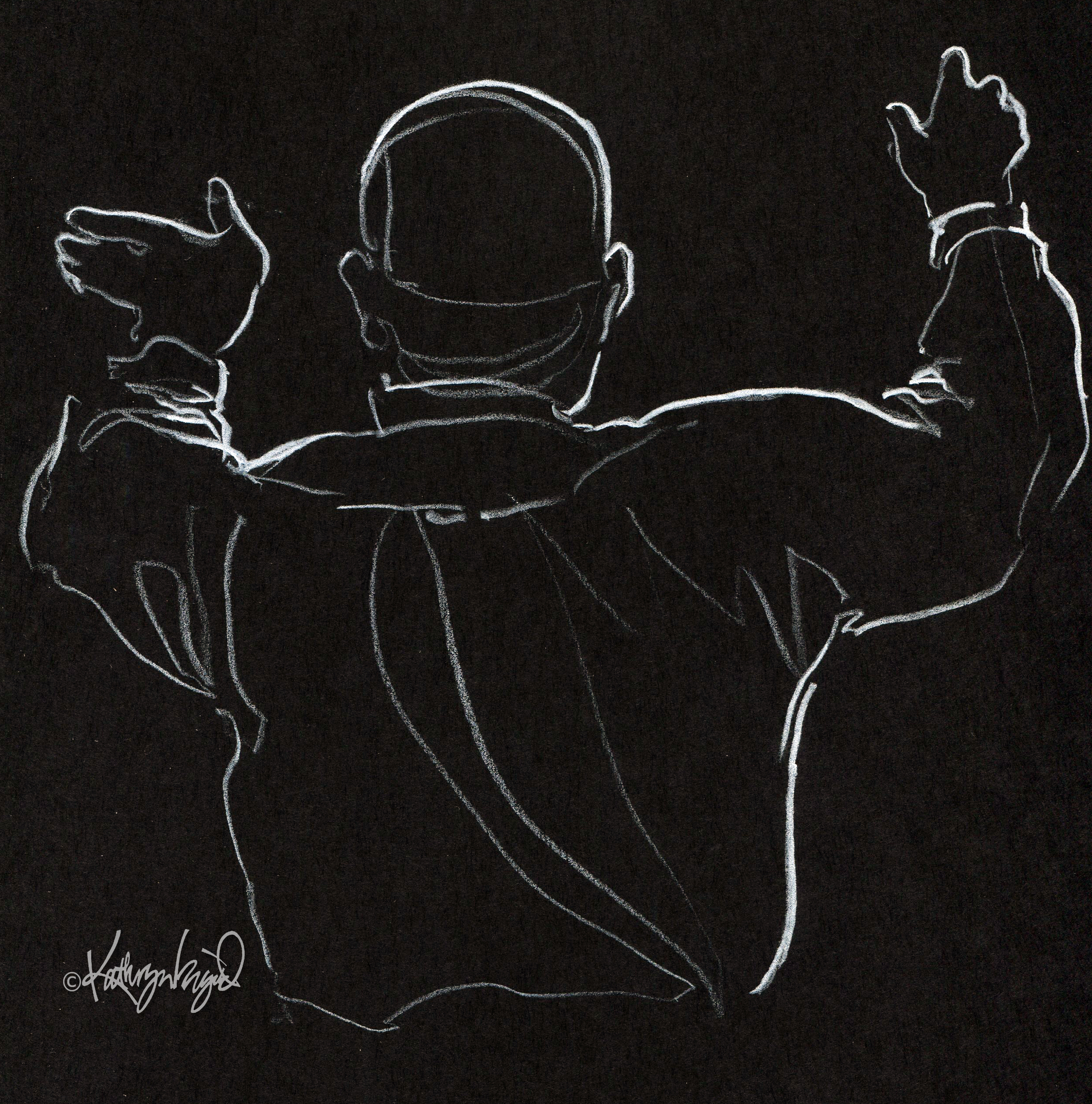
white pencil on black paper

Sketches from a Swedish Radio Choir rehearsal, my husband conducting (if you've seen him conduct enough, you can recognize even the rough sketch of his hand positions) . . .

But as I also pointed out some time ago, the influence of music and of singing remained large and happy in my life, even if I was not destined to be a producer of them. I continued to love listening, cultivated many musical friends who provided the sonic tapestry that was the backdrop of my happiness, and even collaborated with musicians on projects where they provided the aural elements of a performance and I the visual imagery to accompany it. For a few years, I served on the Concert Committee that produced a reasonably ambitious season of musical offerings at our church, which was conveniently located just across a university campus from the music department where many of my fine-musician friends happened to work. It must be added, in fairness, that the draw of being on said Committee was not purely musical but also deeply social, what with all of the musicians and music-lovers therein, and also exceedingly delicious, because most of the musicians I’ve known are committed eaters if not foodies and so the Committee’s meetings quickly evolved into elaborate gustatory events as well.

And that’s precisely why music has remained so largely writ in my life, if not burgeoned and positively exploded, over the years since: music is so intertwined with so many parts of what I love in life that I can’t separate one happiness from another. If music be the food of love, play on! What hasn’t followed for me is what followed for Duke Orsino, because I never found either that I became surfeited by listening to good music or that I became surfeited with love by loving life with musicians–one in particular. Tough luck, your Grace! So I am not dutifully following, wagging my tail obsequiously, as I go to a rehearsal and sit in the darkened hall while choirs work their repertoire into their voices and souls to prepare for performance; I am both absorbing the inner workings of music that don’t exist in me innately or by scholarly wisdom, so to appreciate and bathe in the final production all the more, and also having the beauty of the practice itself wash over me in waves that can inspire me to write, to draw or paint, to design my better garden bed or concoct a more delectable dish for dinner. Waves that, at their best, lift me out of myself and let me feel the singing pass through me as though I, non-musician-non-singer that I am, with spasmodic dysphonia that presumably means even if I ever figure out my head voice and/or learn to read music, I won’t become a great singer–as though I myself were singing.

So, though I may struggle to sing a simple ditty nowadays, I have this magnificent vicarious experience available to me that few are privileged to share, and in this rather out-of-body experiential way expect to sing my way through the rest of my very happy future. As I do the usual end of the year assessments and look ahead to what I imagine and hope for the year soon to come, the imagery is suffused in every possible way with music. I am immersed in song. I write lyrics because I cannot sing them. I listen to rehearsals because I cannot read music well and don’t know the inner workings of music preparation the way performers and conductors do. I attend concerts because the kinds of beauty and grief, daring and humor, poignancy and brilliance that come through well made music embrace, interweave and transcend all of the other parts of my life so that I feel transported, changed to a better self. As though I too am singing in a song that may never have to end.

white pencil on black paper

Conducting another Sparkling performance . . .

Foodie Tuesday: Lefse as History

digital imageMama’s Justifiably Famous Potato Lefse

[This is a recipe she developed in collusion with a group of faithful Old Norskies in Puyallup, Washington, one of whom added the strict instruction that the lefse must be rolled “so thin you can read a faded love letter through it”. I’ve spelled out the procedure here in my own words, so Mom can’t be blamed for that part of the recipe!]

8 c. cooked and finely mashed potatoes

1/4 lb. butter

1/2 T salt

1/4 c. potato cooking water plus 1/4 c. evaporated milk

2-3 c. flour + more for rolling the lefse

Take a gallon bowl filled with 8 cups of riced cooked Russet potatoes, still hot, and press 1/4-pound piece of butter into the middle of it. Put a generous 1/2 tablespoon of salt on top. Pour a mixture of 1/4 cup of the potatoes’ cooking water plus 1/4 cup of evaporated milk over the top of the salt. Mash everything together thoroughly and mix it with 2-3 cups of flour. This makes enough dough for 20 lefse. [Yes, Mom was likely to make a triple recipe or more for many occasions. Eat one piece and you’ll know why.]

The flour amount should start out as small as possible and only get the potatoes into a very light dough-like, rather spongy consistency, and not stick to your hands as you mix. The more flour added, the tougher and drier the finished lefse will be. Mom almost always did the potatoes the day before their appointed baking day, rolled the tender dough into logs about 3″ in diameter and wrapped them in cling film, storing them in a cool place. The fridge is forever too crowded at the time when you’re lefse-baking for festivities of any kind, so if the weather was cool enough, the potatoes usually waited overnight on the workbench in the garage in that state for their final apotheosis.

Baking day is invariably messy and laborious, particularly on the days of multiple batch preparation. One does best to have the correct tools for the occasion, and they are many and specialized. First, you really ought to have a lefse griddle, which is a flat, circular electric griddle about 18″ in diameter and capable of reaching around 500º F in temperature. You’ll also want some nice old flour-sack dish towels or linen tea-towels to stack freshly baked lefse between on the counter as you take them off the griddle. You’ll find it helpful to have a pastry rolling cloth on your work surface, because not only will it keep the lefse from sticking as easily to the countertop, it’ll also help hold the lovely texture of the lefse’s surface that is so ideal for carrying oodles of melted butter and other fillings.

Make sure to have not just a rolling pin but an actual lefse rolling pin, a wooden pin whose roller surface is scored to create the optimum texture: some are simply grooved with parallel lines around the circumference of the roller and others, like Mom’s, textured with a full crosshatch of about 1/16th-inch grooves). Most people using the lefse rolling pins also like to use a soft cloth sleeve over the roller, because (and you can guess how I know this), a very soft, tender and potentially super-sticky dough will create a remarkably gunky agglomeration in the grooves of the pin, and lemme tell you, it’s a serious undertaking to get that concrete out ever again. Think about how many of those little grooves are on a whole rolling pin. Think fondly of an early death. Nahhh, just cover the pin.

Last and not least, it’s good to have a really fine lefse turner. Yes, the person who will flip the lefse when it is appropriately birthmarked on one side with light brown speckling to give the other side its chance for equally pretty freckling, that person will be an important part of your equipment. But even more important is the modest sword-like object known in our household as a lefse turner. It’s a flat stick around a yard/metre long. Yes, it would probably be entirely possible to use an actual sword for the purpose, but if you did, what would you use to fend off the ravening lefse-starved Viking invaders whilst baking? You could probably use a yardstick. Then you might well benefit from the ability to measure your lefse’s circumference in the very midst of moving them from griddle to stack. My mother has two lefse turners of both great practical beauty and artful grace. Gramps handcrafted them from fine-grained wood, making a 3/16″ thick x 2-1/2″ wide handle end pierced with a hanging hole and tapering them down to a soft ovoid tip less than 1/16th” thick, each turner sanded down to perfectly smooth softness so that it feels as sweet in the hand as that aforementioned sword ought to do in a master swordsman’s, and able to slip its narrowest point easily under a magically tender hot lefse to lift it from the griddle to the cooling stack.

photo

Mama's lefse turners, handcrafted by her father, hang on her kitchen wall.

With your mise en place, off you go. Slice the log of soft potato dough into evenly measured pieces that, when you pat them gently into shape, are about the size and shape of a slightly smaller diameter, slightly thicker than typical hamburger patty (twenty pieces from a whole batch, if you remember). Keep them rather cool, so that they don’t become more difficult to roll–they’re sensitive enough as it is. Gently flour the outside of a piece of dough, pop it in the middle of a small handful of flour in the center of the pastry cloth and roll the lefse out into a circle of delicate, ethereal, dainty, lightly textured sheerness as big as you can fit on the lefse griddle–even a tiny bit too big, because it’ll retract a tad and shrink to fit the griddle as soon as it hits the 450-500º heat; test to see how quickly your griddle bakes the flatbreads without either scorching or drying them out.

You don’t want the baked lefse’s spots too dark brown–lift an edge and check occasionally as they cook. You don’t want too much flour flying around–always use the smallest amount you can get away with using. You don’t want the lefse too dry–they’ll dry a bit as it is, when they’re awaiting use. As you can imagine, during the baking day one works hard, gets hungry, and smells buttery mashed potato dough cooking, so some of the lefse will not live long enough to worry your pretty little head about any real drying-out problems with them. Some will have to be rescued from their intended wait immediately for slathering with beautiful melting butter and eaten instantly. After all, there are always some lefse that resist the most valiant efforts to make them into a perfect circle and choose instead to replicate maps of various continents, and once you get too far away from Australia-looking they’re just not going to fold into even quarters for the standard packaging and serving format and it’s best to destroy the evidence. It’s sort of like James Mason’s delightfully dry remark in ‘11 Harrowhouse‘ when he’s found apparently in the midst of removing the contents of a diamond safe: “I’ve eaten the inventory.”

What else is there to say? Roll. Bake. Lay a freshly-minted lefse flat on a clean towel and cover it with another towel. Roll. Bake. Lay the next lefse on top of the first and cover it with that top towel. Repeat until all of that carefully crafted dough is baked into giant, tissue thin circles of lightly moist flatbread. When the whole batch is done, either eat it all for supper or let it cool under its towel, carefully fold each piece into quarters and then package small stacks of the finished lefse in zipper bags for the counter, refrigerator or freezer, depending on how long until they will be eaten.

And what is all of this enormous effort for? Some, including members of my own family, would say as Grandma W said regarding lefse’s cousin kumpe (Norwegian potato dumplings) that it was “a lot of work to spoil potatoes”. Others revere them as the Norsk version of the Mexican tortilla, Middle Eastern pita, South/Central Asian naan, or any other culture’s soft flatbread. Making lefse is of course potentially a fine way both to preserve the Norwegian culture in both country and family, as well as a social event. You know me, though: Lazy Girl helped only when I had to other than in the devouring of the finished product. It was usually other relatives and friends that pitched in with Mom in the manufacturing of lefse. And it’s so fragile, both as a tensile object and in its moisture content, that it doesn’t taste good for very long.

So in my opinion, what this labor of love is about is, well, love. Secondarily, it’s about a great potato flatbread best hot off the griddle and smeared with fresh butter only, as it always was preferred in my family. Others like it best with sugar and perhaps some cinnamon sprinkled on it before it’s folded up and jammed into their mouths, and we would sometimes, if the day had grown extra long and laborious over multiple batches of lefse, make a heartier meal of it by making a sort of quesadilla out of a hot lefse with some cheddar or Jarlsberg cheese and thin slices of good ham folded and warmed inside, not a bad “sandwich” at all.

In any case, I can tell you that there are many who will vouch for Mama’s inimitable lefse as the archetype of all potato lefse. But then, you already knew that Mom is pretty much the archetype of moms, so what would you expect! As for Grandma W, she may be forgiven for thinking potato dumplings, and possibly lefse as well, too labor-intensive for their meager culinary payoff since she grew up in her immigrant father’s grocery store and might have considered it better to enjoy prepared foods in that Modern, American way.photoThat’s Grandma, by the way, the little barefoot girl in white, Christmas-tree-tipping Auntie Ingeborg behind her, with their parents and little brother and an employee (haloed in window light) in Great-Grandpa’s grocery store. Lefse or no, they apparently did have some fine food on hand! May all of you dear readers eat well–whatever you’re eating!
Fanfare

My friends, whether you celebrate Christmas or not, between that and the coming of the New Year this is certainly a time of year in the western world when the presence of Christmas and New Year advertisements and discussions and preparations are ubiquitous to the degree that many of us still get drawn into the whole element of assessing our lives and our places in both the temporal and our inner worlds. It’s not a bad practice to do a bit of examination and evaluation from time to time anyhow, I think. Regardless of beliefs and philosophies, hopes and dreams, politics and projects, we can all benefit from a bit of gentle thinking-through about what matters to us. Somehow, for me that makes the end of a calendar year a cleansing time and a happy one in which I can look forward to a grand and hopeful entrance into the year just ahead.

With that in mind, I wish all of you great happiness in this time. I hope that you can find all the friendship, healing, comfort, peace and joy you desire, now and in the year ahead. And if you do celebrate Christmas, I wish you a truly happy one. If it’s Hanukkah for you, L’Chaim! If you’re preparing to celebrate any other holy days or holidays or are simply going forward full steam ahead with life, I send you my most heartfelt wishes for these delights to fill you now and in the year to come.

digital imageRinging Twelve

As the midday bells are sounding,

Morning light sharpens to blue,

Quiet moments find their grounding;

Thought needs no more things to do

To resolve all unsolved queries,

Weary, troubled, trying times–

Now thoughts rise to higher aeries

In the bell tower, where chimes

Ring new peace, and calm awaken,

Where new joy can sweep away

All the old thoughts, now forsaken,

At the bright noon of the day.

photo + textFanfare

With trumpets blazing bright as stars

The grand procession moves apace

To urge us from a darker place

Into the light no shadow mars

Nor chill cuts in; no drop of gloom

Can enter when this day springs forth

And blossoms cross the secret north

And leave no sorrow any room—

Let each take up the pageant’s pace

To follow at the trumpets’ call

And sing their joy to one and all

In this extremity of spacedigital image collage

The One Person More Lost than Me

photoMom has taught me a whole lot of things. One of the most useful is how to turn one of my most frustrating shortcomings into a strength.  It’s a skill I’ll still spend the rest of my life polishing, but having been taught the basics, I know what I need to practice, and that is a tremendous boost.

My lifelong shyness and social anxiety rose to a not-at-all-surprising high level when I started college. The small university I attended was hardly an unknown element to me, as my parents and a couple of other relatives, as well as some friends, had attended there and my older sister was already starting her junior year there when I arrived. But being predisposed to fear and intimidation as my responses to all social situations, I was guaranteed to struggle with extra doses of my old hauntings by the terrors of interpersonal experience in the new to me surroundings, with a roommate I met the day we moved in to our shared dormitory space, all new classmates, new teachers and administrators and a neighborhood where I’d never more than visited briefly before.

For the most part, I muddled through just as I’d done since I was old enough to know how to be afraid of new people and situations, and even had, as always, plenty of the enjoyment I was capable of having. I did acquire a number of grand new friends, including my roommate, who turned out to be a fantastic companion and like-minded girl. I took classes that challenged and intrigued me and I dragged up enough courage to participate in some events and extracurricular activities that broadened my scope significantly. I was surrounded in my living quarters in an all-female dorm by a cadre of terrific young women who bolstered my puny sense of self and cheered me on like the best of good neighbors.

But one day, as the first year progressed, I was visiting informally with a handful of those girls and we got into a discussion (as college coeds still often do, from what I’ve seen) about First Impressions. One of the girls, to whom I will be eternally grateful, let it slip that on first meeting me she had thought, and had since learned that others had too, that I was Stuck Up. That’s the simple classification among my tribe of someone who thinks herself superior to others and disdains and dismisses them. I was dumbstruck.

She went on, hastily, to add that on getting to know me she had realized that the reason I often refused invitations, that I didn’t look people in the eye, and that I evaded interactions and conversations instead expressed a defensive retreat into my giant ossified shell of shyness and my fear of all things new and unknown and that, in fact, she and others really enjoyed my company. That was some consolation, but realizing through her honesty that I projected an image far less benign and far more distancing than I guessed, I knew I’d have to somehow wrest my way out of the armor I’d built around myself and at the very least learn to act the part of someone with social skills even if I didn’t have them.

Naturally, I went whimpering off to Mom. And she surprised me by going beyond the sympathetic and consoling mother needed in the conversation. I’d never imagined that this person I’d always known as having not only a mother’s authority but a certain status as both the recognized Favorite Mom among all of my friends over the years and a kind of built-in First Lady of all of the organizations in which she participated, not least of all as the pastor’s wife–that she had another side, one not so entirely different from my own. That she had been deeply intimidated by being expected to play the roles of guide, hostess, chief female church member, community do-gooder and cheerleader, and all of the other philanthropic and social leadership parts inherently assumed by others to be part of her place in the world. And that, when Dad was busy being the speaker, preacher, chairman, boss and whatever his role of the moment happened to be, she was stuck in meetings and receptions and services and classes full of strangers who expected her to carry not only her own weight but that of whatever they thought was required for the occasion.

I almost wilted, thinking of what it must have been like for her.

But then she imparted the piece of wisdom that ‘cracked the case’ for me. I got the MacGuffin: social anxiety and extreme shyness assume that I am the center of the universe. That the rest of the world is watching me and is dependent on my doing or being certain things for its success and happiness. And that I am suffering the most for the cause. She put it in much more tactful terms, I’m quite certain, given that I was a flimsy excuse for an ego, a fragile not yet twenty year old still unable to see my path in everyday life clearly.

I think what she really told me (from which I extrapolated the above) was the incredibly handy ‘trick’ she’d learned for coping with all of these unreasonable social and activist demands. When you arrive, immediately look for the one person in the room more uncomfortable and more out of place than you. Even when you’re absolutely sure it’s not possible, there’s always someone more scared, more intimidated, more inexperienced or at the very least, who thinks that they are. It’s true, by the way; I’ve seen it proven over and over since. Go and gently introduce yourself and ask this person about him- or herself. Make this person the most interesting part of your life while you’re there.

That’s it, really. Suddenly, it’s not my job to be perfect or achieve the goals of the event or even to be interesting or brave; it’s my job to make another scared person feel more welcome and at ease. I don’t have to spend any energy on worrying about how I look to others or whether I’m doing what I’m supposed to be doing, because nobody with an ounce of sense is going to argue that taking care of someone in need isn’t what we’re all supposed to be doing, that recognizing that there’s someone whose need is greater than our own isn’t precisely the most attractive thing we can accomplish, and that a friendly smile isn’t the most fashionable item anyone can wear for any occasion.

I fall down on this effort often enough, still, and do my well practiced imitation of an additional pillar holding up the dimmest corner of the room. I haven’t Saved anyone else from the brink of doom through my heroic attempts to cheer them up for a half hour. I still have impressive dramatic skills in making faux pas and pratfalling my way through the day and then doing my best to make the earth swallow me whole.

But afterward, I remember to quit imagining myself the cynosure of Creation, let go of my need to be correct and impressive and likable and spend my energies on helping someone who doesn’t know Mom’s useful little technique to feel more correct and impressive and likable. I will put on my shiny smile and play the role of somebody better than me and hope that someday, if I practice it hard enough, it will become second nature and I won’t even have to work at it at all. It makes me smile just thinking about it.

If you happen to be headed to yet another office holiday party or first-of-the-year reception any time soon, you can test this theory yourself. Thank my mom. Or, if you happen to subscribe to a certain story that is commemorated on this very night, thank the Person who became most vulnerable of all in order to protect and rescue everybody weaker.

photo

A Sort of GPS for Traveling through Life

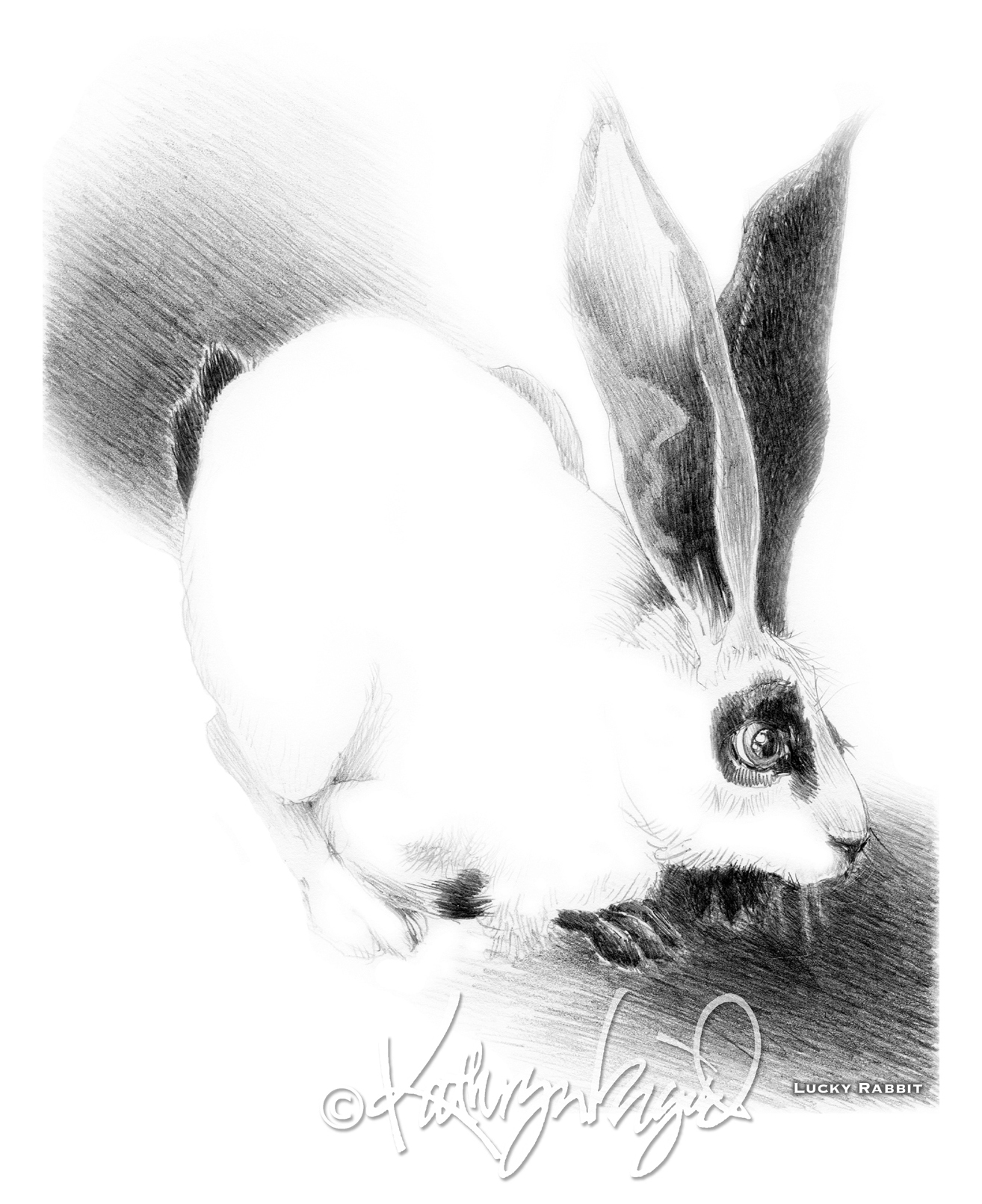
graphite drawingWhile I’m Rabbiting Around

Out in the widest open spaces, and the wildest places, too,

I have the tendency to racing ’round as rabbits tend to do;

I get a wild hair and I tear off just as often as I can,

Run all harum-scarum into Nowhere–yes, like any man,

Woman or child who senses freedom, hopping haplessly amok

With no goal or real direction, until suddenly I’m struck

With the knowledge I’m abandoned, lost, no compass-point in view,

Leaping like a rabid rabbit, with no hope, so far askew

From a purpose, from potential friends and comforts, joys and dreams

That I realize my running’s not the freedom that it seems,

That the beckoning horizon’s better when it holds a prize

I can dash toward, ears pricked upward, light a-dazzle in my eyes

And the scent of grand achievements drawing me to hare ahead;

All of this makes great the dashing and the derring-do, instead

Of tangential, random rambles, jumping pointlessly around,

And I’m glad to race and rabbit onward now, to higher ground
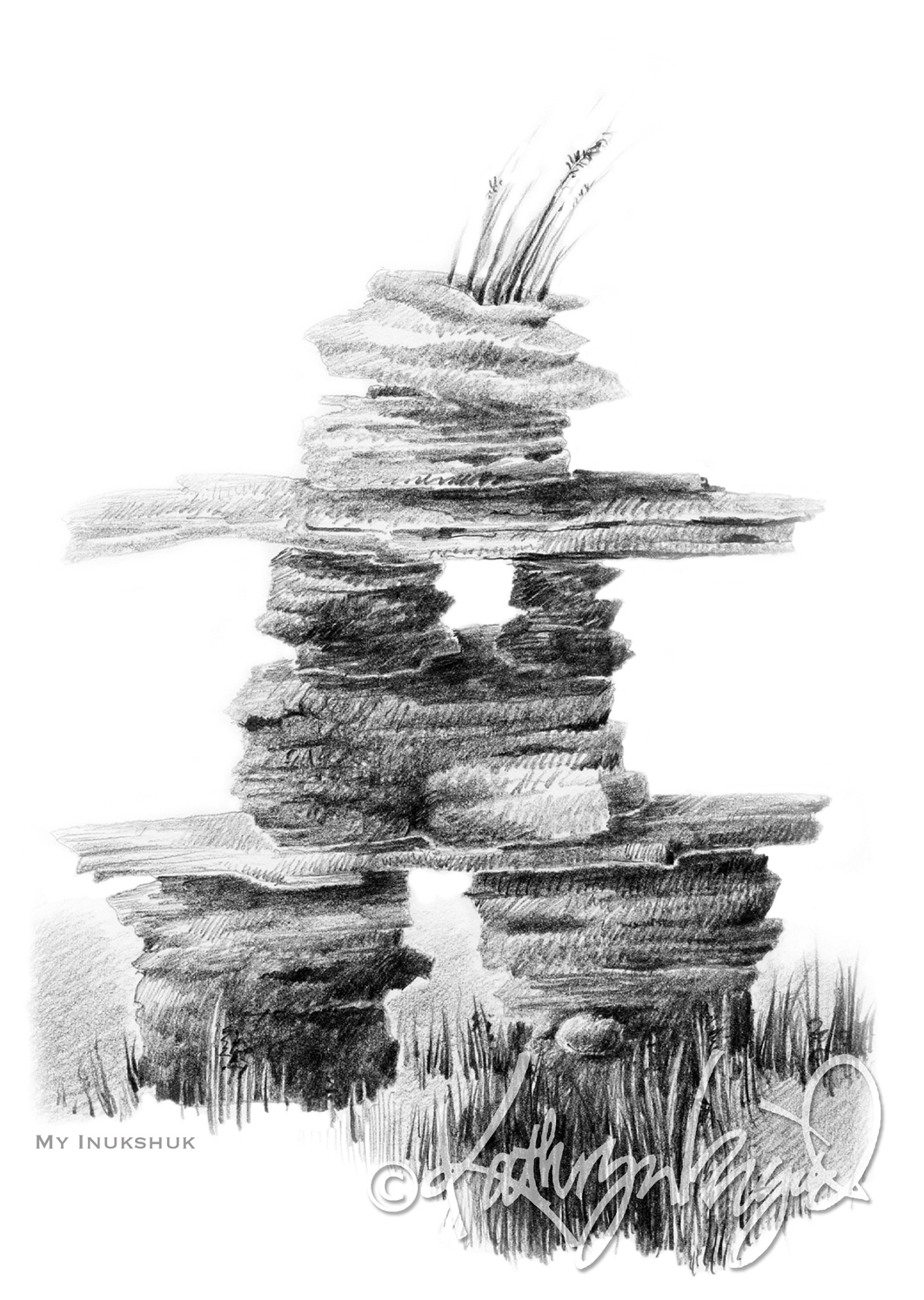
graphite drawingMy Inukshuk

Should I leave my friends a signpost

Where, I wonder, will it lead?

What will mark my place of passage;

Will it serve them in their need

For direction or for comfort?

Will it offer strength or hope?

Should I leave my friends a signpost,

Can it guide them up a slope

To a vista rich with promise,

To an exponential view

Always growing and expanding

With delight, as it should do?

Should I leave my friends a signpost,

I would like to have it guide

Them to grand and gracious places,

To that glorious countryside

Made of sweetness and of pleasures

Great as travelers can see;

Should I leave my friends a signpost,

Love is what the sign should be

There is Not Enough Chocolate in the World

photo collage

This is the anniversary of one of the truly important days in world history. No, I’m not as confused as you think. (Not in that way, anyhow.) I’m not referring to Christmas and getting the date all wrong (nor Hanukkah or Ramadan or Eid or the Chinese New Year or Samhain and getting the date that much wrong-er). December the twenty-second is, in fact, the anniversary of the birth of my Number One Sister. And that is a very big deal.

Believe me when I tell you that there are not enough superlatives in the world to describe how fortunate I feel to have followed in her footsteps, even if I make up really cool sounding words for the occasion.

My big sister paved the way for me. She test-drove our parents through child-rearing for nearly a full two years before entrusting little me to their care–and hers. She trained them in the ways of infants and toddlers admirably, and continued to lead the way right through our developmental (emphasis on the last two syllables) years, both for the parental party and for her pesky little sister. Why, in fact, she didn’t “accidentally” lose me, sell me to a traveling circus or bump me off on certain occasions remains a complete mystery.

Instead, she was a great playmate and co-conspirator. She was both a good enough student to set up positive expectations of the family lineage when I followed her into her former teachers’ lairs and also enough of a strong-minded individualist that they dared not assume we should be compared–thank goodness, as not only were we always distinct in our personalities and tastes but she was easily a more natural scholar than I was and I’d have drowned in those expectations. And she was Firstborn enough to assert her right to test all boundaries and, occasionally, the parental patience, just enough to make my follow-up look that one necessary shade paler by comparison. That’s us in succinct terms, one might say: I’m pretty good at life’s tasks in general–learning, adventuring, inventing, enjoying–and she’s always a notch more substantively and colorfully so. The great thing from my perspective is that I never felt this as a shortcoming on my part but rather that I’ve lived in the presence of a fine example of levels to which I can aspire. I am working on it.

Meanwhile, back in the land of sisterhood, I have this amazing friend who was waiting for me the day I showed up for my first public appearance and has embraced, cajoled, guided, teased, taught, humored, chastised and entertained me ever since. The exemplar of Big-Sisterhood. One I can say anything to and ask anything of, and she still loves me. Even when I’ve been utterly unlikable (I know, it’s hard to believe I’ve ever been a stinker, isn’t it!), she’s stuck by my side. Or at least waited somewhere backstage to reclaim me when I finished my big scene.

Now, I won’t immerse you in treacly lies and say that I think anyone is perfect, not even my sisters, as fabulous as they all are, but I wouldn’t dream of changing a thing. When I showed up on the scene I was immediately gifted with a built-in mentor and companion, and that has never altered. So when I say Happy Birthday to my big sister, it’s always doubled by my sense of having received her as my own first birthday present too.

From that point forward, she has been coaching me in all of those skills and arts most meaningful in living a full life: curiosity, assertion of self, living by one’s convictions, passion for those people and things that matter, playfulness, generosity and a good appreciation of the ridiculous. She taught me, more than anybody else, how to laugh until my face aches and my lungs are bursting and tears are shooting out of my eyes as though I’d had a squirt-gun transplant. And she taught me the proper respectful adulation of all-things-chocolate.

How’s that for a long way of saying there aren’t enough words! But you know what I mean, especially if you have been lucky enough to have a sibling (let alone three) so worthy of hyperbolic paeans. Yes, I think it’s grand that all of those other marvelous and perhaps more widely recognized holidays and celebrations are right ahead, but I have every reason to celebrate this date with elation and a great deal of gratitude, so if you feel like raising a toast or hugging your sister or setting off some nice fireworks or sending my sister a chocolate cake (with chocolate filling and chocolate frosting and hot chocolate on the side) or anything, feel free to join right in and consider this a very worthy day for such things. Happy Twenty-second of December!digitally enhanced photo

Interludes

photoContinuity

Winnowing chaff from new-cut heads

Of grain, the girls toss up from trays,

Flat-woven from the grasses there,

The seeds in ancient ways

And let the antique wind blow out

The husks in clouds of gold,

Then bow back down to seek more grain

As in the days of old,

For nothing changes in the dance

Each time the story’s told.photo

Elixir

They all were young and fair who sat

Under the rustling summer trees,

The copper beeches, lindens; these

Broad green allées of hazel that

Gave shade and silver glints of sun

In rhythm with their part-songs, airs,

And with their sweet dallied affairs

While laughing brooks made haste to run

Away, as time is wont to do,

And youth, but these stayed young and fair

Forever in their summer air

Because their songs of love rang truephoto

Empress of the Ordinary

digital graphicOrdinariness is not a vice. It has taken me most of my life to grasp that home truth, to recognize the sublime simplicity that what is ordinary is not inherently bad. It’s not even necessarily boring or predictable, though most of us treat it that way and make it so.

It occurred to me as, for the umpteenth time in my life, I was marveling at the biography of some outlandishly gifted famous creature and reflecting on the comparably slack bag of tricks that could be held to define me. No one, I thought, will ever have reason to pore over my biography, no, not even to write it. I never so much as kept a diary for more than a few brief delusional periods before being recalled to my senses and silence by the glaring absence of exotica to lure even its author to reread it, once written. What is the great magnetism of the larger-than-life character’s story, I wondered; why am I compelled to recount and savor the life stories of those who loom heroically or with great drama or grand style on the horizon?

And I realized my answer was a strange surprise: I am seeking my own reflection.

Doubtless wiser souls have spotted this long ago! But what a freeing moment, in a way, was the discovery that what I am always hunting is familiarity, commonality, a sense of communion with others. It’s glimpses of characteristics I can truly understand—my own—that make extraordinary people real and attractive to me.

If that’s so, then perhaps my own “universal” qualities, my being Jane Doe or Everywoman, cloak in the seemingly ordinary person that I am not only shared parts that other people would find familiar in that same compelling way but also distinctions they might find equally surprising, strange, dare I say it, impressive. In the rags-to-riches celebrity tales, it’s not entirely the thrilling alternate universe of that unfamiliar life of wealth I find titillating—that’s so often a short last chapter to the tale, revealing little of real mystery and glamor—it’s that someone who seemed as ordinary as me got there. The story of a brilliant achiever or fabulous saint is rarely of great interest unless that greatness is seen set in the contrasting frame of dimmer, plainer beginnings, the quieter greys of mortality and everyday being.

So who am I, if not merely the forgettable dust of common humanity? Perhaps I really am Jane Doe. I have no characteristics more notable or exciting than my DNA or fingerprints and dental records to separate me from billions of others on the teeming earth. No reason to complain; the great and grand, the famous and infamous, the rich and rare among humankind would have less grey to offset their glory without me, and that might be purpose enough.

But I am more. I realize that every Jane and John among us has a story, a single glittering spark of distinction that sets us apart from all others. It may be the peculiar combination of ordinary traits alone, which for the unrecorded life dies with it and may remain ineffable forever. It may be no more (though this is presumably the greatest trait one could aspire to have) than that I am loved. Or maybe, just maybe, I am more interesting than I guess, and looking at myself as a biographer should can reveal someone more impressive and worthy of note than I have heretofore imagined.

And there’s always room to write a new chapter for the autobiography as long as it’s a work in progress.digital graphic illustration