This coming week I get to have consultations for bids on redoing our yard landscape! As I’ve plotted the Q&A lists extensively over time, I have been more and more recollecting my mother’s gardening style and values, and beyond that, returning to her father’s–Gramps’s. Their influences remain deeply embedded in my own ethos of gardening, to be sure.
I won’t be able to strictly replicate either of their styles or efforts, nor should I, since neither the climate and conditions of my current home nor my own personal imprint would make it useful or meaningful to do so. But what was truly valued by both of them in the general sense was upheld in their methods and the lovely and personal and hospitable outcomes of both because it was about combining the sensible and practical with the sort of building and design that would enable them to do more of the tasks of gardening that they each enjoyed, and fewer of those that they didn’t. In short, they were both ‘sustainable’ garden advocates long before there was such a popular trend, and they still both chose plants and arrangements and additions to the yard that suited their sentiments and likes.For Gramps, of course, there was a strong influence of frugality that came from being first an immigrant (and even before that, presumably, from being raised by typically scrupulous Norwegian savers) and then a hard-working General Motors employee (he worked on the crew that produced the first amphibious vehicles). After all of that he was an independent farmer, mainly of sheep, and then also a longtime carpenter and home builder. He was never in any get-rich business, and he appreciated old-fashioned things and earthy things, so it wasn’t a stretch for him to look with his carpenter’s eye and see in his shed the makings of all sorts of fine pasture fencing, outbuildings, picnic tables, benches and more.
Gramps's compost bins, quite beautiful in their own right and certainly very practical, as well as the models for Mom's own bins later . . . and, perhaps, mine yet to come . . .
His idea of plantings began with the practical as well, so if there was any space at all there was always a beautiful kitchen garden with corn, raspberries, potatoes, carrots, tomatoes, rhubarb, and all of that sort of loveliness, and between that and his fishing trips and raising lamb there was a lot of good eating. But beyond raising fine fruit and vegetables on his property, furnished with rich home-cooked compost from his lovely row of hand-built bins, Gramps did have a graceful nature-inspired aesthetic sensibility, capitalizing on the canopy of majestic Douglas-firs and filling in with the native understory treasury of dogwood and trilliums (the source, of course, of Mom’s first ones), azaleas and rhododendrons, ferns and primroses and bleeding hearts and yellow and fuchsia-colored wild violets. For a person who gruffly eschewed frivolity in the main, he had a mighty tender, bleeding heart of his own when it came to the beauty he saw in nature, and he capitalized on that very well in his garden.
His daughter learned from it, and being more overtly sentimental, added yet another layer of appreciation for those marvels and jewels of the natural world that she could nurture to their fullest expression in her own garden and yard, wherever she lived. She adopted her father’s practical and often laborious attentions to getting the most out of the existing landscape and quickly put her own imprint on it and enriched it over time to the degree that her yard was always rightfully an enviable small park for visitors’ delight. By the time I finished college and then spent three years working near to and therefore boarding with my grandparents, thanks to the ridiculously affordable living there–then finished grad school and started working near my parents’ place and moved back to take advantage of the ridiculously affordable living there (anybody sense a theme? I blame the genetic link to Gramps’s frugality)–I had a much greater appreciation myself for both what it took to create and maintain such glorious properties and how much respecting nature’s own local inclinations would be a value-added approach to healthy, sustainable, logical, creative and gorgeous design.I had the bonus, while living at my parents’ again, of not only the privacy and flexibility afforded me by their frequent travel for his work, but the opportunity to practice my own incipient garden design skills both while following Mom around and learning the names and natures of things and while taking things into my own hands whenever they went out of town for any length of time. First of all, having learned a couple of useful things about how to treat some of their plants, I practiced my sculptural pruning skills on them, opening up the lacy umbrella of a laceleaf maple, making faux bonsai out of some of their smaller evergreens, and limbing up tree trunks to clean and open up the space for all of the pretty understory things Mom had brought in as starts from relatives’ gardens, from her trading with friends, and from various nursery expeditions over the years. It was during this time that I especially fell in love with trees. The craggy Garry oaks native to that area are a fairly uncommon yet extraordinarily lovely and impressive variety and I nurtured a seedling or two myself along the way in hopes that sometime long after I’m dead they too will be magnificent and grand old trees sheltering their homes and their denizens like the massive ones already in town.Here in Texas, it’s the two stately post oaks and that lithe red oak in back that endeared our home to us at first notice, along with our two splendid Bradford pear trees. There’s quite the community of sweet oak seedlings sprouting in their shade, and I hope very much that I can manage (with lots of help and advice from the local experts, of course) to relocate a number of them to foster a natural-style mini-grove in a back quadrant of our property over the many years to come. That will help create a fitting foundation for the whole wild, native and well-adapted collection of plants intended to fan out from all of that into the rest of the property. Fun times ahead!
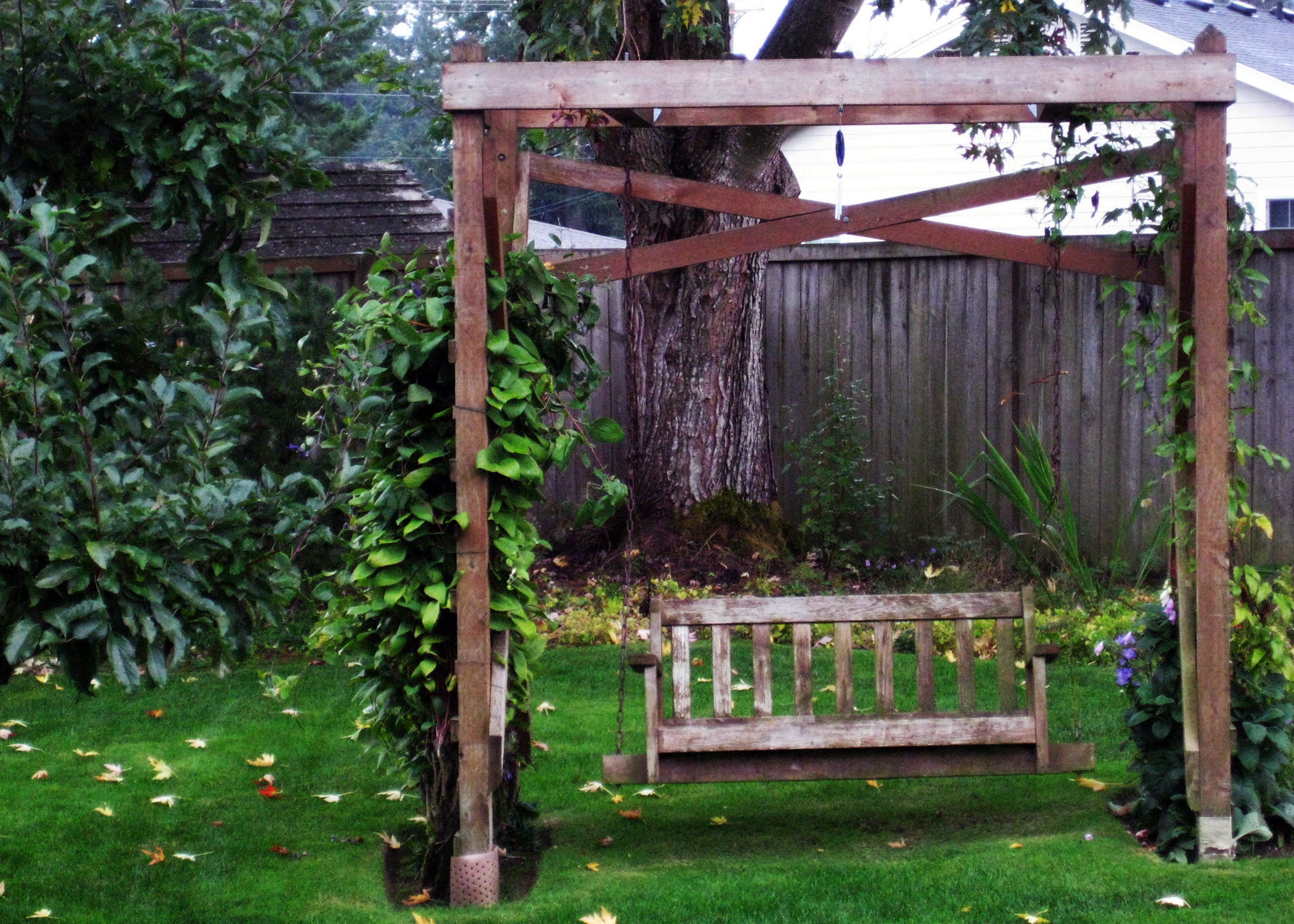
In addition, I love to incorporate some traditionally indoor materials into my gardens so they feel a little more like an extension of the house and invite leisurely visits. I’m thinking of things like the burnished brass chandelier you’ve seen tiny glimpses of in previous garden photos, a little cozy kitchen-style seating on the patio, and a bench or chairs for shaded stopping on the front porch as guests arrive for a gathering. But although I see lots of lovely yard swings around town and love them, I never see people sitting in them–it’s almost always too terribly hot and often very bug-pestered here–so there won’t likely be an investment of money and labor to create a swing like the arbor swing (above) that I designed and my brother-in-law built with my semi-able assistance, to surprise Mom with a little long-fostered-wish fulfillment, while she and Dad were off on one of their longer expeditions.
Still, I do want our yard to invite exploration and to be particularly attractive from all angles inside our air-conditioned house, year round. So many possible ways to accomplish that, that I am excited to see what I can learn and be inspired by, even from a first conversation with each of the landscapers who will visit here this week. I suspect I’ll need to be getting out all of the tools I have, and then some, and it’ll take a bit of a while to get the whole project well and truly underway. I know I’m a little rusty at some of this, having lived with tiny yards for quite some time before buying this house, and will have to relearn much and discover many new things in my new climate. But oh, how invigorating to begin!
Maybe I should buy myself a big tall red conical hat (possibly made of concrete). Because I am not exactly the most useful object, not the most decorative, nor even perhaps the most whimsically amusing, in a garden. But I give it my best from time to time, really I do. And generally, the earth is pretty forgiving and responsive to my fumbling efforts.
The wildflowers hereabouts have continued to delight, with waves of Showy Evening Primrose bordering the roadsides and ditches, and Vervain spiking up out of the meadows . . .
For once, I paid attention to the promises of today’s rain; it’s not been terribly impressive thus far, but it has rained a teeny bit, so it was good to get things a little better in order out there and ready for some watering the day before the rain arrived. Not that I didn’t water it all thoroughly myself, at the end of my stint, since even if the plants hadn’t been so thirsty after all of my brash ministrations on a toasty afternoon, I needed a bit of rinsing too. Besides turning into a human saltwater fountain and being bespeckled by the colorful bite-marks of a seething mass of varied insect pests, I also collected plenty of bits and bobs of garden detritus in my hair, a nice thorough coating of fresh brown dirt all down the front of my clothes (with special emphasis on my mud-capped knees), and the handsome assortment of plant stains reaching up to my elbows, not to mention the weird black stain my cheap metal watchband makes on my wrist when its gets all slippery with sweat. I considered just turning the garden hose on myself full blast but opted for the slightly less neighbor-frightening method of going indoors and showering, after all. They’d suffered enough if they’d just seen me transforming myself into a living blob of nature-gone-bad while gardening.
A sweet mockingbird sat surveying the front yard from the mailbox, but dashed off long before I came closer to tuck some sturdy, spiny agaves around its base . . .
Meanwhile, I did enjoy discovering that besides the blizzards of unlovable bugs gone rampaging on the heels of a warm winter, there are the lovely sorts as well: I was almost constantly surrounded by clouds of butterflies that were attracted to the plants I was tending and the nice little drinking fountains I was making with my sprinkler for them. It was as though the flowers woke up and took wing around me. The birds around here are certainly loving the feast of fresh insects, so at least I can tolerate the biting brats if I know that they may soon, in their turn, be Cardinal Chow. Which reminds me, I’ve heard tell that the hummingbirds are back in town, so the feeders should go back up today. How quickly things change in Spring!
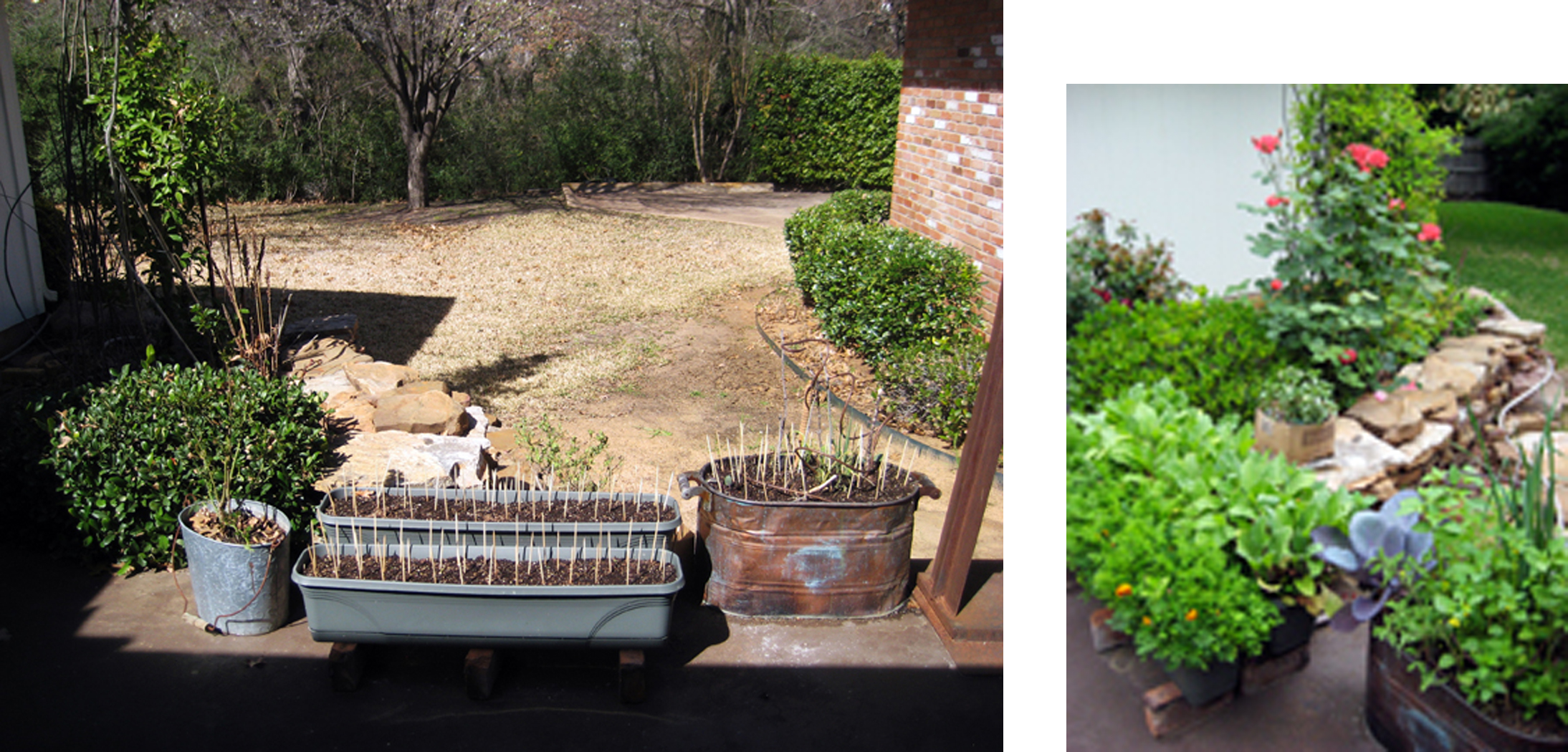
Less than two months of time, and what a difference on the patio and in the yard!
Both the ornamental and the edible is swiftly springing up, and thankfully, many of the latter sort of plants are very much the former too. Along with their other benefits of beauty and entertainment and insect-control, the birds have evidently gotten involved in the garden design work around here, planting a number of sunflowers in serendipitously amusing and even rather unexpectedly apropos spots. I’ll leave them all in place and see what seem to be propitious locations for next year’s crop of sunflowers. Meanwhile, I’ve got lots of other things beginning to come fully into bloom that need deadheading and trimming and fertilizing and watering.
The dainty blooms on the capiscum plants promise sweet bell peppers to come, and the little wild rose is smiling broadly . . .
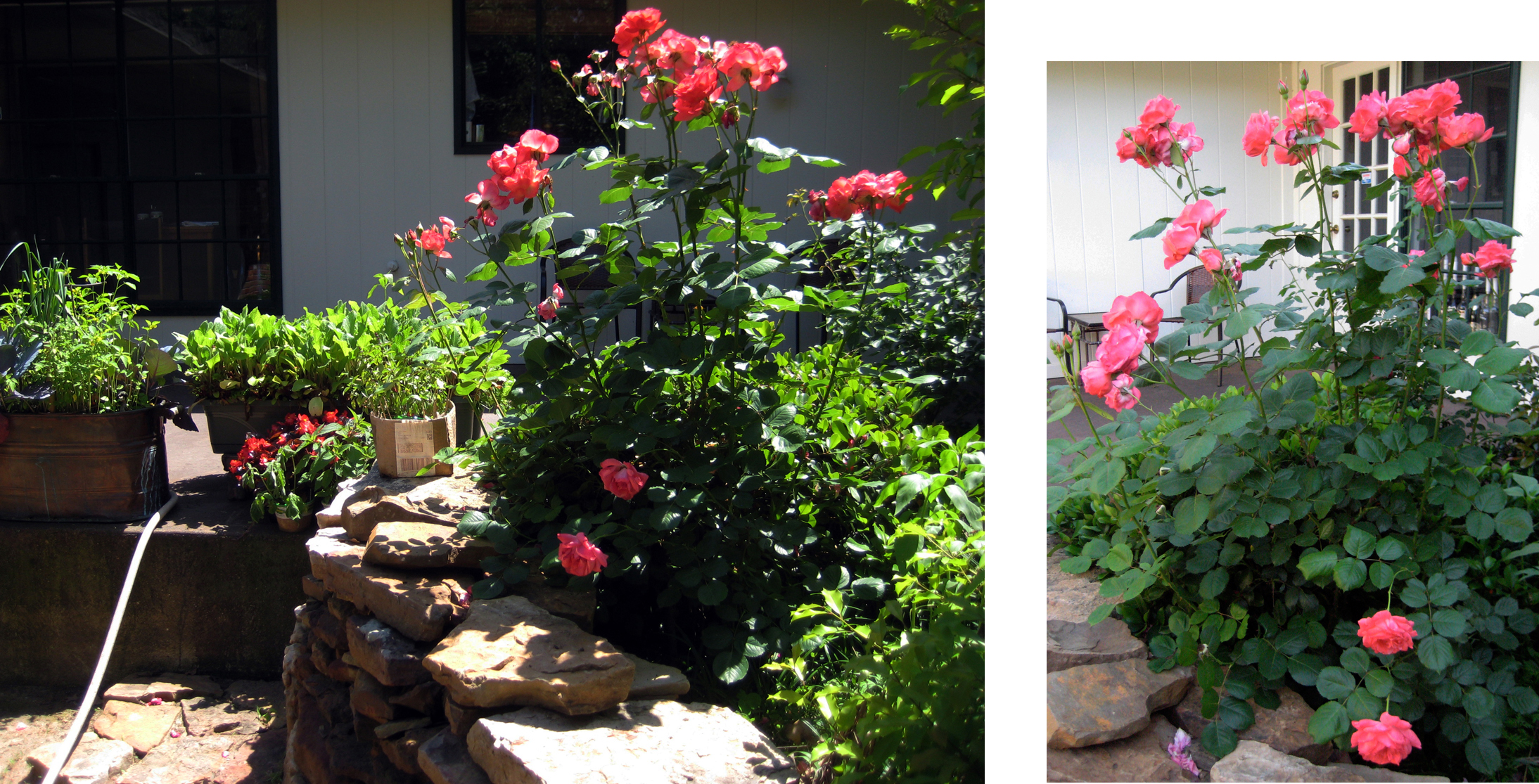
The roses have–not too surprisingly, given the kindly weather–been great show-offs already this season. The little old-fashioned straggler that I dug up from its hidden spot by the back fence last fall and tucked into a pail is thriving and throwing off a fair number of its small but deeply velvety dark red blooms. The coral colored rose that I moved to a more visible place in the raised bed by the patio has probably already fired up close to a hundred of its bold blossoms, bringing its own dazzling light to the little ‘courtyard’ enclosed by the house’s wings.
The detonation of the roses in bright sunlight is impressive even if only from two plants . . . but should I add more, I wonder, when they're all so lovely? Hmmm . . .
That holly tree that I intended to kill, or at least cruelly constrain (someone planted it much too close to the house’s foundation for either’s good) was stripped to its trunk not much more than a year ago but is not only covered with those charmingly soft new leaves that have their pointy edges but no bite yet but is simply a mass of bloom as well, and now that I’ve seen how adored it is by the bees I know I won’t kill the tree but will just keep it as a sort of vertical bonsai, pruning it vigorously but leaving it to stand as a bee haven, a vine post–I loved having my cobalt-blue morning glory glowing from it last summer and have planted that and other colors this year–and a berry farm for birds and winter decor.
Apparently, the birds and butterflies, not to mention the bees, are going to have a grand dance around the holly tree Maypole this year . . .
The herb-and-vegetable planters are well underway, and there’s not only plenty of borage leaf, despite the marauding munching bugs who try to turn them to lace, for a nice tisane long before they will be tall enough to bloom. The marigolds have opened their brilliant eyes to have a look around, and the carrots and beets are shooting upward (and, I hope, downward). The parsley and other, daintier herbs will have to fight their way up through the jungle a little more slowly, perhaps, but should be strong enough by the time they do that they will outlast the root veg and the annual flowers.
Packed with, very likely, too much, these planters are still cheerfully chipping in to do their flaming floral part . . .
The peppers, tomatoes, tomatillos and red cabbages are all quite happy and healthy looking right now, and as long as the garden pests can’t get ahead of the birds and me, there may be a nice little bit of produce before too long. In the meantime, it’s sweet just to look at the plants and measure their growth by the day, if not by the hour. One of the perpetual delights of gardening, of course, is the unplanned element that invites itself into the flowerbeds and borders. I was elated to find, among the dozens of baby oak and elm tree sprouts volunteering on the property (and many of which I will transplant, when they’re big enough, to other parts of the yard), a seedling which I quickly identified as a mulberry tree. This, too, will have to relocate eventually, but I thank the bird or squirrel that kindly donated it, as it will also become a great wildlife feeder on the back-forty one day. In the right-hand photo, it is balanced on the left by a seedling soapberry that I’ve been nursing along for just such a purpose, and together they frame a wonderful volunteer that apparently forgot it was supposed to be a tender annual plant, a brilliant orange Gerbera daisy from last year.
Gifts from the garden to the gardener: a mulberry seedling, a wintered-over annual flower, and lively green growth galore . . .
Along with the Survivor Daisy there are hints of the wildflower seed I threw nearby beginning to assert themselves. The first tiny cosmos has peeped out from the pathway, and there are promising leaves and stems among the sunflowers and cosmos that say we’ll soon enough be seeing nasturtiums, corn (sweet and ornamental), blanketflower and Echinacea and a whole host of other charmers. If you want to know more specifics of what we’re, ahem, expecting, check back to my plant-list post.
Grandpa Gerber Daisy, meet little Miss Cosmos . . .
I was certainly not confining my attentions to the back yard, and am pleased to say that both the surprises given to me by the garden and the things I’ve done myself and with goodness aforethought out front are also paying off in lovely dividends. The area in front of my beloved’s office window was particularly shabby and is not so easy to suss out, as it’s victimized by bad drainage because of the contours and conditions of our property and also is quite heavily shaded by one of our big beautiful post oaks out there. So if you set these characteristics up in combination with naturally hot and over-dry Texan weather, there are what might charitably be called Conflicts of Interest. I’m experimenting, to say the least. But I’m getting a fair return at the moment and will enjoy it while I can. Among the humorous and pleasant surprises I would count that of having celery in bloom there. Yes, celery. I had a very ancient bottle of culinary celery seed sitting in my kitchen for so long that I was quite sure it had no flavor left at all, but being a thrifty mad scientist, I tossed the contents out in the front flowerbed and behold, a year later I have flowering celery. If it’s biennial like some of its cousins, who knows what next year may bring!
Outside the office window, hope is arising in its green and tenacious way . . .
Between the front walkway and the porch, the flowerbed is cut into yet another poorly drained (but sunnier) spot and is too narrow for its own good. But I’m getting a number of things, mostly perennial, to pop up there and even had a happy re-visitation from last year’s annual sweet potato vine (the fluorescent-green leafed sort) that will probably now give me yet another year of excellent fill-in wherever I haven’t yet solved the bed’s Issues. I’ve tucked in a few herbs besides the front door rosemary that’s thriving–far more than expected–and am working to have a broad mix of textures and colors and seasonal change-ups that I hope will continue to mature and fill in the naked spots until any non-flowery weeds will just feel unwelcome to even visit.
Though the tulips are long gone from the planters, there are all sorts of new things coming in and many possibilities yet to sprout . . .
Along with the porch-side plantings there is also another shady stretch, this one less plagued by poor drainage but still overshadowed by one of our big flowering pear trees, so that too is getting an experimental blend of trial-and-error plantings to withstand the vagaries of seemingly opposing growth needs. One of the particular pleasures of yesterday was finding a Bonus Plant tucked into the pot like some sort of vegetal conjoined twin with one of the agaves I laid in yesterday, so now I have this vigorous ‘baby’ to choose a good home for as well. These specific agaves are a variety (Agave parryi) I’ve long admired for their good looks and was thrilled simply to locate, let alone in a size I could afford, but doubly so on learning that they are supposed to be relatively hardy plants–and then on top of all that, I got a big, handsome extra among them. Surely the garden gods were smiling on me yesterday. Or at least the garden gnomes.
Last year's Beautyberry has burst into full bright green leaf, the New Zealand Flax is spiking up its burgundy spears, and the variegated leaves of their companion flax lily lights up the shade with its fine stripes. And where will bonus baby Spike go to live? Stay tuned . . .
Since several people have asked, I’m posting a list today. No, it’s not one of those house-fixing lists I mentioned full of projects. But related, in a way, as it constitutes my contract of To-Do fun with my yard, garden, flower beds, and planter pots. It’s my seed and plant list–what I’ve put in thus far, and some of what I intend to add, the latter being primarily a larger batch of the listed Wildflower Sowing Mix. It’s my own blend, by the way, concocted from reading up on and observing what is native and/or simply adapts well in our part of the landscape. Starred (*) items are known natives or very long established growers here in north Texas, and items marked with two plus signs (++) are ones I’m emphasizing in placement or quantity because they’re particular favorites of mine.
For the Front Yard Flower Beds:
Blue-Eyed Grass (Sisirynchium)* ++ I’ve long been attracted to the tiny-orchid flowers of this miniature lovely, and was thrilled to discover the plant is native here. A surprise bonus when moving to a place that has a generally less easy climate than my place of origin in the Pacific Northwest.
Chives, Garlic (Allium tuberosum)
Coneflower (Echinacea purpurea)* ++
Garlic (Allium sativum) I don’t cook with a whole lot of garlic since marrying a Supertaster, but since they’re beautiful plants, I figure I’ll get what little garlic I need for cooking and have the garden attraction besides.
Lavender (Lavendula angustifolia)
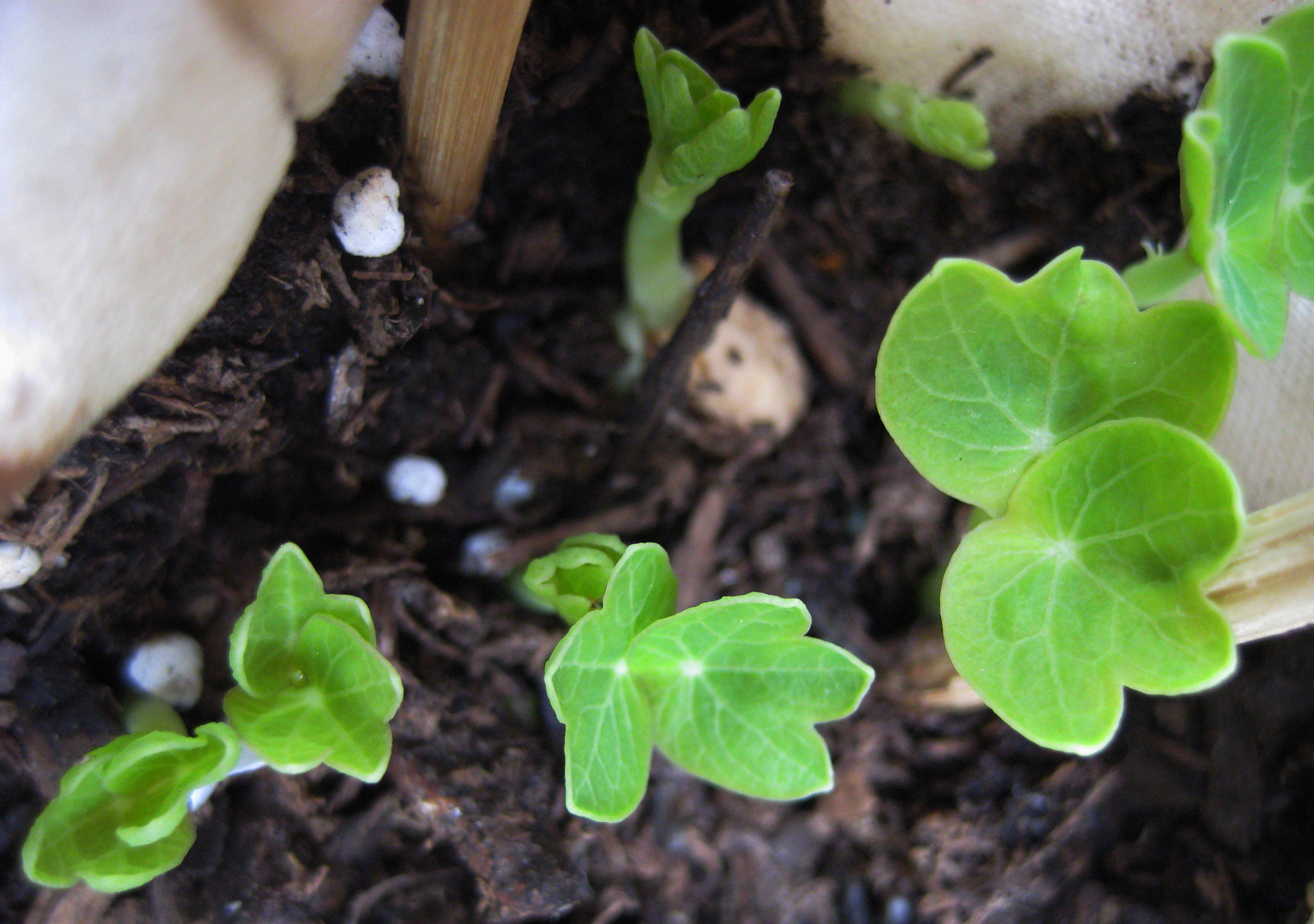
Nasturtium(Tropaeolum ‘Milkmaid’)
I have to admit I enjoy plants whose babies I can recognize early and so chart their progress a little more accurately. Nasturtiums are a very easy one to spot . . .
Spreading Petunia (Petunia x hybrida ‘Purple Wave’)
Texas Bluebonnet (Lupinus texensis)* ++ Seriously, how could I not put in any of this classic when I’ve moved to Texas? Not to mention that I’m a sucker for blue flowers. And things that will self-perpetuate once established.
Herbs (Planted front, back, indoors and out)
Basil, Sweet (Ocimum basilicum)
Borage (Borago Officinalis) ++ A rather magical herb, in my estimation, with its refreshingly cucumber-like flavor and exquisite bright blue flowers.
Chives, Onion (Allium schoenoprasum)
Marigold (Tagetes)
Parsley (Petroselinum hortense)
Curled
Italian Flat-Leaf @ John: I’ll try to have it fully in leaf when you show up here!
Rosemary (Rosmarinus officinalis) ++ I have one healthy plant going, and since it seems to thrive in this yard and I love the plant and its culinary qualities, I have a feeling it will get siblings eventually.
Vegetables (Mostly integrated into the flower beds, for fun)
Beetroot (Beta vulgaris ‘Tall Top Early Wonder’)
Kale (Brassica oleracea ‘Dwarf Blue Curled Vates’)
Bright blue like that of this Salvia gives such pizzazz to the garden . . .
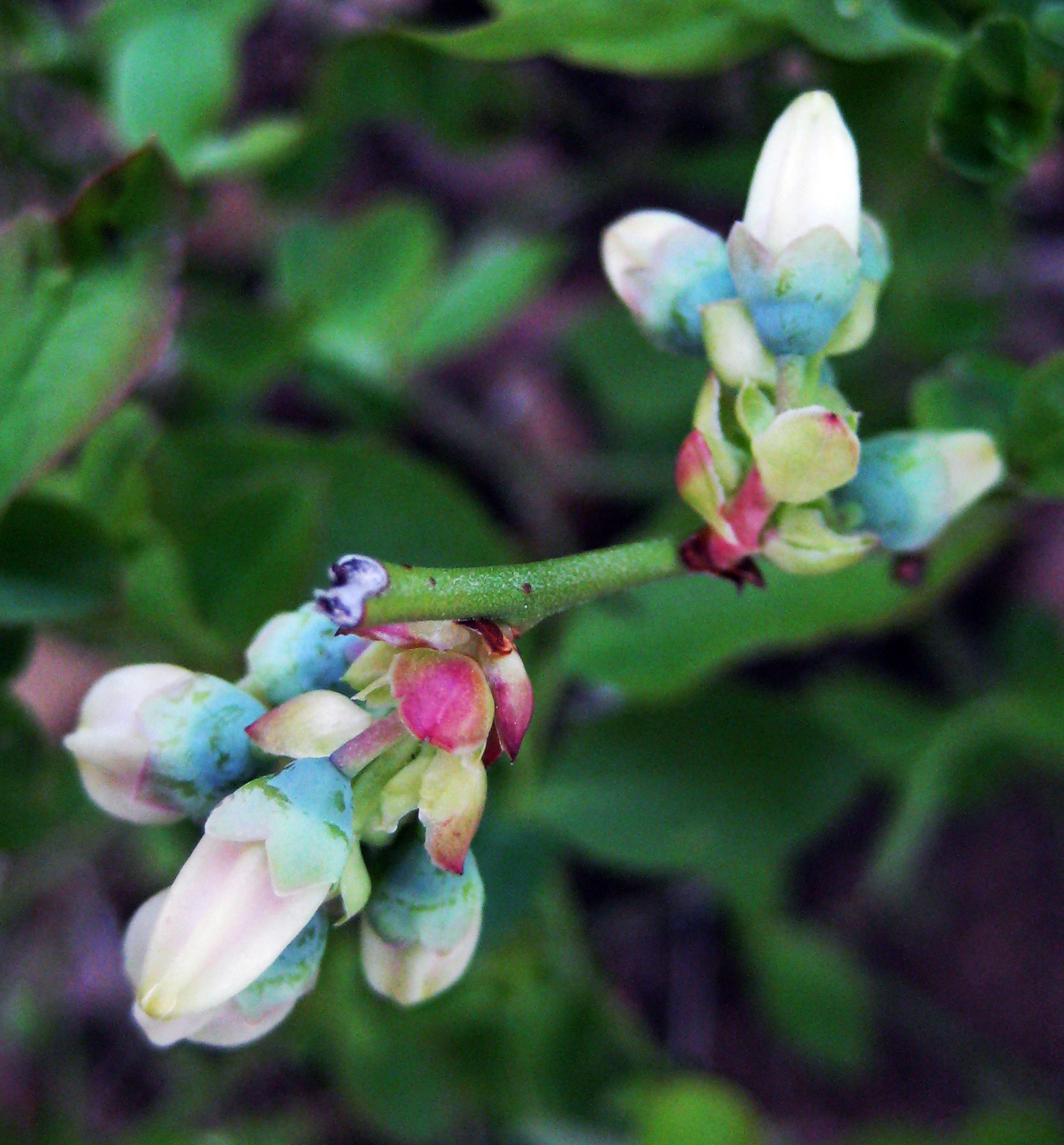
Blueberry(Vaccinium corymbosum ‘Biloxi’) ++ You may recall that I really dislike eating blueberries–but I know the birds and creatures will like them if I leave them, and I think the plants are beautiful!
Irresistible little blooms on the blueberry . . .
Clematis(Clematis, var.) I’ve put in several varieties, and the first leaves are beginning to appear, so I think I had better give those little green pretties something to climb up soon or risk their meandering in the underbrush.
Peering out from under oak leaf-mold and purple tradescantia that's already shown its first bloom of the season, the clematis leaves are beginning to crawl forward . . .
Columbine (Aquilegia ‘Origami Mix’)
Corkscrew Rush (Juncus effusus ‘Spiralis’)
Eastern Redbud(Cercis canadensis) The first of our little city give-away adoptees appears to have survived the winter, but won’t yet show its bud growth.
Fig Tree (Ficus carica ‘Brown Turkey’) I found a sturdy fig tree rooted in a three-gallon pot for four dollars. How could I refuse? Even if it turns out to be only semi-productive (though I’m told they grow well enough here), the leaf will be a nice variant in the yard.
Forsythia (Forsythia x intermedia) A good shot of early color is always welcome.
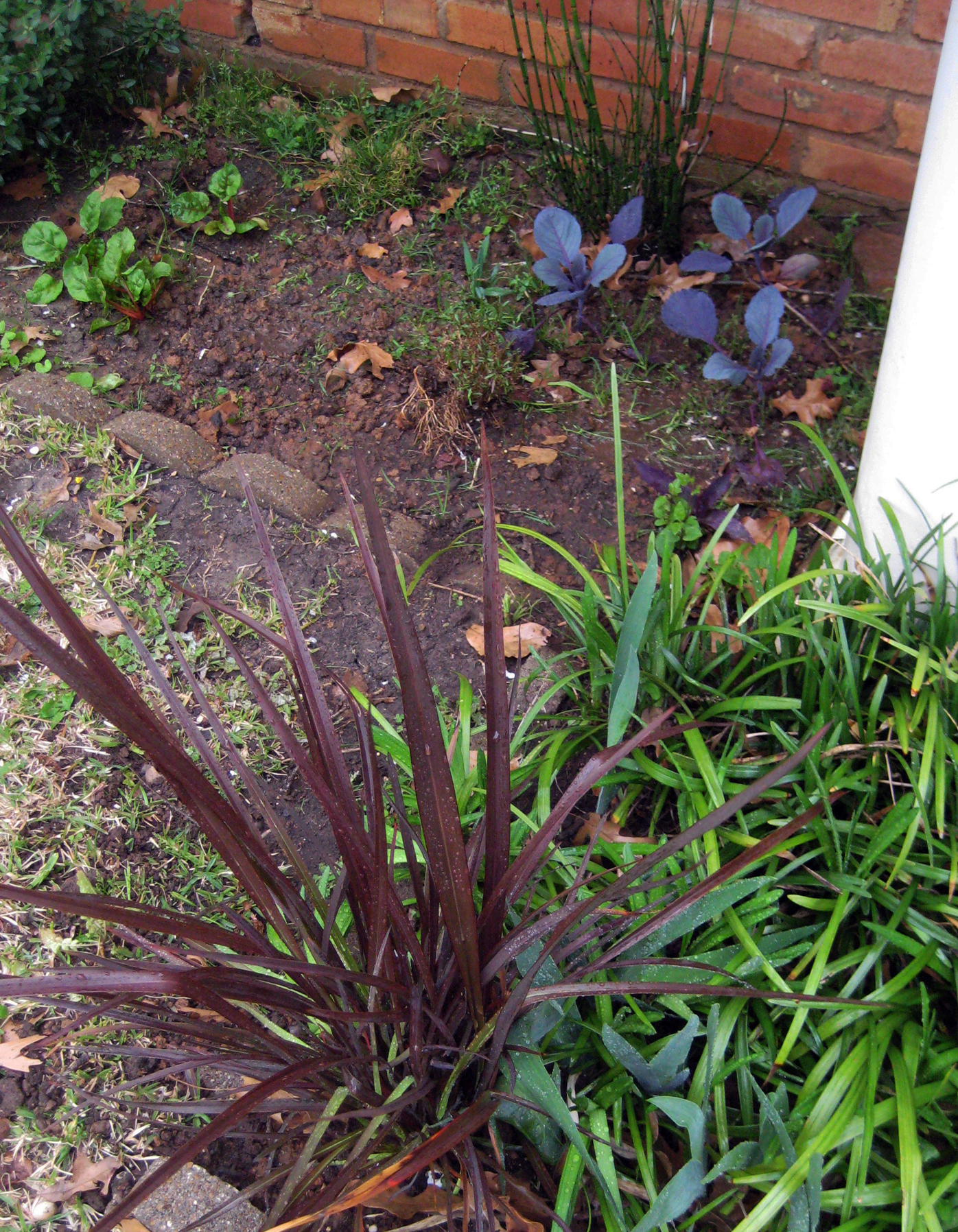
Horsetail Reed(Equisetum hyemale) Strangely for a place that verges on drought, the yard here has one or two water-collecting spots! So wet-footed plants should do fine.
I find it strange that there is a place--ANYWHERE in this north Texas garden--that can stay wet for so long, but it's a handy spot to put water-tolerant plants like the Corkscrew and Horsetail reeds, after all . . .
Lamb’s Ear (Stachys byzantina)
Mexican Plum(Prunus mexicana)
The Mexican Plum tree just planted this last fall has wasted no time in putting out dainty little white flowers . . .
New Zealand Flax (Phormium tenax) Going for a bit of large-scale drama, here. (You can see the NZ flax’s big burgundy swords in front of the wet growing bed above.)
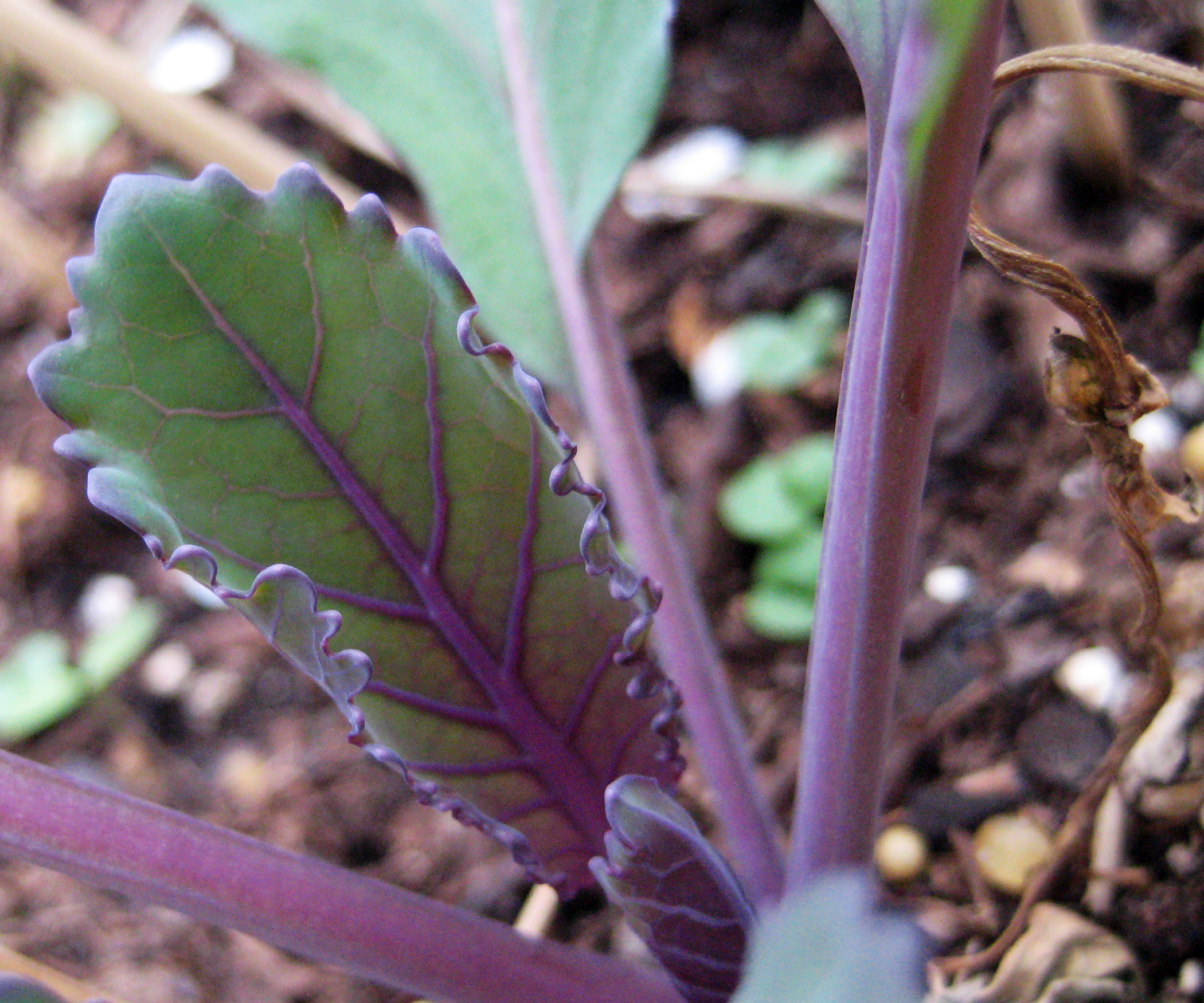
Red Cabbage(Brassica oleracea var. capitata f. rubra)
When it's on sale, why not use the bedding plant! And I got a half-flat of red cabbage babies, so they went out front for their ornament as well as in hopes of good eating . . .
Soapberry (Sapindus saponaria)
Even the six inch tall Soapberry tree seedling from last year is swelling into bud . . .
Tulips (Tulipa spp.) Of a white unnamed variety; oh, yes, I did succumb. I put just a dozen in my front porch planters. Half of them were soldas orange, but buying a generic handful of bulbs, one gets what one gets, no? And white tulips are beautiful too, so I shan’t complain.
A splash of orange might have been showier, but there's no classic like an elegant white flower . . .
The whole idea that a towering sequoia can be sprung from a single, minute seed is preposterous. It’s not that I think this operation is analogous to those amusing party-trick capsules one can buy for kids, where once the pill-like mite is submerged in water, out springs a dinosaur: a sequoia is not masterfully compressed as a whole, living, full-sized tree into its seed to wow us with its razzle-dazzle emergence.
This is a much subtler, more complex, and truly far more astonishing thing, a seed containing all of the raw material and instructions for growing a full-scale, magnificent conifer. It’s more as if a very small package arrived on the front porch, seemingly from IKEA, yet containing every bolt, panel, screw and window, every necessary iota, for making the whole Empire State Building, and when the box was slit open for a peek inside, the building proceeded to assemble itself carefully and perfectly, over a few years, without any intervention from the recipient. Furthermore, if left to its own devices, it will tend to its own growth and maintenance without any aid from humans at all. Repair and beautification and renewal are included in the package with a tree-lifetime guarantee at no extra cost.
This wonder is replicated uncountable times not only in the massive and miraculous evergreen forests but in every growing thing in the earth that emerges at its birth from a seed. And that’s how, despite my impressive impatience and legendary laziness–which in combination would seemingly guarantee my gardening only with the most mature plants I can finagle onto my property and into the soil, I became enamored of gardening from seed. Oh, I still love the instant gratification of transplants and bedding plants and bare-root behemoths and all of that, but to watch this scarcely-believable process of the infinitesimal exploding (in slow motion, mind you) into the impressively complex is, well, intoxicating.
So I have built up a stash of both collected and purchased seeds that I will attempt to nurture into something more substantial over the seasons, and will play the frivolous farmer, the mad scientist of the weed-patch and the proud parent of whatever scrawny or stupendous growing things I can coax out of those jewel cases, their seeds. I will fuss and fume and furrow both the garden and my brow as I try to conjure their beauties out of those weird and fantastical little lock-boxes of seed and I will talk sternly to the reluctant and coo at the flourishing as though I really had anything at all to do with their excellence when in fact I’m just unleashing them to do what comes naturally in the first place. With appropriate respect for their admirable powers, and love for their bloom and fruitfulness, of course. Of course.
 For Gramps, of course, there was a strong influence of frugality that came from being first an immigrant (and even before that, presumably, from being raised by typically scrupulous Norwegian savers) and then a hard-working General Motors employee (he worked on the crew that produced the first amphibious vehicles). After all of that he was an independent farmer, mainly of sheep, and then also a longtime carpenter and home builder. He was never in any get-rich business, and he appreciated old-fashioned things and earthy things, so it wasn’t a stretch for him to look with his carpenter’s eye and see in his shed the makings of all sorts of fine pasture fencing, outbuildings, picnic tables, benches and more.
 I had the bonus, while living at my parents’ again, of not only the privacy and flexibility afforded me by their frequent travel for his work, but the opportunity to practice my own incipient garden design skills both while following Mom around and learning the names and natures of things and while taking things into my own hands whenever they went out of town for any length of time. First of all, having learned a couple of useful things about how to treat some of their plants, I practiced my sculptural pruning skills on them, opening up the lacy umbrella of a laceleaf maple, making faux bonsai out of some of their smaller evergreens, and limbing up tree trunks to clean and open up the space for all of the pretty understory things Mom had brought in as starts from relatives’ gardens, from her trading with friends, and from various nursery expeditions over the years. It was during this time that I especially fell in love with trees. The craggy Garry oaks native to that area are a fairly uncommon yet extraordinarily lovely and impressive variety and I nurtured a seedling or two myself along the way in hopes that sometime long after I’m dead they too will be magnificent and grand old trees sheltering their homes and their denizens like the massive ones already in town.
 Here in Texas, it’s the two stately post oaks and that lithe red oak in back that endeared our home to us at first notice, along with our two splendid Bradford pear trees. There’s quite the community of sweet oak seedlings sprouting in their shade, and I hope very much that I can manage (with lots of help and advice from the local experts, of course) to relocate a number of them to foster a natural-style mini-grove in a back quadrant of our property over the many years to come. That will help create a fitting foundation for the whole wild, native and well-adapted collection of plants intended to fan out from all of that into the rest of the property. Fun times ahead!











 Art-Colored Glasses