
Foodie Tuesday: There’s No Substitute for a Smart Substitution

Nearly every time I get in the mood to bake something I’m missing one or more of the necessary ingredients. This happens often enough when I’m making non-baked goods, but it’s almost a given with baking, because I simply don’t bake all that often: too much wheat flour and sugar makes this sweets-addict too likely to get tummy aches or just plain to overindulge. And the fact that I don’t bake terribly often means that, in that most scientific of culinary skills, I’m the least a genius about getting the fussy proportions and timings and temperatures correct. But I still do like to bake once in a while.

Though I feel pretty safe making all sorts of substitutions in cooked and raw dishes, simply finding analogous items–ingredients that have plenty of similar qualities and can therefore be expected to fill similar roles in the combination–I know less about what the ingredients used in baking are supposed to do, unless you’re talking about spices and flavorings, and so have always been more timid about fooling around with the recipes for baked goods. But lately, I’ve come to be more of a believer that life’s too short not to have a little kitchen adventure more often, and that if I’m not using outrageously expensive ingredients the worst that can happen is that a batch of something goes so far awry that it’s just plain a failed experiment. That’s what trash bins are made for, no? I’ll bet few scientists ever made their paradigm-shifting discoveries without a few boneheaded false starts and cock-ups and misdirections and outright failures along the way either, and, well, brownies are not exactly rocket science.

So I give you:photo

Texican Brownies

Ingredients: Plain ‘classic’ brownies call for the following ingredients and proportions:

4 squares (4 ounces/113 grams) Baker’s Unsweetened Chocolate–I substituted semisweet baking chocolate. It’s what I had in the cupboard.

3/4 cup  butter–while baking recipes almost always specify unsalted butter, I almost always use salted butter anyway unless there’s a lot of additional salt in the recipe; salt heightens sweetness and intensifies other flavors as well. And I love salt.

2 cups sugar–I substituted dark brown sugar for a deeper flavor.
3   eggs
1 teaspoon vanilla
1 cup flour–I substituted instant masa flour (a fine corn flour usually used for tortilla- and tamale-making)

Then I added a few ingredients of my own to make a darker-chocolate brownie and give it a slight Mexican twist:

1/2 tsp baking soda–since the masa flour wouldn’t have gluten like the wheat flour to make the brownies rise a little, I figured they should have a boost in leavening. Look at me, being all fake-scientist-like!

1/2 tsp salt plus 1/8-1/4 tsp ground black pepper–again, wanting to intensify the spicy chocolate of the brownies–plus 1 large tablespoon Dutch processed cocoa–yet more chocolate boosting–plus 1 tablespoon cinnamon

Directions:

Heat your oven to 350°F–mine runs hot, so I heated it to 325°.

Line a 13×9-inch pan with an oversized piece of baking parchment, folding it at the corners to fit and cover the sides as well as the bottom. One piece, no leaks.

Microwave the chocolate and butter together in a large microwaveable bowl on high until the butter is melted. Stir until the chocolate is melted and completely combined with the butter. Blend in the eggs and vanilla. In another bowl, mix all of the dry ingredients. Add them gradually to the wet mix, stirring until everything melds, and pour the batter into the prepared pan, pushing it into the folded parchment corners to fill them.

Bake 30 – 35 minutes (again, with my super-hot oven, I baked mine for more like 20-23 minutes) or until a toothpick inserted in the center comes out with a few moist crumbs. Better to under-bake these than the opposite–fudgy, chewy brownies are good; dry, not.

The parchment will let you easily pop the whole sheet of brownies right out of the pan.

Makes 24 brownies. Mine were still a little too baked, thanks to the hot-hot oven, so I quite happily compensated for the slight dryness by frosting the ones that weren’t immediately devoured. (A number of them were. Clearly, the over-baking didn’t destroy them so badly that the members of this household wouldn’t cheerfully destroy them in another way.)

Thus, we have:photoRustic Red Frosting
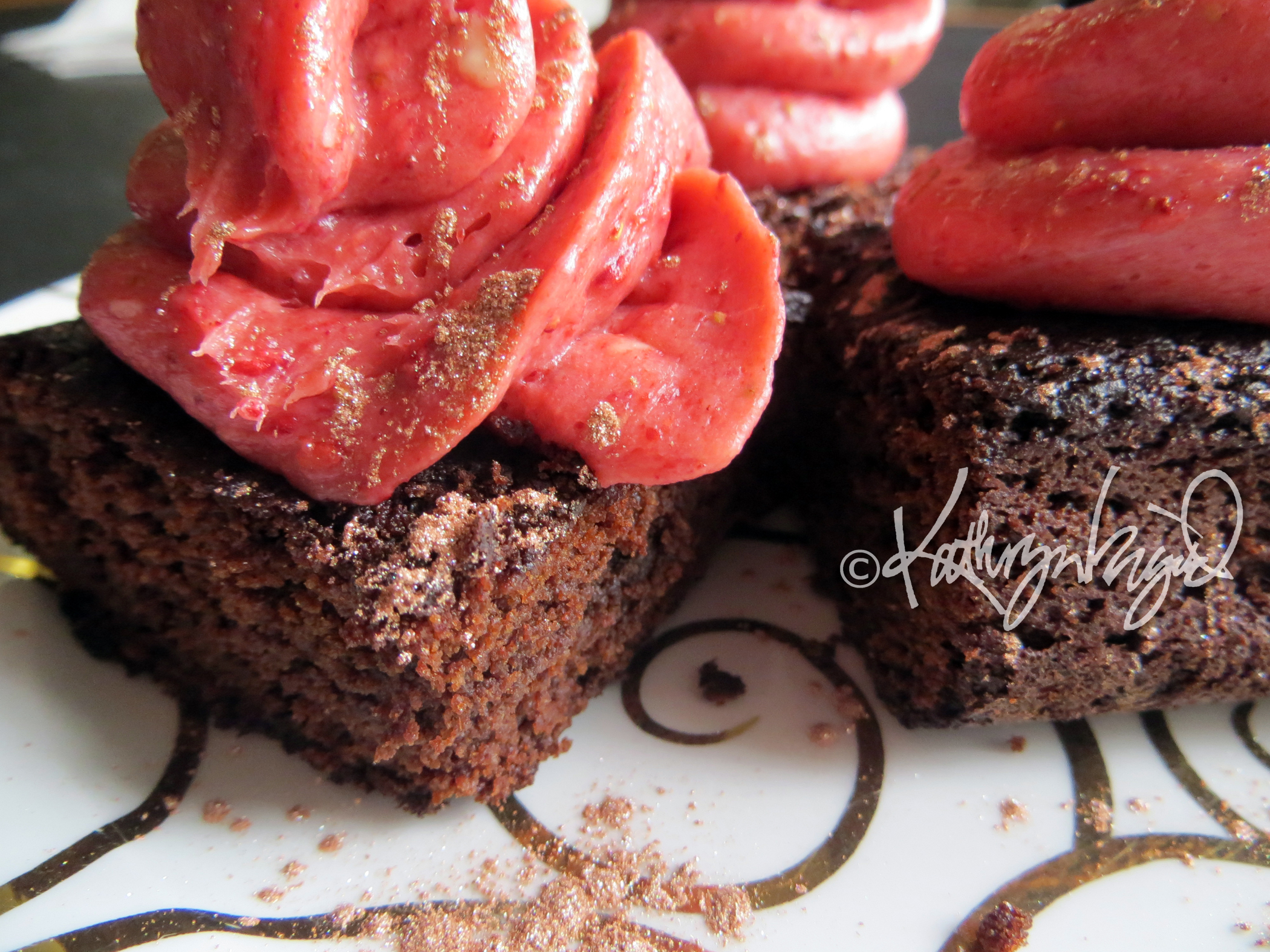
No, I’m no fussy decorator. But I loves me some tasty frosting. And I wanted something that was earthy and yet juicy, something that would stand up to the depth of the spiced brownies and still have a little homey heartfelt quality to it, even if it wasn’t very frilly. I chose strawberry frosting; after all, las fresas are a fantastic favorite fruit treat in some of the Latin-American cuisine I’ve had the pleasure of inhaling eating. And this is just an easy take on buttercream icing.

Grind about one cup of freeze-dried strawberries to a coarse powder. I did mine in the blender, but if they’re dry enough you could even crush them with a wooden spoon in a heavy bowl–leaving some bits rough gives a little burst of berry flavor in the finished frosting and reminds us there are real berries involved. Add to the berry powder about a cup of powdered (confectioner’s) sugar, a teaspoon of vanilla, a cup of soft butter, and a tablespoon or two of heavy cream. Blend them together well, adding more sugar and/or cream as needed for flavor and texture. Apply liberally to the brownies, cake, cookies, tongue, etc, as needed for improved state of bliss.

I sprinkled them with some edible glitter just for good measure. A little extra pizzazz never really hurt anything. But you could just sprinkle yours with the stardust of your affection and it’d be just as glamorous and grand.

This whole brownie-baking urge of mine was motivated in large part because I felt like making a sort of Valentine’s Day treat; since we’ll be in the car on a work-related jaunt much of the actual Valentine’s Day, I figured today was a reasonable substitution for the occasion. Since both my husband and I love chocolate and baked treats but do better with less wheat flour, I figured substituting corn flour could be a decent and respectable enough Tex-Mex way of dealing with that part of the equation. And since neither of us is a stickler for celebrating only on the official or ‘correct’ dates for anything, we’re both quite willing to celebrate the American holiday of love-and-romance any old time we can. Because for love, there really is no acceptable substitute.

photo

XOXOXO!

Foodie Tuesday: All about the Ingredients

photoI’ve said it before, and lots of food experts smarter than I am have said it lots of times before I ever did: good food preparation starts with good ingredients. No amount of genius and skill will make a great meal out of so-so ingredients, let alone out of bad ones. And me, I have a modicum of smarts and very modest, though for a lazy goof-off like me, surprisingly patient skills. So yeah, I can get the job done, as long as I have some excellent ingredients in hand.

photoStarting with salt. One of the most indispensable of delights in the entire pantheon of foods and culinary assets from its first discovery, good salt in just the right quantity is the First Rule of Yumminess in many, many a dish. But, hang on, salt should still often be the last ingredient applied. Tricky, no?

photoThe meal, however, if it’s with fun guests on hand and stretching a little over the course of the day or evening, well that should begin with a little taste of something nice. For the other day’s dinner guests, who were indeed a whole lot of fun, the starters were simple enough, and already on hand: the crackers I made (and posted) last week, the olives I’d previously bathed in sherry and olive oil, and smoked almonds, plus a few chilled prawns with dill-enhanced cocktail sauce. A fresh, cold batch of light Sangría:

Blushing Sangría

Two 750 ml. bottles dry rosé (I used a nice dry Pinot Noir rosé by Toad Hollow), plus 1 bottle of sweet white wine (I used a bottle of Moscato), 1/4 cup of Amaretto, 1/4 cup of Himbeergeist, 1/2 pint of fresh raspberries, 6 small or 3 large fresh peaches, 1 teaspoon rose-water, 1 teaspoon vanilla, 1/4-1/2 cup of light agave syrup or raw honey. Stir gently and chill thoroughly before serving.

The peaches I bought were an unexpected mix of half overripe and half underripe fruits, so I peeled and sliced the underripe pieces into the Sangría, where I’d already immersed the raspberries, and the too-ripe ones I pitted; I put the mushy peaches and all of the skins from both kinds into the blender with a bunch of the liquid ingredients, blended them all thoroughly and sieved the pulp into the Sangría, so I still got all of the mileage of flavor and color from the peaches, if a little less sliced fruit. In the end, it was plenty drinkable, so all was well in our pre-prandial world.photo

photoThe meal needed vegetable balance, of course, so I kept the ingredients to a fair minimum again and the flavors simple. Why mess with good contents? A mix of heirloom tomatoes and red cherry tomatoes made a simple but flavorful topping for romaine lettuce with a couple of simple salad dressing choices. Sweet corn, freshly pared off of the cob, was gently and quickly warmed in butter. And some delicate asparagus was steamed with a little soy sauce, a little plain rice vinegar, a very small dash of toasted sesame oil and a sprinkling of sesame seeds.

photoThe main dish, which I’ve undoubtedly mentioned in previous posts, was our old favorite household standby of Smoked Salmon Pasta. Not even a true recipe, really. Dearest John, I did not hand-craft my pasta. Yes, I bought refrigerated fresh fettuccine. Would that I’d had you supervising the party, not to mention in charge of the pasta-making, this element would indeed have been more, erm, elemental. Not to worry. Some day I shall reform. Meanwhile, a decent store-bought fresh fettuccine is not such a bad thing when dressed up just a leetle bit with smoked salmon cream. Simmer about a pint of heavy cream until it thickens to a nice sauce thickness, add about 1/4 teaspoon of freshly grated nutmeg and 1/4 teaspoon ground white pepper, 1 cup of broken up [hot smoked] alder smoked wild salmon, and a good splash of lemon juice. Toss gently with the freshly cooked and drained pasta and serve.photoThere are only two main high-quality ingredients needed to complete a pretty good party with all the rest of this, then. Dessert, naturally, should be offered–a bit of sweetness to follow all the preceding, and stretch as far into the evening as can be managed by all. But most significantly, the last essential ingredient of the gathering is, well, the gathering. The good company. We had that. Good enough company to want to stretch out the evening. So there was just a touch of dessert. Fresh strawberries and, you guessed it, chocolate.

photoI never said I was original in my menu planning. But I am really good at putting myself in excellent company, and that’s always what the party is all about. There you go: my real culinary talent is cooking up a right magical blend of outstanding people and enjoying the delights that result from the combination. Too bad there’s no cookbook out there that teaches that–no, wait–every good cookbook in the world gives guidance for just this art. As these good books teach us, choose your excellent ingredients wisely, food or company, and you will brew up a marvelous party.

Foodie Tuesday: The Element of Surprise

One of the particularly attractive things about learning of a new cuisine or recipe is the way that it can introduce unexpected ingredients to mind and palate. Things that seemed commonplace or familiar are suddenly tinged with mystery, filled with puzzles and questions never before imagined. So much recombinant mischief can be made when a new ingredient–or a new use for one I thought I’d known–comes into play.

photo

Tomatillos

I’ve long known the delights of tomatillos. Salsa verde is a pleasurable variant of that endlessly flexible family of Mexican sauces best known in their tomato form, hot or cold. Usually made with chopped or pureed tomatillos in combination with onion, jalapeños, chiles, cilantro and whatever additional spices or lime juice the maker uses for her trademark blend, salsa verde brings a slightly lemony brightness of flavor and a zing of lively green to the plating of whatever magnificent assemblage of Mexican cuisine is in hand. As I love putting fruits of various kinds into my salsa cruda (or pico de gallo, the rough-cut raw and chunky form of salsa) for the bright, colorful, juicy and distinctive twists they can introduce to the party. Fruits are such glorious foils for spicy and savory foods that their addition has been popular for far too long for even a venerable geezer like me to credibly claim credit for pretty much any such combination. This is certainly a great reason to love tomatillos in spicy salsas.

The big surprise, for me (again, blame it on my innocence; blame it on my lack of smarts; blame it on the bossa nova) is that it turns out green is not the only color in which tomatillos ripen. So I bought these seeds for purple tomatillos, too, in high hopes of having an eventual opportunity for making some groovy purple salsa cruda. So cool! Unfortunately, the weather fairies of Texas had a little different slant, this summer, on the whole project and the poor little tomatillo plants, purple and green, couldn’t quite make it to full ripeness while being simultaneously strangled by drought. Pity. But one day I will make it happen. Then you can look for me to side my grilled salmon with a nice salsa cruda compounded of purple tomatillo, fresh peach, jalapeño, cilantro, lime juice and jots of salt, pepper, cumin, cinnamon. Fingers crossed!

photo

How nutty is it that I didn't know people could make and use acorn flour!

There are so many other magical goodies around in the meantime, things not so seasonally sensitive perhaps, that there’s no worry about going hungry while waiting. Flours, for one. Asian, Native American and other foodies have already known for eons that acorns can be a source of jellies, cooking and baking, not to mention much-needed nutrition in times of scarcity. Me, I had no idea that acorn flour is useful for so much in the non-squirrel kitchen. But now I’ve acquired a small stash of the stuff so I can remedy my ignorance soon. Yes, acquired–bought–I have no intention of being so marvelously industrious as is required for the long and involved process of soaking out the tannins and preparing the acorns for consumption when I don’t even know how successfully I’ll use the flour, let alone how compellingly palatable the results will be. Time and experimentation will tell. Promise I’ll keep you posted!

On the heels of that particular discovery, of course, I went off on an alternative-flour tangent and hunted for others of interest. I’ve done a bit of baking with almond flour before (almonds ground up, but not so far as to be turning into almond butter, a whole other sort of ingredient altogether and tasty and useful in its own right) and coconut flour as well, and both are godsend finds for one who’s wanting to reduce or eliminate grain-based flours for any reason in cooking and baking. I certainly like that they’re both mild enough in flavor to work for innumerable purposes and are able to be adapted to a large number of functions in different recipes. The next surprise flour that popped up on my radar was mesquite. Say, what??? Making flour from the leguminous seeds of the nearly unkillable weed tree that drives ranchers ’round the bend with its tire-puncturing spines and water-hogging monster tap-root? Well, proponents say mesquite meal has a nutty, “sweet, earthy taste with notes of cinnamon, molasses, and caramel”hard to argue with the allure of that. Needless to say, I look forward to seeing what can come of such a distinctive sounding ingredient.

photo

A rose is a rose is a remarkable herb . . .

Consider the rose: what has long been one of the most favored flowers, universally admired for its varied beauty, perfume, and rather astonishing adaptability to climate and environs is being celebrated as the herb of the year this very year. Rose water, candied rose petals, rose hip tea, rose petal preserves, classic Turkish Delight–the list of rose-based foods has been building over centuries and only adds to the popularity of this queen of flowers. But most of that sort of thing was far outside the ken of a girl growing up in modest middle-class America, and didn’t really attract my attention until I was well into adulthood. Even then, I learned that as delicious as the rose is, a little can go a long way. So as I was contemplating my angle for this post and thinking about how fascinating it could be to yet discover previously unimagined ways to invite the rose to the dining table and began to contemplate what numinous form that idea might take. What did I do? Like any culinary detective-wannabe of the modern age, I Googled, of course. I typed in “rose as herb” and there before my very eyes appeared a handy page trumpeting the rose as Herb of the Year 2012. You call it lazy detective work, I call it kismet. Po-tay-to, po-tah-to. –Say, wouldn’t sweet potatoes be interesting prepared with a faint infusion of rosewater, some white pepper and a bit of fresh goat cheese whipped in? Or is that all old hat and I’m just showing off my ignorant bumpkin-osity once again? Never mind, I’m going to get me some of that Herb of the Year and have some fun. Ladies and gentlemen, spoons up . . .