Sometimes good news comes from truly unexpected sources . . .
Even in languages we think we cannot understand, occasionally–perhaps with the help of images or context or a little theatre-of-mime interaction–we decipher the heart of the matter and make some kind of sense out of what we see and think and hear. Stranger still, sometimes from something terrible a good and beautiful thing can arise.
Modern philosophy and psychology have devoted plenty of study and energy to recognizing and making sense of how ingrained is the human urge to seek and see patterns. The mere fact that it was already bone-deep and age-old in us by the time it became a topic of study and conversation tells us how innate and intrinsic is our desire for the kind of order and continuity and sense found in rhythm, repetition and recurrence. Every kind of pattern offers its own version of meaning, and we like to cling to our own preferred sets of sought and loved markers for comfort.
We start very early with this stuff, showing preferences between different sorts of sensations even as infants–warm over cool, light over dark, sweet over sour, and so forth. We get attached to favorite foods and favorite colors. We develop our tastes and prejudices individually, corporately, culturally.
And we find ways to build elaborate systems of belief around the qualities with which we imbue our likes an dislikes. Not only is blue the boss’s favorite color, it’s THE color, it’s a matter of fact and faith, and people who prefer another color clearly need to be fixed. If the Empress is superstitious that everybody must wear raccoon fur hats on odd-numbered Thursdays, then everybody had better stock up on raccoon fur hats, pronto. (And all of the raccoons in or near the empire might be wise to consider relocating to safer territory.) That’s how dedicated people are to their preferences, my friends. In fact, if a certain sect thinks another certain sect has got hold of wrongheaded enough beliefs, they might just hijack a loaded airplane or two and knock over buildings full of Sect One people and smash them all to oblivion just to make the point of how wrong that bunch are.
Now, I have my favorites and fixations and beliefs, some deep and many shallow as pop-star fame. I like a good Lucky Number Three as much as the next guy, and while I am not the least bit triskaidekaphobic, I might admit to a little pointless fondness for the number Thirteen, if only out of pure cussedness–after all, it’s just the representation of a convenient numerical construct. But with the horrors of a certain 11th day of September so ubiquitous in the hearts, minds and media of the nation at present, I would like to say a word in defense of the wonderfulness of the number 11.
One of the ways I become intrigued by, then somehow attached to, any seemingly random thing is via that process wherein for any reason, at any moment, one becomes aware of having (peripherally or subconsciously) noted a series of recurrences of the object of interest, creating a pattern. In the instance of my seeing elevens repeatedly I can’t even think of how, where or why it caught my attention. But as these things work, once I noticed, I began seeing elevens everywhere for a while. Every time I’d look at a clock, it seemed, it was eleven minutes after some hour. Every meeting somebody required me to attend was either on the eleventh of the month or at 11:00 on some other day. Eleven birds would perch on the billboard across the way, whose white posts against a background of dark trees made a crisp white 11. Clearly once it got on that track, my brain willingly habituated to looking for elevens everywhere, and there was no need for them to have any meaning–their merely being eleven-related was their significance from thenceforward.
But in the way of such things, this made my pattern-seeking soul think that eleven ought to have some significance for me, and so I’d find myself in a reverie, a foggy abstraction in which I was spending any ‘down time’ between purposeful tasks or thoughts on mulling over possible reasons for eleven’s newfound status as a noted number in my life. There was the easy one of my pattern-hungry eye simply finding the clean and upright symmetry of the numeral notation “11” pleasant, soothing and even possibly a nice symbol or metaphor for such appealing characteristics. Of course there are happy temporal associations I could cite: my mother’s birth in the eleventh month of the calendar year; my nephew’s birth on the eleventh day of a far happier September. ‘Elevenses’–well, who can argue with the wisdom of a welcome morning break for sustenance? Not to mention the idea that eleven is even more than, and therefore obviously better than, the ‘standard number of completion’, ten–well, even a not-overly-bright worshiper of guitar amps could see the value in that.
When the dust settled and I’d conceded in my mind that I just had a new “favorite number” for no better reason than why I hold nearly any other thing preferable, I realized that just possibly I was looking harder for reasons to defend and admire eleven precisely because I was bothered by its unfair taintedness of late. That the infamy of the 9-11 attacks took place on the eleventh did not make the number eleven–an inanimate and abstract and essentially minor thing–inherently scary or evil. But if ‘thinking makes it so’, I decided I needed look no further than the damning act itself to see its purest inverse as well, indeed enough goodness to return with one hand what the other was snatching away. Unplumbed human cruelty and violence awoke its shadow twin, an equally unplumbed depth of human generosity and selflessness and healing. From the unwarranted spilling of torrents of blood and poison there also sprang a fountain of communal strength and compassion and they flowed into a sea of determination to be, if only for the moment, much better than we all had been.
For my part, I think I’ll just teach myself that I can count past ten on my fingers if I extend two digits like a skewed pair of twin towers and–far from collapsing–instead they form a V that means both Victory and (better still) Peace.
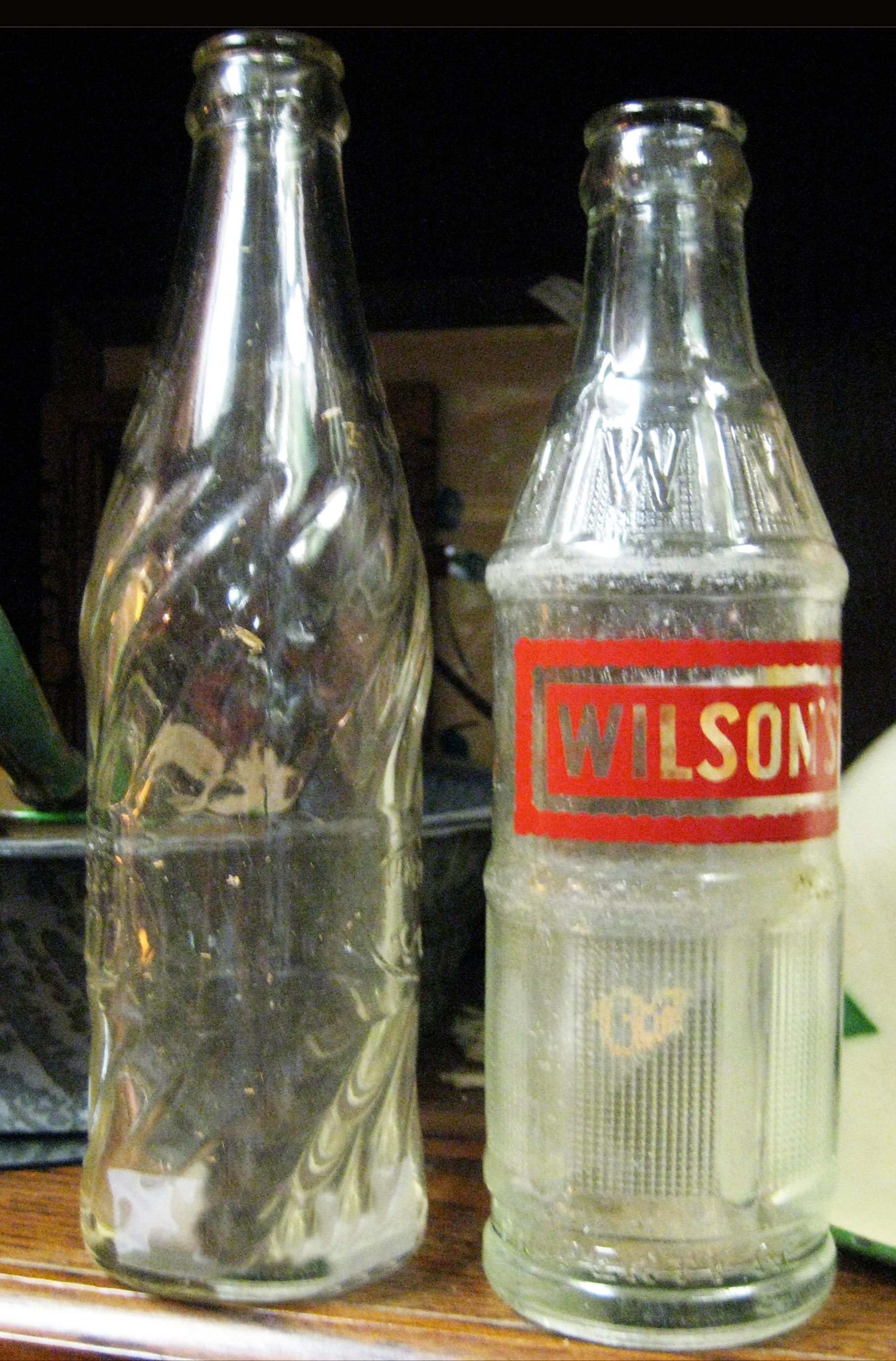
. . . and now let us drink a toast to the milk of human kindness . . .
 Art-Colored Glasses