 When I was a young artist-in-the-making, it irritated me to no end that people who saw my interest in art and knew of my Norwegian roots often instantly assumed that I was a big fan if not acolyte of Edvard Munch, Norway’s best known artist. Besides that my knowledge of Munch’s work was pretty nearly limited to ‘Skrik‘ (‘The Scream’) and what little else I’d seen even in passing was not at all to my taste, I took it as an insult and a frightfully narrow-minded view of my potential. And that, my friends, was the capper, because it implied that I was not in charge of my own future but predestined by my ancestry to be a pale imitation of somebody I wasn’t particularly fond of or impressed by in the first place. I was jolly well going to go my own way and choose my own muses and inspirations and, most of all, I was absolutely not going to be told what to do and when and how to do it by some ghostly abstract borne in my bloodstream.
As a very fortunate young pilgrim, I did manage to get to the Old Country and spend a little time rooting around my ancestral stomping grounds during my undergraduate studies. I got to meet and spend time with my great-aunts and various other relations and visit the house my grandfather helped build for his elder sister, our Tante Anna, and the family farms–the sylvan Ovidsland property with its tidy white house and taller red barn set in among the slender birches, and the more remote summer pastures of Eitland, a smaller and more rustic place on land with a sweet little lake for fishing up dinner. I was able to see the headstones of relatives long-gone, outside the little church where many of the family had attended services for many an age, and walk paths and travel roads where many of them had trod and ridden for ages before that.

Eitland, painted by an unknown family member or friend in the early 20th century.
It was a rich and rare opportunity to both visit the places of my family’s past and to live among my Norwegian family in their current places and way of life, something that few people get the chance to do and that I will treasure for as long as I live. Because it did change me, and change my point of view. It may seem strange, but some of the greatest change happened in completely unexpected ways; I was not especially surprised, though quite pleased, that getting to know family I had not known before and see the world from which my grandfather in particular emerged to live in the States (my other three grandparents‘ ancestors all came from other parts of Norway, where we had less constant and present contact). But I never imagined that simply setting foot in the country of my ancestors would move me as it did. I could never have begun to imagine that I would be so struck, feel such a palpable and somehow heart-wrenching connectedness on standing in front of the amazing Oseberg ship in the Viking Ship Museum of Oslo–but I was; I did.
And I was truly astounded to discover, when I–a little reluctantly, perhaps–went with my sister to visit the Munch Museum that I not only found Edvard Munch’s work much more technically impressive and more profound, his life story and the stories that gave life to and were expressed in his work more impressive and thought-provoking than I had ever dreamed I would allow, but indeed, there was a lot more that I found simply compelling and even, startlingly, appealing. First of all, the guy could draw. He could paint, make prints, tell stories. He was, dammit, gifted and actually worthy of the attention. How very annoying of him, really. Because then I had to come back and re-think what I was doing a little bit. Was it so terrible to reflect something of our however-peripherally-common ancestry in my own work?
I had, if anything, a new appreciation for how much I didn’t wish to emulate his life, with the illness and suffering that marked life for and around him. But to take, as he did, what life presented and put it through the same filters of self and vision and thoughtfulness and surrealist whimsy and passion–that might be precisely what could make me more, dare I say it, myself as an artist. Who knew.
So by the time I set about making the collection of artworks for my master’s degree exhibition, it was an amusing ‘closing of the loop’ to find quite a number of people observing the works in preparation and in the finally installed show coming back to that same old observation that had used to frustrate me so. ‘Has anybody ever mentioned how much your work is reminiscent of Munch’s?’ It was even amusing to me to realize that, though the subjects might stray from his, though the media were sometimes decidedly different and the techniques concomitantly skewed to fit them, and though most of these viewers had no inkling of my ancestry, apparently there was a little something making its way up from my roots to the surface of my art.
Somewhere along the way I had also started to grow up a bit and begun to figure out that we all, inevitably, have less control over our own destinies than we fancy we do, and that that’s not inherently a bad thing–that life will always surprise us and challenge our grand plans and hopeful dreams and carefully charted paths. That the very things we can’t predict or control help to guide and shape us into things we might never have imagined we could plan or wish to do or to be. I guess I just took a longer and more convoluted route to letting my little commonalities with my fellow Norwegian artist Edvard show through; being dead, he could spare the time to wait for me to catch up. And once I got comfortable with the idea of seeing a hint of him in the mirror, I didn’t feel like screaming anymore either.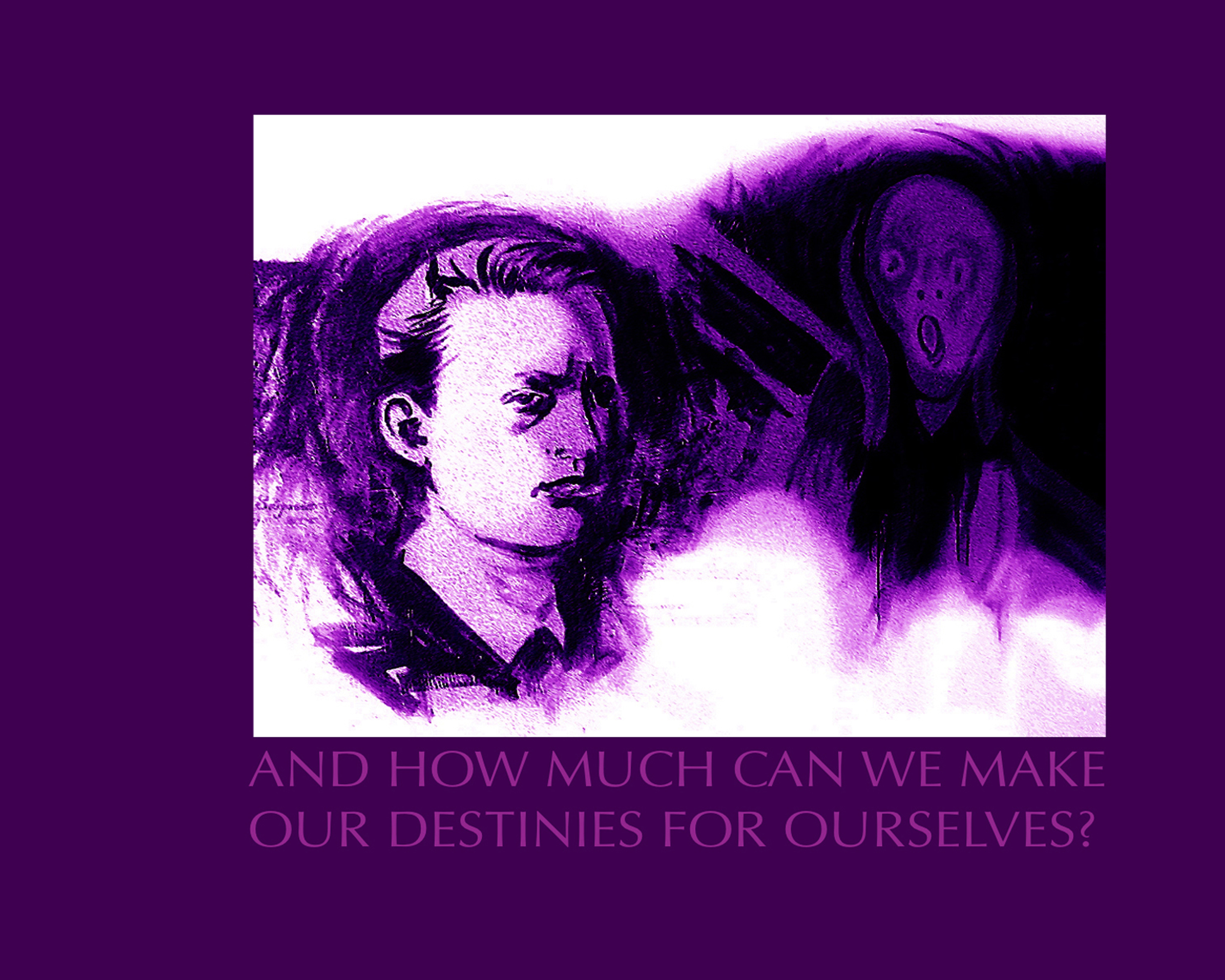


 Art-Colored Glasses