 Just because I have had the benefit of a decent education doesn’t mean I am smart. We all know that it’s entirely possible to have any number of degrees and diplomas, plaques and endorsements, letters and titles decorating your name and still be a complete fool. Idiocy is a far less rare condition than the number of high school and university graduates would have us believe.
Indeed, I have read a great quantity of writings during the course of my life, but I would never go so far as to say that I am well read. Among other contradictions to that claim would be my incredible slowness as a reader, both in speed and in comprehension: as a multifaceted dyslexic, able to turn words, letters, numbers, directions and relative spatial placements all inside out and upside down without even trying, I can easily spend four times the amount of energy and hours reading that any decent reader would need to get through the same amount of text. And of course that doesn’t guarantee that I will actually understand what I read in precisely the way the authors intended.
A more important reason that I don’t consider myself well read is that I have managed to conquer only a relatively small segment of the library most scholarly and literate persons would consider to be well written, informative, accurately researched and defended, or just plain must-read, important stuff among books. Long before I knew why it took me so long and so many tries to read a mere paragraph, let alone a book, I was required to tackle a handful of the so-called Classics of literature, and a bit of contemporary contenders for the title as well. It’s just as well I didn’t imagine I had such an anomalous reading style or that it was considered a disability by others, because I might have had yet more frustrations and difficulties in trying to fit the mold of how one was expected to overcome such things, instead of finding that by plodding through in my own backward way, I became attached to some of the books and stories to an equally unexpected depth. Whom should I, as a struggling reader, admire most among authors but those champions of the dense and complicated, say, Charles Dickens and Robertson Davies.
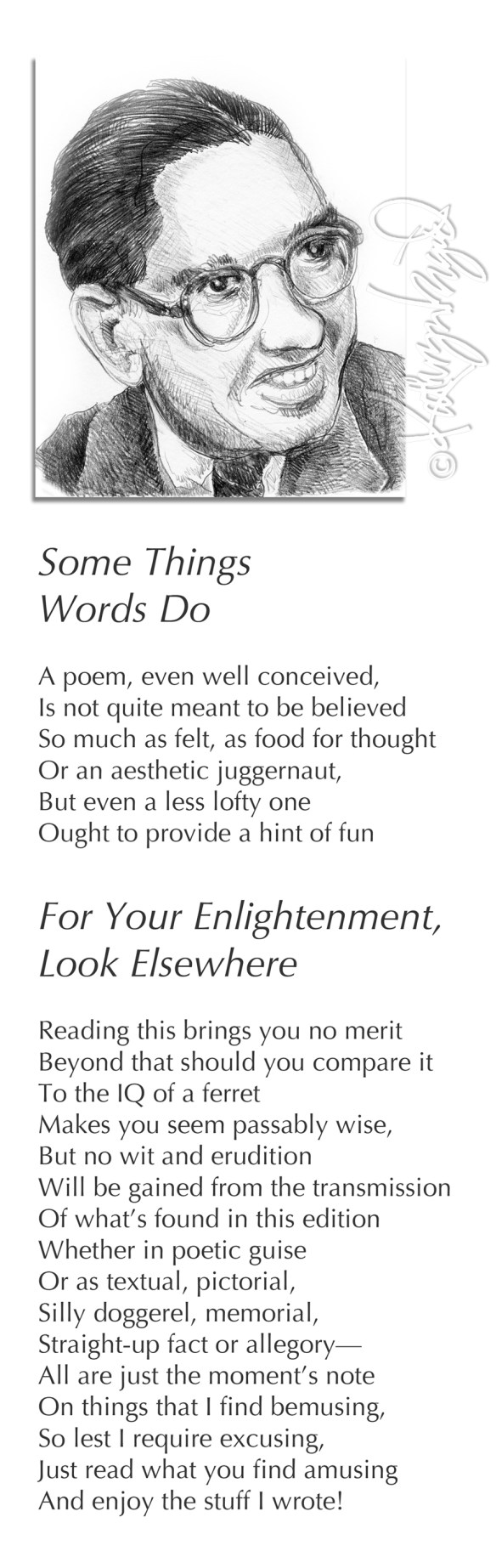
On the other hand, it’s probably less surprising that I also favor the purveyors of the most outlandish and appalling and ridiculous, from Ogden Nash, Evelyn Waugh, and Edgar Allan Poe to Mark Twain, S.J. Perelman and Franz Kafka. This part at least makes some sense, if you tend to believe I’d read writers who reflect something of my own mind’s workings or the weird ways in which I see the world. In any event, this latter crew might explain a little more about my tending to choose the least arduous paths in life, since I find a certain sort of familiarity in the strangest of their inventions and so can perhaps navigate their writings with a surer strength than otherwise.
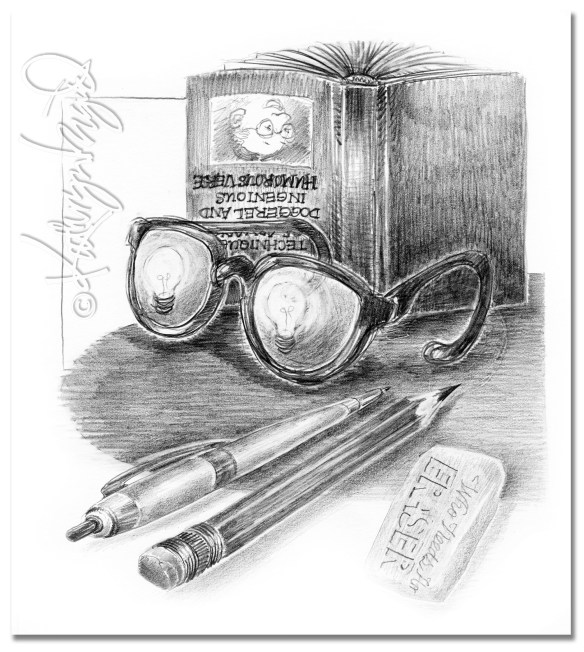
So while I may not be the sharpest pencil in the drawer or the most edified of readers, I have at least a few pieces of proclamatory paper in my coffers to prove that I did my homework somewhat dutifully if not doggedly. My degrees don’t confer any special wisdom upon me, but they at least excuse my curmudgeonly attitude about how long it takes me to read my own posts, let alone anyone else’s books and articles and poems and proposals, no matter how brilliant and scintillating and clever and beautiful they are. I’m still trying, but give me plenty of time!
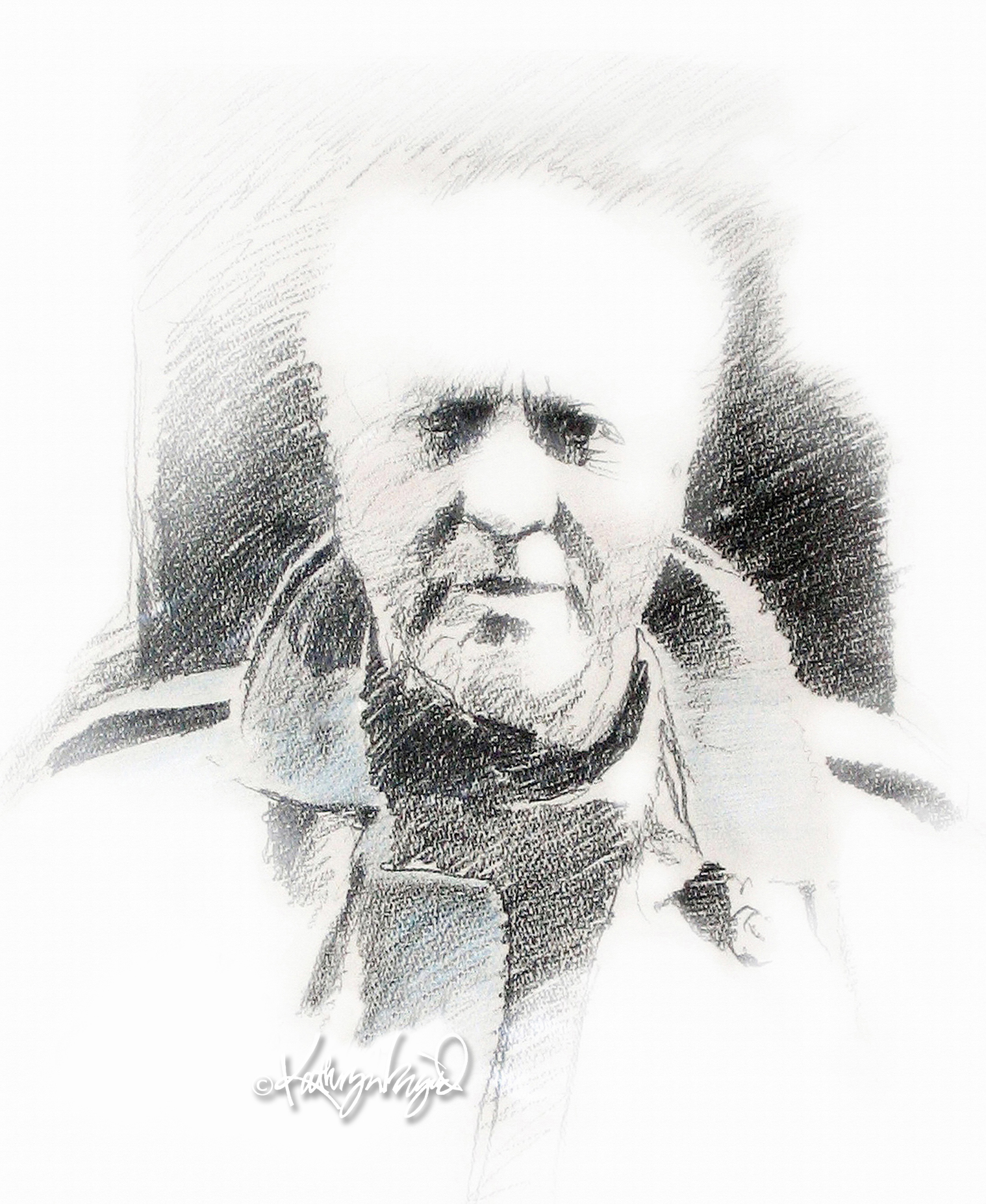
Ingvar Lidholm
Well, Honey, when a mommy artist and a daddy medium love each other very much . . . .
I can’t imagine that there is an artist or creative person alive who hasn’t been asked many and many a time where he gets his ideas or what inspired her to make this piece of artwork, write that song, take whatever photograph or choreograph any given ballet. In many cases, the answers are hard to condense into sound-bite-sized, manageable pieces for the occasion, because much creative endeavor is the tangible end result of a whole lifetime’s experience and train of thought, and we all know how often and how easily that particular train gets rerouted, redirected, diverted and derailed along the way.
But in general, most of us can point to pivotal moments that shaped our thinking, whether on an individual project or about our artistry as a whole. We can cite particular persons and their artistry that inspired and enlightened us and informed our own work as we grew. And for many of us, even we who are relatively late bloomers, a lot of the fodder for this inspiration begins early in life and creeps up on us subliminally to a certain extent.
I’ve already mentioned my long-ago irritation at being ‘bundled’ with Edvard Munch because of my Norwegian roots–and, of course, how ridiculous I realized that irritation was once I discovered that contrary to my belief, the more I got to know his work the more I actually admired it. Now, naturally, I take it as high praise (if perhaps hyperbolically so, though I’m happy to take it anyway) when my stuff is seen as meriting any such comparison.
My personal Style, if there is one, is defined more by a tendency toward slightly aggressive lines and bold coloration and faintly eccentric leanings when it comes to subject treatment than by any distinctive media, techniques or actual subjects. My affections in art are too fickle and my attentions too fleeting for me to be easily contented with any defined set of materials and topics and applications. But I find ideas and encouragement and guidance in the work of many painters, poets, draftsmen, printmakers, essayists, storytellers, architects, boat-builders, jewelers, botanists, lycanthropes . . . dear me, have I wandered again?
Part of the trick in pinning down who has been an influence on my work and where I’ve gotten my inspirations and ideas is that I’m very much a holistic, integrative and analogous operator, so in true Liberal Arts fashion I pull my many threads together from many divergent and possibly unrelated sources. The only consistent thing is that I try very hard to steal from the best.
My gifts are not musical, but I love music. So although my piano skills are fit only for personal amusement and my singing limited by spasmodic dysphonia and lack of practice to in-car singalongs and serenading my spouse with occasional outbursts of bent versions of formerly-familiar songs, I often work with music as my inspiring accompaniment. My paintings could be said to derive more from Aretha Franklin or Felix Mendelssohn, The Real Group or Tomás Luis de Victoria, than from Munch or Vincent van Gogh, though both of the latter have lent me many of my ideas about brushwork and coloration. My writing is more directly writing-derived, perhaps, but all of the favorite writers that spring to mind (Ogden Nash, Vladimir Nabokov, Dr Seuss, JRR Tolkien, S.J. Perelman, Gabriel Garcia Marquez, Tomie dePaola, Geoffrey Chaucer) are on my hit list because of the lyrical, even musical, qualities with which they treat poetry and prose. I love children’s books as much now as I did when an actual child, because the best of them of course comprise a perfect and literal confluence of verbal and visual imagery, something that becomes more deeply ingrained in me by virtue of drawing the senses together. And in that way, my writing is often led to incorporate certain textures and moods and colors or to carry a particular ambience by either pictures (real or imagined) or simply the weight of a visual experience I’m hoping to evoke with words. I’m no synesthete, but all the same I do depend on the interaction of all my senses to shape each of the creative works I’m developing.
I did once make an entire exhibition devoted to portraits of people (mostly historical figures) who had had influence of some significant sort on my art and my creative life, and perhaps the most telling thing about the gallery besides that I had deliberately filled it with nothing but portraits (a form I’d studiously avoided all along in my artistic journey until then) was that very few of them were of visual artists. Most were of composers, singers, and writers. A few were agents of social change, a couple were people I actually know, and a handful were influential in the philosophical or spiritual realms. The writers and musicians ruled the room. I doubt that would change hugely if I were to do such a survey of inspirational influences again. I do know that there would be a new character added, but I’m not certain how exactly I could represent in a portrait my network of online muses in blogdom.

Igor Stravinsky
 Art-Colored Glasses