Thoughtless Thursday

Since a number of Web Wanderers post wonderful Wordless Wednesday items, and I’m always behind the times in oh-so-many ways, I’m posting my own version a day late (and undoubtedly a dollar short), giving you here a highly abbreviated visual history of my life as an artist. Since I’m only middle-aged, I let it end at the Middle Ages for now, though you’ll notice from some of the costumes in the last frame that I’m looking for a Renaissance to appear fairly soon. Can’t hurt to hope, can it?

P&I

I was no prodigy, and I certainly took an early interest in shortcuts and easy techniques when it came to making images, but I did always have an eye for a good juicy and dramatic storyline . . . P&IAs I grew more seriously interested in art, I was also reaching an age where one wants to Fit In, so I did my part of stylizing my imagery and making it seem, I thought, more palatable to the critics (teachers, relatives) . . .P&IThen, of course, there was that awkward age when I started to think for myself, to develop my own philosophy of what my art should or could be, and what I wanted it to be. Presumably, the reason I lost my reason entirely. You just can’t make your own art without giving up at least a little of your already tenuous hold on reality . . .P&I. . . and here you find me, wandering from village to village in the vast land of Internet, telling my tales and making my pictures without much regard for the safety and comfort of those around me, but perhaps in that most of all being at last quite true to myself, the mildly crazed artist in your midst . . .

I was Going to Write the Great American Novel, but I Looked out the Window for a Second and . . .

My attention has drifted awry once again,

Has shifted from matters of weight among men

To things of no import, exceedingly tiny

And so insignificant–Hey! Look! It’s shiny!

I set out to do some magnificent thing,

But what it was? I can’t remember. The sting

Of memory loss in old age will be naught

Compared to the blank Inattention has wrought,

Distraction, and phantasmagorical dreams;

To focus and think is more work than it seems,

So, though I’d meant well and begun my great task,

My progress dried up like a sot’s whiskey flask,

And instead of inventing great stuff, plodding darkly,

I did something else–Hey! Look there! Something sparkly!

mixed media on glass

Look! Up in the air! It's a bird! It's a plane! Hey, it's my attention flying way off course again!

We are Feline Fine, Thank You

graphite drawingTransubstantiation

Fish-eyes ogles us, just to say

in that slippery longing way of his,

that sidelong gaping staring way,

‘I envy the cat that milady is.’

We ponder his liquid love, his fins,

and the way each turn makes him squirm and sink

in the tank (predicament for his sins?),

and we sit and groom ourself and think . . .

Can’t help but pity and love the poor

fish-eyes in turn; think biology,

its cycles, return of what’s been before,

carbon reclamation, and all that we,

with wizard knowledge, learned to admire

and along the way, to recognize

as an opportunity to acquire

matter remade thus if one only tries . . .

what we think is this: that a little fish

could become a cat, graceful, sleek and slim,

by means of becoming a dinner dish–

and on thinking that, we devour him.

Musica Mnemonica

photoI Keyboard Position

(For HH & JDH)

I went to hear a singer sing his due

Recital and to learn to love his voice,

Yet on the instant knew I had no choice

But watch th’ accompanist and think of you,

For when they came onstage a dream began

As German art-songs sung up from a deep

Chasm of voice that ought to haunt my sleep,

My heart was drawn instead to that tall man

Curled over the piano in that soft,

Sprung posture that in you I used to know,

When you assumed it, meant that you would go

Anon, and play your listeners aloft

To dazzling heights of ecstasy and free-

Fall back with us to depths of bronze despair

Because your fluid playing pulled us there,

And art, remembered now, that let me see

That this man taught those notes to you, each one,

And from his posture, know you were his son.photo collage

II Nocturne

(For JDH)

You always play the Evensong or toll

The close of Compline on that rank of keys

That lets the darkness in at night and sees

No morning come again where dawn should roll

Its banner out, because your day is past,

Untimely so, and others left behind

Whose love for you through music was refined,

And evening services to hold us fast

Within your arms; now elders play the songs

As you’d have done if time had let you play

A lifetime–even just another day–

With melody to right the thousand wrongs

That took you from our midst, that stopped the tune,

Left only other hands to tend the notes,

And threw you like a star among the motes

Before you could play in another June.

Now summers come no more, nor daylight’s dawn,

Though through the night your music lingers on.photo

Writing-itis

photo

Scriptorium


Worlds of iridescent gleam

all spring up glinting at the call

insouciant pens make, or they seem

to do: transform a drafty hall

into an arras-covered way

transecting palace corridors–

or granite boulders, flecked with grey,

to gravestones marking mythic wars’

highest heroics, men of myth;

or remnants of some long-forgot

mysterious monster’s kin and kith,

frozen in time upon the spot;

One peep at some dark road reveals

where mullioned windows lend a flash-

quick view of Heaven; one more steals

a different twitch of the eyelash–

a glimpse of Hell–its portals there

right in the same dark road just viewed

as commonplace by those who wear

mere men’s eyes to the interlude.

The glasses worn, instead, by scribes

can coalesce the simplest things

into the marvels of their tribes,

into the wealth of queens and kings,

into kaleidoscopic joys,

playgrounds of sound and touch and hope,

can turn mere scribblings and noise

into a length of golden rope

binding together known, unknown

and things not yet imagined still,

telling those tales their pens have grown

out of pure nothingness and nil

to shape breathtaking, worthy lands

and characters of dash, to cleanse

the mundane world with authors’ hands,

the swordlike flourish of those pens.

photo

Pardon my purple prose . . .

Interludes

photoContinuity

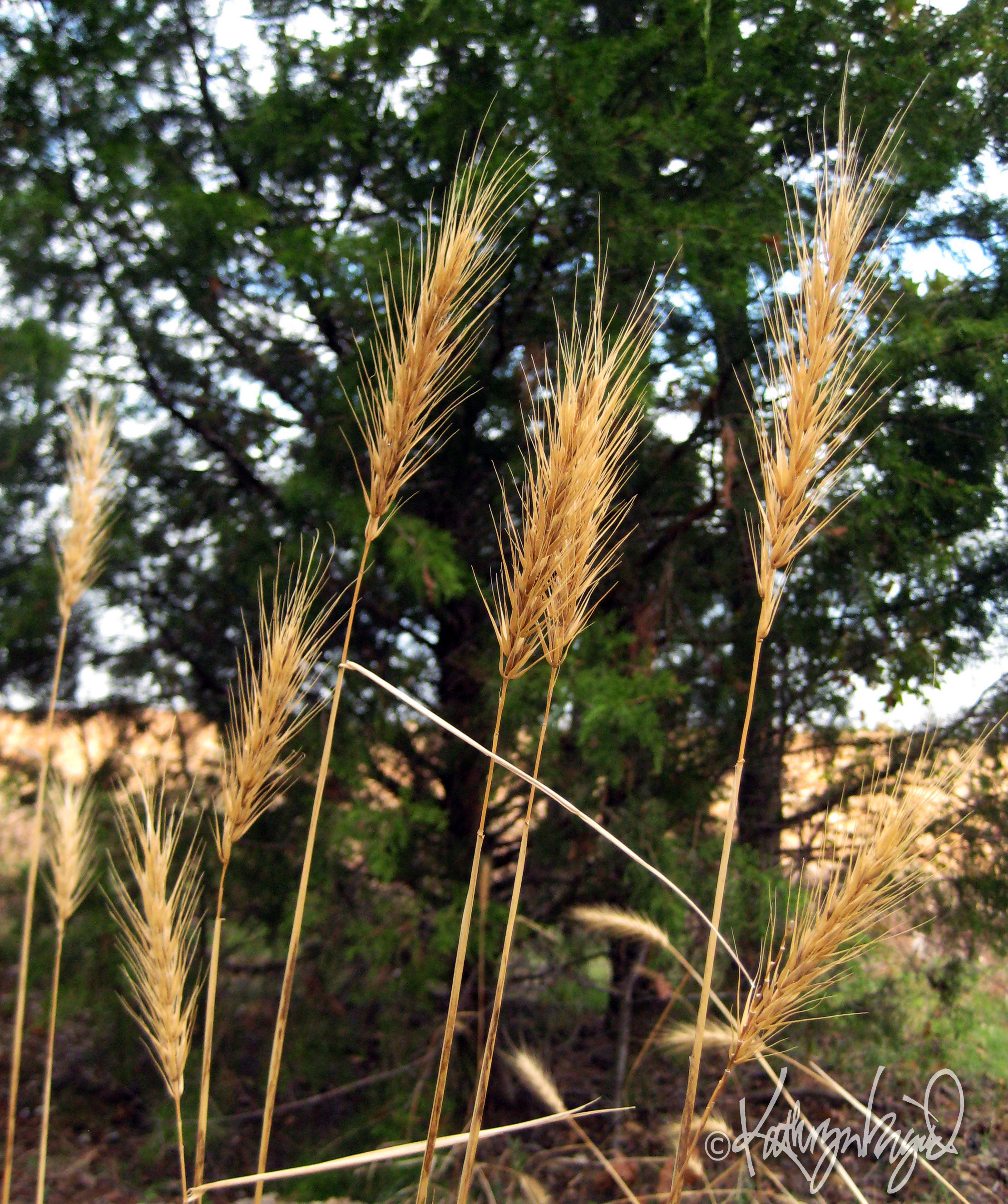
Winnowing chaff from new-cut heads

Of grain, the girls toss up from trays,

Flat-woven from the grasses there,

The seeds in ancient ways

And let the antique wind blow out

The husks in clouds of gold,

Then bow back down to seek more grain

As in the days of old,

For nothing changes in the dance

Each time the story’s told.photo

Elixir

They all were young and fair who sat

Under the rustling summer trees,

The copper beeches, lindens; these

Broad green allées of hazel that

Gave shade and silver glints of sun

In rhythm with their part-songs, airs,

And with their sweet dallied affairs

While laughing brooks made haste to run

Away, as time is wont to do,

And youth, but these stayed young and fair

Forever in their summer air

Because their songs of love rang truephoto

“Mama, Where Do Baby Ideas Come From?”

graphite and colored pencil on paper

Ingvar Lidholm

Well, Honey, when a mommy artist and a daddy medium love each other very much . . . .

I can’t imagine that there is an artist or creative person alive who hasn’t been asked many and many a time where he gets his ideas or what inspired her to make this piece of artwork, write that song, take whatever photograph or choreograph any given ballet. In many cases, the answers are hard to condense into sound-bite-sized, manageable pieces for the occasion, because much creative endeavor is the tangible end result of a whole lifetime’s experience and train of thought, and we all know how often and how easily that particular train gets rerouted, redirected, diverted and derailed along the way.

But in general, most of us can point to pivotal moments that shaped our thinking, whether on an individual project or about our artistry as a whole. We can cite particular persons and their artistry that inspired and enlightened us and informed our own work as we grew. And for many of us, even we who are relatively late bloomers, a lot of the fodder for this inspiration begins early in life and creeps up on us subliminally to a certain extent.

I’ve already mentioned my long-ago irritation at being ‘bundled’ with Edvard Munch because of my Norwegian roots–and, of course, how ridiculous I realized that irritation was once I discovered that contrary to my belief, the more I got to know his work the more I actually admired it. Now, naturally, I take it as high praise (if perhaps hyperbolically so, though I’m happy to take it anyway) when my stuff is seen as meriting any such comparison.

My personal Style, if there is one, is defined more by a tendency toward slightly aggressive lines and bold coloration and faintly eccentric leanings when it comes to subject treatment than by any distinctive media, techniques or actual subjects. My affections in art are too fickle and my attentions too fleeting for me to be easily contented with any defined set of materials and topics and applications. But I find ideas and encouragement and guidance in the work of many painters, poets, draftsmen, printmakers, essayists, storytellers, architects, boat-builders, jewelers, botanists, lycanthropes . . . dear me, have I wandered again?

Part of the trick in pinning down who has been an influence on my work and where I’ve gotten my inspirations and ideas is that I’m very much a holistic, integrative and analogous operator, so in true Liberal Arts fashion I pull my many threads together from many divergent and possibly unrelated sources. The only consistent thing is that I try very hard to steal from the best.

My gifts are not musical, but I love music. So although my piano skills are fit only for personal amusement and my singing limited by spasmodic dysphonia and lack of practice to in-car singalongs and serenading my spouse with occasional outbursts of bent versions of formerly-familiar songs, I often work with music as my inspiring accompaniment. My paintings could be said to derive more from Aretha Franklin or Felix Mendelssohn, The Real Group or Tomás Luis de Victoria, than from Munch or Vincent van Gogh, though both of the latter have lent me many of my ideas about brushwork and coloration. My writing is more directly writing-derived, perhaps, but all of the favorite writers that spring to mind (Ogden Nash, Vladimir Nabokov, Dr Seuss, JRR Tolkien, S.J. Perelman, Gabriel Garcia Marquez, Tomie dePaola, Geoffrey Chaucer) are on my hit list because of the lyrical, even musical, qualities with which they treat poetry and prose. I love children’s books as much now as I did when an actual child, because the best of them of course comprise a perfect and literal confluence of verbal and visual imagery, something that becomes more deeply ingrained in me by virtue of drawing the senses together. And in that way, my writing is often led to incorporate certain textures and moods and colors or to carry a particular ambience by either pictures (real or imagined) or simply the weight of a visual experience I’m hoping to evoke with words. I’m no synesthete, but all the same I do depend on the interaction of all my senses to shape each of the creative works I’m developing.

I did once make an entire exhibition devoted to portraits of people (mostly historical figures) who had had influence of some significant sort on my art and my creative life, and perhaps the most telling thing about the gallery besides that I had deliberately filled it with nothing but portraits (a form I’d studiously avoided all along in my artistic journey until then) was that very few of them were of visual artists. Most were of composers, singers, and writers. A few were agents of social change, a couple were people I actually know, and a handful were influential in the philosophical or spiritual realms. The writers and musicians ruled the room. I doubt that would change hugely if I were to do such a survey of inspirational influences again. I do know that there would be a new character added, but I’m not certain how exactly I could represent in a portrait my network of online muses in blogdom.

acrylic and graphite on canvasboard

Igor Stravinsky

Choosing an Upward Trajectory

Mixed mediaUncertainty of Heart

Amid most fond expressions of affection, endless love,

Devotion and determination to be stewards of

These sentiments and feelings, is that little nagging voice

That tells us it would not be so if we had any choice,

Because we are perfidious by nature, roaming, weak,

And fearful of commitment to degrees we cannot speak,

And paranoid, on top of it, that others are the same,

And so we speak our pretty vows and play our little game,

Attempting to convince ourselves as much as other folk

That our desires and adoration aren’t some flimsy joke—

The shocking Surprise Ending to this tale is that at death,

Some of us finally realize upon our final breath

That all of it was true, and that our hearts were so inclined;

Too bad we take so long, we fools, to see that we have lived as blind.

acrylic on canvasboardLaudate

In a room with bright light and bright sound

It’s as though all the birds in the wide world have set

Their hearts on singing out the highest praise

Of sun and stars and moon, of life and light and love,

And of being wingèd things up in the broad green roof

Of the springtime world–and yet this song,

Sung in truth by mortals mere, by trebles in

The spring of their own lives, can only hint

At the brilliant sweetness of having been born to sing.

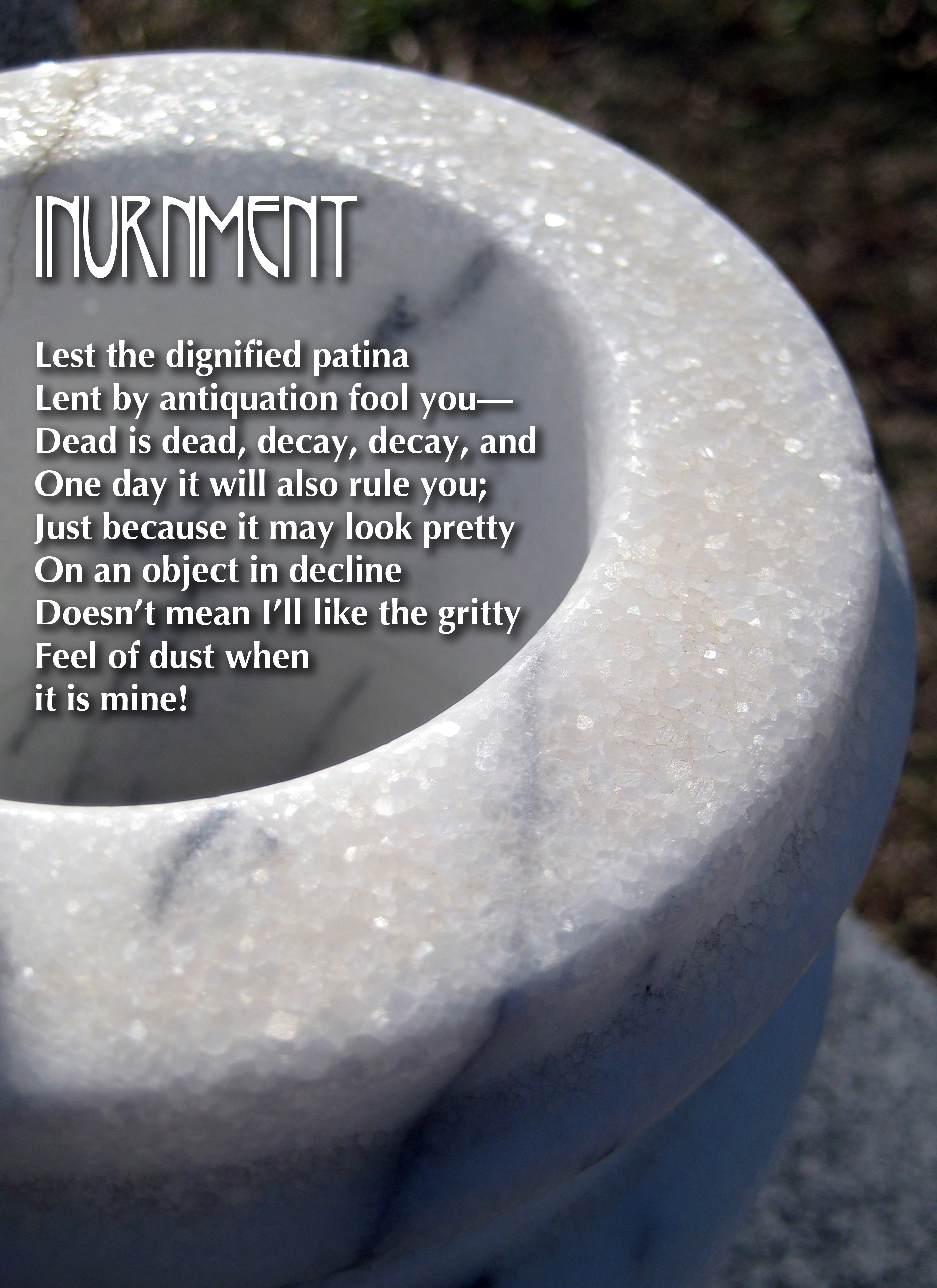
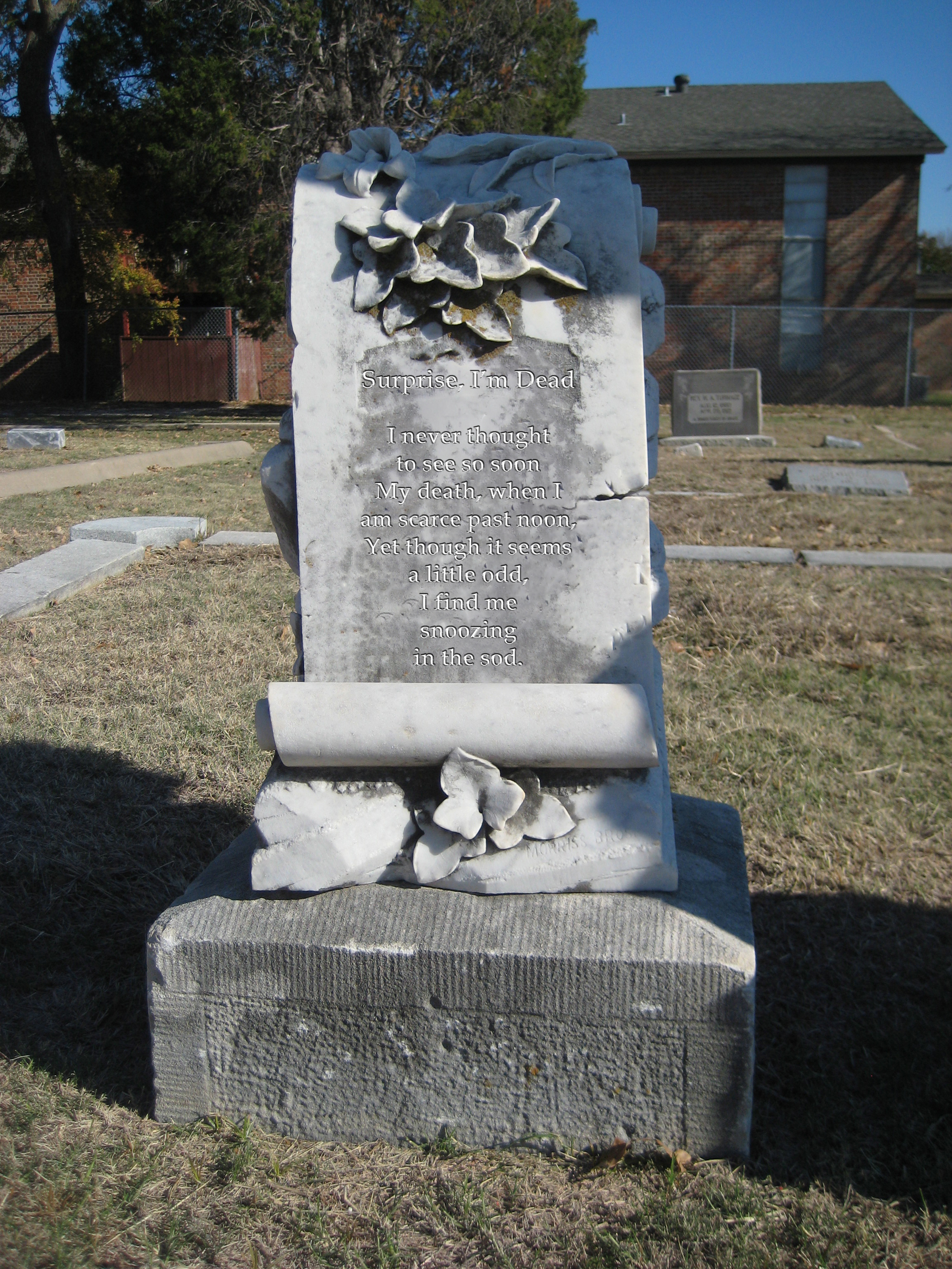
Our Hard-Earned Inurnments

photo + textInurnment

Don’t let the dignified patina

Lent by old age fool you—

Dead is dead, decay, decay:

One day it too will rule you;

Just because it may look pretty

On an object in decline

Doesn’t mean I’ll like the gritty

Feel of dust when it is mine!

photo + textSurprise, I’m Dead

I never thought to see so soon

My death, when I am scarce past noon,

Yet though it seems a little odd,

I find me snoozing in the sod.

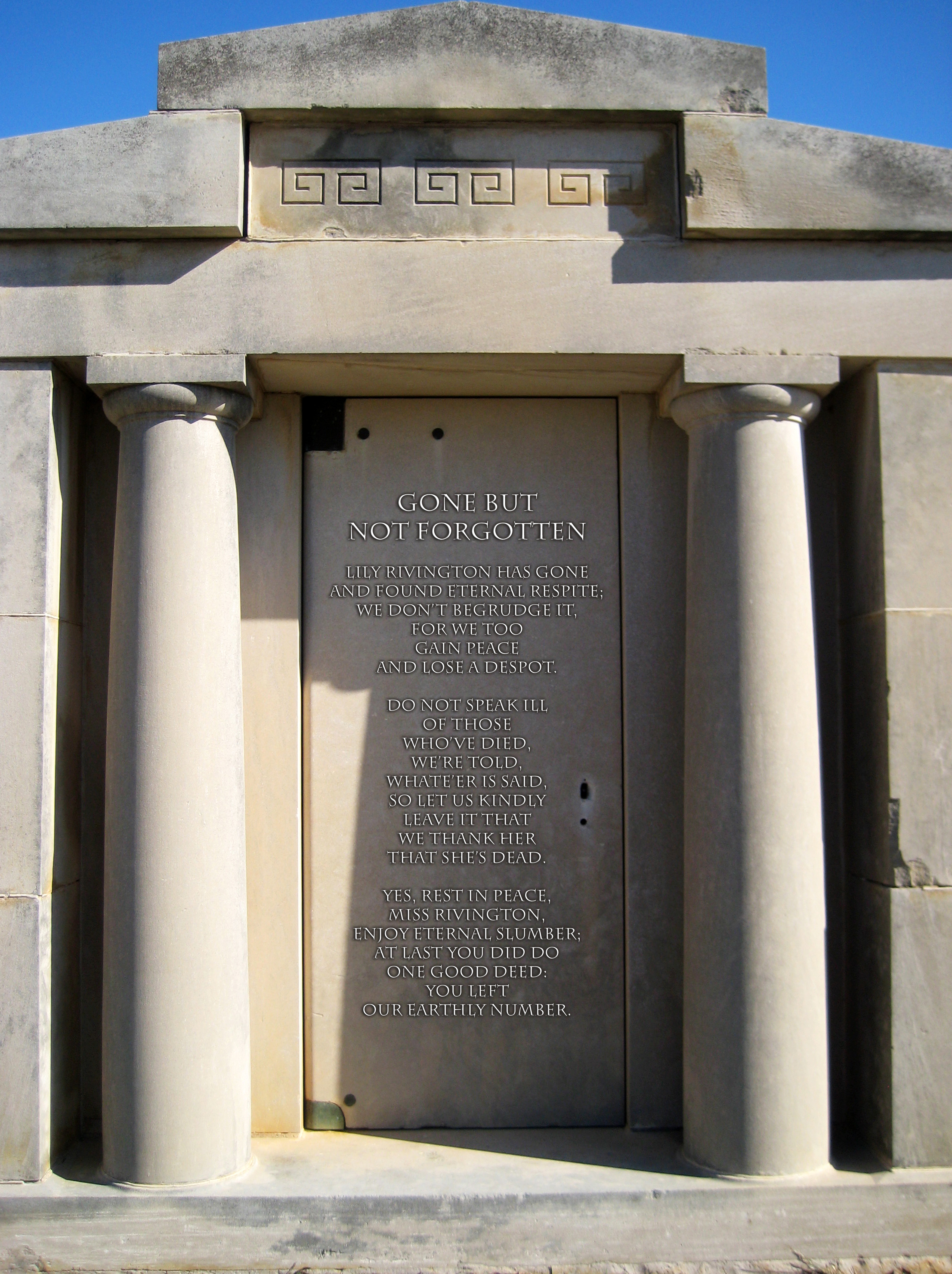
photo + textGone But Not Forgotten

Lily Rivington has gone

And found eternal respite;

We don’t begrudge it, for we too

Gain peace and lose a despot.

Do not speak ill of those who’ve died,

We’re told, whate’er is said,

So let us kindly leave it that

We thank her that she’s dead.

Yes, Rest in Peace, Miss Rivington,

Enjoy eternal slumber;

At last you did do one good deed:

You left our earthly number.

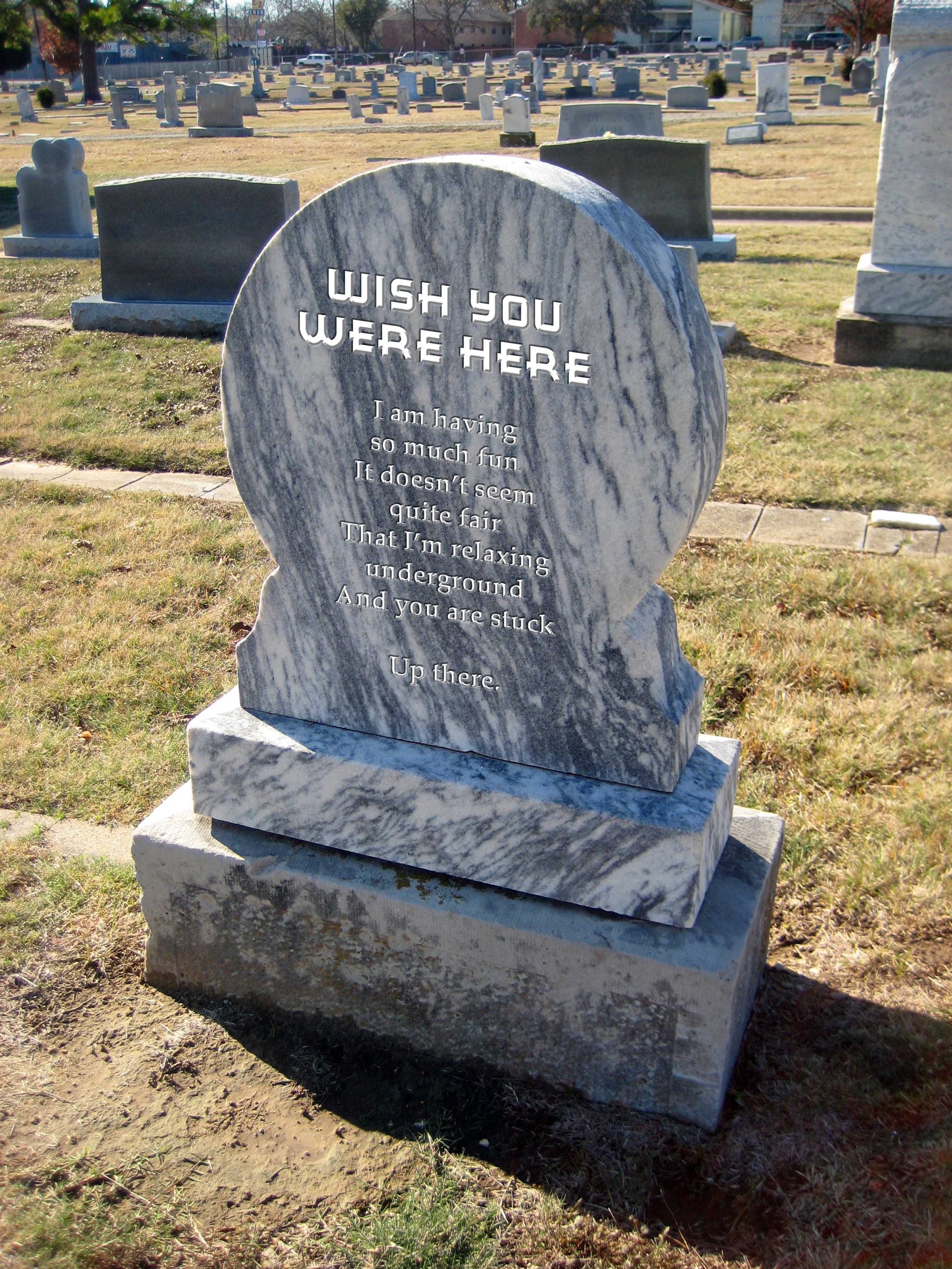
photo + textWish You were Here

I am having so much fun

It doesn’t seem quite fair

That I’m relaxing underground

And you are stuck

Up there.

Gone in an Instant–or Maybe Not . . .

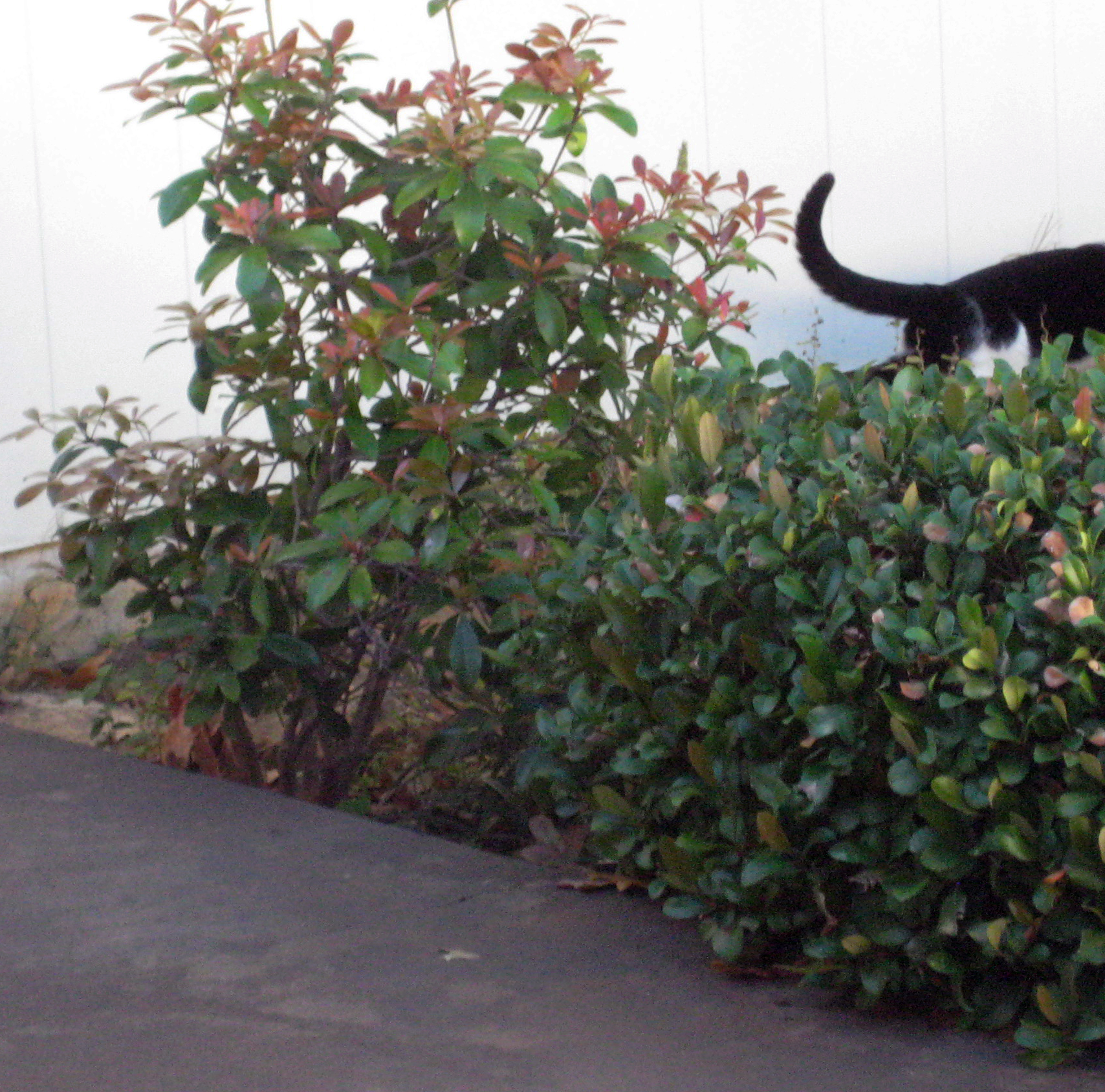
Since some of you have inquired about the possibility of seeing a portrait of Watch-Cat, I shall oblige. But let me tell you, being as stealthy as he is in his work, he is mighty elusive. The following is the only sort of glimpse we get of him most of the time, and certainly the best I’m ever likely to capture with the camera–he’s much too methodical in his rounds to hang around waiting to pose for the paparazzi.

Isn’t that how we all are in life, somewhat? Set on our appointed paths, head down, moving forward with only the rare thought given to change or breaking out of the known and predictable, even rarer the courage and spirit of adventure to follow through on the thought. Why not surprise yourself with one deviation from your expected path today, doing just one small thing that will bring greater enjoyment or move you toward an alluring new horizon?

photo

With a twitch of his tail, he's gone again . . .

He Who Never Overdid It

Howard, a fine, well-rounded cat,

was neither skeletal nor fat,

nor was he far too forceful or

behindhand, coming through a door–

not garrulous but neither mute,

nor glabrous, yet not too hirsute,

and when the milk poured, as you’d think,

was neither fast nor slow to drink.

The strange thing, you may be amazed

to know, knowing that he was praised

as a feline so fine, well-rounded

and refined–you’ll be astounded

–and I say it not in jest–

old Howard died, like all the rest.

So, if it means no jot or tittle,

I say: rock the boat a little!

photo (Calendula)