Rehearsal

photoO Salutaris Hostia (de Pierre de la Rue)

That moment of least confidence–

That time when all I am and ought

To do or be, the competence

And hope I’d with each act besought–

I want to fold full inward, to

Hide what I fear I cannot be,

When from the dark an echo true

To angels’ voices lights on me

As though their paean, their salute,

Raised me from darkest depths so high

That all my terrors must fall mute

Or join to lift me to that sky

Where praisèd saints and holy ones

Have banished fear through angel choir

And sung as though a thousand suns

Make hearts anew with wild desire.

Into Tomorrow, Endlessly Singing

You all know by now that I am not a singer. I get asked all the time, since I’m married to a choral conductor (who happens to also be a lovely singer himself) and I hang out with an enormous cadre of the vocally talented. When I demur, I get asked what kind of musician I am, then, because after all, so many denizens populating the rest of our joint life are outstanding composers, instrumentalists, conductors, and all of the rest that, well, it just seems so obvious. In truth, I did take the obligatory childhood music lessons–about five years at the piano, if you remember–ending with a certain rueful amusement on my teachers’ part but no great skill on mine, plus a brief period of voice lessons from a well-meaning coach who’d heard my sisters and me sing and gave the elder two of us a go. Where again, my failure to learn to read music with any ease was further complicated by my inability to understand and make use of the very important concept of singing with a head voice. Having become accustomed over my earlier years to being mistaken for Dad on the phone, or for an older girl because I was extremely shy and therefore more reserved than many kids my age plus having a relatively deep voice for a girl, or for a more skilled singer than I really was because I was willing to sing any part–and did, at one point, sing in all four choral sections because that was how the need was distributed in my various school and church choirs–well, it all probably let me learn a whole array of bad vocal habits that pretty much put the kibosh on my becoming an actual skilled singer. The likely absence of a notable native vocal “instrument” wouldn’t’ve helped either, had I tried to force the issue, but by the time that I hit high school and time management demanded that I narrow down my interests a bit, choir fell off the list other than occasional singing at church. Who knew I’d end up partnered with this guy!

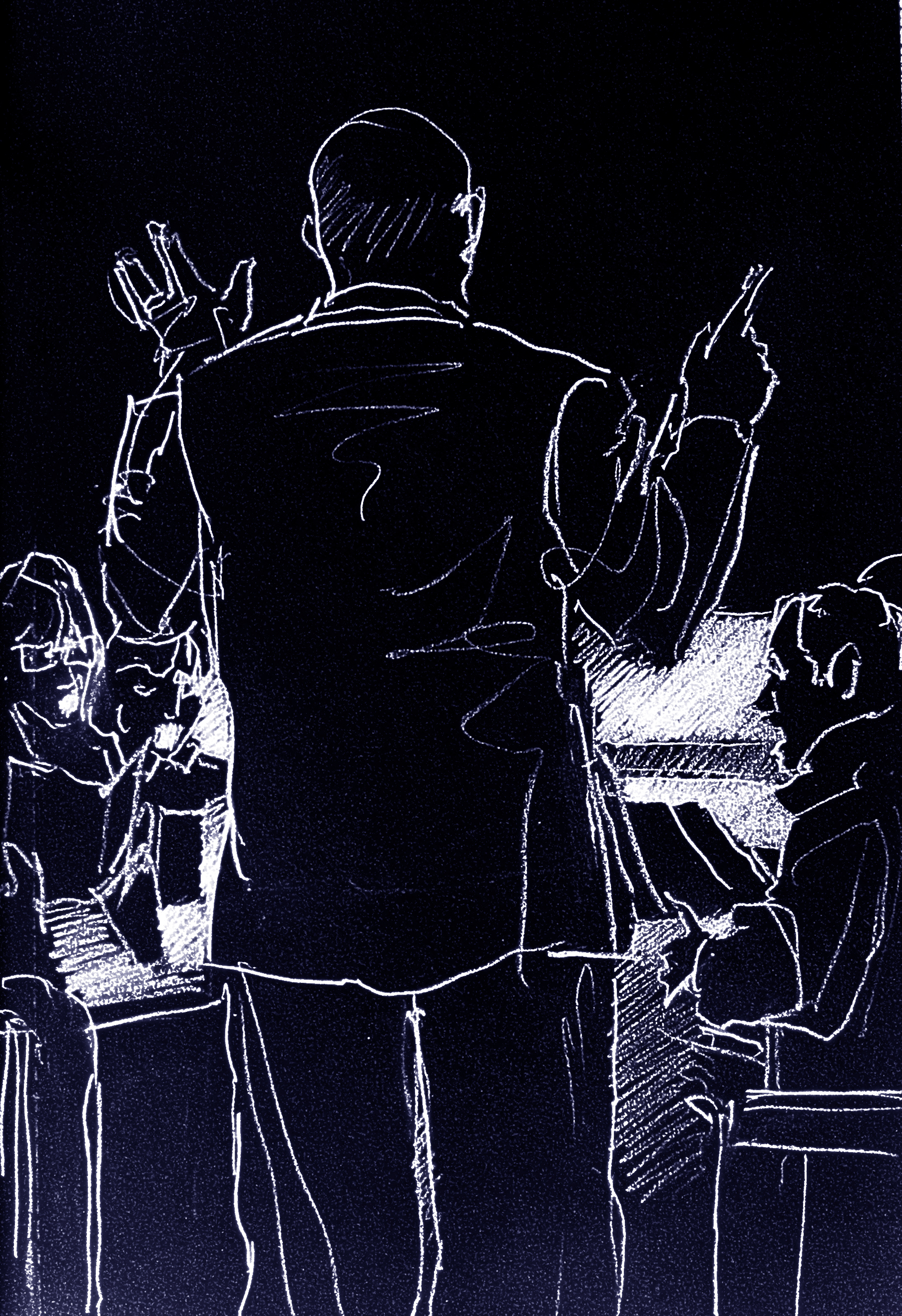
white pencil on black paper

Sketches from a Swedish Radio Choir rehearsal, my husband conducting (if you've seen him conduct enough, you can recognize even the rough sketch of his hand positions) . . .

But as I also pointed out some time ago, the influence of music and of singing remained large and happy in my life, even if I was not destined to be a producer of them. I continued to love listening, cultivated many musical friends who provided the sonic tapestry that was the backdrop of my happiness, and even collaborated with musicians on projects where they provided the aural elements of a performance and I the visual imagery to accompany it. For a few years, I served on the Concert Committee that produced a reasonably ambitious season of musical offerings at our church, which was conveniently located just across a university campus from the music department where many of my fine-musician friends happened to work. It must be added, in fairness, that the draw of being on said Committee was not purely musical but also deeply social, what with all of the musicians and music-lovers therein, and also exceedingly delicious, because most of the musicians I’ve known are committed eaters if not foodies and so the Committee’s meetings quickly evolved into elaborate gustatory events as well.

And that’s precisely why music has remained so largely writ in my life, if not burgeoned and positively exploded, over the years since: music is so intertwined with so many parts of what I love in life that I can’t separate one happiness from another. If music be the food of love, play on! What hasn’t followed for me is what followed for Duke Orsino, because I never found either that I became surfeited by listening to good music or that I became surfeited with love by loving life with musicians–one in particular. Tough luck, your Grace! So I am not dutifully following, wagging my tail obsequiously, as I go to a rehearsal and sit in the darkened hall while choirs work their repertoire into their voices and souls to prepare for performance; I am both absorbing the inner workings of music that don’t exist in me innately or by scholarly wisdom, so to appreciate and bathe in the final production all the more, and also having the beauty of the practice itself wash over me in waves that can inspire me to write, to draw or paint, to design my better garden bed or concoct a more delectable dish for dinner. Waves that, at their best, lift me out of myself and let me feel the singing pass through me as though I, non-musician-non-singer that I am, with spasmodic dysphonia that presumably means even if I ever figure out my head voice and/or learn to read music, I won’t become a great singer–as though I myself were singing.

So, though I may struggle to sing a simple ditty nowadays, I have this magnificent vicarious experience available to me that few are privileged to share, and in this rather out-of-body experiential way expect to sing my way through the rest of my very happy future. As I do the usual end of the year assessments and look ahead to what I imagine and hope for the year soon to come, the imagery is suffused in every possible way with music. I am immersed in song. I write lyrics because I cannot sing them. I listen to rehearsals because I cannot read music well and don’t know the inner workings of music preparation the way performers and conductors do. I attend concerts because the kinds of beauty and grief, daring and humor, poignancy and brilliance that come through well made music embrace, interweave and transcend all of the other parts of my life so that I feel transported, changed to a better self. As though I too am singing in a song that may never have to end.

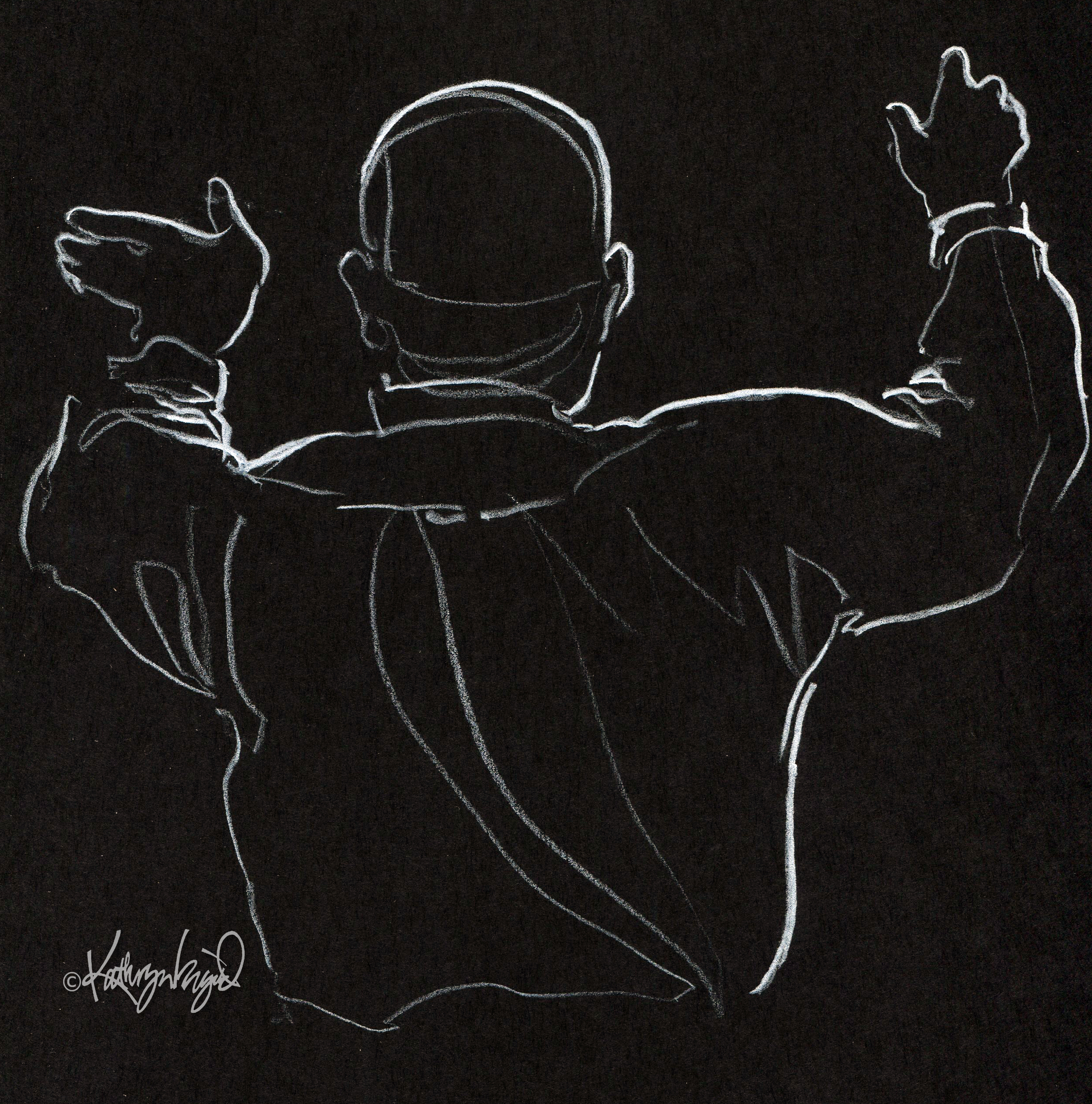
white pencil on black paper

Conducting another Sparkling performance . . .

The Googly-eyed Romantic Point of View

Admit it, you start to slip into a coma the instant someone else starts spewing the horrifically saccharine details of their great love story. I do too; it just doesn’t stop me from being the mushy bore myself the moment I see a hairline of an opening. Honestly, don’t we all do it? There’s nothing much any of us are more inclined to brag about than our happiness, and nothing much that gives us greater happiness than fancying ours the Greatest Love Story in History.

You can be forgiven if you didn’t know yet that that title was already mine.

photoParticularly since I’m quite certain my love story doesn’t conform quite perfectly to your–or anybody else’s–idea of the ideal romance. We’re not much, around this household, on many constant and overt expressions of commercially endorsed couplehood: bouquets of roses, spontaneous gifts of expensive jewelry and sports cars, and going out to chateaux with extravagant four-star restaurants to toast each other over mortgage-worthy vintages are just not high on the list of things we often do. On the other hand, I am in the company of someone still teenager-enough to really like holding hands, hugging like there’s no tomorrow, and blurting out “I love you” pretty much every few minutes or so, even if we happen to be sitting right next to each other. He also reads to me, cuts my hair, laughs at my pitiful jests, cooks for me when there’s time, takes me on meandering road trips or spectacular world travels when the opportunity arises, covers my eyes when the really gruesome surprise is coming up in a scary movie he’s seen before so I won’t have to be tranquilized later, and sings me ridiculous made-up songs in the car.

Thing is, being soggy Romantics isn’t just about the stuff or the standards. It’s about finding pleasure not only in those storybook moments of ecstatic bliss but especially in the ongoing and real kindnesses and shared tasks that fill up the everyday, because the everyday is such an insurmountable percentage of our lives, singly and together.

So there’s no question that one of the things I find most romantic in my partner is that he does have an appreciation for all kinds of beauty and learning and amusement and work, from nature’s resources to friends and family, from rambling around a run-down part of town to finding starlight in the arts that we share as both as passion and as vocation. It’s reassuring, after all, that there’s not some impossible measure of queenly perfection I myself am expected to meet but that he sees good in the ordinary me and values it as though it were something romantic.

All the same, it doesn’t hurt that he’s fed me filets, tirelessly supported my “Expensive Hobby” career of being an artist/writer, and he’s taken me to castles and cottages, forests and mountains, cities of great sophistication and incredible vividness and hidden hamlets with more shaggy livestock than human population, and to seas both of the stormy north and those surrounding tropical islands. It is, truthfully, pretty romantic to stand at the shore of the ocean with the best person in you whole life right by your side.

photo + textThe most striking fact of our coming together as such a love-sodden twosome is that we were both quite content in our single lives and expected to live that way perpetually. I’m convinced that because we both liked who we were and how we lived our lives, had surrounded ourselves with a constellation of astonishing friends and loved ones, and had endless interesting things to do with our time and attentions, it was easier in reality to fall in love than if we’d been avidly hunting for something either of us felt too keenly that we lacked. And that is for me the romance in any part of life: that we don’t necessarily require it to make us whole or contented or excited or whatever-it-is; it’s a genuine, unexpected, unearned treasure. A gift, a bonus. The prize.photo

Choosing an Upward Trajectory

Mixed mediaUncertainty of Heart

Amid most fond expressions of affection, endless love,

Devotion and determination to be stewards of

These sentiments and feelings, is that little nagging voice

That tells us it would not be so if we had any choice,

Because we are perfidious by nature, roaming, weak,

And fearful of commitment to degrees we cannot speak,

And paranoid, on top of it, that others are the same,

And so we speak our pretty vows and play our little game,

Attempting to convince ourselves as much as other folk

That our desires and adoration aren’t some flimsy joke—

The shocking Surprise Ending to this tale is that at death,

Some of us finally realize upon our final breath

That all of it was true, and that our hearts were so inclined;

Too bad we take so long, we fools, to see that we have lived as blind.

acrylic on canvasboardLaudate

In a room with bright light and bright sound

It’s as though all the birds in the wide world have set

Their hearts on singing out the highest praise

Of sun and stars and moon, of life and light and love,

And of being wingèd things up in the broad green roof

Of the springtime world–and yet this song,

Sung in truth by mortals mere, by trebles in

The spring of their own lives, can only hint

At the brilliant sweetness of having been born to sing.

Sound Advice for the Voiceless

watercolor birds x 2

Singing our little hearts out . . .

I have spoken about having Spasmodic Dysphonia. That in itself, when in the aural forum and not (as in yesterday’s blog post) just the printed format of the internet, is a fine thing in my estimation. It means that having SD hasn’t rendered me either mute or unwilling to let my sometimes goofy sounding voice be heard. It could conceivably be argued that it would be good if I would actually shut up occasionally, or at least not be quite so outlandishly talkative as I can get. I consider that other people’s problem. Egotistical, I know, and I’m not really exaggerating when I say that. What you hear is what you get.

Being fortunate enough to retain the power of speech, I prefer not to stop using it. SD has meant getting over any vanity I may have had about the sound or quality of my voice. Having been flattered by many in my younger years as a strong and clear and pleasant speaker and encouraged to take singing lessons, to consider radio work, to be a lector and to speak at public events, I now have a different sense of my voice and what I do and don’t trust it to do than I did then.

So I find it less comfortable both physically and psychologically to sing, and certainly have no desire to show off my resulting lack of confidence and practice publicly. I was always a nervous Nellie when it came to singing in any group smaller than a chamber choir (Yikes! Someone might hear me!), but even singing along with a crowd is not the same fun it once was. It has in no way diminished my delight in hearing others sing, however; quite the contrary, it transformed my understanding of what it means to be able to sing, and to do so with skill and fluidity and grace. Working on proper vocal technique will help me continue being able to speak, but my own sense of music has been shifted rather firmly into listening to and appreciating and being moved by others’ mastery of their instruments. My own musical endeavor now sits much more comfortably in the realm of written and spoken language and of trying to capture the marvels of rhythm and pattern and color and sound in the confined refinements of print and speech. The potential is perhaps equally profound and potent, but simply takes an entirely different route through the senses in some significant ways.

Just to be crystal clear on this, I say this without any sense of loss or privation. I’m not suffering! Indeed, I consider myself incredibly fortunate. I’m neither summarized by nor limited to a description of my anomalies any more than I am defined by the ways in which I conform to any norms. SD is something I have or experience, not who I am or what I’m capable of doing. I could go through the list of potentially problematic quirks that help to shape my daily experience and my present self and sound like either a professional victim or a hypochondriac, or I can find–as I most decidedly do–that while each of those oddities has enough effect on my health and capabilities to be worthy of treatment or accommodation of some sort, each brings awareness of deeper gifts and the drive to overcome not only the irksome ills themselves but anything else I might be letting hold me back.

Yes, I am a lily-livered scaredy-pants of the first order as well as a lollygagging and procrastinating and self-sabotaging ignoramus, able to match pretty much any other arguably normal person around in those foolish and unhealthy arts. But at the same time I am so gifted as to understand that my true limitations are all self-imposed and even self-created, and that not only do people with far greater difficulties and far fewer resources live far more impressive and productive lives than I, I can grow up and into a better version of myself by taking notes on how they do it. Being a somewhat lazy and under-motivated student, I have to actively counter the urge to hide behind the couch until all inspirations and moments of willing effort pass, but on certain miraculous occasions I find that, well, I actually get up and do something.

When I do manage to pull myself up by my nearly invisible bootstraps, I find that despite having familial tremor (mainly in my hands) since who-knows-when, I can draw a straight line or a pretty fine freehand circle when I’m focused enough to make art. When I’m not, I have learned to hold my drinking glass with both hands if need be, or to keep kettle and bowl nearly overlapping when ladling soup. When all else fails, spill cloths and laundry detergent are mighty handy things. I may chill easily, thanks to my slightly off-kilter thyroid, but I’ve got layered-clothing styles down to a -40 Edmontonian nine-layer art form that I can still pack in my carry-on baggage. Wanna learn how to do nearly any basic survival task without an inner compass? I have virtually every dyslexic and perceptually dysfunctional talent I’ve ever heard tell of, from the ever popular reading-related visual chaos to spatial, directional, numerical and probably even temporal displacement. So without even knowing or trying to do it, I learned most of the affected skills upside down, backwards and sideways, doing everything with my own inevitably inimitable flair. Once I started treatment for them, my clinical depression and anxiety stopped holding me back and instead informed more of my interaction with other people as well as with my art. My lack of physical stamina and athleticism may have prevented my becoming a famous basketball player or dancer or a three-meter platform diving star, but I figured out early that leverage and a little logical logistical ingenuity could make up for a largish quantity of strength and skill in things physically challenging. Blazing alternative trails isn’t glamorous work but it’s done useful things in my life, and gives me an appreciative slant on those whose achievements outshine mine.

And when it comes right down to it, my ‘substitute’ versions of reality have served me quite nicely. I don’t sing in the way of the magnificent-voiced soloists and choral artists whose offerings have so richly embellished my existence, but there’s nothing stopping me from using the alternate voice I have in words and images to sing in my own way, and mainly for sheer happiness.

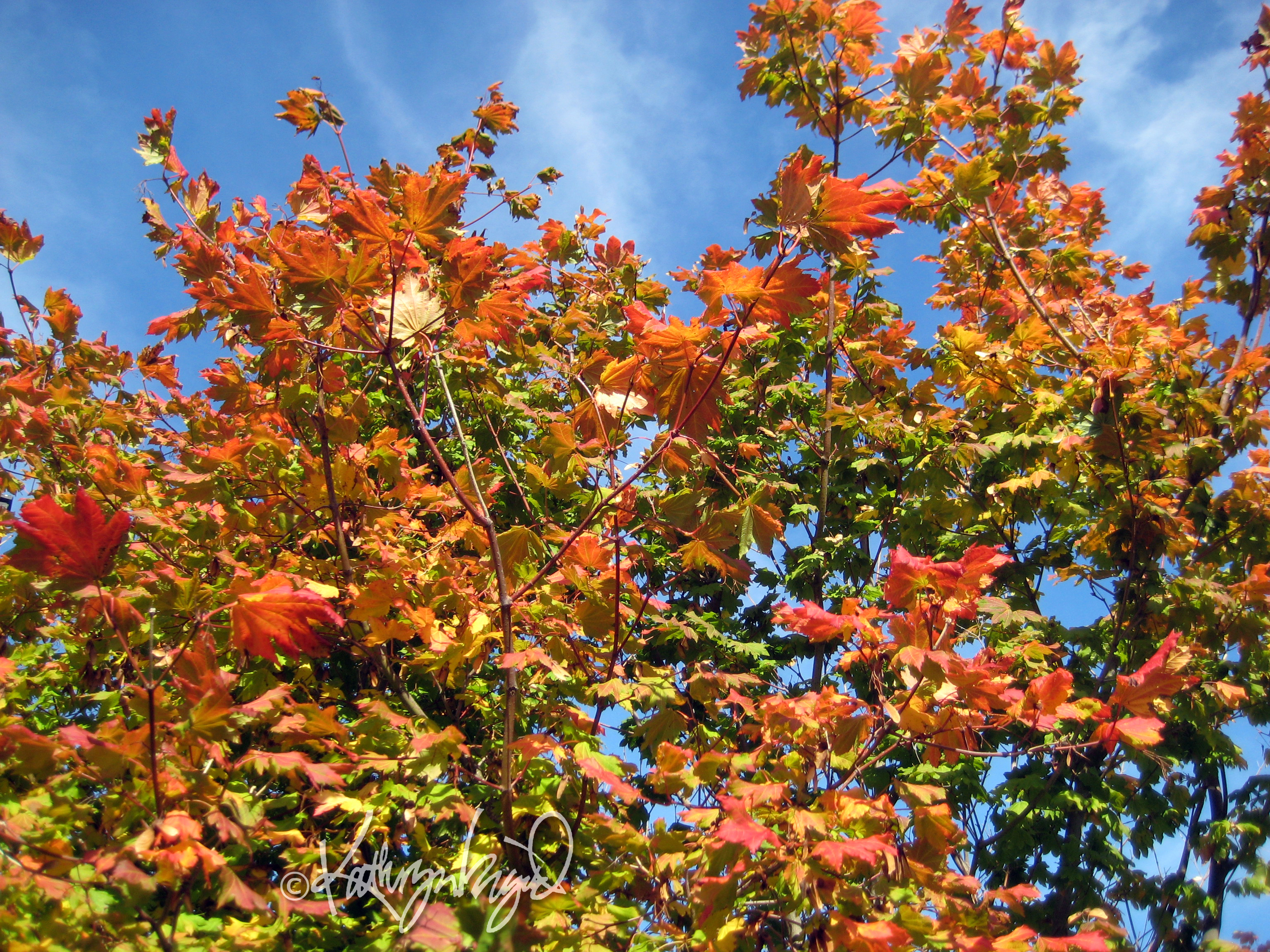
spring green flora + text

There are so many ways — and so many reasons — to sing . . .