Once upon a time, Pablo Neruda came to my rescue.
 I was a perplexed and moody undergraduate taking just a few too many credits at a time to cover for the semester I’d frittered away (both the time and the tuition money) in getting a much broader, deeper education by gallivanting across Europe with my sister to work on being ever-so-modestly less perplexed and moody (it did work, I swear it did!). By pushing a little extra during my remaining semesters I knew I could graduate ‘on time’ with my class and not use up further masses of time and money and my parents’ remaining non-grey hairs, so I crammed a bit to compensate. And by the time I signed up for one particular poetry course I was just a tiny bit frazzled. I knew I had a sort of dispensation from the university to take a certain number of credits Pass/Fail rather than as graded courses, and decided that since I’d not used that option and had taken other legitimate English courses already, now would be an excellent time to relieve a small portion of pressure by opting for P/F. Señor del profesor had a slightly different idea.
As in, “What, are you nuts?” and a firm No. Oddly, it had not occurred to me that this particular academic rubric could only be invoked with the professor’s permission. Silly undergraduate. My response was to burst into tears. But he persuaded me, in good professorial fashion, that it was for my own good and that he was quite certain I would do Just Fine in this course if I was committed enough to take it in the first place. So I pulled up my socks and took it like a good girl. I guess it’s only fair to confirm the obvious, that the professor did his part to get the aforementioned rescue work underway, and I’ll tell you now that being a true educator rather than a sometime impostor like me, he kept at it throughout the semester, and I was no easy or patient patient.
Meanwhile, I quickly discovered under said professor’s tutelage that my incredibly narrow view of poetry was just a sign of lost time and an opportunity to open an infinitely interesting and challenging world of unexplored wonders. But I was still horribly intimidated by the prospect of learning to bravely parse and explicate poems, and I was still amidships in the throes of general anxiety and fear of speaking up as it was. Yikes! Bit of a fright, that.
Then the wonderful Chilean master Pablo Neruda beckoned me to come in and make myself at home. His writing, so evocative and so deeply personal, made me feel somehow safe. This, despite his writing in Spanish, a language unknown to me except for some very useful food-related words. Now, I will admit to having read numerous translations of his poetry alongside the originals, but all one really needs when presented with this juxtaposition is, as I had, a little youthful church-Latin exposure, a handful of high school and college French classes (sorry, I came out of it with appreciation but not much real knowledge), and the will to make serious inroads in various dictionaries; the work simply sings. The variety that emerged from the different translations brought out a wonderful amplitude inherent in Neruda’s poetic work and inspired me beyond measure.
I fell in love with several of the Neruda poems I got to read for that class. But the poem that truly resonated in me turned out to be his ‘Entierro en el Este‘[‘Burial in the East’], and I happily labored over three different translations of my own after studying the existing ones by pros and linguists far beyond my skill level right alongside the beautiful Spanish-language original, whose marvelously lyrical sonorities drew me in inexorably, filling me with their dark and earthy music. Can’t say exactly what happened to those translations. Surely the world is missing nothing with their disappearance. The professional poets’ translations and transcriptions remain for Anglos’ edification. Far more importantly, the rich and exquisite deliciousness of the Spanish version remains, and not just on the page and in the ether but also in my heart.
Because the class requirement to learn and recite a chosen poem in class before writing a paper on it made some strange little spark light up in my soul and I realized that, however hard it might be to memorize a poem in a language I’d never spoken, it was well worth learning this one because I sensed how its incredible beauty would resonate not just with me but with my peers if I managed even barely well enough. Its sheer musicality made it easier to learn, with the help of a Spanish-speaking coach, and the difficulty of learning a foreign-language poem and its meaning deeply enough not only for the recitation but to be able to write semi-cogently about it kept it ingrained, I found, years later as well. Too, it gave me the great gift of lightening my fear: standing in front of my classmates and giving my all to this lovely Chilean masterpiece in Spanish somehow made me less terrified of forgetting or of making it dull–something I just knew it would be hard to do with such beautiful and moving words. I lost myself in the poem, which is precisely what good poetry in any language hopes to make us do.
 ENTIERRO EN EL ESTE
Yo trabajo de noche, rodeado de ciudad,
de pescadores, de alfareros, de difuntos quemados
con azafrán y frutas, envueltos en muselina escarlata:
bajo mi balcón esos muertos terribles
pasan sonando cadenas y flautas de cobre,
estridentes y finas y lúgubres silban
entre el color de las pesadas flores envenenadas
y el grito de los cenicientos danzarines
y el creciente y monótono de los tamtam
y el humo de las maderas que arden y huelen.
Porque una vez doblado el camino, junto al turbio río,
sus corazones, detenidos o iniciando un mayor movimiento
rodarán quemados, con la pierna y el pie hechos fuego,
y la trémula ceniza caerá sobre el agua,
flotará como ramo de flores calcinadas
o como extinto fuego dejado por tan poderosos viajeros
que hicieron arder algo sobre las negras aguas, y devoraron
un aliento desaparecido y un licor extremo.
Pablo Neruda
INTERMENT IN THE EAST [translation: KIW Sparks, 28 October 2011]
I work by night, in the heart of the city and surrounded
by fishermen, by potters, by the cremated dead
with their saffron and fruits, enveloped all in scarlet muslin;
below my balcony these terrible corpses
pass by with the rattle of chains and the playing of copper flutes,
such strident, lugubrious noise,
between the colors of those weighty, poisonous flowers
and the cries of the ash-covered dancers
and the crescendoing monotone of the beating drums
and the fragrant smoke of the burning wood.
For once they reach that place where the road meets the turbid river,
their hearts, stopping or perhaps starting a larger movement,
roll aflame, the leg and foot catching fire,
trembling ashes falling onto the water
to float like calcined blooms
or like a fire set in antique times by voyagers
so powerful they could make the very river burn, could eat
a food no longer known and drink the elixir of extremity.
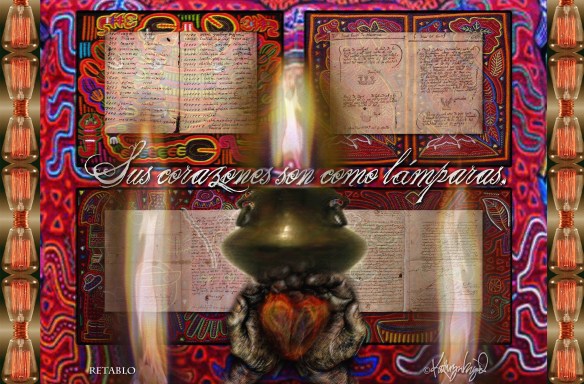
El Día de los Muertos has a certain similar quality to the Neruda poem for me. The traditional Mexican celebration of the Day of the Dead coincides with the Catholic commemoration of All Saints’ and All Souls’ days (the 1st and 2nd of November, respectively). The depth of passion with which the bereaved mourn lost loves is brought to balance in Día de los Muertos in a marvelously worldly and tender way when families gather to tend the graves of their dead, to meet over feasting and drinking, amid art and dance and music and prayer and embraces and revelry of all sorts and to remember with love and joy the lives of the dead whom they have known and now carry in their hearts. I’ve long cherished the magical folk art arising from Día de los Muertos tradition, loving of course the charming and even joyful representations of Death as the natural culmination of life, and admiring the attitudes that these in fact symbolize. They feed that sweet dream in my heart of hearts where life and death intermingle in the most fitting way they can and we all dance between them with passion, with love, with hope–and with a river of deep, sonorous and abiding poetry flowing in our veins.
 From my privileged perch in the corner of rooms where music is being studied, rehearsed and discussed, I hear all sorts of interesting and enlightening things on the musical topics at hand. Also, plenty of stuff that goes right straight over the top of my pointy head. After all, I’m hanging around with a bunch of scholarly and often exceedingly experienced musicians, and they’re speaking their own language, one that has jargon and concepts far beyond the reach of someone who took five years of childhood piano lessons and a few voice lessons, all without ever actually learning to read music. My poor teachers had no idea how far in over their heads they were in taking me on, but I must assume that most of them figured out my scam of ‘play [or sing] it for me so I can hear how it should be done’ so I could learn it by ear in lieu of figuring out why the notes never seemed to be where they were supposed to be in my fancifully dyslexic internal designs. In any case, I rarely hear musicians talking without getting off course myself a few (million) times along the way.


 Art-Colored Glasses