
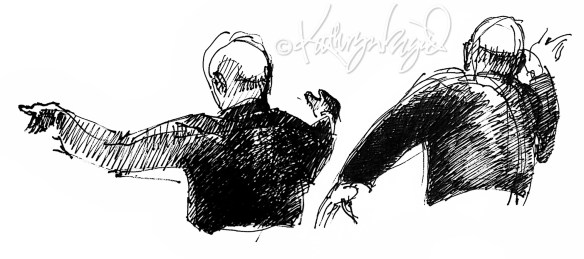
 My spouse, in his combined capacities as a natural-born teacher and a lifelong curious learner himself, is constantly reading, studying, talking shop with others both in and out of his field of music, and cogitating inwardly and through his writing about ways to grow and improve. I am neither a born teacher nor as dedicated and skillful a learner as he is, but I have, I think, grown a fair amount in my appreciation of what quantities and depth of effort it takes to improve oneself, let alone help others to improve themselves, in any chosen course of study. One of the things that intrigues me is that, as in so many areas of life’s experiences, the macro and the micro aspects of learning and, in turn, teaching, always ebb and flow: it takes a multitude of tiny pieces of knowledge and/or effort to make any significant larger ones, and the large ones must generally be reduced to smaller and more manageable parts in order to be changed, eliminated, or simply learned, as well.
In a day’s rehearsal for an upcoming concert, it’s marvelous to see and hear what occurs as a major composition is broken down into its component parts and those parts studied and practiced and rehearsed in detail, bit by bit, but also to realize that the individual parts have no beauty or meaning unless also studied in the context of the whole. Fixing one small phrase or chord at a time can be a portion of the improvement process, but if that’s all that happens, then the performance will never have any cohesion or sense of drama but will forever remain a collation of essentially separate and unrelated atoms that happened to be sounded in the same room on the same night. Playing or singing through transitions—the places where one phrase or larger idea in a composition ends and the next begins—is a way in which my conductor husband helps his choirs, orchestras, and other performers to experience and express the whole of the story more convincingly themselves, and thus bring an audience into the flow of the work as well.
Music is a wonderful vehicle for individual experience of the aesthetic, emotional, artistic, and ephemeral aspects of existence, and as such is a grand gift. But when it becomes a communal, communicative experience rather than only an isolated solo, it has incredible power for building relationships between people, ideas, cultures, lives. When it is a bit of a song, hummed or played on the street, in the car, at work in the kitchen, it can cheer or soothe, feed or please; when it is a performance of a major musical work in concert, in a musical or opera, an oratorio or a middle school end-of-year concert that has many participants and has been labored over with passion by all of them through a string of intense rehearsals, its power is magnified and resonates for a long, long time to come. It’s as though the practice of singing or playing through the transitions from one passage to another of that single composition has expanded into life, letting the dissonances and harmonies, the threads of meaning and the ecstatic shimmer of aural beauty, all remain in the air and in our spirits long after the last notes have gone silent, carrying us through the transition from art into life with renewed depth and purpose.



 Art-Colored Glasses