Don’t Blame Me, My Teacher Did It

photoThe drawing professor responsible for mentoring me in my undergraduate specialization in drawing and printmaking had no idea he was creating a monster. Safe to say there was nothing especially distinguished about either my skills or my scholarship in those days; he may be forgiven if he thought there was little hope of my passing his classes, let alone succeeding in being an actual artist at any point in the future. But for whatever reasons of commitment and kindness and selfless dedication to his pedagogical efforts, he took it upon himself to tutor and nurture me in my studies besides working wonderfully hard in the general studio sessions he taught.

Like any teacher, he had his characteristic methods and terminology, to the degree that any of us who took more than one semester of classes from him had our own favorite little catch-phrases and loving parodies of his work. One of the most frequent phrases (so we thought then, at least) to leave his lips was ‘texturally rich’—and you can bet your sweet pencil sharpener that any of us giving any imitation of him was bound to quote that one.photo
No surprise at all, then, that as soon as I started teaching, which thanks to his intervention and my subsequent hiring I did for the first time out of grad school in the very classroom where he’d taught me, it was as though I was instantly possessed by his spirit. I think I may have visibly started when I heard myself say that mystical phrase, standing there in the very spot where he’d once stood and repeated it to my classmates and me, never having remotely suspected that I would ever quite understand the term let alone use it so glibly and with such conviction a mere few years later. In my turn, I found it became a true favorite topic of study and tool for art-making and there were undoubtedly students of mine who thought it a funny catchphrase of mine and parodied my use of it.

That’s the way this stuff works, isn’t it. We become our teachers. First we find ourselves imitating our parents and siblings and playmates, learning from them both the persistent bad habits and, if we’re lucky and perhaps not too dumb, the worthy and useful skills and knowledge that will stay with us as we grow. Then we turn to teachers outside of the walls of home and neighborhood, as we get to school and move forward, and learn to imitate them too. This, not to put too fine a point upon it, is what helps us create for ourselves our texturally rich lives.photo

In art, it is the visual or tactile form of texture that I most often seek, finding in the wide variety of possible touchable or perceptible patterns and surfaces worlds of ways that I can shape and delineate and describe whatever subject I choose. As I work to make the art deeper and more complex, the textures I seek include less concrete, more metaphorical and philosophical ones that lend further meaning and impact to it. And that is where it begins to intersect with the learning and growing processes of life in general. A life well lived will be inherently texturally rich. I had no idea of the magnitude and import of this when my professor was saying that simple little phrase. But I’m very glad he said it often enough that I did internalize it, ponder it, carry it with me, and eventually, find a wonderful and purposeful truth in it.

Perhaps even fine teachers like him can’t make me into what I never was, a great teacher myself, but there was clearly a place in my heart and mind that resonated to the phrase ‘texturally rich’ happily and hungrily enough for it to take root and teach me good and useful things long after the echo in the classroom had faded away.photo

Twists of Fate

It shouldn’t surprise me, as little sense of direction as I have and as seldom as I have an inkling where my path is leading, that I end up in some weird and completely unpredictable spots at times. Take the time I was at a luncheon with the queen and king of Norway. It’s entirely safe to say that they forgot the occasion right about the minute their motorcade zipped off with its Secret Service escort to ship them back to the White House for their next performance. Having lunch with a bunch of foreign academics, even if it’s coupled with getting a doctoral degree (Queen Sonja was receiving an honorary doctorate for her humanitarian work) and having a permanent outdoor sculpture dedicated in your honor is so yesterday. Like that kind of stuff doesn’t happen to royals every day of the week. I, on the other hand, don’t have that sort of thing occur very regularly in my life and found the events of the day pretty memorable.

photo

(Left to Right: King Harald V and Queen Sonja of Norway; Pacific Lutheran University President Loren Anderson; Gene and Esther Grant, donors; the Rev. David Wold, Bishop and university board Chairman; li’l ol’ me, sculpture designer; David Keyes, professor and chief fabricator of the sculpture; Frank Jennings and other assorted faculty and board representatives. That’s the sculpture, Generations of Oak, behind me.)

It was amusing to take part in the bizarre hoopla that takes place when an assembled group of citizens in a country that takes itself far too seriously as being above such things as royal-worship (erm, Have you not looked into the mirror, O nation of celebrity-slavish fools?) gets a chance to suck up to the high and mighty of another nation. To experience the hilariously artificial and probably pointless stiltedness of security instruction from our friends the Feds; to shake hands with other humans who have been designated super-important and wonder why they would bother to shake hands with me–or, admittedly, I with them–and to hear all of the earnest speech-making and watch the well-meaning maneuvers; all of this was really educational indeed. That it was so for me in the context of the university where I taught was certainly not lost on me. I almost felt like I should get some undergraduate credit in sociology or anthropology for being involved in my little way.

But I’ll admit that most of all, it was entertaining to realize that through no particular virtue of my own I had once again stood in a spot that others might envy and reaped unearned rewards that would remain in my memory-book for a long time to come. Just call me Lucky.

Maybe not Captain of My Own Destiny, but at Least I’m on the Crew

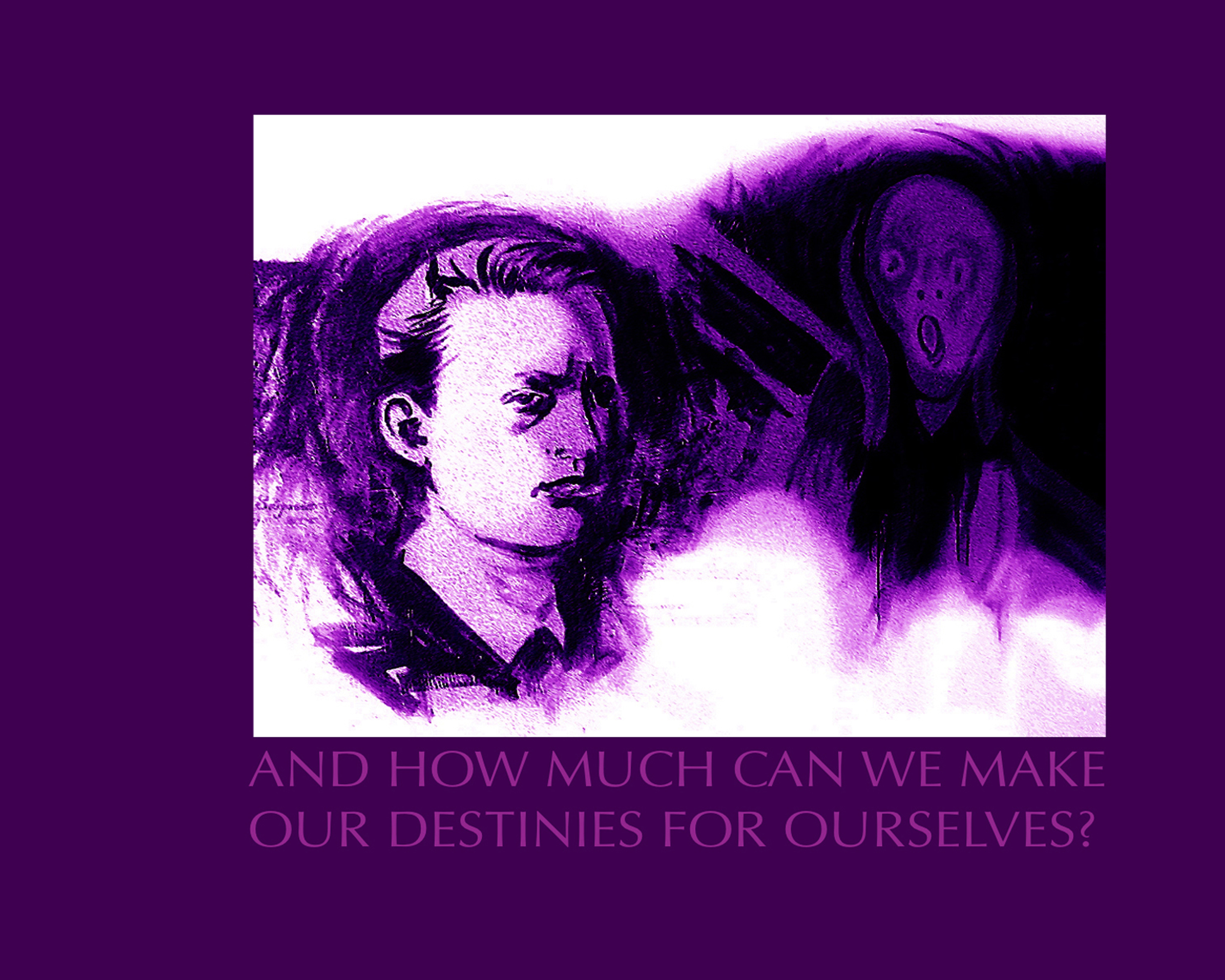
mixed media on canvasboard + textWhen I was a young artist-in-the-making, it irritated me to no end that people who saw my interest in art and knew of my Norwegian roots often instantly assumed that I was a big fan if not acolyte of Edvard Munch, Norway’s best known artist. Besides that my knowledge of Munch’s work was pretty nearly limited to ‘Skrik‘ (‘The Scream’) and what little else I’d seen even in passing was not at all to my taste, I took it as an insult and a frightfully narrow-minded view of my potential. And that, my friends, was the capper, because it implied that I was not in charge of my own future but predestined by my ancestry to be a pale imitation of somebody I wasn’t particularly fond of or impressed by in the first place. I was jolly well going to go my own way and choose my own muses and inspirations and, most of all, I was absolutely not going to be told what to do and when and how to do it by some ghostly abstract borne in my bloodstream.

As a very fortunate young pilgrim, I did manage to get to the Old Country and spend a little time rooting around my ancestral stomping grounds during my undergraduate studies. I got to meet and spend time with my great-aunts and various other relations and visit the house my grandfather helped build for his elder sister, our Tante Anna, and the family farms–the sylvan Ovidsland property with its tidy white house and taller red barn set in among the slender birches, and the more remote summer pastures of Eitland, a smaller and more rustic place on land with a sweet little lake for fishing up dinner. I was able to see the headstones of relatives long-gone, outside the little church where many of the family had attended services for many an age, and walk paths and travel roads where many of them had trod and ridden for ages before that.

oil on panel

Eitland, painted by an unknown family member or friend in the early 20th century.

It was a rich and rare opportunity to both visit the places of my family’s past and to live among my Norwegian family in their current places and way of life, something that few people get the chance to do and that I will treasure for as long as I live. Because it did change me, and change my point of view. It may seem strange, but some of the greatest change happened in completely unexpected ways; I was not especially surprised, though quite pleased, that getting to know family I had not known before and see the world from which my grandfather in particular emerged to live in the States (my other three grandparentsancestors all came from other parts of Norway, where we had less constant and present contact). But I never imagined that simply setting foot in the country of my ancestors would move me as it did. I could never have begun to imagine that I would be so struck, feel such a palpable and somehow heart-wrenching connectedness on standing in front of the amazing Oseberg ship in the Viking Ship Museum of Oslo–but I was; I did.

And I was truly astounded to discover, when I–a little reluctantly, perhaps–went with my sister to visit the Munch Museum that I not only found Edvard Munch’s work much more technically impressive and more profound, his life story and the stories that gave life to and were expressed in his work more impressive and thought-provoking than I had ever dreamed I would allow, but indeed, there was a lot more that I found simply compelling and even, startlingly, appealing. First of all, the guy could draw. He could paint, make prints, tell stories. He was, dammit, gifted and actually worthy of the attention. How very annoying of him, really. Because then I had to come back and re-think what I was doing a little bit. Was it so terrible to reflect something of our however-peripherally-common ancestry in my own work?

I had, if anything, a new appreciation for how much I didn’t wish to emulate his life, with the illness and suffering that marked life for and around him. But to take, as he did, what life presented and put it through the same filters of self and vision and thoughtfulness and surrealist whimsy and passion–that might be precisely what could make me more, dare I say it, myself as an artist. Who knew.

So by the time I set about making the collection of artworks for my master’s degree exhibition, it was an amusing ‘closing of the loop’ to find quite a number of people observing the works in preparation and in the finally installed show coming back to that same old observation that had used to frustrate me so. ‘Has anybody ever mentioned how much your work is reminiscent of Munch’s?’ It was even amusing to me to realize that, though the subjects might stray from his, though the media were sometimes decidedly different and the techniques concomitantly skewed to fit them, and though most of these viewers had no inkling of my ancestry, apparently there was a little something making its way up from my roots to the surface of my art.

Somewhere along the way I had also started to grow up a bit and begun to figure out that we all, inevitably, have less control over our own destinies than we fancy we do, and that that’s not inherently a bad thing–that life will always surprise us and challenge our grand plans and hopeful dreams and carefully charted paths. That the very things we can’t predict or control help to guide and shape us into things we might never have imagined we could plan or wish to do or to be. I guess I just took a longer and more convoluted route to letting my little commonalities with my fellow Norwegian artist Edvard show through; being dead, he could spare the time to wait for me to catch up. And once I got comfortable with the idea of seeing a hint of him in the mirror, I didn’t feel like screaming anymore either.digital painting from an acrylic painted original