Early Music for Breakfast

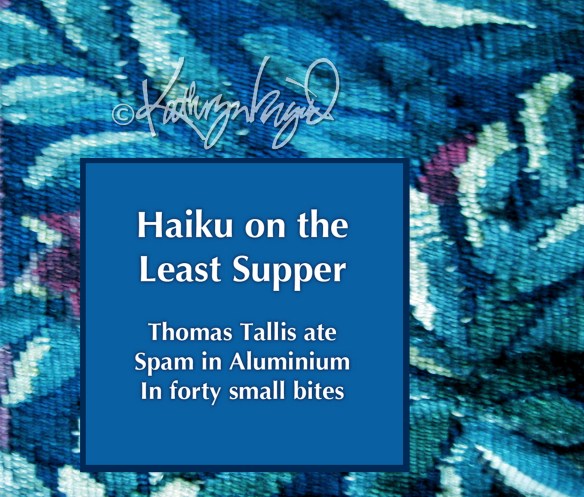
Digital illustration + text: Haiku on the Least Supper

If you haven’t already crossed paths with Thomas Tallis‘s landmark Renaissance motet Spem in alium, I highly recommend it. It’s a truly astounding piece of European music history, representing the confluence of the political and artistic competition for primacy in that time period; it’s believed to have been composed as England’s answer to Italy’s Alessandro Striggio‘s own, earlier 40-part motet, or possibly to Striggio’s 40-60 voice mass. I’m no musician, but I’ve learned, mostly through witnessing a few performances of the Tallis by different groups led by my husband and his colleagues, just what a feat this piece really represents.

While the creation of Striggio’s works for 40 and more independent voices is amazing in its own right, the 40-part motet he wrote specified that the voices be doubled instrumentally. That is impressive enough. For my fellow non-musicians, think of it this way: a typical piece of music for a mixed choir requires singers to perform different notes and lines of music, often at the same time, so that what is heard is not one single series of notes, one after the other the way we sing by ourselves, but layers of notes that become deeper and more distinctive expressions of the words being sung. Instrumental doubling means that some or all of the vocal parts are supported by one or more instruments “singing” the same notes at the same time. This can intensify the effect of that singer or section’s line, and it can sometimes also help a less skilled singer or choir stay on target with the line.

In any event, the more typical choral works tend to have soprano, alto, tenor and bass voice parts, or singing lines, (or some combination of those) and generally, not more than eight or perhaps twelve different lines intermingling at once. Anything more than that means that every singer in a moderate-sized choir is responsible for knowing and performing his or her own notes, on pitch, at the right moments, and with exactly the right loud-soft dynamics and flow at every point throughout the piece. Being in a choir is a thrill; being in a good choir is a real intellectual and artistic and even physical challenge.

What makes the Tallis Spem so incredible is that it comprises not only forty individual, fully independent singers’ voices all singing their own distinct parts of the song, but indeed, doing so entirely unaccompanied. Every one of the singers has to be spot-on at all times without the support of either a fellow singer or any kind of instrumental doubling. If one singer goes off the rails, there’s the possibility that others will be thrown off of their pitch, timing, or even their place in the whole work. It could well lead to a musical train wreck. Think you’d be intimidated by doing this? I think any sane person should be!

But it’s powerful stuff, when it’s well done. I’ve had the privilege of hearing this feat beautifully accomplished by singers surrounding me in a cavernous cathedral space, and by singers standing onstage in a modern performance hall with a carefully engineered acoustic. I’ve experienced it in art galleries where Janet Cardiff‘s intriguing installation of forty high fidelity speakers on stands are placed in a circle in the otherwise rather bare room, each playing in synchrony the recording of one of the singers in a performance of the Tallis, so that one can stand outside the circle or in the center of it surrounded by the speakers, or can move to stand at one individual speaker at a time, getting entirely different effects depending upon which part of the score is being performed and where one stands in relation to the speaker playing that part.

No matter how it’s done, once you’ve gotten a little of the idea how this piece of music intertwines voices that seem at first to be operating without a clear relationship but then, more and more, to be converging into a meditative, chant-like, layered song, it is quite mesmerizing. There are some recordings and performances out there on CD, iTunes, and YouTube worth a listen, and if you get the chance to visit the Cardiff installation, called simply Forty-Part Motet, do it. Best of all, of course, is if some fine choir nearby offers a live performance that you can attend. It’s rather haunting and ethereal, and made all the more impressive by the knowledge of its complex origins.

Meanwhile, I have given you this bite-sized humorous meditation on the work. A haiku seemed the ideal vehicle for acting as either commentary on or antidote to a choral masterpiece so complicated and virtuosic. And I sort of wonder if, in the process of composing this grand work, Mr. Tallis had any chance to stop for rest or was so deep in concentration that he barely had time to do the Renaissance equivalent of opening a tin of luncheon meat and dining directly from it, pen and parchment in one hand and dripping Spam juice on the other. Thankfully, it doesn’t appear that this effort of his was entirely detrimental, let alone leading to his personal version of the Last Supper, since he went on to compose other fine works up until nearer his death some fifteen years later.

Peter Pan vs. Mother Earth

Maturity is a hard concept to nail down. So few of us would willingly embrace the larger idea of maturity after all: the implication is too much doused with the odor of aging and the loss of innocence, playfulness and joie de vivre.

But if I can move away from those irksome, unflattering aspects of maturation, there is a whole world of better and more admirable traits awaiting me. To refuse to grow up, as so famously done by Peter Pan, one has to reject all of those pleasures and opportunities afforded only to those willing to submit to the passage of time.

I will continue to avoid becoming ensnared in the traps and trials of aging as long as I can get away with it, and probably further. Who wants to become exclusively serious, constantly responsible or particularly predictable? Not I! Age may force me to slow down my physical pace or even make me willing to concede that there is such a thing as a skirt too short or heels too high or a blouse too fitted to be quite seemly for my years, never mind that choosing certain forms of entertainment or places to go or goals to achieve are not particularly well suited for me anymore.

But I am also glad to let down the barriers to other aspects of maturity, and to embrace my aging with a certain relief when it comes to those. I care less and less, for example, about whether I look fashionable or impressive, so the heels and hems can be whatever altitude suits my comfort and mood. I’m happier in my own skin with every year spent getting to know and define and design it.

That, my friends, is the greatest gift of aging: I am freer from the worries, demands and expectations of the world around me and can work at shaping who I am, what I want, and how I feel more deeply and contentedly than when I thought there was a greater need to conform. Youth is not nearly so unfettered as we idealize it as being; so long as more mature people own our territories of home, school, work and even play, they also rule our lives. So long as we concern ourselves with comparison, competition and popularity, we let others have the power as well. When we learn to fit in and find community by being our truest selves, it changes the tune entirely. This is the richness, ripeness and harmony–within and between–conferred by true maturity.digital illustrationAnd while I’m thinking about musical metaphors, I really must give you a link to my husband’s latest YouTube appearance, conducting the beautiful and magical Monteverdi Vespers of 1610 with the Collegium Singers and Baroque Orchestra of the University of North Texas, with some tremendous guest artists singing and playing alongside the artful student and faculty musicians. This production was the premiere performance of the new edition of the Vespers that was developed by UNT professor Hendrik Schulze and ten of his graduate students, and among the instrumentalists playing on marvelous period instruments were some of the greatest players now gracing the halls and stages of the Early Music genre. Enjoy!

Clarity (Klart Blikk)

photoLet me make one thing crystal clear: all of my world is seen through my filters, colored by my way of thinking, its perspective all my point of view. And that’s not either strange or bad. It’s how we all operate. It’s just important that I always remember that simple reality.digital image from a photo

I finally had time to sit down today and go through a backlog of seemingly gargantuan proportions in my email inbox. Among the items that were most enjoyable to unearth, there was a note from my sister carrying a link to another blogger’s post about her son’s (our nephew’s) band Honningbarna’s first gig in Dublin, with the requisite embedded YouTube clips of their performance there–which, in turn, linked to other Honningbarna clips, including a couple of very informal interviews between a young journalist in Germany, if I recall, and nephew Christoffer and his bandmate Edvard Valberg, the band’s cellist and frontman. Besides that I get a kick out of seeing our relative as a successful rocker and hearing the band’s wildly kinetic and screamingly energetic punk/metal performances, I am reminded every time I see and hear them that Honningbarna represents a particular brand of cynical idealism that only the irrepressible and wiseacre young can so ably embody.digital image from a photo

Like many a punk band before them, they sing/shout about the wrongs and stupidity and injustice in the world, calling attention to it all and making us want to clarify, if just a little, our own view or stance on such things. One of their biggest hits, to date, is in fact a number called ‘Klart Blikk‘–it translates, approximately, to ‘Clear View’–a call to stop being passive about the world’s imperfections, to get up and ask bold questions, to act. The link on the song title right here is, wonderfully, a Norwegian 5th-graders’ video workshop animation of the song, a perfect (and artfully executed) answer to this very call to intelligent response. And I think it a wonderful, if laughable, serendipity that my computer’s auto-correct recommendation today for ‘properly’ spelling Honningbarna is ‘Housecleaning‘.

Update: blogger/reviewer Andy Barnes has just posted an additional critique of Honningbarna and the band’s debut album, the source of ‘Klart Blikk’.photo

There’s obviously no single thing that can always serve to make any situation clear, let alone ‘cure’ it. Collecting all the facts and information and evidence and being fully honest with them can help, but sometimes perfectly diligent research and full disclosure do not constitute reformation or restitution. We’re all human. And only human. We stay muddled.photo

And some things really are a matter of opinion. The glass is half full; the glass is half empty. I like things the way they are, or I don’t.digital image from a photoNow, occasionally, providing a sharp contrast to the point under debate is just the nudge needed to push our minds toward a firmer understanding or acceptance of the longed-for truth. Sometimes, the discovery of new evidence can shed brighter light and move us to choose and accept a more accurate reality. It’s even possible, from time to time, to elucidate and pinpoint the ‘right’ merely by simplifying–by paring away all that isn’t, bit by bit, with thoughtful and insightful explication.photo

None of that, still, stops us from being opinionated, stubborn, sometimes truly stupid, and occasionally outright determinedly wrong. It’s where we derive a lot of our mortal variety, our strange human brand of exoticism, our color, if you will. It’s okay to be ridiculous and bull-headed, even when the Truth is staring us right in the face and can’t be ignored, because it’s really part of who and what we are.photo

No matter what a charming song it makes, everything does not necessarily look ‘worse in black and white‘–and light and clarity are certainly discernible, even brilliant, when we stop being so saturated with peripheral influences like our feelings and hopes and desires. But there’s so much sheer wonder in our colorful world, I say, Why not revel in it, even if it sometimes distracts us from the seriousness at hand. After all, that will always be with us and will push its way forward again eventually, even if it takes a bunch of young Punks yelling at us to get us to pay attention.digital image from a photo

Come on in, the Water’s Fine!

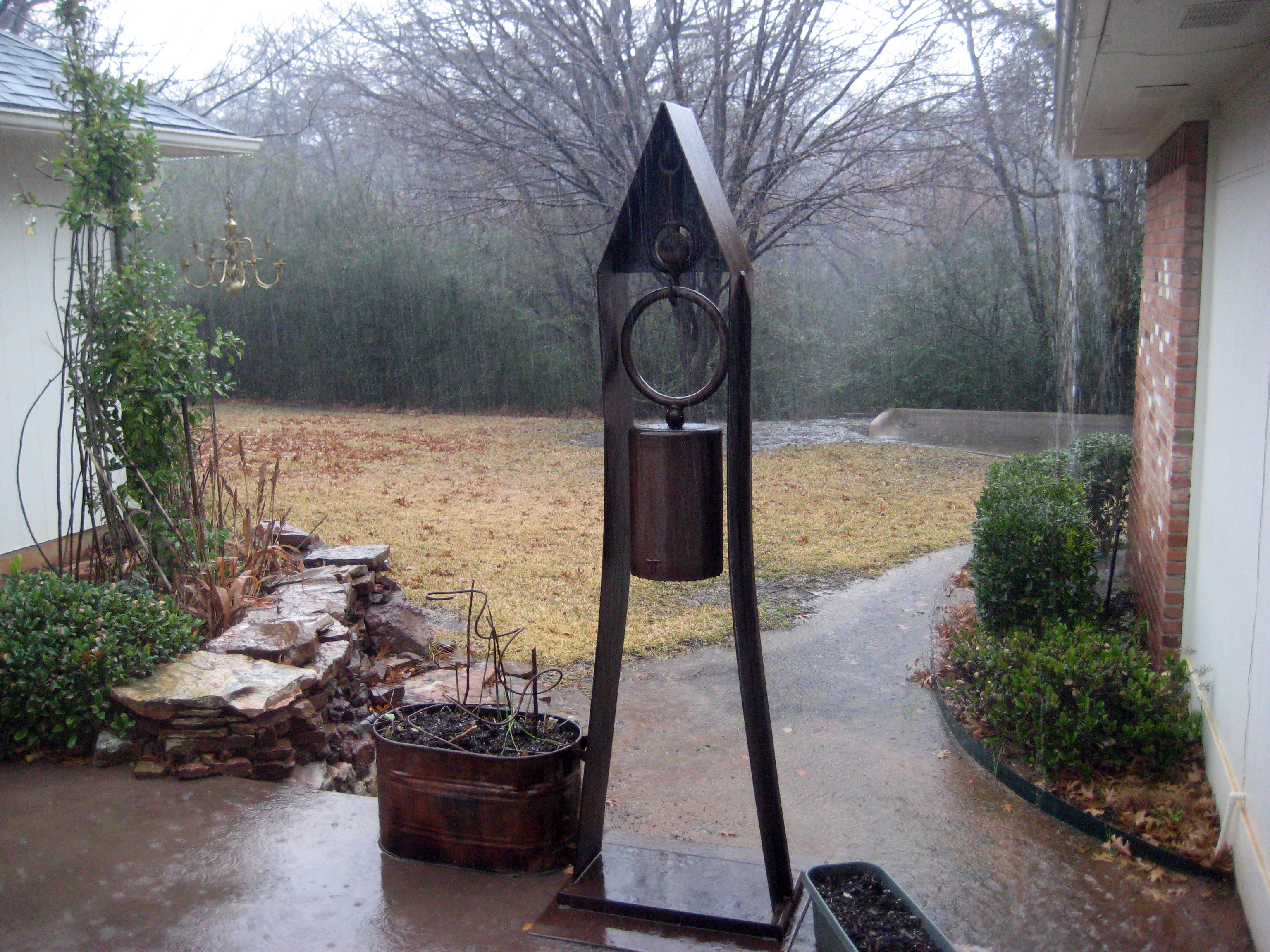
Since rain has been scarce here in the last year, today is a day for being happy to see ‘too much’ of it–it’s pouring out here. Texas style. And what, pray tell, is Texas style? If you haven’t already heard, Texans pride themselves on everything they have or do being big, bigger, biggest, and the weather is no exception: when it’s hot and dry, let’s just git on out there and set all time records, like last year’s string of almost unbroken triple-digit temperatures that exceeded all previous years’ totals. That, of course, is hard to maintain with an accompaniment of rain, so the skies simply curled up into an impenetrable ball like a li’l ol’ armadillo and gave up nary a drop of water until the whole state finally retreated into official drought. Our county was the last to comply, being somewhat feisty and all, but we finally dried up too like last year’s roses.

So today’s pelting, while it won’t miraculously restore the lake levels and revive the dead trees, goes a long way toward soothing shriveled spirits. It will, of course, drown some of the poor little sprouts that fought their way to life after the heat relented, and that’s just the way things go in a land of thorny mesquites and tough hombres. So far we haven’t had to build an ark, and that’s a pretty good tradeoff as these Texas-sized weather happenings go. So today I’ll leave you with a little photo-essay and a link to a bit of YouTube rainy-day fun I posted last year, with a little help from my good friends Joe and Eddie.

photo

The view from the kitchen is decidedly watery today! Hurray!

photo

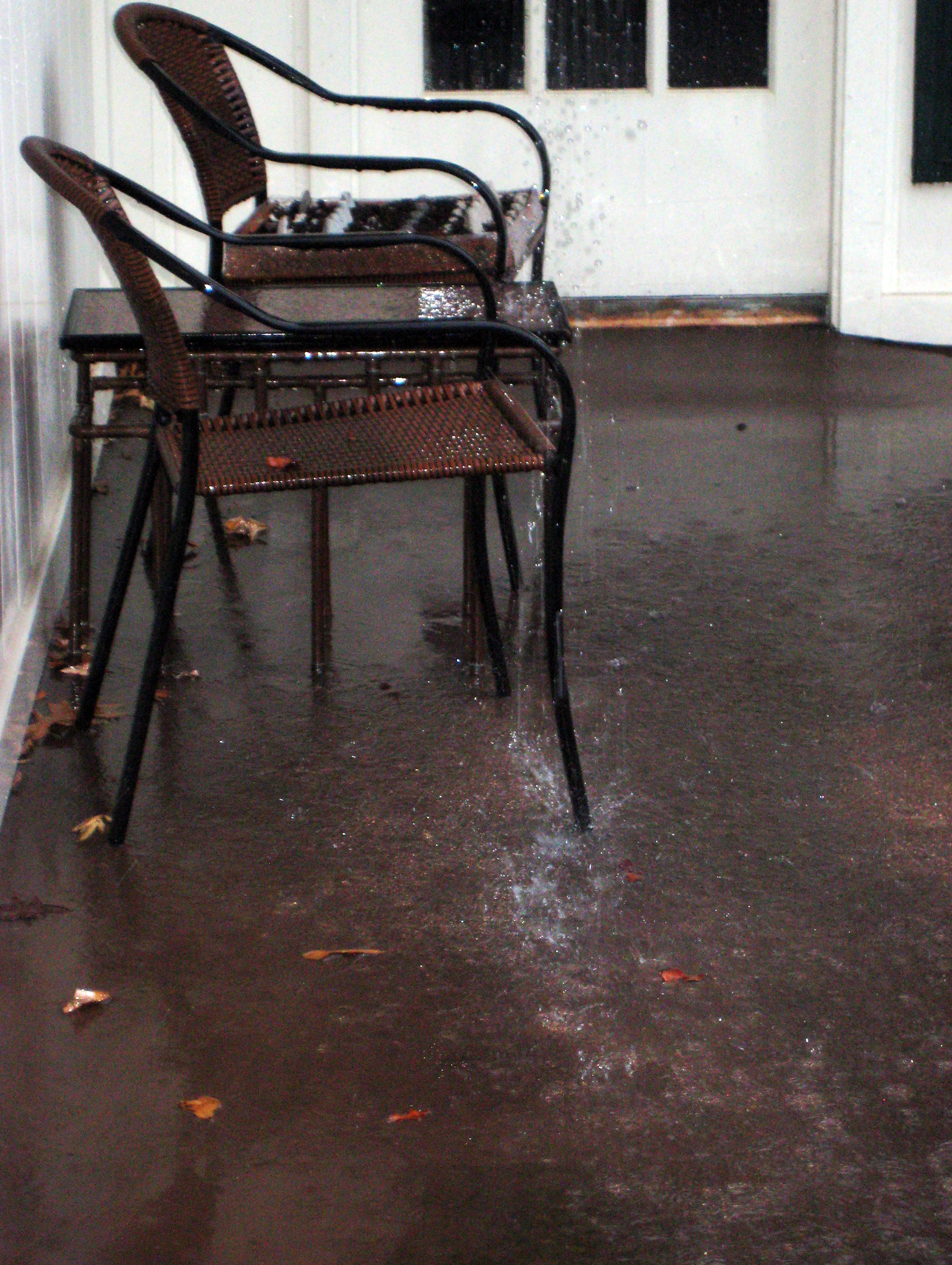
No worries about whether the little seed tray I prepped yesterday (sitting on the farther chair) will get watered . . .

photo

Maybe I should consider installing a koi pond at the foot of the patio steps . . . "Just Add Fish" . . .

photo

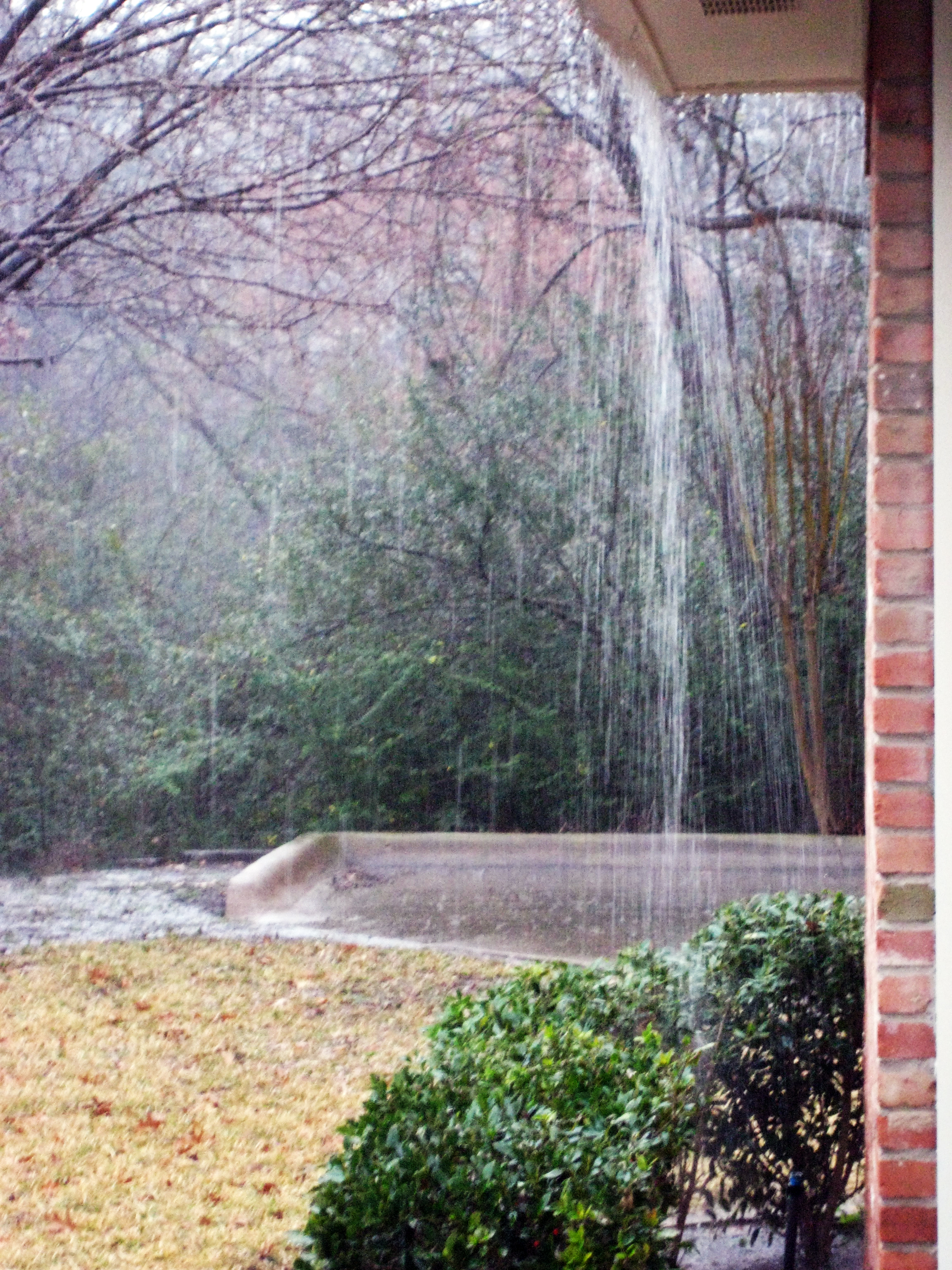
*Now* do you know what I mean by "eavesdropping"? Doesn't really matter if the gutters are clean or not; when it rains around here, they can't keep up with the rivers coming off the roof, so we just have Instant Water Features all 'round the perimeter of the house . . .

photo

. . . and who doesn't like the soothing sound of a lovely waterfall?

photo

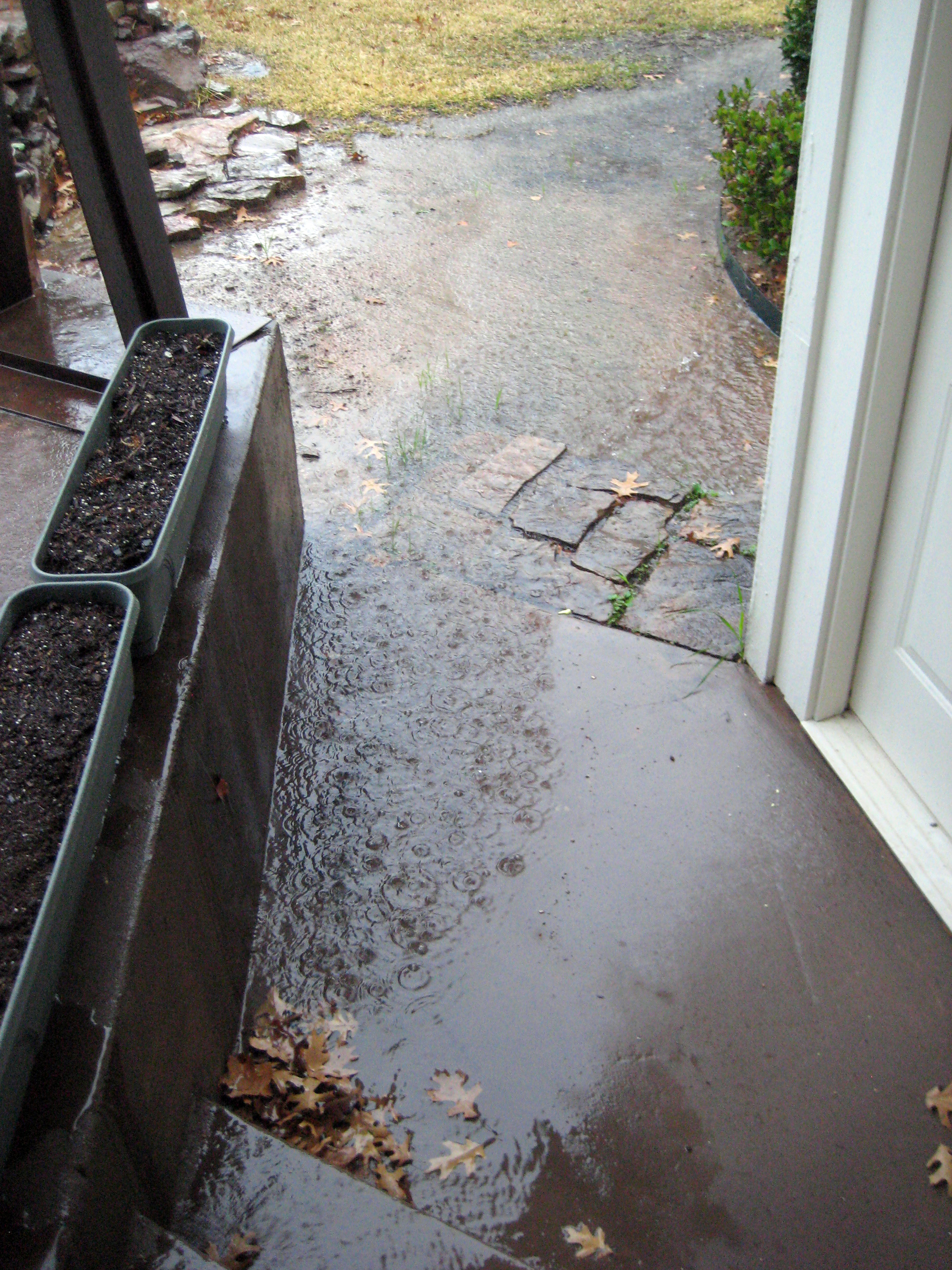
From the shelter of the front porch, there are new "waterfront" views of ponds, rivers, small lakes and more cataracts showering off the roof . . .

photo

I suppose the Texas Sage babies I picked up at the nursery yesterday won't drown, at least, because I hadn't set them in the ground yet, so they're still safely raised up in their pots for now . . .

photo

. . . the little coreopsis I'd nursed through the winter indoors, however, is tucked in and now inundated. We'll see how that fares, never mind the rainbow chard sprouts (microcsopic green specks in the upper right of the photo)--I hope they turn out to be aquatic plants!

So this is how it goes here. Dry as a bone for months on end, and then an outpouring so generous that it might well cause new mutations of several plant species into amphibious forms in one fell swoop. I hadn’t realized we were moving to drought-and-monsoon country, but here we are. The slope of our property has definite ideas about where the water should go, and ultimately it does head for the little rivulet in the ravine behind the backyard, but in the meantime, I do think that directing the flow a bit on our actual lot will go a long way toward making the yard happier, if I can do it right. I was considering a moat around the house, since that’s the level spot where the water from up on the road naturally settles before wandering down-slope again, but I’m afraid the alligators I kept in there would eat too many of the neighborhood pets–or the neighbors–and that just wouldn’t be very sociable of me I suppose.

So I suspect a wiser thing might be to terrace a bit, put in some raised beds, and amend the living daylights out of the impermeable, gluey clay earth here, for starters. In the meantime, I’ll just say that it’s a good sump test for the property to tell me where the natural flow patterns and self-designed ponds like to go and see where it all leads. Good thing I got me some nice, tall, silly polka-dotted, ultra-waterproof gumboots. ‘Cause it’s rainin’ like nobody’s bidness out they-ah.