Dis Guy’s Disguise

I love the way that superheroes remain unrecognized, even by their nearest and dearest, despite nearly always having camouflaged getups as thin as a politician’s commitment. Glasses on a person who doesn’t usually wear glasses: so much coverage! A little mask with big eyeholes in it…yeah, that’ll fool Mom when she looks me straight in the face! At least in more of the fairytales there’s a serious enough literal transformation that I can believe it would confound a reasonable amount of investigative zeal. I mean, I can imagine that Beauty’s pal the Beast could conceivably be tough for most people to spot as his former princely persona, at least more so than a cape and a staggeringly revealing, body-conforming spandex super-suit would tend to do.Digital illo: Beastly Problem, That!

When I become a superhero, and, of course, I will, eventually—it kind of seems like few people on earth don’t at some point fall into a vat of toxic waste and vow revenge on those who allowed it to happen, if you read at all these days—I plan to be so well hidden in my new identity that even you people who have been meeting me here in Bloglandia for four-plus years won’t flinch. Meanwhile, you’ll probably be too distracted by the latest zombie apocalypse or alien invasion (also well documented in current entertaining literature and film) to notice I’ve changed anyhow.

More likely, though, is that the whole hidden-in-plain-sight thing is much closer to reality than I like to think. It’s amazing to consider how many large-looming realities I am capable of missing or simply convincing myself don’t exist because I’m too small-thinking to accept them as present. I don’t like to believe I was wrong, so I convince myself the other person is the one at fault. I don’t want to believe that someone I’ve liked and admired is terribly flawed, so I keep up the idealized image in my mind, pretending that he doesn’t have a detectable alcohol problem or she hasn’t been the obvious only person with access to the accounts that have consistently failed to remain in balance. Might as well be wearing neon signs that say Hey! Lookee here!! Big PROBLEM!!!, and wearing clown costumes.

I still like superhero stories and fabulations and fairytales. I enjoy them immensely. But there is a little part of me that always gets as grouchy as the Beast that they’re so patently improbable, what with all of the costumes that couldn’t fool a baby seeming to deceive the world at large for great lengths of time. Mostly because I know I can’t count myself in the baby’s camp when it comes to such discernment. Fool me twice—a thousand times—shame on me. Grrr!

I Wish for You…

Digital illo from a photo: My Wholehearted WishMay you find all the courage you need to get you through the hour, the day, a lifetime…

May you find the wisdom to untangle whatever vexes you and revel in what you love…

May you find companions who give you comfort, elevate you, and fill you with laughter both in the moment and through the years…

May you find kindness embracing you, erasing your pains, and softening all sorrows…

May you be so enriched by the beauty and goodness around you that you find you can’t help but pass it along and share your gifts with others…

Trust & Trojan Horses

The problem of what and whom to trust or distrust is far older (though my niece and nephews might be shocked to hear it) than I am, but it remains a puzzle to me, too. In some ways, I suppose, the difficulty only increases with the passing of time, both personal and historical. As I get older and, theoretically at least, more mature and educated, I should have a greater base of knowledge and experience and sharpened observational powers and discernment. As history flows forward and the world grows smaller through the connections of increased mobility and communications, there are exponentially more points of view, levels of experience and learning, and sources of information to be sorted. Yet each generation, each individual, is generally born with no more innate wisdom and perception of fact-vs.-fiction than the ones who’ve gone before. We—individually and corporately—have had the opportunity to not only be taught by previous generations and their experience and learning, but also an unprecedented ability to go places, do things, and otherwise see with our own eyes what is possible on this earth. Yet there remains no shortage of people who mistake their opinions or values for facts, and demonstrable fact for somebody else’s ill-informed opinion if it doesn’t suit them.

When our classical predecessors told about the defeat of Troy by canny Greeks who tricked the Trojans into hauling a massive equine sculpture into the city as a victory trophy when it was actually full of Greek operatives who emerged by night, opened the city gates, and let their fellow soldiers in to attack [the standard modern interpretation of the tale], they tapped this universal theme. Whether it was clever subterfuge or a foreseeable pattern in war tactics didn’t matter so much, perhaps, to the ordinary Trojan citizen waking up to the sight of a Greek sword overhead, but any survivor of the battle must surely have considered whether he might have realized the ‘gift horse’ of left behind treasure was such an improbability as to be highly suspicious. A number of citizens did, apparently (as told in other parts of the Trojan Horse story) come to this conclusion, but such is our nature: there’s always someone making a counter-claim, asking the opposing question, and coming to an equally fervent yet incompatible Truth.

It’s on this ambiguity of our understanding and interpretation that American politicians and their supporters, no matter what the Issue or which side of it, thrive. That’s not merely an aside, but a fairly typical example of our quotidian practices. How easily we attach to our ideas, and how hard it is to persuade ourselves, let alone anyone else, that those ideas might merit frequent reexamination.

Digital illo: Truth or Consequences?

Truth or consequences? Can I trust that the drawbridge will stay up as I sail under it, down as I ride over it? Or will some villain throw the counterweight in gear against my safe passage? Do I rely on its long history as a sturdy and reliable bridge, or do I need to worry that all this rust means it hasn’t been properly inspected and maintained? Will it hold a horse? Will it hold a horse full of spies and soldiers?

Ultimately, I tend to think there are relatively few absolutes beyond being Alive or Dead in this realm of ours. The marvels of the world, as little as we know of it, are compelling and astonishing enough to seem beyond pat answers and fixed realities. But I also think that if our existence has any cosmic purpose, then chances are pretty decent that we’ve been set to a few basic tasks and given a few tools with which to attempt their accomplishment. Task: question; wonder. Tools: observation, cogitation, research, testing, conversation, reasoning, challenging, and returning repeatedly to the questions and wonderment. All of these, in endlessly rearranged repetitions, fill our tool and skill inventories.

What was considered self-evident Truth might prove to have some wiggle room for better understanding or a new reality in the long run: a human does not, as once believed, have to sprout feathers in order to achieve flight more extensive and less potentially final than that made by falling off a cliff. What was impossible may become possible. Complications remain. Humans disagree on what is or isn’t incontrovertible. No universally recognized and accepted magic surtitles appear, blazoned on the sky, that define fact, fiction, falsehood and firm truth for all people, for all time. We interpret and surmise. The very ability for the human brain to entertain two opposing potentials simultaneously enough to formulate and ask a question assures me that, answer or not, we will always find ample possibilities for disagreement. And also that we can keep moving forward. Even under or across a drawbridge. Even on—or in—a horse.

Efficiency Expert

Digital illo: Bug

All Tied Up in a Bow

Tidy packages are not

the sole solutions I have got,

but of the puzzles in my path,

few fill me with such rage and wrath

as that I cannot seem to find

what I have lost from in my mind.

I’ve lost more thought than many hath;

Does that make me a psychopath?

Don’t fret, my pretties, yet, for I

am not a wholly rotten guy:

I’d bump you off, but you should know,

won’t (for certain sums of dough)…

and if you can’t afford the fee,

I’ll parcel you out tidily.

Hot Flash Fiction 15: Dazzlingly Dim

Digital illo: Dazzlingly Dim

The streetlights at both corners had already burnt out in a sputter of brownout-fueled sparks when Beasley rolled up the road in Ren Hufnagel’s low-slung station wagon. The neon over Beasley’s jewelry store refused to die as quickly, though, flickering back on faintly, flicking off again with a buzz, and opening its weary eye for one more second to guide him to the parking strip before it winked out at last. The car, a 1978 monster of decrepit steel, crunched onto the gravel and died there, too, with a hoarse cough.

Beasley, the second-to-last living inhabitant of the state as far as he knew, had carjacked Hufnagel for the last liter of his fuel to get to his store and rescue the paltry inventory. It hadn’t occurred to Beasley that there was nobody else left to steal the jewelry, let alone buy or barter anything for it. Standing there on the weedy parking strip, he did finally think that perhaps overpowering his victim by shattering Ren’s last bottle of whiskey over his skull might not have been the most brilliant move, either. That maneuver probably meant that there was only one survivor now, and it definitely left the remaining one thirstier than ever. Willard Beasley sat down there in the dust and waited for more of nothing to happen, and that was the end of the beginning.

Mine for the Taking

Precious Things

Copper in the morning hours and gold at peak of noon,

And sparkling like a thousand gems until the silver moon

Highlights the constellations of diamonds in the sky—

None has a richer treasury than Nature has—and I.Digital illo: Natural Treasures

I’m Dying to Know

Do you dare to think about your own death in reasonable, detached terms? Do you think that’s morbid and grotesque to even consider, or do you find it easy? If you find it easy to contemplate in the abstract, is it because you suffer from depression or are suicidal, or is it simply that you recognize living as an inherently terminal condition?

This is big stuff. Even the clinically depressed are sometimes able to recognize, on those tiny instants of light in the midst of the abysmal dark, that their death, no matter how insignificant and unworthy they may think themselves, will affect others. I know this from experience, and from lots of reading and conversation and observation. I know that even when I was at my lowest—thankfully, not as hideously low as that reached by many, as I know in retrospect—my rational moments told me that no matter how they felt about me, or even if they didn’t notice me at all, when I was alive, everyone who was peripheral to me in any way would have some tidying-up to do after my death. Physical, perhaps, for those to whom body removal and disposal fell, but whatever tiny tasks I was not present to perform anymore would either default to another’s To Do list or leave a gap, incomplete. I realized that I am the butterfly effect, in human form. You are. Every living, breathing being has a space in the universe, a purpose, and however unnoticed in life, has an impact both by living and by dying.

All the same, I feel especially fortunate that in my family, talk about death and dying were far from taboo. It wasn’t all that uncommon to find the dinner table talk veering in that direction, if somebody we knew was unwell or had just died. We didn’t need euphemisms and pussy-footing to protect us from the reality of death. It’s nothing more or less than the inevitable cessation of life, and if we can’t talk about that, we’re stuck dealing with all kinds of petty and logistical nonsense just to get through the process when we’d rather be spending time living and loving each other and getting through the complexities of the occasion with a modicum of grace and humanity.

So my family already knows that I would prefer they donate what they can of my organs or remains to someone who has a better chance of survival and health if I give it to them, or to scientists who can learn how to give future patients that better chance. In fact, the government know this: I’m on the organ-donor registry, should I die unexpectedly or with usable parts intact. My loved ones also know that I’d prefer a minimum of fuss disposing of whatever remains of my physical shell after that, the cheapest and quickest cremation and scattering of my ashes being my top choice. I figure that any Supreme Being capable of inventing the human creature from scratch can easily put me into another, newer shell if and when it’s my turn to exist in any other form, and as for the current body, it’s a good source of recyclable carbon and nutrients to replenish any part of the earth that enjoys a good, tasty meal of ashes, say, my long-loved flowers the irises.

Those close to me also know that I have far less interest in what they do to celebrate or mourn my passing than the still-living will. If the occasion of my death can be used as an excuse for a marvelous concert to raise awareness or funds or mere pleasure for the sake of a musical group, whether my spouse is still alive to conduct or attend such an event or not, that would be lovely. But hey, I’ll still be dead, so y’all can do whatever it is that makes sense to you and I promise I won’t roll in my grave or be a pesky poltergeist or complain in any other way. Still dead, if you didn’t catch my drift.

And that, in fact, is a beautiful thing, and a great comfort to me. I don’t look forward to the actual process of dying or the moment of my death. I’d happily live a long, long life in great health and an approximation of sanity that seems cheery enough to me, before dying for real. But once I do, I feel genuinely confident that none of this worldly stuff will matter to me in the slightest, so as much as I like to “plan” ahead to keep my survivors from any terribly fussy practical matters in the event, I’m not worried. Go ahead and dance on my grave, if there is one. Keep on living. Don’t worry about me; I’ll be fine. Really.

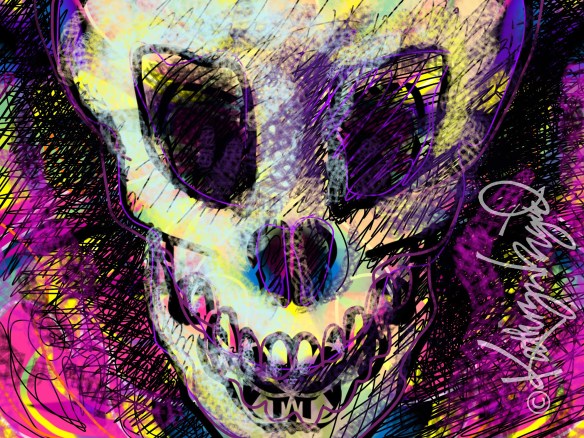
Digital illo: Mine was a Death's Head

Turn on the Waterworks

I don’t own a pool. Poor, poor me. Weep for me, all ye who have any tears to spare. Ha ha! Just kidding!! I’ve never, ever owned—or even felt compelled to own—a swimming pool, actually. I’m much too lazy to want the responsibility of either maintaining a pool or keeping it secure, and even too lumpish to be an avid swimmer. My only claim to fame in the latter regard is that I managed, almost inexplicably, to pass the required lifesaving/pool safety class at my high school, and this I only accomplished because I was stubborn and kind of unsympathetic as a rescuer, having learned some dandy but unfriendly tricks for subduing a panicked person who was struggling ‘uncooperatively’ while drowning.

When the weather gets hot enough, I might turn a slightly more longing eye toward any swimming pool in my vicinity, if only for the cooling of my heels. But I’m too pragmatic in my aversion to labor to indulge in the fantasy for very long. Just until the latest hot flash or external heat wave diminishes a bit, at most.
Digital illo: Turn on the Waterworks

So it’s kind of funny, even to me, how incredibly rejuvenated and rejoiced I am the minute I get to the coast anywhere. I forget, conveniently and blessedly, between times quite what an impact being near open water has on my spirits even though I don’t relish swimming in it and don’t even care especially about wading in it. The tang of the water’s salt and the occasional spritz of mist when a breeze carries it to my cheek, these are the attributes that pull at my heart. The gentle, steady lapping of tidewater as it sweeps back and forth across the scree and sand, this is the soundtrack of my contentment.

You can keep your gently chlorinated, mosaic-spangled, sanitized beauties, all of you pool owners out there. I don’t mind the special occasion of dipping my toe into the temperate, turquoise splendors of such sparkling basins when I can, but I will always lean toward the shore. Call me when your tidepool sports dancing anemones and bold sea stars, your lap pool spontaneously cleans itself with a refreshing swish and spray of tidal movement, and your patio is scattered with shells and sandblasted gems of glass and dried seaweed in graceful bouquets and…well, I guess I’ll see you when I get back from the ocean.

Things I’ve Learned

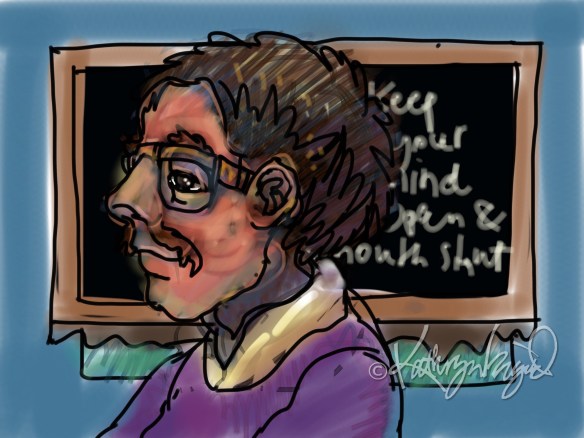
Most of the stuff I’ve been taught over the years hasn’t stuck especially well. Key among the useful and meaningful skills and knowledge that have been handed down to me are the remarkably applicable ones wherein I ought to spend most of my energy on keeping my mind open and my mouth shut. Many a disaster can be averted, I know, and many a mountain scaled, if one only practices this simple-sounding combination. But I also know from long experience that the person able to perform this remarkably magical duo of acts on a consistent basis is all too rare, and I am hardly the best practitioner of them.

Other people’s shortcomings, of course, are neither my excuse nor my problem: it’s I alone who need to iron out the kinks in this skill set. Along with these, there are a huge number of additional talents I ought to have cultivated better by now, knowing as I do through experience and example how significantly they can and should improve my life and the lives of those around me. For example, what if I stuck to the demonstrably excellent principle I’ve been taught, in which one stays focused and present in the now, the moment being lived, rather than entangled in mistakes past or muddled by the ever-impossible-to-read future? I can only imagine I’d waste a whole lot less time, energy, and worry, and spend it much more profitably and pleasurably.

I have learned a lot of things that, on their own and at face value, seem quite minute and insignificant but can actually be useful, if I pay attention to them. And if I bother to consider their inverses, their hidden sides, they may all the more inform and improve my existence. Life isn’t all clover and strawberries. Yet, as it happens, the occasional, if less-adorable, onions and garlic can season delicious dishes that even the most sensitive palates can love. A weedy dandelion brings provocative beauty, sometimes by its mere contrast, to the most refined and orderly of gardens. At times, the best company is oneself alone. Bigger, newer, louder, faster, stronger, and prettier are not always better. Cuddly looking creatures can bite. Long, heavy books can be well worth reading, but “Classics” aren’t always so.

Does hearing, knowing, practicing, or appreciating any of these tidbits really make me a better or more righteous person? Nope. But a longtime practice of attempting to find and test such little specks of potential goodness in the chaos of life might—could—help.
Digital illo: Things I've Learned

I’ve learned a lot of brilliant and useful things in my lifetime thus far. It’s too bad I’m not always good at putting them into practice. But I’m working on it, really I am.

Wriggling with Happiness

Digital illo: My Heart's Aflutter

Heart’s Aflutter

Forgive me if I seem a nutter,

the way I mumble, moon, and mutter,

but I can’t help my palpitating

when my heart is all aflutter.

Pardon that I cling to what’re

rhymes as rife with fat as butter—

maybe even nauseating—

but my heart is all aflutter.

Please absolve me when I putter

aimlessly, and stammer, stutter,

stumble as I’m indicating

that my heart is all aflutter!