No Greater Gift

Digital illo: The Greatest GiftLove is the answer. Not romance, not lust, not preferential treatment; love. Real, tangible, spoken and expressed with clockwork regularity and with kindness and clarity. The sort of love that fills your car’s gas tank before you leave for work and gives you snow tires for an anniversary gift, that calls Tech Support and sits around on hold for forty minutes before the ninety-minute-long session of troubleshooting to fix your confounded computer’s latest case of the hiccups. The sort of love that silently reaches over and holds your hand when there are no possible words for the occasion, good or bad.

Love is forgetful and fretful, persistent to the point of irritating, deaf in one ear and hard of hearing in the other, and demands, without realizing it, a high percentage of return—and all of this is absolutely nothing in exchange for the comfort, companionship, reverence, and acceptance received before any of these minor shortcomings are called into account. This kind of love transcends human norms so far that I can only assume it derives from some larger, more stable and powerful force than our own desires and whims. Love is what makes me sorrowful for the sorrows of a kindred soul, joyful in her joys, and comforted by a deep sense of her presence when she’s absent.

Love is, too, the act of sending a hand-written note, in this age of technology, that says “I’m thinking of you” and carries with it great personal weight in and between the lines. My second mother, the one I acquired so fortuitously and blessedly through marrying her son, sent just such a note recently. It wasn’t long. It didn’t cover a lot of ground. It said little that she doesn’t say to us in our regular phone conversations. But it was so sweet, so heartfelt and unexpected, that it brought happy tears to my eyes and I was flooded with a renewed sense of how deeply glad I am to be immersed in such love. And it reminded me that I will be all the more deeply blessed if I can find ways to pass along such love, no matter how small or simple those ways might seem at the time, to all of the other people I possibly can, for as long as I possibly can. Amazing how these things can multiply. That, of course, is one of the reasons that love, in all its forms, is such a powerful gift.Digital illo: The Amazing Multiplier

Singing Our Song

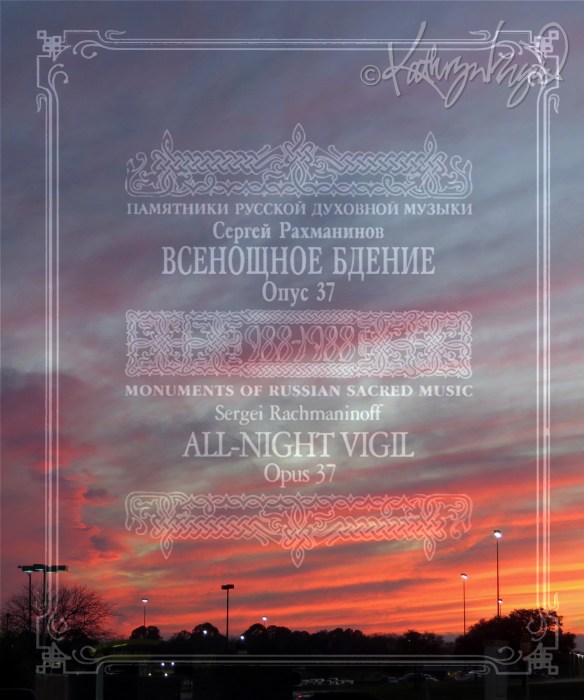
Photo + score cover: Singing Our Song: Rach Vigil

The original ‘our song’ I shared with my true love, because he was in the midst of rehearsing his choir for its performance when we came together—so intensely rehearsing, in fact, that in pretty much the only time I’ve ever known him to talk in his sleep, he whispered dreaming sweet nothings to me in Church Slavonic. Good times!

The expression ‘they’re singing our song’ refers, generally, to recognizing a tune or lyric that carries particular personal weight for a pair or occasionally, slightly larger group of people. It’s our school’s version of Alma Mater, the theme song of our organization, the song that accompanied a memorable first date, first dance, first kiss. Because of its power as a connective tool in communication and in recollection, music is bound to evoke potent responses and pull us into the examination of them, regardless of their current context. I’m one of that lucky class of people for whom music is a pervasive and positive element of my daily life, but I still have some specific favorites not only for what I find appealing about them musically or in their mood, style, and character—and yes, those range pretty widely—but also for the few that stand out in mnemonic and sentimental ways.

There are songs that reconnect me instantly with my childhood, something I suspect is quite a different experience for the younger generations than for mine and earlier ones. Until my youth, childhood songs came not exclusively from radio, films, television, and other distant, anonymous, fixed, or recorded sources but first from the relatives, friends, and teachers who shared them with us and often expected us to sing along. When my family sang in the car on a road trip, it might have sometimes been along with whoever was singing or playing the radio’s pre-packaged tunes, but as often as not it was singing folk songs we’d learned by rote, silly playground songs and game-narrative ones, bits of summer camp songs, rounds, and easily harmonized songs that were popular long before I ever stretched my little pipes to sing. I don’t imagine there’s so much of a lingua franca of family and playground singing not derived from Disney scores and downloads nowadays. There’s lots of delightful and even sophisticated stuff in those, to be sure, but I would guess that there’s a whole lot less that would be in any way distinguishable as historic, traditional, or regional, let along cultural, landmark music that’s just sung for fun anymore unless it’s loaded with undercurrents of market- or message-driven content. Is Mrs. Grady‘s daughter even known, let alone adored, by anyone under a half-century of age anymore?

It’s not strictly old-lady cantankerousness or being prudish, prune-ish, and nostalgic for what may be rose-colored memories that makes me sad for this sort of loss, though there are assuredly elements of those. It’s also a bit of longing for the subtle societal glue that resides in knowing a song: if I spontaneously start to sing an “old familiar lay” under my breath, will there be anybody within earshot who will hear, remember, and join in the song? Are all such endeavors relegated to prearranged flash mobs now? I had a couple of reminders of this urge, recently, and they renewed my quest for an expanded casual-singing culture of the kind that doesn’t require sets, costumes, death-defying choreography, and Auto-Tune.

The first such occasion was, unsurprisingly, in a church setting. Western churches of many sorts are still places where communal singing is common and many songs known to many of the participants by heart. I was at a Protestant church service where, as is typical during communion, the church choir sang anthems and the congregation then sang a hymn or two as well; when the high attendance at the service made communion stretch far longer than expected, the experienced organist got right on the task of keeping the flow going by playing an old hymn. After a few seconds, choristers started softly humming or singing the lyrics along with him, then grew bolder and harmonized, and gradually a number of congregants in the pews were joining in as well. It was really quite sweet, and I certainly thought it perfectly appropriate to the whole concept of a Communal event. But even there, I quickly realized, the truly familiar old hymn couldn’t quite be carried in the old way, because even the choir members clearly only knew one verse by heart, and while it was a lovely bonding experience for everyone, it was fleeting; at the end of Verse 1, a collective dive for hymnals to search for the words (what’s that eponymous first line, again?!), then the resignation to repeat the first verse or fall silent.

Another reminder came in one of the places where such random burst-into-song things do still exist beyond the borders of the performance hall but are perhaps not exercised as often as they used to be: a choral convention. The regional and national gatherings of musicians devoted to choral music—the composing, conducting, rehearsing, singing, performing, and yes, enjoyment of music made for groups of singers—are a great source of education, entertainment, and vivifying energy for me as the partner and follower of a choral musician. And even at these, it’s not as though I hear people breaking into song together, unless they’re rehearsing to perform for each other. Attending an enormous regional musicians’ convention recently, followed ten days later by an equally huge national one, was both exhausting and energizing. And at such events, I don’t often find people gathering to sing together outside of the so-called All Sing sessions, which are of course organized, arranged, led, and regulated nearly as much as any choir’s regular rehearsals.

The point of such conventions isn’t necessarily to build ‘casual relationships’ with singing. But mightn’t it be a fine thing, really? I would guess that the expectation that singing just because, at unplanned moments, with other people, could in fact lead not only to greater interest in and better understanding of more formal choral experiences but also to a more connected social world than social media alone can provide. As the 1971 Coca-Cola advertisement—yes, a commercial jingle—encouraged such idealism and eventually did indeed manage to build into a hugely popular, ex-post-brand-name sing-along song, I [would] Like to Teach the World to Sing. But obviously I can’t do it alone.

Photo + score: Singing Our Song: Nance 'Seal'

This is, in a unique way, truly Our song, because Richard Nance composed it as an anthem for our wedding, and it both became widely popular as an exquisite modern choral piece and remains deeply personal as a gift to my beloved and me from one of our dearest friends.

I Dream the World

I dream the world will learn to sing ‘Til joy suffuses everything—

When peace and happiness abound, I dream a song will be the sound

Most widely heard by every ear Around the globe that longs to hear

A note of kindness, care; of grace, When melody wraps its embrace

Around us like an angel’s wing—I dream the world will learn to sing!


I dream the world will learn to sing And make earth’s darkest corners ring,

Will throw aside all warring ways, Mend brokenness, take up the phrase

That calls to harmony all souls The way a carillon bell tolls,

First, lone and softly, then a pair Joins in, and more, and then the air

Is filled with song, like bells a-swing—I dream the world will learn to sing!


I dream the world will learn to sing And this, the message it will bring:

We must not wait in silent nights, Unsung ’til happiness alights,

‘Til care and kindness, sweetness, peace, Miraculously buy release

And save us from our voiceless state: If we don’t sing, it is too late,

So let our song rise up and ring—I dream the world will learn to sing!

I Am Not Alone (Part 3 of a 3-part series)

Disclaimer: I’m no doctor, therapist, counselor, or genius. If this post about hope in the midst of depression and anxiety and related mental-health experiences is in any way true for you, know that it might be uncomfortable to read in the first place, but much more importantly, that reading it will not, cannot save you from your troubles. What you need is not a word of empathetic support from a fellow mortal with related experiences but genuine professional help, just as it’s what I needed first. Come back and visit me if and when you’re ready. If you don’t have any such problems, hurray for you! And read on anyway, because you might be able to help another person if you know better how she or he is living. Everyone’s truth matters, even when we don’t agree with or share it.

I’ve said it before, and I’ll shout it again and again from the rooftops: ♥♥♥♥♥♥♥♥♥♥♥♥♥♥♥♥♥     ASK FOR THE HELP YOU NEED!     ♥♥♥♥♥♥♥♥♥♥♥♥♥♥♥♥♥

When you’re feeling strong enough to do it, fellow struggler, I want you to ask for, and find, the help you need. A friend wrote me after reading the previous two parts of this post series, quite rightly asking: “As someone foreign to what you describe here, I’m wondering whether you’ve ever found it beneficial for two people who are both despondent to work together. Can the shared despondency do some good, like two negatives making a positive?” My short answer (strictly my opinion, of course) is, Yes and No. Feeling alone in sorrow is, ironically, almost universal, but the feeling ignores the reality. Being reminded we’re ‘all in it together’ can help. Mutuality of support and dependence can be useful, but only if genuinely committed on both sides to the wellness and well-being of self and other, and only in partnership with those qualified to help. Wallowing and giving up hope together is no better than doing so alone. Find the counseling, student resources center or person at your school, workplace, or community services center, and get in contact. Do a little research to find out what’s affordable or free, and accredited, in your area. Make an appointment, and be sure to tell the person with whom you make the appointment that your need is anxiety and depression related and therefore time sensitive.

Stand up for yourself enough to insist on getting the help you need. I was really, really lucky that the counseling center my doctor sent me to visit had trained ‘triage’ telephone operators who could determine how urgent it was that we patients get in and guaranteed an appointment within a week or even 24 hours, depending on the situation. We all know that for anyone who is suicidal, only genuine emergency care will do: a suicide prevention hotline, phoning 911 [the American universal emergency phone number], or heading to the hospital is essential. But knowing that the assessing operators at my local mental health center were trained to spot the differences gave me a little needed comfort and the strength to wait 24 hours more.

Meeting with this counselor won’t be an instant solution for you, though, honestly, getting through the first step of making the contact was for me by far the hardest, bravest thing I ever did, so everything after that seemed progressively easier! I cried and sniffled and howled through the phone call, through the days (weeks) leading up to the appointment, through the drive to the appointment—wondering if I could go through with it, though I’m delighted, if that’s the right word, that I was too afraid and embarrassed to cancel and inconvenience the stranger I was going to see—and I wept through the majority of the first appointment, too, even though I had little that I believed was so urgently, impressively scary or important-seeming to say or do. That’s the nature of the beast, isn’t it. I think it’s useful, when you decide you’re in need of help, regardless of feeling ready or courageous enough to seek it, to have a few little strategies for taking the starting steps. A checklist, if you will, can make the attempt at something so large ever so slightly less daunting. From my own perspective I can offer some possible options.

Think of others. The world shrinks incredibly when one is depressed and anxious. It’s all I can do, in the midst of it, to consider that I’m not the lone creature in the entire miserable universe. But realizing that my misery spreads invisibly to others, like any kind of infection, helped me, albeit incrementally, to decide I had to make a change somehow. I could at least drag myself to strive toward health for others’ sake when I couldn’t muster it for my own sake. The one ‘trick’ that still helps me the most often is one I suggest you try even before you manage to go out and get professional help: Focus your energy, however infinitesimal it may seem, on doing whatever itty-bitty-teensy-weensy thing you can do to help someone else through a struggle. I wrote about this technique that my mom taught me in a previous blog post, and it still regularly saves my shaky hold on sanity in stressful situations where I’m not actually alone, especially at social events, which are big stressors for me. Give it a shot a couple of times, and give yourself permission to ‘play the part’ of somebody cool and confident (at least cool enough to admit to a stranger that you totally lack confidence) and you’ll be amazed, almost invariably, how much it can help you. I’ve managed to get through events crowded with intimidatingly high-powered, celebrated politicians, artists, and social giants, in countries where I spoke little or none of the local language, by doing this. I’ve also learned along the way that many of the aforementioned intimidatingly powerful persons turn out to be just as needy and insecure as I am, merely better disguised!

Build a DIY support network. It’s a network only if you think of it going out as well as flowing in: you’re not only asking for help but offering it, and though you don’t believe you have enough resources for your own puny self, working to give some to others will show you better what you can do. It’ll be a hard slog, since so many depressives, like me, also fight social anxiety, and either (let alone both) can make it mighty hard to openly discuss deeply personal things like our mental health. Doesn’t even sound possible, does it? But it is. Dare to test the theory; you already know that you’ve got nothing to lose.

Commit to wellness. Sit down with at least one supportive person, preferably a loved and trusted one if you have any such thing. A fellow struggler, a professional, even a total stranger whom you deem trustworthy, might offer support, and that can be useful, too. Find one, or make one. Say to your supporters how much it means to have them on your side and that you will do whatever you’re capable of doing to help each other go through this process, knowing that you’ll all fall down on the job but you will not quit trying, because you owe it to each other as much as to yourself. You might not believe that fully yet, but I promise you it’s true. Even those who think themselves insignificant and invisible aren’t; what affects them for worse or better affects all of the lives around them similarly. If you can’t seek health and happiness for your own sake, try to do it with the idea that you can aim to improve the lives of those around you by being happier, healthier, and better able to assist them through their own difficulties. Imagine your improved health and well-being first as a fantastic, romantic ideal, then as a remote possibility, and then as a goal, and you’ll have a better shot at accomplishing this amazing thing than you might guess.

Take a first step. Make the first appointment you need, even if you don’t yet know how deeply you do, with the mental health counselor or resource person. GO. If this is someone who can see you and your supportive companion together, it might make it easier for you to approach at least the first meeting if you’re there to encourage each other. The first session or two will likely be little more than figuring out your current state of being and understanding your “baseline” in any case. Be bold, and assume that you will be helped by this process, even though it might not seem so at all times, and persist doggedly. Fight for your life. Ask your professional helpers straightaway: Please tell me about all of the FREE resources you can share with me [us], refer or recommend for my needs, so I won’t have the added anxiety and depression of finding something that helps, only to be denied it for financial reasons thereafter.

Commit to continuity. Follow up, whether it’s with this same person/center, or someone/where else that’s recommended. Do your homework. A counselor should be teaching you how to assess your own situation and what you can do to have a positive effect on it, whether it’s through making lists, keeping a simple journal (your blog or diary will certainly qualify, in many instances), doing some reading, learning to meditate, doing a small amount of exercise, adjusting your diet, listening to music, or something else entirely. Do the work. It might be laborious or even painful, but every bit you get through will be something you can cross off your list of struggles.

Reward yourself with your healthiest and most affordable pleasures every single time you feel you’ve made one atom’s-worth of progress. Don’t worry about falling down on the job again tomorrow, because you will. Know that when you’ve rewarded yourself with an honest “hey, I didn’t think I could manage that until now, but I DID IT!!!!” followed, perhaps, by doing the Snoopy Dance or wallowing in an hour of reading from that really trashy, sappy book that always makes you feel like hugging the universe a little, you will be more inclined to get back up and do the work again as soon as you’re able. Keep hunting for your Happy Place among your matrix of matrices. [Have I just coined a phrase?]

If all else fails, take the time to look at your reflection in a window or mirror on occasion and practice smiling ever more genuinely and convincingly, while saying to yourself in your silliest Stuart Smalley impression: “Kathryn Sparks thinks I’m cool. And she’s really amazing, so who am I to argue with her?” Because I really do know how tough it is to be one’s best self and I truly admire all who manage to do the hard work it can take to move in that direction in difficult times.

You do matter. Your well-being matters. Your relationships with fine people (me, for example) matter. Peace and joy to all of us.

♥♥♥♥♥♥♥♥♥♥♥♥♥♥♥♥♥♥♥♥♥♥♥♥♥♥♥♥♥♥♥♥♥♥♥♥♥♥♥♥♥♥♥♥♥♥♥♥♥♥♥♥♥♥♥♥♥♥♥♥♥♥♥♥♥
Photo: I'm Only Human

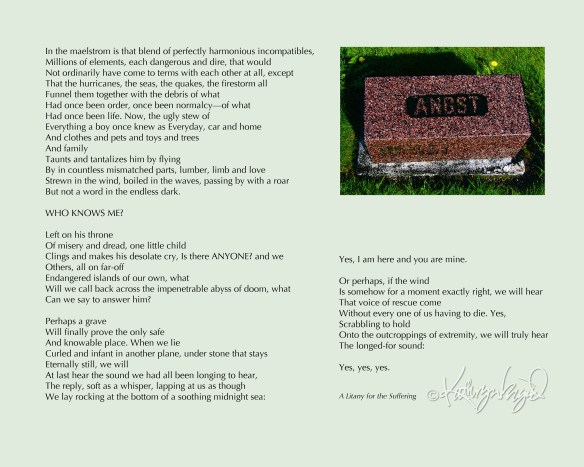
Is There Anyone Who Knows Me?

This is the first post of a three-part series on depression and anxiety, so if that’s an off-limits topic for you, I’ll see you again on the weekend! But it’s really intended as a series on hope from someone who has been-there-done-that and loves life in all of its complicated craziness as I know it now, on the other, generally sunnier, end of the tunnel. Today, for your contemplation, a meditation based on a true story of fear and loneliness and the possibility of triumph through one faint but persistent call for help.Photo + text: Under Sea, Under Stone 1

Photo + text: Under Sea, Under Stone 2

For Guiding Us All

We learn how to live, in many ways, mostly by accident. But those of us who learn to live well, whether as better scholars, more skilled laborers or artisans, or simply as more loving and kind and generous and good-hearted people—that growth and knowledge is gained best of all through the care and guidance of those who serve as our teachers and mentors. Parents and relatives can do this, friends and neighbors and co-workers. We who are most fortunate of all have many such positive influences come into our lives and help to shape us and bring forth our best selves.

And those who are best at being this sort of careful, patient, challenging, and giving tutors in one other person’s life tend to be so naturally inclined to raise up the best in anyone within their reach that they serve as mentors to many, regardless of any plan or intention. We who have been the beneficiaries of this largesse owe a debt of gratitude, and perhaps too, our own best efforts to pass the gifts along to another circle of influence in the great, rippling pond of our connectedness, to a further acre or two of young and beautiful growth that waits between today and our own eventual horizons. Life is brief, and best enriched in its short seasons by propagating mutual help and guidance. I am thankful to have been gifted with a number of superb guides and examples, friends and mentors, in my own life. May you all be as well.Photo: A Dahlia for Neil

Bright Dahlias

The autumn came too soon, and left a pallor on the pretty paint

of those tall dahlias that you had nurtured faithfully, their saint;

It turned them into shadows of

themselves too soon, shadows of love…

Frost cut them down and took them in its bony hands to steal their dance

the graces you had tended there so tenderly, by circumstance,

From shoot to bud to blooming beds,

by stealthy ice that bowed their heads…

And you saw early autumn, too, too soon—were bit untimely by

the frost and plucked from gardening, the sun still in your sky-blue eye

Made winter’s sparkling snowy air

of beauties we were loath to spare…

Yet all this theft you had foreseen, and readied us to stay and tend

bright dahlias, each, our own; to go on gardening, and so amend

Our sorrows in your still-wide gaze

by passing on your gentle ways…

The rich inheritance you gave still grows like dahlias among

us all, your heirs, and in their turn, those we raise up as happy young

New imitators of your gift

for singing to give hearts a lift…

In loving memory of Neil Lieurance, and with deep and abiding gratitude for the treasure that is a true mentor in any life.


My Portfolio

I’ll leave it to others, preferably sometime after I’m dead and even less likely to be concerned about it that I am now, to determine whether I’m a real artist or writer. No doubt there are, and will be, many who are dubious that I am a real person, for that matter. But it’s of little consequence, as long as I believe I exist. There’s room enough in my delusion for a number of delightful companions, and as long as I am happy in my imaginary world, all is well. But I will stake a small claim that, whether as a real artist or writer or a mere fantasist, I’ve been making art and writing stuff for as long as I can remember.
Photo: Portfolio 1

I think it unlikely that much of either kind of output will ever be considered especially valuable by others. I don’t flatter myself so far as to think that a large quantity of my work in visual or verbal invention is more than a passing amusement even to me, so there’s no reason to believe that the rest of the viewing and reading world will be so moved by my thrilling creations as to consider it important. And I don’t worry about that.

After all, I am as ephemeral as all persons of the human persuasion are, and thus unlikely to be troubled by anything lasting after I’m dead. I’m not one to concern myself with my epitaph (although I’ve written dozens of silly couplets and quatrains that would more than suffice in summing me up for a headstone, so that’s taken care of already if it worries you) or my legacy. The latter, I hope, will be to not have left too much of a mark on the world when I’m gone, but rather have trod on it fairly lightly, as these things go.

But because I am alive in an era when a veteran introvert like me can now also easily ‘go public’ without the great anxiety-production that comes from real world interaction with other humanoids, and in order to keep myself motivated to enjoy my practice of art and writing as much and as long as I can, why then: I am; therefore, I blog. Inevitably, others will feel it incumbent upon them to critique. Thankfully, the most succinct and practical form of critique in the digital age is first, to ignore, and then, Delete. So if anyone finds my work offensive or ugly, or just plain tedious and tiresome, their best defense of their tender eyebulbs and precious time is to run away from my website and never darken its portals again. I take the grand liberty of assuming that anyone who comes here does so unforced, and is free to go galumphing off in a cloud of huffiness when and if that suits them, and has therefore no cause to chastise me with wasting their life-energy here.

Photo: Portfolio 2

Meanwhile, having this platform for self-training and/or self-amusement, I go on producing new posts, new drawings and photos and poems and fictions and musings and digital collages daily and to my heart’s content.

But I consider that my portfolio is more than just a blog. It’s more than all of the art and writing and publications and stashed-away unshared works of my lifetime thus far and to the end of my days, whenever that will be. My true portfolio is all of the inspirations and ideas and inventions from the alpha to the omega of my lifespan, plus every experience and dream, study and accident, fear and hope and longing that led to those works of my brain and hands. And most of all, it is the collected community of friends, teachers, icons, playmates, correspondents, counselors, and loved ones who have moved, and continue to move, me to pour out this satchel of tricks and treats by which I will leave what little mark I do make upon the universe before I go.

The Façade isn’t Worth It

Ask for help. Short phrase, simple concept. Really, really hard to execute sometimes. We place such high value on ‘keeping face’ or seeming tough and cool and untouched by mere human foibles, trials, and concerns that many of us are perversely frightened at the idea of doing what should be the one easy thing. Ask for help.

It doesn’t pay to play the brave one or the willing martyr when your world is caving in on you, and even less so when you consider the ripples through the host of people who—though you may forget it at times—count on you, whether for equally small and simple things or for being the love and joy of their lives. It doesn’t do any good to sit and wait for help to come to you: remember how hard it is for you to know your own mind, let alone read anyone else’s, and know that they can’t read yours any better. Even if they realize how deeply in need you are, they may be fearful of offering their assistance because of that very mask of competence and courage you’re hiding behind, and you both lose.

There might not be help enough in the universe to fill your need, never mind your desire. But there’s no Maybe, if you ask that from yourself alone; you will fall. You will fail. When you feel you have nothing further to lose, there are really no such things as “acceptable losses.” Accept, instead, the handout, the hand up, whatever it is that anyone at all can offer you, and with it the hope of better things. It might mean nothing more significant than lightening your mood, and that is important enough. It might save your sanity, or your life. Ask.Digital illo from a photo: Nine, Ten, a Big Fat Hen

Keep the Lines Open

In a general sense, I know life is better and easier when the lines of communication remain open and flow freely in both directions. Recent notes from friends and family who have been visited by disasters—natural or otherwise—remind me of how spectacularly crucial the communication becomes in moments of crisis. The mere words “it’s okay” have virtual magic powers in those instances when we know that something big is happening and we can’t be there to offer help or consolation. I have mostly been incredibly fortunate in this regard, rarely hearing of terrible goings-on in progress without being able to get regular reports from my connexions in their midst, but like everyone, I have had enough moments of that intense fear and anxiety arising out of ‘dead air‘ to know what high value is in keeping the flow of information steady.

The latest round of wind- and snowstorms in various parts of my loved ones’ worlds is an instant review of those times when, amid a winter howler or while driving through flooded terrain or hunkered down in a good-sized earthquake, I had no easy access to a telephone or (if they were yet a household item) computer. A perfect example from my own memory is one clear winter Saturday when I was working around the house and the winds began picking up significantly. I hadn’t watched the weather forecast and was unaware that any storm was incoming, only realizing over a matter of a couple of hours that the gusts had grown to a point where I was hearing the towering evergreens and maples close to the house creak and branches snap, and could look out the back windows and see Douglas-firs dancing like hula dancers. But nothing major had broken when I looked outside. I was so preoccupied with the impressive action and the whistling and moaning noises of the trees that it startled me into an electric jump when the phone rang.Photo: Storm Clouds

I trotted into the back bedroom to grab the phone where I could sit at bedside and watch the wind’s power at play through the window while reassuring my sister, who had called from a bit farther north to see if everything down our way was safe since the reports of the storm had in fact preceded it northward. I was cheerily reporting on the show and the snug and intact condition of house and inhabitants when I saw a six-by-four-foot section of the back fence uproot twenty feet behind the house and sail like a kite right through the plate glass window. Thankfully, the shards of flying glass went in the direction of the fence, which in turn was not aimed directly at me, so as soon as the crash and shatter quieted I could speak into the receiver that was still gripped in my hand and assure my sister that I was quite all right, tell her what had happened, and promise to call back after the window was closed off again. Because, of course, with that wind, the rain was close behind.

The instance was fortuitous in many ways, not least of which was that my mother arrived on the scene mere moments later, and that we had pieces of plywood in the garage large enough to cover the whole big window with just two hunks. We dutifully covered the new opening with plastic sheeting, screwed plywood panels over it to close, and put up a bit more sealed plastic to hold off the remaining elements, and managed, if I remember right, to beat all but the first sprinkles of the downpour. A good seal was, we knew, important, since in our region there were not only vast swaths of evergreens to knock over or prune limb by limb onto roofs and through windows but many of them were Douglas-firs, a shallow rooted variety that is not hard to fell full length if the wind catches it just right. And in such windstorms in the area, many do go down. Growing up in a family of carpenters, I knew full well that even if we could reach one of the relatives and set up repairs earlier than other folk, their calendars would be jammed for days or weeks after a storm like this one.Photo: Kicking up a Storm

The first order of business was, of course, to call my sister back and tell her that not only were we all safe but the house was closed up tightly again, the bedroom carpet vacuumed about six times over to get all of the glass out of it, the fence section dismantled and relocated outdoors, a temporary barrier put up where it had been so that the neighbors’ horses couldn’t just walk over for an unsupervised visit, and that the wind was already abating, leaving mostly rain in its wake. She, in turn, called the other sisters to pass along the news. No one else was ‘visited’ by anything untoward in that storm, and we all lived happily ever after. And though it was a challenge to reach my uncle’s construction company and get a repair appointment, we even managed that before the day was done. Of course, having closed up the broken window sufficiently, we did have to get in line behind people without roofs, with trees lying lengthwise through their bedrooms, and the like, as was only fair. For them, I could only hope that they hadn’t also been harmed themselves—and could still call their loved ones to report on their safety.

Little Green Men

When I grow up I aspire to communicate with aliens.
Digital illustration: Little Green Man

You know how it is, when you’re a kid: the stories of the unknown are easy for anybody to concoct, since practically everything in the universe is still complete terra incognito to a kid. When I was a little squirt, there were endless options for what could be considered alien, from plain old grownups I couldn’t understand to spies and horror-story monsters, teachers and people who spoke indecipherable languages (you know, like Mathematics), ghosts and clowns. Or any combination thereof. But the best kind of aliens about which to tell tall tales would pretty much have to be extraterrestrials, nearly all of them apparently coming from Mars in the popular lore of my youth, and virtually every one of the Martians being, evidently, a little green man.

We make our gods and monsters in our own image, to a certain extent, even as grownups but most especially as children, so it makes sense that my childhood’s aliens should still have been humanoid, even if from 225 million kilometers away in space, give or take. I suppose that the green skin was mainly to clarify just how different these otherwise similar creatures were from us earthlings, and the littleness perhaps meant to signify their being lesser life forms than the obviously superior terrestrial ones.

But we little life forms known as kids were also savvy enough to make up our tales of Martians and Little Green Men in ways that would generally prove that our own smallness wasn’t so much a marker of inferiority in our race; we could best the invaders (as they always were, in those days) just as much as our elders could, maybe better. And of course we all knew at some point that we could best the human grownups, too. Especially as we grew older and began to realize that, like all of the other sorts of unknown and fearsome creatures that were alien to us, those ghosts and monsters and clowns and teachers, aliens might prove to be different from what we had imagined them to be.

Some might, in fact, turn out to be smarter than us. Be revealed as benign or, to our amazement, even benevolent. Just as we began to understand that not all humans and creatures that resembled humans to the casual observer were intelligent or benevolent or, indeed, quite human at all, we started to realize that each being whose path intersects with our own might prove, on closer observation and interaction, to have unknown depths and nuances, hidden flaws and unimagined strengths and gifts. We all begin as aliens to one another, in a way. It’s in learning to know each other as real and distinct individuals, to see each other with unprejudiced and open-eyed clarity and no preconceived notions of worth, of the good and bad of our hearts, that we can discover connections. Kinship.

I can’t say I think it at all likely that my ancestors were little green men who arrived in a flying saucer from Mars. And I’m not so all-embracing that I’ve given up my sense that there’s something alien and not quite right about most clowns. But I’ve got my own set of strange quirks and characteristics, and since I’d like to think other people will give me the chance to become a good person if I’m not already there, I hope I’m at least smart enough to get to know them as well as I can before assuming that they’re from another planet.

Tenderheartedness isn’t for Softies

It takes strength to maintain the goodwill and generosity that creates true bonds between people—individually and corporately. But through that steadfastness is the best path to peace and wholeness, a consummation devoutly to be wished.Digital illustration: Constellation

River of Stars

A river made of silver stars with sapphire deeps below,

The sweet compassion of the heart is ceaseless in its flow—

A font of healing, kindness, care; a waterfall of grace;

A draught to slake the deepest thirst; and with it, keeping pace,

Persistent hope, watered withal, along its banks to grow,

To bloom as peace, compassion’s flow’r, where starry rivers flow.