The Effects of Gravity

It’s wonderfully simple. Physics. Science. Gravity pulls us down. It’s a force that draws everything to it. Living creatures, all of us on the planet, are pulled toward the dense center of the earth just as we go along through our lives toward the time when we will reach the end, die, and be buried in the earth, drawn at last more fully toward its heart.

But along the way, it’s possible to pull against gravity, too. What happens if we choose to resist for a bit in life? How high can we rise? Any one of us rises to our highest point of all, I’ll be bound, when we choose to raise up someone else. It’s in elevating others that we ourselves are best elevated.Digital illustration: Against Gravity

All Together Now

One of my favorite vocal coaches is fond of characterizing people who focus on their own singing to the point of losing track of and/or sticking out from the rest of a performance at inappropriate times as expressing their “individual enthusiasms.” I’m doubtful I would be as tactfully euphemistic. We’ve all seen and, more importantly, heard concerts where one unplanned solo ended up hijacking the whole event, and it’s hard to forget what was so frustrating and embarrassing about it for the other performers and the audience and even harder to remember all of the probably fine or even excellent things that were supposed to be the stars of the day.

The same is true, naturellement, outside of musical performances as well. Our individual enthusiasms lead us to speak out of turn, act squirrelly in the middle of serious events, blurt out exceedingly inconveniently unfiltered thoughts, and generally act like little kids at the best of times. At worst, they make us deeply uncivil, unwilling or unable to negotiate, and self-centered to the point of implosion. Or, more often, explosion. This world does not need my opinion, unless I’m willing to get the rest of the passionate populace to engage in the conversation and collaboration that will make it needful. And in that case, they’ll quite generally be on board with my enthusiasm already and there will be little to negotiate.

None of this means that everyone should think and act in lockstep. What a horrific idea! Most of the great performances of our time are not solos, even those that feature soloists, but rather collaborations with the entire cast, crew, production staff, and audience, at a minimum. The deliberate and thoughtful give-and-take of everyone performing his and her part to the very best level possible is what creates the ideal of harmony, even in times when fruitful dissonance is desirable to throw that harmony into beautifully sharp contrast. Music is obviously full of grand examples of this stuff, but so is life in general. The sorrows and hardships, if they are carefully shared burdens, throw the joys and pleasures into higher relief, and the larger song of human experience continues to grow in beauty.

Photo montage: In the Works

Instead of throwing a spanner in the works, why not find ways to make them run more smoothly together for a more harmonious performance?

Celebrate Anyway

Christmas day means nothing at all to a whole lot of the world. Even some fairly devoted Christians are either skeptical about the accuracy of modern guesstimates of when the historical person Jesus appeared on earth or, in some cases, just plain weary of the commercial kidnaping of Christmas as a secular holiday. Beyond that, there are innumerable people and nations so impoverished or endangered as individuals, as communities, or as entire regions of the world that the last thing they can afford to pay attention to is an arbitrarily set date for recognizing anything as a reason for joy and revelry.Photo: Cymbals

There are no gladly clashing cymbals, no brass choirs trumpeting their huzzahs to the skies, no parades or packages, masses or meditations that can fill the void in hearts and homes oppressed by war, famine, disease, hatred, or inner turmoil. The very thought of happiness and reverential bliss, if it can even pierce the noise and violence, the stress and terror holding such people hostage, seems hollow and artificial. Goodness and light are as distant and unimaginable as the most ridiculous fiction.
Photo: What a Lot of Brass

These sufferers deserve to have their sorrows and their pains lifted from them, obliterated by any and all who dare to change history. No one knows better than I that not everyone has the strength and wherewithal to be so bold in action. But if we cannot do so with our physical labors, we must do so with our hearts and minds, our words, our plans, and our constancy in spirit. One voice at a time, one solitary note sung by a tiny, quavering voice, is the only way to begin moving toward a day when others, also one by one, will join and build to a worldwide song of peace. Only when we direct our every breath toward healing, harmony, and hope will the song come fully alive. Every atom of our being will whisper, speak, sing, and shout until the whole of humanity rings with echoing gladness.
Photo: Stringed Instruments

One moment’s pause, one hour of cease-fire, one hospital patient or lost child or elderly neighbor rescued for one single part of a day at a time makes space for the sound to bloom. We need to make room, and lest the horrors should return to fill the void, we must fill it up instead with songs of hope and joy and celebrate any way we possibly can. The other voices will someday, if we sing for long enough, follow.

10 Terrible Words that Shouldn’t Exist in Any Language

Digital text-illustration: 10 Terrible WordsOne person who hates is a Weapon of Mass Destruction. One who cares and shares? Perhaps the only antidote.

As I recently said to my friend Maryam: poverty—both of concrete, material resources like food and shelter, and of intellectual and ephemeral resources (education, spiritual enrichment, the arts, community engagement, etc)—seems to me to be perpetrated and perpetuated more by selfishness than by an actual shortage of any of those resources. The rich and powerful always want more riches and power, and what they do have makes them able to afford and acquire more and to keep their feet firmly on the backs of the have-nots. Plenty is never enough. The resulting imbalance is as old as history, and rotten as ever. Only those who will speak up and resist entrenched inequities and injustices will have any hope of making change.Photo montage: Wolverine & Badger

The badger and the wolverine have a reputation for being among the most tenaciously savage brutes of all the mammals. Yeah, Honey Badger even has his own meme to show for it. But let’s be honest: no beast of earth, air, or sea has a capacity for vile, rapacious cruelty rivaling that of the human animal. Even creatures of the natural enmity of predator and prey compete, fight, kill, and are sated. They have little apparent ideation of hatred and war to match people’s. A wolverine or badger will fight to defend, or to kill for food, but unlike the human, doesn’t seem inclined to attack indiscriminately outside of its primal needs for safety, shelter, and food; when the skirmish is done as efficiently as possible and the need assuaged, the sharpest of tooth and reddest of claw among them doesn’t do an end-zone dance to celebrate its pleasure in winning but will usually depart the scene or go to rest for the next time of need. The remaining food and shelter and other resources stay in place for whatever creature comes next, hunter or hunted, cousin or not.

Can we humans not learn from such a thing? I’m pretty sure that if we destroy each other and ourselves in our constant self-righteous, self-congratulatory belief that we deserve everything we can get our hands on, Honey Badger won’t be the only creature that doesn’t care.

PessimOptimism

Graphite drawing: Self-Inflicted“Prepare for the worst but hope for the best.” It’s part of my credo, I guess, and may well have been aided in its development by doing those hilariously futile duck-and-cover atomic bomb drills of the Cold War era. And the air raid drills—we lived in a Ground Zero area near several military bases, strategic coast, and a handful of Nike missile sites in those days—fire drills, earthquake drills, tsunami drills, and later when we lived in the midwest, tornado drills. You’d think we’d all have grown up incredibly paranoid after such stuff in childhood. But I think that besides being remarkably resilient, kids use logic on such daily puzzles far better than they remember how to do when they hit adulthood and have been taught their prejudices, and are much more easily distracted and blinded by grey areas.

I don’t remember ever believing that crouching under a flimsy little wood-and-steel desk would save me even from the shrapnel of shattering windows and imploding walls in the event of an attack or large-scale disaster, particularly since I imagined the desk itself would become shrapnel along with everything else in the atomizing roar of a bombing. Little and naïve though we were, we had gleaned hints of the enormity of such things from our beginning school studies of the world history of war (skewed to our own culture’s view, of course); no matter how grownups think they’re shielding kids by sanitizing and limiting the information the wee ones are allowed to see and hear, children are quick to notice the blank spaces where redacted information interrupts the flow of facts, and no adult is more curious than a child to hunt for clues as to what was redacted. Frankly, if there really is any use for an institution like the CIA in this day and age when practically anyone can find out practically anything with the aid of easily accessible tools like the internet, cellular phone, and, apparently, privately owned drones, along with all of the more traditional tools of spy-craft, I suggest that the crew best equipped to uncover any facts not in evidence would probably be a band of children all under the age of about twelve.

Meanwhile, we still have large numbers of people who think it prudent to withhold or skew the information passed along to not only kids but even fellow adults, giving out misguided or even malevolent half-truths or remaining stubbornly silent and in full denial about things considered too dark for others’ knowledge. And what do we gain from this? Are there truly adults among us who still think that even smallish tots can’t quickly discern the differences between a fable or fairytale, no matter how brutish and gory it may be, and the dangers and trials of real-world trouble? Does delusion or deception serve any purpose, in the long run, other than to steer us all off course in search of firmer, more reliable realities?

As I just wrote to my dear friend Desi, it seems to me that the majority of humans always assume a fight-or-flight stance in new or unfamiliar circumstances before allowing that these might be mere puzzles to decipher, and more importantly, we assume the obvious solution to be that whatever is most quickly discernible as different from self IS the problem. Therefore, if I’m white, then non-white is the problem; if I’m female, then male. Ad infinitum. And we’re generally not satisfied with identifying differentness as problematic until we define it as threatening or evil. This, of course, only scratches the surface—quite literally, as the moment we get past visible differences we hunt for the non-visible ones like sexual orientation, religious or political beliefs, and so on.

Unless and until we can change this horribly wrongheaded approach on a large scale, we’ll always have these awful problems, from petty playground scuffles right into the middle of the final mushroom cloud. The so-called justice systems of the world are set up and operated by the same flawed humans who make individual judgements, so the cycle is reinforced at all levels. Sometimes it truly makes me wonder how we’ve lasted this long.

Can we learn from kids? The younger the person, the more likely to blurt out the truth, whether it’s welcome or not. The subtleties of subterfuge are mostly wasted on children, who unless they’re engaged in happy storytelling for purposes of amusement and amazement, would rather be actively puzzling out the wonders of life than mucking about in search of evasive answers and duck-and-cover maneuvers. We might gain a great deal by reverting a little to a more innocent and simplistic view of the universe, one that blithely assumes that others are not always out to get us, that direness and doom aren’t lying open-jawed around every blind corner, and that the great powers of the internet and cell phones might just as well bear cheery tidings of goodness and kindness, and drones be removed from deployment as spies and weapons to work instead at delivering birthday presents to friends and packets of food to hungry strangers.

I’m not fooled into thinking any of this is easy to do, any more than any savvy kid would be, but I’m willing to believe it’s possible if more and more of us will commit to such ideals.

Empathy over Courage

Bravery is a rare commodity. Many people who think they’re being brave only dare to do so from within a like-minded group, however small in number, and when they are genuinely in the minority spend more energy on protesting that the majority from which they’re excluded is unfair and unjust than on doing anything useful to change it. It may be true—knowing human nature, often probably is true—that one’s opposition is no exemplar of justice and fair-mindedness. But we’re seldom willing or able, ourselves, to make a cleanly balanced assessment and especially, to act wisely and compassionately on it either. We’re generally convinced that anyone else having anything good means less goodness for ourselves, and that that is a terrible thing.

What impresses me more than bravery, real or imagined, is seeing anyone express real empathy for others through their own beliefs, lives, and actions. I tend to doubt that we’re capable of doing or even wanting very lofty things, but I also think that small doses of empathy will go ever so much further than any amount of derring-do and action-figure heroics in bettering the world and the human condition within it. Daring to let another person be richer or more privileged than me or to have the last word, even when I’m fairly sure I’m smarter, closer to correct, or more deserving requires quite a different sort of courage than running into danger in anyone’s defense or their stead.

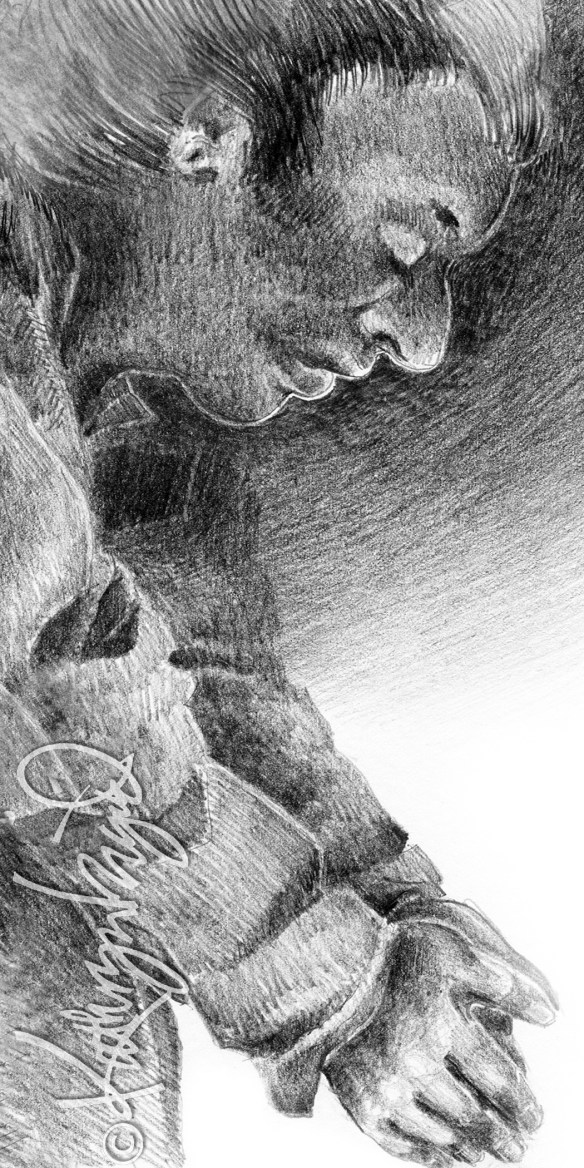
But treating others with such respect seems to me far more likely than argument and defensiveness, self-protection and fear, to get anyone to trust and respect me in turn. So shines a good deed. The unselfish willingness to accept another person’s reality as valid even when it might cost me something significant is a kind of courage I dream of having, hope to learn.Graphite drawing: Reach Down to Raise Up

Contagion vs. Compassion

“One bad apple spoils the lot.” That creaky aphorism is based on equally venerable experience. Rot is contagious.

Bad company makes bad behavior seem the norm, and we adjust our own standards ever lower accordingly. One or two disheveled houses bring down the values of the others in the neighborhood, and those, in turn, fall into neglect and decay as their owners lose the courage and determination to resist the incredible pull of entropy. What isn’t growth is death.

What leads otherwise good and sane people to fall apart like that? Doubt; fear; despair. These are the hallmarks of contagion: the plague succeeds in felling us not only through its own virulence but because rather than seek its cure with full courage and determination we flee with it hot pursuit, and when it eventually catches up with us, we topple, curl up in the fetal position, and succumb.

The fall of one member of the world community—like Mr. Duncan, who was felled by Ebola in Texas—is a very real and terrible loss for all. The loss of thousands—those dying in West Africa—is indeed a plague and a thousand-fold grief we all must recognize and bear. The response, though, cannot be equally contagious doubt, fear, and despair. That can only make us choose unconstructive, even destructive, responses like blame, xenophobia, retreat, and the neglect of our fellow citizens of the earth. Then, no matter how many or few have been overtaken by disease and disaster, the contagion will have won.Photo: Snakebit

The Great-Greats

Naming things is an endlessly fascinating and complicated way of creating and better understanding our relationships with them. Different cultures have even devised quite distinct ways of classifying and identifying the kinships within them, to the extent that families and relations in the different cultures affect the very ways people interact and consider themselves connected, responsible for each other, and much more.Photo: Great Great Grandparents

One of the appealing (or appalling) quirks, depending upon one’s view, of the American traditions of familial identification and the names given them in English is the way we use the word Great to specify layers of distance from ourselves. This photo, for example, is of one of my sets of great- and/or great-great grandparents (my maternal grandfather’s forebears), if I am not mistaken, and there is much to pique my curiosity in this image.

First, of course, is the question of whether I have identified them correctly at all. But then, in what ways—besides the nominal—were they great? Clearly, being among my ancestors is an easy in to that category. [Ba-dum-tsssssssshhhhhh!]*

Seriously, though, what distinguished these people? Safe to assume, from what little I do know of my relatives in Norway, these two lived on a small farm, and they worked hard. I mean, incredibly hard, by my standards. I’m inclined, actually, to think that the gent is my great grandpa and the lady next to him is his mummified mum, but having seen many a portrait from that era whose subject I was shocked to discover was eons younger than I’d have imagined, I can’t be sure. If this is a couple, I am extra, extra glad I have such a lazy and comfortable life. I may be no spring chicken, but I like to think that people will be able to tell whether or not I’ve already died, and when it does occur, won’t be able to make work boots out of my hide without tanning it further.

This could be the great-grandfather who was a tinsmith. A pretty skilled one, at that. The hands I see here could easily be tough enough to have put metal in its place. As for the farming, what little I’ve gleaned [enough with the shtick! I’ll try to behave myself]* from the various family stories and photos indicates that my family were subsistence farmers, growing what produce would feed their own households or be swapped with neighbors for  further goods, and raising enough sheep and goats, chickens and cattle to keep them in meat, eggs, hides and bones as needed. Agrarian life, until more recent decades, was generally a far more solitary and jack of all trades kind of existence. My grandmothers, great and otherwise (and I can only assume all of the neighbor women of this ancestress’ approximate vintage) did such work as probably made them all look equally leathery.

I would like to think that the sober, if not condemnatory, expressions in the photo sprang from the typical problem of holding still for the interminable exposure time a photograph required in those days, not to mention doing so while squinting in the sunlight. But I also suspect that a combination of that hardscrabble life of theirs and the grimly perdition-obsessed brand of religion to which many of my relatives have subscribed means that these two generally took life mighty seriously as well. They probably didn’t see so much to joke about or room for fun and games in their daily lives.

What I can safely assume about my relatives still gives me some hope. Obviously, they knew enough about how to survive and yes, thankfully, to procreate, that I am here generations later to tell the tale. I consider my existence a fine thing. Although they weren’t either wealthy or showy, they are dressed in well made, tidily kept clothing and lo, my mustachioed male relative even sports a watch chain, so theirs was not, even from the perspective of my privileged and cushy life, a torturous life of pure privation. So I don’t feel enormous existential guilt for their suffering. But I’m not inclined that way like they might have been, anyhow.

My late Norwegian relatives lived and labored in a landscape and climate rather like where I grew up in the American northwest, so I know that even if their daily work was hard they did it surrounded by beauty and nurtured in a mostly benevolent natural environment. They raised children who were able to go out in turn into the wider world and make their ways, eventually finding own their paths, making their own livings, and raising their own families, and eventually crossing many mountains, borders, and seas. I think all of this a fine, if modest, sampler of human existence with [dang it, I just can’t help it!]* relatively little grand tragedy or overblown drama. Most of all, I am glad that the long-gone beings who posed for this rather inscrutable image contributed to the production of a line of pretty good folk, culminating in my immediate family. That’s greatness enough for me, and makes me very thankful indeed. Happy Thanksgiving, my friends.
Dirty Jobs, but Never Done Dirt Cheap

The world is truly full of overlooked and underpaid laborers.
Photo: Housekeeping Cart

This is a story as old as human community, and yet it’s notable how little it’s changed. The ugliest, dirtiest, the most physically demanding and unpleasant tasks, the ones that no one in his or her right mind would usually choose to do, let alone without any recognition or reasonable pay, these jobs don’t cease to exist because nobody likes them. They simply get done by people who have no other choice. And do we thank them for it? Do we give them public honor and paychecks commensurate with the knowledge and patience and back-breaking effort and yes, specialized skills that are required of them?

You know the answer. In this country, we spend more time and energy on vilifying the working poor as nuisances and a weight around the necks of their higher-taxpaying richer neighbors, at best. At worst, we accuse them of criminality, many of coming into the country illegally—which they may well have done—to snatch bread from the very lips of our own better educated and better protected children through their stealing jobs from the local citizenry. Which, of course, they rarely do, considering that neither we nor said children are willing and able to do without the jobs that the working poor do for us, let alone perform those tasks ourselves. Never mind that those we abhor for daring to come across the nation’s borders unseen are doing precisely what the vast majority of our own ancestors did, and out of the same desperation for survival, but now with the additional barrier of laws designed more out of fear and hatred than out of specific plans to better the safety and welfare of any of the parties involved.

If immigrants could remotely afford the risky business of taking a national day of “working poor flu,” the way that unionized workers go on strike or recognized organizations march in protest, just imagine what that day would look like across the United States. I don’t begin to think that there’s an easy solution to the problems of regulating this country, protecting individuals and the nation from the very real danger of criminal activity and the bane of individualism gone rogue. The latter being, in my opinion, a far larger risk to the rest of us from among native-born citizens who take their American privileges as the right to do as they please, even by force and against US governmental “interference” with their personal sovereignty. But I can’t believe that the draconian and targeted proposals many suggest these days are the right solution, either.

Let our internal renegades, our legal complainants against immigrants, and all foes of the “lazy” or “problematic” working poor themselves take up the labor and care required to ensure that every one of their fellow Americans has enough food to eat, education to navigate life and progress beyond restrictive ignorance, health care to prevent the spread of diseases and unnecessary pain or early death, and a safe, clean place to sleep without fear of exposure to the elements, destruction of their environment, or unfriendly intruders. Then I might start thinking we can narrow the gates to allow in only primly approved new neighbors able to contribute equally to the cause. Or would anybody out there like to see what happens on that imagined Flu Day, when all of the orderlies, cooks, construction workers, landscape maintenance crews, sanitation workers, child- and elder-caregivers, and all of their fellow underpaid workers lay down their tools and lie down on the job for even 24 hours?

I surely don’t know the solution to any, let alone all, of the problems that roll up into this one massive puzzle we have sitting on our doorstep. But I know that I will try to do better at giving proper respect and thanks, and a hand up when possible, to anyone who does what I can’t or won’t do myself. My life depends upon it.

Foodie Tuesday: Advantageous [Gifted] Food

Starting the preparation of a meal with fabulous leftovers given to me by friends after I’ve dined at their place is truly one of the most cheering and hunger-encouraging ways to go to the task. Food that was delicious in itself, made more so by having been prepared for me by good friends, and now the excess of which has been gifted for yet another meal’s foundation, becomes an almost perfect centerpiece for another delicious and happy meal.

The gift that shaped such a duo of meals recently was grilled pork tenderloin. Our friends served it hot from their patio grill along with an assortment of glorious side dishes and the grand finale of homemade pie, all of this well-seasoned with beautiful, comforting, joyful good company. Fresh garden salad, baked potatoes, vegetable crisps, and that succulent, clean-flavored pork tenderloin. I didn’t even pretend to resist when I was offered some of the remaining roast to take home at the end of the day.Photo: Grilled Pork Tenderloin

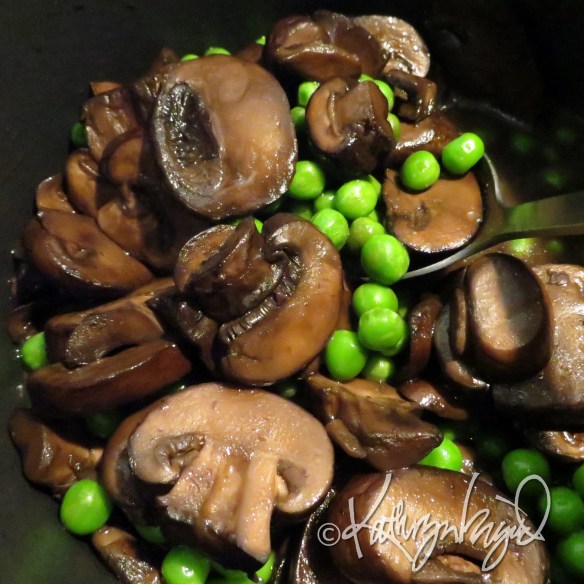
My version of the meal went in a little different direction, any attempt to copy that event exactly being doomed from the start, but I knew I wanted to keep the simple excellence of that roast’s flavor as the centerpiece. It was made for such things. I already had a variant sort of loaded-baked-potato in my refrigerator, so I used the cheese, cream, and bacon filled mashed potatoes, deepened with smoked paprika, there as the stand-ins for the day. Not having had any success with growing greens, I thought store-bought ones might seem like a little bit of a come-down after the previous dinner’s, so I skipped salad. Peas, instead; peas barely cooked in a batch of brown mushrooms that had been marinated and cooked in Tamari, dry sherry, and butter and then cooked until hot enough to warm the peas without further time on the cooktop.Photo: Mushrooms and Peas

I made a compote of fresh pears with lime juice, maple syrup, and butter and seasoned them with a splash of homemade vanilla, a pinch of salt, and a healthy pinch of ground cardamom. I guess I must’ve been in mashing mode after the potatoes, so I just cooked the pears down until they, too, could be mashed, and I finished the pork the same way I’d finished the peas: got the pear sauce good and hot, laid the slices of pork loin on top of it, put the lid on the pan, and took it off the burner, letting the sauce steam the meat through to warm it once more. Dinner was delicious. Again. Now, isn’t that twice as nice?Photo: Pork Tenderloin Dinner